Works › The Mariale: Questions on “Missus est”
Volume 37 · pp. 37–39
Question XV, continuation and response
A marker with ≈ is an approximate page boundary, placed by measure of the text; the page photographs remain the authority. In the paired views, clicking a page marker brings that page into view.
5. Item, Ecclesia canit in prosa: «Castissima corpore, sanctissima moribus, omniumque pulcherrima Virgo virginum.»
6. Item, Corpus humanum est nobilius omnibus corporibus brutorum propter unionem ad animam rationalem: ergo nobilitas in corporibus intenditur ad nobilitatem animae ad quam ordinatur: forma enim et materia debent esse proportionabilia: sed anima beatissimae Virginis fuit nobilissima post animam Filii Dei: ergo et corpus ejus erit nobilissimum et pulcherrimum post corpus Filii Dei.
7. Item, Corpus unitum divinitati, perfectissimum est in pulchritudine, ita etiam, quod Angeli desiderant in ipsum prospicere: ergo corpus immediate ordinatum ad ipsum, erit secundo loco pulcherrimum: hoc autem est corpus matris, unde formabatur illud quod divinitati uniebatur: ergo erit illud secundo loco pulcherrimum.
8. Item, Philosophus diffiniens naturam, dicit quod est vis insita rebus ex similibus similia procreans: nisi ergo natura impediatur vel erret, filius similis erit patri vel matri: ergo qui nascitur de matre et non de patre, et tali operante qui non potest impediri vel errare, ibi necesse est filium similem esse matri, et e converso: sed ipse pulcherrimus: ergo et ipsa pulcherrima.
9. Item, Qui viderunt Veronicam, dicunt quod gratiosissimam et pulcherrimam faciem repraesentat.
10. Item, Ordo inest rebus naturalibus: et in corporibus humanis natura facit aliquid pulchrum, et aliquid pulchrius: ergo et aliquid pulcherrimum debet esse secundum naturam: natura enim aliquem habet terminum ad quem potest, et non ultra illum: ergo aut alicubi contingit, aut nusquam. Si nusquam: ergo deficit respectu suarum operationum: hoc est falsum: quia dicit Philosophus, quod natura non abundat in superfluis, nec deficit in necessariis: ergo natura alicubi habet suum summum. Corpus autem naturale quandoque formatur a corpore naturali, ipsa natura operante naturaliter immediate et per se, aliquando operante Deo supernaturaliter: ergo alicubi summum est in corpore humano, Deo operante: et alicubi summum, natura operante. Et sicut natura operans est immediate sub Deo operante, ita summum naturale operantis est immediate sub Deo operante. Sicut ergo corpus Christi, quod Deus per seipsum formavit, est perfectissimum et pulcherrimum in natura quod Deus potuit facere secundum statum viae: ita corpus beatissimae Virginis ad hoc immediate ordinatum, erit pulcherrimum secundum statum viae quod natura facere potest se operante.
11. Item, Damascenus dicit, quod ipsa a nullo illustrium superatur: sed aliae virgines et sancti laudantur de pulchritudine corporali, quando est conjuncta cum spirituali, ut est illud: Pulchra facie, sed pulchrior fide. Et similiter in praedictis mulieribus Veteris Testamenti. Ergo beatissima Virgo omni laude digna, imo dignissima, debuit de utraque pulchritudine laudari.
5. Likewise, the Church sings in prose: "Most chaste in body, most holy in morals, and most beautiful of all, Virgin of virgins."
6. Likewise, the human body is nobler than all bodies of brute animals on account of union with a rational soul; therefore nobility in bodies is intensified according to the nobility of the soul to which it is ordered, for form and matter ought to be proportionable. But the soul of the most blessed Virgin was the noblest after the soul of the Son of God; therefore her body too will be the noblest and most beautiful after the body of the Son of God.
7. Likewise, the body united to divinity is most perfect in beauty, so much so that Angels desire to look into it; therefore the body immediately ordered to it will be most beautiful in second place. But this is the body of the mother, from which that which was being united to divinity was formed; therefore that body will be most beautiful in second place.
8. Likewise, the Philosopher, defining nature, says that it is a force implanted in things, producing like things from like things. Therefore unless nature is impeded or errs, a son will be like father or mother; therefore one who is born from a mother and not from a father, and with such a one operating who cannot be impeded or err, there it is necessary that the son be like the mother, and conversely. But he is most beautiful; therefore she also is most beautiful.
9. Likewise, those who have seen Veronica say that it represents a most gracious and most beautiful face.
10. Likewise, order is present in natural things; and in human bodies nature makes something beautiful and something more beautiful; therefore there ought also to be something most beautiful according to nature. For nature has some limit to which it can go and not beyond that; therefore it either happens somewhere or nowhere. If nowhere, then nature is deficient with respect to its operations. This is false, because the Philosopher says that nature does not abound in superfluities nor fail in necessities. Therefore nature somewhere has its highest. But a natural body is sometimes formed from a natural body, nature itself operating naturally, immediately and through itself, and sometimes with God operating supernaturally. Therefore somewhere there is a highest in the human body with God operating, and somewhere a highest with nature operating. And just as operating nature is immediately under operating God, so the natural highest of the one operating is immediately under operating God. Therefore just as the body of Christ, which God formed through himself, is the most perfect and most beautiful in nature that God could make according to the state of the way, so the body of the most blessed Virgin, immediately ordered to this, will be the most beautiful according to the state of the way that nature can make when it operates.
11. Likewise, Damascene says that she is surpassed by none of the illustrious; but other virgins and saints are praised for bodily beauty when it is joined with spiritual beauty, as in that saying: Beautiful in face, but more beautiful in faith. And similarly in the aforesaid women of the Old Testament. Therefore the most blessed Virgin, worthy, indeed most worthy, of every praise, ought to be praised for both kinds of beauty.
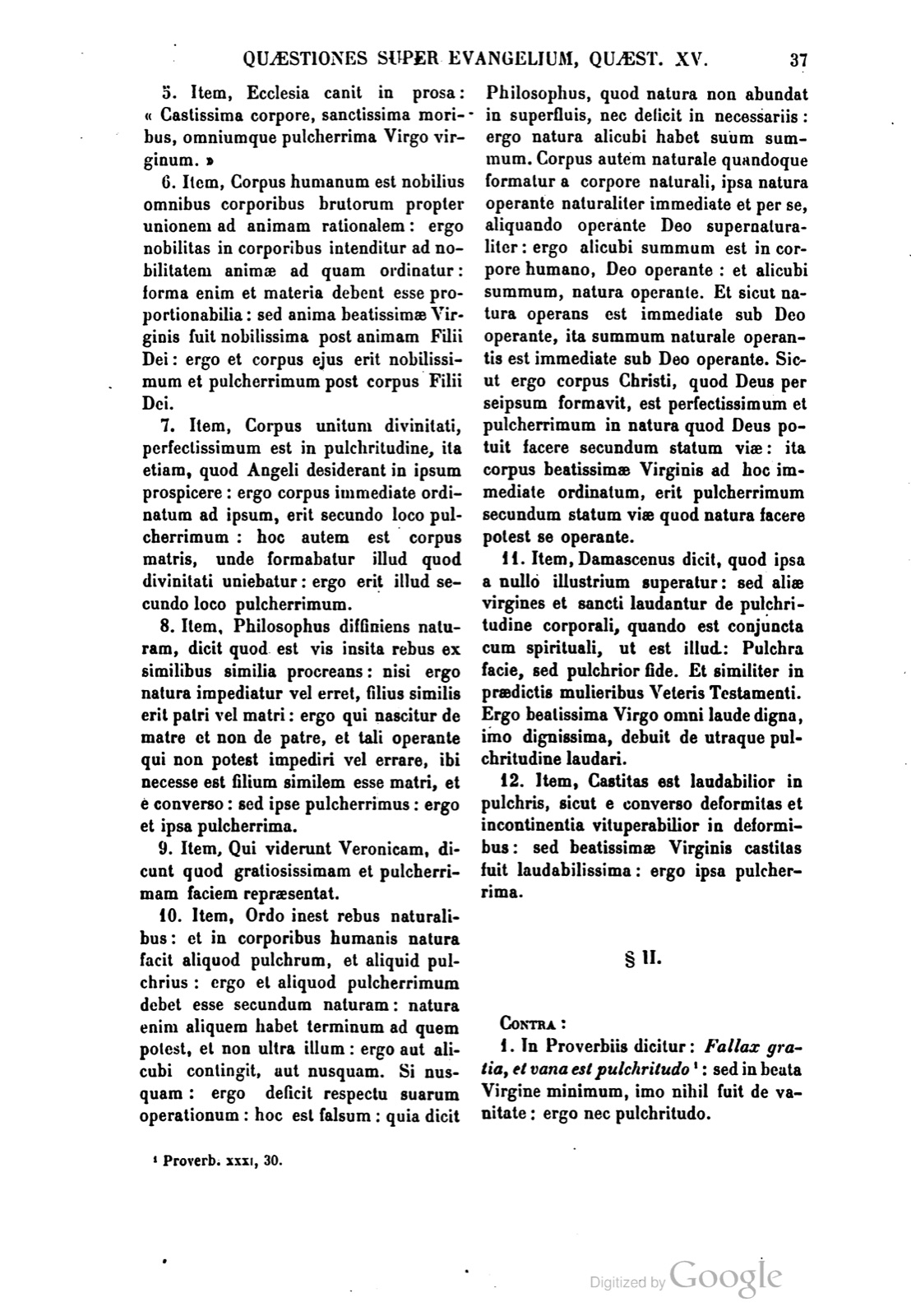
12. Item, Castitas est laudabilior in pulchris, sicut e converso deformitas et incontinentia vituperabilior in deformibus: sed beatissimae Virginis castitas fuit laudabilissima: ergo ipsa pulcherrima.
§ II. Contra: 1. In Proverbiis dicitur: Fallax gratia, et vana est pulchritudo 1: sed in beata Virgine minimum, imo nihil fuit de vanitate: ergo nec pulchritudo. 2. Item, Pulchritudo mulieris occasio est magni mali. Unde, Eccli. IX, 5: Virginem ne conspicias, ne forte scandalizeris in decore illius. Item, ibidem, versu 9: Propter speciem mulieris multi perierunt 2. Unde, Job XXXI, 1: Pepigi foedus cum oculis meis, ut nec cogitarem quidem de virgine. Sed beatissima Virgo omnibus debuit esse causa salvandi, et nulli causa pereundi. Ergo non debuit esse pulchra corporaliter. 3. Item, Quanto plures sunt causae humilitatis, tanto fortior et major humilitas: ergo quae summam habuit humilitatem, omnes causas habere debuit humilitatis: sed fastus inest pulchris, etc., deformitas autem est causa humilitatis: ergo beatissima Virgo debuit esse deformis. 4. Item, Dominus in Incarnatione semetipsum exinanivit 3, et sic maximam ostendit humiliationem: sed major humilitas est carnem accipere de deformi quam de pulchra: ergo Dominus nasci de deformi debuit.
§ III. Responsio. Respondendo dicimus, quod sicut Dominus noster Jesus Christus fuit speciosus forma prae filiis hominum 4, ita beatissima Virgo pulcherrima et speciosissima fuit inter filias hominum: et quod ipsa habuit summum et perfectissimum gradum in pulchritudine, qui esse potuit in mortali corpore secundum statum viae, operante natura. Quod autem Evangelium nihil scribit super eo, plures possunt esse causae. Una, cum Domina nostra posita sit in speculum et exemplum salvos fiendi, non vult eam laudari a talibus quorum appetitus inordinatus vel abusus multis est causa pereundi. Alia causa est, quod Scripturae sufficit hoc sub silentio quasi per locum a minori inferre, quod quidquid umquam bonitatis vel pulchritudinis in aliquo sanctorum fuerit, in ipsa credamus minime defuisse. Unde Scriptura magis laudat eam, hoc tacite supponendo, quam verbotenus explicando: tacendo enim pro reverentia regulam nobis tradidit infallibilem, quod quidquid boni vel laudis in aliis fuerit, hoc de ipsa minime oporteat dubitari, nec in quaestionem venire debeat quod nefas est dubitare.
Item, Sicut Angeli supremi a donis nobilioribus laudantur et denominantur, et non ab inferioribus, quae tamen in ipsis esse nullatenus dubitatur: ita et beatissima Virgo donis spiritualibus plenissima, bonis gratissimis et nobilissimis ita occupat et implet animas laudantium Evangelistarum, quod eorum admiratione quasi obliviscantur bonorum corporalium.
12. Likewise, chastity is more praiseworthy in the beautiful, just as conversely deformity and incontinence are more blameworthy in the deformed; but the chastity of the most blessed Virgin was most praiseworthy; therefore she was most beautiful.
§ II. On the contrary: 1. In Proverbs it is said: Grace is deceptive and beauty is vain 1; but in the blessed Virgin there was the least, indeed nothing, of vanity; therefore neither beauty. 2. Likewise, the beauty of a woman is the occasion of great evil. Hence Ecclesiasticus IX, 5: Do not gaze upon a virgin, lest perhaps you be scandalized by her beauty. Likewise, in the same place, verse 9: On account of the appearance of a woman many have perished 2. Hence Job XXXI, 1: I have made a covenant with my eyes that I would not even think of a virgin. But the most blessed Virgin ought to be for all a cause of being saved and for none a cause of perishing. Therefore she ought not to have been beautiful bodily. 3. Likewise, the more causes of humility there are, the stronger and greater humility is; therefore she who had the highest humility ought to have had all causes of humility. But pride is present in the beautiful, etc., and deformity is a cause of humility; therefore the most blessed Virgin ought to have been deformed. 4. Likewise, the Lord in the Incarnation emptied himself 3 and thus showed the greatest humiliation; but it is greater humility to receive flesh from a deformed woman than from a beautiful one; therefore the Lord ought to have been born from a deformed woman.
§ III. Response. In responding we say that just as our Lord Jesus Christ was beautiful in form above the sons of men 4, so the most blessed Virgin was the most beautiful and most shapely among the daughters of men, and that she had the highest and most perfect degree in beauty that could exist in a mortal body according to the state of the way, with nature operating. But that the Gospel writes nothing about it can have several causes. One is that, since our Lady has been placed as a mirror and example of becoming saved, it does not wish her to be praised by such things whose disordered appetite or abuse is for many a cause of perishing. Another cause is that it is enough for Scripture to infer this under silence as by an argument from the lesser: that whatever of goodness or beauty was ever in any of the saints, we should believe was least of all lacking in her. Hence Scripture praises her more by tacitly supposing this than by explaining it in words; for by keeping silence out of reverence it handed on to us an infallible rule, that whatever of good or praise was in others, concerning this in her there ought least of all to be doubt, nor should that come into question which it is impious to doubt.
Likewise, as the highest Angels are praised and named from the nobler gifts and not from the lower ones, which nevertheless are in no way doubted to be in them, so also the most blessed Virgin, fullest of spiritual gifts, so occupies and fills the souls of the praising Evangelists with the most gracious and noblest goods that in their admiration they almost forget the bodily goods.
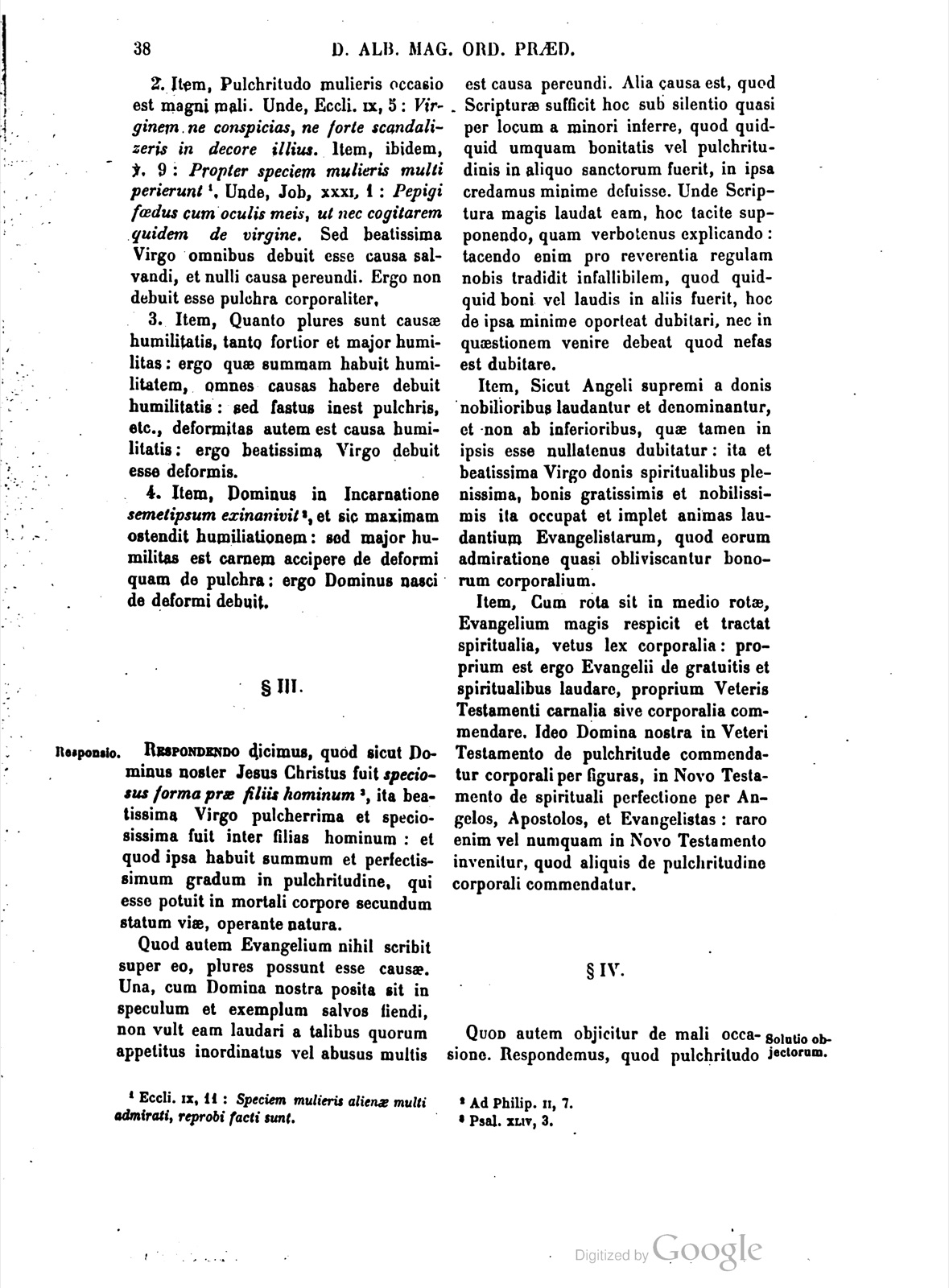
Item, Cum rota sit in medio rotae, Evangelium magis respicit et tractat spiritualia, vetus lex corporalia: proprium est ergo Evangelii de gratuitis et spiritualibus laudare, proprium Veteris Testamenti carnalia sive corporalia commendare. Ideo Domina nostra in Veteri Testamento de pulchritudine commendatur corporali per figuras, in Novo Testamento de spirituali perfectione per Angelos, Apostolos, et Evangelistas: raro enim vel numquam in Novo Testamento invenitur, quod aliquis de pulchritudine corporali commendatur.
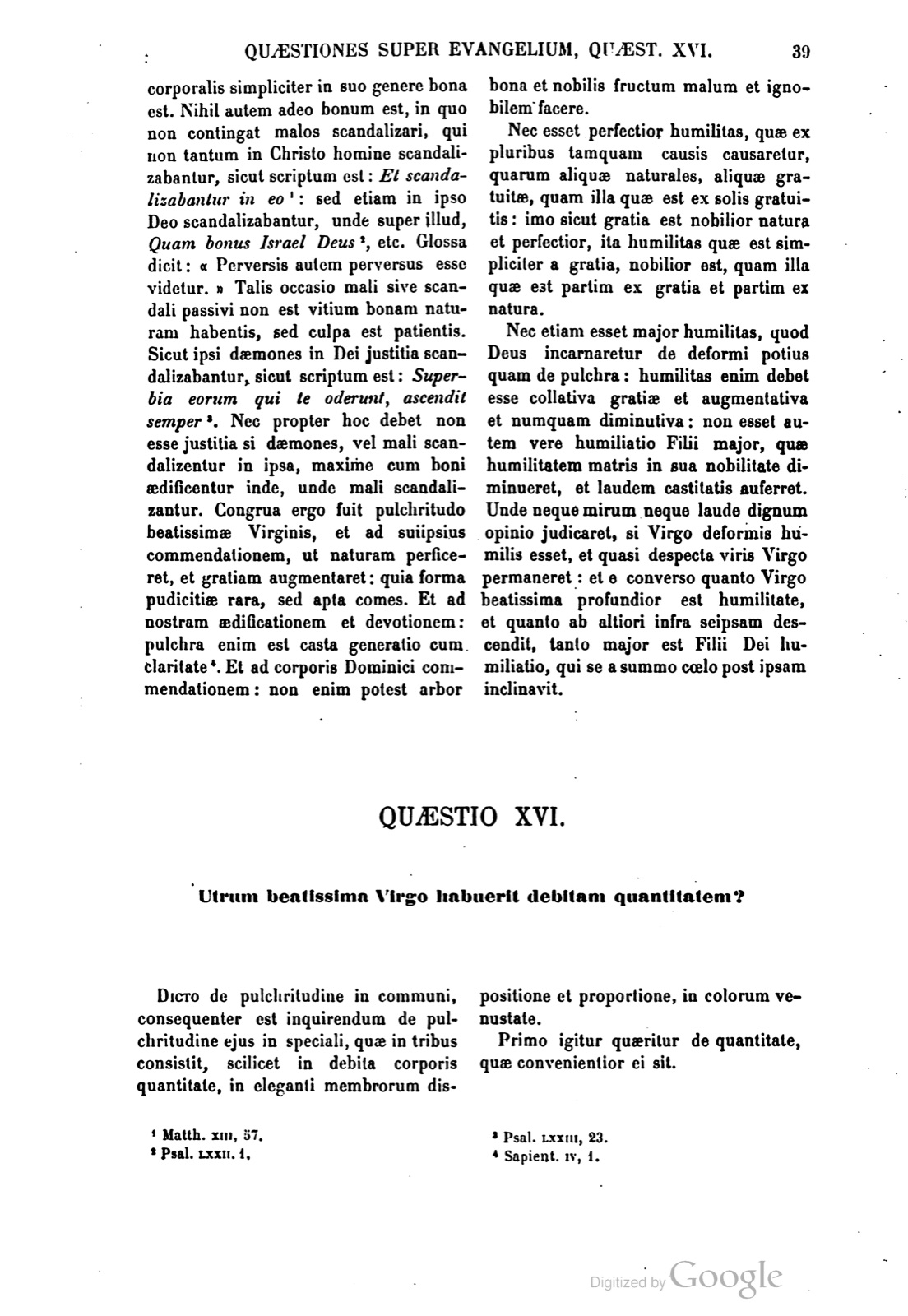
§ IV. Solutio objectorum. Quod autem objicitur de mali occasione. Respondemus, quod pulchritudo corporalis simpliciter in suo genere bona est. Nihil autem adeo bonum est, in quo non contingat malos scandalizari, qui non tantum in Christo homine scandalizabantur, sicut scriptum est: Et scandalizabantur in eo 5: sed etiam in ipso Deo scandalizabantur, unde super illud, Quam bonus Israel Deus 6, etc. Glossa dicit: «Perversis autem perversus esse videtur.» Talis occasio mali sive scandali passivi non est vitium bonam naturam habentis, sed culpa est patientis. Sicut ipsi daemones in Dei justitia scandalizabantur, sicut scriptum est: Superbia eorum qui te oderunt, ascendit semper 7. Nec propter hoc debet non esse justitia si daemones, vel mali scandalizentur in ipsa, maxime cum boni aedificentur inde, unde mali scandalizantur. Congrua ergo fuit pulchritudo beatissimae Virginis, et ad suiipsius commendationem, ut naturam perficeret, et gratiam augmentaret: quia forma pudicitiae rara, sed apta comes. Et ad nostram aedificationem et devotionem: pulchra enim est casta generatio cum claritate 8. Et ad corporis Dominici commendationem: non enim potest arbor bona et nobilis fructum malum et ignobilem facere.
Nec esset perfectior humilitas, quae ex pluribus tamquam causis causaretur, quarum aliquae naturales, aliquae gratuitae, quam illa quae est ex solis gratuitis: imo sicut gratia est nobilior natura et perfectior, ita humilitas quae est simpliciter a gratia, nobilior est, quam illa quae est partim ex gratia et partim ex natura. Nec etiam esset major humilitas, quod Deus incarnaretur de deformi potius quam de pulchra: humilitas enim debet esse collativa gratiae et augmentativa et numquam diminutiva: non esset autem vere humiliatio Filii major, quae humilitatem matris in sua nobilitate diminueret, et laudem castitatis auferret. Unde neque mirum neque laude dignum opinio judicaret, si Virgo deformis humilis esset, et quasi despecta viris Virgo permaneret: et e converso quanto Virgo beatissima profundior est humilitate, et quanto ab altiori infra seipsam descendit, tanto major est Filii Dei humiliatio, qui se a summo caelo post ipsam inclinavit.
Likewise, since the wheel is in the midst of the wheel, the Gospel regards and treats spiritual things more, the old law bodily things; therefore it is proper to the Gospel to praise gratuitous and spiritual things, and proper to the Old Testament to commend fleshly or bodily things. Therefore our Lady in the Old Testament is commended for bodily beauty through figures; in the New Testament, for spiritual perfection through Angels, Apostles, and Evangelists. For rarely or never is it found in the New Testament that someone is commended for bodily beauty.
§ IV. Solution of the objections. As to what is objected about the occasion of evil, we respond that bodily beauty simply in its own genus is good. But nothing is so good that it may not happen that the evil are scandalized in it; they were scandalized not only in Christ as man, as it is written: And they were scandalized in him 5, but they were scandalized even in God himself. Hence on that phrase, How good is God to Israel 6, etc., the Gloss says: "To the perverse he seems to be perverse." Such an occasion of evil or of passive scandal is not the vice of the one having a good nature, but is the fault of the one suffering it. Thus even the demons were scandalized in God's justice, as it is written: The pride of those who hate you ascends always 7. Nor on this account should justice not exist if demons or evil persons are scandalized in it, especially since the good are edified from that from which the evil are scandalized. Therefore the beauty of the most blessed Virgin was fitting both for the commendation of herself, so that it might perfect nature and increase grace, because the form of modesty is a rare but apt companion, and for our edification and devotion: for beautiful is chaste generation with brightness 8. And it was fitting for the commendation of the Lord's body; for a good and noble tree cannot make a bad and ignoble fruit.
Nor would humility be more perfect if it were caused by more things as causes, of which some are natural and some gratuitous, than that humility which is from gratuitous things alone. Indeed, as grace is nobler and more perfect than nature, so humility that is simply from grace is nobler than that which is partly from grace and partly from nature. Nor also would it be greater humility that God be incarnate from a deformed woman rather than from a beautiful one; for humility ought to confer and increase grace and never diminish it. But the humiliation of the Son would not truly be greater if it diminished the humility of the mother in her nobility and removed the praise of chastity. Hence opinion would judge it neither wonderful nor worthy of praise if a deformed Virgin were humble and, as one almost despised by men, remained a Virgin; and conversely, the deeper the most blessed Virgin is in humility, and the more she descends from a higher place beneath herself, the greater is the humiliation of the Son of God, who inclined himself after her from the highest heaven.
Notes
- Proverbs 31:30. (Proverb. XXXI, 30.) ↩
- Ecclesiasticus 9:11: Many, admiring the appearance of another woman, have become reprobate. (Eccli. IX, 11: Speciem mulieris alienae multi admirati, reprobi facti sunt.) ↩
- To the Philippians 2:7. (Ad Philip. II, 7.) ↩
- Psalm 44:3. (Psal. XLIV, 3.) ↩
- Matthew 13:57. (Matth. XIII, 57.) ↩
- Psalm 72:1. (Psal. LXXII, 1.) ↩
- Psalm 73:23. (Psal. LXXIII, 23.) ↩
- Wisdom 4:1. (Sapient. IV, 1.) ↩
If a page does not appear, its photograph has not been uploaded yet.