Works › The Mariale: Questions on “Missus est”
Volume 37 · p. 36
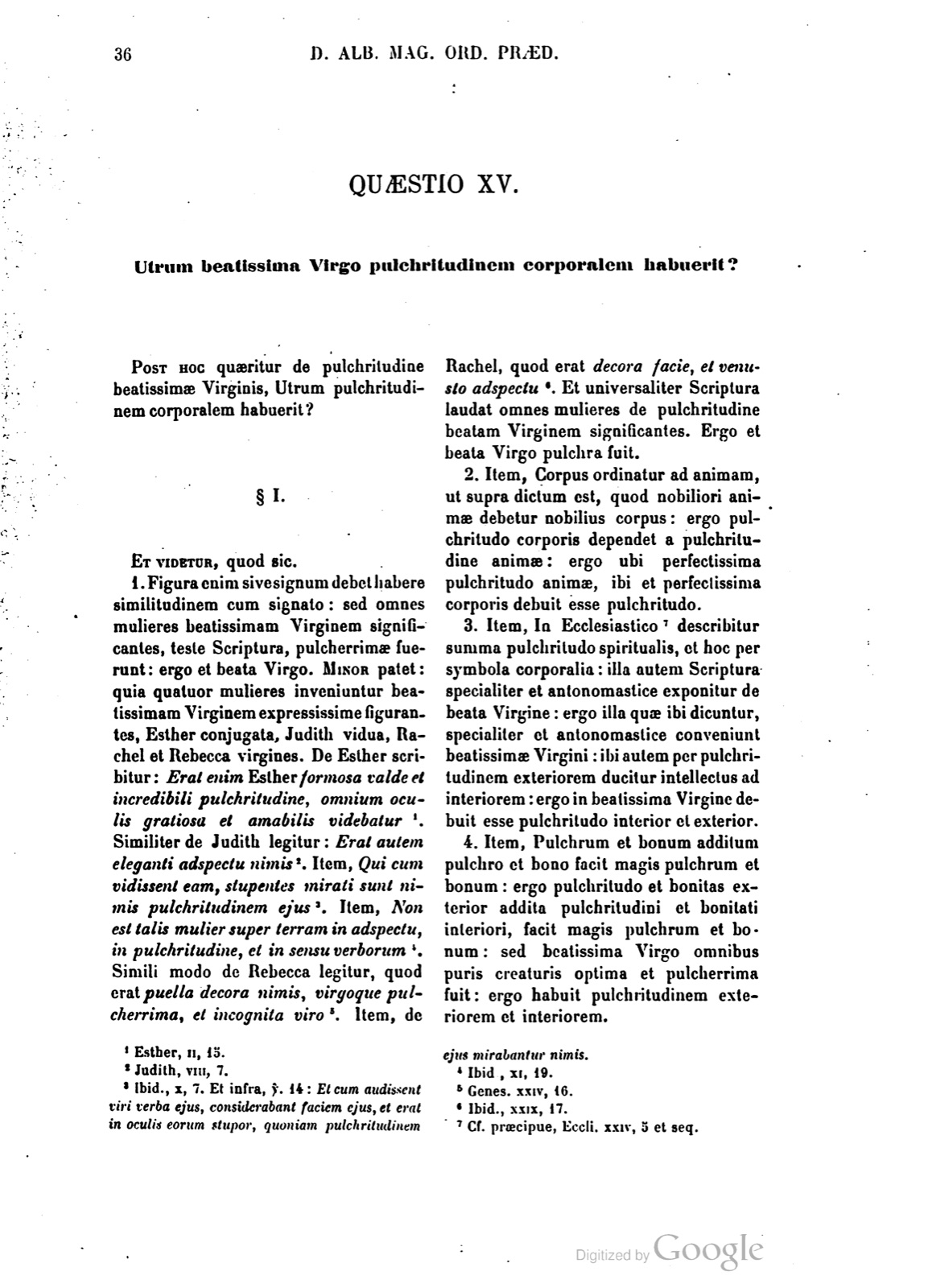
Question XV. Whether the most blessed Virgin had bodily beauty
Quaestio XV. Utrum beatissima Virgo pulchritudinem corporalem habuerit?
Post hoc quaeritur de pulchritudine beatissimae Virginis, Utrum pulchritudinem corporalem habuerit?
§ I. Et videtur, quod sic. 1. Figura enim sive signum debet habere similitudinem cum signato: sed omnes mulieres beatissimam Virginem significantes, teste Scriptura, pulcherrimae fuerunt: ergo et beata Virgo. Minor patet: quia quatuor mulieres inveniuntur beatissimam Virginem expressissime figurantes, Esther conjugata, Judith vidua, Rachel et Rebecca virgines. De Esther scribitur: Erat enim Esther formosa valde et incredibili pulchritudine, omnium oculis gratiosa et amabilis videbatur 1. Similiter de Judith legitur: Erat autem eleganti adspectu nimis 2. Item, Qui cum vidissent eam, stupentes mirati sunt nimis pulchritudinem ejus 3. Item, Non est talis mulier super terram in adspectu, in pulchritudine, et in sensu verborum 4. Simili modo de Rebecca legitur, quod erat puella decora nimis, virgoque pulcherrima, et incognita viro 5. Item, de Rachel, quod erat decora facie, et venusto adspectu 6. Et universaliter Scriptura laudat omnes mulieres de pulchritudine beatam Virginem significantes. Ergo et beata Virgo pulchra fuit.
2. Item, Corpus ordinatur ad animam, ut supra dictum est, quod nobiliori animae debetur nobilius corpus: ergo pulchritudo corporis dependet a pulchritudine animae: ergo ubi perfectissima pulchritudo animae, ibi et perfectissima corporis debuit esse pulchritudo. 3. Item, In Ecclesiastico 7 describitur summa pulchritudo spiritualis, et hoc per symbola corporalia: illa autem Scriptura specialiter et antonomastice exponitur de beata Virgine: ergo illa quae ibi dicuntur, specialiter et antonomastice conveniunt beatissimae Virgini: ibi autem per pulchritudinem exteriorem ducitur intellectus ad interiorem: ergo in beatissima Virgine debuit esse pulchritudo interior et exterior. 4. Item, Pulchrum et bonum additum pulchro et bono facit magis pulchrum et bonum: ergo pulchritudo et bonitas exterior addita pulchritudini et bonitati interiori, facit magis pulchrum et bonum: sed beatissima Virgo omnibus puris creaturis optima et pulcherrima fuit: ergo habuit pulchritudinem exteriorem et interiorem.
Question XV. Whether the most blessed Virgin had bodily beauty.
After this inquiry is made concerning the beauty of the most blessed Virgin, whether she had bodily beauty.
§ I. And it seems that she did. 1. For a figure or sign ought to have likeness with the thing signified. But all women signifying the most blessed Virgin, with Scripture as witness, were most beautiful; therefore also the blessed Virgin. The minor is clear, because four women are found most expressly figuring the most blessed Virgin: Esther as married, Judith as widow, Rachel and Rebecca as virgins. About Esther it is written: For Esther was very shapely and of incredible beauty; she appeared gracious and lovable in the eyes of all 1. Similarly of Judith it is read: She was of exceedingly elegant appearance 2. Likewise: When they had seen her, being stupefied, they marveled exceedingly at her beauty 3. Likewise: There is no such woman on earth in appearance, in beauty, and in sense of words 4. In a similar way it is read of Rebecca that she was an exceedingly fair girl, a most beautiful virgin, and unknown to a man 5. Likewise of Rachel, that she was fair in face and lovely in appearance 6. And universally Scripture praises all women signifying the blessed Virgin for beauty. Therefore the blessed Virgin also was beautiful.
2. Likewise, the body is ordered to the soul, as was said above, because a nobler body is owed to a nobler soul; therefore beauty of body depends on beauty of soul. Therefore where there is the most perfect beauty of soul, there ought also to have been the most perfect beauty of body. 3. Likewise, in Ecclesiasticus 7 the highest spiritual beauty is described, and this through bodily symbols. But that Scripture is specially and antonomastically expounded of the blessed Virgin; therefore the things that are said there specially and antonomastically fit the most blessed Virgin. But there through exterior beauty the understanding is led to interior beauty; therefore in the most blessed Virgin there ought to have been interior and exterior beauty. 4. Likewise, the beautiful and good added to the beautiful and good makes it more beautiful and good; therefore exterior beauty and goodness added to interior beauty and goodness makes it more beautiful and good. But the most blessed Virgin was the best and most beautiful among all pure creatures; therefore she had exterior and interior beauty.
Notes
- Esther 2:15. (Esther II, 15.) ↩
- Judith 8:7. (Judith VIII, 7.) ↩
- Judith 10:7; and below, verse 14: And when the men heard her words, they considered her face, and there was wonder in their eyes, because they marveled exceedingly at her beauty. (Judith X, 7; et infra, versu 14: Et cum audissent viri verba ejus, considerabant faciem ejus, et erat in oculis eorum stupor, quoniam pulchritudinem ejus mirabantur nimis.) ↩
- Ibid., 11:19. (Ibid. XI, 19.) ↩
- Genesis 24:16. (Genes. XXIV, 16.) ↩
- Ibid., 29:17. (Ibid. XXIX, 17.) ↩
- Compare especially Ecclesiasticus 24:5 and following. (Cf. praecipue, Eccli. XXIV, 5 et seq.) ↩
If a page does not appear, its photograph has not been uploaded yet.