Works › The Mariale: Questions on “Missus est”
Volume 37 · pp. 34–35
Question XIV. At what age the most blessed Virgin was when she contracted with Joseph and when she conceived the Lord
A marker with ≈ is an approximate page boundary, placed by measure of the text; the page photographs remain the authority. In the paired views, clicking a page marker brings that page into view.
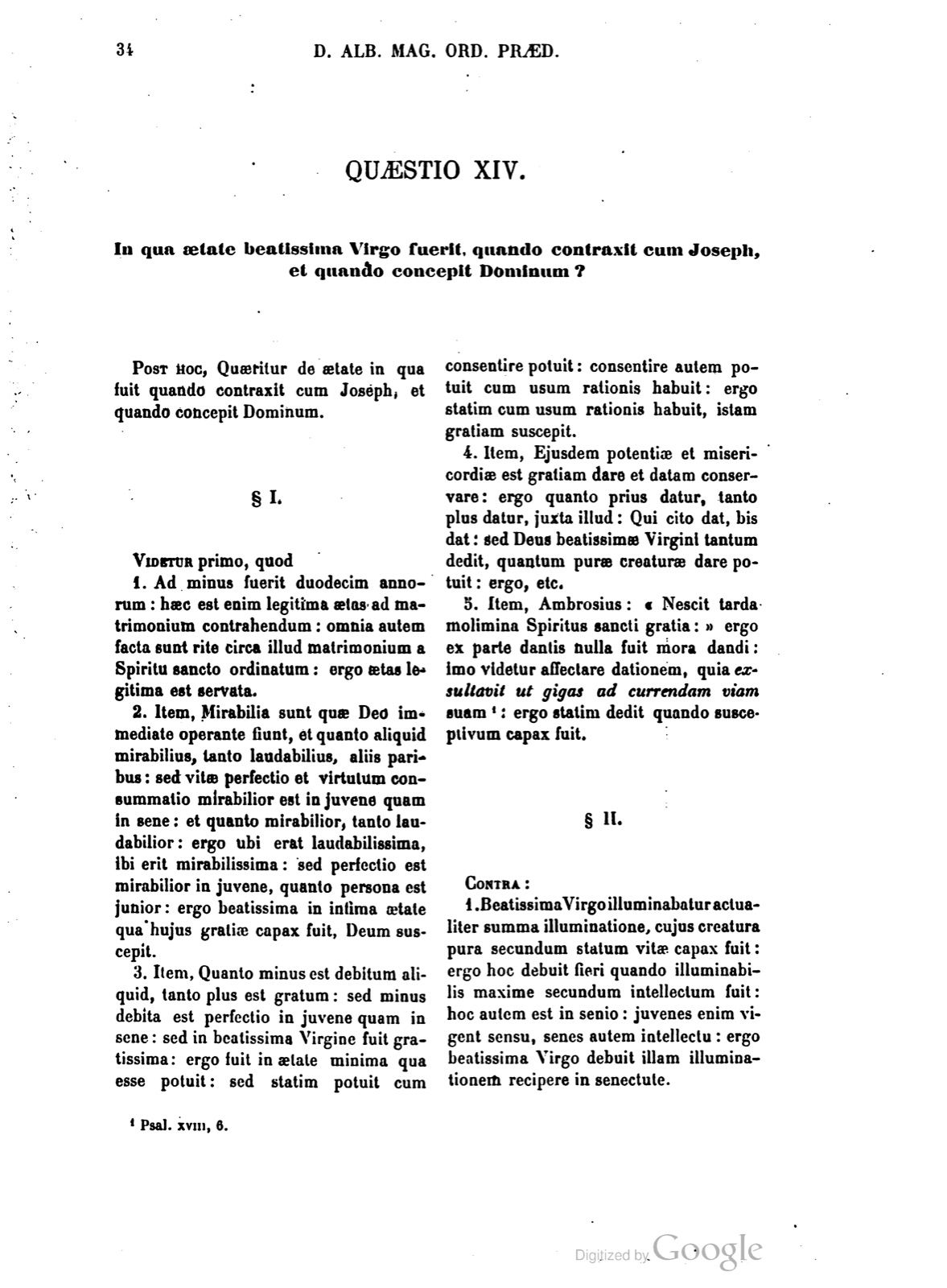
Quaestio XIV. In qua aetate beatissima Virgo fuerit, quando contraxit cum Joseph, et quando concepit Dominum?
Post hoc, Quaeritur de aetate in qua fuit quando contraxit cum Joseph, et quando concepit Dominum.
§ I. Videtur primo, quod 1. Ad minus fuerit duodecim annorum: haec est enim legitima aetas ad matrimonium contrahendum: omnia autem facta sunt rite circa illud matrimonium a Spiritu sancto ordinatum: ergo aetas legitima est servata. 2. Item, Mirabilia sunt quae Deo immediate operante fiunt, et quanto aliquid mirabilius, tanto laudabilius, aliis paribus: sed vitae perfectio et virtutum consummatio mirabilior est in juvene quam in sene: et quanto mirabilior, tanto laudabilior: ergo ubi erat laudabilissima, ibi erit mirabilissima: sed perfectio est mirabilior in juvene, quanto persona est junior: ergo beatissima in intima aetate qua hujus gratiae capax fuit, Deum suscepit. 3. Item, Quanto minus est debitum aliquid, tanto plus est gratum: sed minus debita est perfectio in juvene quam in sene: sed in beatissima Virgine fuit gratissima: ergo fuit in aetate minima qua esse potuit: sed statim potuit cum consentire potuit: consentire autem potuit cum usum rationis habuit: ergo statim cum usum rationis habuit, istam gratiam suscepit. 4. Item, Ejusdem potentiae et misericordiae est gratiam dare et datam conservare: ergo quanto prius datur, tanto plus datur, juxta illud: Qui cito dat, bis dat: sed Deus beatissimae Virgini tantum dedit, quantum purae creaturae dare potuit: ergo, etc. 5. Item, Ambrosius: «Nescit tarda molimina Spiritus sancti gratia»: ergo ex parte dantis nulla fuit mora dandi: imo videtur affectare dationem, quia exsultavit ut gigas ad currendam viam suam 1: ergo statim dedit quando susceptivum capax fuit.
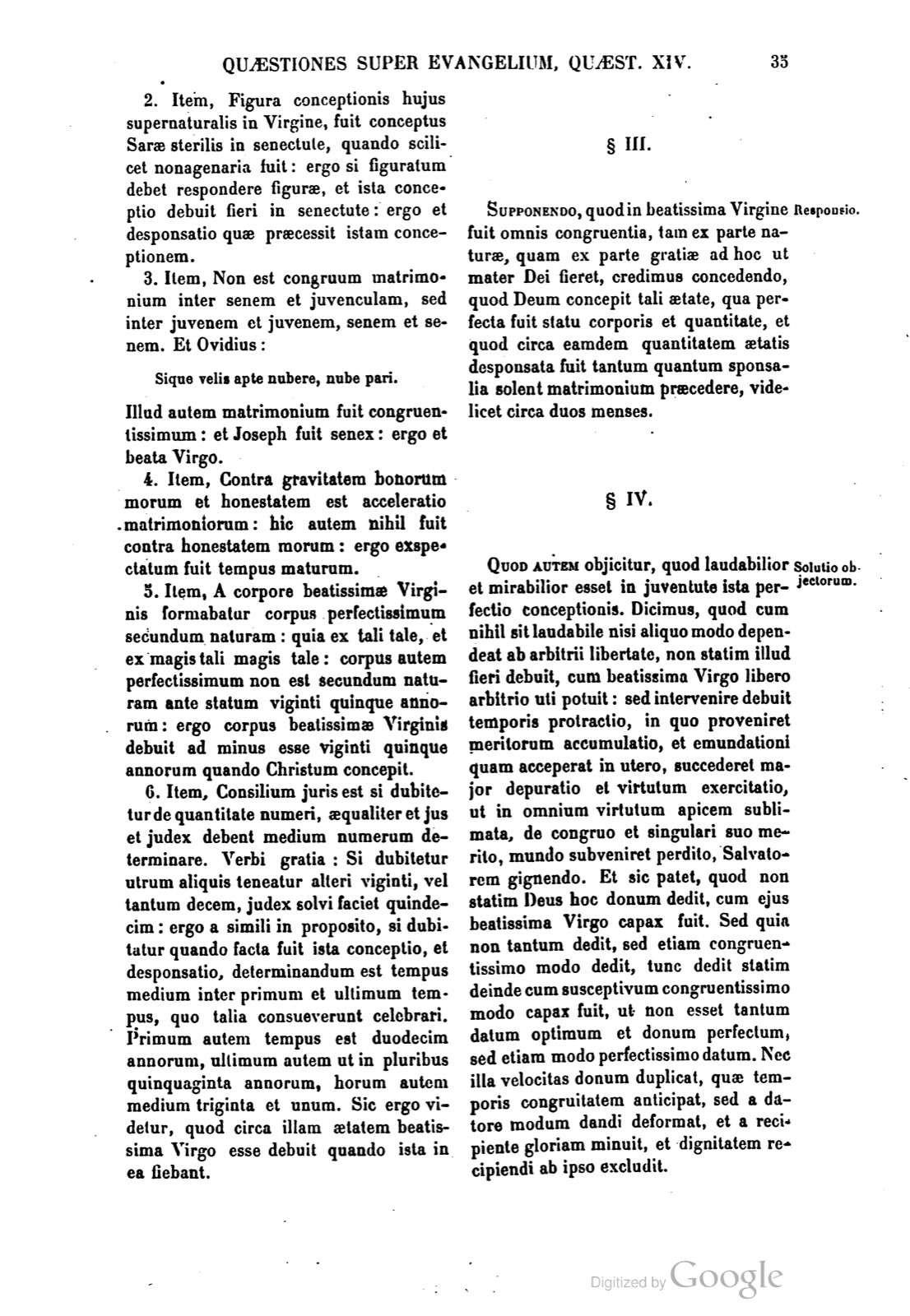
§ II. Contra: 1. Beatissima Virgo illuminabatur actualiter summa illuminatione, cujus creatura pura secundum statum vitae capax fuit: ergo hoc debuit fieri quando illuminabilis maxime secundum intellectum fuit: hoc autem est in senio: juvenes enim vigent sensu, senes autem intellectu: ergo beatissima Virgo debuit illam illuminationem recipere in senectute. 2. Item, Figura conceptionis hujus supernaturalis in Virgine, fuit conceptus Sarae sterilis in senectute, quando scilicet nonagenaria fuit: ergo si figuratum debet respondere figurae, et ista conceptio debuit fieri in senectute: ergo et desponsatio quae praecessit istam conceptionem. 3. Item, Non est congruum matrimonium inter senem et juvenculam, sed inter juvenem et juvenem, senem et senem. Et Ovidius: Sique velis apte nubere, nube pari. Illud autem matrimonium fuit congruentissimum: et Joseph fuit senex: ergo et beata Virgo. 4. Item, Contra gravitatem bonorum morum et honestatem est acceleratio matrimoniorum: hic autem nihil fuit contra honestatem morum: ergo exspectatum fuit tempus maturum. 5. Item, A corpore beatissimae Virginis formabatur corpus perfectissimum secundum naturam: quia ex tali tale, et ex magis tali magis tale: corpus autem perfectissimum non est secundum naturam ante statum viginti quinque annorum: ergo corpus beatissimae Virginis debuit ad minus esse viginti quinque annorum quando Christum concepit. 6. Item, Consilium juris est si dubitetur de quantitate numeri, aequaliter et jus et judex debent medium numerum determinare. Verbi gratia: Si dubitetur utrum aliquis teneatur alteri viginti, vel tantum decem, judex solvi faciet quindecim: ergo a simili in proposito, si dubitatur quando facta fuit ista conceptio, et desponsatio, determinandum est tempus medium inter primum et ultimum tempus, quo talia consueverunt celebrari. Primum autem tempus est duodecim annorum, ultimum autem ut in pluribus quinquaginta annorum, horum autem medium triginta et unum. Sic ergo videtur, quod circa illam aetatem beatissima Virgo esse debuit quando ista in ea fiebant.
Question XIV. At what age the most blessed Virgin was when she contracted with Joseph and when she conceived the Lord.
After this inquiry is made about the age at which she was when she contracted with Joseph and when she conceived the Lord.
§ I. It seems first that 1. she was at least twelve years old, for this is the lawful age for contracting marriage. But all things were done duly around that marriage ordained by the Holy Spirit; therefore the lawful age was observed. 2. Likewise, those things that happen by God immediately working are wonderful, and the more wonderful something is, the more praiseworthy, other things being equal. But perfection of life and consummation of virtues is more wonderful in a young person than in an old person; and the more wonderful, the more praiseworthy. Therefore where it was most praiseworthy, there it will be most wonderful. But perfection is more wonderful in a young person the younger the person is; therefore the most blessed one received God at the innermost age at which she was capable of this grace. 3. Likewise, the less something is owed, the more gracious it is. But perfection is less owed in a young person than in an old person; but in the most blessed Virgin it was most gracious; therefore it was at the least age at which it could be. But she was able as soon as she was able to consent; and she was able to consent when she had the use of reason; therefore as soon as she had the use of reason, she received that grace. 4. Likewise, it belongs to the same power and mercy to give grace and to preserve it when given; therefore the earlier it is given, the more it is given, according to that saying, He who gives quickly gives twice. But God gave the most blessed Virgin as much as he could give to a pure creature; therefore, etc. 5. Likewise, Ambrose says: "The grace of the Holy Spirit does not know slow efforts"; therefore on the part of the giver there was no delay in giving. Indeed he seems to hasten toward the giving, because he exulted like a giant to run his course 1; therefore he gave at once when the receptive subject was capable.
§ II. On the contrary: 1. The most blessed Virgin was actually illuminated with the highest illumination of which a pure creature was capable according to the state of life; therefore this ought to have happened when she was most illuminable according to intellect. But this is in old age, for young persons flourish in sense, old persons in intellect. Therefore the most blessed Virgin ought to have received that illumination in old age. 2. Likewise, the figure of this supernatural conception in the Virgin was the conception of sterile Sarah in old age, namely when she was ninety years old; therefore if the thing figured ought to correspond to the figure, this conception too ought to have happened in old age; therefore also the espousal that preceded that conception. 3. Likewise, marriage between an old man and a young woman is not fitting, but between young and young, old and old. And Ovid says: If you wish to marry aptly, marry an equal. But that marriage was most fitting, and Joseph was old; therefore also the blessed Virgin. 4. Likewise, the acceleration of marriages is against the gravity of good morals and honorability. But here nothing was against honorability of morals; therefore mature time was awaited. 5. Likewise, from the body of the most blessed Virgin the most perfect body according to nature was formed, because from such comes such, and from what is more such comes what is more such. But the most perfect body according to nature does not exist before the state of twenty-five years; therefore the body of the most blessed Virgin ought to have been at least twenty-five years old when she conceived Christ. 6. Likewise, the counsel of law is that if there is doubt about the quantity of a number, both the law and the judge ought equally to determine the middle number. For example, if it is doubtful whether someone owes another twenty or only ten, the judge will make him pay fifteen. Therefore similarly in the present matter, if it is doubtful when that conception and espousal were made, the middle time between the first and last time at which such things are customarily celebrated must be determined. But the first time is twelve years, and the last, as in many cases, fifty years; the middle of these is thirty-one. Thus therefore it seems that the most blessed Virgin ought to have been around that age when these things were happening in her.
§ III. Responsio. Supponendo, quod in beatissima Virgine fuit omnis congruentia, tam ex parte naturae, quam ex parte gratiae ad hoc ut mater Dei fieret, credimus concedendo, quod Deum concepit tali aetate, qua perfecta fuit statu corporis et quantitate, et quod circa eamdem quantitatem aetatis desponsata fuit tantum quantum sponsalia solent matrimonium praecedere, videlicet circa duos menses.
§ IV. Solutio objectorum. Quod autem objicitur, quod laudabilior et mirabilior esset in juventute ista perfectio conceptionis. Dicimus, quod cum nihil sit laudabile nisi aliquo modo dependeat ab arbitrii libertate, non statim illud fieri debuit, cum beatissima Virgo libero arbitrio uti potuit: sed intervenire debuit temporis protractio, in quo proveniret meritorum accumulatio, et emundationi quam acceperat in utero, succederet major depuratio et virtutum exercitatio, ut in omnium virtutum apicem sublimata, de congruo et singulari suo merito, mundo subveniret perdito, Salvatorem gignendo. Et sic patet, quod non statim Deus hoc donum dedit, cum ejus beatissima Virgo capax fuit. Sed quia non tantum dedit, sed etiam congruentissimo modo dedit, tunc dedit statim deinde cum susceptivum congruentissimo modo capax fuit, ut non esset tantum datum optimum et donum perfectum, sed etiam modo perfectissimo datum. Nec illa velocitas donum duplicat, quae temporis congruitatem anticipat, sed a datore modum dandi deformat, et a recipiente gloriam minuit, et dignitatem recipiendi ab ipso excludit.
§ III. Response. Supposing that in the most blessed Virgin there was every fittingness, both on the part of nature and on the part of grace, for this, that she become mother of God, we believe by conceding that she conceived God at such an age at which she was perfect in the state and quantity of her body, and that she was espoused around the same quantity of age by as much time as betrothals customarily precede marriage, namely around two months.
§ IV. Solution of the objections. As to what is objected, that this perfection of conception would be more praiseworthy and more wonderful in youth: we say that since nothing is praiseworthy unless it depends in some way on freedom of choice, that ought not to have happened immediately when the most blessed Virgin could use free choice. Rather, a lengthening of time ought to intervene, in which there would come an accumulation of merits, and a greater purification and exercise of virtues would succeed the cleansing that she had received in the womb, so that, raised to the summit of all virtues, by her fitting and singular merit she might assist the lost world by begetting the Savior. And thus it is clear that God did not give this gift immediately when his most blessed Virgin was capable of it. But because he not only gave it, but also gave it in the most fitting mode, he then gave it immediately thereafter when the receptive subject was capable in the most fitting mode, so that there would not only be the best given thing and perfect gift, but also a thing given in the most perfect mode. Nor does that speed double the gift which anticipates the fittingness of time; rather, from the giver it deforms the mode of giving, and from the receiver it diminishes the glory and excludes from the receiver the dignity of receiving from him.
Notes
- Psalm 18:6. (Psal. XVIII, 6.) ↩
If a page does not appear, its photograph has not been uploaded yet.