Works › The Mariale: Questions on “Missus est”
Volume 37 · pp. 32–33
Question XIII. Whether the Evangelist ought to have said, Espoused
A marker with ≈ is an approximate page boundary, placed by measure of the text; the page photographs remain the authority. In the paired views, clicking a page marker brings that page into view.
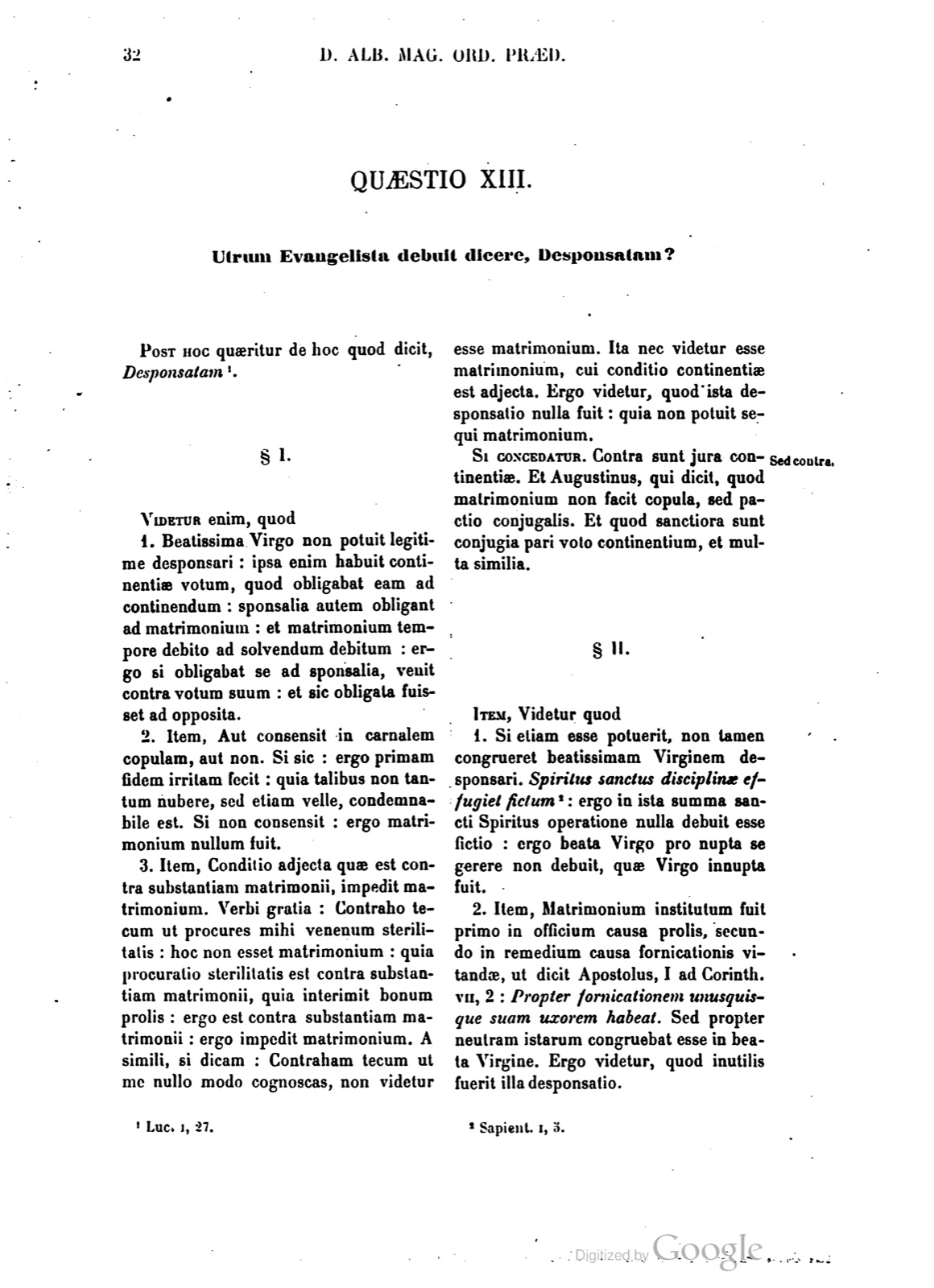
Quaestio XIII. Utrum Evangelista debuit dicere, Desponsatam?
Post hoc quaeritur de hoc quod dicit, Desponsatam 1.
§ I. Videtur enim, quod 1. Beatissima Virgo non potuit legitime desponsari: ipsa enim habuit continentiae votum, quod obligabat eam ad continendum: sponsalia autem obligant ad matrimonium: et matrimonium tempore debito ad solvendum debitum: ergo si obligabat se ad sponsalia, venit contra votum suum: et sic obligata fuisset ad opposita. 2. Item, Aut consensit in carnalem copulam, aut non. Si sic: ergo primam fidem irritam fecit: quia talibus non tantum nubere, sed etiam velle, condemnabile est. Si non consensit: ergo matrimonium nullum fuit. 3. Item, Conditio adjecta quae est contra substantiam matrimonii, impedit matrimonium. Verbi gratia: Contraho tecum ut procures mihi venenum sterilitatis: hoc non esset matrimonium: quia procuratio sterilitatis est contra substantiam matrimonii, quia interimit bonum prolis: ergo est contra substantiam matrimonii: ergo impedit matrimonium. A simili, si dicam: Contraham tecum ut me nullo modo cognoscas, non videtur esse matrimonium. Ita nec videtur esse matrimonium, cui conditio continentiae est adjecta. Ergo videtur, quod ista desponsatio nulla fuit: quia non potuit sequi matrimonium. Si concedatur. Contra sunt jura continentiae. Et Augustinus, qui dicit, quod matrimonium non facit copula, sed pactio conjugalis. Et quod sanctiora sunt conjugia pari voto continentium, et multa similia.
§ II. Item, Videtur quod 1. Si etiam esse potuerit, non tamen congrueret beatissimam Virginem desponsari. Spiritus sanctus disciplinae effugiet fictum 2: ergo in ista summa sancti Spiritus operatione nulla debuit esse fictio: ergo beata Virgo pro nupta se gerere non debuit, quae Virgo innupta fuit. 2. Item, Matrimonium institutum fuit primo in officium causa prolis, secundo in remedium causa fornicationis vitandae, ut dicit Apostolus, I ad Corinth. VII, 2: Propter fornicationem unusquisque suam uxorem habeat. Sed propter neutram istarum congruebat esse in beata Virgine. Ergo videtur, quod inutilis fuerit illa desponsatio.
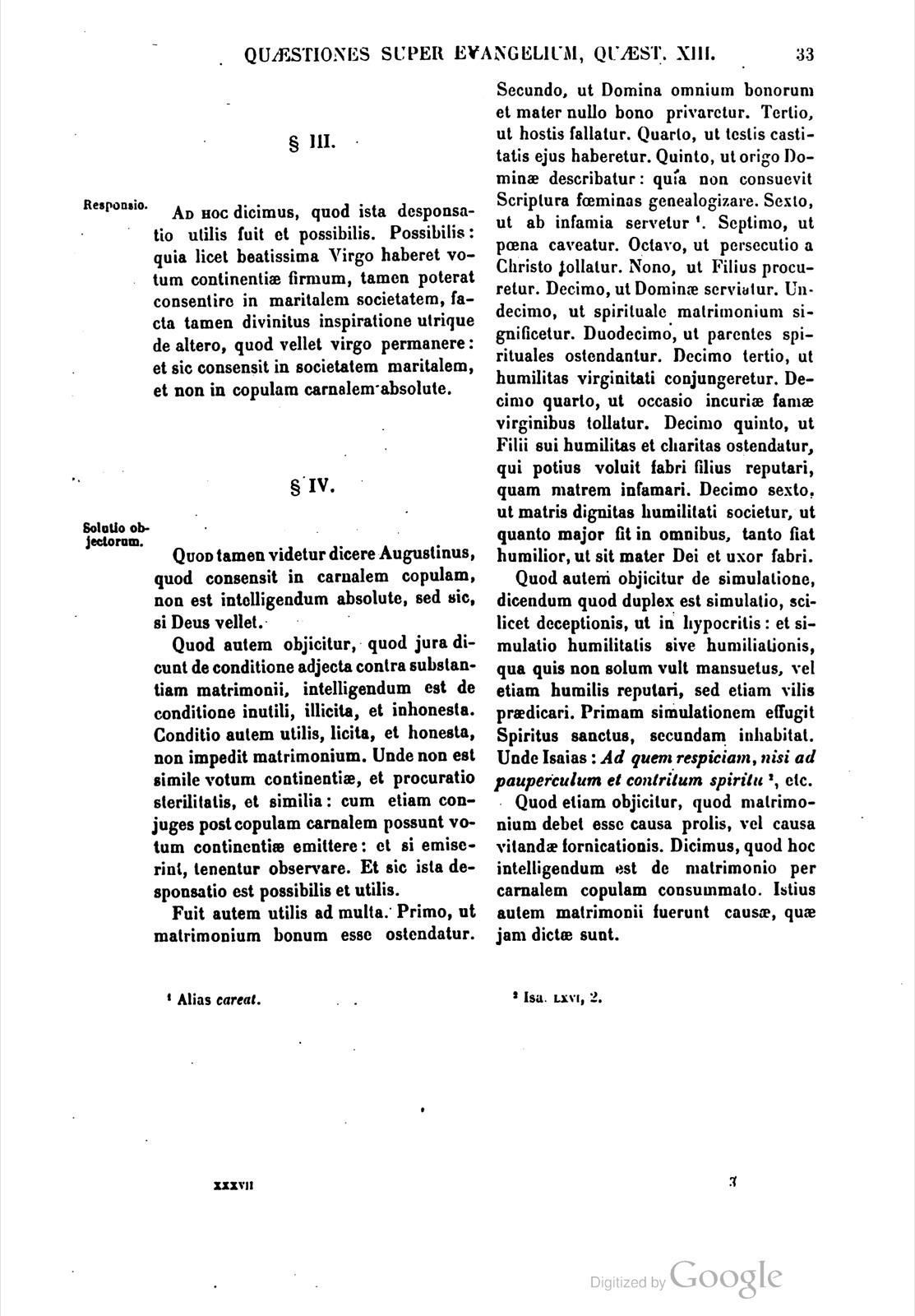
§ III. Responsio. Ad hoc dicimus, quod ista desponsatio utilis fuit et possibilis. Possibilis: quia licet beatissima Virgo haberet votum continentiae firmum, tamen poterat consentire in maritalem societatem, facta tamen divinitus inspiratione utrique de altero, quod vellet virgo permanere: et sic consensit in societatem maritalem, et non in copulam carnalem absolute.
Question XIII. Whether the Evangelist ought to have said, Espoused.
After this inquiry is made about what he says, Espoused 1.
§ I. For it seems that 1. the most blessed Virgin could not lawfully be espoused, for she had a vow of continence which obliged her to contain herself. But betrothal obliges to marriage, and marriage in due time to paying the debt. Therefore if she obliged herself to betrothal, she acted against her vow, and thus would have been obliged to opposites. 2. Likewise, either she consented to carnal copulation or not. If so, then she made her first faith void, because for such persons not only to marry but even to will it is condemnable. If she did not consent, then there was no marriage. 3. Likewise, an added condition that is against the substance of marriage impedes marriage. For example: I contract with you so that you may procure for me the poison of sterility; this would not be marriage, because the procuring of sterility is against the substance of marriage, since it destroys the good of offspring; therefore it is against the substance of marriage and therefore impedes marriage. Similarly, if I say: I shall contract with you so that you may in no way know me, it does not seem to be marriage. Thus neither does that seem to be marriage to which the condition of continence is added. Therefore it seems that this espousal was null, because marriage could not follow. If this is conceded, against it are the laws of continence, and Augustine, who says that copulation does not make marriage but the conjugal pact does, and that marriages of those containing themselves by equal vow are holier, and many similar things.
§ II. Likewise, it seems that 1. even if it could have existed, nevertheless it would not be fitting for the most blessed Virgin to be espoused. The Holy Spirit of discipline will flee what is feigned 2; therefore in that highest work of the Holy Spirit there ought to have been no fiction; therefore the blessed Virgin, who was an unmarried Virgin, ought not to have conducted herself as married. 2. Likewise, marriage was instituted first as an office on account of offspring, second as a remedy on account of avoiding fornication, as the Apostle says, First Corinthians VII, 2: On account of fornication let each man have his wife. But it was not fitting for either of these to exist in the blessed Virgin. Therefore it seems that that espousal was useless.
§ III. Response. To this we say that this espousal was useful and possible. Possible, because although the most blessed Virgin had a firm vow of continence, nevertheless she could consent to marital society, provided that an inspiration had been divinely made to each concerning the other, that each wished to remain virgin; and thus she consented to marital society and not absolutely to carnal copulation.
§ IV. Solutio objectorum. Quod tamen videtur dicere Augustinus, quod consensit in carnalem copulam, non est intelligendum absolute, sed sic, si Deus vellet. Quod autem objicitur, quod jura dicunt de conditione adjecta contra substantiam matrimonii, intelligendum est de conditione inutili, illicita, et inhonesta. Conditio autem utilis, licita, et honesta, non impedit matrimonium. Unde non est simile votum continentiae, et procuratio sterilitatis, et similia: cum etiam conjuges post copulam carnalem possunt votum continentiae emittere: et si emiserint, tenentur observare. Et sic ista desponsatio est possibilis et utilis.
Fuit autem utilis ad multa. Primo, ut matrimonium bonum esse ostendatur. Secundo, ut Domina omnium bonorum et mater nullo bono privaretur. Tertio, ut hostis fallatur. Quarto, ut testis castitatis ejus haberetur. Quinto, ut origo Dominae describatur: quia non consuevit Scriptura feminas genealogizare. Sexto, ut ab infamia servetur 3. Septimo, ut poena caveatur. Octavo, ut persecutio a Christo tollatur. Nono, ut Filius procuretur. Decimo, ut Dominae serviatur. Undecimo, ut spirituale matrimonium significetur. Duodecimo, ut parentes spirituales ostendantur. Decimo tertio, ut humilitas virginitati conjungeretur. Decimo quarto, ut occasio incuriae famae virginibus tollatur. Decimo quinto, ut Filii sui humilitas et charitas ostendatur, qui potius voluit fabri filius reputari, quam matrem infamari. Decimo sexto, ut matris dignitas humilitati societur, ut quanto major fit in omnibus, tanto fiat humilior, ut sit mater Dei et uxor fabri.
Quod autem objicitur de simulatione, dicendum quod duplex est simulatio, scilicet deceptionis, ut in hypocritis: et simulatio humilitatis sive humiliationis, qua quis non solum vult mansuetus, vel etiam humilis reputari, sed etiam vilis praedicari. Primam simulationem effugit Spiritus sanctus, secundam inhabitat. Unde Isaias: Ad quem respiciam, nisi ad pauperculum et contritum spiritu 4, etc. Quod etiam objicitur, quod matrimonium debet esse causa prolis, vel causa vitandae fornicationis. Dicimus, quod hoc intelligendum est de matrimonio per carnalem copulam consummato. Istius autem matrimonii fuerunt causae, quae jam dictae sunt.
§ IV. Solution of the objections. But what Augustine seems to say, that she consented to carnal copulation, must not be understood absolutely, but in this way: if God willed it. As to what is objected, that the laws speak about a condition added against the substance of marriage, it must be understood of a useless, illicit, and dishonorable condition. But a useful, licit, and honorable condition does not impede marriage. Hence the vow of continence and the procuring of sterility and similar things are not alike, since even spouses after carnal copulation can emit a vow of continence, and if they have emitted it, they are bound to observe it. And thus this espousal is possible and useful.
It was useful for many things. First, so that marriage might be shown to be good. Second, so that the Lady and mother of all good things might be deprived of no good. Third, so that the enemy might be deceived. Fourth, so that a witness of her chastity might be had. Fifth, so that the origin of the Lady might be described, because Scripture is not accustomed to genealogize women. Sixth, so that she might be preserved from infamy 3. Seventh, so that punishment might be avoided. Eighth, so that persecution might be removed from Christ. Ninth, so that the Son might be cared for. Tenth, so that service might be rendered to the Lady. Eleventh, so that spiritual marriage might be signified. Twelfth, so that spiritual parents might be shown. Thirteenth, so that humility might be joined to virginity. Fourteenth, so that the occasion of neglect of reputation might be removed from virgins. Fifteenth, so that the humility and charity of her Son might be shown, who preferred to be reckoned the son of a craftsman rather than that his mother be defamed. Sixteenth, so that the dignity of the mother might be allied to humility, so that the greater she becomes in all things, the humbler she may become, being mother of God and wife of a craftsman.
As to what is objected about simulation, it must be said that simulation is twofold, namely simulation of deception, as in hypocrites, and simulation of humility or humiliation, by which someone not only wishes to be reckoned meek or even humble, but also to be proclaimed vile. The Holy Spirit flees the first simulation and inhabits the second. Hence Isaiah says: To whom shall I look, except to the poor little one and the contrite in spirit 4, etc. As to what is also objected, that marriage ought to exist for the sake of offspring or for the sake of avoiding fornication, we say that this must be understood of marriage consummated through carnal copulation. But the causes of this marriage were those that have already been stated.
If a page does not appear, its photograph has not been uploaded yet.