Works › The Mariale: Questions on “Missus est”
Volume 37 · pp. 29–31
Question XII. In what act the most blessed Virgin was when the Angel announced to her
A marker with ≈ is an approximate page boundary, placed by measure of the text; the page photographs remain the authority. In the paired views, clicking a page marker brings that page into view.
Quaestio XII. In quo actu beatissima Virgo fuerit, quando Angelus ei annuntiavit?
Post hoc quaeritur, In quo actu beatissima Virgo fuerit, quando Angelus ei annuntiavit, hoc est, utrum fuerit in actu contemplationis vel operationis?
§ I. Et videtur, quod in actu contemplationis. 1. Dicit enim Isaias: In silentio et spe erit fortitudo vestra 1. Sed Domina nostra maxime indigebat fidei fortitudine. Ergo debuit esse in silentio et spe: et hoc est esse in contemplatione: ergo fuit in contemplatione. 2. Item, Ducam eam in solitudinem, et loquar ad cor ejus 2. Per hoc tangitur status contemplationis. Ergo illi ad quos fit locutio Domini, debent esse in statu contemplationis. 3. Item, Sedebit solitarius, et tacebit, quia levavit super se 3. Ex hoc sic arguimus: movens non quocumque modo se habens movet, neque mobile quocumque modo se habens movetur: quia oportet utriusque esse approximationem: sed Dominus appropinquavit beatissimae Virgini descendendo: ergo ipsa obviare debuit ascendendo: ergo debebat sic levare se supra se: et hoc per contemplationem: ergo debuit esse in contemplatione. 4. Item, Philosophus septimo Physicorum: «Anima sedendo et quiescendo fit prudens.» Sed beatissima Virgo debebat hic fieri Virgo prudentissima, utpote mater ipsius sapientiae. Ergo congruebat ei sedere et quiescere, et hoc est esse in contemplatione. 5. Item, Nobilissima operatio congruebat nobilissimo statui: sed haec fuit nobilissima operatio, scilicet conceptio Filii Dei: ergo fieri debuit in nobilissimo statu: ergo in contemplatione. 6. Item, Si substantia super substantiam, et potentia super potentiam, et actus super actum: sed in hac annuntiatione beatissima Virgo in substantia elevabatur ad summam propinquitatem cum Deo: nisi enim Deus fieret, non poterat altius elevari quam quod esset mater Dei: ergo si substantia elevabatur ad summum, tunc potentia et operatio debuerunt elevari in summum: ergo ipsa debuit esse in altissimo statu contemplationis. 7. Item, Dantis et recipientis debet esse ad invicem conversio: anima autem duas facies habet secundum rationem: portionem superiorem, et inferiorem: inferiorem quae temporalibus pertractandis intendit, superiorem vero quae aeternis consulendis inhaereat: ergo si Dei et beatissimae Virginis tamquam dantis et recipientis debet esse ad invicem conversio, necesse est ut secundum illam partem operetur secundum quam ad Deum convertitur: ergo fuit in contemplatione.
§ II. Sed contra. 1. In Canticis dicitur: Dum esset rex in accubitu suo, nardus mea dedit odorem suum 4. Nardus figurat humilitatem: ergo videtur quod humilitas fuerit dispositio praeparatoria beatissimae Virgini ad Deum concipiendum. Hoc etiam dicit Augustinus, quod humilitas nobis Deum genuit. Humilitas autem semper est in descendendo, semper enim recumbit in novissimo loco: descensus autem est in actione, et ascensus in contemplatione: ergo beatissima Virgo esse debuit in actione. 2. Item, Qui se humiliat, exaltabitur 5: haec proportio est per se: ergo et quando maxima est in actu exaltatio, tunc et maxima debet esset humiliatio in actu: sed in hac annuntiatione beatissima Virgo maxime exaltata fuit in actu: ergo et maxime tunc humiliari debuit actu: humiliatio autem in descendendo est, et contemplatio ascendendo: ergo non fuit in contemplatione, sed in actione. 3. Item, Genes. XVIII, 27: Loquar ad Dominum meum, cum sim pulvis et cinis. Ergo pulverizatio et incineratio qua se annihilat et humiliat homo Deo, est praeparatio ut homo loquatur cum Deo et Deus cum ipso: sed hic Deus familiarissime locutus fuit beatissimae Virgini: ergo hic maxime debuit incinerari et humiliari. 4. Item, Abscondisti haec a prudentibus et sapientibus, et revelasti ea parvulis 6. Ergo qui desiderat revelationem, oportet quod se parvulum reputet per humiliationem. 5. Item, Humilibus dat gratiam 7, hoc est, per se: ergo magis humili datur major gratia: ergo summa gratia actu datur summe humili actu: sed hic dabatur beatissimae Virgini summa gratia actu: ergo summe fuit humilis actu: humilitas autem est in descendendo, sed contemplatio in ascendendo: ergo non debuit esse in actu contemplationis qui est in sursum, sed in actu humiliationis qui est deorsum. Si concedatur. Contra: Vidit Jacob in somnis scalam 8, etc. Glossa dicit: «Illi divina conspiciunt, qui ab appetitu temporalium oculos claudunt.» Sed beatissima Virgo hic deiformissimum adspectum habuit: ergo maxime oculos a temporalibus clausit: ergo contemplationi et non actioni vacabat.
Question XII. In what act the most blessed Virgin was when the Angel announced to her.
After this it is asked in what act the most blessed Virgin was when the Angel announced to her, that is, whether she was in an act of contemplation or of operation.
§ I. And it seems that she was in an act of contemplation. 1. For Isaiah says: In silence and hope shall be your strength 1. But our Lady especially needed strength of faith. Therefore she ought to have been in silence and hope; and this is to be in contemplation; therefore she was in contemplation. 2. Likewise, I will lead her into solitude and will speak to her heart 2. Through this the state of contemplation is touched. Therefore those to whom the Lord's speech is made ought to be in the state of contemplation. 3. Likewise, He shall sit solitary and be silent, because he has raised himself above himself 3. From this we argue thus: a mover does not move when disposed in just any way, nor is a movable moved when disposed in just any way, because there must be an approximation of both. But the Lord approached the most blessed Virgin by descending; therefore she ought to have met him by ascending; therefore she ought thus to raise herself above herself; and this is through contemplation; therefore she ought to have been in contemplation. 4. Likewise, the Philosopher in the seventh book of the Physics says: "The soul by sitting and resting becomes prudent." But the most blessed Virgin ought here to become the most prudent Virgin, as mother of wisdom itself. Therefore it was fitting for her to sit and rest, and this is to be in contemplation. 5. Likewise, the noblest operation was fitting for the noblest state; but this was the noblest operation, namely the conception of the Son of God; therefore it ought to be made in the noblest state, and therefore in contemplation. 6. Likewise, if substance is above substance, power above power, and act above act, and in this announcing the most blessed Virgin was elevated in substance to the highest nearness with God, for unless she became God she could not be raised higher than to be mother of God, then if substance was elevated to the highest, power and operation also ought to have been elevated to the highest; therefore she ought to have been in the highest state of contemplation. 7. Likewise, between giver and receiver there ought to be mutual conversion. But the soul has two faces according to reason, an upper and a lower portion: the lower, which intends temporal things to be handled, and the higher, which inheres in consulting eternal things. Therefore if God and the most blessed Virgin, as giver and receiver, ought to have mutual conversion, it is necessary that she operate according to that part according to which she is converted to God; therefore she was in contemplation.
§ II. But on the contrary. 1. In Canticles it is said: While the king was on his couch, my nard gave its fragrance 4. Nard figures humility; therefore it seems that humility was the preparatory disposition in the most blessed Virgin for conceiving God. Augustine also says this, that humility gave birth to God for us. But humility is always in descending, for it always reclines in the lowest place; descent is in action, and ascent in contemplation; therefore the most blessed Virgin ought to have been in action. 2. Likewise, He who humbles himself shall be exalted 5. This proportion is through itself; therefore when the greatest exaltation is in act, then also the greatest humiliation ought to be in act. But in this announcing the most blessed Virgin was most greatly exalted in act; therefore she then also ought to have been most greatly humbled in act. But humiliation is by descending, and contemplation by ascending; therefore she was not in contemplation but in action. 3. Likewise, Genesis XVIII, 27: I shall speak to my Lord, although I am dust and ashes. Therefore pulverization and incineration, by which a human being annihilates and humbles himself before God, is a preparation so that the human being may speak with God and God with him. But here God spoke most familiarly to the most blessed Virgin; therefore here she ought especially to have been reduced to ashes and humbled. 4. Likewise, You have hidden these things from the prudent and wise, and have revealed them to little ones 6. Therefore one who desires revelation must reckon himself a little one through humiliation. 5. Likewise, He gives grace to the humble 7, that is, through himself; therefore greater grace is given to one more humble. Therefore the highest grace in act is given to the one most humble in act; but here the highest grace was given to the most blessed Virgin in act; therefore she was most humble in act. But humility is in descending, whereas contemplation is in ascending; therefore she ought not to have been in the act of contemplation, which is upward, but in the act of humiliation, which is downward. If this is conceded. On the contrary: Jacob saw a ladder in a dream 8, etc. The Gloss says: "Those behold divine things who close their eyes from desire for temporal things." But the most blessed Virgin here had the most deiform sight; therefore she especially closed her eyes to temporal things; therefore she was free for contemplation and not action.
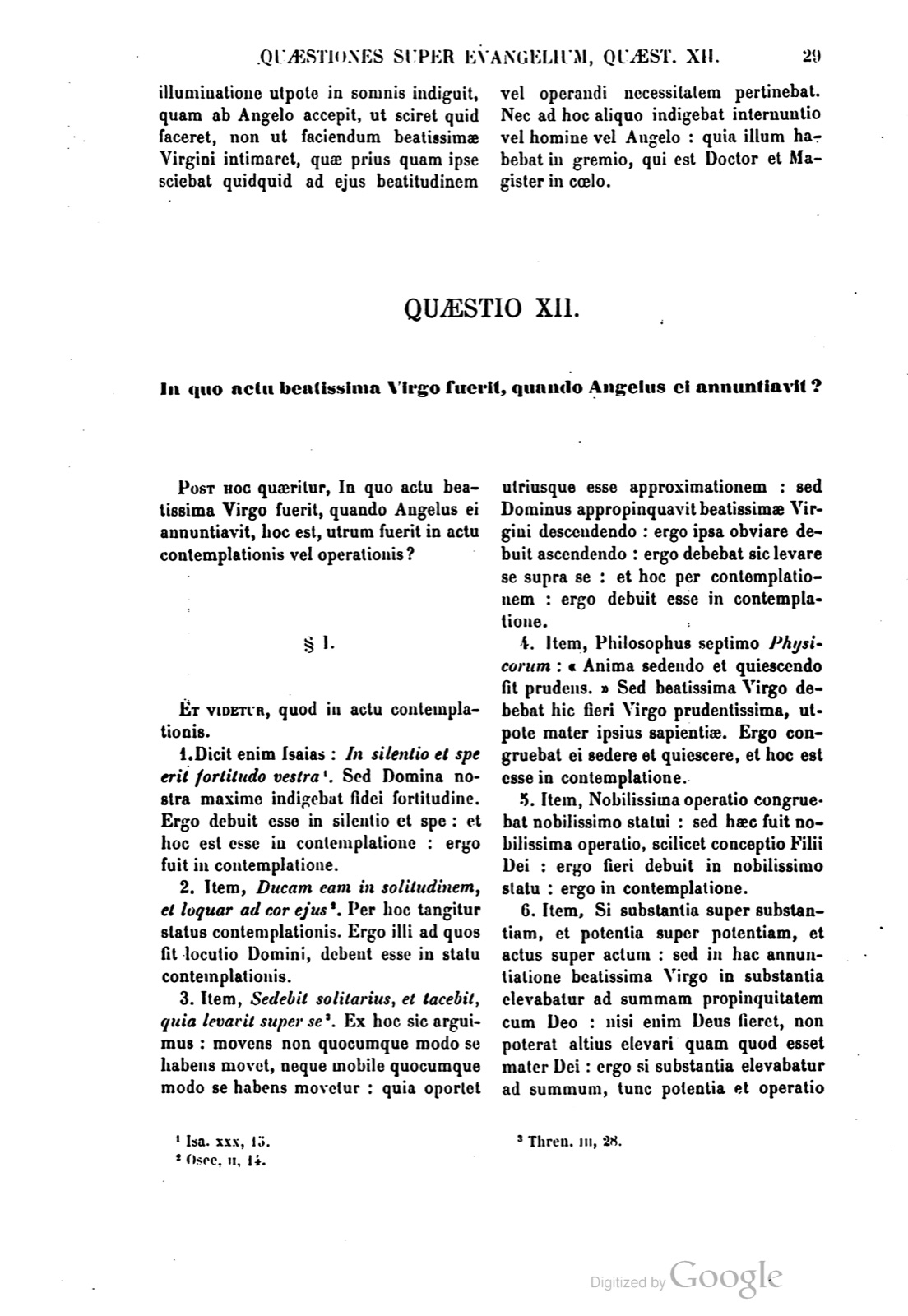
§ III. Responsio. Concedimus, quod beatissima Virgo in actu contemplationis fuit, quando ei ista annuntiatio venit. Quod autem quaeritur, per quem actum ad istam gratiam maxime praeparabatur. Dicimus, quod beata Virgo in hac annuntiatione in summo purae creaturae elevabatur causalitate in summam potestatem, quia Deum genuit: in summam dignitatem, per hoc quod totius creaturae per recreationem mater effecta fuit: in summam charitatem, quia Deo per hoc summe omni propinquitate propinquissima fuit: utpote quae ipsius filia, mater, et sponsa fuit. Ad potestatem fides elevabat eam, juxta illud: Omnia possibilia sunt credenti 9. Ad dignitatem elevabat humilitas, juxta illud: Omnis qui se humiliat, exaltabitur 10. Ad charitatem elevabat dilectio, juxta illud: Ego diligentes me diligo 11. Item elevabatur ad summam familiaritatem: et illam faciebat castitas, juxta illud: Incorruptio facit esse proximum Deo 12.
§ III. Response. We concede that the most blessed Virgin was in an act of contemplation when that announcing came to her. As to the question by what act she was most prepared for that grace, we say that the blessed Virgin in this announcing, at the highest point of a pure creature, was elevated by causality into the highest power, because she generated God; into the highest dignity, because through this she was made mother of every creature through recreation; into the highest charity, because through this she was nearest to God with every highest nearness, as one who was his daughter, mother, and spouse. Faith elevated her to power, according to that saying: All things are possible to one who believes 9. Humility elevated her to dignity, according to that saying: Everyone who humbles himself shall be exalted 10. Love elevated her to charity, according to that saying: I love those who love me 11. Likewise she was elevated to the highest familiarity; and chastity made that, according to that saying: Incorruption makes one be near to God 12.
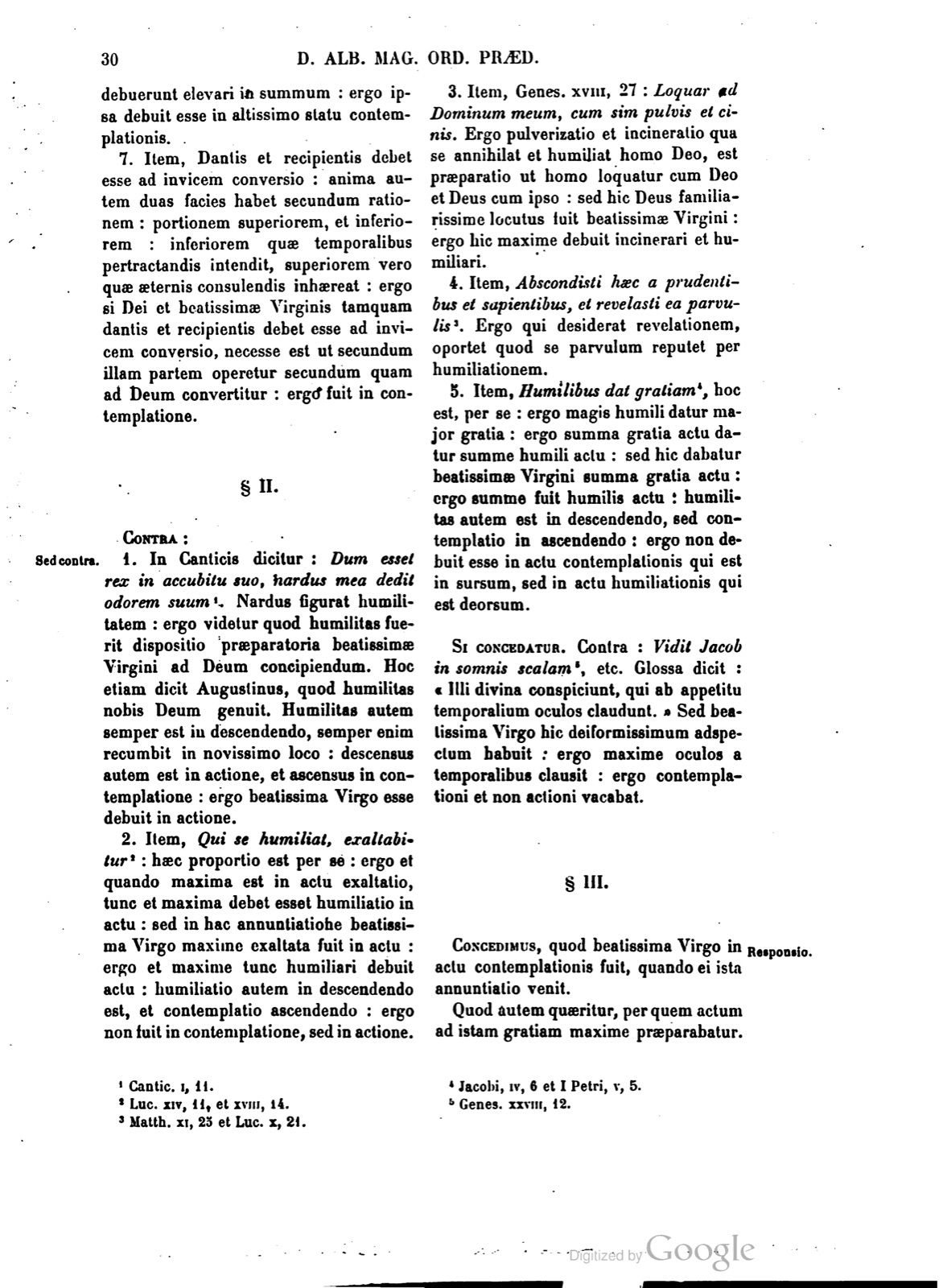
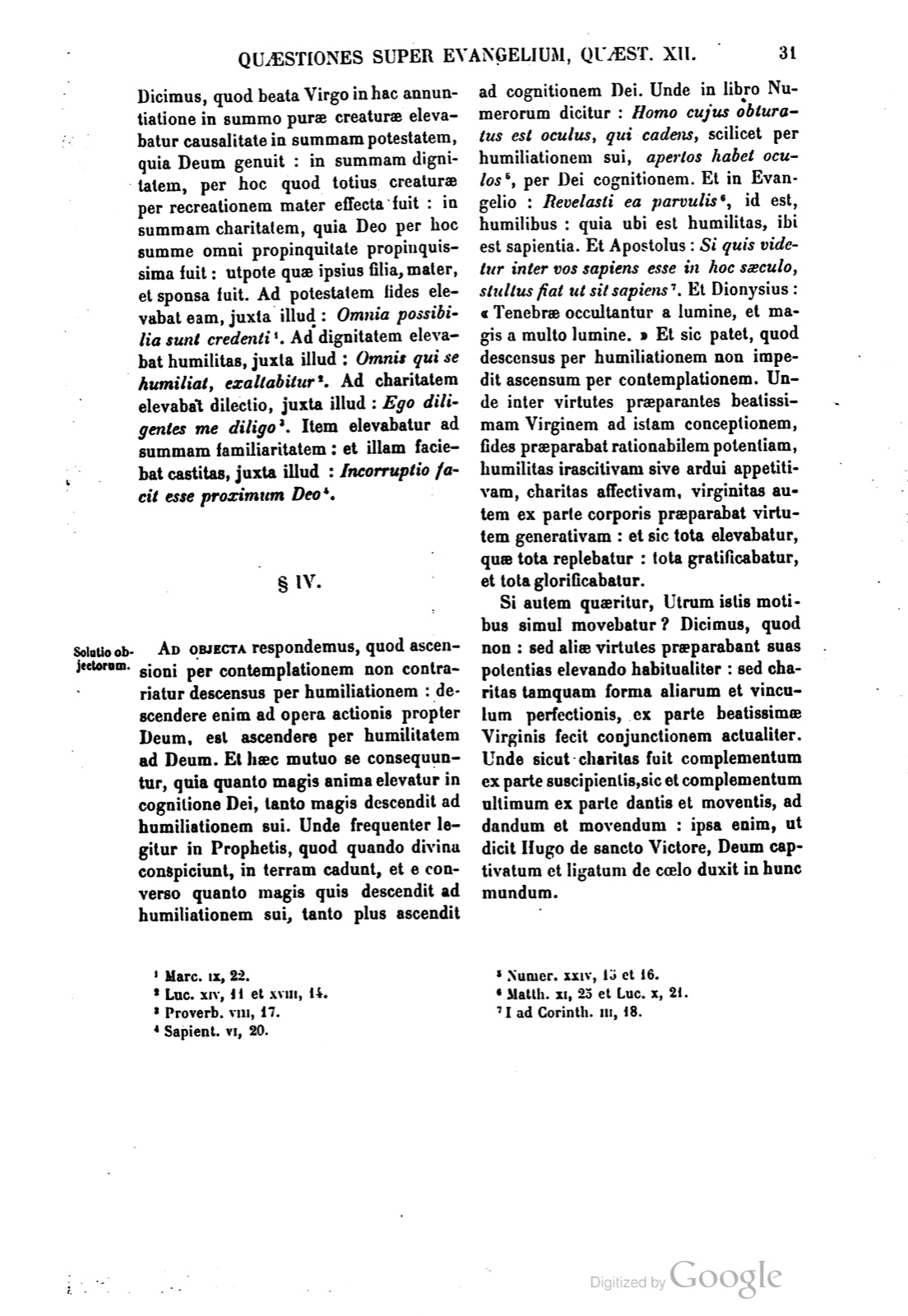
§ IV. Solutio objectorum. Ad objecta respondemus, quod ascensioni per contemplationem non contrariatur descensus per humiliationem: descendere enim ad opera actionis propter Deum, est ascendere per humilitatem ad Deum. Et haec mutuo se consequuntur, quia quanto magis anima elevatur in cognitione Dei, tanto magis descendit ad humiliationem sui. Unde frequenter legitur in Prophetis, quod quando divina conspiciunt, in terram cadunt, et e converso quanto magis quis descendit ad humiliationem sui, tanto plus ascendit ad cognitionem Dei. Unde in libro Numerorum dicitur: Homo cujus obturatus est oculus, qui cadens, scilicet per humiliationem sui, apertos habet oculos 13, per Dei cognitionem. Et in Evangelio: Revelasti ea parvulis 14, id est, humilibus: quia ubi est humilitas, ibi est sapientia. Et Apostolus: Si quis videtur inter vos sapiens esse in hoc saeculo, stultus fiat ut sit sapiens 15. Et Dionysius: «Tenebrae occultantur a lumine, et magis a multo lumine.» Et sic patet, quod descensus per humiliationem non impedit ascensum per contemplationem. Unde inter virtutes praeparantes beatissimam Virginem ad istam conceptionem, fides praeparabat rationabilem potentiam, humilitas irascitivam sive ardui appetitivam, charitas affectivam, virginitas autem ex parte corporis praeparabat virtutem generativam: et sic tota elevabatur, quae tota replebatur: tota gratificabatur, et tota glorificabatur. Si autem quaeritur, Utrum istis motibus simul movebatur? Dicimus, quod non: sed aliae virtutes praeparabant suas potentias elevando habitualiter: sed charitas tamquam forma aliarum et vinculum perfectionis, ex parte beatissimae Virginis fecit conjunctionem actualiter. Unde sicut charitas fuit complementum ex parte suscipientis, sic et complementum ultimum ex parte dantis et moventis, ad dandum et movendum: ipsa enim, ut dicit Hugo de sancto Victore, Deum captivatum et ligatum de caelo duxit in hunc mundum.
§ IV. Solution of the objections. To the objections we respond that descent through humiliation is not contrary to ascent through contemplation; for to descend to works of action on account of God is to ascend through humility to God. And these follow each other mutually, because the more the soul is elevated in knowledge of God, the more it descends to humiliation of itself. Hence it is frequently read in the Prophets that when they behold divine things, they fall to the earth; and conversely, the more someone descends to humiliation of himself, the more he ascends to knowledge of God. Hence in the book of Numbers it is said: A man whose eye is stopped, who while falling, namely through humiliation of himself, has his eyes open 13 through knowledge of God. And in the Gospel: You have revealed these things to little ones 14, that is, to the humble, because where humility is, there is wisdom. And the Apostle says: If anyone among you seems wise in this age, let him become foolish so that he may be wise 15. And Dionysius says: "Darknesses are hidden by light, and more by much light." And thus it is clear that descent through humiliation does not impede ascent through contemplation. Hence, among the virtues preparing the most blessed Virgin for that conception, faith prepared the rational power, humility the irascible power or the appetitive power of the arduous, charity the affective power, and virginity on the part of the body prepared the generative power; and thus she was wholly elevated, who was wholly filled, wholly graced, and wholly glorified. But if it is asked whether she was moved by those motions at once, we say no; rather, the other virtues prepared their powers by elevating them habitually, but charity, as the form of the others and the bond of perfection, on the part of the most blessed Virgin made the conjunction actually. Hence just as charity was the complement on the part of the receiver, so also it was the ultimate complement on the part of the giver and mover for giving and moving; for charity itself, as Hugh of Saint Victor says, led God captive and bound from heaven into this world.
Notes
- Isaiah 30:15. (Isa. XXX, 15.) ↩
- Hosea 2:14. (Osee II, 14.) ↩
- Lamentations 3:28. (Thren. III, 28.) ↩
- Canticles 1:11. (Cantic. I, 11.) ↩
- Luke 14:11 and 18:14. (Luc. XIV, 11 et XVIII, 14.) ↩
- Matthew 11:25 and Luke 10:21. (Matth. XI, 25 et Luc. X, 21.) ↩
- James 4:6 and First Peter 5:5. (Jacobi IV, 6 et I Petri V, 5.) ↩
- Genesis 28:12. (Genes. XXVIII, 12.) ↩
- Mark 9:22. (Marc. IX, 22.) ↩
- Luke 14:11 and 18:14. (Luc. XIV, 11 et XVIII, 14.) ↩
- Proverbs 8:17. (Proverb. VIII, 17.) ↩
- Wisdom 6:20. (Sapient. VI, 20.) ↩
- Numbers 24:13 and 16. (Numer. XXIV, 13 et 16.) ↩
- Matthew 11:25 and Luke 10:21. (Matth. XI, 25 et Luc. X, 21.) ↩
- First to the Corinthians 3:18. (I ad Corinth. III, 18.) ↩
If a page does not appear, its photograph has not been uploaded yet.