Works › The Mariale: Questions on “Missus est”
Volume 37 · pp. 26–29
Question XI. Whether the Evangelist ought to have said, To a Virgin
A marker with ≈ is an approximate page boundary, placed by measure of the text; the page photographs remain the authority. In the paired views, clicking a page marker brings that page into view.
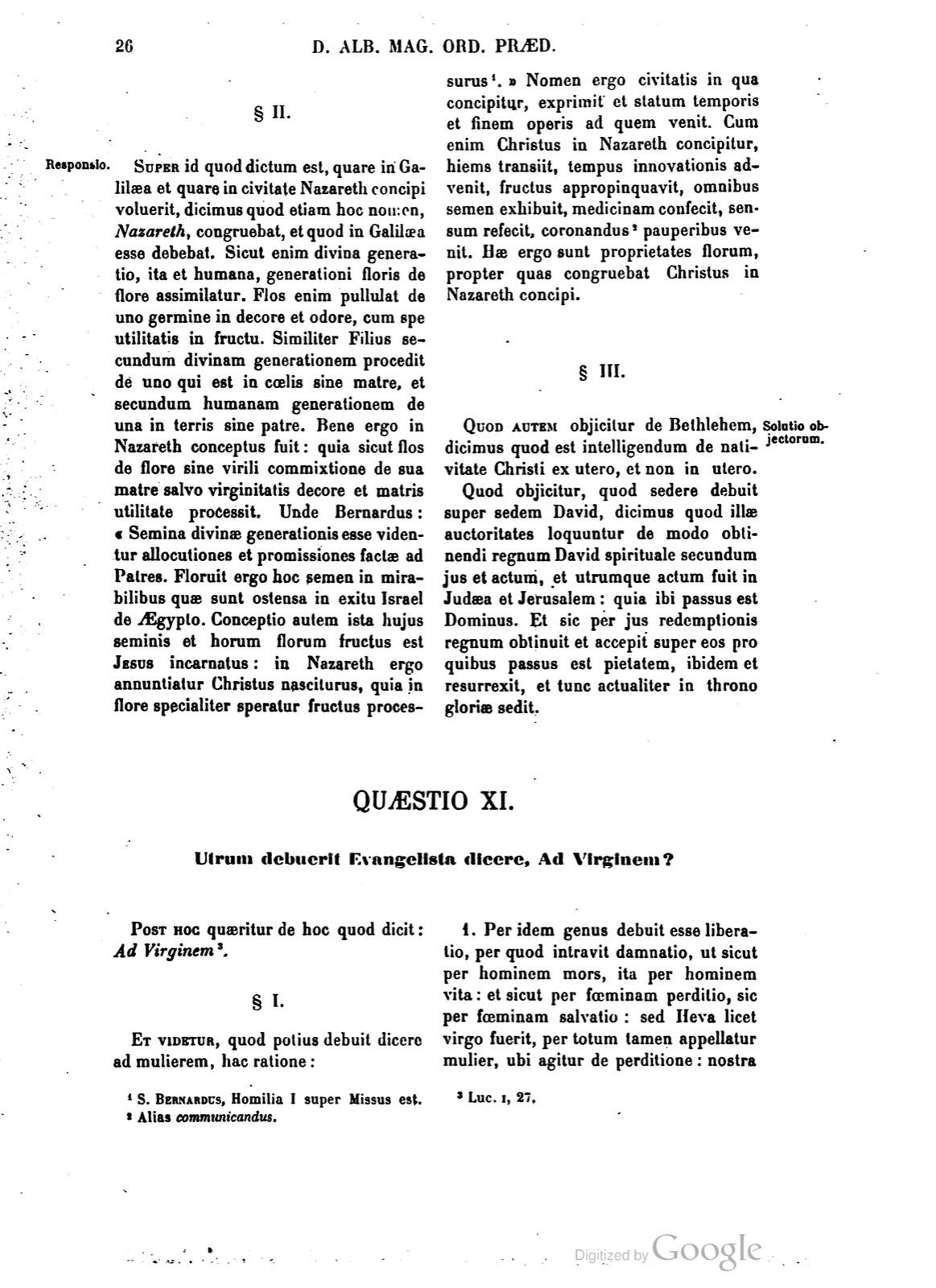
Quaestio XI. Utrum debuerit Evangelista dicere, Ad Virginem?
Post hoc quaeritur de hoc quod dicit: Ad Virginem 1.
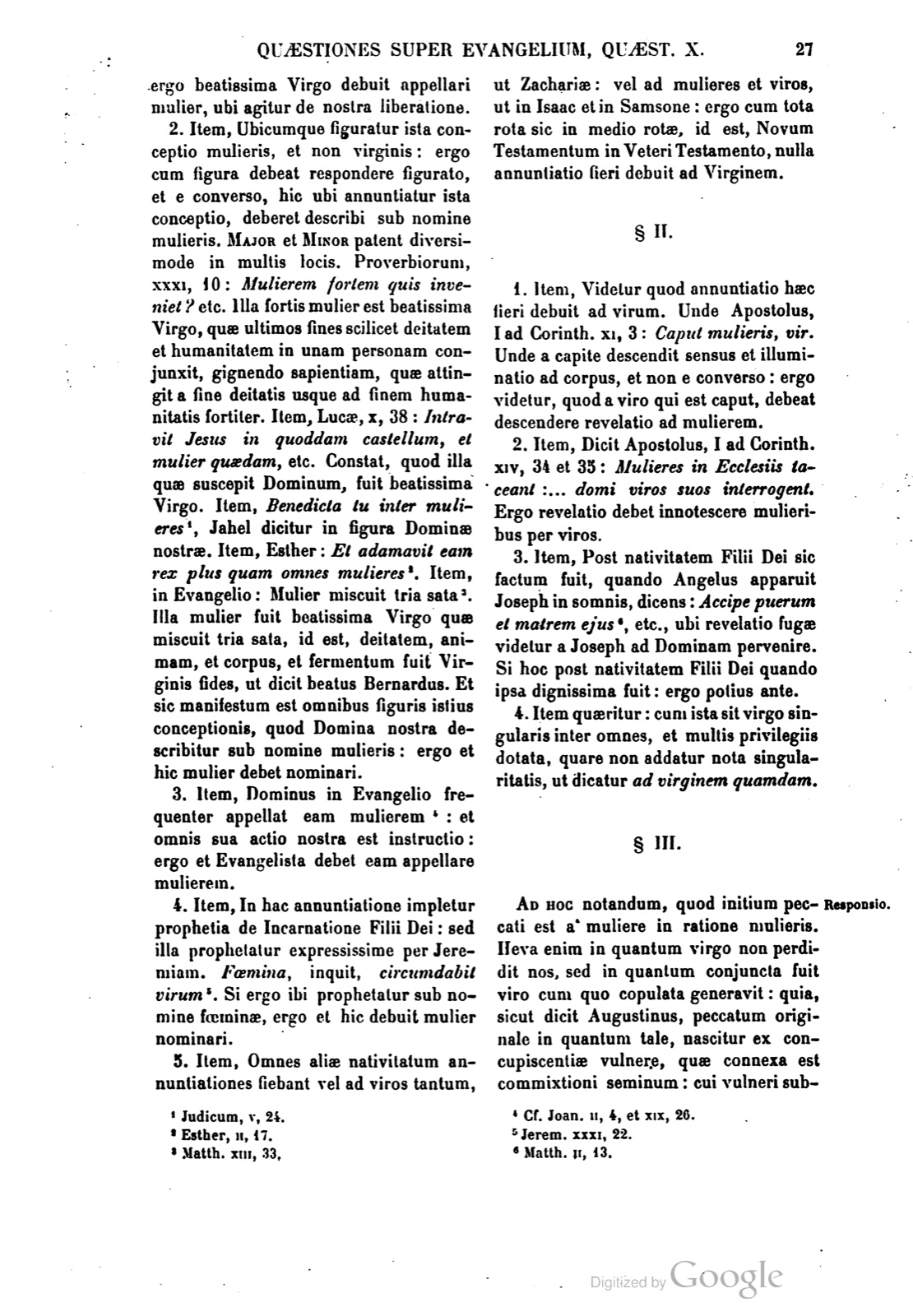
§ I. Et videtur, quod potius debuit dicere ad mulierem, hac ratione: 1. Per idem genus debuit esse liberatio, per quod intravit damnatio, ut sicut per hominem mors, ita per hominem vita: et sicut per feminam perditio, sic per feminam salvatio: sed Heva licet virgo fuerit, per totum tamen appellatur mulier, ubi agitur de perditione: nostra ergo beatissima Virgo debuit appellari mulier, ubi agitur de nostra liberatione. 2. Item, Ubicumque figuratur ista conceptio mulieris, et non virginis: ergo cum figura debeat respondere figurato, et e converso, hic ubi annuntiatur ista conceptio, deberet describi sub nomine mulieris. Major et minor patent diverse in multis locis. Proverbiorum XXXI, 10: Mulierem fortem quis inveniet? etc. Illa fortis mulier est beatissima Virgo, quae ultimos fines scilicet deitatem et humanitatem in unam personam conjunxit, gignendo sapientiam, quae attingit a fine deitatis usque ad finem humanitatis fortiter. Item, Lucae X, 38: Intravit Jesus in quoddam castellum, et mulier quaedam, etc. Constat, quod illa quae suscepit Dominum, fuit beatissima Virgo. Item, Benedicta tu inter mulieres 2, Jahel dicitur in figura Dominae nostrae. Item, Esther: Et adamavit eam rex plus quam omnes mulieres 3. Item, in Evangelio: Mulier miscuit tria sata 4. Illa mulier fuit beatissima Virgo quae miscuit tria sata, id est, deitatem, animam, et corpus, et fermentum fuit Virginis fides, ut dicit beatus Bernardus. Et sic manifestum est omnibus figuris istius conceptionis, quod Domina nostra describitur sub nomine mulieris: ergo et hic mulier debet nominari. 3. Item, Dominus in Evangelio frequenter appellat eam mulierem 5: et omnis sua actio nostra est instructio: ergo et Evangelista debet eam appellare mulierem. 4. Item, In hac annuntiatione impletur prophetia de Incarnatione Filii Dei: sed illa prophetatur expressissime per Jeremiam. Femina, inquit, circumdabit virum 6. Si ergo ibi prophetatur sub nomine feminae, ergo et hic debuit mulier nominari. 5. Item, Omnes aliae nativitatum annuntiationes fiebant vel ad viros tantum, ut Zachariae: vel ad mulieres et viros, ut in Isaac et in Samsone: ergo cum tota rota sic in medio rotae, id est, Novum Testamentum in Veteri Testamento, nulla annuntiatio fieri debuit ad Virginem.
Question XI. Whether the Evangelist ought to have said, To a Virgin.
After this inquiry is made about what he says: To a Virgin 1.
§ I. And it seems that he ought rather to have said to a woman, for this reason. 1. Liberation ought to be through the same genus through which damnation entered: as death through man, so life through man; and as perdition through a woman, so salvation through a woman. But although Eve was a virgin, nevertheless throughout she is called woman where perdition is treated; therefore our most blessed Virgin ought to have been called woman where our liberation is treated. 2. Likewise, everywhere this conception is figured as that of a woman and not of a virgin; therefore, since the figure ought to correspond to the thing figured, and conversely, here where that conception is announced, she ought to be described under the name woman. The major and minor are clear in different ways in many places. Proverbs XXXI, 10: Who will find a strong woman? etc. That strong woman is the most blessed Virgin, who joined the final ends, namely deity and humanity, into one person, by begetting wisdom, which reaches mightily from the end of deity to the end of humanity. Likewise, Luke X, 38: Jesus entered a certain town, and a certain woman, etc. It is agreed that she who received the Lord was the most blessed Virgin. Likewise, Blessed are you among women 2 is said of Jael in figure of our Lady. Likewise, Esther: And the king loved her more than all women 3. Likewise, in the Gospel: A woman mixed three measures 4. That woman was the most blessed Virgin, who mixed three measures, that is, deity, soul, and body, and the leaven was the Virgin's faith, as blessed Bernard says. And thus it is manifest in all the figures of that conception that our Lady is described under the name woman; therefore also here woman ought to be named. 3. Likewise, the Lord in the Gospel frequently calls her woman 5, and every action of his is our instruction; therefore the Evangelist too ought to call her woman. 4. Likewise, in this announcing the prophecy concerning the Incarnation of the Son of God is fulfilled; but that is prophesied most expressly by Jeremiah, saying: A woman shall surround a man 6. Therefore if there she is prophesied under the name female, then here too woman ought to have been named. 5. Likewise, all other announcements of births were made either to men only, as to Zechariah, or to women and men, as in Isaac and in Samson. Therefore since the whole wheel is thus in the middle of the wheel, that is, the New Testament in the Old Testament, no announcement ought to have been made to a Virgin.
§ II. 1. Item, Videtur quod annuntiatio haec fieri debuit ad virum. Unde Apostolus, I ad Corinth. XI, 3: Caput mulieris, vir. Unde a capite descendit sensus et illuminatio ad corpus, et non e converso: ergo videtur, quod a viro qui est caput, debeat descendere revelatio ad mulierem. 2. Item, Dicit Apostolus, I ad Corinth. XIV, 34 et 35: Mulieres in Ecclesiis taceant: ... domi viros suos interrogent. Ergo revelatio debet innotescere mulieribus per viros. 3. Item, Post nativitatem Filii Dei sic factum fuit, quando Angelus apparuit Joseph in somnis, dicens: Accipe puerum et matrem ejus 7, etc., ubi revelatio fugae videtur a Joseph ad Dominam pervenire. Si hoc post nativitatem Filii Dei quando ipsa dignissima fuit: ergo potius ante. 4. Item quaeritur: cum ista sit virgo singularis inter omnes, et multis privilegiis dotata, quare non addatur nota singularitatis, ut dicatur ad virginem quamdam.
§ III. Responsio. Ad hoc notandum, quod initium peccati est a muliere in ratione mulieris. Heva enim in quantum virgo non perdidit nos, sed in quantum conjuncta fuit viro cum quo copulata generavit: quia, sicut dicit Augustinus, peccatum originale in quantum tale, nascitur ex concupiscentiae vulnere, quae connexa est commixtioni seminum: cui vulneri subjacere non debuit, quae ut vulnus curaret, venit. Praeterea, generatio temporalis est imago generationis aeternae. Unde sicut aeterna est de uno manente incorrupto et indiviso, ita generatio temporalis debuit esse de una incorrupta, hoc est, de virgine. Et sic patet, quod origini perditionis congruebat ratio mulieris, et origini salvationis ratio virginis.
§ II. 1. Likewise, it seems that this announcing ought to have been made to a man. Hence the Apostle, First Corinthians XI, 3: The head of the woman is the man. Hence sense and illumination descends from the head to the body and not conversely; therefore it seems that revelation ought to descend to the woman from the man who is the head. 2. Likewise, the Apostle says, First Corinthians XIV, 34 and 35: Let women be silent in the Churches; ... let them ask their husbands at home. Therefore revelation ought to become known to women through men. 3. Likewise, after the birth of the Son of God this was done when the Angel appeared to Joseph in sleep, saying: Take the child and his mother 7, etc., where the revelation of the flight seems to pass from Joseph to the Lady. If this was so after the birth of the Son of God, when she was most worthy, then rather before. 4. Likewise it is asked: since she is a singular virgin among all and endowed with many privileges, why is a mark of singularity not added, so that it would say to a certain virgin?
§ III. Response. To this one must note that the beginning of sin is from woman under the aspect of woman. For Eve did not destroy us insofar as she was a virgin, but insofar as she was joined to the man with whom, having been coupled, she begot. For, as Augustine says, original sin as such is born from the wound of concupiscence, which is connected with the commixture of seeds; and she who came to cure the wound ought not to lie under that wound. Furthermore, temporal generation is an image of eternal generation. Hence, as eternal generation is from one remaining incorrupt and undivided, so temporal generation ought to be from one incorrupt, that is, from a virgin. And thus it is clear that the account of woman was fitting for the origin of perdition, and the account of virgin for the origin of salvation.
§ IV. Solutio objectorum. Quod autem objicitur, quod omnes figurae fiebant sub ratione et nomine mulieris, et omnes annuntiationes ad viros et mulieres factas, et non ad virginem. Dicendum est, quod figurae et prophetiae semiplenam lucem continentes omnes deficiunt ab ipsa luce. Unde nulla figura in facto plene potuit exprimere istam annuntiationem ad Virginem: quia nulla alia virgo conceptura umquam fuit, et usque ad Virginem hanc maledicta et opprobriosa virginitas fuit. Haec autem Virgo opprobrium virginitatis abstulit, et virginitatem consecravit: unde ipsa initium beatitudinis virginitatis fuit: et sic est Virgo virginum, quae sine praecepto et sine consilio, sine exemplo gloriosum munus virginitatis Deo obtulit, pro quo per imitationem omnes virgines Deo Virgo generavit: ergo quidquid ante eam utilitatis vel dignitatis feminis attribui potuit, hoc sub ratione mulieris et non virginis fieri debuit, ut benedictio virginitatis benedictissimae Virgini tamquam virginitatis matri pro privilegio sibi proprio servaretur. Prophetiae autem quae de ipsa persona beatissimae Virginis loquuntur, in excellentissimis prophetiis ipsam appellant modo virginem, modo mulierem. Virginem Isaias: Ecce virgo concipiet 8. Feminam Jeremias: Femina circumdabit virum 9. Ad signandum videlicet, quod mater Dei habitura fuerat et virginitatis integritatem, et mulieris fecunditatem.
Item, Quia virgo futura fuit quae mulieris peccatum abolevit, et sic quod ista virgo inter omnes virgines singularis fuit, utputa nec primam habens similem nec sequentem, ideo sub nota singularitatis quandoque figuratur ut quoddam castellum, etc., et quaedam mulier, etc. Sed quia ipsa vere sola virginitatem in summo habuit, ut infra patebit, ideo virgo sine additione antonomastice nominatur. Fuit enim haec Virgo causa et principium omnium aliorum Sanctorum summa virginitatis puritate, peccati immunitate, peccandi impossibilitate, virginitatem habens cum fecunditate, mater sanctissimi hominis, mater Creatoris, mater Dei et corporalis hominis, mater omnium hominum spiritualis, mater machinae mundialis, mater angelicae restitutionis.
§ IV. Solution of the objections. As to what is objected, that all figures were made under the account and name of woman, and all announcements were made to men and women and not to a virgin: it must be said that figures and prophecies, containing a half-full light, all fall short of the light itself. Hence no figure in fact could fully express this announcing to a Virgin, because no other virgin was ever going to conceive, and until this Virgin virginity was cursed and shameful. But this Virgin removed the shame of virginity and consecrated virginity; hence she was the beginning of the blessedness of virginity. And thus she is Virgin of virgins, who without precept and without counsel, without example, offered to God the glorious gift of virginity, for which, by imitation, the Virgin generated all virgins to God. Therefore whatever usefulness or dignity could be attributed to women before her had to be done under the account of woman and not virgin, so that the blessing of virginity might be reserved for the most blessed Virgin, as mother of virginity, for a privilege proper to herself. But the prophecies which speak of the person of the most blessed Virgin herself, in the most excellent prophecies, call her now virgin, now woman. Isaiah calls her virgin: Behold a virgin shall conceive 8. Jeremiah calls her female: A woman shall surround a man 9. This is to signify that the mother of God would have both the integrity of virginity and the fecundity of a woman.
Likewise, because she was going to be the virgin who abolished the sin of the woman, and because this virgin was singular among all virgins, as having neither a prior like herself nor a subsequent one, therefore she is sometimes figured under a mark of singularity as a certain town, etc., and a certain woman, etc. But because she truly alone had virginity in the highest degree, as will be clear below, therefore she is named virgin antonomastically without addition. For this Virgin was the cause and principle of all the other Saints by the highest purity of virginity, immunity from sin, impossibility of sinning, having virginity with fecundity, mother of the holiest man, mother of the Creator, mother of God and of corporeal man, spiritual mother of all human beings, mother of the worldly machine, mother of angelic restoration.
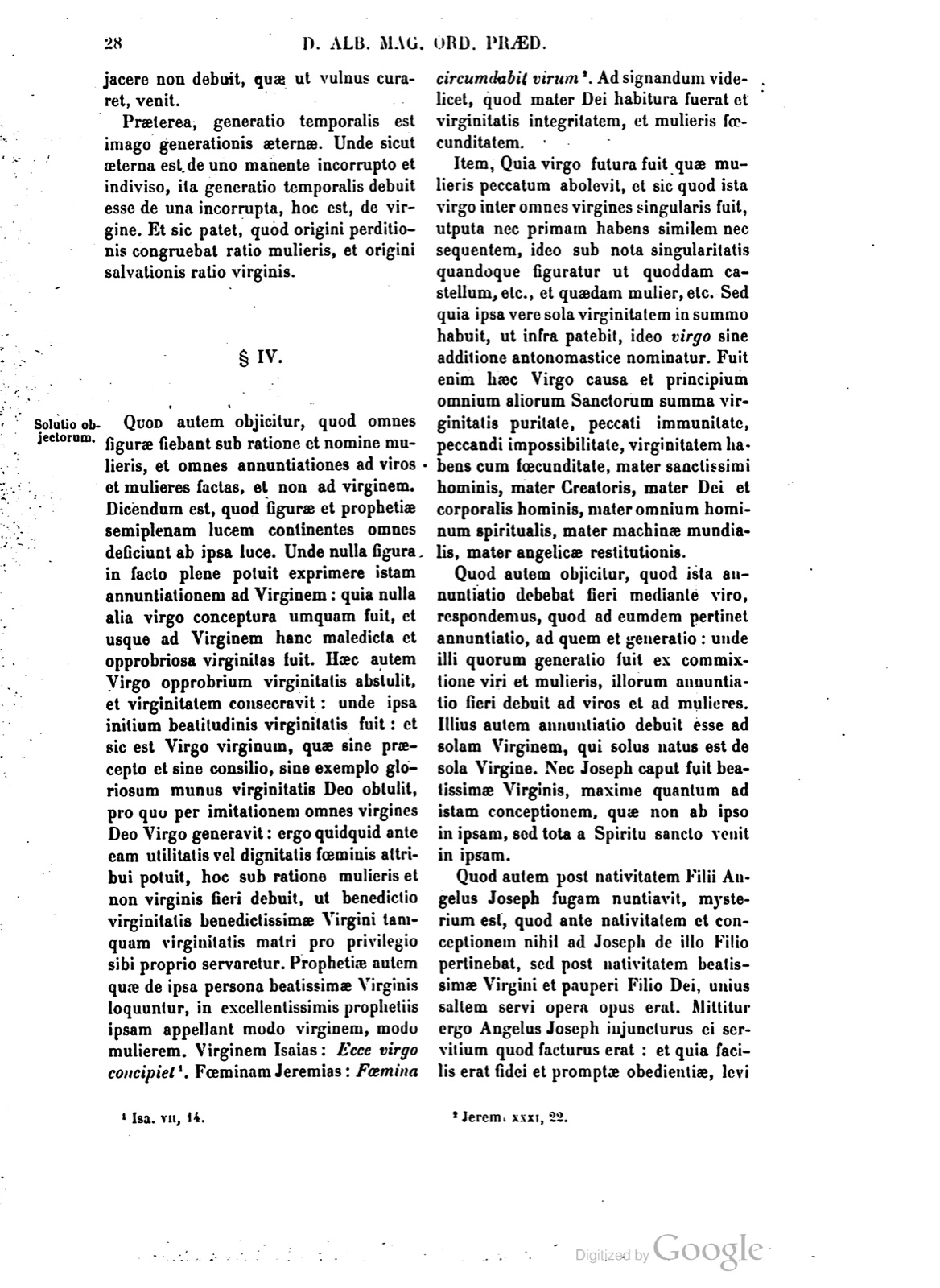
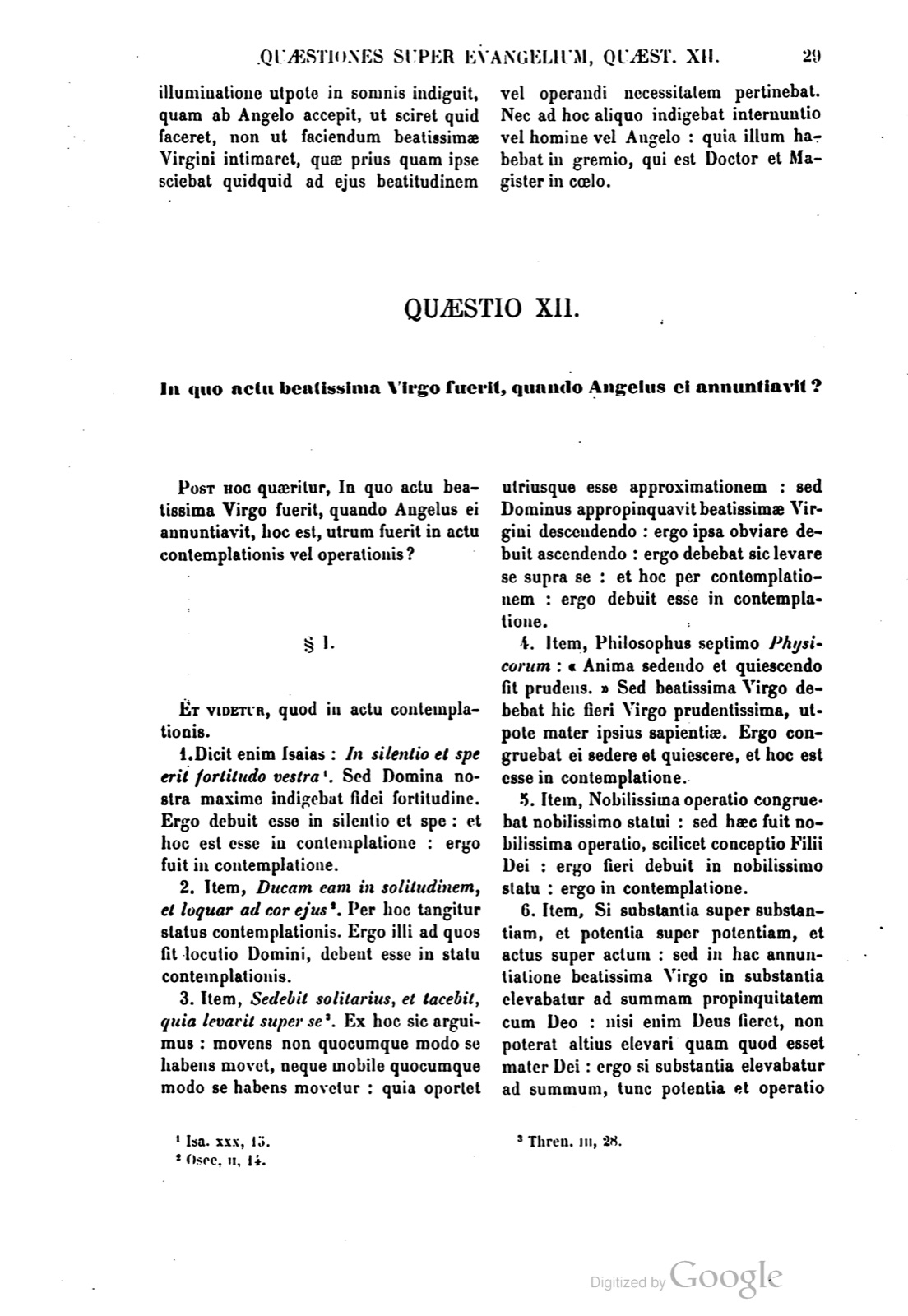
Quod autem objicitur, quod ista annuntiatio debebat fieri mediante viro, respondemus, quod ad eumdem pertinet annuntiatio, ad quem et generatio: unde illi quorum generatio fuit ex commixtione viri et mulieris, illorum annuntiatio fieri debuit ad viros et ad mulieres. Illius autem annuntiatio debuit esse ad solam Virginem, qui solus natus est de sola Virgine. Nec Joseph caput fuit beatissimae Virginis, maxime quantum ad istam conceptionem, quae non ab ipso in ipsam, sed tota a Spiritu sancto venit in ipsam. Quod autem post nativitatem Filii Angelus Joseph fugam nuntiavit, mysterium est, quod ante nativitatem et conceptionem nihil ad Joseph de illo Filio pertinebat, sed post nativitatem beatissimae Virgini et pauperi Filio Dei, unius saltem servi opera opus erat. Mittitur ergo Angelus Joseph injuncturus ei servitium quod facturus erat: et quia facilis erat fidei et promptae obedientiae, levi illuminatione utpote in somnis indiguit, quam ab Angelo accepit, ut sciret quid faceret, non ut faciendum beatissimae Virgini intimaret, quae prius quam ipse sciebat quidquid ad ejus beatitudinem vel operandi necessitatem pertinebat. Nec ad hoc aliquo indigebat internuntio vel homine vel Angelo: quia illum habebat in gremio, qui est Doctor et Magister in caelo.
As to what is objected, that this announcing ought to have been made through the mediation of a man, we respond that the announcing belongs to the same one to whom the generation belongs. Hence for those whose generation was from the commixture of man and woman, their announcement ought to have been made to men and to women. But the announcing of him ought to have been to the Virgin alone, who alone was born from the Virgin alone. Nor was Joseph the head of the most blessed Virgin, especially as to this conception, which came into her not from him into her, but entirely from the Holy Spirit into her. But that after the birth of the Son the Angel announced the flight to Joseph is a mystery: before the birth and conception nothing concerning that Son pertained to Joseph; but after the birth the most blessed Virgin and the poor Son of God needed the work of at least one servant. Therefore the Angel is sent to Joseph to enjoin on him the service he was about to do; and because he was ready in faith and prompt in obedience, he needed a light illumination, as in dreams, which he received from the Angel, so that he might know what he should do, not so that he might intimate to the most blessed Virgin what was to be done. She knew before he did whatever pertained to his blessedness or to the necessity of acting. Nor did she need for this any go-between, either human or Angel, because she had in her womb him who is Teacher and Master in heaven.
Notes
- Luke 1:27. (Luc. 1, 27.) ↩
- Judges 5:24. (Judicum V, 24.) ↩
- Esther 2:17. (Esther II, 17.) ↩
- Matthew 11:33. (Matth. XI, 33.) ↩
- Compare John 2:4 and 19:26. (Cf. Joan. II, 4, et XIX, 26.) ↩
- Jeremiah 31:22. (Jerem. XXXI, 22.) ↩
- Matthew 1:13. (Matth. I, 13.) ↩
- Isaiah 7:14. (Isa. VII, 14.) ↩
- Jeremiah 31:22. (Jerem. XXXI, 22.) ↩
If a page does not appear, its photograph has not been uploaded yet.