Works › The Mariale: Questions on “Missus est”
Volume 37 · pp. 25–26
Question X. In what city ought Christ to have been announced?
A marker with ≈ is an approximate page boundary, placed by measure of the text; the page photographs remain the authority. In the paired views, clicking a page marker brings that page into view.
Quaestio X. In qua civitate Christus annuntiari debuit?
Post hoc quaeritur, In qua civitate Christus annuntiari debuit?
§ I. Et videtur, quod non debuit esse Nazareth. 1. David enim dictum est: De fructu ventris tui ponam super sedem tuam 1. Ergo videtur, quod potius in civitate David concipi debuit quam in Nazareth. 2. Item, Hoc videtur per Michaeam, qui dicit: Et tu, Bethlehem Ephrata 2, etc. 3. Item, Videtur per alium: O Judaea et Jerusalem, etc. Ergo videtur, quod ista annuntiatio debuit fieri in Jerusalem. 4. Item, Joannis, I, 46: A Nazareth potest aliquid boni esse? Quasi diceret: Bonum quod exspectamus, non venit a Nazareth, sed de Bethlehem: ergo, etc. 5. Item, Nulla prophetia videtur habere, quod Dominus concipiatur in Nazareth. Si concedatur. Contra: 1. Egredietur virga de radice Jesse 3, etc. Ergo videtur prophetatum esse, quod Dominus in Nazareth concipi debuerit. 2. Item, Postquam dixerat Nathanael: A Nazareth potest, etc., Dominus quasi approbando et commendando dictum suum, ait: Ecce vere Israelita. Ergo videtur intellexisse, quod esset prophetia de Domino incarnando in Nazareth.
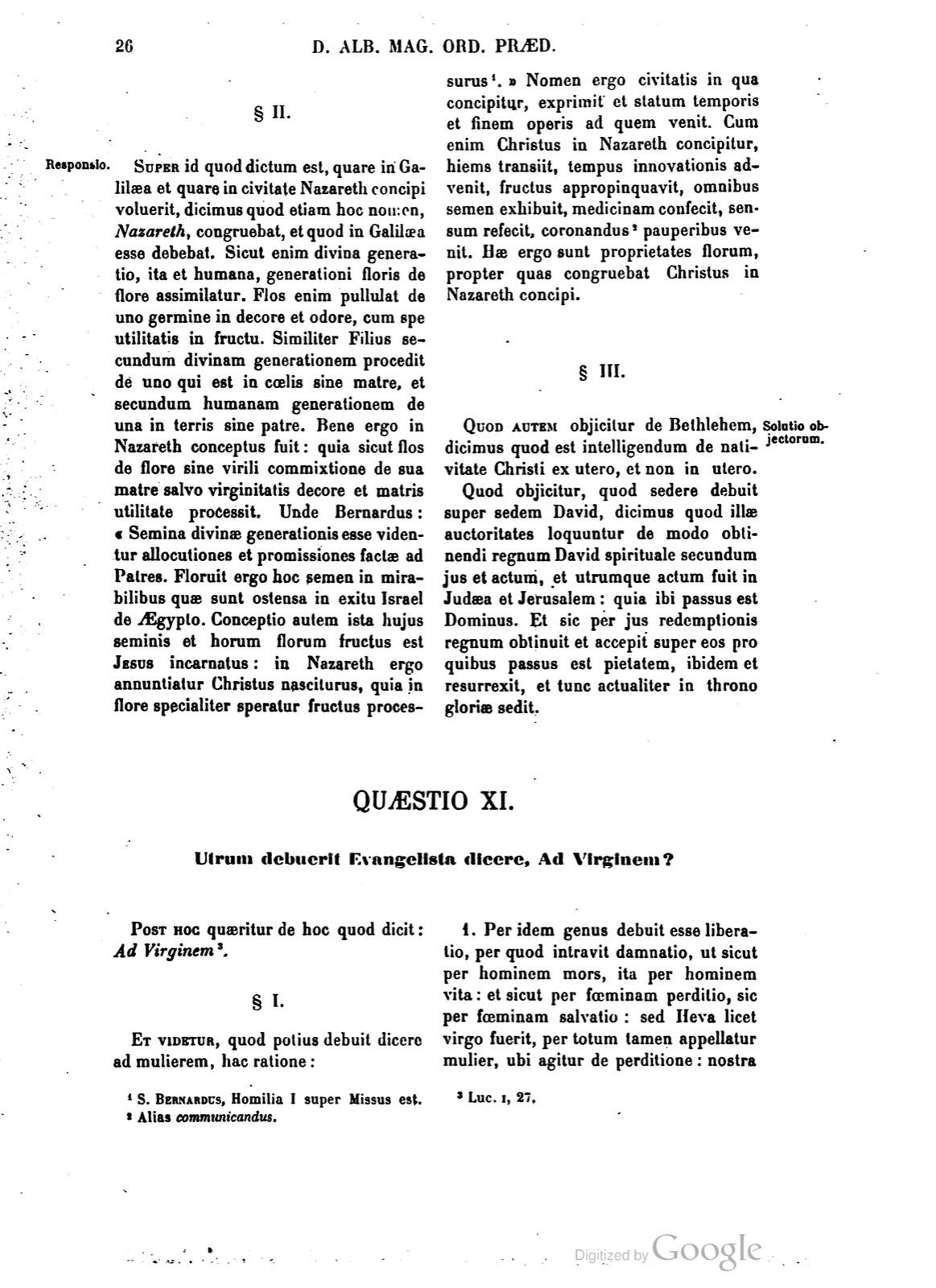
§ II. Responsio. Super id quod dictum est, quare in Galilaea et quare in civitate Nazareth concipi voluerit, dicimus quod etiam hoc nomen, Nazareth, congruebat, et quod in Galilaea esse debebat. Sicut enim divina generatio, ita et humana, generationi floris de flore assimilatur. Flos enim pullulat de uno germine in decore et odore, cum spe utilitatis in fructu. Similiter Filius secundum divinam generationem procedit de uno qui est in caelis sine matre, et secundum humanam generationem de una in terris sine patre. Bene ergo in Nazareth conceptus fuit: quia sicut flos de flore sine virili commixtione de sua matre salvo virginitatis decore et matris utilitate processit. Unde Bernardus: «Semina divinae generationis esse videntur allocutiones et promissiones factae ad Patres. Floruit ergo hoc semen in mirabilibus quae sunt ostensa in exitu Israel de Aegypto. Conceptio autem ista hujus seminis et horum florum fructus est Jesus incarnatus: in Nazareth ergo annuntiatur Christus nasciturus, quia in flore specialiter speratur fructus processurus 4.» Nomen ergo civitatis in qua concipitur, exprimit et statum temporis et finem operis ad quem venit. Cum enim Christus in Nazareth concipitur, hiems transiit, tempus innovationis advenit, fructus appropinquavit, omnibus semen exhibuit, medicinam confecit, sensum refecit, coronandus pauperibus venit. Hae ergo sunt proprietates florum, propter quas congruebat Christus in Nazareth concipi.
Question X. In what city ought Christ to have been announced?
After this it is asked: in what city ought Christ to have been announced?
§ I. And it seems that it ought not to have been Nazareth. 1. For it was said to David: Of the fruit of your womb I will set one upon your throne 1. Therefore it seems that he ought to have been conceived in the city of David rather than in Nazareth. 2. Likewise, this seems so through Micah, who says: And you, Bethlehem Ephrathah 2, etc. 3. Likewise, it seems through another: O Judea and Jerusalem, etc. Therefore it seems that this announcing ought to have been made in Jerusalem. 4. Likewise, John I, 46: Can anything good be from Nazareth? as if he were saying: the good thing we await does not come from Nazareth, but from Bethlehem; therefore, etc. 5. Likewise, no prophecy seems to have that the Lord is conceived in Nazareth. If this is conceded. On the contrary: 1. A rod shall go forth from the root of Jesse 3, etc. Therefore it seems to have been prophesied that the Lord ought to have been conceived in Nazareth. 2. Likewise, after Nathanael had said, Can anything be from Nazareth? etc., the Lord, as if approving and commending his saying, said: Behold a true Israelite. Therefore he seems to have understood that there was a prophecy concerning the Lord to be incarnate in Nazareth.
§ II. Response. Concerning what has been said, why he willed to be conceived in Galilee and why in the city Nazareth, we say that this name also, Nazareth, was fitting, and that it ought to have been in Galilee. For as divine generation, so also human generation, is likened to the generation of a flower from a flower. For a flower sprouts from one shoot in beauty and fragrance, with hope of usefulness in fruit. Similarly, according to divine generation the Son proceeds from the one who is in heaven without a mother, and according to human generation from one on earth without a father. Therefore he was fittingly conceived in Nazareth, because as a flower from a flower he proceeded without male commixture from his mother, with the beauty of virginity and the usefulness of the mother preserved. Hence Bernard says: "The seeds of divine generation seem to be the addresses and promises made to the Fathers. Therefore this seed flowered in the wonders that were shown in the departure of Israel from Egypt. But this conception of this seed and the fruit of these flowers is Jesus incarnate: therefore Christ about to be born is announced in Nazareth, because in the flower the fruit about to come forth is especially hoped for 4." Therefore the name of the city in which he is conceived expresses both the state of the time and the end of the work for which he came. For when Christ is conceived in Nazareth, winter has passed, the time of renewal has come, the fruit has drawn near, he has shown seed to all, prepared medicine, refreshed sense, and came to be crowned by the poor. These therefore are the properties of flowers on account of which it was fitting for Christ to be conceived in Nazareth.
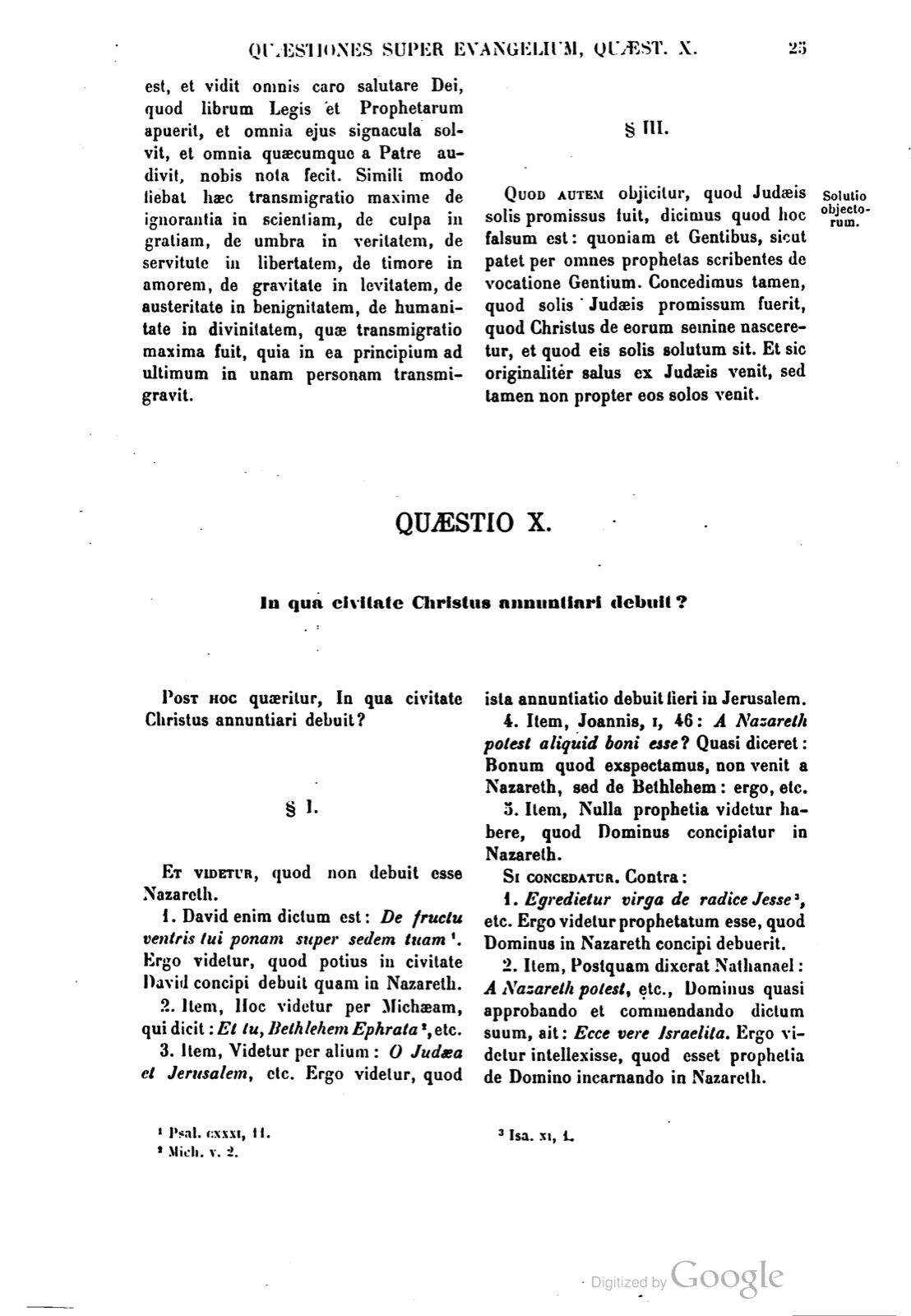
§ III. Solutio objectorum. Quod autem objicitur de Bethlehem, dicimus quod est intelligendum de nativitate Christi ex utero, et non in utero. Quod objicitur, quod sedere debuit super sedem David, dicimus quod illae auctoritates loquuntur de modo obtinendi regnum David spirituale secundum jus et actum, et utrumque actum fuit in Judaea et Jerusalem: quia ibi passus est Dominus. Et sic per jus redemptionis regnum obtinuit et accepit super eos pro quibus passus est pietatem, ibidem et resurrexit, et tunc actualiter in throno gloriae sedit.
§ III. Solution of the objections. As to what is objected about Bethlehem, we say that it must be understood of Christ's nativity from the womb, not in the womb. As to what is objected, that he ought to sit upon the throne of David, we say that those authorities speak of the mode of obtaining David's spiritual kingdom according to right and act, and both acts were in Judea and Jerusalem, because there the Lord suffered. And thus through the right of redemption he obtained the kingdom and received dominion over those for whom he suffered; there also he rose, and then actually sat on the throne of glory.
If a page does not appear, its photograph has not been uploaded yet.