Works › The Mariale: Questions on “Missus est”
Volume 37 · pp. 22–23
Question VIII. Whether the Annunciation was made in a city
A marker with ≈ is an approximate page boundary, placed by measure of the text; the page photographs remain the authority. In the paired views, clicking a page marker brings that page into view.
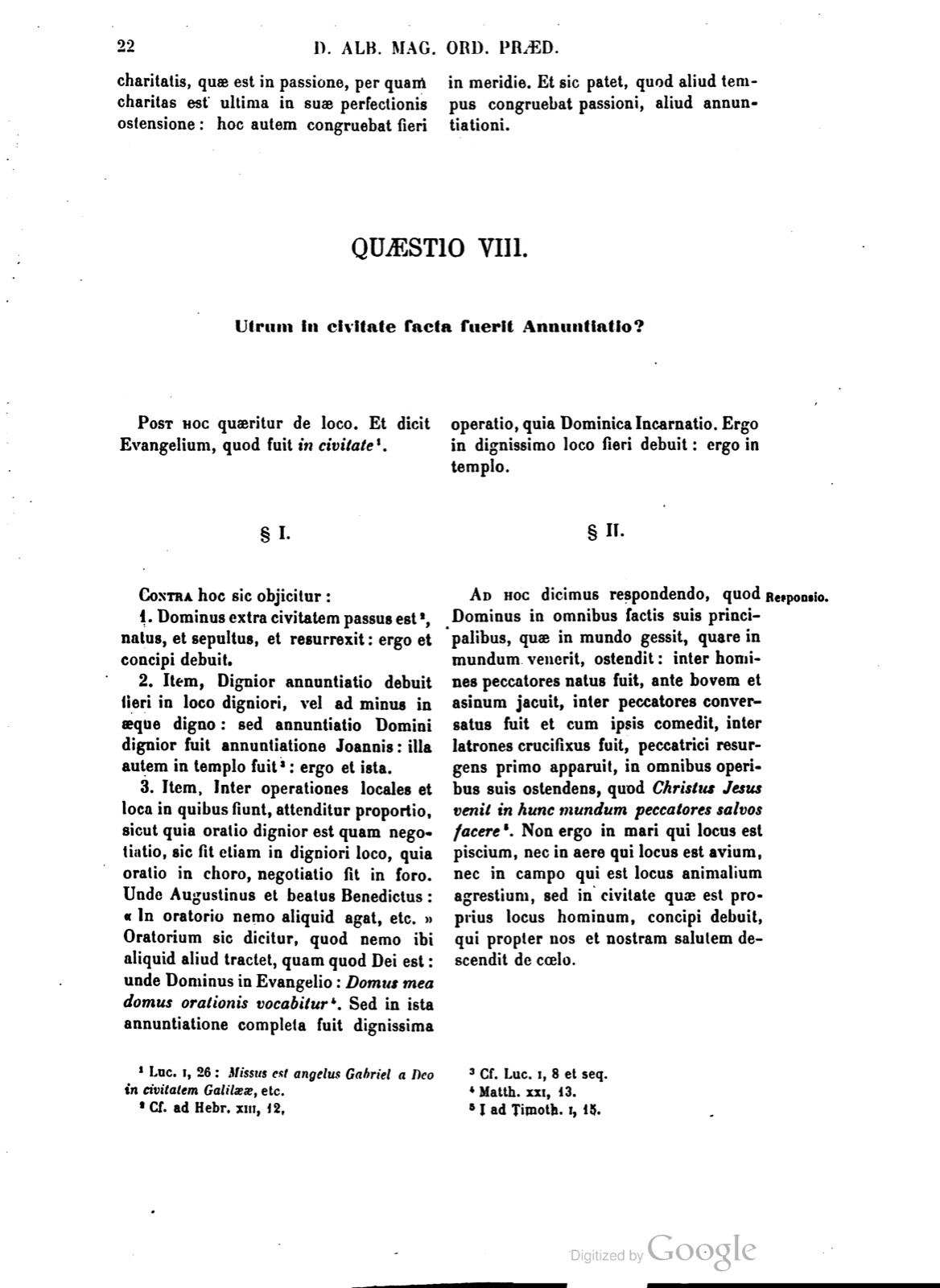
Quaestio VIII. Utrum in civitate facta fuerit Annuntiatio?
Post hoc quaeritur de loco. Et dicit Evangelium, quod fuit in civitate 1.
§ I. Contra hoc sic objicitur: 1. Dominus extra civitatem passus est, natus, et sepultus, et resurrexit 2: ergo et concipi debuit. 2. Item, Dignior annuntiatio debuit fieri in loco digniori, vel ad minus in aeque digno: sed annuntiatio Domini dignior fuit annuntiatione Joannis: illa autem in templo fuit 3: ergo et ista. 3. Item, Inter operationes locales et loca in quibus fiunt, attenditur proportio, sicut quia oratio dignior est quam negotiatio, sic fit etiam in digniori loco, quia oratio in choro, negotiatio fit in foro. Unde Augustinus et beatus Benedictus: «In oratorio nemo aliquid agat, etc.» Oratorium sic dicitur, quod nemo ibi aliquid aliud tractet, quam quod Dei est: unde Dominus in Evangelio: Domus mea domus orationis vocabitur 4. Sed in ista annuntiatione completa fuit dignissima operatio, quia Dominica Incarnatio. Ergo in dignissimo loco fieri debuit: ergo in templo.
§ II. Responsio. Ad hoc dicimus respondendo, quod Dominus in omnibus factis suis principalibus, quae in mundo gessit, quare in mundum venerit, ostendit: inter homines peccatores natus fuit, ante bovem et asinum jacuit, inter peccatores conversatus fuit et cum ipsis comedit, inter latrones crucifixus fuit, peccatrici resurgens primo apparuit, in omnibus operibus suis ostendens, quod Christus Jesus venit in hunc mundum peccatores salvos facere 5. Non ergo in mari qui locus est piscium, nec in aere qui locus est avium, nec in campo qui est locus animalium agrestium, sed in civitate quae est proprius locus hominum, concipi debuit, qui propter nos et nostram salutem descendit de caelo.
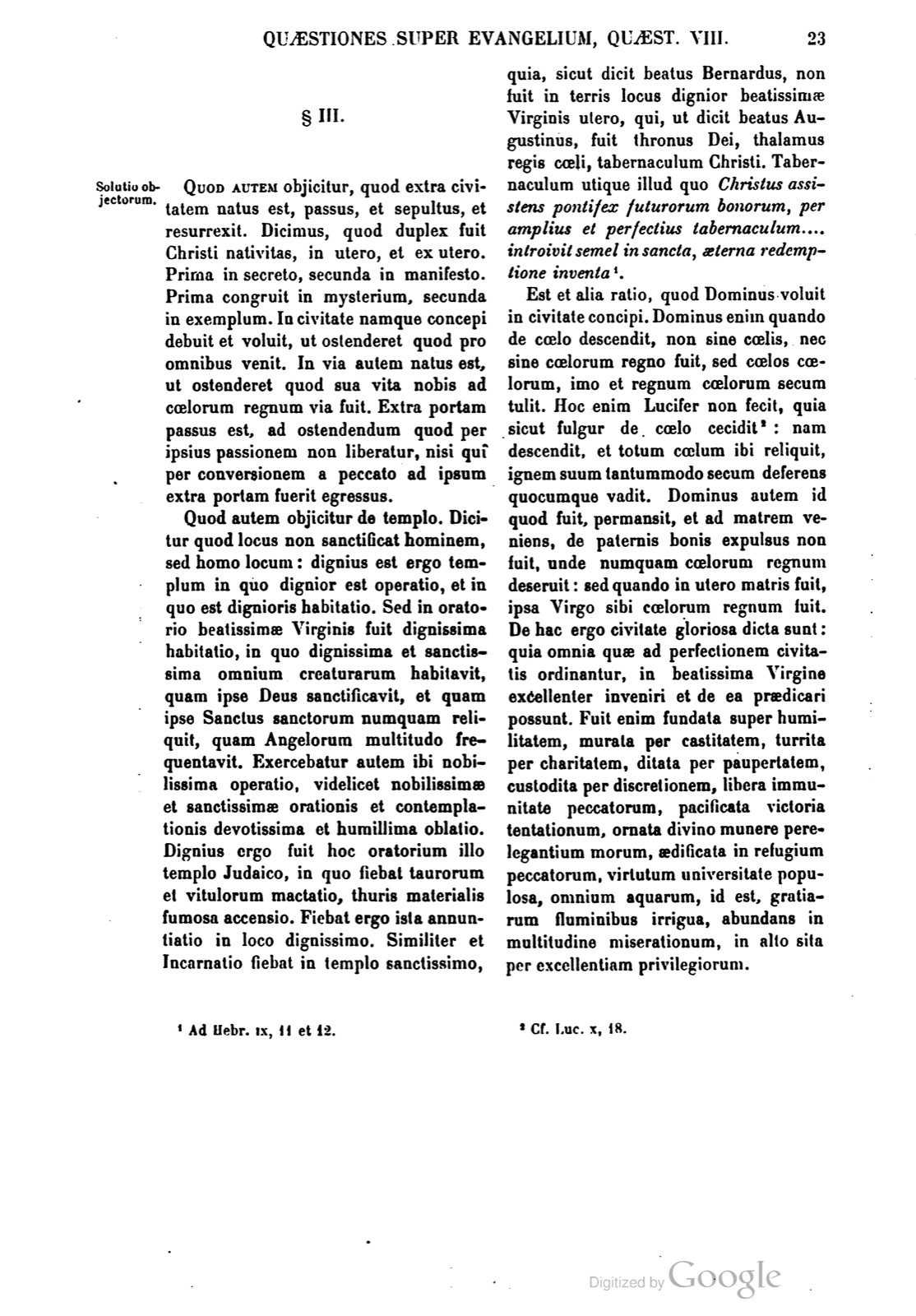
§ III. Solutio objectorum. Quod autem objicitur, quod extra civitatem natus est, passus, et sepultus, et resurrexit. Dicimus, quod duplex fuit Christi nativitas, in utero, et ex utero. Prima in secreto, secunda in manifesto. Prima congruit in mysterium, secunda in exemplum. In civitate namque concipi debuit et voluit, ut ostenderet quod pro omnibus venit. In via autem natus est, ut ostenderet quod sua vita nobis ad caelorum regnum via fuit. Extra portam passus est, ad ostendendum quod per ipsius passionem non liberatur, nisi qui per conversionem a peccato ad ipsum extra portam fuerit egressus.
Quod autem objicitur de templo. Dicitur quod locus non sanctificat hominem, sed homo locum: dignius est ergo templum in quo dignior est operatio, et in quo est dignioris habitatio. Sed in oratorio beatissimae Virginis fuit dignissima habitatio, in quo dignissima et sanctissima omnium creaturarum habitavit, quam ipse Deus sanctificavit, et quam ipse Sanctus sanctorum numquam reliquit, quam Angelorum multitudo frequentavit. Exercebatur autem ibi nobilissima operatio, videlicet nobilissimae et sanctissimae orationis et contemplationis devotissima et humillima oblatio. Dignius ergo fuit hoc oratorium illo templo Judaico, in quo fiebat taurorum et vitulorum mactatio, thuris materialis fumosa accensio. Fiebat ergo ista annuntiatio in loco dignissimo. Similiter et Incarnatio fiebat in templo sanctissimo, quia, sicut dicit beatus Bernardus, non fuit in terris locus dignior beatissimae Virginis utero, qui, ut dicit beatus Augustinus, fuit thronus Dei, thalamus regis caeli, tabernaculum Christi. Tabernaculum utique illud quo Christus assistens pontifex futurorum bonorum, per amplius et perfectius tabernaculum.... introivit semel in sancta, aeterna redemptione inventa 6.
Question VIII. Whether the Annunciation was made in a city.
After this the inquiry is about place. And the Gospel says that it was in a city 1.
§ I. Against this it is objected thus: 1. The Lord suffered, was born, was buried, and rose outside the city 2; therefore he also ought to have been conceived outside it. 2. Likewise, the more worthy announcement ought to have been made in a more worthy place, or at least in an equally worthy place; but the announcement of the Lord was more worthy than the announcement of John, and that one was in the temple 3; therefore also this one. 3. Likewise, between local operations and the places in which they occur, proportion is observed; for because prayer is more worthy than business, so it also occurs in a more worthy place, because prayer is in the choir, business in the forum. Hence Augustine and blessed Benedict say: "Let no one do anything in the oratory, etc." It is called an oratory in this way, that no one should treat anything else there except what belongs to God. Hence the Lord in the Gospel says: My house shall be called a house of prayer 4. But in that announcing the most worthy operation was completed, namely the Lord's Incarnation. Therefore it ought to have been done in the most worthy place; therefore in the temple.
§ II. Response. To this we say in responding that in all his principal deeds that he performed in the world, the Lord showed why he came into the world: he was born among sinful human beings, lay before an ox and an ass, lived among sinners and ate with them, was crucified between thieves, and rising appeared first to a sinful woman, showing in all his works that Christ Jesus came into this world to save sinners 5. Therefore he ought to have been conceived not in the sea, which is the place of fish, nor in the air, which is the place of birds, nor in the field, which is the place of wild animals, but in a city, which is the proper place of human beings, he who for us and for our salvation came down from heaven.
§ III. Solution of the objections. As to what is objected, that he was born, suffered, was buried, and rose outside the city: we say that Christ's nativity was twofold, in the womb and from the womb. The first was in secret, the second in manifestation. The first agrees with mystery, the second with example. For he ought and willed to be conceived in a city, so that he might show that he came for all. But he was born on the road so that he might show that his life was the way for us to the kingdom of heaven. He suffered outside the gate to show that no one is freed through his passion except the one who by conversion from sin has gone forth to him outside the gate.
As to what is objected about the temple: it is said that place does not sanctify the human being, but the human being sanctifies the place. Therefore that temple is more worthy in which the operation is more worthy and in which there is the dwelling of one more worthy. But in the oratory of the most blessed Virgin there was the most worthy dwelling, in which the most worthy and holiest of all creatures dwelt, whom God himself sanctified, whom the Holy of holies himself never left, and which a multitude of Angels frequented. Moreover the noblest operation was exercised there, namely the most devoted and humble offering of the noblest and holiest prayer and contemplation. Therefore this oratory was more worthy than that Judaic temple in which the slaughter of bulls and calves and the smoky burning of material incense occurred. Therefore that announcing was made in the most worthy place. Similarly, the Incarnation too was made in the holiest temple, because, as blessed Bernard says, there was no place on earth more worthy than the womb of the most blessed Virgin, which, as blessed Augustine says, was the throne of God, the chamber of the king of heaven, the tabernacle of Christ. Indeed that tabernacle by which Christ, standing as pontiff of future good things, through a greater and more perfect tabernacle... entered once into the holy places, eternal redemption having been found 6.
Est et alia ratio, quod Dominus voluit in civitate concipi. Dominus enim quando de caelo descendit, non sine caelis, nec sine caelorum regno fuit, sed caelos caelorum, imo et regnum caelorum secum tulit. Hoc enim Lucifer non fecit, quia sicut fulgur de caelo cecidit 7: nam descendit, et totum caelum ibi reliquit, ignem suum tantummodo secum deferens quocumque vadit. Dominus autem id quod fuit, permansit, et ad matrem veniens, de paternis bonis expulsus non fuit, unde numquam caelorum regnum deseruit: sed quando in utero matris fuit, ipsa Virgo sibi caelorum regnum fuit. De hac ergo civitate gloriosa dicta sunt: quia omnia quae ad perfectionem civitatis ordinantur, in beatissima Virgine excellenter inveniri et de ea praedicari possunt. Fuit enim fundata super humilitatem, murata per castitatem, turrita per charitatem, ditata per paupertatem, custodita per discretionem, libera immunitate peccatorum, pacificata victoria tentationum, ornata divino munere perelegantium morum, aedificata in refugium peccatorum, virtutum universitate populosa, omnium aquarum, id est, gratiarum fluminibus irrigua, abundans in multitudine miserationum, in alto sita per excellentiam privilegiorum.
There is also another reason why the Lord willed to be conceived in a city. For when the Lord came down from heaven, he was not without the heavens, nor without the kingdom of heaven, but he carried with him the heavens of heavens, indeed also the kingdom of heaven. Lucifer did not do this, because he fell like lightning from heaven 7; for he descended and left the whole heaven there, carrying only his own fire with him wherever he goes. But the Lord remained what he was, and, coming to his mother, was not expelled from his Father's goods; hence he never deserted the kingdom of heaven. But when he was in the womb of his mother, the Virgin herself was the kingdom of heaven for him. Therefore these things were said about this glorious city, because all things which are ordered to the perfection of a city can be found excellently in the most blessed Virgin and can be preached about her. For she was founded upon humility, walled by chastity, towered by charity, enriched by poverty, guarded by discretion, free by immunity from sins, pacified by victory over temptations, adorned by the divine gift of most elegant morals, built as a refuge of sinners, populous with the universality of virtues, irrigated by the rivers of all waters, that is, of graces, abounding in the multitude of mercies, and set on high by the excellence of privileges.
Notes
- Luke 1:26: The angel Gabriel was sent by God into a city of Galilee, etc. (Luc. 1, 26: Missus est angelus Gabriel a Deo in civitatem Galilaeae, etc.) ↩
- Compare Hebrews 13:12. (Cf. ad Hebr. XIII, 12.) ↩
- Compare Luke 1:8 and following. (Cf. Luc. 1, 8 et seq.) ↩
- Matthew 21:13. (Matth. XXI, 13.) ↩
- First to Timothy 1:15. (I ad Timoth. 1, 15.) ↩
- Hebrews 9:11-12. (Ad Hebr. IX, 11 et 12.) ↩
- Compare Luke 10:18. (Cf. Luc. X, 18.) ↩
If a page does not appear, its photograph has not been uploaded yet.