Works › The Mariale: Questions on “Missus est”
Volume 37 · pp. 20–22
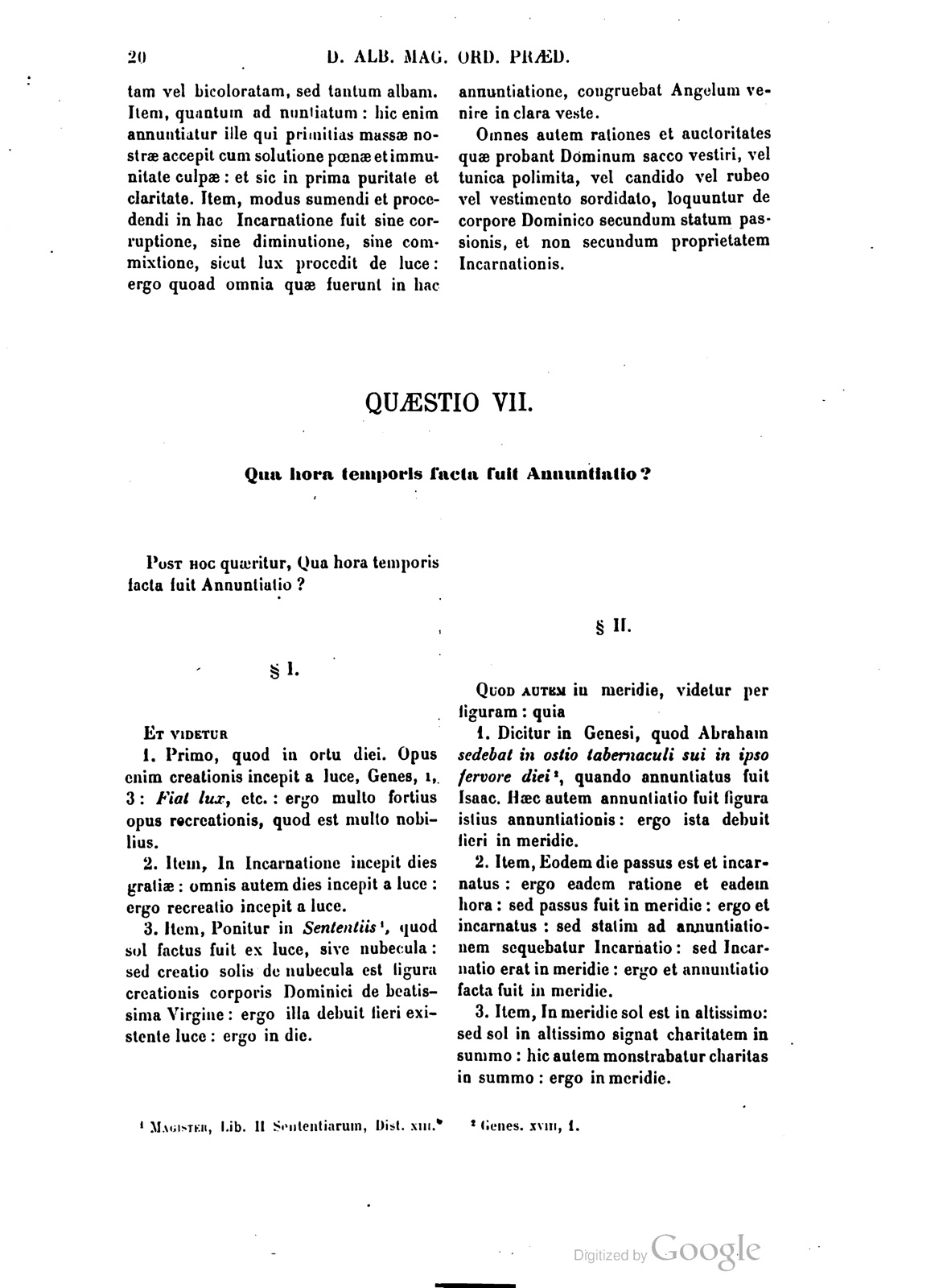
Question VII. At what hour of time was the Annunciation made?
A marker with ≈ is an approximate page boundary, placed by measure of the text; the page photographs remain the authority. In the paired views, clicking a page marker brings that page into view.
Quaestio VII. Qua hora temporis facta fuit Annuntiatio?
Post hoc quaeritur, Qua hora temporis facta fuit Annuntiatio?
§ I. Et videtur 1. Primo, quod in ortu diei. Opus enim creationis incepit a luce, Genes. I, 3: Fiat lux, etc.: ergo multo fortius opus recreationis, quod est multo nobilius. 2. Item, In Incarnatione incepit dies gratiae: omnis autem dies incepit a luce: ergo recreatio incepit a luce. 3. Item, Ponitur in Sententiis 1, quod sol factus fuit ex luce, sive nubecula: sed creatio solis de nubecula est figura creationis corporis Dominici de beatissima Virgine: ergo illa debuit fieri existente luce: ergo in die.
§ II. Quod autem in meridie, videtur per figuram: quia 1. Dicitur in Genesi 2, quod Abraham sedebat in ostio tabernaculi sui in ipso fervore diei, quando annuntiatus fuit Isaac. Haec autem annuntiatio fuit figura istius annuntiationis: ergo ista debuit fieri in meridie. 2. Item, Eodem die passus est et incarnatus: ergo eadem ratione et eadem hora: sed passus fuit in meridie: ergo et incarnatus: sed statim ad annuntiationem sequebatur Incarnatio: sed Incarnatio erat in meridie: ergo et annuntiatio facta fuit in meridie. 3. Item, In meridie sol est in altissimo: sed sol in altissimo signat charitatem in summo: hic autem monstrabatur charitas in summo: ergo in meridie. 4. Item, Joannes fuit annuntiatus in meridie, qui gessit officium luciferi: ergo multo fortius Christus qui fuit verus sol. 5. Item, Maria Magdalena venit ad monumentum, cum adhuc tenebrae essent 3. Glossa: «Dicitur Maria venire in tenebris, quia adhuc in infidelitate fuit, cum ad Angelos venit»: ergo per oppositum, Angelus ad illam venire debuit in luce, quia Maria fide et dilectione plena fuit.
Question VII. At what hour of time was the Annunciation made?
After this it is asked: at what hour of time was the Annunciation made?
§ I. And it seems, 1. First, that it was at daybreak. For the work of creation began from light, Genesis I, 3: Let there be light, etc.; therefore much more strongly the work of recreation, which is much nobler. 2. Likewise, in the Incarnation the day of grace began; but every day begins from light; therefore recreation began from light. 3. Likewise, it is set down in the Sentences 1 that the sun was made from light, or from a little cloud; but the creation of the sun from a little cloud is a figure of the creation of the Lord's body from the most blessed Virgin; therefore that ought to have been done when light existed; therefore in the day.
§ II. But that it was at midday seems through a figure, because 1. It is said in Genesis 2 that Abraham was sitting at the door of his tabernacle in the very heat of the day when Isaac was announced. But that announcing was a figure of this announcing; therefore this one ought to have been made at midday. 2. Likewise, on the same day he suffered and was incarnate; therefore by the same reasoning and at the same hour. But he suffered at midday; therefore also he was incarnate. But the Incarnation immediately followed the announcing; but the Incarnation was at midday; therefore the announcing too was made at midday. 3. Likewise, at midday the sun is at its highest; but the sun at its highest signifies charity in the highest degree; but here charity was shown in the highest degree; therefore at midday. 4. Likewise, John was announced at midday, who bore the office of the morning star; therefore much more Christ, who was the true sun. 5. Likewise, Mary Magdalene came to the tomb while it was still dark 3. The Gloss says: "Mary is said to come in darkness because she was still in unbelief when she came to the Angels." Therefore by the opposite, the Angel ought to have come to Mary in light, because Mary was full of faith and love.
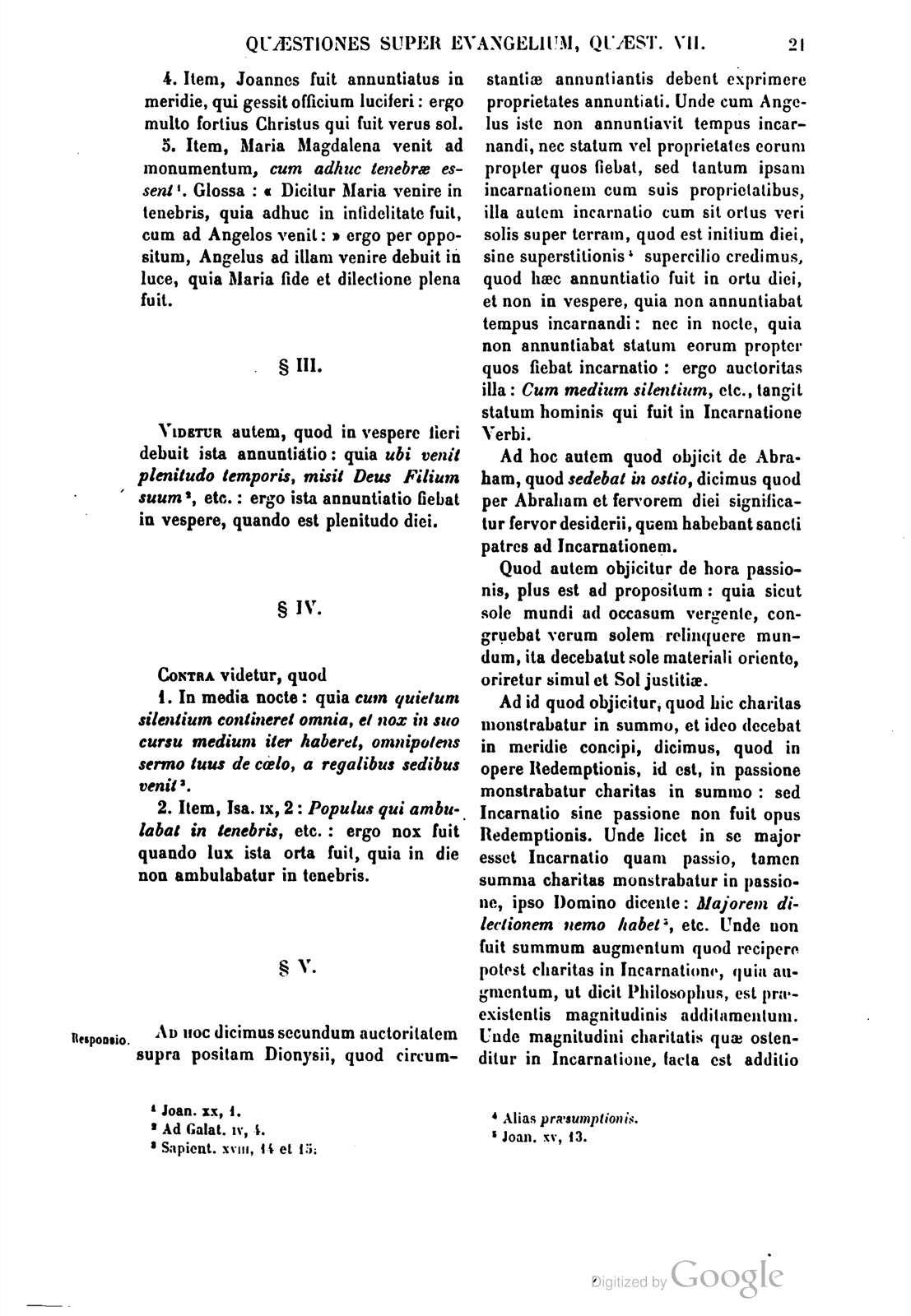
§ III. Videtur autem, quod in vespere fieri debuit ista annuntiatio: quia ubi venit plenitudo temporis, misit Deus Filium suum 4, etc.: ergo ista annuntiatio fiebat in vespere, quando est plenitudo diei.
§ IV. Contra videtur, quod 1. In media nocte: quia cum quietum silentium contineret omnia, et nox in suo cursu medium iter haberet, omnipotens sermo tuus de caelo, a regalibus sedibus venit 5. 2. Item, Isa. IX, 2: Populus qui ambulabat in tenebris, etc.: ergo nox fuit quando lux ista orta fuit, quia in die non ambulabatur in tenebris.
§ V. Responsio. Ad hoc dicimus secundum auctoritatem supra positam Dionysii, quod circumstantiae annuntiantis debent exprimere proprietates annuntiati. Unde cum Angelus iste non annuntiavit tempus incarnandi, nec statum vel proprietates eorum propter quos fiebat, sed tantum ipsam incarnationem cum suis proprietatibus, illa autem incarnatio cum sit ortus veri solis super terram, quod est initium diei, sine superstitionis supercilio credimus, quod haec annuntiatio fuit in ortu diei, et non in vespere, quia non annuntiabat tempus incarnandi: nec in nocte, quia non annuntiabat statum eorum propter quos fiebat incarnatio: ergo auctoritas illa: Cum medium silentium, etc., tangit statum hominis qui fuit in Incarnatione Verbi.
§ III. But it seems that this announcing ought to have been made in the evening, because when the fullness of time came, God sent his Son 4, etc.; therefore that announcing was made in the evening, when the fullness of the day is present.
§ IV. On the contrary, it seems that 1. It was in the middle of the night, because when quiet silence held all things and night in its course held the middle path, your almighty Word came from heaven, from royal seats 5. 2. Likewise, Isaiah IX, 2: The people who walked in darkness, etc.; therefore it was night when that light rose, because in the day one did not walk in darkness.
§ V. Response. To this we say, according to the authority of Dionysius set down above, that the circumstances of the announcer ought to express the properties of the one announced. Hence, since this Angel did not announce the time of becoming incarnate, nor the state or properties of those for whose sake it was done, but only the incarnation itself with its properties, and since that incarnation is the rising of the true sun over the earth, which is the beginning of day, we believe, without the haughty brow of superstition, that this announcing was at daybreak and not in the evening, because he was not announcing the time of becoming incarnate; nor in the night, because he was not announcing the state of those for whose sake the incarnation was made. Therefore that authority, When middle silence, etc., touches the state of the human being who was in the Incarnation of the Word.
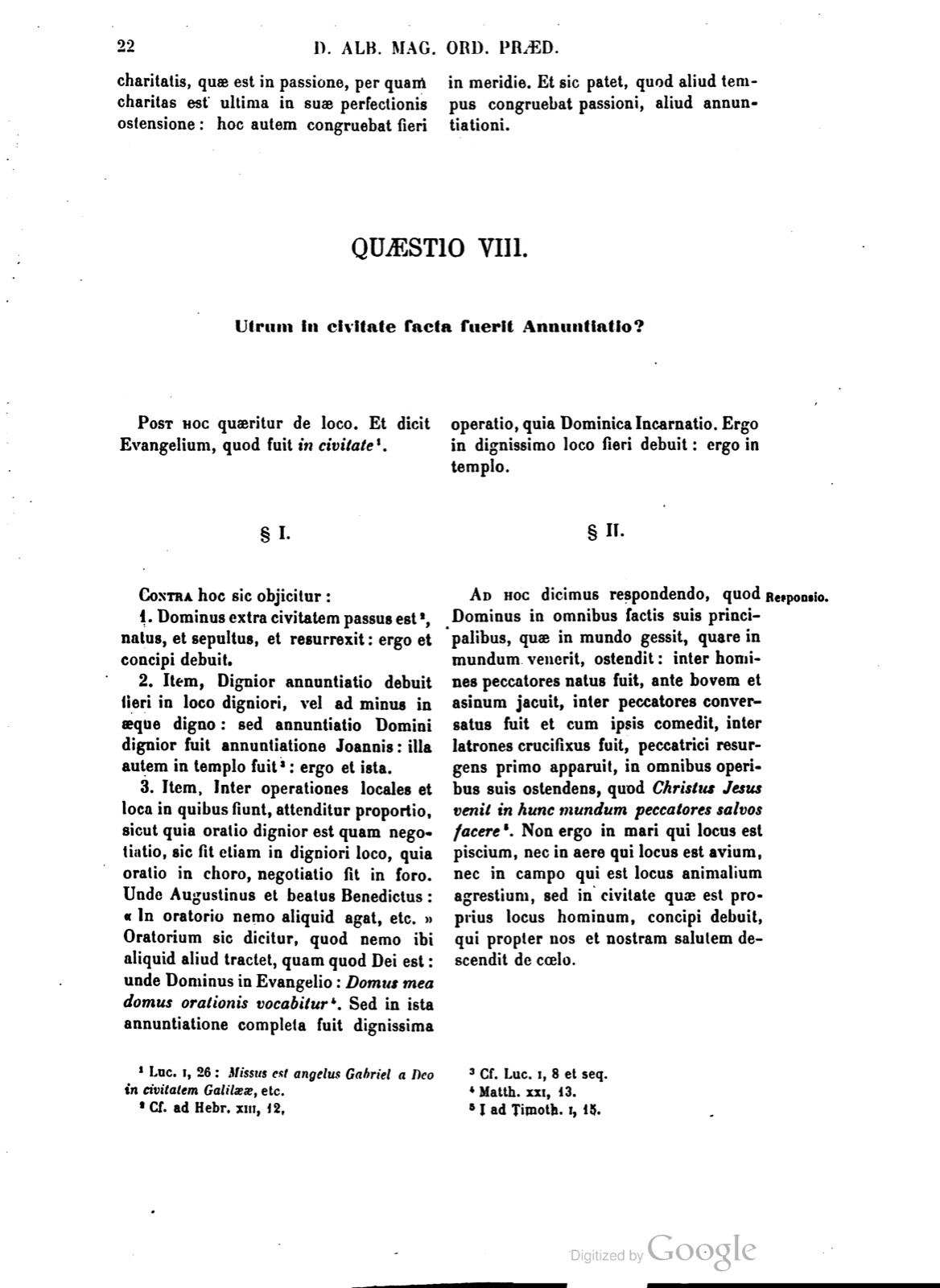
Ad hoc autem quod objicit de Abraham, quod sedebat in ostio, dicimus quod per Abraham et fervorem diei significatur fervor desiderii, quem habebant sancti patres ad Incarnationem. Quod autem objicitur de hora passionis, plus est ad propositum: quia sicut sole mundi ad occasum vergente, congruebat verum solem relinquere mundum, ita decebat ut sole materiali oriente, oriretur simul et Sol justitiae. Ad id quod objicitur, quod hic charitas monstrabatur in summo, et ideo decebat in meridie concipi, dicimus, quod in opere Redemptionis, id est, in passione monstrabatur charitas in summo: sed Incarnatio sine passione non fuit opus Redemptionis. Unde licet in se major esset Incarnatio quam passio, tamen summa charitas monstrabatur in passione, ipso Domino dicente: Majorem dilectionem nemo habet 6, etc. Unde non fuit summum augmentum quod recipere potest charitas in Incarnatione, quia augmentum, ut dicit Philosophus, est praeexistentis magnitudinis additamentum. Unde magnitudini charitatis quae ostenditur in Incarnatione, facta est additio charitatis, quae est in passione, per quam charitas est ultima in suae perfectionis ostensione: hoc autem congruebat fieri in meridie. Et sic patet, quod aliud tempus congruebat passioni, aliud annuntiationi.
But as to what is objected about Abraham, that he was sitting at the door, we say that through Abraham and the heat of the day is signified the fervor of desire which the holy fathers had for the Incarnation. What is objected about the hour of the Passion is more to the point, because just as, when the sun of the world was inclining to setting, it was fitting for the true sun to leave the world, so it was fitting that, when the material sun was rising, the Sun of justice should rise at the same time. To that which is objected, that charity was shown here in the highest degree and therefore it was fitting to be conceived at midday, we say that in the work of Redemption, that is, in the Passion, charity was shown in the highest degree; but the Incarnation without the Passion was not the work of Redemption. Hence, although the Incarnation in itself was greater than the Passion, nevertheless the highest charity was shown in the Passion, the Lord himself saying: Greater love no one has 6, etc. Hence in the Incarnation there was not the highest increase that charity can receive, because increase, as the Philosopher says, is an addition to a pre-existing magnitude. Hence to the magnitude of charity that is shown in the Incarnation there was made an addition of charity, which is in the Passion, through which charity is ultimate in the manifestation of its perfection; but this fittingly happened at midday. And thus it is clear that one time was fitting for the Passion, another for the announcing.
If a page does not appear, its photograph has not been uploaded yet.