Works › The Mariale: Questions on “Missus est”
Volume 37 · pp. 18–20
Question VI. In what garment did the Angel appear?
A marker with ≈ is an approximate page boundary, placed by measure of the text; the page photographs remain the authority. In the paired views, clicking a page marker brings that page into view.
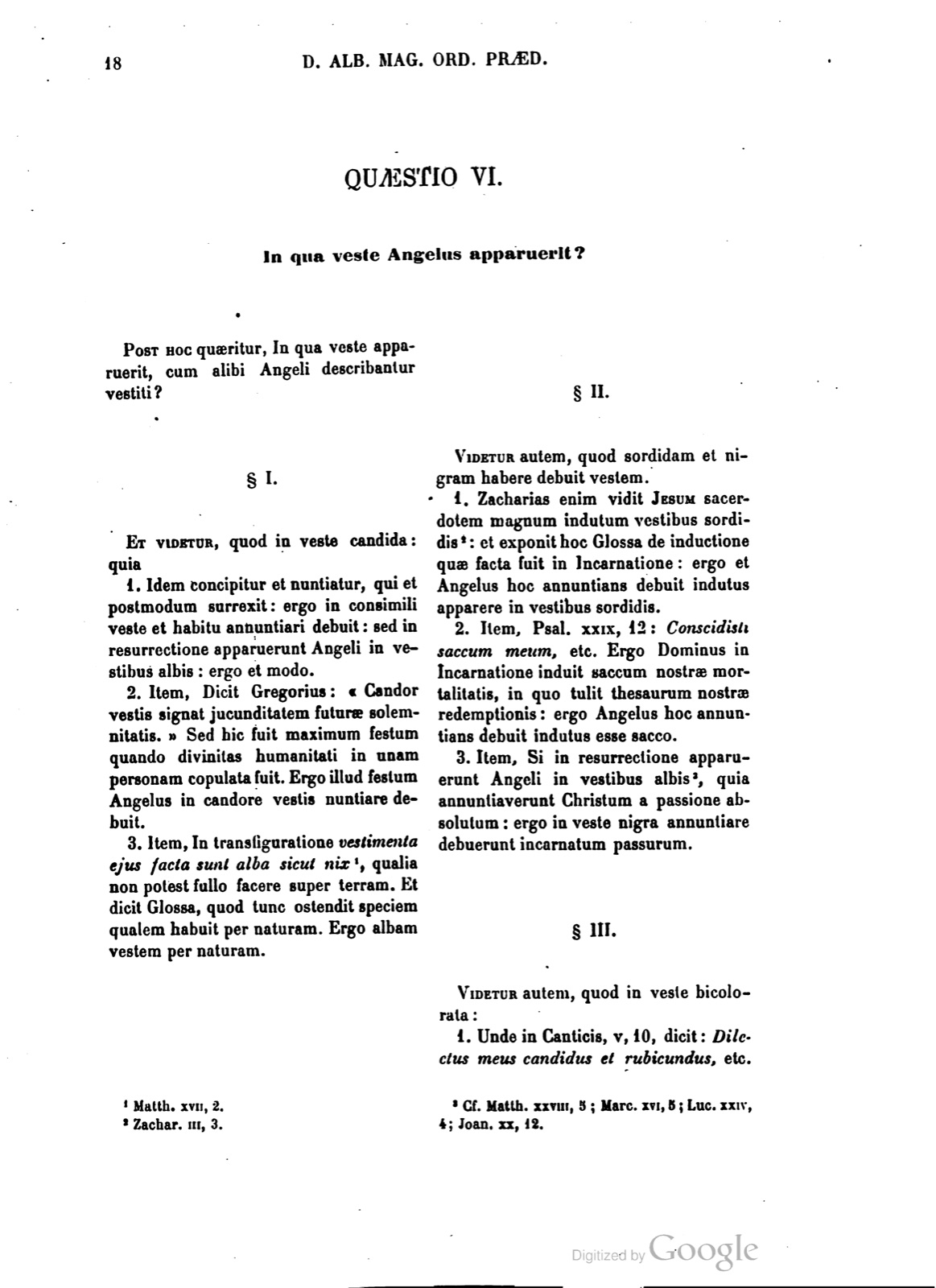
Quaestio VI. In qua veste Angelus apparuerit?
Post hoc quaeritur, In qua veste apparuerit, cum alibi Angeli describantur vestiti?
§ I. Et videtur, quod in veste candida: quia 1. Idem concipitur et nuntiatur, qui et postmodum surrexit: ergo in consimili veste et habitu annuntiari debuit: sed in resurrectione apparuerunt Angeli in vestibus albis: ergo et modo. 2. Item, Dicit Gregorius: «Candor vestis signat jucunditatem futurae solemnitatis.» Sed hic fuit maximum festum quando divinitas humanitati in unam personam copulata fuit. Ergo illud festum Angelus in candore vestis nuntiare debuit. 3. Item, In transfiguratione vestimenta ejus facta sunt alba sicut nix 1, qualia non potest fullo facere super terram. Et dicit Glossa, quod tunc ostendit speciem qualem habuit per naturam. Ergo albam vestem per naturam.
§ II. Videtur autem, quod sordidam et nigram habere debuit vestem. 1. Zacharias enim vidit Jesum sacerdotem magnum indutum vestibus sordidis 2: et exponit hoc Glossa de inductione quae facta fuit in Incarnatione: ergo et Angelus hoc annuntians debuit indutus apparere in vestibus sordidis. 2. Item, Psal. XXIX, 12: Conscidisti saccum meum, etc. Ergo Dominus in Incarnatione induit saccum nostrae mortalitatis, in quo tulit thesaurum nostrae redemptionis: ergo Angelus hoc annuntians debuit indutus esse sacco. 3. Item, Si in resurrectione apparuerunt Angeli in vestibus albis 3, quia annuntiaverunt Christum a passione absolutum: ergo in veste nigra annuntiare debuerunt incarnatum passurum.
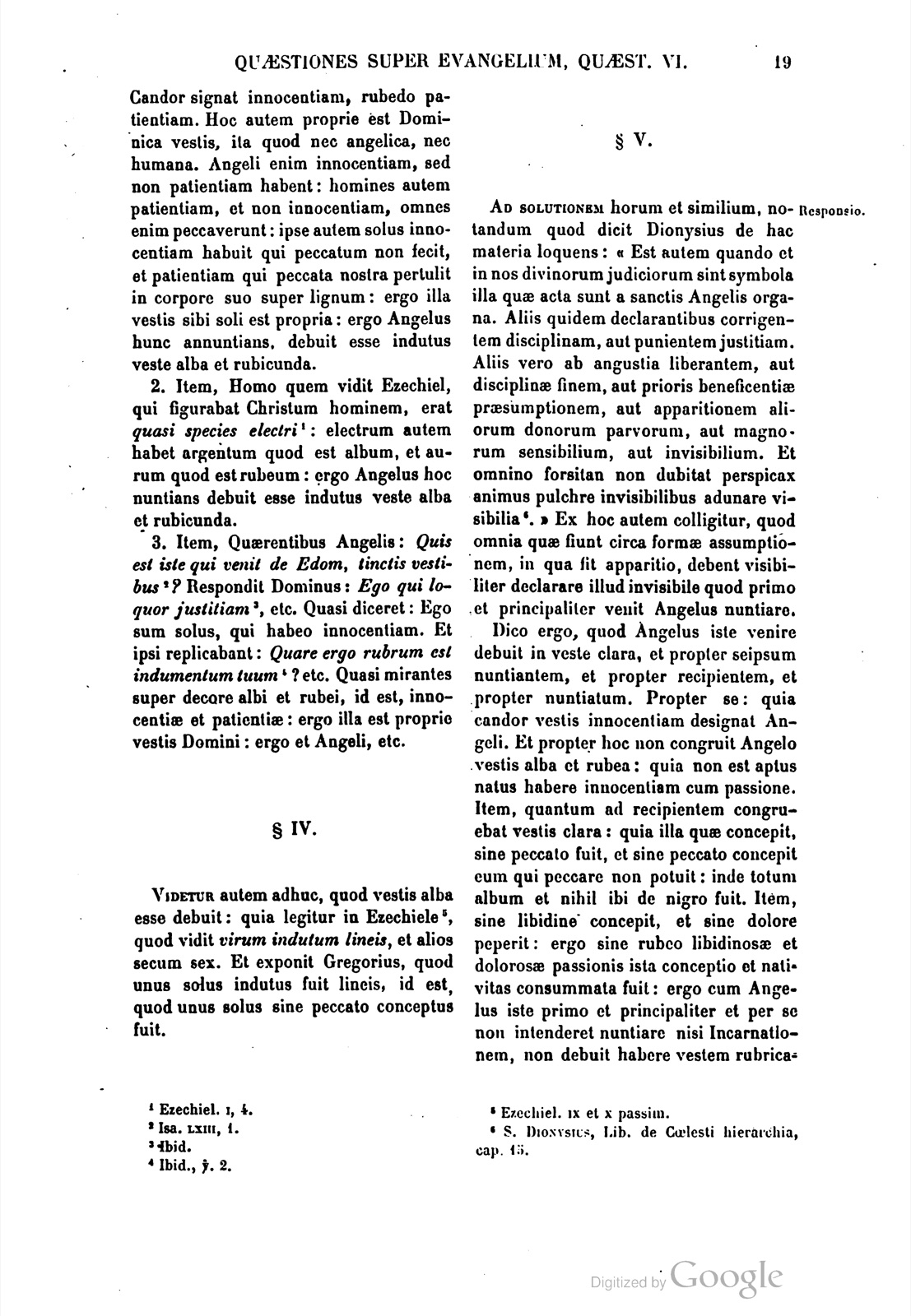
§ III. Videtur autem, quod in veste bicolorata: 1. Unde in Canticis, V, 10, dicit: Dilectus meus candidus et rubicundus, etc. Candor signat innocentiam, rubedo patientiam. Hoc autem proprie est Dominica vestis, ita quod nec angelica, nec humana. Angeli enim innocentiam, sed non patientiam habent: homines autem patientiam, et non innocentiam, omnes enim peccaverunt: ipse autem solus innocentiam habuit qui peccatum non fecit, et patientiam qui peccata nostra pertulit in corpore suo super lignum: ergo illa vestis sibi soli est propria: ergo Angelus hunc annuntians, debuit esse indutus veste alba et rubicunda. 2. Item, Homo quem vidit Ezechiel, qui figurabat Christum hominem, erat quasi species electri 4: electrum autem habet argentum quod est album, et aurum quod est rubeum: ergo Angelus hoc nuntians debuit esse indutus veste alba et rubicunda. 3. Item, Quaerentibus Angelis: Quis est iste qui venit de Edom, tinctis vestibus 5? Respondit Dominus: Ego qui loquor justitiam 6, etc. Quasi diceret: Ego sum solus, qui habeo innocentiam. Et ipsi replicabant: Quare ergo rubrum est indumentum tuum 7? etc. Quasi mirantes super decore albi et rubei, id est, innocentiae et patientiae: ergo illa est proprie vestis Domini: ergo et Angeli, etc.
Question VI. In what garment did the Angel appear?
After this it is asked: in what garment did he appear, since elsewhere Angels are described as clothed?
§ I. And it seems that in a white garment, because 1. The same one is conceived and announced who also later rose; therefore he ought to have been announced in a similar garment and habit. But in the resurrection Angels appeared in white garments; therefore also now. 2. Likewise, Gregory says: "The whiteness of the garment signifies the joy of the future solemnity." But here was the greatest feast, when divinity was joined to humanity in one person. Therefore the Angel ought to have announced that feast in the whiteness of a garment. 3. Likewise, in the transfiguration his garments were made white as snow 1, such as a fuller cannot make on earth. And the Gloss says that then he showed the appearance that he had by nature. Therefore a white garment by nature.
§ II. But it seems that he ought to have had a filthy and black garment. 1. For Zechariah saw Jesus the high priest clothed in filthy garments 2, and the Gloss explains this of the putting-on that was made in the Incarnation; therefore also the Angel announcing this ought to have appeared clothed in filthy garments. 2. Likewise, Psalm XXIX, 12: You have torn my sackcloth, etc. Therefore the Lord in the Incarnation put on the sackcloth of our mortality, in which he carried the treasure of our redemption; therefore the Angel announcing this ought to have been clothed in sackcloth. 3. Likewise, if in the resurrection Angels appeared in white garments 3 because they announced Christ released from the Passion, then they ought to have announced in a black garment the incarnate one who would suffer.
§ III. But it seems that in a two-colored garment. 1. Hence in Canticles V, 10, it says: My beloved is white and ruddy, etc. Whiteness signifies innocence, redness patience. But this is properly the Lord's garment, so that it is neither angelic nor human. For Angels have innocence but not patience; human beings have patience but not innocence, for all have sinned; but he alone had innocence who did not commit sin, and patience who bore our sins in his body upon the wood. Therefore that garment is proper to him alone; therefore the Angel announcing him ought to have been clothed in a white and ruddy garment. 2. Likewise, the man whom Ezekiel saw, who figured Christ as man, was like the appearance of electrum 4; but electrum has silver, which is white, and gold, which is red; therefore the Angel announcing this ought to have been clothed in a white and ruddy garment. 3. Likewise, when the Angels asked: Who is this who comes from Edom, with dyed garments 5? the Lord answered: I who speak justice 6, etc., as if he were saying: I alone am he who has innocence. And they replied: Why then is your clothing red 7? etc., as if wondering over the beauty of white and red, that is, of innocence and patience. Therefore that is properly the garment of the Lord; therefore also of the Angel, etc.
§ IV. Videtur autem adhuc, quod vestis alba esse debuit: quia legitur in Ezechiele 8, quod vidit virum indutum lineis, et alios secum sex. Et exponit Gregorius, quod unus solus indutus fuit lineis, id est, quod unus solus sine peccato conceptus fuit.
§ V. Responsio. Ad solutionem horum et similium, notandum quod dicit Dionysius de hac materia loquens: «Est autem quando et innos divinorum judiciorum sint symbola illa quae acta sunt a sanctis Angelis organa. Aliis quidem declarantibus corrigentem disciplinam, aut punientem justitiam. Aliis vero ab angustia liberantem, aut disciplinae finem, aut prioris beneficentiae praesumptionem, aut apparitionem aliorum donorum parvorum, aut magnorum sensibilium, aut invisibilium. Et omnino forsitan non dubitat perspicax animus pulchre invisibilibus adunare visibilia 9.» Ex hoc autem colligitur, quod omnia quae fiunt circa formae assumptionem, in qua fit apparitio, debent visibiliter declarare illud invisibile quod primo et principaliter venit Angelus nuntiare.
§ IV. But it still seems that the garment ought to have been white, because it is read in Ezekiel 8 that he saw a man clothed in linen and six others with him. And Gregory explains that one alone was clothed in linen, that is, that one alone was conceived without sin.
§ V. Response. For the solution of these and similar things, one must note what Dionysius says when speaking about this matter: "It happens also that those things which have been done by the holy Angels as instruments are symbols of divine judgments. Some declare corrective discipline or punishing justice. Others declare liberation from distress, or the end of discipline, or the presumption of an earlier beneficence, or the appearance of other gifts, small or great, sensible or invisible. And altogether perhaps the discerning mind does not doubt beautifully to unite visible things to invisible things 9." From this it is gathered that all things which are done around the assumption of the form in which the apparition is made ought visibly to declare that invisible thing which the Angel came first and principally to announce.
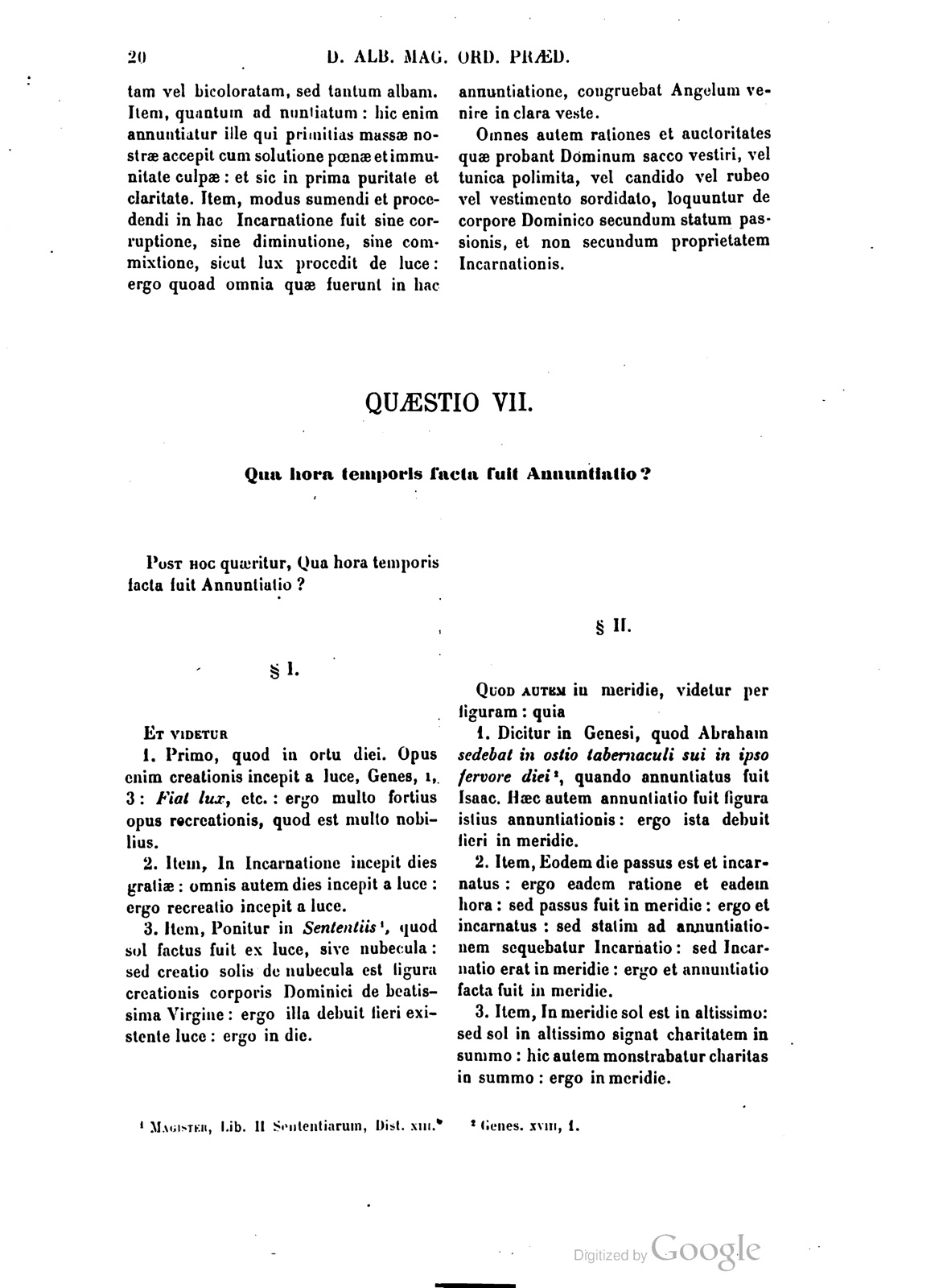
Dico ergo, quod Angelus iste venire debuit in veste clara, et propter seipsum nuntiantem, et propter recipientem, et propter nuntiatum. Propter se: quia candor vestis innocentiam designat Angeli. Et propter hoc non congruit Angelo vestis alba et rubea: quia non est aptus natus habere innocentiam cum passione. Item, quantum ad recipientem congruebat vestis clara: quia illa quae concepit, sine peccato fuit, et sine peccato concepit eum qui peccare non potuit: inde totum album et nihil ibi de nigro fuit. Item, sine libidine concepit, et sine dolore peperit: ergo sine rubeo libidinosae et dolorosae passionis ista conceptio et nativitas consummata fuit: ergo cum Angelus iste primo et principaliter et per se non intenderet nuntiare nisi Incarnationem, non debuit habere vestem rubricatam vel bicoloratam, sed tantum albam. Item, quantum ad nuntiatum: hic enim annuntiatur ille qui primitias massae nostrae accepit cum solutione poenae et immunitate culpae: et sic in prima puritate et claritate. Item, modus sumendi et procedendi in hac Incarnatione fuit sine corruptione, sine diminutione, sine commixtione, sicut lux procedit de luce: ergo quoad omnia quae fuerunt in hac annuntiatione, congruebat Angelum venire in clara veste. Omnes autem rationes et auctoritates quae probant Dominum sacco vestiri, vel tunica polimita, vel candido vel rubeo vel vestimento sordidato, loquuntur de corpore Dominico secundum statum passionis, et non secundum proprietatem Incarnationis.
Therefore I say that this Angel ought to have come in a bright garment, both on account of himself announcing, and on account of the receiver, and on account of the one announced. On account of himself, because the whiteness of the garment designates the innocence of the Angel. And for this reason a white and red garment does not fit the Angel, because he is not apt by nature to have innocence with suffering. Likewise, as to the receiver, a bright garment was fitting because she who conceived was without sin, and without sin conceived him who could not sin; therefore all was white and nothing there was black. Likewise, she conceived without lust and gave birth without pain; therefore this conception and nativity were consummated without the red of lustful and painful passion. Therefore since this Angel first and principally and through himself did not intend to announce anything except the Incarnation, he ought not to have had a red or two-colored garment, but only a white one. Likewise, as to the one announced: here he is announced who received the first-fruits of our mass with release from punishment and immunity from fault, and thus in first purity and brightness. Likewise, the mode of taking and proceeding in this Incarnation was without corruption, without diminution, without commixture, as light proceeds from light; therefore with respect to all things that were in this announcing, it was fitting for the Angel to come in a bright garment. But all the reasons and authorities which prove that the Lord was clothed in sackcloth, or a many-colored tunic, or in white or red or a stained garment, speak of the Lord's body according to the state of the Passion and not according to the property of the Incarnation.
Notes
- Matthew 17:2. (Matth. XVII, 2.) ↩
- Zechariah 3:3. (Zachar. III, 3.) ↩
- Compare Matthew 28:5; Mark 16:5; Luke 24:4; John 20:12. (Cf. Matth. XXVIII, 5; Marc. XVI, 5; Luc. XXIV, 4; Joan. XX, 12.) ↩
- Ezekiel 1:4. (Ezechiel. I, 4.) ↩
- Isaiah 63:1. (Isa. LXIII, 1.) ↩
- Ibid. ↩
- Ibid., verse 2. (Ibid., versu 2.) ↩
- Ezekiel 9 and 10 passim. (Ezechiel. IX et X passim.) ↩
- St. Dionysius, book On the Heavenly Hierarchy, chapter 15. (S. Dionysius, Lib. de Coelesti hierarchia, cap. 15.) ↩
If a page does not appear, its photograph has not been uploaded yet.