Works › The Mariale: Questions on “Missus est”
Volume 37 · p. 17
Question V. In the appearance of what age did the Angel appear?
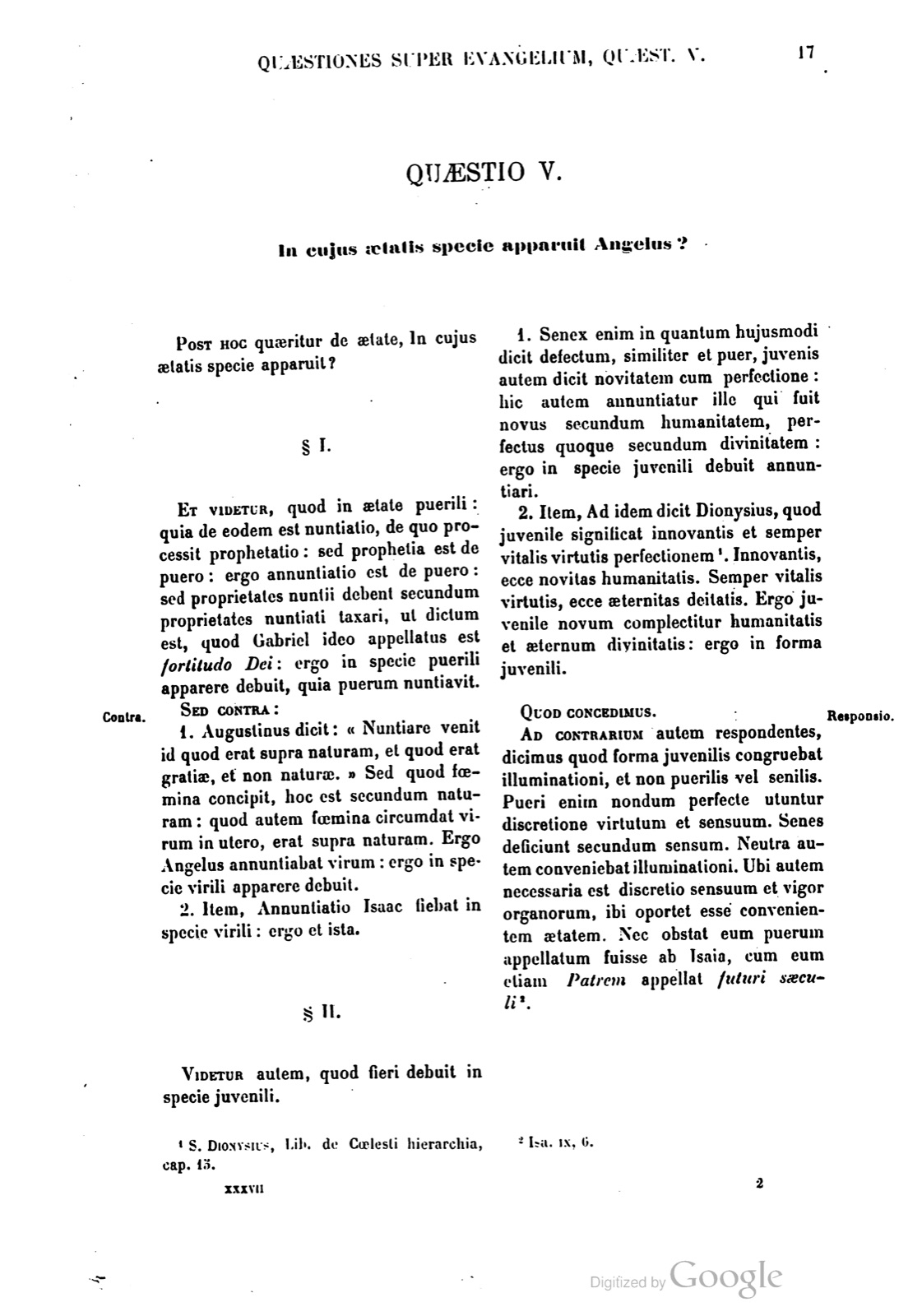
Quaestio V. In cujus aetatis specie apparuit Angelus?
Post hoc quaeritur de aetate, In cujus aetatis specie apparuit?
§ I. Et videtur, quod in aetate puerili: quia de eodem est nuntiatio, de quo processit prophetatio: sed prophetia est de puero: ergo annuntiatio est de puero: sed proprietates nuntii debent secundum proprietates nuntiati taxari, ut dictum est, quod Gabriel ideo appellatus est fortitudo Dei: ergo in specie puerili apparere debuit, quia puerum nuntiavit.
Sed contra: 1. Augustinus dicit: «Nuntiare venit id quod erat supra naturam, et quod erat gratiae, et non naturae.» Sed quod femina concipit, hoc est secundum naturam: quod autem femina circumdat virum in utero, erat supra naturam. Ergo Angelus annuntiabat virum: ergo in specie virili apparere debuit. 2. Item, Annuntiatio Isaac fiebat in specie virili: ergo et ista.
§ II. Videtur autem, quod fieri debuit in specie juvenili. 1. Senex enim in quantum hujusmodi dicit defectum, similiter et puer, juvenis autem dicit novitatem cum perfectione: hic autem annuntiatur ille qui fuit novus secundum humanitatem, perfectus quoque secundum divinitatem: ergo in specie juvenili debuit annuntiari. 2. Item, Ad idem dicit Dionysius, quod juvenile significat innovantis et semper vitalis virtutis perfectionem 1. Innovantis, ecce novitas humanitatis. Semper vitalis virtutis, ecce aeternitas deitatis. Ergo juvenile novum complectitur humanitatis et aeternum divinitatis: ergo in forma juvenili. Quod concedimus. Responsio. Ad contrarium autem respondentes, dicimus quod forma juvenilis congruebat illuminationi, et non puerilis vel senilis. Pueri enim nondum perfecte utuntur discretione virtutum et sensuum. Senes deficiunt secundum sensum. Neutra autem conveniebat illuminationi. Ubi autem necessaria est discretio sensuum et vigor organorum, ibi oportet esse convenientem aetatem. Nec obstat eum puerum appellatum fuisse ab Isaia, cum eum etiam Patrem appellat futuri saeculi 2.
Question V. In the appearance of what age did the Angel appear?
After this inquiry is made about age: in the appearance of what age did he appear?
§ I. And it seems that in boyish age, because the announcing is about the same one about whom prophecy proceeded; but the prophecy is about a boy; therefore the announcing is about a boy. But the properties of the messenger ought to be assessed according to the properties of the one announced, as it was said that Gabriel was therefore called the strength of God; therefore he ought to have appeared in boyish appearance, because he announced a boy.
But on the contrary: 1. Augustine says: "He came to announce that which was above nature, and which belonged to grace, not to nature." But that a woman conceives is according to nature; but that a woman surrounds a man in the womb was above nature. Therefore the Angel was announcing a man; therefore he ought to have appeared in manly appearance. 2. Likewise, the announcing of Isaac was made in manly appearance; therefore also this one.
§ II. But it seems that it ought to have been done in youthful appearance. 1. For an old man as such indicates defect, and similarly a boy; but a youth indicates newness with perfection. Here, however, he is announced who was new according to humanity and also perfect according to divinity; therefore he ought to have been announced in youthful appearance. 2. Likewise, Dionysius says to the same point that youthful signifies the perfection of innovating and always vital power 1. Of innovating: behold the newness of humanity. Of always vital power: behold the eternity of deity. Therefore the youthful embraces the new thing of humanity and the eternal thing of divinity; therefore in youthful form. This we concede. Response. In responding to the contrary, we say that youthful form was fitting for illumination, and not boyish or senile form. For boys do not yet perfectly use the discretion of virtues and senses. Old men are defective according to sense. Neither was fitting for illumination. But where discretion of the senses and vigor of the organs are necessary, there a fitting age must be present. Nor does it stand in the way that he was called a boy by Isaiah, since he also calls him Father of the future age 2.
If a page does not appear, its photograph has not been uploaded yet.