Works › The Mariale: Questions on “Missus est”
Volume 37 · pp. 15–16
Questions III-IV
A marker with ≈ is an approximate page boundary, placed by measure of the text; the page photographs remain the authority. In the paired views, clicking a page marker brings that page into view.
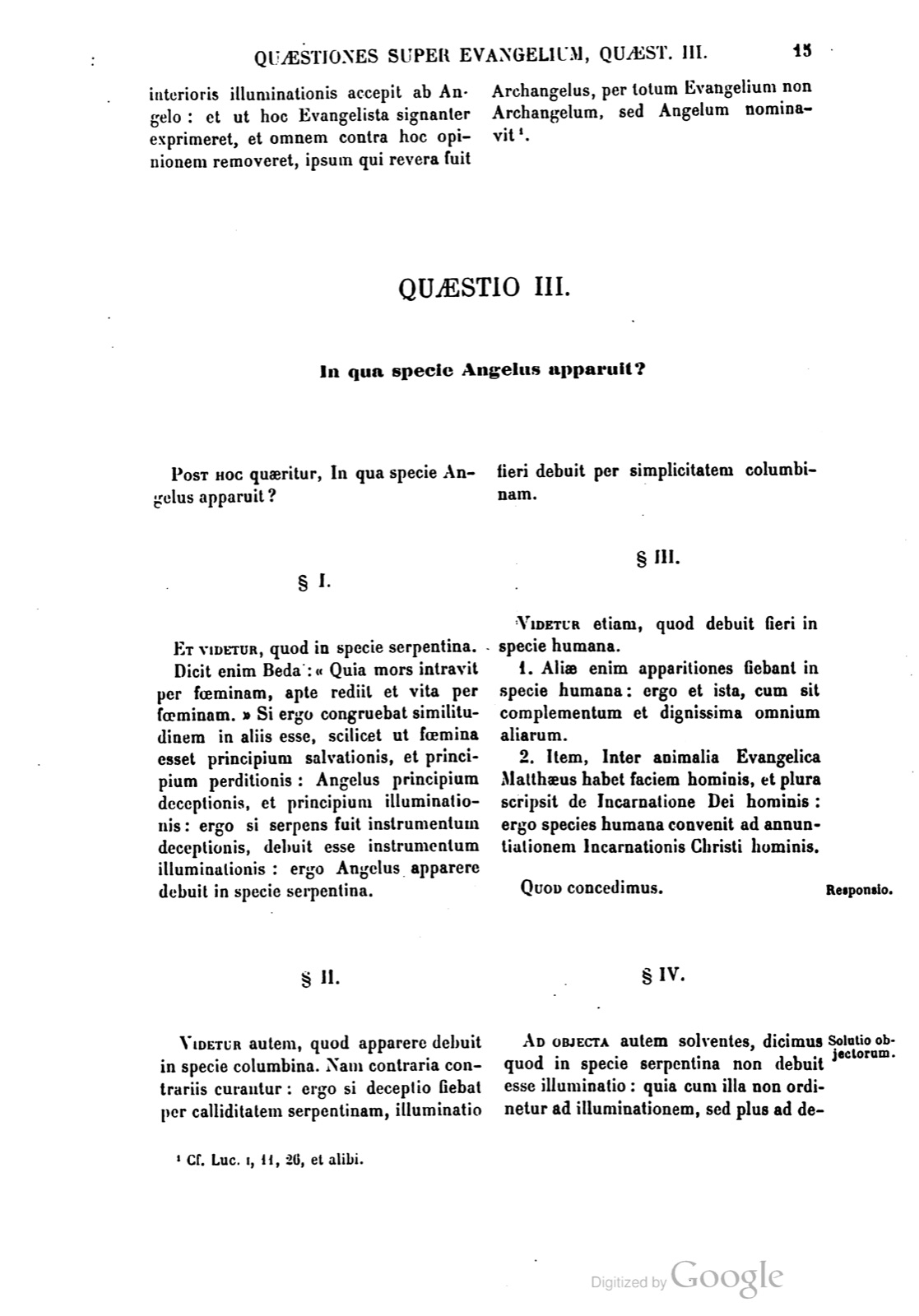
Quaestio III. In qua specie Angelus apparuit?
Post hoc quaeritur, In qua specie Angelus apparuit?
§ I. Et videtur, quod in specie serpentina. Dicit enim Beda 1: «Quia mors intravit per feminam, apte rediit et vita per feminam.» Si ergo congruebat similitudinem in aliis esse, scilicet ut femina esset principium salvationis, et principium perditionis; Angelus principium deceptionis, et principium illuminationis: ergo si serpens fuit instrumentum deceptionis, debuit esse instrumentum illuminationis: ergo Angelus apparere debuit in specie serpentina.
§ II. Videtur autem, quod apparere debuit in specie columbina. Nam contraria contrariis curantur: ergo si deceptio fiebat per calliditatem serpentinam, illuminatio fieri debuit per simplicitatem columbinam.
§ III. Videtur etiam, quod debuit fieri in specie humana. 1. Aliae enim apparitiones fiebant in specie humana: ergo et ista, cum sit complementum et dignissima omnium aliarum. 2. Item, Inter animalia Evangelica Matthaeus habet faciem hominis, et plura scripsit de Incarnatione Dei hominis: ergo species humana convenit ad annuntiationem Incarnationis Christi hominis. Quod concedimus.
§ IV. Solutio objectorum. Ad objecta autem solventes, dicimus quod in specie serpentina non debuit esse illuminatio: quia cum illa non ordinetur ad illuminationem, sed plus ad deceptionem, cum in deceptione species serpentina congruerit et persuasioni congruissima esset: quia, ut dicit Magister in Sententiis 2, venit ad hominem in serpente, qui forte si permitteretur, in columbae specie venire maluisset. Et infra: «Non ergo nisi per serpentem tentare permissus fuit diabolus, ut per illud quod foris erat, astutiam tentantis animadvertere femina quiret.» Unde Augustinus: «Non est putandum, quod diabolus serpentem per quem tentaret elegerit, sed cum decipere cuperet, non potuit, nisi per quod animal posse permissus est 3.» Unde accidit, quod serpens fuit instrumentum deceptionis: non ergo esse debuit instrumentum illuminationis. Item, In specie columbae venire non debuit. Beatissima enim Virgo sensibiliter ab Angelo illuminari debuit: illuminatio autem sensitiva ad cognitionem fit mediante locutione: ergo medium illuminationis debuit esse locutivum: sed nullum sensitivum est locutivum nisi solus homo: ergo debuit fieri in specie humana, ut sicut nobilissimum intellectivum erat quod illuminabat eam interius, utputa Deus: sic etiam nobilissimum esset sensitivum quod illuminabat eam exterius, puta homo.
Question III. In what appearance did the Angel appear?
After this it is asked: In what appearance did the Angel appear?
§ I. And it seems that in serpentine appearance. For Bede says 1: "Because death entered through a woman, fittingly life also returned through a woman." Therefore if it was fitting that likeness be present in the other things, namely that a woman should be the beginning of salvation and the beginning of perdition, and an Angel the beginning of deception and the beginning of illumination, then if the serpent was the instrument of deception, it ought to have been the instrument of illumination; therefore the Angel ought to have appeared in serpentine appearance.
§ II. But it seems that he ought to have appeared in dove-like appearance. For contraries are cured by contraries; therefore if deception was made through serpentine cunning, illumination ought to have been made through dove-like simplicity.
§ III. It also seems that it ought to have been done in human appearance. 1. For the other apparitions were made in human appearance; therefore also this one, since it is the complement and the most worthy of all the others. 2. Likewise, among the Evangelical animals Matthew has the face of a man, and he wrote more things about the Incarnation of God as man; therefore human appearance is fitting for the announcing of the Incarnation of Christ as man. This we concede.
§ IV. Solution of the objections. In solving the objections we say that illumination ought not to have been in serpentine appearance, because that appearance is not ordered to illumination but rather to deception, since in deception the serpentine appearance was fitting and was most fitting for persuasion. For, as the Master says in the Sentences 2, he came to the human being in a serpent, who perhaps, if he had been permitted, would have preferred to come in the appearance of a dove. And below: "Therefore the devil was permitted to tempt only through a serpent, so that through that which was outside the woman might be able to notice the craftiness of the tempter." Hence Augustine says: "It must not be thought that the devil chose the serpent through which he might tempt, but when he desired to deceive, he could not do it except through the animal through which he was permitted to be able 3." Hence it happened that the serpent was the instrument of deception; therefore it ought not to have been the instrument of illumination. Likewise, he ought not to have come in the appearance of a dove. For the most blessed Virgin ought to have been illuminated sensibly by the Angel; but sensitive illumination comes to knowledge through the mediation of speech; therefore the medium of illumination ought to have been capable of speech. But no sensitive thing is capable of speech except man alone; therefore it ought to have been done in human appearance, so that, just as the noblest intellectual being was what illuminated her inwardly, namely God, so also the noblest sensitive being should be what illuminated her outwardly, namely man.
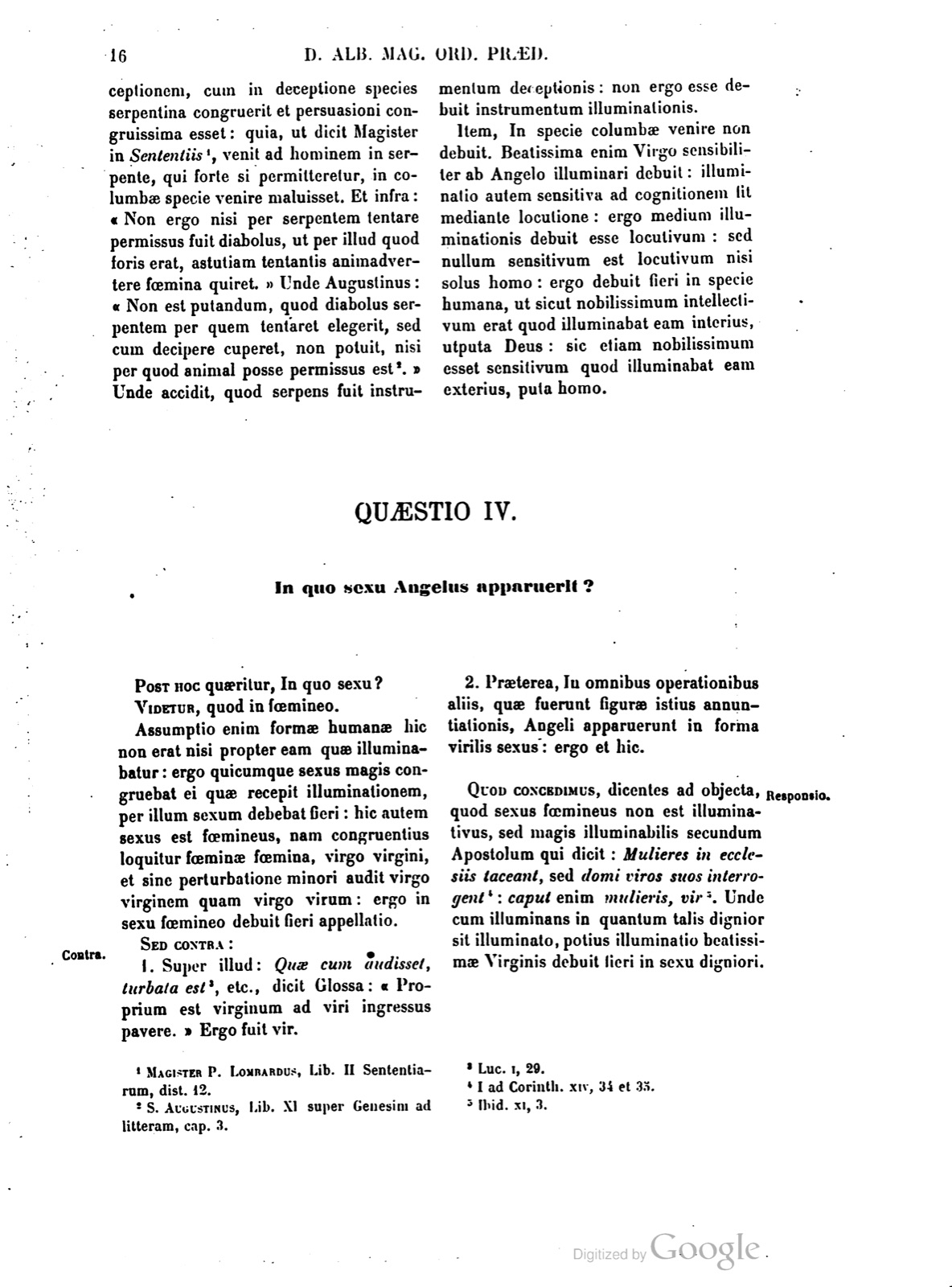
Quaestio IV. In quo sexu Angelus apparuerit?
Post hoc quaeritur, In quo sexu? Videtur, quod in femineo. Assumptio enim formae humanae hic non erat nisi propter eam quae illuminabatur: ergo quicumque sexus magis congruebat ei quae recepit illuminationem, per illum sexum debebat fieri: hic autem sexus est femineus, nam congruentius loquitur feminae femina, virgo virgini, et sine perturbatione minori audit virgo virginem quam virgo virum: ergo in sexu femineo debuit fieri appellatio.
Sed contra: 1. Super illud: Quae cum audisset, turbata est 4, etc., dicit Glossa: «Proprium est virginum ad viri ingressus pavere.» Ergo fuit vir. 2. Praeterea, In omnibus operationibus aliis, quae fuerunt figurae istius annuntiationis, Angeli apparuerunt in forma virilis sexus: ergo et hic. Quod concedimus, dicentes ad objecta, quod sexus femineus non est illuminativus, sed magis illuminabilis secundum Apostolum qui dicit: Mulieres in ecclesiis taceant, sed domi viros suos interrogent 5: caput enim mulieris, vir 6. Unde cum illuminans in quantum talis dignior sit illuminato, potius illuminatio beatissimae Virginis debuit fieri in sexu digniori.
Question IV. In what sex did the Angel appear?
After this it is asked: In what sex? It seems that in the female sex. For the assumption of human form here was only on account of her who was illuminated; therefore through whatever sex was more fitting to her who received illumination, through that sex it ought to have been done. But here the sex is female, for a woman speaks more fittingly to a woman, a virgin to a virgin, and a virgin hears a virgin with less disturbance than a virgin hears a man; therefore the address ought to have been made in the female sex.
But on the contrary: 1. On that phrase, When she had heard, she was troubled 4, etc., the Gloss says: "It is proper to virgins to fear at the entrance of a man." Therefore he was a man. 2. Furthermore, in all the other operations that were figures of this announcing, Angels appeared in the form of the male sex; therefore also here. This we concede, saying to the objections that the female sex is not illuminative, but rather illuminable, according to the Apostle who says: Let women be silent in the churches, but let them ask their husbands at home 5; for the head of the woman is the man 6. Hence, since the one illuminating, insofar as such, is more worthy than the one illuminated, the illumination of the most blessed Virgin ought rather to have been made in the more worthy sex.
Notes
- Bede, cited in the printed text. (Beda, cited in the printed text.) ↩
- Master Peter Lombard, book II of the Sentences, distinction 12. (Magister P. Lombardus, Lib. II Sententiarum, dist. 12.) ↩
- St. Augustine, book XI On Genesis according to the Letter, chapter 3. (S. Augustinus, Lib. XI super Genesim ad litteram, cap. 3.) ↩
- Luke 1:29. (Luc. 1, 29.) ↩
- First to the Corinthians 14:34-35. (I ad Corinth. XIV, 34 et 35.) ↩
- Ibid., 11:3. (Ibid. XI, 3.) ↩
If a page does not appear, its photograph has not been uploaded yet.