Works › The Mariale: Questions on “Missus est”
Volume 37 · pp. 13–15
Question II, §§ XIII-XVIII
A marker with ≈ is an approximate page boundary, placed by measure of the text; the page photographs remain the authority. In the paired views, clicking a page marker brings that page into view.
§ XIII. 1. Hic enim annuntiatur effectus summae bonitatis: bonitas autem appropriatur Spiritui sancto: ergo debuit fieri per Spiritum sanctum. 2. Item, Ista conceptio quae hic annuntiatur, attribuitur Spiritui sancto: dicitur enim, Conceptus de Spiritu sancto, licet tota Trinitas sit operata istam conceptionem: ergo mitti debuit Spiritus sanctus. 3. Item, Ad repletionem Apostolorum mittebatur Spiritus sanctus: ergo multo dignius ad plenitudinem beatissimae Virginis.
§ XIV. Videbatur etiam, quod debuit mitti Filius. «Filius enim, ut dicit Augustinus 1, qui est sapientia, mittitur, cum cognitio de spiritualibus datur.» Hic autem ipsa sapientia per seipsam totaliter infunditur. Ergo Filius mitti debebatur.
§ XV. Videtur autem, quod Pater debuit mitti. 1. Patri enim appropriatur summa potentia, quae hic manifestatur in summo: ergo Pater mitti debuit. Minor patet. Magis enim manifestat potentiam recreatio quam creatio, licet utrumque sit ex nihilo, quia in superiorem et in perfectiorem statum ordinatur recreatio quam creatio. 2. Item, In figura hujus incarnationis legitur, quod dixit Samson patri suo: Vidi mulierem in Thamnata de filiabus Philistinorum: quam quaeso ut mihi accipiatis uxorem 2. Et infra, versu 10: Descendit itaque pater ejus ad mulierem, et fecit filio suo Samson convivium. Si ergo Pater descendit ad accipiendum Filio suo uxorem, videtur quod Pater sit missus ad annuntiandum Incarnationem.
§ XVI. Quod autem tota Trinitas mitti debuit, videtur. 1. Per auctoritatem Damasceni supra positam, quod in Incarnatione monstrabatur potentia, sapientia, et bonitas simul: et illa appropriantur tribus personis: ergo tres personae simul debebant mitti. 2. Item, Videtur per ipsum Evangelium, ubi dicitur: Spiritus sanctus superveniet in te, et virtus Altissimi 3, etc. In quibus verbis omnes personae tanguntur, per virtutem Filius, per Altissimum Pater, Spiritus sanctus ponitur in littera. 3. Item, In annuntiatione Isaac, quae fuit figura istius annuntiationis, dicitur quod apparuerunt tres viri 4, id est, tres Angeli in specie virorum, per quos datur Trinitas intelligi, quia dicitur, quod tres vidit et unum adoravit. Et ibi commiscuit Sara tria sata, id est, deitatem, animam, et corpus. Ergo Trinitas fuit missa ad annuntiandum Incarnationem.
§ XIII. 1. For here the effect of the highest goodness is announced; but goodness is appropriated to the Holy Spirit; therefore it ought to have been done through the Holy Spirit. 2. Likewise, this conception which is announced here is attributed to the Holy Spirit, for it is said, Conceived of the Holy Spirit, although the whole Trinity worked that conception; therefore the Holy Spirit ought to have been sent. 3. Likewise, the Holy Spirit was being sent for the filling of the Apostles; therefore much more worthily for the fullness of the most blessed Virgin.
§ XIV. It also seemed that the Son ought to have been sent. "For the Son, as Augustine says 1, who is wisdom, is sent when knowledge concerning spiritual things is given." But here wisdom itself is totally infused through itself. Therefore the Son ought to have been sent.
§ XV. But it seems that the Father ought to have been sent. 1. For the highest power is appropriated to the Father, which is here manifested in the highest degree; therefore the Father ought to have been sent. The minor is clear. For recreation manifests power more than creation does, although both are from nothing, because recreation is ordered to a higher and more perfect state than creation. 2. Likewise, in the figure of this incarnation it is read that Samson said to his father: I have seen a woman in Timnah from the daughters of the Philistines; please take her as wife for me 2. And below, verse 10: Therefore his father went down to the woman and made a feast for his son Samson. Therefore, if the Father went down to take a wife for his Son, it seems that the Father was sent to announce the Incarnation.
§ XVI. But that the whole Trinity ought to have been sent seems so. 1. Through the authority of Damascene set down above, because in the Incarnation power, wisdom, and goodness were shown at once; and these are appropriated to the three persons; therefore the three persons ought to have been sent together. 2. Likewise, it seems so through the Gospel itself, where it is said: The Holy Spirit will come upon you, and the power of the Most High 3, etc. In these words all the persons are touched: by power, the Son; by Most High, the Father; the Holy Spirit is set down in the letter. 3. Likewise, in the announcing of Isaac, which was a figure of this announcing, it is said that three men appeared 4, that is, three Angels in the appearance of men, through whom the Trinity is given to be understood, because it is said that he saw three and adored one. And there Sarah mixed together three measures, that is, deity, soul, and body. Therefore the Trinity was sent to announce the Incarnation.
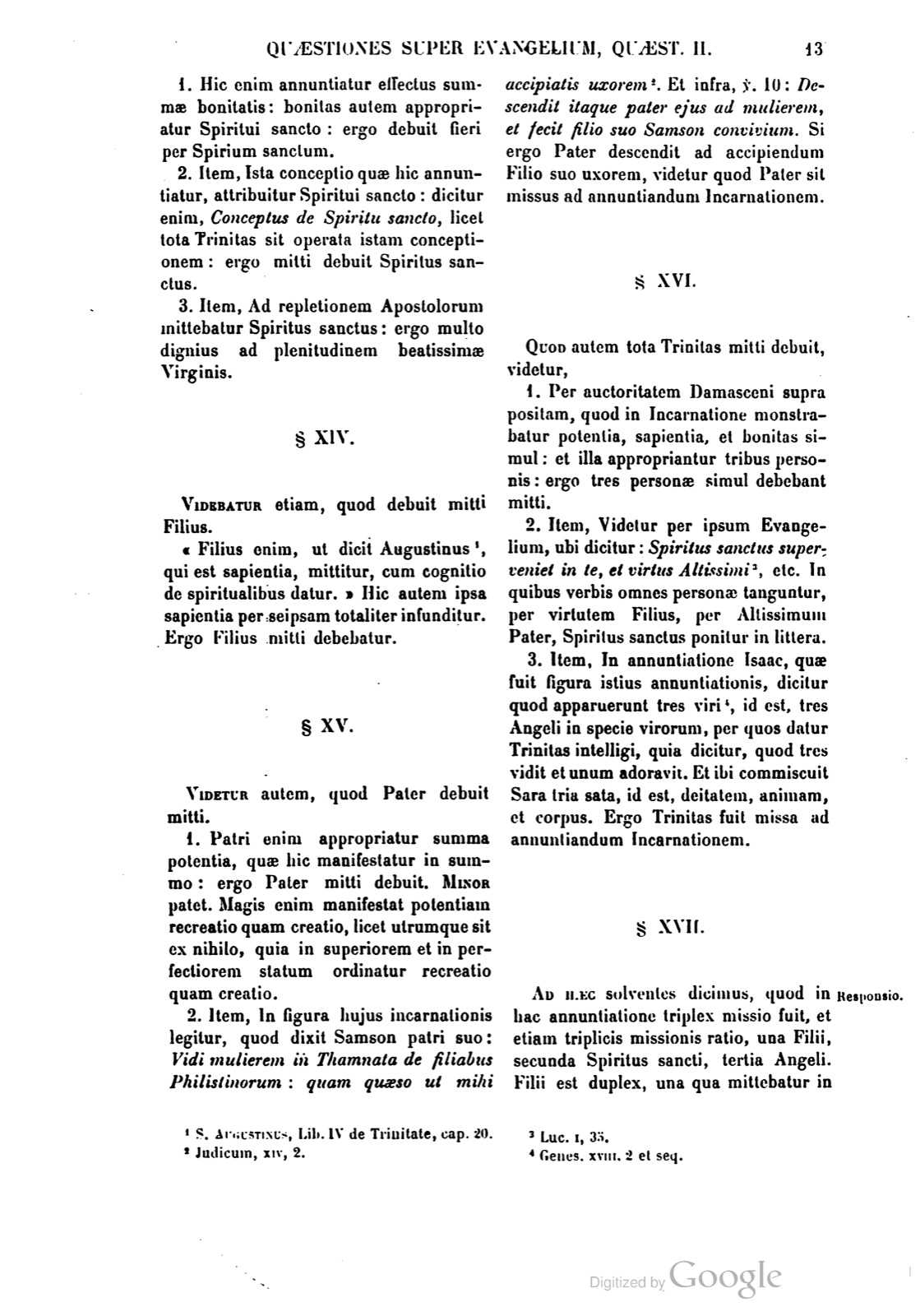
§ XVII. Responsio. Ad haec solventes dicimus, quod in hac annuntiatione triplex missio fuit, et etiam triplicis missionis ratio, una Filii, secunda Spiritus sancti, tertia Angeli. Filii est duplex, una qua mittebatur in carnem, et illa est incarnatio. Alia est, qua mittebatur in mentem, et illa est interior mentis illuminatio beatissimae Virginis ad intelligendum 5, et consentiendum verbis angelicis. Missio Spiritus sancti fuit ibi plenitudinis gratiae infusio, id est, summa virtutum gratuitarum, prout in pura creatura esse potuit in via, perfectio. Missio Angeli fuit ibi intimationis, quia ipsa debebat esse mater Dei, et ideo congruebat ministerialis et exterior ad sensum delatio. Unde Angelus non fuit illuminator, sed illuminationis interioris exterior delator et revelator. Illius autem intelligentiae cujus opus est in visione, Deus Trinitas per se fuit inspiratrix et interpretatrix, sicut et nuntiati inventrix.
§ XVIII. Solutio objectorum. His habitis, respondemus ad objecta, concedentes quod Filius mittebatur secundum quod dictum est, et Spiritus sanctus mittebatur secundum quod dictum est. Pater autem non mittebatur quantum ad Incarnationem, licet bene aliquod appropriabile sit Patri in Incarnatione. In conditione namque ad missionem alicujus personae tria exiguntur. Primum est, quod aliquis effectus sit in creatura a tota Trinitate. Secundum est, quod ille effectus sit appropriabilis illi personae. Tertium est, quod manifestetur processio illius personae ab altera. Et sic patet, quod Pater non mittitur, prout mitti est idem secundum Augustinum quod cognosci ab alio esse: Pater autem non est ab alio. Eadem ratione tota Trinitas mitti non debuit: quia sequitur, si Trinitas mittitur, ergo Pater mittitur.
Concedimus etiam rationes quae probant, quod homo non debuit esse nuntius. Nec obstat, quod lex et Prophetae usque ad Joannem durarunt 6. Ista enim annuntiatio non fuit ad demonstrationem Joannis ordinata tamquam aliquod medium. Haec enim fuit nobilior illa tamquam finis et complementum omnium revelationum et apparitionum praecedentium propter praesentialem exhibitionem luminis, quod illuminat omnem hominem venientem in hunc mundum. Et fuit completior in ratione illuminandi: quia etiam intus et extra illuminavit luce suae deitatis mediante, qua testam nostrae mortalitatis accendit, et omnes tenebras profugavit. Joannis autem demonstratio lumen non accendit, sed semiortis et lippientibus oculis solem digito ostendit: nec jam quasi secretum revelavit, sed manifestum incredulis inculcavit. Plus ergo quam Propheta dicitur 7, non propter nobilitatem revelationis, sed propter praesentiam lucis, quam non futuram praedixit, sed praesentem demonstravit.
§ XVII. Response. In solving these things we say that in this announcing there was a threefold mission, and also the account of a threefold mission: one of the Son, the second of the Holy Spirit, the third of the Angel. The Son's mission is twofold: one by which he was sent into flesh, and that is incarnation; another by which he was sent into the mind, and that is the interior illumination of the mind of the most blessed Virgin for understanding 5 and for consenting to the angelic words. The mission of the Holy Spirit there was the infusion of fullness of grace, that is, the perfection of the highest gratuitous virtues, insofar as it could exist in a pure creature on the way. The mission of the Angel there was of intimation, because she ought to be the mother of God, and therefore a ministerial and exterior carrying to sense was fitting. Hence the Angel was not the illuminator, but the exterior bearer and revealer of the interior illumination. But of that understanding whose work is in vision, God the Trinity through himself was the inspirer and interpreter, just as he was also the inventor of what was announced.
§ XVIII. Solution of the objections. Having these things, we respond to the objections, conceding that the Son was sent according to what has been said, and that the Holy Spirit was sent according to what has been said. But the Father was not sent as to the Incarnation, although indeed something appropriable to the Father is in the Incarnation. For in the condition for the mission of some person three things are required. The first is that some effect be in a creature from the whole Trinity. The second is that that effect be appropriable to that person. The third is that the procession of that person from another be manifested. And thus it is clear that the Father is not sent, insofar as to be sent is, according to Augustine, the same as to be known to be from another; but the Father is not from another. For the same reason the whole Trinity ought not to have been sent, because it follows: if the Trinity is sent, therefore the Father is sent.
We also concede the reasons which prove that a human being ought not to have been the messenger. Nor does it stand in the way that the law and Prophets lasted until John 6. For that announcing was not ordered to John's demonstration as some middle thing. For this was nobler than that as the end and complement of all preceding revelations and apparitions on account of the present exhibition of the light that illuminates every human being coming into this world. And it was more complete in the account of illuminating, because it also illuminated within and without by means of the light of his deity, by which he kindled the shell of our mortality and drove away all darkness. But John's demonstration did not kindle the light; rather, to eyes half-risen and bleary it showed the sun with a finger, nor did it now reveal as if a secret, but impressed what was manifest upon unbelievers. Therefore he is called more than a Prophet 7, not on account of the nobility of the revelation, but on account of the presence of the light, which he did not foretell as future but demonstrated as present.
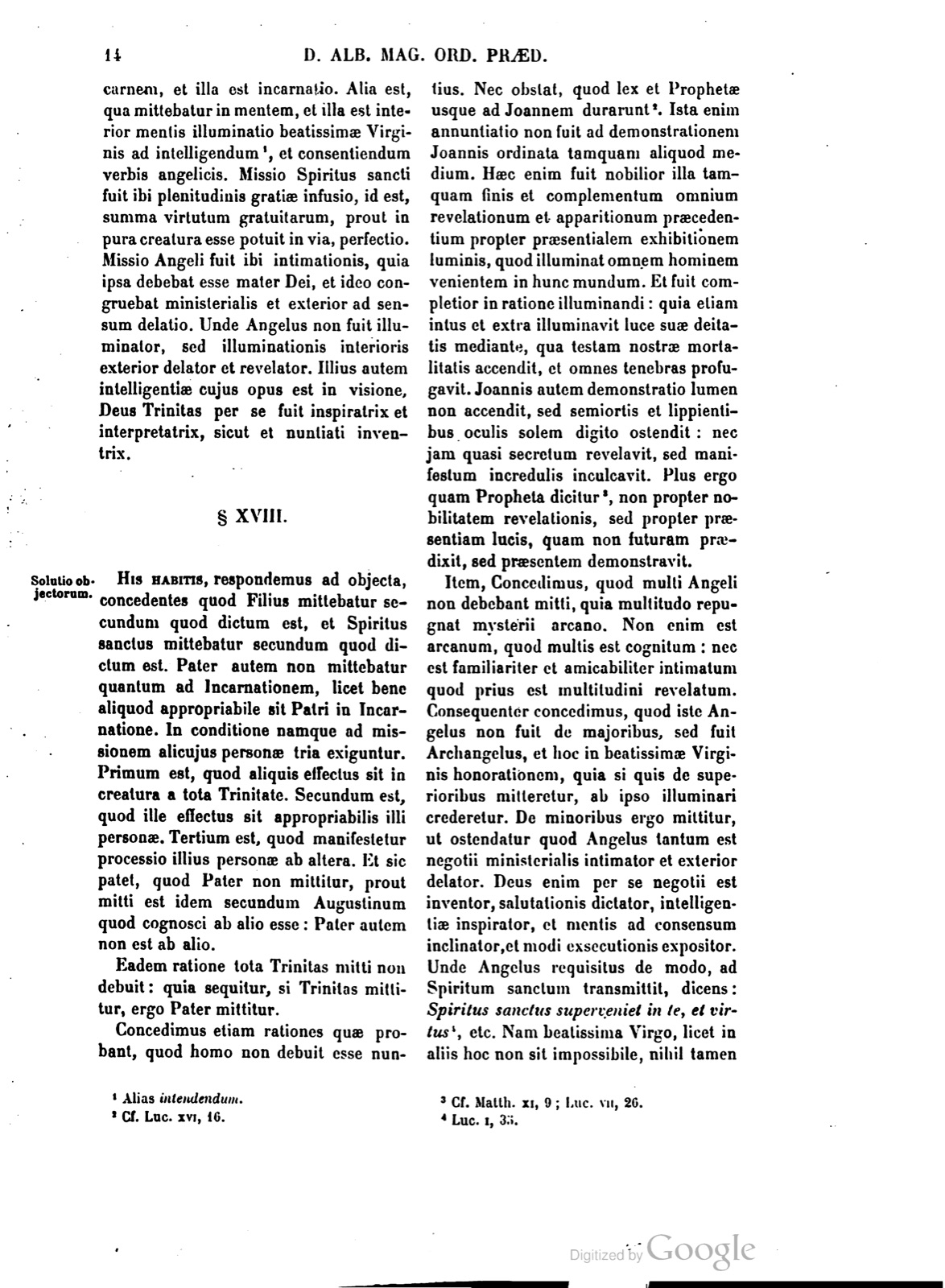
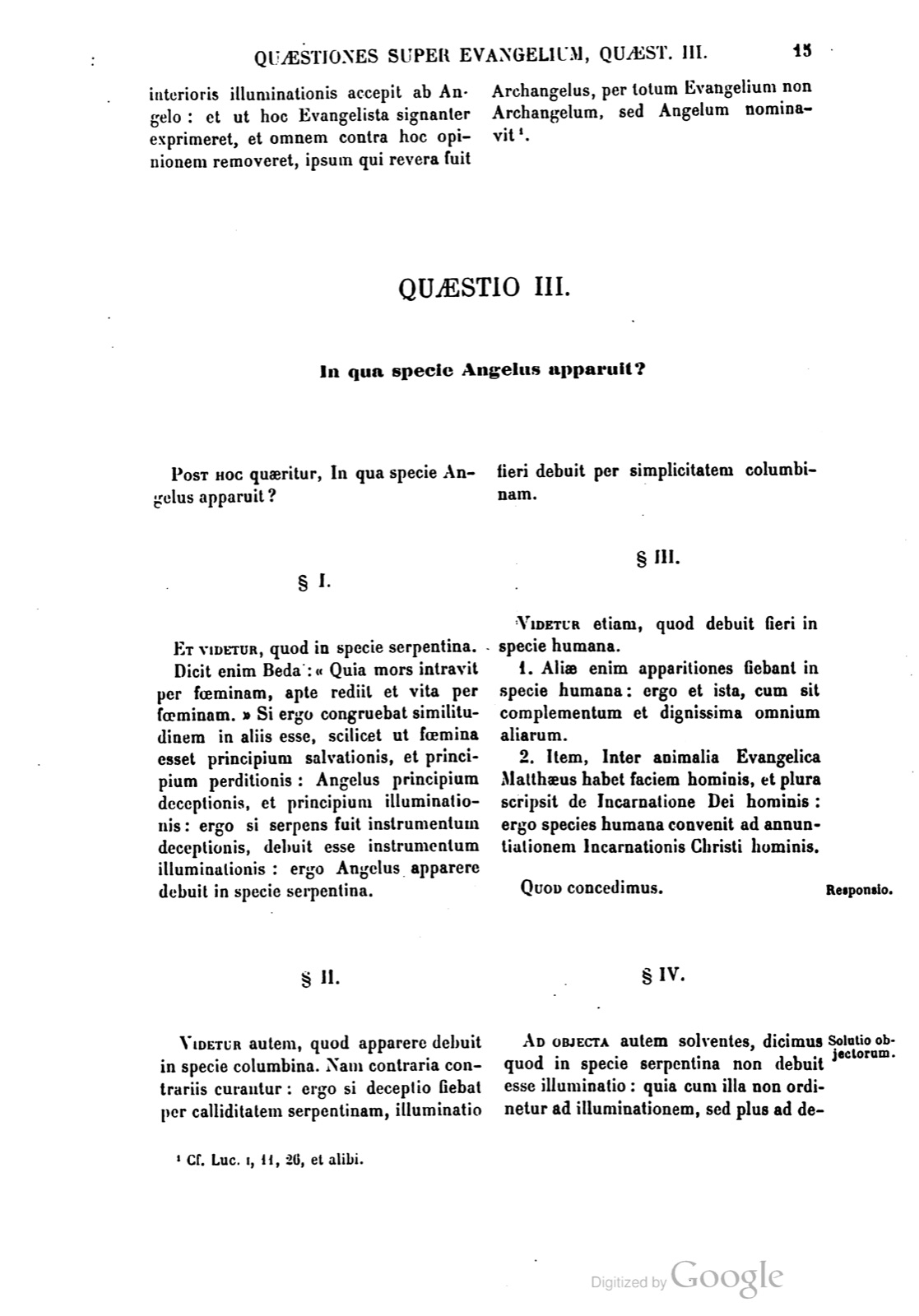
Item, Concedimus, quod multi Angeli non debebant mitti, quia multitudo repugnat mysterii arcano. Non enim est arcanum, quod multis est cognitum: nec est familiariter et amicabiliter intimatum quod prius est multitudini revelatum. Consequenter concedimus, quod iste Angelus non fuit de majoribus, sed fuit Archangelus, et hoc in beatissimae Virginis honorationem, quia si quis de superioribus mitteretur, ab ipso illuminari crederetur. De minoribus ergo mittitur, ut ostendatur quod Angelus tantum est negotii ministerialis intimator et exterior delator. Deus enim per se negotii est inventor, salutationis dictator, intelligentiae inspirator, et mentis ad consensum inclinator, et modi exsecutionis expositor. Unde Angelus requisitus de modo, ad Spiritum sanctum transmittit, dicens: Spiritus sanctus superveniet in te, et virtus 8, etc. Nam beatissima Virgo, licet in aliis hoc non sit impossibile, nihil tamen interioris illuminationis accepit ab Angelo: et ut hoc Evangelista signanter exprimeret, et omnem contra hoc opinionem removeret, ipsum qui revera fuit Archangelus, per totum Evangelium non Archangelum, sed Angelum nominavit 9.
Likewise, we concede that many Angels ought not to have been sent, because multitude is opposed to the secrecy of a mystery. For that is not secret which is known to many; nor is that familiarly and amicably intimated which has first been revealed to a multitude. Consequently we concede that this Angel was not from the greater orders, but was an Archangel, and this for the honoring of the most blessed Virgin, because if someone from the higher orders were sent, she would be believed to be illuminated by him. Therefore he is sent from the lesser orders so that it may be shown that the Angel is only the ministerial intimator and exterior bearer of the business. For God through himself is the inventor of the business, the dictator of the greeting, the inspirer of understanding, the incliner of the mind to consent, and the expositor of the manner of execution. Hence the Angel, asked about the manner, sends her on to the Holy Spirit, saying: The Holy Spirit will come upon you, and the power 8, etc. For the most blessed Virgin, although in other persons this is not impossible, nevertheless received nothing of interior illumination from the Angel; and so that the Evangelist might express this pointedly and remove every opinion against this, he named throughout the Gospel the one who in reality was an Archangel not an Archangel, but an Angel 9.
Notes
- St. Augustine, book IV On the Trinity, chapter 20. (S. Augustinus, Lib. IV de Trinitate, cap. 20.) ↩
- Judges 14:2. (Judicum XIV, 2.) ↩
- Luke 1:35. (Luc. 1, 35.) ↩
- Genesis 18:2 and following. (Genes. XVIII, 2 et seq.) ↩
- Another reading: to intending. (Alias intendendum.) ↩
- Compare Luke 16:16. (Cf. Luc. XVI, 16.) ↩
- Compare Matthew 11:9; Luke 7:26. (Cf. Matth. XI, 9; Luc. VII, 26.) ↩
- Luke 1:35. (Luc. 1, 35.) ↩
- Compare Luke 1:11, 26, and elsewhere. (Cf. Luc. 1, 11, 26, et alibi.) ↩
If a page does not appear, its photograph has not been uploaded yet.