Works › The Mariale: Questions on “Missus est”
Volume 37 · pp. 8–12
Question II. Through what messenger was it fitting for this announcing to be made?
A marker with ≈ is an approximate page boundary, placed by measure of the text; the page photographs remain the authority. In the paired views, clicking a page marker brings that page into view.
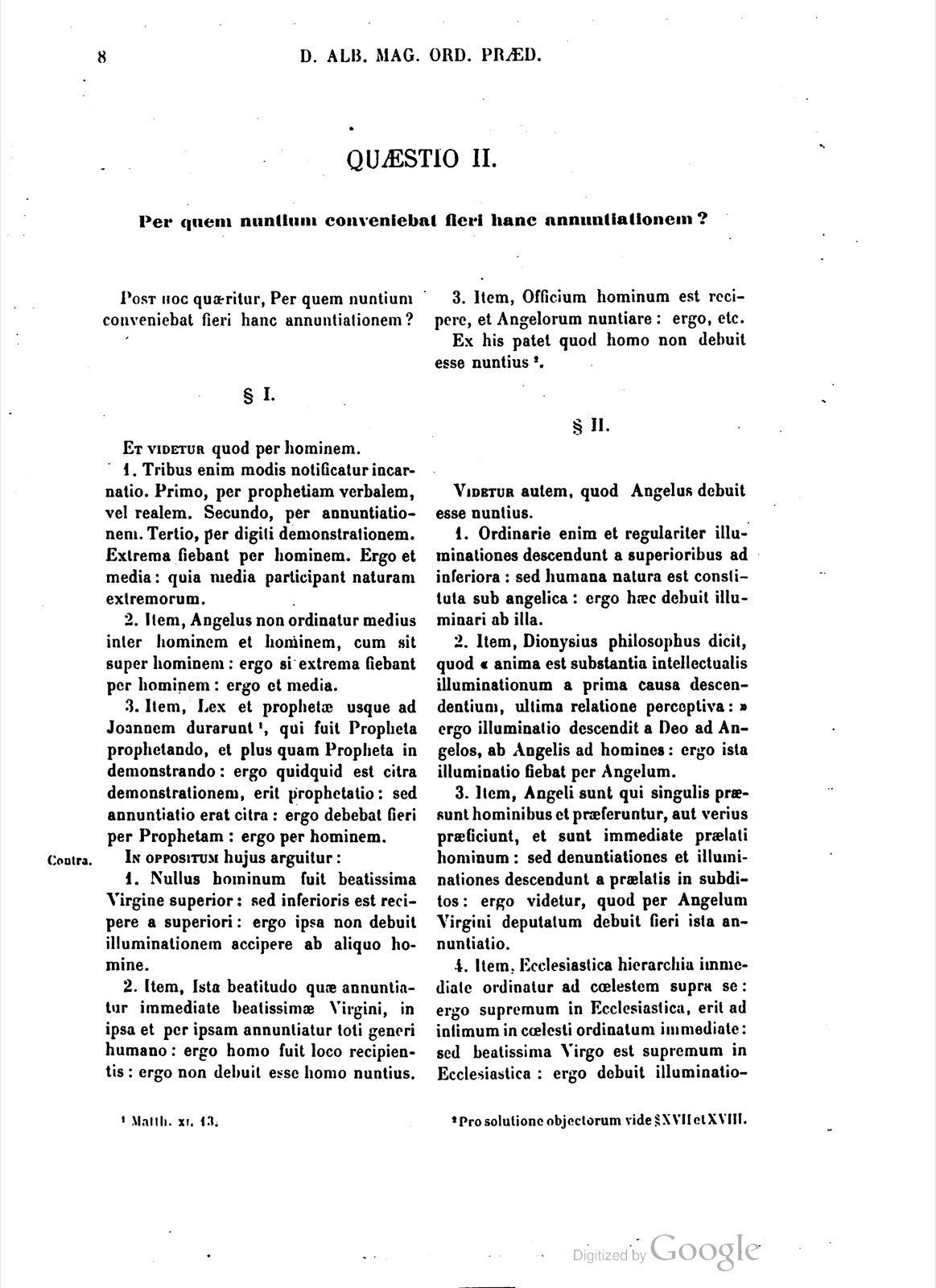
Quaestio II. Per quem nuntium conveniebat fieri hanc annuntiationem?
Post hoc quaeritur, Per quem nuntium conveniebat fieri hanc annuntiationem?
§ I. Et videtur quod per hominem. 1. Tribus enim modis notificatur incarnatio. Primo, per prophetiam verbalem, vel realem. Secundo, per annuntiationem. Tertio, per digiti demonstrationem. Extrema fiebant per hominem. Ergo et media: quia media participant naturam extremorum.
2. Item, Angelus non ordinatur medius inter hominem et hominem, cum sit super hominem: ergo si extrema fiebant per hominem: ergo et media.
3. Item, Lex et prophetae usque ad Joannem durarunt 1, qui fuit Propheta prophetando, et plus quam Propheta in demonstrando: ergo quidquid est citra demonstrationem, erit prophetatio: sed annuntiatio erat citra: ergo debebat fieri per Prophetam: ergo per hominem.
In oppositum hujus arguitur: 1. Nullus hominum fuit beatissima Virgine superior: sed inferioris est recipere a superiori: ergo ipsa non debuit illuminationem accipere ab aliquo homine. 2. Item, Ista beatitudo quae annuntiatur immediate beatissimae Virgini, in ipsa et per ipsam annuntiatur toti generi humano: ergo homo fuit loco recipientis: ergo non debuit esse homo nuntius. 3. Item, Officium hominum est recipere, et Angelorum nuntiare: ergo, etc. Ex his patet quod homo non debuit esse nuntius 2.
§ II. Videtur autem, quod Angelus debuit esse nuntius. 1. Ordinarie enim et regulariter illuminationes descendunt a superioribus ad inferiora: sed humana natura est constituta sub angelica: ergo haec debuit illuminari ab illa.
2. Item, Dionysius philosophus dicit, quod «anima est substantia intellectualis illuminationum a prima causa descendentium, ultima relatione perceptiva»: ergo illuminatio descendit a Deo ad Angelos, ab Angelis ad homines: ergo ista illuminatio fiebat per Angelum.
3. Item, Angeli sunt qui singulis praesunt hominibus et praeferuntur, aut verius praeficiunt, et sunt immediate praelati hominum: sed denuntiationes et illuminationes descendunt a praelatis in subditos: ergo videtur, quod per Angelum Virgini deputatum debuit fieri ista annuntiatio.
4. Item, Ecclesiastica hierarchia immediate ordinatur ad caelestem supra se: ergo supremum in Ecclesiastica, erit ad intimum in caelesti ordinatum immediate: sed beatissima Virgo est supremum in Ecclesiastica: ergo debuit illuminationem recipere ab infimo in caelesti hierarchia.
5. Item, Per totum Evangelium appellatur Angelus, et ita videtur, quod fuit Angelus.
In oppositum hujus arguitur: 1. Illuminatores sunt superiores eis quos illuminant, sicut vult Dionysius per totum: sed Angeli non fuerunt superiores beatissima Virgine: ergo Angelus non debuit ipsam illuminare. 2. Item, Quis est iste qui venit de Edom 3? etc.: ubi dicit Hieronymus, quod haec quaestio est in persona minorum Angelorum ignorantium mysterium Incarnationis: sed si ignoraverunt, ergo non nuntiaverunt. 3. Item, Alibi, Volavit ad me unus de Seraphim 4. Si ergo de majoribus fuit unus qui Prophetam ad prophetandam incarnationem purgabat, nequaquam de minoribus esse debuit, qui ipsam incarnationem nuntiabat.
Question II. Through what messenger was it fitting for this announcing to be made?
After this it is asked: Through what messenger was it fitting for this announcing to be made?
§ I. And it seems that it was through a human being. 1. For the incarnation is made known in three ways. First, through verbal or real prophecy. Second, through announcement. Third, through demonstration by the finger. The extremes were done through a human being. Therefore also the middle thing, because middle things participate in the nature of the extremes.
2. Likewise, an Angel is not ordered as a middle between a human being and a human being, since he is above a human being; therefore, if the extremes were done through a human being, therefore also the middle things.
3. Likewise, the Law and the prophets lasted until John 1, who was a Prophet by prophesying and more than a Prophet by demonstrating; therefore whatever falls short of demonstration will be prophecy; but announcement fell short; therefore it ought to have been done through a Prophet; therefore through a human being.
Against this it is argued: 1. No human being was superior to the most blessed Virgin; but it belongs to an inferior to receive from a superior; therefore she ought not to have received illumination from any human being. 2. Likewise, that blessedness which is announced immediately to the most blessed Virgin is announced in her and through her to the whole human race; therefore a human being was in the place of the receiver; therefore a human being ought not to have been the messenger. 3. Likewise, the office of human beings is to receive, and of Angels to announce; therefore, etc. From these things it is clear that a human being ought not to have been the messenger 2.
§ II. But it seems that an Angel ought to have been the messenger. 1. For in an orderly and regular way illuminations descend from superiors to inferiors; but human nature is established under angelic nature; therefore this nature ought to have been illuminated by that one.
2. Likewise, Dionysius the philosopher says that "the soul is an intellectual substance, perceptive in the last relation of illuminations descending from the first cause"; therefore illumination descends from God to Angels, from Angels to human beings; therefore that illumination was made through an Angel.
3. Likewise, Angels are those who preside over individual human beings and are preferred to them, or more truly are placed over them, and they are the immediate prelates of human beings; but announcements and illuminations descend from prelates into subjects; therefore it seems that that announcing ought to have been made through the Angel deputed to the Virgin.
4. Likewise, the ecclesiastical hierarchy is immediately ordered to the heavenly hierarchy above it; therefore the highest thing in the ecclesiastical hierarchy will be immediately ordered to the innermost thing in the heavenly hierarchy; but the most blessed Virgin is the highest thing in the ecclesiastical hierarchy; therefore she ought to have received illumination from the lowest thing in the heavenly hierarchy.
5. Likewise, throughout the Gospel he is called an Angel, and thus it seems that he was an Angel.
Against this it is argued: 1. Illuminators are superior to those whom they illuminate, as Dionysius means throughout; but Angels were not superior to the most blessed Virgin; therefore an Angel ought not to have illuminated her. 2. Likewise, Who is this who comes from Edom 3? etc.; there Jerome says that this question is in the person of the lesser Angels ignorant of the mystery of the Incarnation; but if they were ignorant, therefore they did not announce. 3. Likewise elsewhere, One of the Seraphim flew to me 4. Therefore, if one from the greater orders purified the Prophet for prophesying the incarnation, the one who announced the incarnation itself ought by no means to have been from the lesser orders.
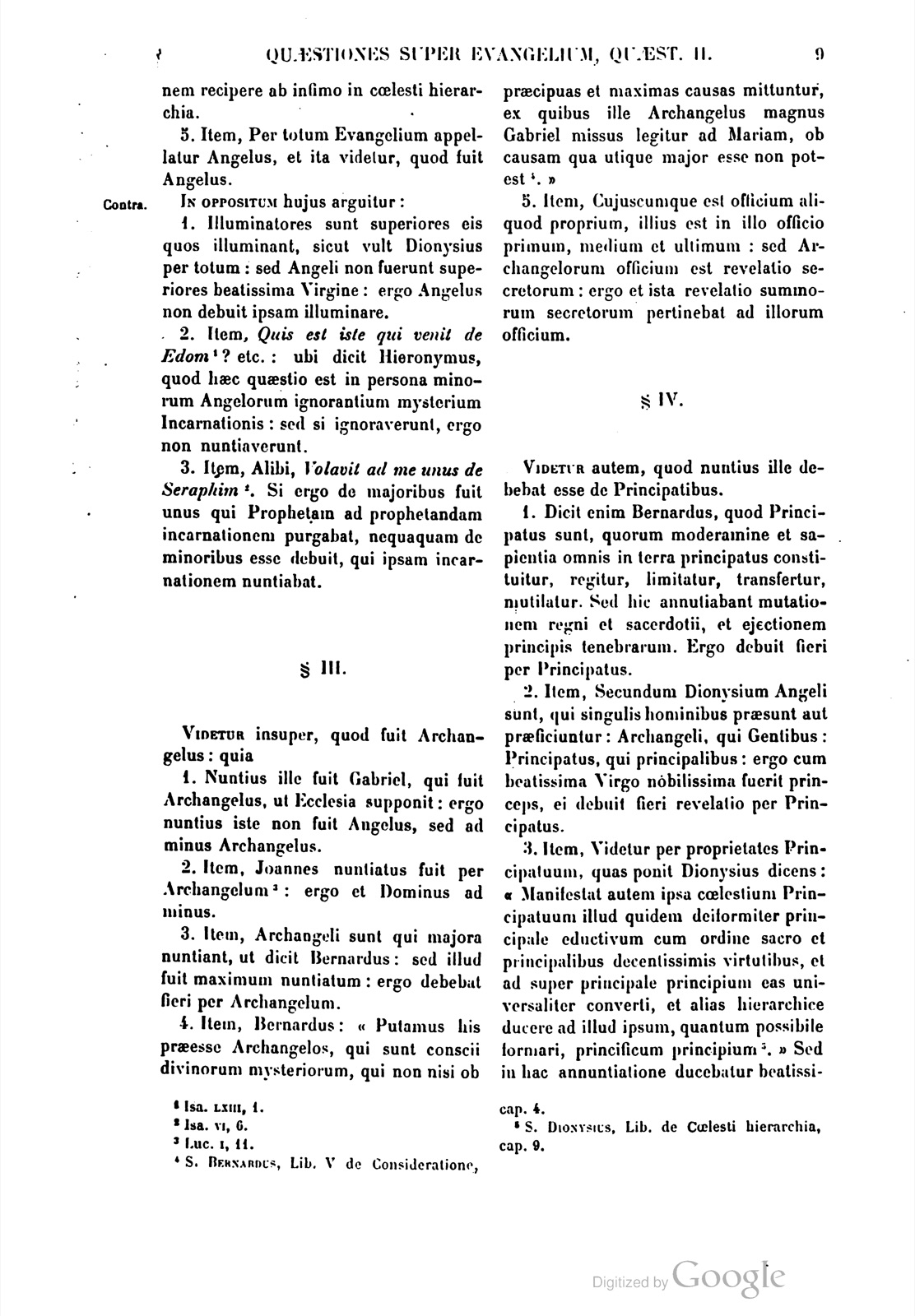
§ III. Videtur insuper, quod fuit Archangelus: quia 1. Nuntius ille fuit Gabriel, qui fuit Archangelus, ut Ecclesia supponit: ergo nuntius iste non fuit Angelus, sed ad minus Archangelus. 2. Item, Joannes nuntiatus fuit per Archangelum 5: ergo et Dominus ad minus. 3. Item, Archangeli sunt qui majora nuntiant, ut dicit Bernardus: sed illud fuit maximum nuntiatum: ergo debebat fieri per Archangelum. 4. Item, Bernardus: «Putamus his praeesse Archangelos, qui sunt conscii divinorum mysteriorum, qui non nisi ob praecipuas et maximas causas mittuntur, ex quibus ille Archangelus magnus Gabriel missus legitur ad Mariam, ob causam qua utique major esse non potest 6.» 5. Item, Cujuscumque est officium aliquod proprium, illius est in illo officio primum, medium et ultimum: sed Archangelorum officium est revelatio secretorum: ergo et ista revelatio summorum secretorum pertinebat ad illorum officium.
§ IV. Videtur autem, quod nuntius ille debebat esse de Principatibus. 1. Dicit enim Bernardus, quod Principatus sunt, quorum moderamine et sapientia omnis in terra principatus constituitur, regitur, limitatur, transfertur, mutilatur. Sed hic annuntiabant mutationem regni et sacerdotii, et ejectionem principis tenebrarum. Ergo debuit fieri per Principatus. 2. Item, Secundum Dionysium Angeli sunt, qui singulis hominibus praesunt aut praeficiuntur: Archangeli, qui Gentibus: Principatus, qui principalibus: ergo cum beatissima Virgo nobilissima fuerit princeps, ei debuit fieri revelatio per Principatus. 3. Item, Videtur per proprietates Principatuum, quas ponit Dionysius dicens: «Manifestat autem ipsa caelestium Principatuum illud quidem deiformiter principale eductivum cum ordine sacro et principalibus decentissimis virtutibus, et ad super principale principium eas universaliter converti, et alias hierarchice ducere ad illud ipsum, quantum possibile formari, princificum principium 7.» Sed in hac annuntiatione ducebatur beatissima Virgo hierarchice ad superprincipale princificum principium, quantum possibile fuit. Ergo debebat fieri per Principatus.
§ V. Videtur autem, quod adhuc superior debeat esse, scilicet de Potestatibus. 1. «Potestates sunt, ut dicit Bernardus, quarum virtute potestas tenebrarum comprimitur 8.» Haec autem potestas principem tenebrarum maxime comprimebat: ergo debebat fieri per Potestates. 2. Item, Glossa dicit super Missus, quod ideo Gabriel fortitudo Dei dicitur, quia illum nuntiabat, qui ad debellandum diabolum veniebat. Hoc autem est Potestatum. Ergo fieri debuit per Potestates.
§ III. It seems further that he was an Archangel, because 1. That messenger was Gabriel, who was an Archangel, as the Church supposes; therefore that messenger was not an Angel, but at least an Archangel. 2. Likewise, John was announced through an Archangel 5; therefore also the Lord at least. 3. Likewise, Archangels are those who announce greater things, as Bernard says; but that which was announced was the greatest; therefore it ought to have been done through an Archangel. 4. Likewise, Bernard says: "We think that Archangels preside over these, who are conscious of divine mysteries, who are sent only for outstanding and very great causes, among whom that great Archangel Gabriel is read to have been sent to Mary, for a cause than which certainly none can be greater 6." 5. Likewise, to whomever some proper office belongs, to him belongs the first, middle, and last thing in that office; but the office of Archangels is the revelation of secrets; therefore also that revelation of the highest secrets belonged to their office.
§ IV. But it seems that that messenger ought to have been from the Principalities. 1. For Bernard says that the Principalities are those by whose moderation and wisdom every principality on earth is established, ruled, limited, transferred, and mutilated. But here they were announcing the change of kingdom and priesthood and the ejection of the prince of darkness. Therefore it ought to have been done through the Principalities. 2. Likewise, according to Dionysius, Angels are those who preside over or are set over individual human beings; Archangels over peoples; Principalities over principal persons. Therefore, since the most blessed Virgin was the noblest prince, revelation ought to have been made to her through the Principalities. 3. Likewise, it seems so through the properties of Principalities, which Dionysius sets down, saying: "The naming itself of the heavenly Principalities manifests that deiformly principal leading power with sacred order and with most fitting principal virtues, and that they are universally converted to the super-principal principle, and that they hierarchically lead others to that very thing, so far as possible to be formed, the principial principle 7." But in this announcing the most blessed Virgin was being led hierarchically to the super-principal principle of principles, so far as was possible. Therefore it ought to have been done through the Principalities.
§ V. But it seems that he ought to be still higher, namely from the Powers. 1. "Powers are, as Bernard says, those by whose virtue the power of darkness is repressed 8." But this power was repressing the prince of darkness most of all; therefore it ought to have been done through the Powers. 2. Likewise, the Gloss says on Missus that Gabriel is called the strength of God because he was announcing him who was coming to wage war against the devil. But this belongs to the Powers. Therefore it ought to have been done through the Powers.
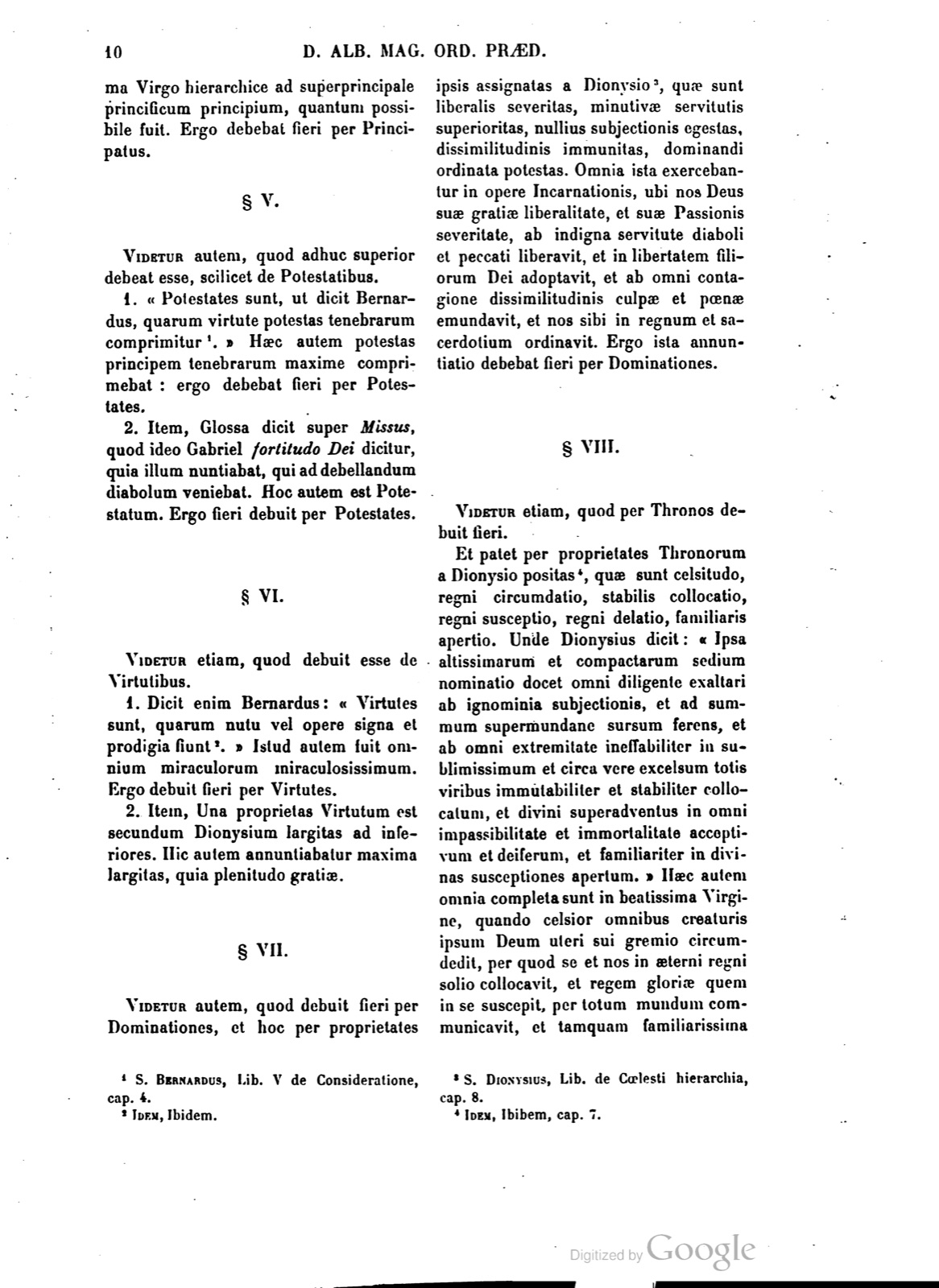
§ VI. Videtur etiam, quod debuit esse de Virtutibus. 1. Dicit enim Bernardus: «Virtutes sunt, quarum nutu vel opere signa et prodigia fiunt 9.» Istud autem fuit omnium miraculorum miraculosissimum. Ergo debuit fieri per Virtutes. 2. Item, Una proprietas Virtutum est secundum Dionysium largitas ad inferiores. Hic autem annuntiabatur maxima largitas, quia plenitudo gratiae.
§ VII. Videtur autem, quod debuit fieri per Dominationes, et hoc per proprietates ipsis assignatas a Dionysio, quae sunt liberalis severitas, minutivae servitutis superioritas, nullius subjectionis egestas, dissimilitudinis immunitas, dominandi ordinata potestas. Omnia ista exercebantur in opere Incarnationis, ubi nos Deus suae gratiae liberalitate, et suae Passionis severitate, ab indigna servitute diaboli et peccati liberavit, et in libertatem filiorum Dei adoptavit, et ab omni contagione dissimilitudinis culpae et poenae emundavit, et nos sibi in regnum et sacerdotium ordinavit. Ergo ista annuntiatio debebat fieri per Dominationes.
§ VIII. Videtur etiam, quod per Thronos debuit fieri. Et patet per proprietates Thronorum a Dionysio positas, quae sunt celsitudo, regni circumdatio, stabilis collocatio, regni susceptio, regni delatio, familiaris apertio. Unde Dionysius dicit: «Ipsa altissimarum et compactarum sedium nominatio docet omni diligente exaltari ab ignominia subjectionis, et ad summum supermundane sursum ferens, et ab omni extremitate ineffabiliter in sublimissimum et circa vere excelsum totis viribus immutabiliter et stabiliter collocatum, et divini superadventus in omni impassibilitate et immortalitate acceptivum et deiferum, et familiariter in divinas susceptiones apertum 10.» Haec autem omnia completa sunt in beatissima Virgine, quando celsior omnibus creaturis ipsum Deum uteri sui gremio circumdedit, per quod se et nos in aeterni regni solio collocavit, et regem gloriae quem in se suscepit, per totum mundum communicavit, et tamquam familiarissima mediatrix totum mundum sibi reconciliavit, et per quam tamquam per conjunctissimum sibi medium omne bonum effluxit, et omne genus hominum per se tamquam per portas caeli ad summam familiaritatem Dei Patris introduxit, et per hoc quod ipsum Deum cum homine familiarissime in unam personam conjunxit. Haec autem omnia annuntiantur in ista annuntiatione. Ergo propriissime debuit fieri per Thronos.
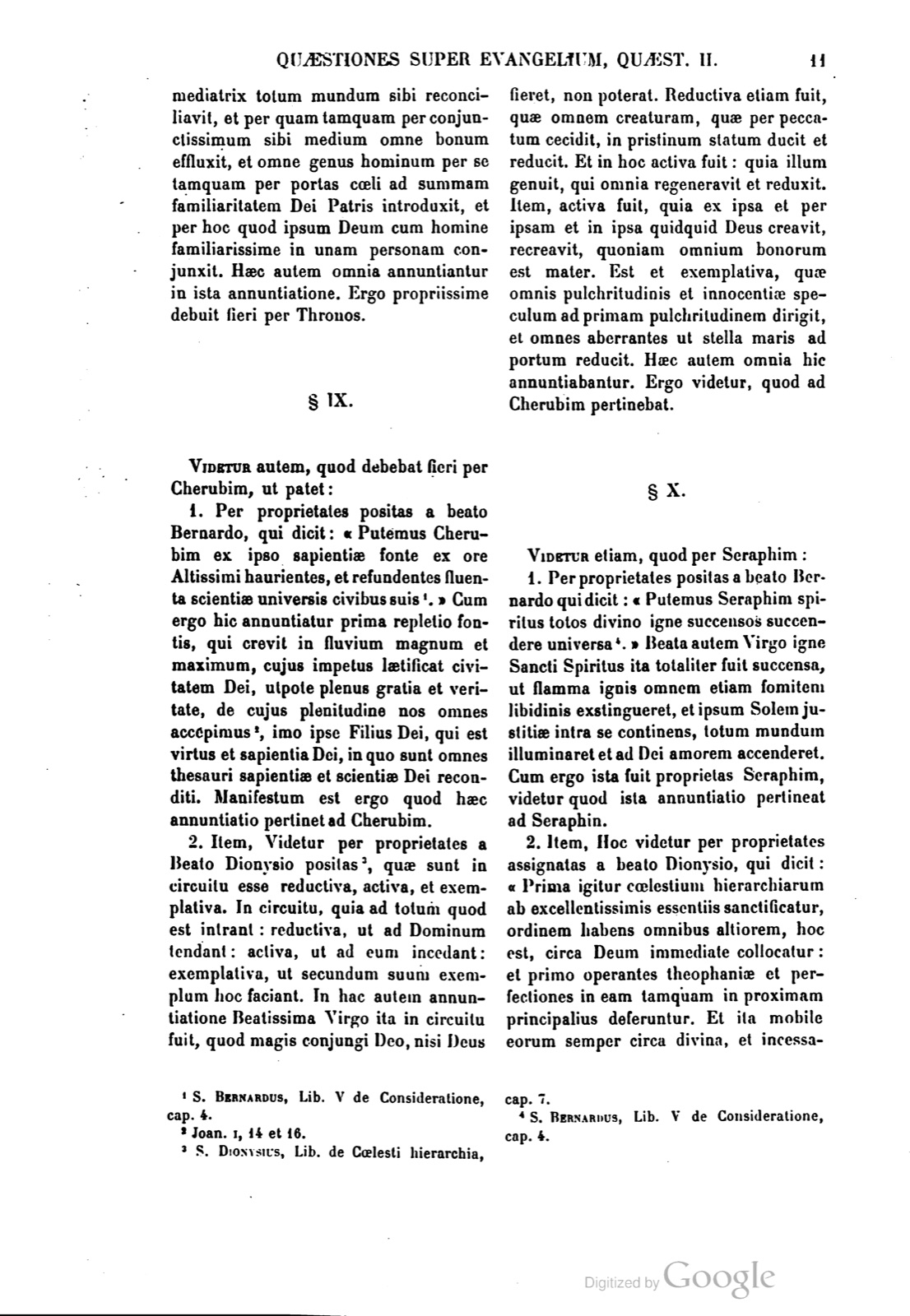
§ IX. Videtur autem, quod debebat fieri per Cherubim, ut patet: 1. Per proprietates positas a beato Bernardo, qui dicit: «Putemus Cherubim ex ipso sapientiae fonte ex ore Altissimi haurientes, et refundentes fluenta scientiae universis civibus suis 11.» Cum ergo hic annuntiatur prima repletio fontis, qui crevit in fluvium magnum et maximum, cujus impetus laetificat civitatem Dei, utpote plenus gratia et veritate, de cujus plenitudine nos omnes accepimus 12, imo ipse Filius Dei, qui est virtus et sapientia Dei, in quo sunt omnes thesauri sapientiae et scientiae Dei reconditi. Manifestum est ergo quod haec annuntiatio pertinet ad Cherubim. 2. Item, Videtur per proprietates a Beato Dionysio positas, quae sunt in circuitu esse reductiva, activa, et exemplativa. In circuitu, quia ad totum quod est intrant: reductiva, ut ad Dominum tendant: activa, ut ad eum incedant: exemplativa, ut secundum suum exemplum hoc faciant. In hac autem annuntiatione Beatissima Virgo ita in circuitu fuit, quod magis conjungi Deo, nisi Deus fieret, non poterat. Reductiva etiam fuit, quae omnem creaturam, quae per peccatum cecidit, in pristinum statum ducit et reducit. Et in hoc activa fuit: quia illum genuit, qui omnia regeneravit et reduxit. Item, activa fuit, quia ex ipsa et per ipsam et in ipsa quidquid Deus creavit, recreavit, quoniam omnium bonorum est mater. Est et exemplativa, quae omnis pulchritudinis et innocentiae speculum ad primam pulchritudinem dirigit, et omnes aberrantes ut stella maris ad portum reducit. Haec autem omnia hic annuntiabantur. Ergo videtur, quod ad Cherubim pertinebat.
§ VI. It also seems that he ought to have been from the Virtues. 1. For Bernard says: "Virtues are those by whose nod or work signs and wonders are done 9." But that was the most miraculous of all miracles. Therefore it ought to have been done through the Virtues. 2. Likewise, one property of the Virtues according to Dionysius is generosity toward inferiors. But here the greatest generosity was announced, namely the fullness of grace.
§ VII. But it seems that it ought to have been done through the Dominations, and this through the properties assigned to them by Dionysius, which are liberal severity, superiority over diminishing servitude, want of any subjection, immunity from dissimilitude, and ordered power of ruling. All those things were exercised in the work of the Incarnation, where God, by the liberality of his grace and by the severity of his Passion, freed us from the unworthy servitude of the devil and sin, adopted us into the liberty of the children of God, cleansed us from every contagion of the dissimilitude of fault and punishment, and ordered us to himself into a kingdom and priesthood. Therefore that announcing ought to have been done through the Dominations.
§ VIII. It also seems that it ought to have been done through the Thrones. And this is clear through the properties of the Thrones set down by Dionysius, which are loftiness, encirclement of the kingdom, stable placement, reception of the kingdom, carrying of the kingdom, and familiar opening. Hence Dionysius says: "The naming itself of the highest and compact seats teaches that one is exalted by every diligence from the disgrace of subjection, and, bearing upward supermundanely to the highest, and from every extreme ineffably to the most sublime and around the truly exalted, placed immutably and stably with all powers, and receptive and God-bearing of the divine super-advent in every impassibility and immortality, and familiarly opened to divine receptions 10." But all these things were completed in the most blessed Virgin, when, loftier than all creatures, she encircled God himself in the bosom of her womb; through this she placed herself and us on the throne of the eternal kingdom, and communicated through the whole world the king of glory whom she received in herself, and as the most familiar mediator reconciled the whole world to him; through her as through a medium most closely joined to him every good flowed out, and the whole race of human beings through her, as through the gates of heaven, was introduced to the highest familiarity of God the Father, and through this she most familiarly joined God himself with man into one person. But all these things are announced in that announcing. Therefore most properly it ought to have been done through the Thrones.
§ IX. But it seems that it ought to have been done through the Cherubim, as is clear: 1. Through the properties set down by blessed Bernard, who says: "Let us think of the Cherubim as drawing from the very fount of wisdom, from the mouth of the Most High, and pouring back streams of knowledge to all their fellow citizens 11." Therefore, since here the first filling of the fount is announced, which grew into a great and greatest river, whose force makes glad the city of God, as being full of grace and truth, from whose fullness we all have received 12, indeed the very Son of God, who is the virtue and wisdom of God, in whom all the treasures of the wisdom and knowledge of God are hidden: therefore it is manifest that this announcing belongs to the Cherubim. 2. Likewise, it seems so through the properties set down by blessed Dionysius, which are to be reductive, active, and exemplary in circuit. In circuit, because they enter into the whole of what exists; reductive, so that they tend to the Lord; active, so that they advance toward him; exemplary, so that they do this according to their example. But in this announcing the most blessed Virgin was in circuit in such a way that she could not be joined more to God unless she became God. She was also reductive, she who leads and reduces every creature that fell through sin into its pristine state. And in this she was active, because she gave birth to him who regenerated and reduced all things. Likewise, she was active because from her and through her and in her God recreated whatever he created, since she is the mother of all good things. She is also exemplary, she who directs the mirror of all beauty and innocence to the first beauty and reduces all who wander, as the star of the sea, to the harbor. But all these things were being announced here. Therefore it seems that it belonged to the Cherubim.
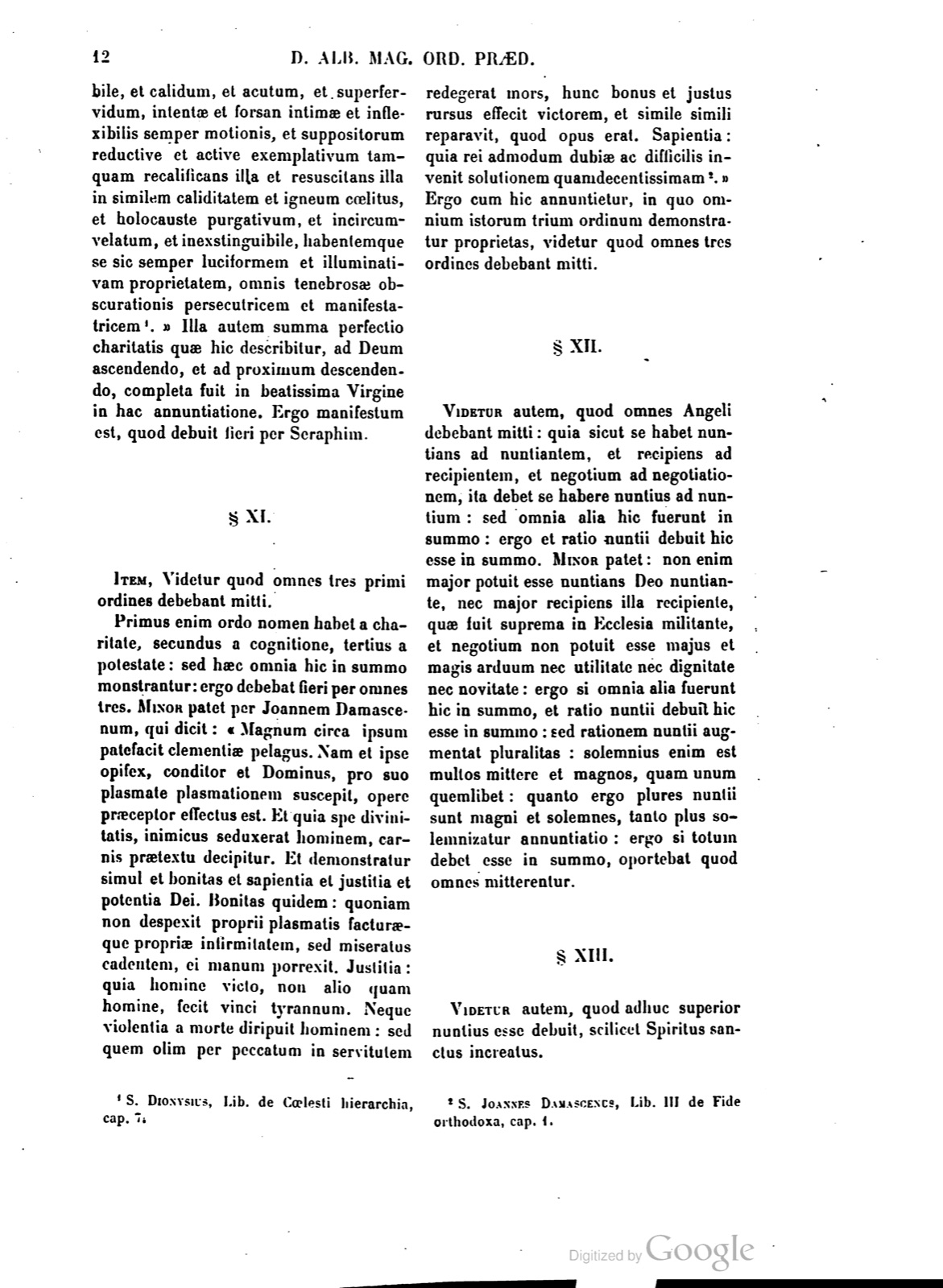
§ X. Videtur etiam, quod per Seraphim: 1. Per proprietates positas a beato Bernardo qui dicit: «Putemus Seraphim spiritus totos divino igne succensos succendere universa 13.» Beata autem Virgo igne Sancti Spiritus ita totaliter fuit succensa, ut flamma ignis omnem etiam fomitem libidinis exstingueret, et ipsum Solem justitiae intra se continens, totum mundum illuminaret et ad Dei amorem accenderet. Cum ergo ista fuit proprietas Seraphim, videtur quod ista annuntiatio pertineat ad Seraphim. 2. Item, Hoc videtur per proprietates assignatas a beato Dionysio, qui dicit: «Prima igitur caelestium hierarchiarum ab excellentissimis essentiis sanctificatur, ordinem habens omnibus altiorem, hoc est, circa Deum immediate collocatur: et primo operantes theophaniae et perfectiones in eam tamquam in proximam principalius deferuntur. Et ita mobile eorum semper circa divina, et incessabile, et calidum, et acutum, et superfervidum, intentae et forsan intimae et inflexibilis semper motionis, et suppositorum reductive et active exemplativum tamquam recalificans illa et resuscitans illa in similem caliditatem et igneum caelitus, et holocauste purgativum, et incircumvelatum, et inexstinguibile, habentemque se sic semper luciformem et illuminativam proprietatem, omnis tenebrosae obscurationis persecutricem et manifestatricem 14.» Illa autem summa perfectio charitatis quae hic describitur, ad Deum ascendendo, et ad proximum descendendo, completa fuit in beatissima Virgine in hac annuntiatione. Ergo manifestum est, quod debuit fieri per Seraphim.
§ X. It also seems that it was through the Seraphim. 1. Through the properties set down by blessed Bernard, who says: "Let us think of the Seraphim as spirits wholly enkindled by divine fire, enkindling all things 13." But the blessed Virgin was so totally enkindled by the fire of the Holy Spirit that the flame of fire extinguished even every tinder of lust, and, containing within herself the very Sun of justice, illuminated the whole world and kindled it to the love of God. Therefore, since this was the property of the Seraphim, it seems that that announcing belongs to the Seraphim. 2. Likewise, this seems so through the properties assigned by blessed Dionysius, who says: "The first of the heavenly hierarchies is sanctified by the most excellent essences, having an order higher than all, that is, it is placed immediately around God; and the first-working theophanies and perfections are carried into it more principally as into what is nearest. And thus their motion is always around divine things, and unceasing, and warm, and sharp, and super-fervid, of an intense and perhaps innermost and always inflexible motion, and reductively and actively exemplary of things beneath, as recalefying them and raising them into a similar warmth and heavenly fire, and holocaustically purgative, and unveiled, and inextinguishable, and having itself thus always with a light-forming and illuminating property, persecuting and manifesting every dark obscuration 14." But that highest perfection of charity which is described here was completed in the most blessed Virgin, by ascending to God and by descending to neighbor, in this announcing. Therefore it is manifest that it ought to have been done through the Seraphim.
§ XI. Item, Videtur quod omnes tres primi ordines debebant mitti. Primus enim ordo nomen habet a charitate, secundus a cognitione, tertius a potestate: sed haec omnia hic in summo monstrantur: ergo debebat fieri per omnes tres. Minor patet per Joannem Damascenum, qui dicit: «Magnum circa ipsum patefacit clementiae pelagus. Nam et ipse opifex, conditor et Dominus, pro suo plasmate plasmationem suscepit, opere praeceptor effectus est. Et quia spe divinitatis, inimicus seduxerat hominem, carnis praetextu decipitur. Et demonstratur simul et bonitas et sapientia et justitia et potentia Dei. Bonitas quidem: quoniam non despexit proprii plasmatis facturaeque propriae infirmitatem, sed miseratus cadentem, ei manum porrexit. Justitia: quia homine victo, non alio quam homine, fecit vinci tyrannum. Neque violentia a morte diripuit hominem: sed quem olim per peccatum in servitutem redegerat mors, hunc bonus et justus rursus effecit victorem, et simile simili reparavit, quod opus erat. Sapientia: quia rei admodum dubiae ac difficilis invenit solutionem quam decentissimam 15.» Ergo cum hic annuntietur, in quo omnium istorum trium ordinum demonstratur proprietas, videtur quod omnes tres ordines debebant mitti.
§ XII. Videtur autem, quod omnes Angeli debebant mitti: quia sicut se habet nuntians ad nuntiantem, et recipiens ad recipientem, et negotium ad negotiationem, ita debet se habere nuntius ad nuntium: sed omnia alia hic fuerunt in summo: ergo et ratio nuntii debuit hic esse in summo. Minor patet: non enim major potuit esse nuntians Deo nuntiante, nec major recipiens illa recipiente, quae fuit suprema in Ecclesia militante, et negotium non potuit esse majus et magis arduum nec utilitate nec dignitate nec novitate: ergo si omnia alia fuerunt hic in summo, et ratio nuntii debuit hic esse in summo: sed rationem nuntii augmentat pluralitas: solemnius enim est multos mittere et magnos, quam unum quemlibet: quanto ergo plures nuntii sunt magni et solemnes, tanto plus solemnizatur annuntiatio: ergo si totum debet esse in summo, oportebat quod omnes mitterentur.
§ XIII. Videtur autem, quod adhuc superior nuntius esse debuit, scilicet Spiritus sanctus increatus.
§ XI. Likewise, it seems that all three first orders ought to have been sent. For the first order has its name from charity, the second from knowledge, the third from power; but all these things are shown here in the highest degree; therefore it ought to have been done through all three. The minor is clear through John Damascene, who says: "He reveals a great sea of clemency concerning him. For the maker himself, the founder and Lord, for the sake of his formed thing, undertook formation, having become a teacher by work. And because, by hope of divinity, the enemy had seduced man, he is deceived under the pretext of flesh. And at once the goodness and wisdom and justice and power of God are shown. Goodness indeed: because he did not despise the weakness of his own formed thing and his own making, but, pitying the fallen one, stretched out his hand to him. Justice: because, after man had been conquered, he made the tyrant be conquered not by another than man. Nor did he snatch man away from death by violence; rather, the one whom death had once reduced through sin into servitude, this one, good and just, he again made victor, and he repaired like by like, which was necessary. Wisdom: because for a very doubtful and difficult matter he found the most fitting solution 15." Therefore, since here that is announced in which the property of all those three orders is demonstrated, it seems that all three orders ought to have been sent.
§ XII. But it seems that all Angels ought to have been sent, because as announcer is related to announcer, and receiver to receiver, and business to transaction, so messenger ought to be related to messenger; but all the other things here were in the highest degree; therefore also the account of the messenger ought to have been here in the highest degree. The minor is clear: for there could not have been a greater announcer than God announcing, nor a greater receiver than she receiving, who was supreme in the Church militant; and the business could not have been greater and more arduous, either in usefulness or in dignity or in novelty. Therefore if all the other things were here in the highest degree, the account of the messenger also ought to have been here in the highest degree. But plurality increases the account of messenger, for it is more solemn to send many and great ones than any single one; therefore the more the messengers are many, great, and solemn, so much the more the announcing is solemnized. Therefore, if the whole ought to be in the highest degree, it was necessary that all be sent.
§ XIII. But it seems that the messenger ought to have been still higher, namely the uncreated Holy Spirit.
Notes
- Matthew 10:13. (Matth. X, 13.) ↩
- For the solution of the objections see §§ XVII and XVIII. (Pro solutione objectorum vide § XVII et XVIII.) ↩
- Isaiah 62:1. (Isa. LXII, 1.) ↩
- Isaiah 6:6. (Isa. VI, 6.) ↩
- Luke 1:11. (Luc. 1, 11.) ↩
- St. Bernard, book V On Consideration, chapter 4. (S. Bernardus, Lib. V de Consideratione, cap. 4.) ↩
- St. Dionysius, book On the Heavenly Hierarchy, chapter 9. (S. Dionysius, Lib. de Coelesti hierarchia, cap. 9.) ↩
- St. Bernard, book V On Consideration, chapter 4. (S. Bernardus, Lib. V de Consideratione, cap. 4.) ↩
- The same, in the same place. (Idem, ibidem.) ↩
- St. Dionysius, book On the Heavenly Hierarchy, chapter 7. (S. Dionysius, Lib. de Coelesti hierarchia, cap. 7.) ↩
- St. Bernard, book V On Consideration, chapter 4. (S. Bernardus, Lib. V de Consideratione, cap. 4.) ↩
- John 1:14 and 16. (Joan. 1, 14 et 16.) ↩
- St. Bernard, book V On Consideration, chapter 4. (S. Bernardus, Lib. V de Consideratione, cap. 4.) ↩
- St. Dionysius, book On the Heavenly Hierarchy, chapter 7. (S. Dionysius, Lib. de Coelesti hierarchia, cap. 7.) ↩
- St. John Damascene, book III On the Orthodox Faith, chapter 1. (S. Joannes Damascenus, Lib. III de Fide orthodoxa, cap. 1.) ↩
If a page does not appear, its photograph has not been uploaded yet.