Works › The Mariale: Questions on “Missus est”
Volume 37 · pp. 5–7
Question I. Whether it was necessary that the Angel Gabriel be sent to Mary
A marker with ≈ is an approximate page boundary, placed by measure of the text; the page photographs remain the authority. In the paired views, clicking a page marker brings that page into view.
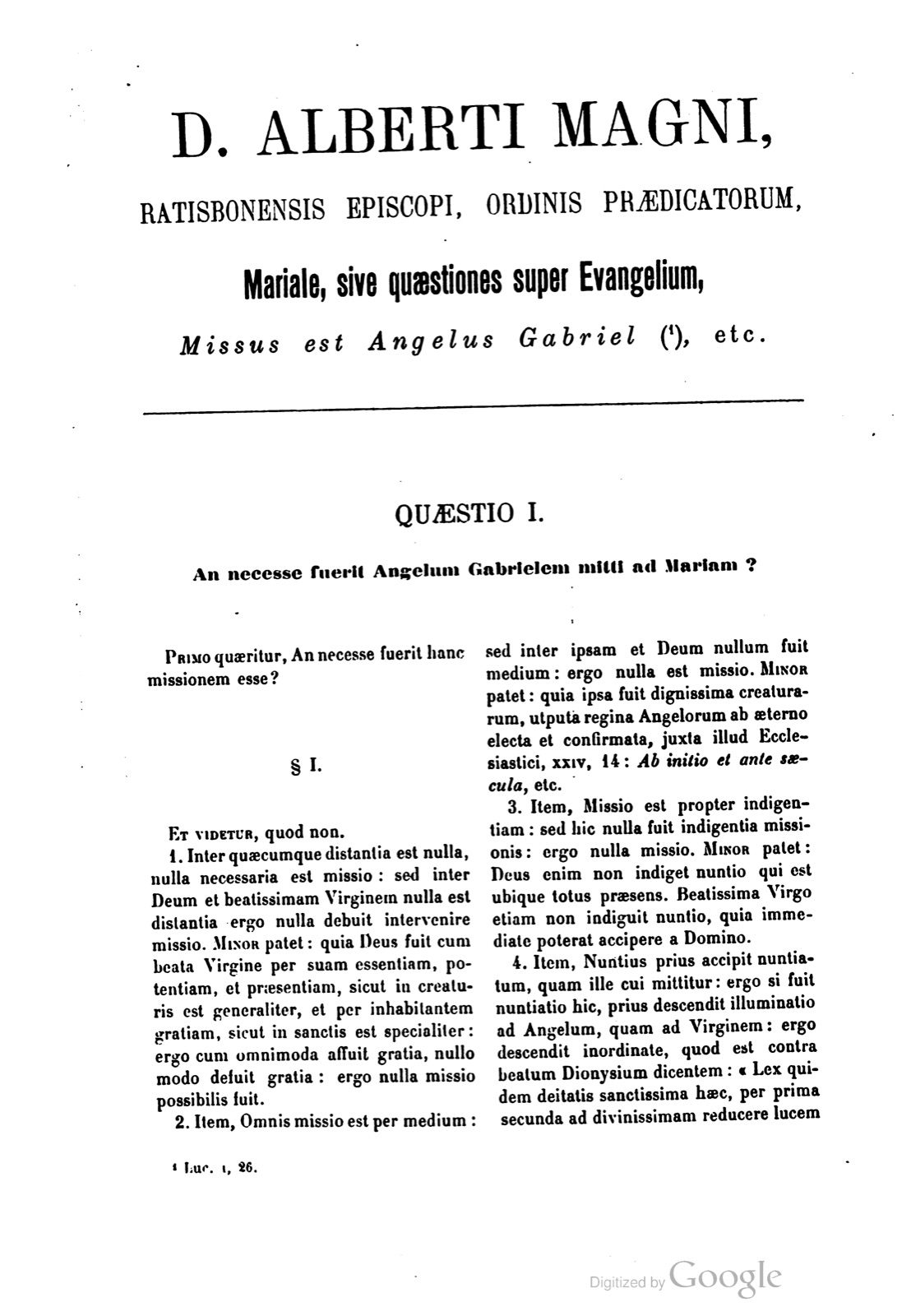
Quaestio I. An necesse fuerit Angelum Gabrielem mitti ad Mariam?
Primo quaeritur, An necesse fuerit hanc missionem esse?
§ I. Et videtur, quod non. 1. Inter quaecumque distantia est nulla, nulla necessaria est missio: sed inter Deum et beatissimam Virginem nulla est distantia: ergo nulla debuit intervenire missio. Minor patet: quia Deus fuit cum beata Virgine per suam essentiam, potentiam, et praesentiam, sicut in creaturis est generaliter, et per inhabitantem gratiam, sicut in sanctis est specialiter: ergo cum omnimoda affuit gratia, nullo modo defuit gratia: ergo nulla missio possibilis fuit.
2. Item, Omnis missio est per medium: sed inter ipsam et Deum nullum fuit medium: ergo nulla est missio. Minor patet: quia ipsa fuit dignissima creaturarum, utputa regina Angelorum ab aeterno electa et confirmata, juxta illud Ecclesiastici, XXIV, 14: Ab initio et ante saecula, etc.
3. Item, Missio est propter indigentiam: sed hic nulla fuit indigentia missionis: ergo nulla missio. Minor patet: Deus enim non indiget nuntio qui est ubique totus praesens. Beatissima Virgo etiam non indiguit nuntio, quia immediate poterat accipere a Domino.
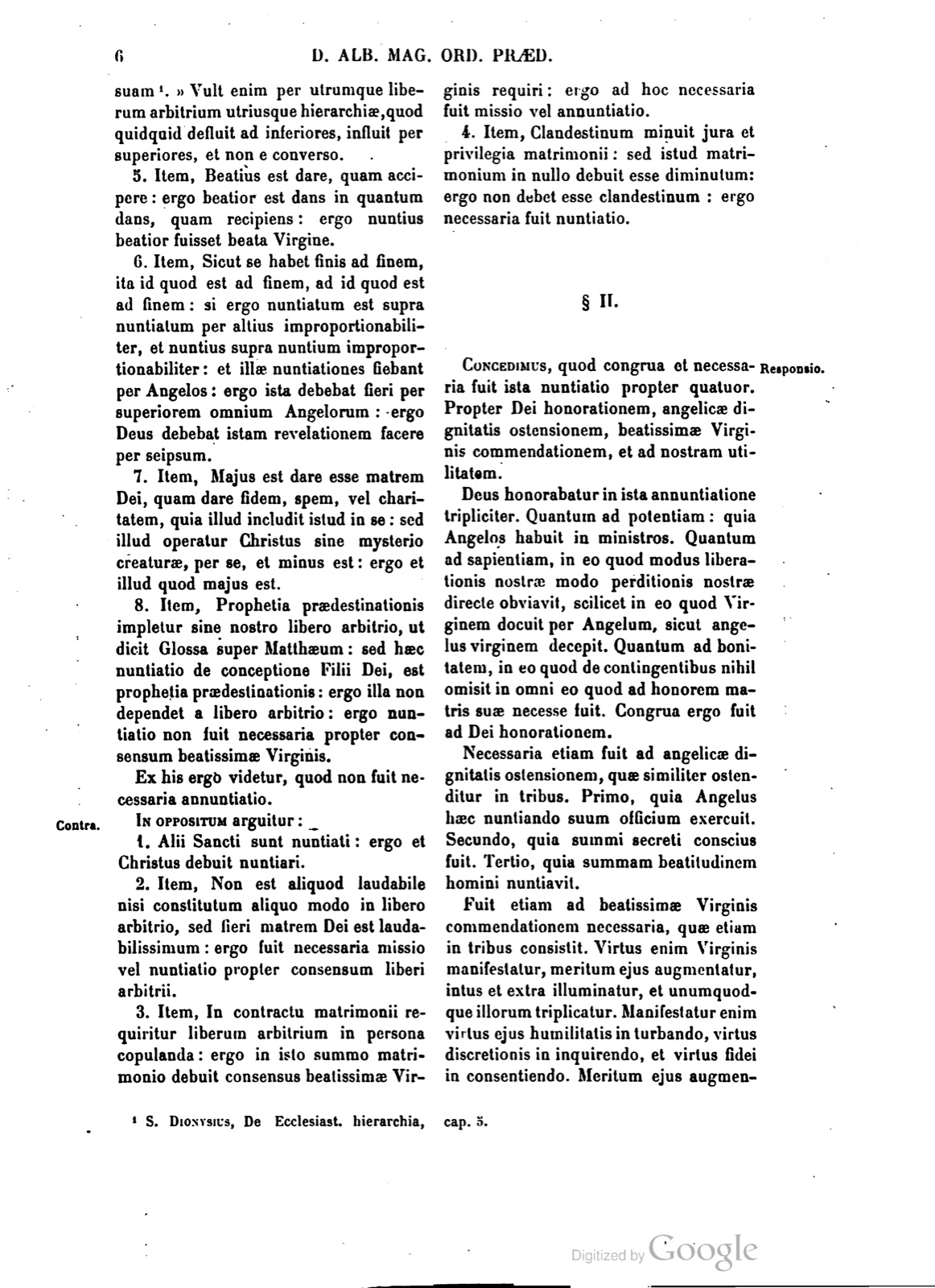
4. Item, Nuntius prius accipit nuntiatum, quam ille cui mittitur: ergo si fuit nuntiatio hic, prius descendit illuminatio ad Angelum, quam ad Virginem: ergo descendit inordinate, quod est contra beatum Dionysium dicentem: «Lex quidem deitatis sanctissima haec, per prima secunda ad divinissimam reducere lucem suam 1.» Vult enim per utrumque liberum arbitrium utriusque hierarchiae, quod quidquid defluit ad inferiores, influit per superiores, et non e converso.
5. Item, Beatius est dare, quam accipere: ergo beatior est dans in quantum dans, quam recipiens: ergo nuntius beatior fuisset beata Virgine.
6. Item, Sicut se habet finis ad finem, ita id quod est ad finem, ad id quod est ad finem: si ergo nuntiatum est supra nuntiatum per altius improportionabiliter, et nuntius supra nuntium improportionabiliter: et illae nuntiationes fiebant per Angelos: ergo ista debebat fieri per superiorem omnium Angelorum: ergo Deus debebat istam revelationem facere per seipsum.
7. Item, Majus est dare esse matrem Dei, quam dare fidem, spem, vel charitatem, quia illud includit istud in se: sed illud operatur Christus sine mysterio creaturae, per se, et minus est: ergo et illud quod majus est.
8. Item, Prophetia praedestinationis impletur sine nostro libero arbitrio, ut dicit Glossa super Matthaeum: sed haec nuntiatio de conceptione Filii Dei, est prophetia praedestinationis: ergo illa non dependet a libero arbitrio: ergo nuntiatio non fuit necessaria propter consensum beatissimae Virginis. Ex his ergo videtur, quod non fuit necessaria annuntiatio.
Question I. Whether it was necessary that the Angel Gabriel be sent to Mary.
First it is asked whether it was necessary that this mission exist.
§ I. And it seems that not. 1. Between whatever things there is no distance, no mission is necessary; but between God and the most blessed Virgin there is no distance; therefore no mission ought to have intervened. The minor is clear: because God was with the blessed Virgin through his essence, power, and presence, as he is generally in creatures, and through indwelling grace, as he is specially in the saints; therefore, since grace was present in every way, grace was in no way lacking; therefore no mission was possible.
2. Likewise, every mission is through a medium; but between her and God there was no medium; therefore there is no mission. The minor is clear: because she was the most worthy of creatures, as queen of the Angels elected and confirmed from eternity, according to that saying of Ecclesiasticus XXIV, 14: From the beginning and before the ages, etc.
3. Likewise, mission is on account of need; but here there was no need of mission; therefore no mission. The minor is clear: for God does not need a messenger, since he is everywhere wholly present. The most blessed Virgin also did not need a messenger, because she could receive immediately from the Lord.
4. Likewise, a messenger receives what is announced before the one to whom he is sent; therefore, if there was an announcing here, illumination descended first to the Angel rather than to the Virgin; therefore it descended inordinately, which is contrary to blessed Dionysius saying: "This indeed is the most sacred law of deity, to lead the second things back through the first to his most divine light 1." For he means, through each free choice of each hierarchy, that whatever flows down to inferiors flows in through superiors, and not conversely.
5. Likewise, it is more blessed to give than to receive; therefore the one giving, insofar as he gives, is more blessed than the one receiving; therefore the messenger would have been more blessed than the blessed Virgin.
6. Likewise, as end is related to end, so that which is for the end is related to that which is for the end; therefore if what was announced is above what was announced through something higher disproportionally, and messenger above messenger disproportionally, and those announcements were made through Angels, then this one ought to have been made through the superior of all the Angels; therefore God ought to have made this revelation through himself.
7. Likewise, it is greater to give to be the mother of God than to give faith, hope, or charity, because the former includes the latter in itself; but Christ works the latter without the mystery of a creature, through himself, and it is lesser; therefore also that which is greater.
8. Likewise, prophecy of predestination is fulfilled without our free choice, as the Gloss says on Matthew; but this announcement concerning the conception of the Son of God is prophecy of predestination; therefore that does not depend on free choice; therefore the announcement was not necessary on account of the consent of the most blessed Virgin. From these things, therefore, it seems that the announcement was not necessary.
In oppositum arguitur: 1. Alii Sancti sunt nuntiati: ergo et Christus debuit nuntiari. 2. Item, Non est aliquod laudabile nisi constitutum aliquo modo in libero arbitrio, sed fieri matrem Dei est laudabilissimum: ergo fuit necessaria missio vel nuntiatio propter consensum liberi arbitrii. 3. Item, In contractu matrimonii requiritur liberum arbitrium in persona copulanda: ergo in isto summo matrimonio debuit consensus beatissimae Virginis requiri: ergo ad hoc necessaria fuit missio vel annuntiatio. 4. Item, Clandestinum minuit jura et privilegia matrimonii: sed istud matrimonium in nullo debuit esse diminutum: ergo non debet esse clandestinum: ergo necessaria fuit nuntiatio.
§ II. Responsio. Concedimus, quod congrua et necessaria fuit ista nuntiatio propter quatuor. Propter Dei honorationem, angelicae dignitatis ostensionem, beatissimae Virginis commendationem, et ad nostram utilitatem.
Deus honorabatur in ista annuntiatione tripliciter. Quantum ad potentiam: quia Angelos habuit in ministros. Quantum ad sapientiam, in eo quod modus liberationis nostrae modo perditionis nostrae directe obviavit, scilicet in eo quod Virginem docuit per Angelum, sicut angelus virginem decepit. Quantum ad bonitatem, in eo quod de contingentibus nihil omisit in omni eo quod ad honorem matris suae necesse fuit. Congrua ergo fuit ad Dei honorationem.
Necessaria etiam fuit ad angelicae dignitatis ostensionem, quae similiter ostenditur in tribus. Primo, quia Angelus haec nuntiando suum officium exercuit. Secundo, quia summi secreti conscius fuit. Tertio, quia summam beatitudinem homini nuntiavit.
Fuit etiam ad beatissimae Virginis commendationem necessaria, quae etiam in tribus consistit. Virtus enim Virginis manifestatur, meritum ejus augmentatur, intus et extra illuminatur, et unumquodque illorum triplicatur. Manifestatur enim virtus ejus humilitatis in turbando, virtus discretionis in inquirendo, et virtus fidei in consentiendo. Meritum ejus augmentatur in tribus: in credendo nuntio, in consentiendo nuntiato, in humiliando se Deo. Intus et extra tripliciter illuminatur, in potentiis primis, mediis, et ultimis: in primis, id est, sensualitate per allocutionem et responsionem, in mediis per imaginationem et cognitionem, in ultimis per internam inspirationem. Et sic annuntiatio fuit utilis ad Virginis commendationem.
Fuit etiam necessaria ad nostram utilitatem: ad hanc quoque tripliciter, ad fidei confirmationem, ad devotionis accensionem, ad actuum informationem. Fides nostra confirmatur in eo quod origo et exordium processus nostrae redemptionis seriatim et ordinate describitur, et sancti Evangelii testimonio roboratur. Devotio accenditur, cum toti humano generi, mediante beatissima Virgine, perfecta pax et reconciliatio nuntiatur, et humana natura Deo abjecta et Angelis inimica, a Deo prior per Angelum salutatur. In hac annuntiatione actus nostri informantur per id quod beatissima Virgo gessit, quando ad ipsam Angelus venit, et per id quod respondit Angelo, et per id quod post receptionem plenitudinis gratiae fecit, elegantissime instruimur qualiter audita debemus conservare, qualiter nos debeamus ad recuperandam gratiam praeparare, qualiter recuperatam gratiam augmentare, qualiter augmentatam conservare. Et sic patet ad quae, et ad quid necessaria fuit ista nuntiatio.
To the opposite it is argued: 1. Other saints were announced; therefore Christ too ought to have been announced. 2. Likewise, nothing is praiseworthy unless it is established in some way in free choice; but to become the mother of God is most praiseworthy; therefore a mission or announcement was necessary on account of the consent of free choice. 3. Likewise, in the contract of marriage free choice is required in the person being joined; therefore in this highest marriage the consent of the most blessed Virgin ought to have been required; therefore for this a mission or announcement was necessary. 4. Likewise, what is clandestine diminishes the rights and privileges of marriage; but that marriage ought to have been diminished in nothing; therefore it ought not to be clandestine; therefore an announcement was necessary.
§ II. Response. We concede that that announcing was fitting and necessary for four reasons: for the honoring of God, the showing of angelic dignity, the commendation of the most blessed Virgin, and for our usefulness.
God was honored in that announcing in three ways. As to power: because he had Angels as ministers. As to wisdom: in that the manner of our liberation directly met the manner of our perdition, namely in that he instructed a virgin through an Angel, just as an angel deceived a virgin. As to goodness: in that he omitted nothing among contingent things in everything that was necessary for the honor of his mother. Therefore it was fitting for the honoring of God.
It was also necessary for the showing of angelic dignity, which likewise is shown in three things. First, because the Angel exercised his office by announcing these things. Second, because he was conscious of the highest secret. Third, because he announced the highest blessedness to a human being.
It was also necessary for the commendation of the most blessed Virgin, and this too consists in three things. For the Virgin's virtue is manifested, her merit is increased, she is illuminated within and without, and each of these is tripled. The virtue of her humility is manifested in being troubled, the virtue of discretion in inquiring, and the virtue of faith in consenting. Her merit is increased in three things: in believing the messenger, in consenting to what was announced, in humbling herself to God. Within and without she is illuminated in three ways, in the first, middle, and last powers: in the first, that is, sensuality, through address and response; in the middle through imagination and knowledge; in the last through internal inspiration. And thus the announcement was useful for the commendation of the Virgin.
It was also necessary for our usefulness, and for this also in three ways: for confirmation of faith, for enkindling of devotion, and for the informing of acts. Our faith is confirmed in that the origin and beginning of the process of our redemption is described serially and in order, and is strengthened by the testimony of the holy Gospel. Devotion is enkindled when perfect peace and reconciliation is announced to the whole human race through the mediation of the most blessed Virgin, and human nature, cast away from God and hostile to Angels, is first greeted by God through an Angel. In this announcing our acts are informed by what the most blessed Virgin did when the Angel came to her, and by what she answered the Angel, and by what she did after the reception of the fullness of grace; we are most elegantly instructed how we ought to preserve things heard, how we ought to prepare ourselves to recover grace, how to increase grace recovered, and how to preserve grace increased. And thus it is clear for what things and for what purpose that announcing was necessary.
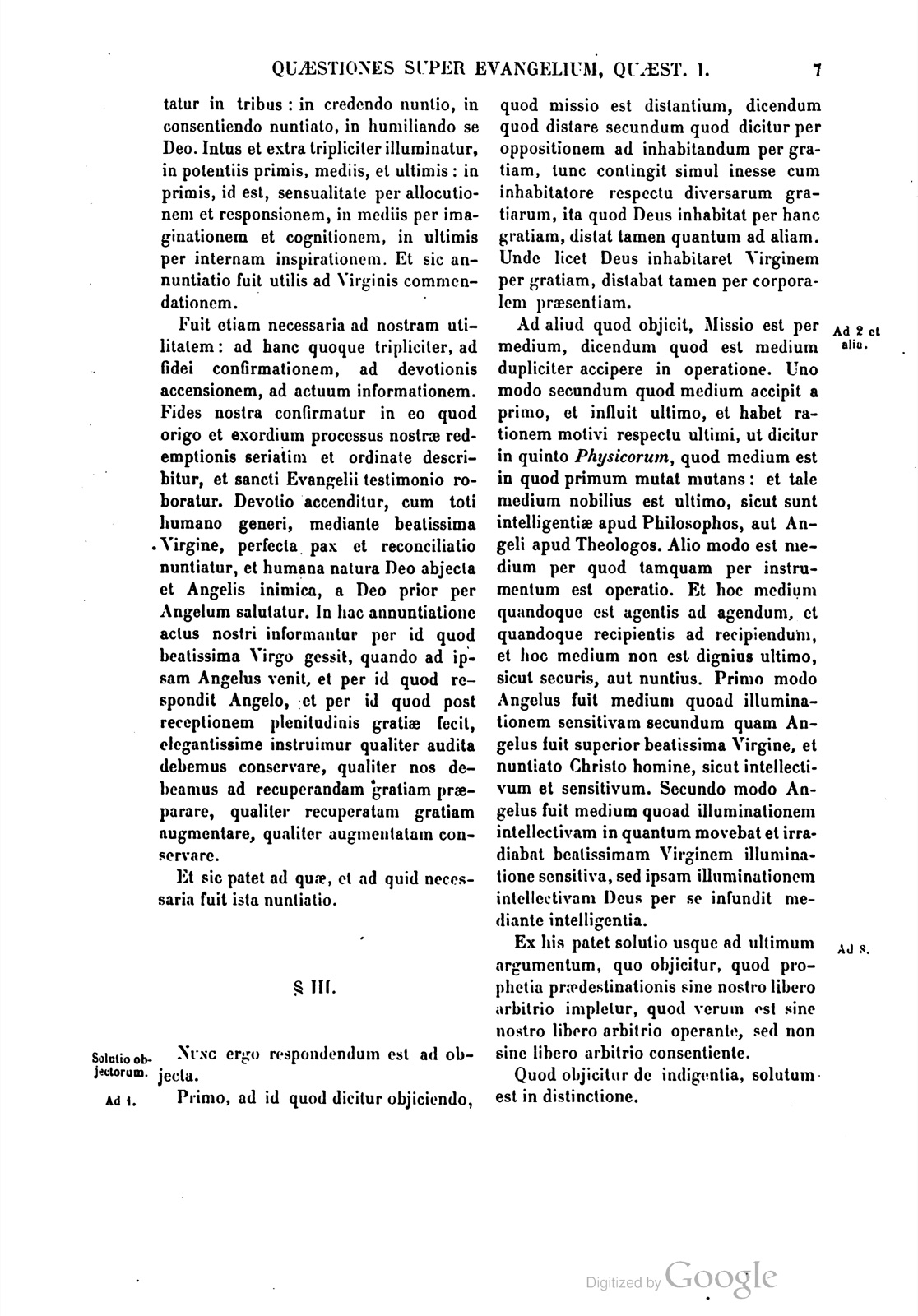
§ III. Solutio objectorum. Nunc ergo respondendum est ad objecta. Primo, ad id quod dicitur objiciendo, quod missio est distantium, dicendum quod distare secundum quod dicitur per oppositionem ad inhabitandum per gratiam, tunc contingit simul inesse cum inhabitatore respectu diversarum gratiarum, ita quod Deus inhabitat per hanc gratiam, distat tamen quantum ad aliam. Unde licet Deus inhabitaret Virginem per gratiam, distabat tamen per corporalem praesentiam.
Ad aliud quod objicit, Missio est per medium, dicendum quod est medium dupliciter accipere in operatione. Uno modo secundum quod medium accipit a primo, et influit ultimo, et habet rationem motivi respectu ultimi, ut dicitur in quinto Physicorum, quod medium est in quod primum mutat mutans: et tale medium nobilius est ultimo, sicut sunt intelligentiae apud Philosophos, aut Angeli apud Theologos. Alio modo est medium per quod tamquam per instrumentum est operatio. Et hoc medium quandoque est agentis ad agendum, et quandoque recipientis ad recipiendum, et hoc medium non est dignius ultimo, sicut securis, aut nuntius. Primo modo Angelus fuit medium quoad illuminationem sensitivam secundum quam Angelus fuit superior beatissima Virgine, et nuntiato Christo homine, sicut intellectivum et sensitivum. Secundo modo Angelus fuit medium quoad illuminationem intellectivam in quantum movebat et irradiabat beatissimam Virginem illuminatione sensitiva, sed ipsam illuminationem intellectivam Deus per se infundit mediante intelligentia.
Ex his patet solutio usque ad ultimum argumentum, quo objicitur, quod prophetia praedestinationis sine nostro libero arbitrio impletur, quod verum est sine nostro libero arbitrio operante, sed non sine libero arbitrio consentiente. Quod objicitur de indigentia, solutum est in distinctione.
§ III. Solution of the objections. Now, therefore, one must respond to the objections. First, to what is said in objecting, that mission belongs to things distant, it must be said that to be distant, insofar as it is said in opposition to indwelling through grace, then happens to be present at the same time with the indweller with respect to diverse graces, so that God indwells through this grace and nevertheless is distant as to another. Hence although God indwelt the Virgin through grace, nevertheless he was distant through bodily presence.
To the other thing which he objects, Mission is through a medium, it must be said that one may take medium in operation in two ways. In one way, insofar as the medium receives from the first and flows into the last, and has the character of a motive principle with respect to the last, as is said in the fifth book of the Physics, that the medium is that into which the mover first changes; and such a medium is nobler than the last, as the intelligences are among the Philosophers, or the Angels among the Theologians. In another way there is a medium through which the operation is as through an instrument. And this medium sometimes belongs to the agent for acting, and sometimes to the recipient for receiving, and this medium is not more worthy than the last, as an axe or a messenger. In the first way the Angel was a medium with respect to sensitive illumination, according to which the Angel was superior to the most blessed Virgin and to Christ announced as man, as the intellectual is to the sensitive. In the second way the Angel was a medium with respect to intellectual illumination insofar as he moved and irradiated the most blessed Virgin with sensitive illumination; but God through himself infused the intellectual illumination itself through the mediation of intelligence.
From these things the solution is clear up to the last argument, by which it is objected that prophecy of predestination is fulfilled without our free choice. This is true without our free choice operating, but not without free choice consenting. What is objected about need has been solved in the distinction.
Notes
- St. Dionysius, On the Ecclesiastical Hierarchy, chapter 5. (S. Dionysius, De Ecclesiast. hierarchia, cap. 5.) ↩
If a page does not appear, its photograph has not been uploaded yet.