Works › The Mariale: Questions on “Missus est”
Volume 37 · pp. 1–3
Mariale, or Questions on the Gospel, The Angel Gabriel was sent. Proemium; Presuppositions
A marker with ≈ is an approximate page boundary, placed by measure of the text; the page photographs remain the authority. In the paired views, clicking a page marker brings that page into view.
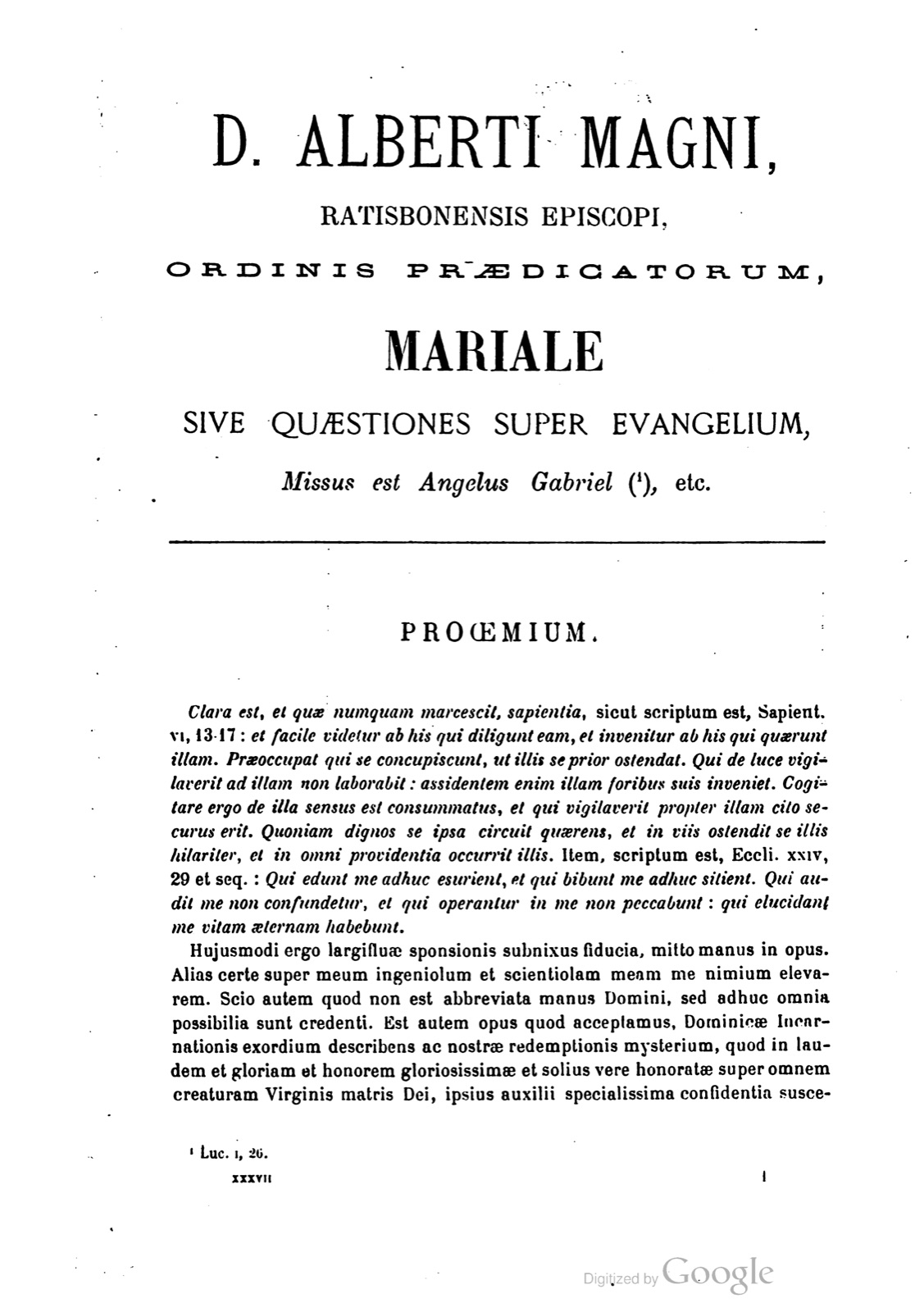
D. Alberti Magni, Ratisbonensis episcopi, Ordinis Praedicatorum, Mariale, sive quaestiones super Evangelium, Missus est Angelus Gabriel 1, etc. Proemium.
Clara est, et quae numquam marcescit, sapientia, sicut scriptum est, Sapient. VI, 13-17: et facile videtur ab his qui diligunt eam, et invenitur ab his qui quaerunt illam. Praeoccupat qui se concupiscunt, ut illis se prior ostendat. Qui de luce vigilaverit ad illam non laborabit: assidentem enim illam foribus suis inveniet. Cogitare ergo de illa sensus est consummatus, et qui vigilaverit propter illam cito securus erit. Quoniam dignos se ipsa circuit quaerens, et in viis ostendit se illis hilariter, et in omni providentia occurrit illis. Item, scriptum est, Eccli. XXIV, 29 et seq.: Qui edunt me adhuc esurient, et qui bibunt me adhuc sitient. Qui audit me non confundetur, et qui operantur in me non peccabunt: qui elucidant me vitam aeternam habebunt.
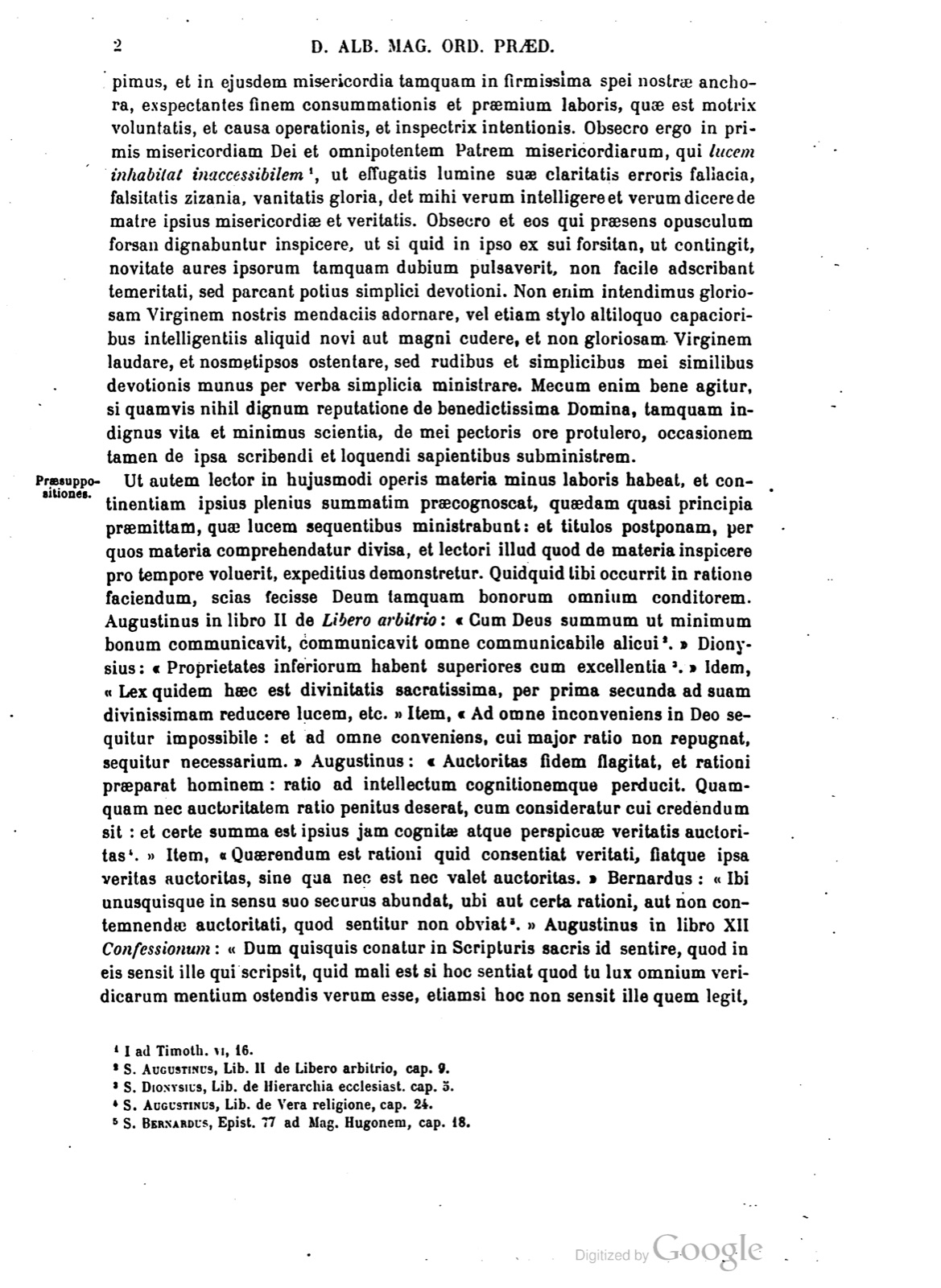
Hujusmodi ergo largifluae sponsionis subnixus fiducia, mitto manus in opus. Alias certe super meum ingeniolum et scientiolam meam me nimium elevarem. Scio autem quod non est abbreviata manus Domini, sed adhuc omnia possibilia sunt credenti. Est autem opus quod acceptamus, Dominicae Incarnationis exordium describens ac nostrae redemptionis mysterium, quod in laudem et gloriam et honorem gloriosissimae et solius vere honoratae super omnem creaturam Virginis matris Dei, ipsius auxilii specialissima confidentia suscepimus, et in ejusdem misericordia tamquam in firmissima spei nostrae anchora, exspectantes finem consummationis et praemium laboris, quae est motrix voluntatis, et causa operationis, et inspectrix intentionis. Obsecro ergo in primis misericordiam Dei et omnipotentem Patrem misericordiarum, qui lucem inhabitat inaccessibilem 2, ut effugatis lumine suae claritatis erroris fallacia, falsitatis zizania, vanitatis gloria, det mihi verum intelligere et verum dicere de matre ipsius misericordiae et veritatis. Obsecro et eos qui praesens opusculum forsan dignabuntur inspicere, ut si quid in ipso ex sui forsitan, ut contingit, novitate aures ipsorum tamquam dubium pulsaverit, non facile adscribant temeritati, sed parcant potius simplici devotioni. Non enim intendimus gloriosam Virginem nostris mendaciis adornare, vel etiam stylo altiloquo capacioribus intelligentiis aliquid novi aut magni cudere, et non gloriosam Virginem laudare, et nosmetipsos ostentare, sed rudibus et simplicibus mei similibus devotionis munus per verba simplicia ministrare. Mecum enim bene agitur, si quamvis nihil dignum reputatione de benedictissima Domina, tamquam indignus vita et minimus scientia, de mei pectoris ore protulero, occasionem tamen de ipsa scribendi et loquendi sapientibus subministrem.
D. Albert the Great, bishop of Ratisbon, of the Order of Preachers, Mariale, or Questions on the Gospel, The Angel Gabriel was sent 1, etc. Proemium.
Wisdom is bright and never withers, as it is written, Wisdom VI, 13-17: and she is easily seen by those who love her, and is found by those who seek her. She anticipates those who desire her, so that she may show herself to them first. He who has kept watch for her from the light shall not labor, for he will find her sitting at his doors. Therefore to think about her is perfected sense, and he who has kept watch on account of her will quickly be secure. For she herself goes about seeking those worthy of her, and in the ways she shows herself to them cheerfully, and in all providence she meets them. Likewise, it is written, Ecclesiasticus XXIV, 29 and following: Those who eat me shall still hunger, and those who drink me shall still thirst. He who hears me shall not be confounded, and those who work in me shall not sin: those who explain me shall have eternal life.
Therefore, supported by confidence in a promise so bountifully flowing, I put my hands to the work. Otherwise surely I would be raising myself too much above my little talent and my little knowledge. But I know that the hand of the Lord has not been shortened, but that all things are still possible to one who believes. Now the work that we undertake describes the beginning of the Lord's Incarnation and the mystery of our redemption; we have undertaken it for the praise and glory and honor of the most glorious Virgin, mother of God, who alone is truly honored above every creature, with most special confidence in her help, and in the mercy of the same as in the firmest anchor of our hope, awaiting the end of consummation and the reward of labor, which is the mover of the will, the cause of operation, and the inspector of intention. Therefore first of all I beseech the mercy of God and the almighty Father of mercies, who dwells in inaccessible light 2, that, after the deception of error, the darnel of falsity, and the glory of vanity have been put to flight by the light of his brightness, he may grant me to understand what is true and to speak what is true concerning the mother of his mercy and truth. I also beseech those who perhaps will deem the present little work worthy to inspect, that if anything in it, perhaps from its own novelty, as happens, should strike their ears as doubtful, they not readily ascribe it to rashness, but rather spare simple devotion. For we do not intend to adorn the glorious Virgin with our lies, or even by a lofty style to forge some new or great thing for more capable understandings, and not to praise the glorious Virgin and display ourselves; rather, we intend to minister the gift of devotion through simple words to the unlearned and simple, like me. For it goes well with me if, although I, unworthy in life and least in knowledge, bring forth from the mouth of my breast nothing worthy in estimation about the most blessed Lady, nevertheless I furnish to the wise an occasion for writing and speaking about her.
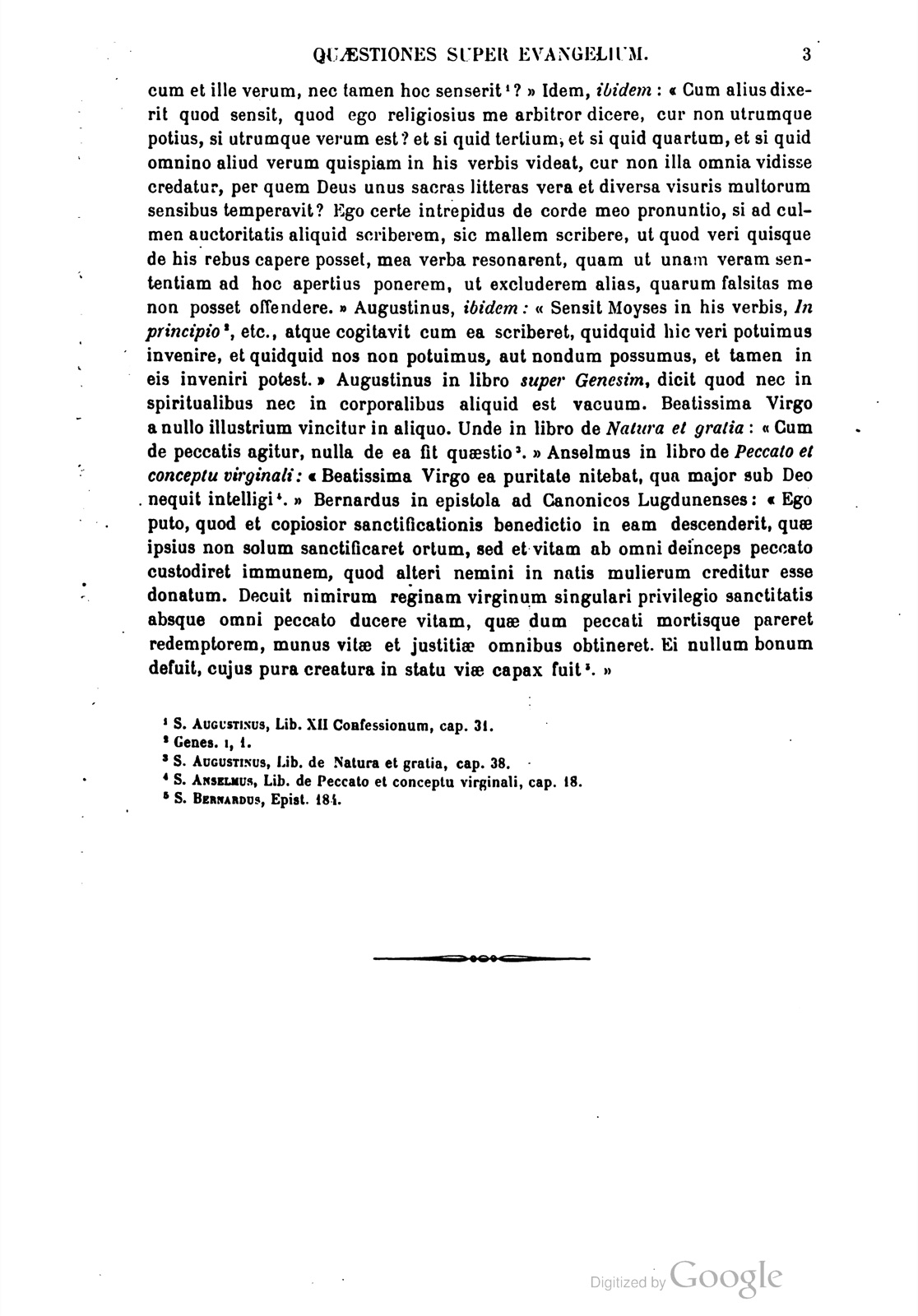
Praesuppositiones. Ut autem lector in hujusmodi operis materia minus laboris habeat, et continentiam ipsius plenius summatim praecognoscat, quaedam quasi principia praemittam, quae lucem sequentibus ministrabunt: et titulos postponam, per quos materia comprehendatur divisa, et lectori illud quod de materia inspicere pro tempore voluerit, expeditius demonstretur. Quidquid tibi occurrit in ratione faciendum, scias fecisse Deum tamquam bonorum omnium conditorem. Augustinus in libro II de Libero arbitrio: «Cum Deus summum ut minimum bonum communicavit, communicavit omne communicabile alicui 3.» Dionysius: «Proprietates inferiorum habent superiores cum excellentia 4.» Idem, «Lex quidem haec est divinitatis sacratissima, per prima secunda ad suam divinissimam reducere lucem, etc.» Item, «Ad omne inconveniens in Deo sequitur impossibile: et ad omne conveniens, cui major ratio non repugnat, sequitur necessarium.» Augustinus: «Auctoritas fidem flagitat, et rationi praeparat hominem: ratio ad intellectum cognitionemque perducit. Quamquam nec auctoritatem ratio penitus deserat, cum consideratur cui credendum sit: et certe summa est ipsius jam cognitae atque perspicuae veritatis auctoritas 5.» Item, «Quaerendum est rationi quid consentiat veritati, fiatque ipsa veritas auctoritas, sine qua nec est nec valet auctoritas.» Bernardus: «Ibi unusquisque in sensu suo securus abundat, ubi aut certa rationi, aut non contemnendae auctoritati, quod sentitur non obviat 6.» Augustinus in libro XII Confessionum: «Dum quisquis conatur in Scripturis sacris id sentire, quod in eis sensit ille qui scripsit, quid mali est si hoc sentiat quod tu lux omnium veridicarum mentium ostendis verum esse, etiamsi hoc non sensit ille quem legit, cum et ille verum, nec tamen hoc senserit 7?» Idem, ibidem: «Cum alius dixerit quod sensit, quod ego religiosius me arbitror dicere, cur non utrumque potius, si utrumque verum est? et si quid tertium, et si quid quartum, et si quid omnino aliud verum quispiam in his verbis videat, cur non illa omnia vidisse credatur, per quem Deus unus sacras litteras vera et diversa visuris multorum sensibus temperavit? Ego certe intrepidus de corde meo pronuntio, si ad culmen auctoritatis aliquid scriberem, sic mallem scribere, ut quod veri quisque de his rebus capere posset, mea verba resonarent, quam ut unam veram sententiam ad hoc apertius ponerem, ut excluderem alias, quarum falsitas me non posset offendere.» Augustinus, ibidem: «Sensit Moyses in his verbis, In principio 8, etc., atque cogitavit cum ea scriberet, quidquid hic veri potuimus invenire, et quidquid nos non potuimus, aut nondum possumus, et tamen in eis inveniri potest.» Augustinus in libro super Genesim, dicit quod nec in spiritualibus nec in corporalibus aliquid est vacuum. Beatissima Virgo a nullo illustrium vincitur in aliquo. Unde in libro de Natura et gratia: «Cum de peccatis agitur, nulla de ea fit quaestio 9.» Anselmus in libro de Peccato et conceptu virginali: «Beatissima Virgo ea puritate nitebat, qua major sub Deo nequit intelligi 10.» Bernardus in epistola ad Canonicos Lugdunenses: «Ego puto, quod et copiosior sanctificationis benedictio in eam descenderit, quae ipsius non solum sanctificaret ortum, sed et vitam ab omni deinceps peccato custodiret immunem, quod alteri nemini in natis mulierum creditur esse donatum. Decuit nimirum reginam virginum singulari privilegio sanctitatis absque omni peccato ducere vitam, quae dum peccati mortisque pareret redemptorem, munus vitae et justitiae omnibus obtineret. Ei nullum bonum defuit, cujus pura creatura in statu viae capax fuit 11.»
Presuppositions. But so that the reader may have less labor in the matter of a work of this sort, and may more fully know beforehand its contents in summary, I shall set before him certain things as principles, which will minister light to what follows; and I shall place titles after them, by which the matter may be comprehended as divided, and that which the reader may wish for the time to inspect concerning the matter may be shown more expeditiously. Whatever occurs to you as needing to be done in reason, know that God has done it as the founder of all good things. Augustine in book II On Free Choice: "When God communicated the highest good as the least good, he communicated everything communicable to someone 3." Dionysius: "Higher beings have the properties of lower beings with excellence 4." The same: "This indeed is the most sacred law of divinity, to lead back the second things through the first things to its own most divine light, etc." Likewise, "Upon every inconvenience in God there follows the impossible; and upon everything fitting, to which a greater reason is not opposed, there follows the necessary." Augustine: "Authority demands faith, and prepares a human being for reason; reason leads him to understanding and knowledge. Yet reason does not utterly desert authority, since it is considered whom one must believe; and certainly the authority of truth already known and clear is the highest 5." Likewise, "One must seek for reason what agrees with truth, and truth itself becomes authority, without which authority neither is nor has force." Bernard: "There each one securely abounds in his own sense, where what is thought is opposed neither to certain reason nor to authority that must not be despised 6." Augustine in book XII of the Confessions: "When anyone strives in the sacred Scriptures to perceive that which the one who wrote perceived in them, what evil is there if he perceives what you, the light of all truth-speaking minds, show to be true, even if the one whom he reads did not perceive this, since both he perceived something true and yet did not perceive this 7?" The same, in the same place: "When another has said what he perceived, what I judge that I speak more religiously, why not rather both, if both are true? and if some third thing, and if some fourth thing, and if any other thing altogether that is true someone sees in these words, why should he not be believed to have seen all those things, through whom the one God tempered the sacred letters to the true and diverse senses of many who would see them? I indeed fearlessly pronounce from my heart: if I were writing anything up to the summit of authority, I would prefer to write in such a way that my words would resound with whatever true thing each person could grasp concerning these matters, rather than that I should set down one true opinion more openly for this purpose, that I might exclude others whose falsity could not offend me." Augustine, in the same place: "Moses perceived in these words, In the beginning 8, etc., and thought, when he wrote them, whatever true thing we have been able to find here, and whatever we have not been able, or are not yet able, to find, and yet can be found in them." Augustine, in the book On Genesis, says that neither in spiritual things nor in bodily things is anything empty. The most blessed Virgin is surpassed by none of the illustrious in anything. Hence in the book On Nature and Grace: "When sins are being treated, no question is made concerning her 9." Anselm in the book On Sin and Virginal Conception: "The most blessed Virgin shone with that purity than which a greater under God cannot be understood 10." Bernard in the letter to the Canons of Lyons: "I think that a more abundant blessing of sanctification descended into her, which not only sanctified her origin itself, but also kept her life immune thereafter from every sin, which is believed to have been granted to no other among those born of women. Indeed it was fitting that the queen of virgins should lead her life with a singular privilege of sanctity without every sin, she who, when she bore the redeemer of sin and death, obtained for all the gift of life and justice. No good was lacking to her of which a pure creature in the state of the way was capable 11."
Notes
- Luke 1:26. (Luc. 1, 26.) ↩
- First to Timothy 6:16. (I ad Timoth. VI, 16.) ↩
- St. Augustine, book II On Free Choice, chapter 9. (S. Augustinus, Lib. II de Libero arbitrio, cap. 9.) ↩
- St. Dionysius, book On the Ecclesiastical Hierarchy, chapter 5. (S. Dionysius, Lib. de Hierarchia ecclesiast. cap. 5.) ↩
- St. Augustine, book On True Religion, chapter 24. (S. Augustinus, Lib. de Vera religione, cap. 24.) ↩
- St. Bernard, Letter 77 to Master Hugh, chapter 18. (S. Bernardus, Epist. 77 ad Mag. Hugonem, cap. 18.) ↩
- St. Augustine, book XII of the Confessions, chapter 31. (S. Augustinus, Lib. XII Confessionum, cap. 31.) ↩
- Genesis 1:1. (Genes. 1, 1.) ↩
- St. Augustine, book On Nature and Grace, chapter 38. (S. Augustinus, Lib. de Natura et gratia, cap. 38.) ↩
- St. Anselm, book On Sin and Virginal Conception, chapter 18. (S. Anselmus, Lib. de Peccato et conceptu virginali, cap. 18.) ↩
- St. Bernard, Letter 184. (S. Bernardus, Epist. 184.) ↩
If a page does not appear, its photograph has not been uploaded yet.