Works › Sermons on the Most Holy Sacrament of the Eucharist
Volume 13 · pp. 765–767
Sermon XXIV. On the Three Principal Effects, and That Each Avails for Three Things
A marker with ≈ is an approximate page boundary, placed by measure of the text; the page photographs remain the authority. In the paired views, clicking a page marker brings that page into view.
### Sermo XXIV
### De tribus effectibus principalibus, et quod quilibet valet ad tria
Venite, comedite panem meum. Prov. ix, 5. Ut supra.
Sacrosanctum Corpus Domini tres habet effectus principales:
Primus est peccatorum destructio.
Secundus, bonorum spiritualium augmentatio.
Tertius, animarum confortatio, vel vitae aeternae collatio.
De primo, Dan. ii, 34: Videbas donec abscissus est lapis de monte sine manibus: et percussit statuam, id est, figmenta peccatorum, in pedibus, et comminuit eos. I Joan. iii, 8: In hoc apparuit Filius Dei, ut dissolvat opera diaboli.
De secundo, Prov. xii, 2: Qui bonus est, hauriet gratiam a Domino, quia scilicet ipse est fons totius gratiae. Eccli. xxiv, 25 et 26: In me gratia omnis viae, et veritatis. Transite ad me omnes qui concupiscitis me, et a generationibus meis adimplemini.
De tertio. Psal. ciii, 15: Panis cor hominis confirmat. Gen. xviii, 5: Ponam buccellam panis, et confortate cor vestrum, etc.
I.
Primus ergo effectus principalis corporis Christi, est peccatorum destructio. Et hoc ad tria: 1. Ad delendam maculam cordis, 2. Ad mitigandum stimulum carnis, 3. Ad resistendum cogitationibus pravis.
1. De primo, Psal. lxvii, 13: Nive dealbabuntur in Selmon. Selmon mons Dei est, et interpretatur umbra, et (sicut dicit Glossa) corpus Christi significat: quia sicut umbra fit de lumine et corpore, ita in corpore Christi est lumen divinitatis, et caro humanitatis. In hoc monte umbroso fideles super nivem dealbabuntur: quia virtute corporis Christi incomparabiliter a macula peccatorum emundantur. Isa. xliii, 25: Ego sum ipse, qui deleo iniquitates tuas.
2. De secundo, Exo. xvi, 13 et 14: Mane ros jacuit... in similitudinem pruinae super terram. Panis caelestis in similitudine roris et pruinae apparebat, quia corpus Christi a furore vitiorum refrigerat. Psal. lxxxviii, 10: Tu dominaris potestati maris, etc. Mare significat multas miserias hominis, motus fluctuum, stimulum carnis.
3. De tertio, Cant. i, 12: Fasciculus myrrhae dilectus meus mihi. Myrrha servat corpora a vermibus incorrupta: sic corpus Christi corda fidelium a pravis cogitationibus illaesa: quia cum dilectum Dominum suscipimus, si fasciculum myrrhae, id est, amaritudinem Passionis ejus mente cogitamus, vermes malorum cogitationum a nobis repellimus.
II.
Secundus effectus principalis est bonorum spiritualium augmentatio: et hoc ad tria: 1. Ad decorem castitatis, 2. Ad fervorem charitatis, 3. Ad saporem suavitatis.
1. De primo, Dan. i, 15: Apparuerunt vultus eorum meliores, et corpulentiores prae omnibus pueris, qui vescebantur cibo regio. Glossa: "Vultus eorum, quos panis satiabat qui de caelo descendit, apparuerunt meliores," decore scilicet castitatis: unde et pueri illi casti erant. Cant. vii, 6: Quam pulchra es, et quam decora carissima, in deliciis! Sicut enim bonum nutrimentum multum facit ad decorem corporis, sic deliciae cibi spiritualis ad pulchritudinem castitatis. Ezech. xvi, 13: Similam, et mel, et oleum comedisti, et decora facta es vehementer nimis.
### Sermon XXIV
### On the Three Principal Effects, and That Each Avails for Three Things
Come, eat my bread. Proverbs 9:5. As above.
The most holy Body of the Lord has three principal effects:
The first is the destruction of sins.
The second, the increase of spiritual goods.
The third, the strengthening of souls, or the bestowal of eternal life.
Concerning the first, Daniel 2:34: You watched until a stone was cut from the mountain without hands, and it struck the statue, that is, the fabrications of sins, in the feet, and broke them to pieces. 1 John 3:8: For this the Son of God appeared, that he might dissolve the works of the devil.
Concerning the second, Proverbs 12:2: He who is good will draw grace from the Lord, because namely he himself is the fount of all grace. Ecclesiasticus 24:25 and 26: In me is all grace of the way and of truth. Pass over to me, all you who desire me, and be filled from my generations.
Concerning the third, Psalm 103:15: Bread confirms the heart of man. Genesis 18:5: I will put a morsel of bread, and strengthen your heart, etc.
I.
Therefore the first principal effect of the body of Christ is the destruction of sins. And this is for three things: 1. for wiping away the stain of the heart, 2. for mitigating the goad of the flesh, 3. for resisting depraved thoughts.
1. Concerning the first, Psalm 67:13: They will be whitened with snow in Selmon. Selmon is the mountain of God, and is interpreted shadow, and, as the Gloss says, signifies the body of Christ, because just as shadow is made from light and body, so in the body of Christ there is the light of divinity and the flesh of humanity. On this shadowy mountain the faithful will be whitened beyond snow, because by the power of Christ's body they are incomparably cleansed from the stain of sins. Isaiah 43:25: I am he who wipes away your iniquities.
2. Concerning the second, Exodus 16:13 and 14: In the morning dew lay... in the likeness of hoarfrost upon the earth. The heavenly bread appeared in the likeness of dew and hoarfrost because the body of Christ cools from the fury of vices. Psalm 88:10: You rule the power of the sea, etc. The sea signifies the many miseries of man, the motion of waves, the goad of the flesh.
3. Concerning the third, Song of Songs 1:12: My beloved is a bundle of myrrh to me. Myrrh keeps bodies uncorrupted by worms; so the body of Christ keeps the hearts of the faithful unharmed by depraved thoughts, because when we receive the beloved Lord, if we think in mind on the bundle of myrrh, that is, the bitterness of his Passion, we drive away from ourselves the worms of evil thoughts.
II.
The second principal effect is the increase of spiritual goods, and this for three things: 1. for the beauty of chastity, 2. for the fervor of charity, 3. for the taste of sweetness.
1. Concerning the first, Daniel 1:15: Their faces appeared better and fatter than all the boys who ate the royal food. The Gloss says: "Their faces, whom the bread that descended from heaven satisfied, appeared better," namely with the beauty of chastity; hence those boys also were chaste. Song of Songs 7:6: How beautiful you are, and how comely, dearest one, in delights! For just as good nourishment does much for the beauty of the body, so the delights of spiritual food do much for the beauty of chastity. Ezekiel 16:13: You ate fine flour and honey and oil, and you were made exceedingly beautiful.
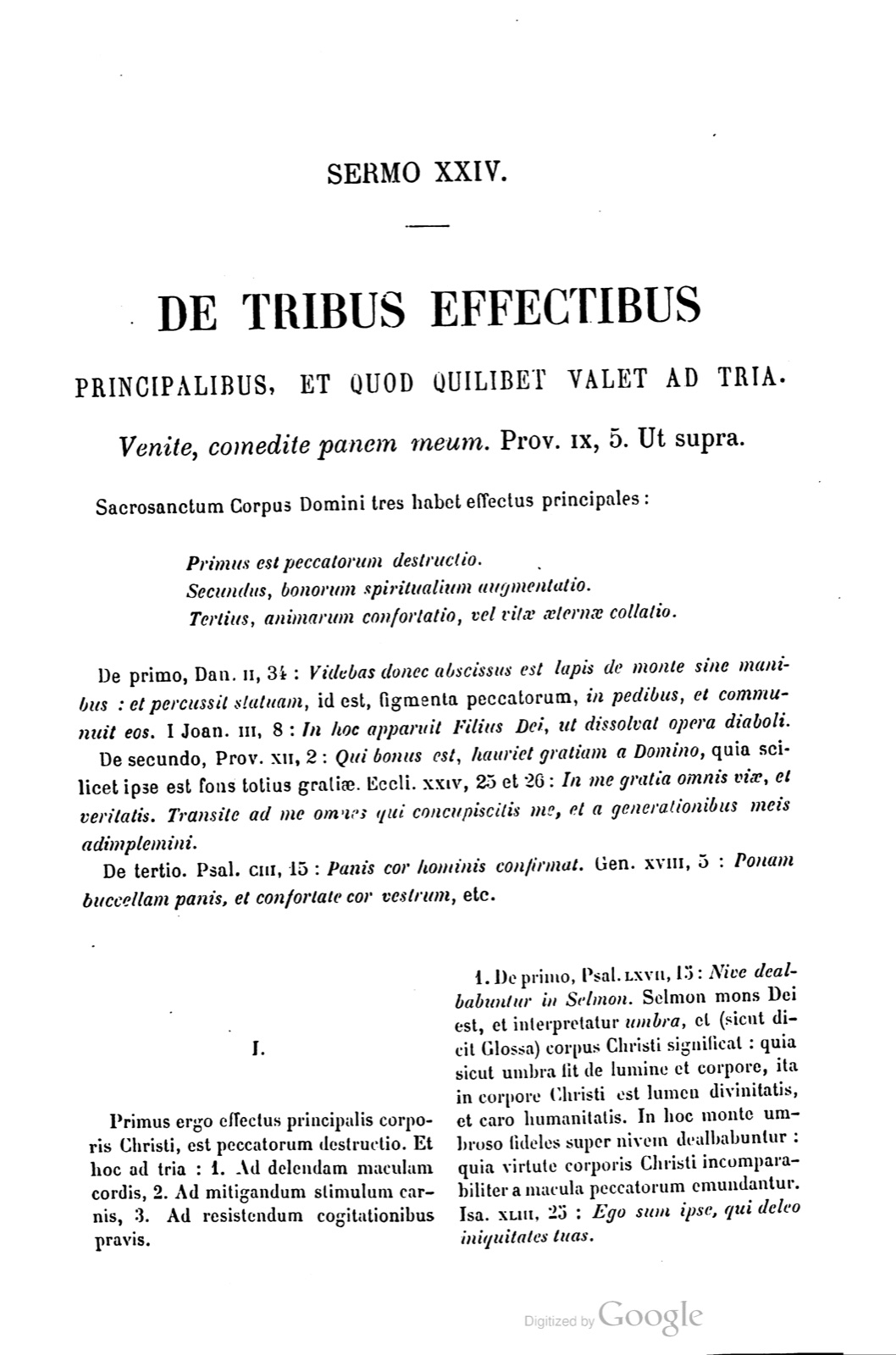
2. De secundo, Eccli. xxxii, 7: Gemmula carbunculi in ornamento auri. Glossa: "Ardentium gemmarum principatum tenet carbunculus." Sic Deus. Quia ignitus, ut carbo, signat corpus Christi: quod cor accipientis et ornat castitate, et inflammat charitate. Psal. xvii, 9: Ignis a facie ejus exarsit: carbones succensi sunt ab eo. Hinc IV Reg. iv, 35: Eliseus incumbens incurvavit se super puerum, et calefacta est caro pueri.
3. De tertio, Gen. xlix, 20: Aser, pinguis panis ejus, et praebebit delicias regibus. Sap. xvi, 20 et 21: Angelorum esca nutrivisti populum tuum, et paratum panem de caelo praestitisti illis, omne delectamentum in se habentem, et omnis saporis suavitatem. Substantia enim tua dulcedinem tuam, quam in filios habes, ostendebat. Cant. v, 1: Comedi favum cum melle meo, id est, dulcedinem carnis Christi cum dulcedine divinitatis: bibi vinum meum cum lacte meo, id est, dulcedinem sanguinis Christi cum dulcedine spiritualis consolationis.
III.
Tertius effectus principalis est animarum confortatio: et hoc ad tria: 1. Ad debellandum daemonia, 2. Ad sustinendum adversa, 3. Ad operandum bona.
1. De primo, I Reg. xxx, 11 et seq.: Invenerunt viri David virum Aegyptium in agro, et adduxerunt eum ad David: dederuntque ei panem ut comederet,... et refocillatus est: et adduxit David ad latrunculos, et percussit eos. Vir Aegyptius significat peccatorem quem Praedicatores adducunt ad Christum per conversionem, qui pane Dominici corporis confortatus, fit dux Christi exercitus ad daemones debellandos. Ad Eph. vi, 10 et 11: Confortamini in Domino, et in potentia virtutis ejus, ut possitis stare adversus insidias diaboli. I Reg. vii, 10: Factum est cum offerret Samuel agnum in holocaustum, exterruit Dominus Philisthaeum, et caesi sunt a filiis Israel.
2. De secundo, III Reg. xxii, 27: Mittite virum istum in carcerem, et sustentate eum pane tribulationis. In carcerem mittitur, qui in hoc mundo adversa patitur. Panis tribulationis quo sustentatur, est panis aeternae vitae, quo ad sustinenda adversa confortatur. Act. xxvii, 34 et 36, dicit Apostolus existentibus in magno periculo maris: Rogo vos accipere cibum pro salute vestra: et omnes sumpserunt cibum, et animaequiores facti sunt. Ad Philip. iv, 13: Omnia possum in eo qui me confortat.
2. Concerning the second, Ecclesiasticus 32:7: A small gem of carbuncle in an ornament of gold. The Gloss says: "The carbuncle holds the chief place of burning gems." Thus God. Because fiery like coal, it signifies the body of Christ, which both adorns the heart of the one receiving it with chastity and inflames it with charity. Psalm 17:9: Fire blazed from his face; coals were kindled by him. Hence 4 Kings 4:35: Elisha, lying upon him, bent himself over the boy, and the flesh of the boy was warmed.
3. Concerning the third, Genesis 49:20: Asher, his bread is fat, and he will provide delights for kings. Wisdom 16:20 and 21: You nourished your people with the food of Angels and supplied them with bread prepared from heaven, having in itself every delight and the sweetness of every taste. For your substance showed your sweetness which you have toward your children. Song of Songs 5:1: I ate my honeycomb with my honey, that is, the sweetness of the flesh of Christ with the sweetness of divinity; I drank my wine with my milk, that is, the sweetness of Christ's blood with the sweetness of spiritual consolation.
III.
The third principal effect is the strengthening of souls, and this for three things: 1. for defeating demons, 2. for sustaining adversities, 3. for doing good works.
1. Concerning the first, 1 Kings 30:11 and following: The men of David found an Egyptian man in the field and brought him to David; and they gave him bread so that he might eat, ... and he was refreshed; and he led David to the bandits, and he struck them. The Egyptian man signifies the sinner whom Preachers lead to Christ through conversion, who, strengthened by the bread of the Lord's body, becomes the leader of Christ's army for defeating demons. Ephesians 6:10 and 11: Be strengthened in the Lord and in the power of his might, so that you may be able to stand against the snares of the devil. 1 Kings 7:10: It happened, when Samuel offered the lamb as a holocaust, the Lord terrified the Philistine, and they were slain by the sons of Israel.
2. Concerning the second, 3 Kings 22:27: Send that man into prison, and sustain him with the bread of tribulation. He is sent into prison who suffers adversities in this world. The bread of tribulation by which he is sustained is the bread of eternal life, by which he is strengthened for sustaining adversities. Acts 27:34 and 36: the Apostle says to those existing in great danger of the sea: I ask you to receive food for your salvation; and all took food and were made more calm in spirit. Philippians 4:13: I can do all things in him who strengthens me.
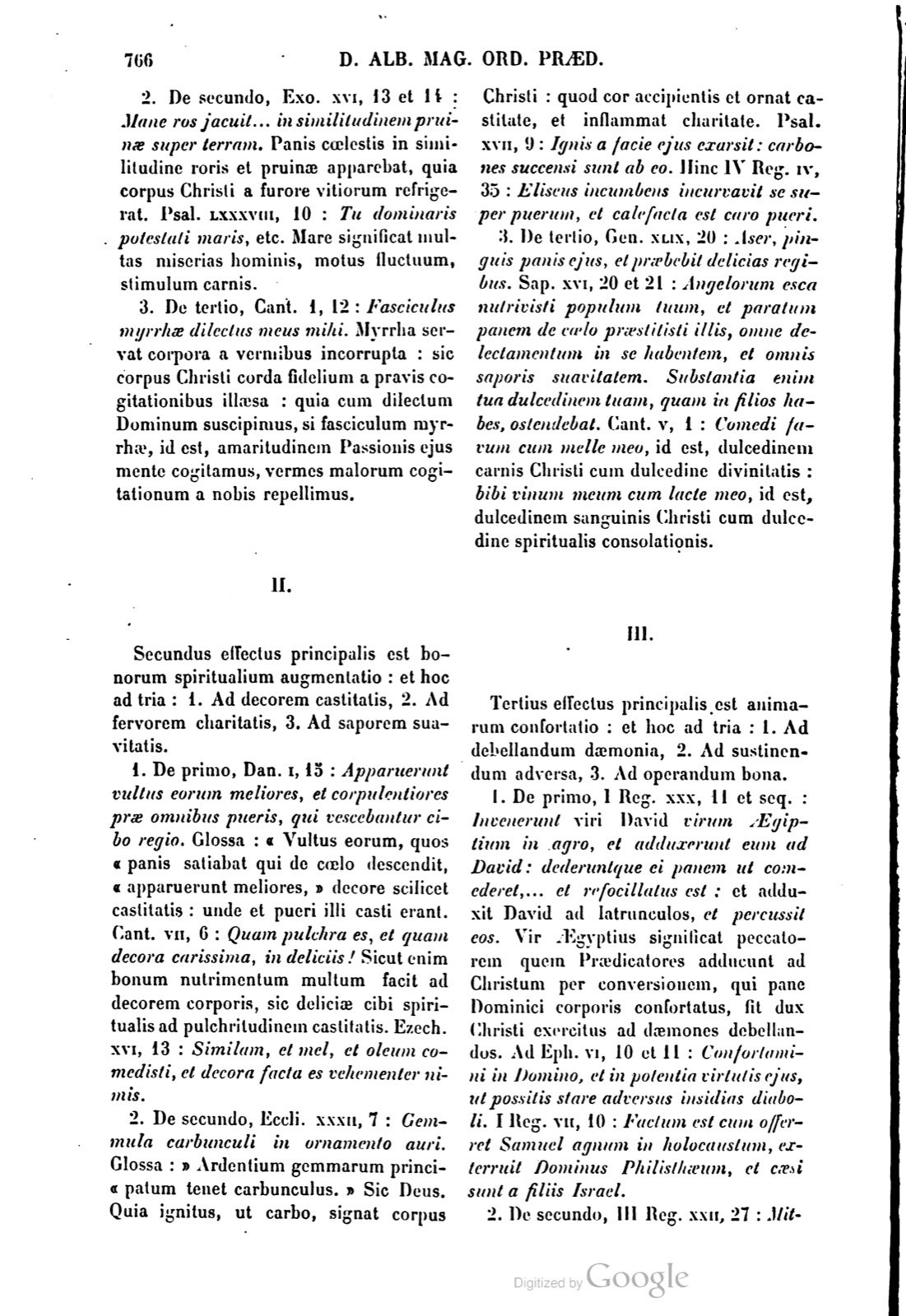
3. De tertio, Prov. xxxi, 15: Mulier fortis de nocte surrexit, deditque praedam domesticis suis, et cibaria ancillis suis. Mulier fortis est Ecclesia de Gentibus. Haec de nocte surrexit: quia per auditum verbi Dei de tenebris peccatorum ad Christum se convertit. Praedam domesticis et cibaria ancillis suis dedit: quia sacramenta Judaeae missa quae suscipere noluit, haec cum omni desiderio rapuit, et de eis familiam suam, id est, fideles pavit: et hoc ut eos ad tria bona confortaret: 1. Ad opera misericordiarum, 2. Ad lucrum animarum, 3. Ad emptionem caelestium divitiarum. Unde sequitur post praedictum cibum: Consideravit agrum, et emit eum: De fructu manuum suarum plantavit vineam (Prov. xxxi, 16).
1. Primo ergo confortamur cibo Domini ad opus bonum. Eccli. xxxiii, 25: Cibaria, et virga, et onus asino: panis, et disciplina, et opus servo. Sicut pabulum confortat asinum ad onera sua portanda, sic panis caelestis servum Dei ad opera bona perficienda. I ad Tim. i, 12: Gratias ago ei, qui me confortavit, Christo Jesu Domino nostro. Qui enim vere considerat in hoc sacramento immensam circa se Dei liberalitatem, valde confortat eum ad proximi pietatem.
2. Secundo, confortamur ad lucrum animarum: unde, Act. ix, 15: Vas electionis est mihi iste, ut portet nomen meum coram gentibus, nomen meum, scilicet, Jesum Christum, quasi caeleste oleum ad sanitatem animarum. Cant. i, 2: Oleum effusum nomen tuum. De pleno corde Christi fluit oleum gratiae ad salutem animae.
3. Tertio, confortamur ad emptionem bonorum caelestium. Hinc supra dictum est, quod mulier fortis post cibum consideravit agrum, et emit eum, virtutibus scilicet, et bonis operibus. Jer. xxxii, 44: Agri ementur pecunia, et scribentur in libro, et imprimetur signum, et testis adhibetur. Agri caelestis haereditatis ementur pecunia virtutum et bonorum operum: et scribentur tam agri quam homines emptores in libro vitae: et imprimetur in corde emptoris signum, scilicet crucis Christi, et lumen imaginis Dei, pro certo pignore: et adhibetur testis: quia in die judicii coram omnibus testis erit Dominus, quod vere emisti regnum caelorum pretio bonorum operum.
Vel tertius effectus principalis dici potest vitae aeternae collatio. Joan. vi, 52: Si quis manducaverit ex hoc pane, vivet in aeternum. Et hoc in tribus: 1. In omnium deliciarum praeparatione, 2. In omnium desideriorum impletione, 3. In omnium bonorum secura et aeterna fruitione. Require in Serm. X, in fine.
3. Concerning the third, Proverbs 31:15: The strong woman arose in the night, and gave prey to her household and food to her maidservants. The strong woman is the Church from the Gentiles. She arose in the night because through hearing the word of God she converted herself from the darkness of sins to Christ. She gave prey to the household and food to her maidservants because, when the sacraments were sent to Judea and Judea was unwilling to receive them, she seized them with all desire and fed from them her family, that is, the faithful; and this so that she might strengthen them for three goods: 1. for works of mercies, 2. for the gain of souls, 3. for the purchase of heavenly riches. Hence there follows after the aforesaid food: She considered a field and bought it; from the fruit of her hands she planted a vineyard (Proverbs 31:16).
1. First, therefore, we are strengthened by the food of the Lord for good work. Ecclesiasticus 33:25: Food and rod and burden for an ass; bread and discipline and work for a servant. Just as fodder strengthens an ass for carrying its burdens, so heavenly bread strengthens the servant of God for completing good works. 1 Timothy 1:12: I give thanks to him who strengthened me, Christ Jesus our Lord. For he who truly considers in this sacrament the immense liberality of God toward himself is greatly strengthened by it for piety toward neighbor.
2. Secondly, we are strengthened for the gain of souls; hence Acts 9:15: He is a vessel of election for me, so that he may carry my name before the Gentiles, my name, namely Jesus Christ, as heavenly oil for the healing of souls. Song of Songs 1:2: Your name is oil poured out. From the full heart of Christ flows the oil of grace for the salvation of the soul.
3. Thirdly, we are strengthened for the purchase of heavenly goods. Hence it was said above that the strong woman after food considered a field and bought it, namely by virtues and good works. Jeremiah 32:44: Fields will be bought with money, and they will be written in a book, and a seal will be impressed, and a witness will be brought in. The fields of the heavenly inheritance will be bought with the money of virtues and good works; and both the fields and the human buyers will be written in the book of life; and in the heart of the buyer a sign will be impressed, namely of the cross of Christ and the light of the image of God, as a sure pledge; and a witness is brought in, because on the day of judgment before all, the Lord will be witness that you truly bought the kingdom of heaven at the price of good works.
Or the third principal effect can be called the bestowal of eternal life. John 6:52: If anyone shall eat from this bread, he will live forever. And this is in three things: 1. in the preparation of all delights, 2. in the fulfillment of all desires, 3. in the secure and eternal enjoyment of all goods. Look in Sermon X, at the end.
If a page does not appear, its photograph has not been uploaded yet.