Works › Sermons on the Most Holy Sacrament of the Eucharist
Volume 13 · pp. 763–764
Sermon XXIII conclusion
A marker with ≈ is an approximate page boundary, placed by measure of the text; the page photographs remain the authority. In the paired views, clicking a page marker brings that page into view.
mundi vita, quasi pro multiplicandis meritis bonae vitae. Sicut enim parvulus per cibum corporalem crescit magnitudine, robore, et decore: sic fidelis per cibum sacramentalem proficit meritis bonae vitae. Joan. x, 11, 10: Ego sum pastor bonus. Ego veni ut oves meae vitam habeant, et abundantius habeant. Psalm. xx, 5: Vitam petiit a te: et tribuisti ei, Domine, longitudinem dierum: ut scilicet proficiat de claritate in claritatem, de virtute in virtutem. Item, Psal. cxxxvii, 3: Multiplicabis in anima mea virtutem. Joan. xv, 5: Qui manet in me, et ego in eo, hic fert fructum multum.
3. De tertio fructu, Joan. vi, 51 et 52: Ego sum panis vivus qui de caelo descendi. Si quis manducaverit ex hoc pane, vivet in aeternum, id est deducam eum de exsilio praesentis miseriae ad caelum: unde descendi, ubi est vita aeterna. Ambrosius: "Domini corporis figura praecessit, quando Dominus in deserto pluribus manna pluit." Quia sicut ille panis populum per desertum ad terram promissionis duxit: ita haec esca caelestis fideles hujus saeculi desertum transeuntes in caelum subvehit, unde recte viaticum appellatur, quia in via nos reficiens in patriam usque perducit. Jerem. xii, 15: Reducam virum ad haereditatem suam. Proverb. iii, 18: Lignum vitae est his, qui apprehenderint eam. Glossa: "Sicut in paradiso fuit lignum vitae: ita per sapientiam Dei quae est Christus, vivificatur Ecclesia, cujus nunc sacramento corporis et sanguinis vitae aeternae accipit pignus." Sic ergo corpus Christi sumptum, pignus est vitae aeternae: et pignus dimittitur, donec id pro quo impignoratum est, accipitur. Profecto per id ad vitam aeternam perducimur.
4. De quarto fructu, Joan. vi, 55: Qui manducat meam carnem, et bibit meum sanguinem, habet vitam aeternam: et ego resuscitabo eum in novissimo die. Verum omnem hominem, sive malus sit, sive bonus, Dominus suscitabit. I ad Cor. xv, 21: Per hominem mors, scilicet omnium, et per hominem, scilicet Christum, resurrectio mortuorum. Sed haec erit valde dissimilis, unde sequitur, xv, 51: Omnes quidem resurgemus, sed non omnes immutabimur. Omnes resurgemus: quia, ut dicitur II ad Corinth. v, 10: Omnes nos manifestari oportet ante tribunal Christi, ut referat unusquisque propria corporis, prout gessit, sive bonum, sive malum. Sed non omnes immutabimur: quia soli electi propter corporis Christi participationem, scilicet sacramentalem vel spiritualem, surgent sole pulchriores. Sed reprobi surgent miseri, infirmi, et deformes. Dan. xii, 2 et 3: Qui dormiunt in terrae pulvere, evigilabunt: alii in vitam aeternam, qui et fulgebunt sicut splendor firmamenti: et alii in opprobrium sempiternum, quos scilicet, ut dicitur Isa. xiii, 8: Torsiones et dolores tenebunt, quasi parturiens, dolebunt: facies combustae vultus eorum. Quale semen quod cadit in terram, talis fructus de terra surgit. Similiter qualis vita tua est dum moreris, talis suo tempore resurrectio erit. Seminatur zizania, et surgit ex ea deformis et odibilis herba. Seminatur triticum, resurgit frumentum pulchrum et electum.
for the life of the world, as if for multiplying the merits of a good life. For just as a little child grows by bodily food in size, strength, and beauty, so the faithful person profits through sacramental food in the merits of a good life. John 10:11, 10: I am the good shepherd. I came that my sheep may have life, and may have it more abundantly. Psalm 20:5: He asked life of you, and you granted him, O Lord, length of days, that namely he may advance from brightness into brightness, from virtue into virtue. Likewise, Psalm 137:3: You will multiply virtue in my soul. John 15:5: He who remains in me, and I in him, this one bears much fruit.
3. Concerning the third fruit, John 6:51 and 52: I am the living bread who descended from heaven. If anyone shall eat from this bread, he will live forever, that is, I will lead him from the exile of present misery to heaven, whence I descended, where eternal life is. Ambrose says: "The figure of the Lord's body went before, when the Lord rained manna upon many in the desert." For just as that bread led the people through the desert to the land of promise, so this heavenly food carries up into heaven the faithful passing through the desert of this age; hence it is rightly called viaticum, because refreshing us on the way, it leads us all the way into the homeland. Jeremiah 12:15: I will lead the man back to his inheritance. Proverbs 3:18: It is a tree of life to those who have grasped it. The Gloss says: "Just as in paradise there was the tree of life, so through the wisdom of God which is Christ, the Church is given life, of whose eternal life it now receives a pledge in the sacrament of the body and blood." Thus therefore the body of Christ received is a pledge of eternal life; and a pledge is left behind until that for which it was pledged is received. Surely through it we are led to eternal life.
4. Concerning the fourth fruit, John 6:55: He who eats my flesh and drinks my blood has eternal life, and I will raise him up on the last day. Yet the Lord will raise up every man, whether he is evil or good. 1 Corinthians 15:21: Through a man came death, namely of all, and through a man, namely Christ, the resurrection of the dead. But this will be very dissimilar; hence it follows, 15:51: We shall all indeed rise, but we shall not all be changed. We shall all rise because, as it is said in 2 Corinthians 5:10: We all must be manifested before the tribunal of Christ, so that each may report the proper things of the body, according as he has done, whether good or evil. But we shall not all be changed, because only the elect, on account of participation in Christ's body, namely sacramental or spiritual, will rise more beautiful than the sun. But the reprobate will rise miserable, weak, and deformed. Daniel 12:2 and 3: Those who sleep in the dust of the earth will awake: some unto eternal life, who will also shine like the splendor of the firmament, and others unto everlasting reproach, whom, namely, as is said in Isaiah 13:8: writhings and pains will hold; they will grieve as one giving birth; the faces of their countenances will be burned. Such as the seed is which falls into the earth, such is the fruit that rises from the earth. Likewise, such as your life is when you die, such in its time will be your resurrection. Darnel is sown, and from it there rises a deformed and hateful herb. Wheat is sown, and beautiful and chosen grain rises again.
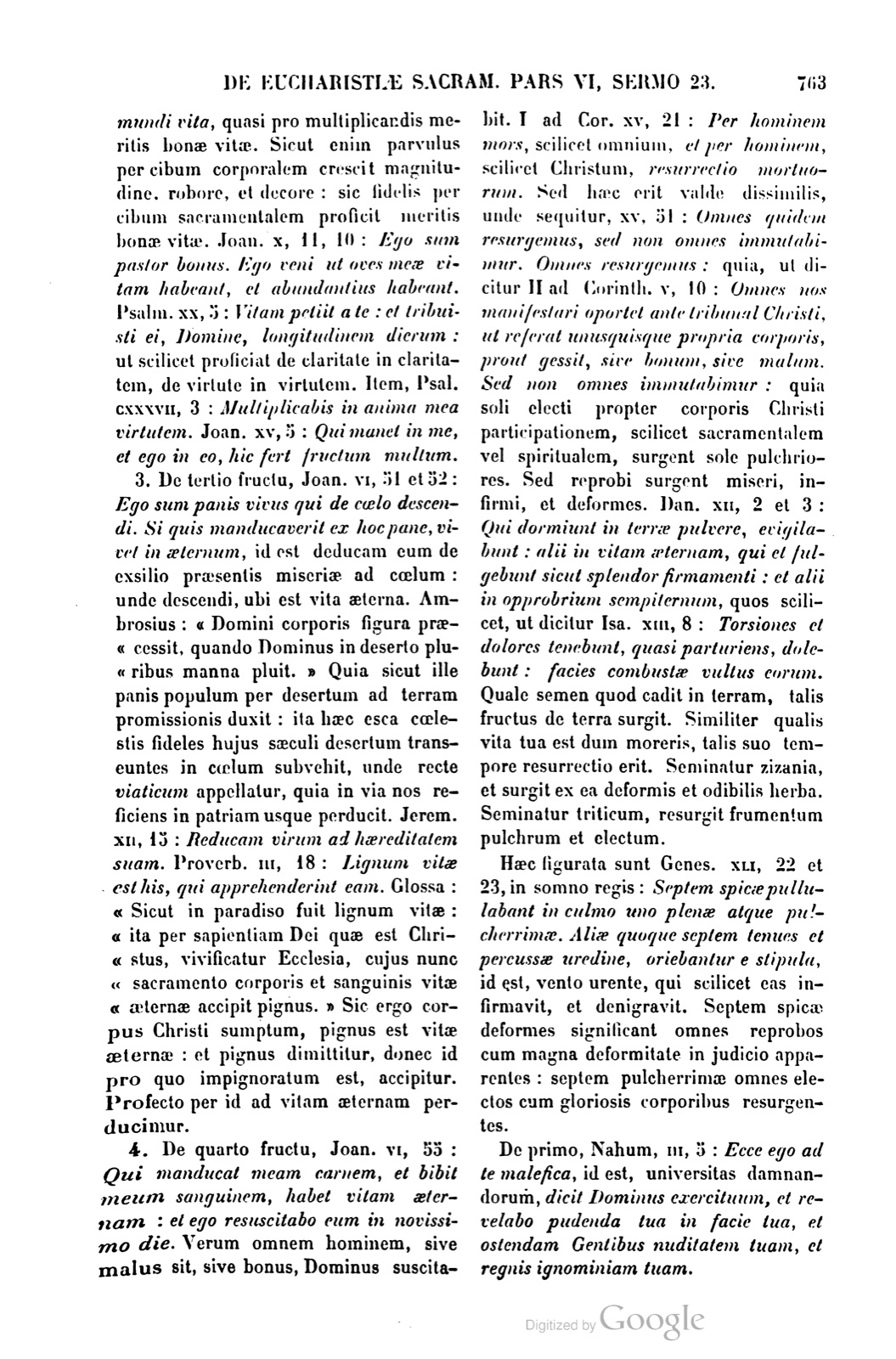
Haec figurata sunt Genes. xli, 22 et 23, in somno regis: Septem spicae pullulabant in culmo uno plenae atque pulcherrimae. Aliae quoque septem tenues et percussae uredine, oriebantur e stipula, id est, vento urente, qui scilicet eas infirmavit, et denigravit. Septem spicae deformes significant omnes reprobos cum magna deformitate in judicio apparentes: septem pulcherrimae omnes electos cum gloriosis corporibus resurgentes.
De primo, Nahum, iii, 5: Ecce ego ad te malefica, id est, universitas damnandorum, dicit Dominus exercituum, et revelabo pudenda tua in facie tua, et ostendam Gentibus nuditatem tuam, et regnis ignominiam tuam.
De secundo, ad Philip. iii, 20 et 21: Salvatorem exspectamus Dominum nostrum Jesum Christum, qui reformabit corpus humilitatis nostrae, configuratum corpori claritatis suae. I ad Corinth. xv, 42 et seq.: Seminatur corpus in corruptione, surget in incorruptione. Seminatur in ignobilitate, surget in gloria. Seminatur in infirmitate, surget in virtute. Seminatur corpus animale, surget corpus spiritale. Amen.
These things were figured in Genesis 41:22 and 23, in the king's dream: Seven ears sprouted on one stalk, full and very beautiful. Also seven others, thin and struck by blight, arose from the stalk, that is, by a burning wind, which namely weakened them and blackened them. The seven deformed ears signify all the reprobate appearing with great deformity in judgment; the seven very beautiful ears signify all the elect rising again with glorious bodies.
Concerning the first, Nahum 3:5: Behold, I am against you, wicked woman, that is, the whole body of those to be damned, says the Lord of hosts, and I will reveal your shameful parts in your face, and I will show your nakedness to the Gentiles and your ignominy to kingdoms.
Concerning the second, Philippians 3:20 and 21: We await our Savior, our Lord Jesus Christ, who will reform the body of our humility, configured to the body of his brightness. 1 Corinthians 15:42 and following: The body is sown in corruption; it will rise in incorruption. It is sown in ignobility; it will rise in glory. It is sown in weakness; it will rise in power. An animal body is sown; a spiritual body will rise. Amen.

If a page does not appear, its photograph has not been uploaded yet.