Works › Sermons on the Most Holy Sacrament of the Eucharist
Volume 13 · pp. 707–710
Sermon X. On the Form of Donation under the Species of Wheaten Bread
A marker with ≈ is an approximate page boundary, placed by measure of the text; the page photographs remain the authority. In the paired views, clicking a page marker brings that page into view.
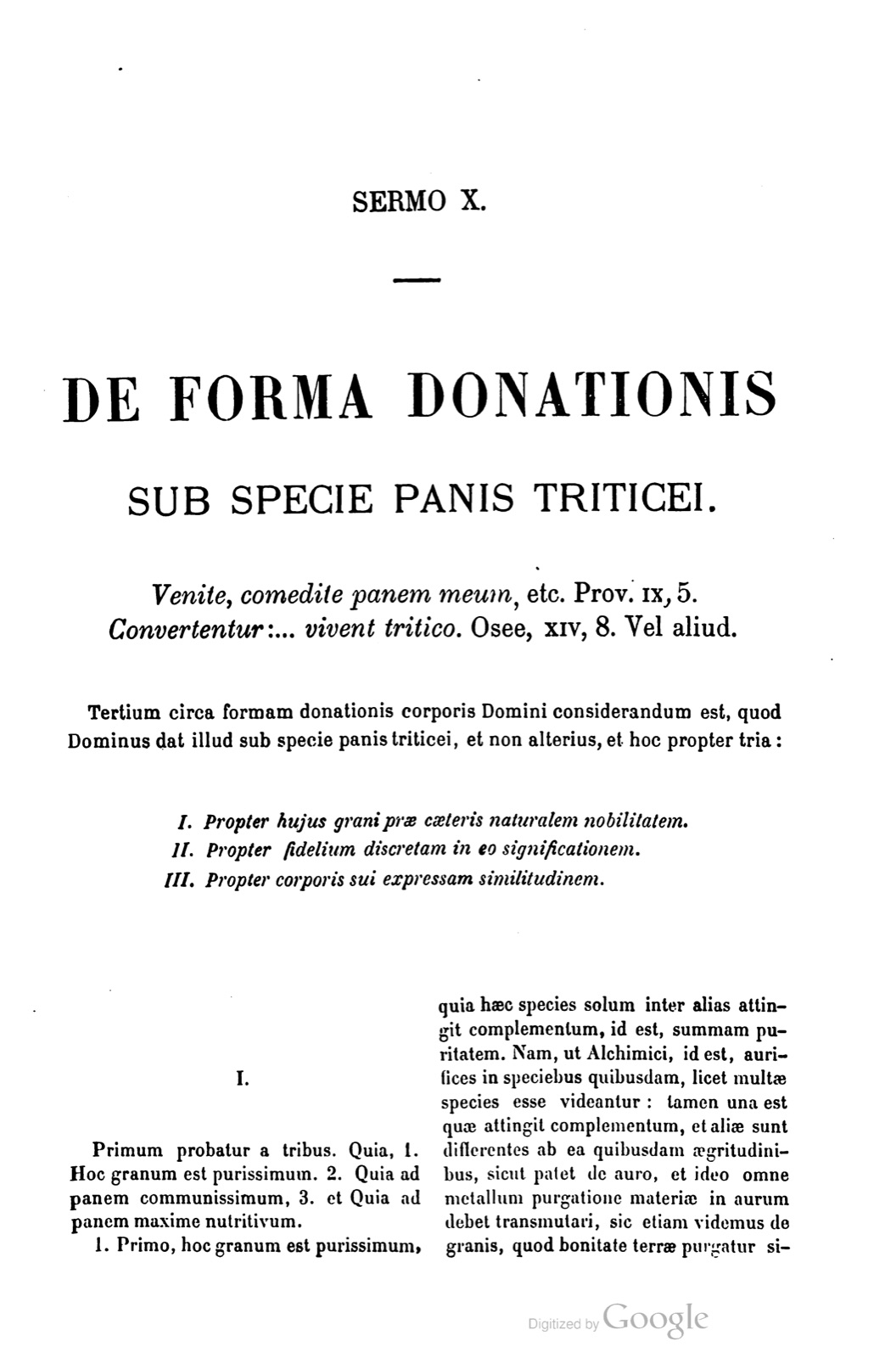
### Sermo X
### De forma donationis sub specie panis triticei
Venite, comedite panem meum, etc. Prov. ix, 5.
Convertentur: ... vivent tritico. Osee, xiv, 8. Vel aliud.
Tertium circa formam donationis corporis Domini considerandum est, quod Dominus dat illud sub specie panis triticei, et non alterius, et hoc propter tria:
I. Propter hujus grani prae caeteris naturalem nobilitatem.
II. Propter fidelium discretam in eo significationem.
III. Propter corporis sui expressam similitudinem.
I.
Primum probatur a tribus. Quia, 1. Hoc granum est purissimum. 2. Quia ad panem communissimum, 3. et Quia ad panem maxime nutritivum.
1. Primo, hoc granum est purissimum, quia haec species solum inter alias attingit complementum, id est, summam puritatem. Nam, ut Alchimici, id est, aurifices in speciebus quibusdam, licet multae species esse videantur: tamen una est quae attingit complementum, et aliae sunt differentes ab ea quibusdam aegritudinibus, sicut patet de auro, et ideo omne metallum purgatione materiae in aurum debet transmutari, sic etiam videmus de granis, quod bonitate terrae purgatur siligo, et in triticum nobilitatur, et ideo tripliciter et absolute panis triticeus est panis, propter excellentem puritatis suae nobilitatem.
2. Secundo, granum tritici est ad panem communissimum, quia competit sanis et infirmis, imo omni animali panem comedenti: et ideo vere est panis, propter communis convenientiae nobilitatem.
3. Tertio, granum tritici est ad panem maxime nutritivum, quia puritate naturali et competibilitate communi maxime membris adhaeret, et confortat, et hac ratione congruum est, ut nobilissimum corpus quasi nobilissimus panis filiorum Dei detur filiis, sub specie nobilissimi panis, scilicet triticei.
II.
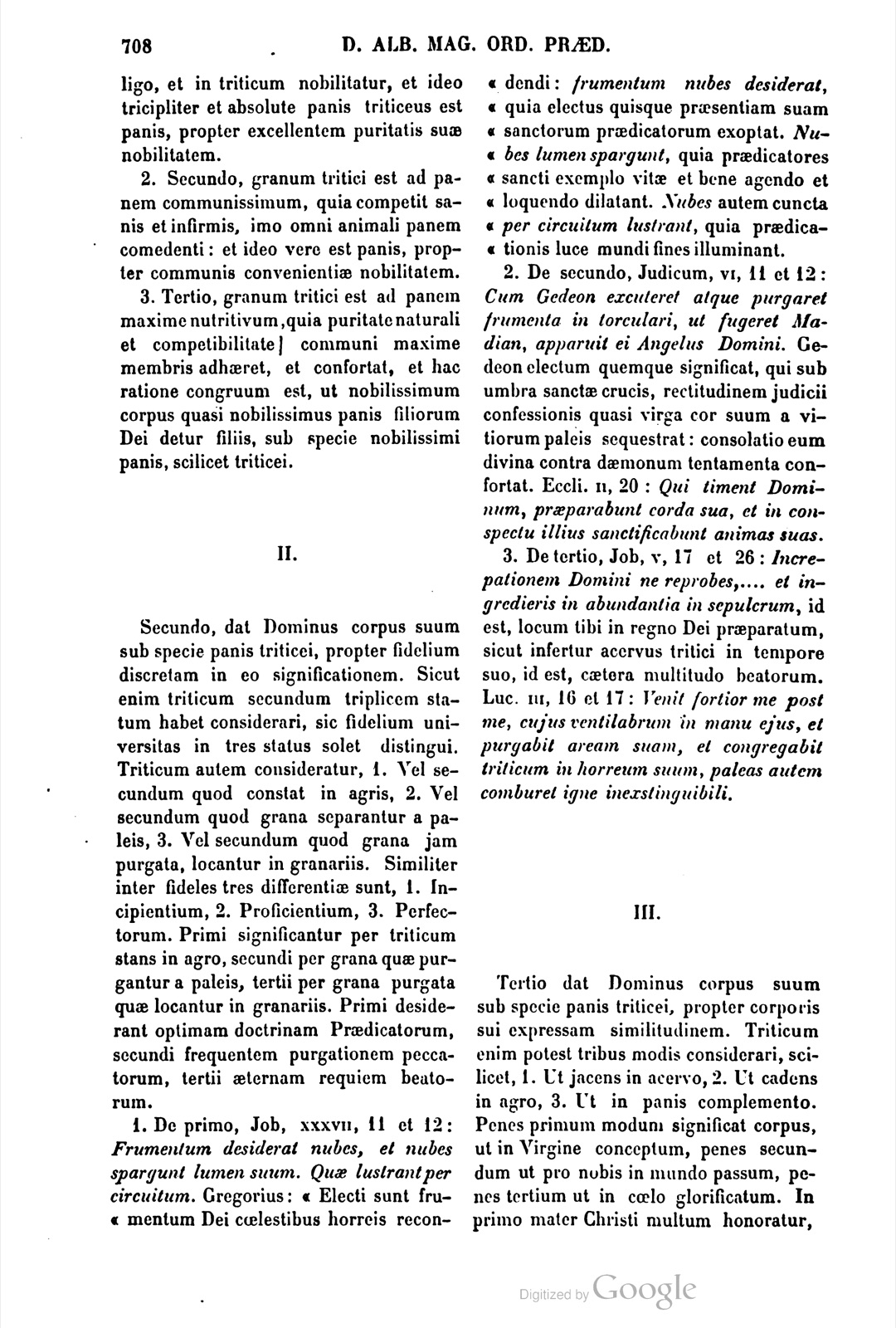
Secundo, dat Dominus corpus suum sub specie panis triticei, propter fidelium discretam in eo significationem. Sicut enim triticum secundum triplicem statum habet considerari, sic fidelium universitas in tres status solet distingui. Triticum autem consideratur, 1. Vel secundum quod constat in agris, 2. Vel secundum quod grana separantur a paleis, 3. Vel secundum quod grana jam purgata, locantur in granariis. Similiter inter fideles tres differentiae sunt, 1. Incipientium, 2. Proficientium, 3. Perfectorum. Primi significantur per triticum stans in agro, secundi per grana quae purgantur a paleis, tertii per grana purgata quae locantur in granariis. Primi desiderant optimam doctrinam Praedicatorum, secundi frequentem purgationem peccatorum, tertii aeternam requiem beatorum.
### Sermon X
### On the Form of Donation under the Species of Wheaten Bread
Come, eat my bread, etc. Proverbs 9:5.
They will be converted: ... they will live by wheat. Hosea 14:8. Or another text.
The third thing to be considered concerning the form of donation of the body of the Lord is that the Lord gives it under the species of wheaten bread, and not of another, and this on account of three things:
I. On account of the natural nobility of this grain before the others.
II. On account of the distinct signification of the faithful in it.
III. On account of the express likeness of his body.
I.
The first is proved from three things. Because, 1. This grain is most pure. 2. Because it is for the most common bread, 3. and Because it is for the most nutritive bread.
1. First, this grain is most pure, because this species alone among the others attains the complement, that is, the highest purity. For, as Alchemists, that is, goldsmiths, say concerning certain species, although there seem to be many species, nevertheless there is one which attains the complement, and the others are different from it by certain diseases, as is clear concerning gold; and therefore every metal by purification of its matter ought to be transmuted into gold. Thus also we see concerning grains that rye is purified by the goodness of the earth and ennobled into wheat, and therefore triply and absolutely wheaten bread is bread, on account of the excellent nobility of its purity.
2. Secondly, the grain of wheat is for the most common bread, because it is suitable to the healthy and the sick, indeed to every animal that eats bread; and therefore it truly is bread, on account of the nobility of common suitability.
3. Thirdly, the grain of wheat is for the most nutritive bread, because by natural purity and common suitability it adheres most greatly to the members and strengthens; and for this reason it is fitting that the most noble body, as the most noble bread of the sons of God, be given to the sons under the species of the most noble bread, namely wheaten bread.
II.
Secondly, the Lord gives his body under the species of wheaten bread on account of the distinct signification of the faithful in it. For just as wheat has to be considered according to a threefold state, so the universality of the faithful is customarily distinguished into three states. But wheat is considered 1. either according as it stands in the fields, 2. or according as the grains are separated from the chaff, 3. or according as the grains, already purged, are placed in granaries. Similarly among the faithful there are three differences: 1. of beginners, 2. of those advancing, 3. of the perfect. The first are signified by wheat standing in the field; the second by grains which are purged from the chaff; the third by purged grains which are placed in granaries. The first desire the best doctrine of Preachers, the second frequent purgation of sins, the third the eternal rest of the blessed.
1. De primo, Job, xxxvii, 11 et 12: Frumentum desiderat nubes, et nubes spargunt lumen suum. Quae lustrant per circuitum. Gregorius: « Electi sunt frumentum Dei coelestibus horreis recondendi: frumentum nubes desiderat, quia electus quisque praesentiam suam sanctorum praedicatorum exoptat. Nubes lumen spargunt, quia praedicatores sancti exemplo vitae et bene agendo et loquendo dilatant. Nubes autem cuncta per circuitum lustrant, quia praedicationis luce mundi fines illuminant. »
2. De secundo, Judicum, vi, 11 et 12: Cum Gedeon excuteret atque purgaret frumenta in torculari, ut fugeret Madian, apparuit ei Angelus Domini. Gedeon electum quemque significat, qui sub umbra sanctae crucis, rectitudinem judicii confessionis quasi virga cor suum a vitiorum paleis sequestrat: consolatio eum divina contra daemonum tentamenta confortat. Eccli. ii, 20: Qui timent Dominum, praeparabunt corda sua, et in conspectu illius sanctificabunt animas suas.
3. De tertio, Job, v, 17 et 26: Increpationem Domini ne reprobes, ... et ingredieris in abundantia in sepulcrum, id est, locum tibi in regno Dei praeparatum, sicut infertur acervus tritici in tempore suo, id est, caetera multitudo beatorum. Luc. iii, 16 et 17: Venit fortior me post me, cujus ventilabrum in manu ejus, et purgabit aream suam, et congregabit triticum in horreum suum, paleas autem comburet igne inexstinguibili.
1. Concerning the first, Job 37:11 and 12: The wheat desires the clouds, and the clouds scatter their light. They illumine by circuit. Gregory says: "The elect are the wheat of God to be stored in heavenly granaries: the wheat desires the clouds, because each elect person longs for the presence of holy preachers for himself. The clouds scatter light, because holy preachers spread abroad by example of life and by acting and speaking well. But the clouds illumine all things by circuit, because they illuminate the ends of the world by the light of preaching."
2. Concerning the second, Judges 6:11 and 12: When Gideon was shaking out and purging the grains in the winepress, so that he might flee Madian, the Angel of the Lord appeared to him. Gideon signifies each elect person who under the shadow of the holy cross separates the rectitude of the judgment of confession, as with a rod, from the chaff of vices in his heart; divine consolation strengthens him against the temptations of demons. Ecclesiasticus 2:20: Those who fear the Lord will prepare their hearts, and in his sight they will sanctify their souls.
3. Concerning the third, Job 5:17 and 26: Do not reject the rebuke of the Lord, ... and you will enter into the grave in abundance, that is, into the place prepared for you in the kingdom of God, just as a heap of wheat is brought in in its season, that is, the other multitude of the blessed. Luke 3:16 and 17: One stronger than I comes after me, whose winnowing-fan is in his hand, and he will purge his threshing-floor and gather the wheat into his barn, but the chaff he will burn with unquenchable fire.
III.
Tertio dat Dominus corpus suum sub specie panis triticei, propter corporis sui expressam similitudinem. Triticum enim potest tribus modis considerari, scilicet, 1. Ut jacens in acervo, 2. Ut cadens in agro, 3. Ut in panis complemento. Penes primum modum significat corpus, ut in Virgine conceptum, penes secundum ut pro nobis in mundo passum, penes tertium ut in coelo glorificatum. In primo mater Christi multum honoratur, in secundo peccator liberatur, in tertio beatus delectatur.
1. De primo, Cant. vii, 2: Venter tuus sicut acervus tritici, vallatus liliis. Venter est corpus Beatae Virginis. Luc. xi, 27: Beatus venter, qui te portavit. Acervus tritici, munda membra Christi, ut conservata in utero virginali. Lilia, decor omnimodae castitatis, quo ornantur membra et sensus Beatae Virginis.
2. De secundo, Joan. xii, 24 et 25: Nisi granum frumenti cadens in terram, mortuum fuerit, etc.: Si autem mortuum fuerit, multum fructum affert. Christus enim per mortem suam genus humanum de morte aeterna liberavit. Ad Rom. v, 8 et 9: Commendat charitatem suam Deus in nobis: quoniam cum adhuc peccatores essemus, Christus pro nobis mortuus est. Ex hoc quod Dominus se dicit granum frumenti, habet Ecclesia quod sub nulla alia specie panis consecrat corpus Domini.
3. De tertio, Zach. ix, 17: Quid bonum ejus est, et quid pulchrum ejus, nisi frumentum electorum? quasi panis pulcherrimus, dulcissimus, et nobilissimus corporis Christi in gloria beatorum.
III.
Thirdly, the Lord gives his body under the species of wheaten bread on account of the express likeness of his body. For wheat can be considered in three ways, namely 1. as lying in a heap, 2. as falling in a field, 3. as in the completion of bread. According to the first mode it signifies the body as conceived in the Virgin; according to the second, as suffered for us in the world; according to the third, as glorified in heaven. In the first the mother of Christ is greatly honored; in the second the sinner is freed; in the third the blessed person is delighted.
1. Concerning the first, Song of Songs 7:2: Your belly is like a heap of wheat, set about with lilies. The belly is the body of the Blessed Virgin. Luke 11:27: Blessed is the belly which bore you. The heap of wheat is the clean members of Christ, as preserved in the virginal womb. The lilies are the beauty of all manner of chastity, by which the members and senses of the Blessed Virgin are adorned.
2. Concerning the second, John 12:24 and 25: Unless the grain of wheat falling into the earth has died, etc.; But if it has died, it brings forth much fruit. For Christ through his death freed the human race from eternal death. Romans 5:8 and 9: God commends his charity in us, because when we were still sinners, Christ died for us. From the fact that the Lord calls himself a grain of wheat, the Church has that whereby she consecrates the body of the Lord under no other species of bread.
3. Concerning the third, Zechariah 9:17: What is his good, and what is his beauty, unless the wheat of the elect? as the most beautiful, sweetest, and most noble bread of the body of Christ in the glory of the blessed.
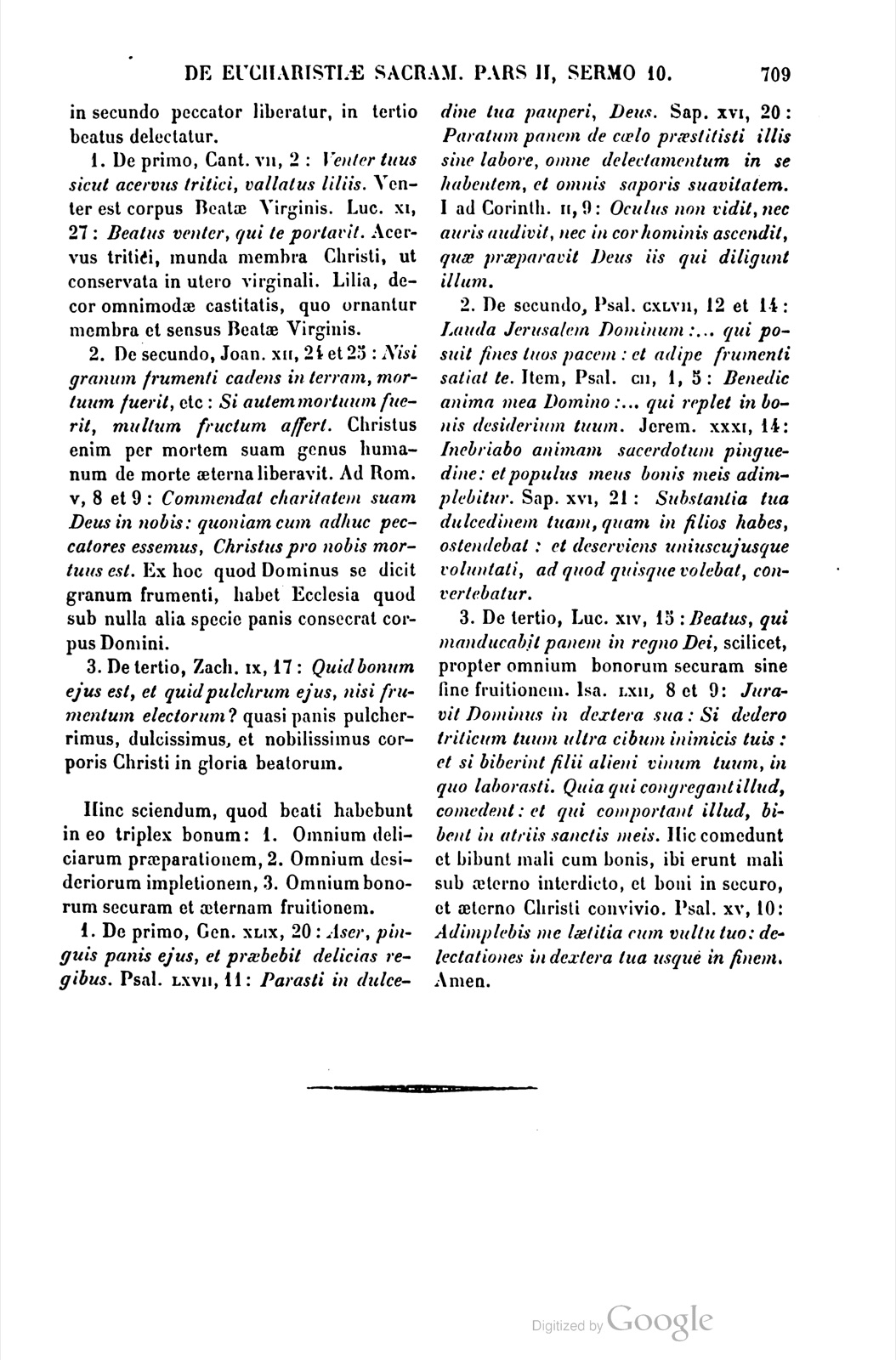
Hinc sciendum, quod beati habebunt in eo triplex bonum: 1. Omnium deliciarum praeparationem, 2. Omnium desideriorum impletionem, 3. Omnium bonorum securam et aeternam fruitionem.
1. De primo, Gen. xlix, 20: Aser, pinguis panis ejus, et praebebit delicias regibus. Psal. lxvii, 11: Parasti in dulcedine tua pauperi, Deus. Sap. xvi, 20: Paratum panem de coelo praestitisti illis sine labore, omne delectamentum in se habentem, et omnis saporis suavitatem. I ad Corinth. ii, 9: Oculus non vidit, nec auris audivit, nec in cor hominis ascendit, quae praeparavit Deus iis qui diligunt illum.
2. De secundo, Psal. cxlvii, 12 et 14: Lauda Jerusalem Dominum: ... qui posuit fines tuos pacem: et adipe frumenti satiat te. Item, Psal. cii, 1, 5: Benedic anima mea Domino: ... qui replet in bonis desiderium tuum. Jerem. xxxi, 14: Inebriabo animam sacerdotum pinguedine: et populus meus bonis meis adimplebitur. Sap. xvi, 21: Substantia tua dulcedinem tuam, quam in filios habes, ostendebat: et deserviens uniuscujusque voluntati, ad quod quisque volebat, convertebatur.
3. De tertio, Luc. xiv, 15: Beatus, qui manducabit panem in regno Dei, scilicet, propter omnium bonorum securam sine fine fruitionem. Isa. lxii, 8 et 9: Juravit Dominus in dextera sua: Si dedero triticum tuum ultra cibum inimicis tuis: et si biberint filii alieni vinum tuum, in quo laborasti. Quia qui congregant illud, comedent: et qui comportant illud, bibent in atriis sanctis meis. Hic comedunt et bibunt mali cum bonis, ibi erunt mali sub aeterno interdicto, et boni in securo, et aeterno Christi convivio. Psal. xv, 10: Adimplebis me laetitia cum vultu tuo: delectationes in dextera tua usque in finem. Amen.
Hence it must be known that the blessed will have in it a threefold good: 1. The preparation of all delights, 2. The fulfillment of all desires, 3. The secure and eternal enjoyment of all goods.
1. Concerning the first, Genesis 49:20: Asher, his bread is rich, and he will provide delights for kings. Psalm 67:11: You have prepared in your sweetness for the poor, O God. Wisdom 16:20: You provided for them prepared bread from heaven without labor, having every delight in itself and the sweetness of every taste. 1 Corinthians 2:9: Eye has not seen, nor ear heard, nor has it ascended into the heart of man, what things God has prepared for those who love him.
2. Concerning the second, Psalm 147:12 and 14: Praise the Lord, O Jerusalem: ... who has set peace as your borders, and satisfies you with the fat of wheat. Likewise, Psalm 102:1, 5: Bless the Lord, O my soul: ... who fills your desire with good things. Jeremiah 31:14: I will make the soul of the priests drunk with fatness, and my people will be filled with my goods. Wisdom 16:21: Your substance showed your sweetness, which you have toward your children, and, serving the will of each one, was changed into whatever each one wished.
3. Concerning the third, Luke 14:15: Blessed is he who will eat bread in the kingdom of God, namely on account of the secure enjoyment without end of all goods. Isaiah 62:8 and 9: The Lord has sworn by his right hand: If I give your wheat any more as food to your enemies, and if alien sons drink your wine in which you labored. For those who gather it will eat it, and those who carry it will drink in my holy courts. Here the evil eat and drink with the good; there the evil will be under eternal interdiction, and the good in the secure and eternal banquet of Christ. Psalm 15:10: You will fill me with joy with your countenance; delights are at your right hand even unto the end. Amen.

If a page does not appear, its photograph has not been uploaded yet.