Works › Sermons on the Most Holy Sacrament of the Eucharist
Volume 13 · pp. 761–762
Sermon XXIII. On the Third Four Fruits
A marker with ≈ is an approximate page boundary, placed by measure of the text; the page photographs remain the authority. In the paired views, clicking a page marker brings that page into view.
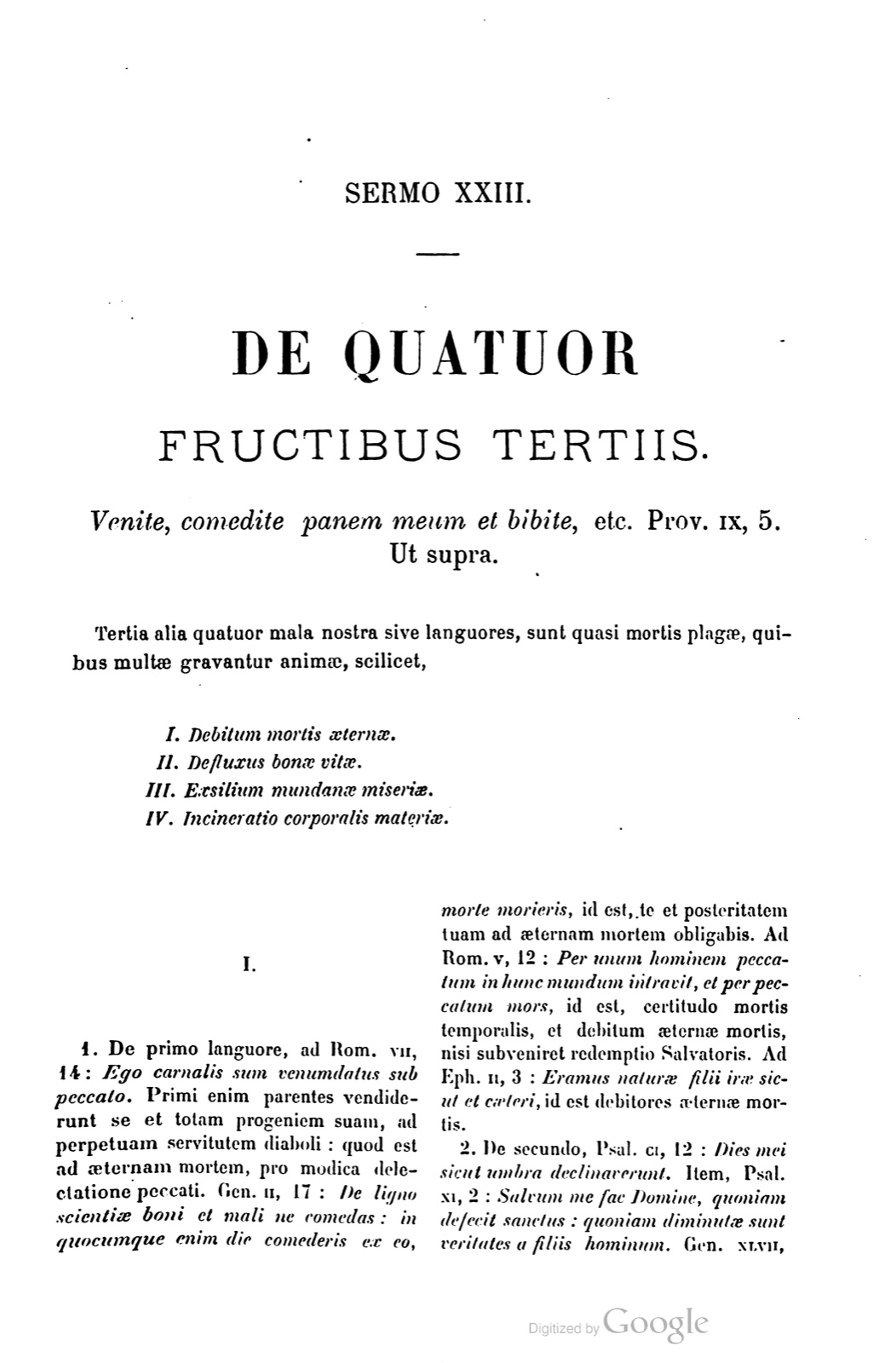
### Sermo XXIII
### De quatuor fructibus tertiis
Venite, comedite panem meum et bibite, etc. Prov. ix, 5. Ut supra.
Tertia alia quatuor mala nostra sive languores, sunt quasi mortis plagae, quibus multae gravantur animae, scilicet,
I. Debitum mortis aeternae.
II. Defluxus bonae vitae.
III. Exsilium mundanae miseriae.
IV. Incineratio corporalis materiae.
I.
1. De primo languore, ad Rom. vii, 14: Ego carnalis sum venumdatus sub peccato. Primi enim parentes vendiderunt se et totam progeniem suam, ad perpetuam servitutem diaboli: quod est ad aeternam mortem, pro modica delectatione peccati. Gen. ii, 17: De ligno scientiae boni et mali ne comedas: in quocumque enim die comederis ex eo, morte morieris, id est, te et posteritatem tuam ad aeternam mortem obligabis. Ad Rom. v, 12: Per unum hominem peccatum in hunc mundum intravit, et per peccatum mors, id est, certitudo mortis temporalis, et debitum aeternae mortis, nisi subveniret redemptio Salvatoris. Ad Eph. ii, 3: Eramus naturae filii irae sicut et caeteri, id est debitores aeternae mortis.
2. De secundo, Psal. ci, 12: Dies mei sicut umbra declinaverunt. Item, Psal. xi, 2: Salvum me fac Domine, quoniam defecit sanctus: quoniam diminutae sunt veritates a filiis hominum. Gen. xlvii, 9: Dies peregrinationis meae centum triginta annorum sunt, parvi et mali, et non pervenerunt usque ad dies patrum meorum. Item, Gen. viii, 21: Sensus et cogitatio humani cordis in malum prona sunt ab adolescentia sua. Eccli. xix, 1: Qui spernit modica, paulatim decidet. Ad Heb. ii, 1: Propterea abundantius oportet observare nos ea, quae audivimus, ne forte pereffluamus.
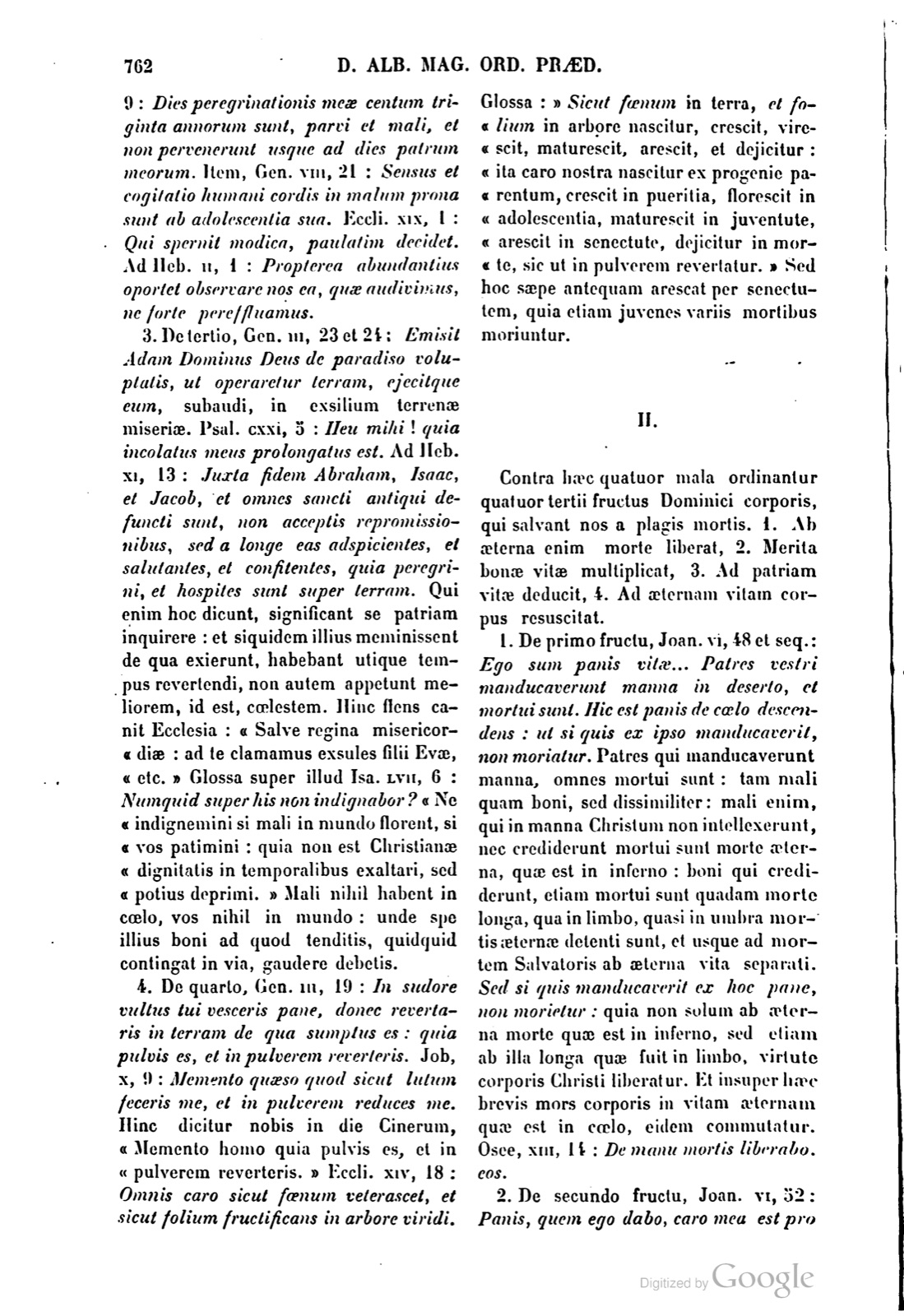
3. De tertio, Gen. iii, 23 et 24: Emisit Adam Dominus Deus de paradiso voluptatis, ut operaretur terram, ejecitque eum, subaudi, in exsilium terrenae miseriae. Psal. cxxi, 5: Heu mihi! quia incolatus meus prolongatus est. Ad Heb. xi, 13: Juxta fidem Abraham, Isaac, et Jacob, et omnes sancti antiqui defuncti sunt, non acceptis repromissionibus, sed a longe eas adspicientes, et salutantes, et confitentes, quia peregrini, et hospites sunt super terram. Qui enim hoc dicunt, significant se patriam inquirere: et siquidem illius meminissent de qua exierunt, habebant utique tempus revertendi, non autem appetunt meliorem, id est, coelestem. Hinc flens canit Ecclesia: "Salve regina misericordiae: ad te clamamus exsules filii Evae, etc." Glossa super illud Isa. lvi, 6: Numquid super his non indignabor? "Ne indignemini si mali in mundo florent, si vos patimini: quia non est Christianae dignitatis in temporalibus exaltari, sed potius deprimi." Mali nihil habent in coelo, vos nihil in mundo: unde spe illius boni ad quod tenditis, quidquid contingat in via, gaudere debetis.
### Sermon XXIII
### On the Third Four Fruits
Come, eat my bread and drink, etc. Proverbs 9:5. As above.
The third other four evils of ours, or languors, are as plagues of death, by which many souls are weighed down, namely:
I. The debt of eternal death.
II. The flowing away of good life.
III. The exile of worldly misery.
IV. The incineration of bodily matter.
I.
1. Concerning the first languor, Romans 7:14: I am carnal, sold under sin. For the first parents sold themselves and their whole progeny into perpetual servitude of the devil, which is unto eternal death, for the modest delight of sin. Genesis 2:17: Do not eat from the tree of knowledge of good and evil, for on whatever day you eat from it, you will die by death, that is, you will bind yourself and your posterity to eternal death. Romans 5:12: Through one man sin entered into this world, and through sin death, that is, the certainty of temporal death and the debt of eternal death, unless the redemption of the Savior came to help. Ephesians 2:3: We were by nature children of wrath like the others, that is, debtors of eternal death.
2. Concerning the second, Psalm 101:12: My days have declined like a shadow. Likewise, Psalm 11:2: Save me, O Lord, because the holy man has failed, because truths have been diminished from the sons of men. Genesis 47:9: The days of my pilgrimage are one hundred and thirty years, few and evil, and they have not reached the days of my fathers. Likewise, Genesis 8:21: The sense and thought of the human heart are prone to evil from its adolescence. Ecclesiasticus 19:1: He who scorns small things will fall little by little. Hebrews 2:1: Therefore it is necessary for us more abundantly to observe the things which we have heard, lest perhaps we flow away.
3. Concerning the third, Genesis 3:23 and 24: The Lord God sent Adam out from the paradise of pleasure, so that he might work the earth, and he cast him out, understand, into the exile of earthly misery. Psalm 121:5: Woe to me, because my dwelling abroad has been prolonged. Hebrews 11:13: According to faith Abraham, Isaac, and Jacob, and all the holy ancients died, not having received the promises, but seeing them from afar and greeting them and confessing that they are pilgrims and guests upon the earth. For those who say this signify that they seek a homeland; and if indeed they had been mindful of that one from which they went out, they certainly had time for returning, but they desire a better one, that is, a heavenly one. Hence the Church sings weeping: "Hail, queen of mercy; to you we cry, exiled children of Eve, etc." The Gloss on that text Isaiah 56:6: Shall I not be angry over these things? says: "Do not be indignant if the evil flourish in the world, if you suffer, because it is not of Christian dignity to be exalted in temporal things, but rather to be pressed down." The evil have nothing in heaven; you have nothing in the world; hence in the hope of that good toward which you tend, whatever happens on the way, you ought to rejoice.
4. De quarto, Gen. iii, 19: In sudore vultus tui vesceris pane, donec revertaris in terram de qua sumptus es: quia pulvis es, et in pulverem reverteris. Job, x, 9: Memento quaeso quod sicut lutum feceris me, et in pulverem reduces me. Hinc dicitur nobis in die Cinerum, "Memento homo quia pulvis es, et in pulverem reverteris." Eccli. xiv, 18: Omnis caro sicut foenum veterascet, et sicut folium fructificans in arbore viridi. Glossa: "Sicut foenum in terra, et folium in arbore nascitur, crescit, virescit, maturescit, arescit, et dejicitur: ita caro nostra nascitur ex progenie parentum, crescit in pueritia, florescit in adolescentia, maturescit in juventute, arescit in senectute, dejicitur in morte, sic ut in pulverem revertatur." Sed hoc saepe antequam arescat per senectutem, quia etiam juvenes variis mortibus moriuntur.
II.
Contra haec quatuor mala ordinantur quatuor tertii fructus Dominici corporis, qui salvant nos a plagis mortis. 1. Ab aeterna enim morte liberat, 2. Merita bonae vitae multiplicat, 3. Ad patriam vitae deducit, 4. Ad aeternam vitam corpus resuscitat.
1. De primo fructu, Joan. vi, 48 et seq.: Ego sum panis vitae... Patres vestri manducaverunt manna in deserto, et mortui sunt. Hic est panis de caelo descendens: ut si quis ex ipso manducaverit, non moriatur. Patres qui manducaverunt manna, omnes mortui sunt: tam mali quam boni, sed dissimiliter: mali enim, qui in manna Christum non intellexerunt, nec crediderunt mortui sunt morte aeterna, quae est in inferno: boni qui crediderunt, etiam mortui sunt quadam morte longa, qua in limbo, quasi in umbra mortis aeternae detenti sunt, et usque ad mortem Salvatoris ab aeterna vita separati. Sed si quis manducaverit ex hoc pane, non morietur: quia non solum ab aeterna morte quae est in inferno, sed etiam ab illa longa quae fuit in limbo, virtute corporis Christi liberatur. Et insuper haec brevis mors corporis in vitam aeternam quae est in coelo, eidem commutatur. Osee, xiii, 14: De manu mortis liberabo eos.
2. De secundo fructu, Joan. vi, 52: Panis, quem ego dabo, caro mea est pro
4. Concerning the fourth, Genesis 3:19: In the sweat of your face you will eat bread, until you return to the earth from which you were taken, because you are dust and into dust you will return. Job 10:9: Remember, I ask, that you made me like clay, and you will lead me back into dust. Hence it is said to us on the day of Ashes: "Remember, man, that you are dust, and into dust you will return." Ecclesiasticus 14:18: All flesh will grow old like hay, and like a fruit-bearing leaf on a green tree. The Gloss says: "Just as hay on the earth and a leaf on a tree is born, grows, becomes green, matures, dries, and is cast down, so our flesh is born from the progeny of parents, grows in childhood, flowers in adolescence, matures in youth, dries in old age, is cast down in death, so as to return into dust." But this often happens before it dries through old age, because even young people die by various deaths.
II.
Against these four evils are ordained the four third fruits of the Lord's body, which save us from the plagues of death. 1. For it frees from eternal death, 2. it multiplies the merits of good life, 3. it leads to the homeland of life, 4. it raises the body to eternal life.
1. Concerning the first fruit, John 6:48 and following: I am the bread of life... Your fathers ate manna in the desert and died. This is the bread descending from heaven, so that if anyone eats from it, he may not die. The fathers who ate manna all died, both evil and good, but dissimilarly: for the evil, who did not understand Christ in the manna, nor believed, died by eternal death, which is in hell; the good who believed also died by a certain long death, by which they were detained in limbo as in the shadow of eternal death, and until the death of the Savior they were separated from eternal life. But if anyone eats from this bread, he will not die, because not only is he freed from eternal death which is in hell, but also from that long death which was in limbo, by the power of Christ's body. And moreover this brief death of the body is changed for him into eternal life which is in heaven. Hosea 13:14: From the hand of death I will free them.
2. Concerning the second fruit, John 6:52: The bread which I will give is my flesh for
If a page does not appear, its photograph has not been uploaded yet.