Works › Sermons on the Most Holy Sacrament of the Eucharist
Volume 13 · pp. 744–748
Sermon XIX. On the Second Mode of Eating, Spiritual Only, by Which the Good Eat
A marker with ≈ is an approximate page boundary, placed by measure of the text; the page photographs remain the authority. In the paired views, clicking a page marker brings that page into view.
### Sermo XIX
### De secundo modo manducandi spirituali tantum, quo boni manducant
Venite, comedite, etc. Prov. ix, 5. Ut supra. Patres nostri omnes eamdem escam spiritualem manducaverunt. I ad Corinth. x, 3.
Id est, omnes boni veteres in manna cibum invisibilem, scilicet Christum spiritualiter intellexerunt, crediderunt, gustaverunt, et ab aeterna morte per eum sanati sunt.
Secundus modus manducandi Christum est spiritualis tantum. Et isto modo omnes salvati ab initio manducaverunt, et salvandi manducant. Isti vero non manducant, et tamen manducant. Ambrosius: "Non manducans manducat, et manducans non manducat." Quia scilicet non manducans sacramentaliter, aliquando manducat spiritualiter, et e converso. Eccle. vi, 2: Est vir, cui Deus dedit divitias, et substantiam, et honorem, etc.: nec tribuit ei potestatem Deus ut comedat ex eo, sed homo extraneus vorabit illud, scilicet cum magno desiderio spiritualiter manducando.
Circa spiritualem manducationem tria sunt consideranda:
I. Differentia personarum sic manducantium.
II. Ratio spiritualiter manducandi,
III. Et effectus manducationis hujus.
I.
Prima triplex est, scilicet incipientium, proficientium, et perfectorum. Matth. xiv, 21: Manducantium fuit numerus, quinque millia virorum, exceptis mulieribus, et parvulis. In parvulis signantur incipientes, in mulieribus proficientes, in viris perfecti.
Secundum circa idem considerandum, est ratio, qua dicuntur jam dicti spiritualiter manducare. Unde sciendum, quod primi, scilicet incipientes manducant spiritualiter, ratione fidei Salvatoris: secundi, ratione bonae conversationis: tertii, ratione devotae meditationis.
I. Primi, scilicet incipientes, manducant spiritualiter ratione fidei Salvatoris. Habacuc, ii, 4 et ad Heb. x, 38: Justus ex fide vivet, tamquam ex cibo spirituali. Augustinus: "Crede, et manducasti." Credere enim in Christum, est credendo in eum ire, ipsi corde inhaerere, in ipso delectari, et per veram charitatem membris ejus incorporari.
II. Secundi, scilicet proficientes, manducant spiritualiter, ratione bonae conversationis. Joan. iv, 32 et 34: Ego cibum habeo manducare, quem vos nescitis... Meus cibus est ut faciam voluntatem Patris mei. Eccli. xv, 1 et 3: Qui timet Deum, faciet bona, etc. Cibabit illum pane vitae.
Iste cibus bonae conversationis consistit ex tribus virtutibus, quasi ex tribus ferculis, 1. Innocentia, 2. Poenitentia, 3. et Misericordia.
1. De primo, Psal. ci, 5: Percussus sum ut foenum, et aruit cor meum: quia oblitus sum comedere panem meum, scilicet innocentiae, dum delectabar cibo malitiae. Augustinus: "Panem de altari spiritualiter manducare, est innocentiam ad altare portare, debitoribus peccata dimittere."
2. De secundo, Psal. cxxvi, 2: Surgite postquam sederitis, qui manducatis panem doloris, scilicet poenitentiae pro peccatis. Tob. ii, 5 et 6: Manducavit panem cum luctu et tremore, memorans illum sermonem, quem dixit Dominus per Amos1 prophetam: Dies festi vestri, id est, gaudii in peccatis, convertentur in lamentationem et luctum. Psal. ci, 10: Cinerem tamquam panem manducabam, cinerem scilicet poenitentiae.
### Sermon XIX
### On the Second Mode of Eating, Spiritual Only, by Which the Good Eat
Come, eat, etc. Proverbs 9:5. As above. Our fathers all ate the same spiritual food. 1 Corinthians 10:3.
That is, all the good of old understood, believed, and tasted spiritually the invisible food in the manna, namely Christ, and through him they were healed from eternal death.
The second mode of eating Christ is spiritual only. And in this mode all who have been saved from the beginning have eaten, and those to be saved eat. But these do not eat, and yet they eat. Ambrose says: "The one not eating eats, and the one eating does not eat." Because, namely, one not eating sacramentally sometimes eats spiritually, and conversely. Ecclesiastes 6:2: There is a man to whom God gave riches, substance, and honor, etc., and God did not give him power to eat from it, but an alien man will devour it, namely by eating spiritually with great desire.
Concerning spiritual eating three things must be considered:
I. The difference of the persons eating in this way.
II. The reason of eating spiritually,
III. And the effect of this eating.
I.
The first is threefold, namely of beginners, of those advancing, and of the perfect. Matthew 14:21: The number of those eating was five thousand men, besides women and little children. In the little children beginners are signified, in the women those advancing, in the men the perfect.
The second thing to be considered concerning the same matter is the reason by which the already named persons are said to eat spiritually. Hence one must know that the first, namely beginners, eat spiritually by reason of faith in the Savior; the second by reason of good conduct; the third by reason of devout meditation.
I. The first, namely beginners, eat spiritually by reason of faith in the Savior. Habakkuk 2:4 and Hebrews 10:38: The just man lives from faith, as from spiritual food. Augustine says: "Believe, and you have eaten." For to believe in Christ is to go into him by believing, to cling to him with the heart, to delight in him, and to be incorporated into his members through true charity.
II. The second, namely those advancing, eat spiritually by reason of good conduct. John 4:32 and 34: I have food to eat which you do not know... My food is to do the will of my Father. Ecclesiasticus 15:1 and 3: He who fears God will do good, etc. He will feed him with the bread of life.
This food of good conduct consists of three virtues, as of three dishes: 1. innocence, 2. penance, 3. and mercy.
1. Concerning the first, Psalm 101:5: I have been struck like hay, and my heart has dried up, because I forgot to eat my bread, namely of innocence, while I delighted in the food of malice. Augustine says: "To eat spiritually the bread from the altar is to carry innocence to the altar, to forgive sins to debtors."
2. Concerning the second, Psalm 126:2: Rise after you have sat, you who eat the bread of sorrow, namely of penance for sins. Tobit 2:5 and 6: He ate bread with mourning and trembling, remembering that word which the Lord spoke through Amos1 the prophet: Your feast days, that is, of rejoicing in sins, will be turned into lamentation and mourning. Psalm 101:10: I ate ashes like bread, namely the ash of penance.
3. De tertio, Prov. xi, 17: Benefacit animae suae vir misericors, quia dum pauper ab eo corporaliter reficitur, ipse multo melius a Deo spiritualiter pascitur. Apoc. iii, 20: Ecce sto ad ostium, et pulso, scilicet in paupere: si quis aperuerit mihi januam, intrabo ad illum, et coenabo cum illo, et ipse mecum.
II.
Tertii, scilicet perfecti, manducant spiritualiter, ratione devotae meditationis, et in hac manducatione tria erunt, quae in comestione corporali consistunt: 1. Appetitus, 2. Masticatio, 3. Delectatio. Primo enim debemus spiritualiter esurire Christum cibum nostrum intimo corde desiderando. Secundo, masticare magna discretione cogitationes discutiendo. Tertio, in eo delectari dulcedinem ejus eligendo, id est, debemus spiritualiter esurire, Christum ardentius desiderando.
I. Job, xxxi, 31: Si non dixerunt viri tabernaculi mei: Quis det de carnibus ejus ut saturemur? quasi optabant et desiderabant saturari. Eccli. xxiv, 29: Qui edunt me, adhuc esurient. Gregorius: "In deliciis carnis appetitus placet, experientia displicet. Quia quo magis sentitur, quod earum saturitas mentem non replet, sed cruciat: eo magis cognoscitur, quod fastidiatur. In spiritualibus deliciis saturitas appetitum parit. Quia quanto magis earum sapor percipitur, eo amplius cognoscitur, quod avidius ametur." Isa. xxvi, 8: Domine, nomen tuum, et memoriale tuum in desiderio animae: Anima mea desideravit te in nocte, scilicet adversitatis. Psal. xxxvii, 10: Domine, ante te omne desiderium meum: et gemitus meus.
II. Debemus spiritualiter masticare totum Christum, scilicet membra et caput, id est, nos ipsos, et Sanctos Dei, et Salvatorem mundi, discreta discussione cogitare nos ipsos dijudicando, Sanctorum vitam ad imitandum pertractando, et incarnationis beneficium devote mente ruminando.
1. Primo, perfecti masticant, seipsos diligenter se examinando. I ad Corinth. xi, 28: Probet autem seipsum homo, et sic de corpore, vel de pane illo edat. Primo probet, id est, examinet, et purget seipsum totum, scilicet cor, linguam, manum, etc. Et sic postea edat. Job, xiii, 14: Quare lacero carnes meas dentibus meis, et animam meam porto in manibus meis? ut scilicet spiritualiter masticem dijudicando peccata carnis et spiritus.
2. Secundo, perfecti masticant Sanctos mortuos, et beatos adhuc viventes, vitam eorum ad imitandam considerando. Matth. xxii, 4: Ecce prandium meum paravi: tauri mei et altilia occisa sunt, et omnia parata: venite ad nuptias. Tauri Prophetae et Apostoli sunt, qui fortitudine fidei, quasi cornu Principibus mundi restiterunt, et ab eis passi, virtutum exempla nobis reliquerunt. Altilia ab alendo dicta, pinguia sunt volatilia, et significant Sanctos interna charitate saginatos, et contemplationis penna superna petentes. Occisa sunt, vel ab eo quod fuerunt per poenitentiam, vel per mortem carnis, jam in requie posita. Haec nobis sunt spiritualiter masticanda, id est, ad imitandum diligenter consideranda. Deut. xiv, 20 et 22: Omne quod mundum est, comedite... Quidquid morticinum est, ne vescamini ex eo. Omne mundum, id est, honestis verbis, operibus, et moribus. Comedite, in corde ponite ad imitandum. Quidquid morticinum est, id est, peccato contaminatum, ne vescamini ex eo, consentiendo, vel idem faciendo. Ad Philip. iv, 8: De caetero fratres, quaecumque sunt vera, quaecumque pudica, quaecumque justa, quaecumque sancta, quaecumque amabilia, quaecumque bonae famae, si qua virtus, si qua laus disciplinae, haec cogitate. Quae et didicistis, et accepistis, et audistis, et vidistis in me, haec agite: et Deus pacis erit vobiscum.
3. Concerning the third, Proverbs 11:17: The merciful man does good to his own soul, because while the poor man is refreshed bodily by him, he himself is much better fed spiritually by God. Apocalypse 3:20: Behold, I stand at the door and knock, namely in the poor man. If anyone opens the door to me, I will enter to him, and I will dine with him and he with me.
II.
The third, namely the perfect, eat spiritually by reason of devout meditation, and in this eating there will be three things which consist in bodily eating: 1. appetite, 2. chewing, 3. delight. For first we ought spiritually to hunger by desiring Christ our food with the inward heart. Secondly, to chew by discussing thoughts with great discretion. Thirdly, to delight in him by choosing his sweetness; that is, we ought spiritually to hunger by desiring Christ more ardently.
I. Job 31:31: If the men of my tent did not say: Who will give us of his flesh so that we may be filled? as if they were choosing and desiring to be filled. Ecclesiasticus 24:29: Those who eat me will still hunger. Gregory says: "In the delights of the flesh the appetite pleases, the experience displeases. Because the more it is felt that their fullness does not fill the mind but torments it, the more it is known that it is loathed. In spiritual delights fullness begets appetite, because the more their savor is perceived, the more it is known that it is loved more eagerly." Isaiah 26:8: Lord, your name and your memorial are in the desire of the soul; my soul desired you in the night, namely of adversity. Psalm 37:10: Lord, before you is all my desire, and my groaning.
II. We ought spiritually to chew the whole Christ, namely members and head, that is, ourselves and the Saints of God and the Savior of the world, to think by discreet discussion: judging ourselves, treating carefully the life of the Saints for imitation, and devoutly ruminating with the mind the benefit of the incarnation.
1. First, the perfect chew themselves, by diligently examining themselves. 1 Corinthians 11:28: But let a man prove himself, and so let him eat of the body, or of that bread. First let him prove, that is, examine and purge, his whole self, namely heart, tongue, hand, etc. And so afterward let him eat. Job 13:14: Why do I tear my flesh with my teeth, and carry my soul in my hands? that is, so that I may chew spiritually by judging the sins of flesh and spirit.
2. Secondly, the perfect chew the dead Saints and the blessed still living, by considering their life for imitation. Matthew 22:4: Behold, I have prepared my dinner; my bulls and fatlings have been killed, and all things are prepared; come to the wedding. The bulls are the Prophets and Apostles, who resisted the Princes of the world by the strength of faith, as if by a horn, and, having suffered from them, left us examples of virtues. Fatlings, named from feeding, are fat birds, and they signify the Saints fattened with interior charity and seeking the things above by the wing of contemplation. They have been killed either from the fact that they were placed already in rest through penance or through the death of the flesh. These must be chewed spiritually by us, that is, diligently considered for imitation. Deuteronomy 14:20 and 22: Eat everything that is clean... Do not eat anything that is dead. Everything clean, that is, in honorable words, works, and morals. Eat, that is, place it in the heart for imitation. Whatever is dead, that is, contaminated by sin, do not eat from it by consenting or doing the same. Philippians 4:8: For the rest, brothers, whatever things are true, whatever modest, whatever just, whatever holy, whatever lovable, whatever of good fame, if there is any virtue, if any praise of discipline, think on these things. The things which you have learned and received and heard and seen in me, do these, and the God of peace will be with you.
3. Tertio, perfecti masticant spiritualiter carnem Christi, scilicet incarnationis ejus sacramenta et beneficia devote meditando. Joan. vi, 55: Qui manducat meam carnem, et bibit meum sanguinem, habet vitam aeternam. Qui manducat, vel spiritualiter bene masticat. Augustinus: "Hoc pertinet ad virtutem sacramenti, non ad visibile sacramentum." Quasi diceret: Manducat intus, non foris: Qui manducat mente, non qui premit dente. Et hoc est, quod Apostolus (I ad Corinth. x, 3) vigilanter dicit tantum de bonis. Omnes eamdem escam spiritualem manducaverunt. Sic manducavit et masticavit Christum Apostolus: unde I ad Tim. iii, 16: Magnum est pietatis sacramentum quod manifestatum est, in carne, justificatum est in spiritu, id est, Christus justus ostensus est: quia de Spiritu sancto conceptus, apparuit Angelis, praedicatum est Gentibus, creditum est mundo: ut tantum beneficium curent solvere Deo, assumptum est in gloria. Eccle. i, 5 et 6: Oritur sol, et occidit, id est, Christus in sua nativitate oritur, et occidit in Passione, et ad locum suum revertitur, id est, ad sepulcrum terrae, ibique reviviscens in Resurrectione, gyrat per meridiem, in Ascensione, et flectitur ad aquilonem: lustrans universa in circuitu in extremi judicii discussione.
III. Debemus in spirituali manducatione delectari interna dulcedine, quae elicitur de praedicti Christi masticatione. Isa. lv, 2: Audite audientes me, et comedite bonum, et delectabitur in crassitudine anima vestra, id est, dulcedine spiritualis gratiae. Sap. viii, 16 et 18: Intrans in domum meam, conquiescam cum Dei sapientia, id est, cum Christo, qui est sapida essentia: non enim habet amaritudinem conversatio illius, nec taedium convictus illius, sed laetitiam et gaudium: et in amicitia illius delectatio bona. Psalm. xxx, 20: Quam magna multitudo dulcedinis tuae Domine, quam abscondisti timentibus te. Idem, xxxiii, 9: Gustate, et videte quoniam suavis est Dominus. Cant. iv, 11: Mel et lac sub lingua tua, id est, dulcedo spiritualis in meditatione cordis.
3. Thirdly, the perfect chew spiritually the flesh of Christ, namely the sacraments and benefits of his incarnation, by meditating devoutly. John 6:55: He who eats my flesh and drinks my blood has eternal life. He who eats, or who spiritually chews well. Augustine says: "This belongs to the power of the sacrament, not to the visible sacrament." As if he were saying: He eats inwardly, not outwardly; he who eats with the mind, not he who presses with the tooth. And this is what the Apostle (1 Corinthians 10:3) vigilantly says only about the good: They all ate the same spiritual food. Thus the Apostle ate and chewed Christ; hence 1 Timothy 3:16: Great is the sacrament of piety, which was manifested in flesh, justified in spirit, that is, Christ was shown to be just, because, conceived from the Holy Spirit, he appeared to Angels, was preached to the Gentiles, was believed in the world, so that they should care to repay so great a benefit to God; he was taken up in glory. Ecclesiastes 1:5 and 6: The sun rises and sets, that is, Christ rises in his Nativity and sets in the Passion, and returns to his place, that is, to the sepulchre of the earth, and there, coming back to life in the Resurrection, he circles through the south in the Ascension, and bends toward the north, surveying all things around in the examination of the last judgment.
III. We ought in spiritual eating to delight in the interior sweetness which is elicited from the aforesaid chewing of Christ. Isaiah 55:2: Hear me, you who hear, and eat the good, and your soul will delight in fatness, that is, the sweetness of spiritual grace. Wisdom 8:16 and 18: Entering my house, I will rest with the wisdom of God, that is, with Christ, who is flavorful essence; for conversation with him has no bitterness, nor companionship with him any weariness, but gladness and joy, and in friendship with him there is good delight. Psalm 30:20: How great is the multitude of your sweetness, O Lord, which you have hidden for those fearing you. The same, 33:9: Taste and see that the Lord is sweet. Song of Songs 4:11: Honey and milk are under your tongue, that is, spiritual sweetness in the meditation of the heart.
Haec dulcedo quaedam est praegustatio regni coelestis, valens Christiano contra tria mala, quae sunt in mundo. Ibi enim falsa est 1. Dulcedo in delectabilibus utendis, 2. Grandis amaritudo in adversis sustinendis, 3. Tristis imago in bonis faciendis.
1. De primo, Prov. ix, 17: Aquae furtivae dulciores sunt, et panis absconditus suavior. Sed haec falsa est dulcedo, quia animae perditio. Job, xxiv, 20: Dulcedo illius vermes. Eccle. ix, 12: Sicut pisces capiuntur hamo, ... sic capiuntur homines tempore malo. Esca foris delectat, sed aculeus intus perforat. Job, xxi, 13: Ducunt in bonis dies suos, et in puncto ad inferna descendunt.
2. De secundo, Psal. ciii, 25: Hoc mare magnum, et spatiosum manibus. Quia scilicet in hoc mundo magna est et multa amaritudo. Jerem. ix, 15: Cibabo populum istum absinthio, et potum dabo eis aquam fellis. Job, xiv, 1: Homo natus de muliere, brevi vivens tempore, repletur multis miseriis. Psal. xxxiii, 20: Multae tribulationes justorum.
3. De tertio, Matth. xix, 21 et 22, dixit Dominus cuidam diviti: Vade, vende quae habes, et da pauperibus, et habebis thesaurum in caelo: et veni, sequere me: qui contristatus in verbo, abiit tristis. I Reg. xxv, 8, 11, dixerunt pueri David ad Nabal: Quodcumque invenerit manus tua, da servis tuis, et filio tuo David. Qui respondit: Tollam panes meos, et aquas meas, et carnes pecorum, et dabo viris quos nescio unde sint? Gen. iv, 3 et 5: Factum est post multos dies ut offerret Cain de fructibus terrae munera Domino... et non respexit Dominus ad eum, nec ad munera ejus. Hujus causa fuit, quod male obtulit, scilicet de tristi corde, et facie.
Contra haec valet spiritualis dulcedo: quia, 1. Falsam mundi dulcedinem facit insipidam, 2. Grandem amaritudinem facit dulcem, 3. Tristem imaginem reddit jucundam.
1. De primo, Prov. xxvii, 7: Anima saturata calcabit favum. Gregorius: "Gustato spiritu, desipit omnis caro." Ad Philip. iii, 7 et 8: Quae mihi fuerunt lucra, haec arbitratus sum propter Christum detrimenta, propter quem omnia arbitror ut stercora. De Augustino dicitur, "Displicebat ei quidquid agebat in saeculo prae dulcedine Dei."
2. De secundo, Deut. xxxiii, 19: Inundationem maris quasi lac sugent, id est, boni repleti dulcedine spirituali, vincunt amaritudinem mundi. IV Reg. ii, 21, 22, Eliseus misit sal in aquas amaras, quae in dulces versae sunt: sic Christus sapore spirituali sanat amaritudinem mundi. Hinc Stephano lapides torrentis dulces fuere: et multis sanctis ardentes prunae, candentes testae, visae sunt suaves tanquam rosae. Hinc multi boni gaudent in tribulatione.
This sweetness is a certain foretaste of the heavenly kingdom, helping a Christian against three evils which are in the world. For there is false 1. sweetness in enjoyable things to be used, 2. great bitterness in adversities to be sustained, 3. a sad image in good things to be done.
1. Concerning the first, Proverbs 9:17: Stolen waters are sweeter, and hidden bread is more pleasant. But this sweetness is false, because it is the destruction of the soul. Job 24:20: His sweetness is worms. Ecclesiastes 9:12: As fish are caught with a hook, ... so men are caught in an evil time. The bait delights outside, but the hook pierces within. Job 21:13: They lead their days in good things, and in a point they descend to hell.
2. Concerning the second, Psalm 103:25: This sea is great and wide with hands, because, namely, in this world there is great and much bitterness. Jeremiah 9:15: I will feed this people with wormwood, and I will give them water of gall to drink. Job 14:1: Man born of woman, living a short time, is filled with many miseries. Psalm 33:20: Many are the tribulations of the just.
3. Concerning the third, Matthew 19:21 and 22, the Lord said to a certain rich man: Go, sell what you have and give to the poor, and you will have treasure in heaven; and come, follow me. Being saddened at the word, he went away sad. 1 Kings 25:8, 11, David's young men said to Nabal: Whatever your hand finds, give to your servants and to your son David. He answered: Shall I take my breads and my waters and the flesh of cattle and give them to men whom I do not know, whence they are? Genesis 4:3 and 5: It happened after many days that Cain offered gifts to the Lord from the fruits of the earth... and the Lord did not look upon him, nor upon his gifts. The cause of this was that he offered badly, namely from a sad heart and face.
Spiritual sweetness avails against these, because 1. it makes the false sweetness of the world tasteless, 2. it makes great bitterness sweet, 3. it renders a sad image pleasant.
1. Concerning the first, Proverbs 27:7: A satiated soul will tread upon the honeycomb. Gregory says: "Once the spirit has been tasted, all flesh loses taste." Philippians 3:7 and 8: The things which were gains to me, these I have counted as losses on account of Christ, on account of whom I count all things as dung. Concerning Augustine it is said: "Whatever he was doing in the world displeased him before the sweetness of God."
2. Concerning the second, Deuteronomy 33:19: They will suck the inundation of the sea as milk, that is, the good, filled with spiritual sweetness, overcome the bitterness of the world. 4 Kings 2:21, 22: Elisha sent salt into the bitter waters, which were changed into sweet ones; thus Christ heals the bitterness of the world by spiritual savor. Hence the stones of the torrent were sweet to Stephen, and burning coals and glowing potsherds seemed sweet as roses to many saints. Hence many good persons rejoice in tribulation.
3. De tertio, Dan. i, 15: Post dies decem apparuerunt vultus eorum meliores, et corpulentiores prae omnibus pueris, qui vescebantur cibo regio. Vultus eorum quos panis satiavit, qui de coelo descendit, dicit Glossa, apparuerunt meliores, "decore scilicet et hilaritate ad benefaciendum." Prov. xv, 13: Cor gaudens exhilarat faciem. II ad Corinth. ix, 7: Hilarem datorem diligit Deus.
III.
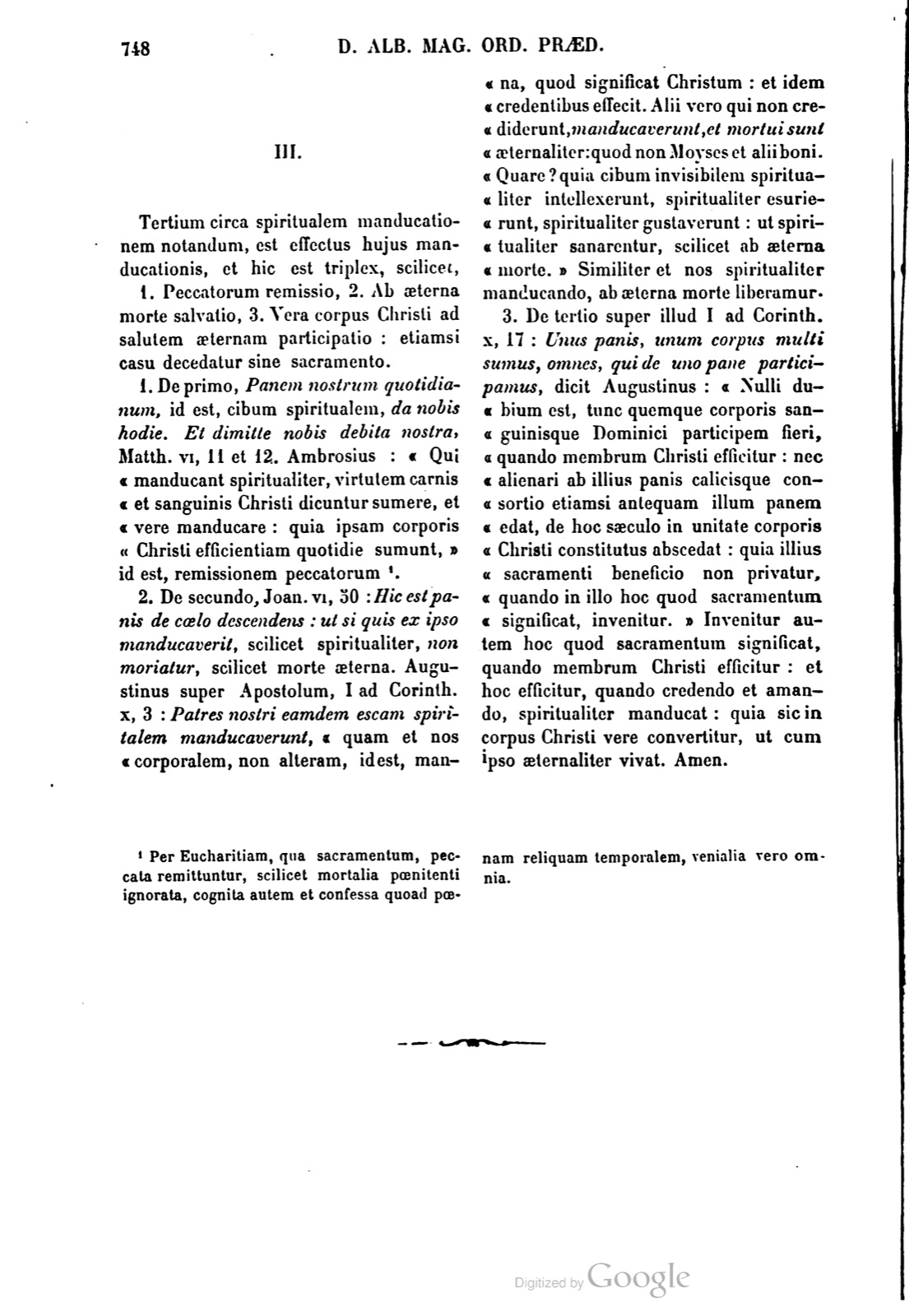
Tertium circa spiritualem manducationem notandum, est effectus hujus manducationis, et hic est triplex, scilicet, 1. Peccatorum remissio, 2. Ab aeterna morte salvatio, 3. Vera corpus Christi ad salutem aeternam participatio: etiamsi casu decedatur sine sacramento.
1. De primo, Panem nostrum quotidianum, id est, cibum spiritualem, da nobis hodie. Et dimitte nobis debita nostra, Matth. vi, 11 et 12. Ambrosius: "Qui manducant spiritualiter, virtutem carnis et sanguinis Christi dicuntur sumere, et vere manducare: quia ipsam corporis Christi efficientiam quotidie sumunt," id est, remissionem peccatorum2.
2. De secundo, Joan. vi, 50: Hic est panis de caelo descendens: ut si quis ex ipso manducaverit, scilicet spiritualiter, non moriatur, scilicet morte aeterna. Augustinus super Apostolum, I ad Corinth. x, 3: Patres nostri eamdem escam spiritualem manducaverunt, "quam et nos corporalem, non alteram, id est, manna, quod significat Christum: et idem credentibus effecit. Alii vero qui non crediderunt, manducaverunt, et mortui sunt aeternaliter: quod non Moyses et alii boni. Quare? quia cibum invisibilem spiritualiter intellexerunt, spiritualiter esurierunt, spiritualiter gustaverunt: ut spiritualiter sanarentur, scilicet ab aeterna morte." Similiter et nos spiritualiter manducando, ab aeterna morte liberamur.
3. De tertio super illud I ad Corinth. x, 17: Unus panis, unum corpus multi sumus, omnes, qui de uno pane participamus, dicit Augustinus: "Nulli dubium est, tunc quemque corporis sanguinisque Dominici participem fieri, quando membrum Christi efficitur: nec alienari ab illius panis calicisque consortio etiamsi antequam illum panem edat, de hoc saeculo in unitate corporis Christi constitutus abscedat: quia illius sacramenti beneficio non privatur, quando in illo hoc quod sacramentum significat, invenitur." Invenitur autem hoc quod sacramentum significat, quando membrum Christi efficitur: et hoc efficitur, quando credendo et amando, spiritualiter manducat: quia sic in corpus Christi vere convertitur, ut cum ipso aeternaliter vivat. Amen.
3. Concerning the third, Daniel 1:15: After ten days their faces appeared better and fatter than all the youths who were eating the royal food. The faces of those whom the bread that descended from heaven satisfied, says the Gloss, appeared better, "namely in beauty and cheerfulness for doing good." Proverbs 15:13: A joyful heart makes the face cheerful. 2 Corinthians 9:7: God loves a cheerful giver.
III.
The third thing to be noted concerning spiritual eating is the effect of this eating, and this is threefold, namely 1. remission of sins, 2. salvation from eternal death, 3. true participation in the body of Christ unto eternal salvation, even if by chance one dies without the sacrament.
1. Concerning the first, Give us today our daily bread, that is, spiritual food. And forgive us our debts, Matthew 6:11 and 12. Ambrose says: "Those who eat spiritually are said to receive the power of Christ's flesh and blood and to eat truly, because they daily receive the efficacy itself of Christ's body," that is, remission of sins2.
2. Concerning the second, John 6:50: This is the bread descending from heaven, so that if anyone eats from it, namely spiritually, he may not die, namely by eternal death. Augustine on the Apostle, 1 Corinthians 10:3: Our fathers ate the same spiritual food, "which also we eat bodily, not another, that is, manna, which signifies Christ, and it effected the same for believers. But others who did not believe ate and died eternally, which Moses and the other good persons did not. Why? Because they understood the invisible food spiritually, hungered spiritually, tasted spiritually, so that they might be healed spiritually, namely from eternal death." Similarly also we, by eating spiritually, are freed from eternal death.
3. Concerning the third, on that text 1 Corinthians 10:17: One bread, we who are many are one body, all who participate from the one bread, Augustine says: "No one doubts that each person then becomes a participant of the Lord's body and blood, when he is made a member of Christ; nor is he alienated from the fellowship of that bread and chalice even if, before he eats that bread, he departs from this world established in the unity of Christ's body, because he is not deprived of the benefit of that sacrament when that which the sacrament signifies is found in him." But that which the sacrament signifies is found when one is made a member of Christ, and this is effected when by believing and loving he eats spiritually, because thus he is truly converted into the body of Christ, so that he may live eternally with him. Amen.
Notes
- Amos 8:10. (Amos, viii, 10.) ↩
- Through the Eucharist, as sacrament, sins are remitted: namely mortal sins unknown to the penitent, but known and confessed ones with respect to the remaining temporal punishment, and all venial sins. (Per Eucharistiam, qua sacramentum, peccata remittuntur, scilicet mortalia poenitenti ignorata, cognita autem et confessa quoad poenam reliquam temporalem, venialia vero omnia.) ↩
If a page does not appear, its photograph has not been uploaded yet.