Works › Sermons on the Most Holy Sacrament of the Eucharist
Volume 13 · pp. 749–750
Sermon XX. On the Third Mode of Eating, Namely Spiritual and Sacramental, by Which the Good Eat
A marker with ≈ is an approximate page boundary, placed by measure of the text; the page photographs remain the authority. In the paired views, clicking a page marker brings that page into view.
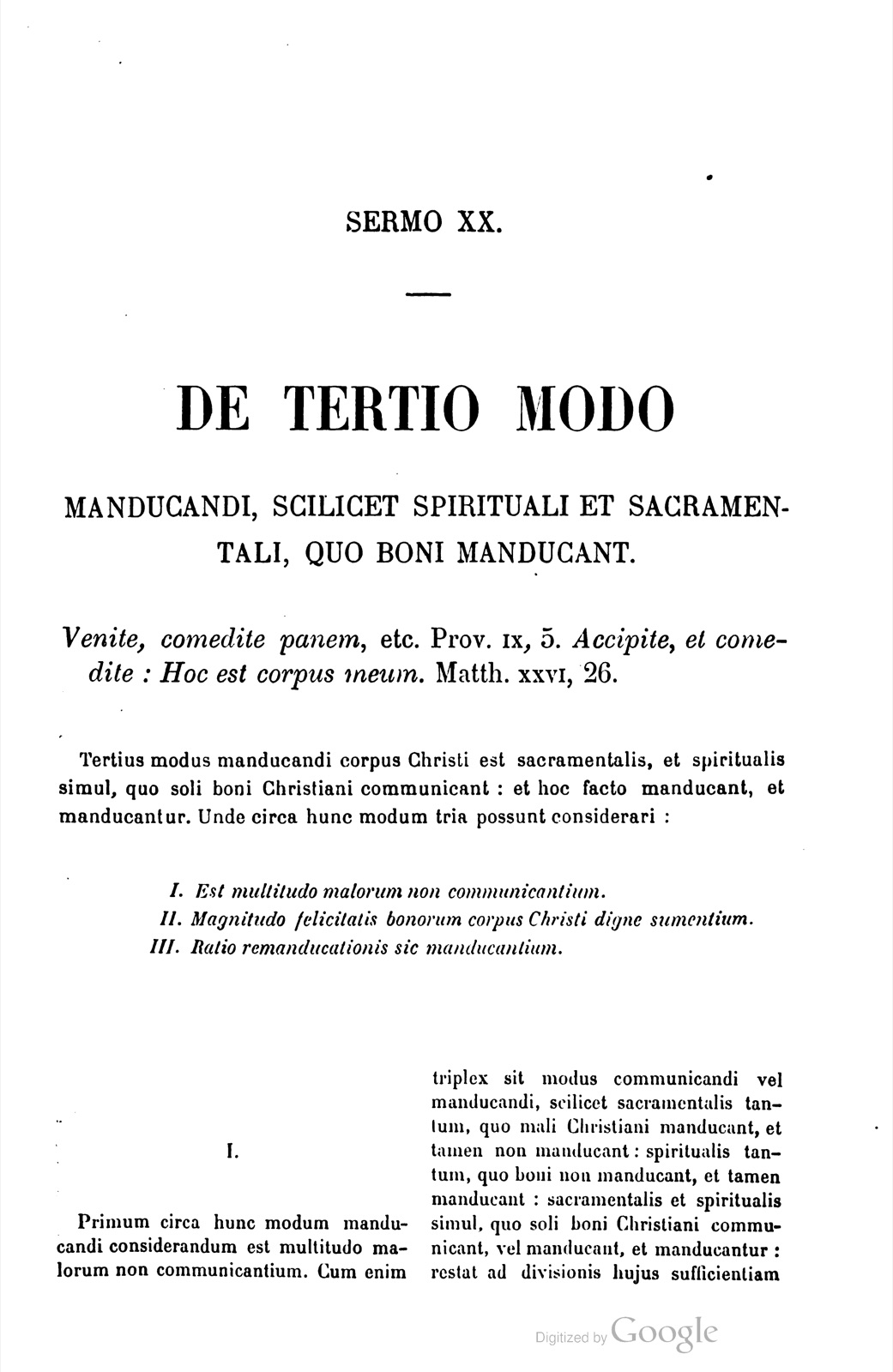
### Sermo XX
### De tertio modo manducandi, scilicet spirituali et sacramentali, quo boni manducant
Venite, comedite panem, etc. Prov. ix, 5. Accipite, et comedite: Hoc est corpus meum. Matth. xxvi, 26.
Tertius modus manducandi corpus Christi est sacramentalis, et spiritualis simul, quo soli boni Christiani communicant: et hoc facto manducant, et manducantur. Unde circa hunc modum tria possunt considerari:
I. Est multitudo malorum non communicantium.
II. Magnitudo felicitatis bonorum corpus Christi digne sumentium.
III. Ratio remanducationis sic manducantium.
I.
Primum circa hunc modum manducandi considerandum est multitudo malorum non communicantium. Cum enim triplex sit modus communicandi vel manducandi, scilicet sacramentalis tantum, quo mali Christiani manducant, et tamen non manducant: spiritualis tantum, quo boni non manducant, et tamen manducant: sacramentalis et spiritualis simul, quo soli boni Christiani communicant, vel manducant, et manducantur: restat ad divisionis hujus sufficientiam multitudo quaedam malorum, qui nec manducant, nec manducantur, id est, qui corpus Christi non suscipiunt, et ideo morte aeterna peribunt. Istorum tres species sunt ac turmae. Primi, infideles: secundi, negligentes: tertii, contemptores. 1. Infideles sunt, quorum corda per malitiam suam fallente diabolo sic excaecata sunt, ut non possint cognoscere, et credere divina sacramenta pro salute mundi mirabili Dei sapientia instituta. 2. Negligentes sunt quidam Christiani, qui temporalibus lucris, et saecularibus negotiis in tantum se occupant, ut sacram communionem tempore debito sumere negligant. 3. Contemptores sunt, qui sceleribus suis tanto amore inhaerent, quod corpus Domini sumere penitus parvipendunt.
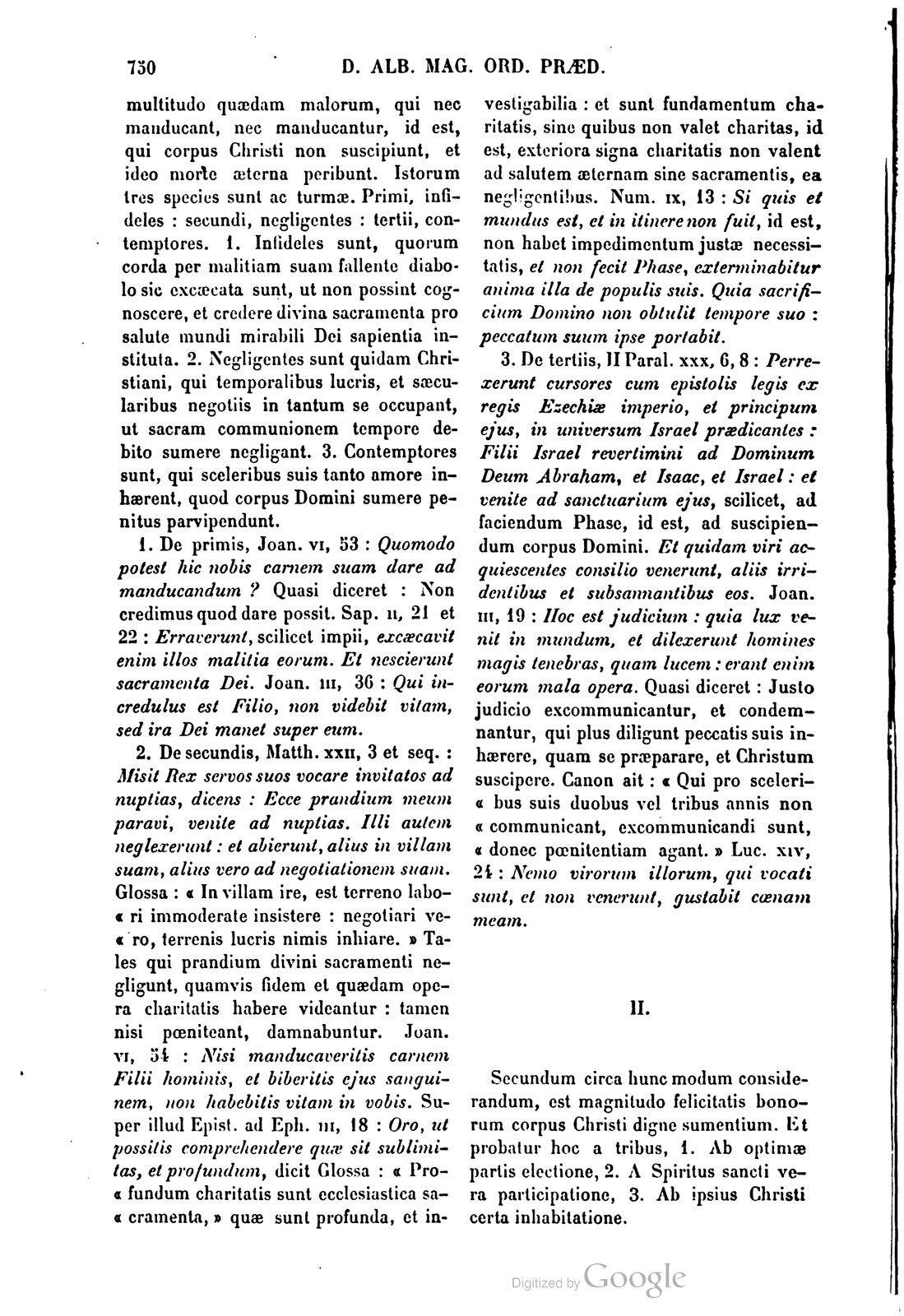
1. De primis, Joan. vi, 53: Quomodo potest hic nobis carnem suam dare ad manducandum? Quasi diceret: Non credimus quod dare possit. Sap. ii, 21 et 22: Erraverunt, scilicet impii, excaecavit enim illos malitia eorum. Et nescierunt sacramenta Dei. Joan. iii, 36: Qui incredulus est Filio, non videbit vitam, sed ira Dei manet super eum.
2. De secundis, Matth. xxii, 3 et seq.: Misit Rex servos suos vocare invitatos ad nuptias, dicens: Ecce prandium meum paravi, venite ad nuptias. Illi autem neglexerunt: et abierunt, alius in villam suam, alius vero ad negotiationem suam. Glossa: "In villam ire, est terreno labori immoderate insistere: negotiari vero, terrenis lucris nimis inhiare." Tales qui prandium divini sacramenti negligunt, quamvis fidem et quaedam opera charitatis habere videantur: tamen nisi poeniteant, damnabuntur. Joan. vi, 54: Nisi manducaveritis carnem Filii hominis, et biberitis ejus sanguinem, non habebitis vitam in vobis. Super illud Epist. ad Eph. iii, 18: Oro, ut possitis comprehendere quae sit sublimitas, et profundum, dicit Glossa: "Profundum charitatis sunt ecclesiastica sacramenta," quae sunt profunda, et investigabilia: et sunt fundamentum charitatis, sine quibus non valet charitas, id est, exteriora signa charitatis non valent ad salutem aeternam sine sacramentis, ea negligentibus. Num. ix, 13: Si quis et mundus est, et in itinere non fuit, id est, non habet impedimentum justae necessitatis, et non fecit Phase, exterminabitur anima illa de populis suis. Quia sacrificium Domino non obtulit tempore suo: peccatum suum ipse portabit.
### Sermon XX
### On the Third Mode of Eating, Namely Spiritual and Sacramental, by Which the Good Eat
Come, eat bread, etc. Proverbs 9:5. Take and eat: This is my body. Matthew 26:26.
The third mode of eating the body of Christ is sacramental and spiritual at the same time, by which only good Christians communicate, and when this has been done, they eat and are eaten. Hence concerning this mode three things can be considered:
I. There is the multitude of evil persons not communicating.
II. The magnitude of the happiness of the good who worthily receive the body of Christ.
III. The reason of the re-eating of those thus eating.
I.
The first thing to be considered concerning this mode of eating is the multitude of evil persons not communicating. For since there is a threefold mode of communicating or eating, namely sacramental only, by which evil Christians eat and nevertheless do not eat; spiritual only, by which the good do not eat and nevertheless eat; sacramental and spiritual at the same time, by which only good Christians communicate or eat and are eaten, for the sufficiency of this division there remains a certain multitude of evil persons who neither eat nor are eaten, that is, who do not receive the body of Christ, and therefore will perish by eternal death. There are three species and companies of these. The first are unbelievers; the second, the negligent; the third, contemners. 1. Unbelievers are those whose hearts, with the devil deceiving them, have been so blinded through their malice that they cannot know and believe the divine sacraments instituted for the salvation of the world by the marvelous wisdom of God. 2. The negligent are certain Christians who occupy themselves so much with temporal gains and secular business that they neglect to receive sacred communion at the proper time. 3. Contemners are those who cling to their crimes with so much love that they utterly make little of receiving the body of the Lord.
1. Concerning the first, John 6:53: How can this man give us his flesh to eat? As if he were saying: We do not believe that he can give it. Wisdom 2:21 and 22: They erred, namely the impious; for their malice blinded them. And they did not know the sacraments of God. John 3:36: He who is unbelieving toward the Son will not see life, but the anger of God remains upon him.
2. Concerning the second, Matthew 22:3 and following: The King sent his servants to call those invited to the wedding, saying: Behold, I have prepared my dinner; come to the wedding. But they neglected it and went away, one to his farm and another to his business. The Gloss says: "To go to the farm is to insist immoderately on earthly labor; but to do business is to gape too much after earthly gains." Such persons who neglect the dinner of the divine sacrament, although they seem to have faith and certain works of charity, nevertheless, unless they do penance, will be damned. John 6:54: Unless you eat the flesh of the Son of man and drink his blood, you will not have life in you. On that text Ephesians 3:18: I pray that you may be able to comprehend what is the sublimity and depth, the Gloss says: "The depth of charity is the ecclesiastical sacraments," which are profound and investigable, and are the foundation of charity, without which charity has no force; that is, exterior signs of charity have no force for eternal salvation without the sacraments for those neglecting them. Numbers 9:13: If someone is clean and was not on a journey, that is, does not have the impediment of just necessity, and did not make the Passover, that soul will be exterminated from his peoples, because he did not offer sacrifice to the Lord in its time; he himself will bear his sin.
3. De tertiis, II Paral. xxx, 6, 8: Perrexerunt cursores cum epistolis legis ex regis Ezechiae imperio, et principum ejus, in universum Israel praedicantes: Filii Israel revertimini ad Dominum Deum Abraham, et Isaac, et Israel: et venite ad sanctuarium ejus, scilicet, ad faciendum Phase, id est, ad suscipiendum corpus Domini. Et quidam viri acquiescentes consilio venerunt, aliis irridentibus et subsannantibus eos. Joan. iii, 19: Hoc est judicium: quia lux venit in mundum, et dilexerunt homines magis tenebras, quam lucem: erant enim eorum mala opera. Quasi diceret: Justo judicio excommunicantur, et condemnantur, qui plus diligunt peccatis suis inhaerere, quam se praeparare, et Christum suscipere. Canon ait: "Qui pro sceleribus suis duobus vel tribus annis non communicant, excommunicandi sunt, donec poenitentiam agant." Luc. xiv, 24: Nemo virorum illorum, qui vocati sunt, et non venerunt, gustabit coenam meam.
II.
Secundum circa hunc modum considerandum, est magnitudo felicitatis bonorum corpus Christi digne sumentium. Et probatur hoc a tribus, 1. Ab optimae partis electione, 2. A Spiritus sancti vera participatione, 3. Ab ipsius Christi certa inhabitatione.
3. Concerning the third, 2 Chronicles 30:6, 8: The runners went with letters of the law by the command of King Hezekiah and of his princes, preaching in all Israel: Children of Israel, return to the Lord God of Abraham, Isaac, and Israel, and come to his sanctuary, namely to make the Passover, that is, to receive the body of the Lord. And certain men, acquiescing in the counsel, came, while others laughed at and mocked them. John 3:19: This is the judgment: because light came into the world, and men loved darkness more than light; for their works were evil. As if he were saying: By just judgment those who love more to cling to their sins than to prepare themselves and receive Christ are excommunicated and condemned. The Canon says: "Those who for their crimes do not communicate for two or three years are to be excommunicated until they do penance." Luke 14:24: None of those men who were called and did not come will taste my supper.
II.
The second thing to be considered concerning this mode is the magnitude of the happiness of the good who worthily receive the body of Christ. And this is proved from three things: 1. from the choice of the best part, 2. from true participation in the Holy Spirit, 3. from the certain indwelling of Christ himself.
If a page does not appear, its photograph has not been uploaded yet.