Works › Sermons on the Most Holy Sacrament of the Eucharist
Volume 13 · pp. 735–738
Part V. On the Threefold Mode of Eating. Sermon XVII. First, on the Sacramental Mode Only, by Which the Malevolent and Deceitful Eat Unworthily
A marker with ≈ is an approximate page boundary, placed by measure of the text; the page photographs remain the authority. In the paired views, clicking a page marker brings that page into view.
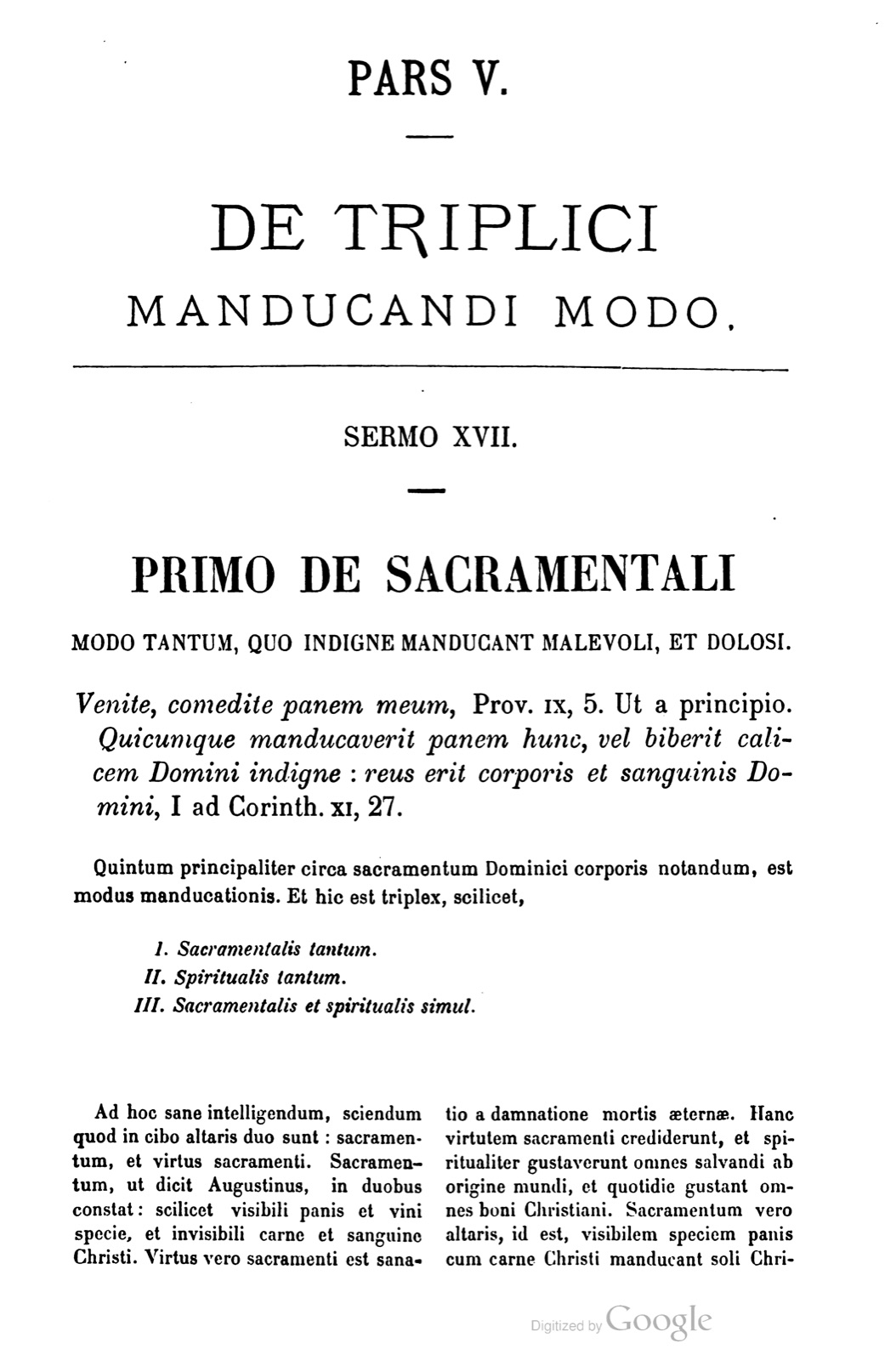
### Pars V
### De triplici manducandi modo
### Sermo XVII
### Primo de sacramentali modo tantum, quo indigne manducant malevoli, et dolosi
Venite, comedite panem meum, Prov. ix, 5. Ut a principio. Quicumque manducaverit panem hunc, vel biberit calicem Domini indigne: reus erit corporis et sanguinis Domini, I ad Corinth. xi, 27.
Quintum principaliter circa sacramentum Dominici corporis notandum, est modus manducationis. Et hic est triplex, scilicet,
I. Sacramentalis tantum.
II. Spiritualis tantum.
III. Sacramentalis et spiritualis simul.
Ad hoc sane intelligendum, sciendum quod in cibo altaris duo sunt: sacramentum, et virtus sacramenti. Sacramentum, ut dicit Augustinus, in duobus constat: scilicet visibili panis et vini specie, et invisibili carne et sanguine Christi. Virtus vero sacramenti est sanatio a damnatione mortis aeternae. Hanc virtutem sacramenti crediderunt, et spiritualiter gustaverunt omnes salvandi ab origine mundi, et quotidie gustant omnes boni Christiani. Sacramentum vero altaris, id est, visibilem speciem panis cum carne Christi manducant soli Christiani: et hoc tam boni quam mali, sed modo dissimili: quia mali manducant sacramentum tantum, id est, sub visibili specie panis corpus Christi, sed non manducant virtutem sacramenti spiritualem, id est, salutem et vitam aeternam. Boni vero manducant utrumque simul, scilicet sacramentum, et virtutem sacramenti.
Ex his patet triplex modus manducandi corpus Christi, primus sacramentalis tantum, secundus spiritualis tantum, tertius sacramentalis et spiritualis simul. Primo modo manducant mali Christiani, secundo omnes salvandi, tertio soli boni Christiani. Primi manducant, et non manducant: secundi non manducant, sed tamen manducant: tertii manducant, et manducantur.
Primus modus manducandi corpus Christi, est sacramentaliter tantum, quo mali Christiani manducant: quia venerandum corpus in mortali peccato, ore polluto sumentes, cordis affectum ad influentiam virtutis bonitatis ejus, peccatis suis immundis et duris, quasi luto et lapide, claudunt. Ezech. xiv, 3: Posuerunt immunditias suas in cordibus suis, et scandalum iniquitatis suae statuerunt contra faciem suam. Isti manducant et non manducant. Manducant quidem, quia corpus Christi sacramentaliter sumunt: sed tamen non manducant, quia virtutem spiritualem, id est, salutem animae non percipiunt. Eccle. vi, 1 et 2: Est et aliud malum, quod vidi sub sole, et quidem frequens apud homines: Vir, cui dedit Deus divitias, et substantiam, et honorem: ... nec tribuit ei potestatem Deus ut comedat ex eo. Ad Heb. xiii, 10: Habemus altare, de quo edere non habent potestatem, qui tabernaculo deserviunt, id est, peccatis carnalibus. I ad Corinth. x, 20: Non potestis Domini bibere calicem et calicem daemoniorum. Gregorius: « Est quidem in peccatoribus, et indigne sumentibus vera caro Christi, et verus sanguis, » videlicet, praesentiali essentia, non salubri efficientia. Augustinus: « Qui discordat a Christo, nec manducat carnem ejus, nec bibit sanguinem: etsi tantae rei sacramentum quotidie sumat, sibi tamen erit ad judicium. » Discordat a Christo, qui cordis affectum ab eo avertens ad peccatum convertit. Et talis valde infelix dici potest, ad quem tantum bonum frequenter venit, et nullum spirituale lucrum inde percipit.
### Part V
### On the Threefold Mode of Eating
### Sermon XVII
### First, on the Sacramental Mode Only, by Which the Malevolent and Deceitful Eat Unworthily
Come, eat my bread, Proverbs 9:5. As from the beginning. Whoever will have eaten this bread or drunk the chalice of the Lord unworthily will be guilty of the body and blood of the Lord, 1 Corinthians 11:27.
The fifth thing principally to be noted concerning the sacrament of the Lord's body is the mode of eating. And this is threefold, namely:
I. Sacramental only.
II. Spiritual only.
III. Sacramental and spiritual at the same time.
For understanding this sanely, one must know that in the food of the altar there are two things: the sacrament and the power of the sacrament. The sacrament, as Augustine says, consists in two things, namely in the visible species of bread and wine and in the invisible flesh and blood of Christ. But the power of the sacrament is healing from the damnation of eternal death. All who were to be saved from the origin of the world believed this power of the sacrament and tasted it spiritually, and all good Christians taste it daily. But only Christians eat the sacrament of the altar, that is, the visible species of bread with the flesh of Christ, and this both good and evil Christians do, but in a dissimilar mode: because the evil eat only the sacrament, that is, under the visible species of bread, the body of Christ, but they do not eat the spiritual power of the sacrament, that is, salvation and eternal life. But the good eat both at the same time, namely the sacrament and the power of the sacrament.
From these things the threefold mode of eating the body of Christ is clear: the first sacramental only, the second spiritual only, the third sacramental and spiritual at the same time. In the first mode evil Christians eat; in the second, all who are to be saved; in the third, only good Christians. The first eat and do not eat; the second do not eat, and nevertheless eat; the third eat and are eaten.
The first mode of eating the body of Christ is sacramentally only, by which evil Christians eat, because when they receive the venerable body in mortal sin, with a polluted mouth, they close the affection of the heart to the influx of the power of its goodness by their unclean and hard sins, as by mud and stone. Ezekiel 14:3: They placed their uncleannesses in their hearts and set the scandal of their iniquity against their face. These eat and do not eat. They indeed eat, because they receive the body of Christ sacramentally, but nevertheless they do not eat, because they do not receive the spiritual power, that is, the salvation of the soul. Ecclesiastes 6:1 and 2: There is also another evil which I saw under the sun, and indeed frequent among men: a man to whom God gave riches, substance, and honor, ... and God did not give him power to eat from it. Hebrews 13:10: We have an altar from which those who serve the tabernacle do not have power to eat, that is, those who serve carnal sins. 1 Corinthians 10:20: You cannot drink the chalice of the Lord and the chalice of demons. Gregory says: "There is indeed in sinners and those receiving unworthily the true flesh of Christ and the true blood," namely by present essence, not by salutary efficacy. Augustine says: "He who disagrees with Christ neither eats his flesh nor drinks his blood; and although he receives daily the sacrament of so great a thing, nevertheless it will be for judgment to him." He disagrees with Christ who, turning the affection of the heart away from him, turns it toward sin. And such a person can be called very unhappy, to whom so great a good frequently comes and who perceives no spiritual gain from it.
Hoc modo, scilicet sacramentaliter tantum manducantium, tria sunt genera. Primi malevoli, secundi dolosi, tertii praesumptuosi.
Primi sunt, qui corpus Christi sumunt in peccandi voluntate. Secundi sunt, hypocritae qui foris boni apparentes, occulte sunt pravi, et tamquam justi accedunt ad altare. Tertii sunt, qui manifeste mali sunt, tamen praesumunt manducare. De primis duobus potest hic dici, et de tertiis in sequenti sermone.
I.
De primo genere dicitur, Isa. xxix, 13: Appropinquat enim populus iste ore: cor autem ejus longe est a me. Appropinquat ore per sacramenti sumptionem: sed cor longe est per peccati voluntatem. Tales tria mala sequuntur, scilicet, 1. Peccati sui aggravatio, 2. A gratia Christi separatio, 3. Ad aeternam poenam damnatio.
1. De primo, Matth. xv, 26: Non est bonum sumere panem filiorum, et mittere canibus, id est, malevolis. Augustinus: « Habentes voluntatem peccandi, variari magis dico Eucharistiae perceptione, quam purificari. »
2. De secundo, Sap. i, 3 et 4: Perversae cogitationes separant a Deo. Quoniam in malevolam animam non introibit sapientia, nec habitabit in corpore subdito peccatis.
Of those who eat in this way, namely sacramentally only, there are three kinds. The first are the malevolent, the second deceitful, the third presumptuous.
The first are those who receive the body of Christ with a will to sin. The second are hypocrites who, appearing good outwardly, are secretly wicked and approach the altar as if just. The third are those who are manifestly evil, yet presume to eat. Concerning the first two something can be said here, and concerning the third in the following sermon.
I.
Concerning the first kind it is said, Isaiah 29:13: For this people approaches with the mouth, but its heart is far from me. It approaches with the mouth through the reception of the sacrament, but the heart is far through the will of sin. Three evils follow such persons, namely 1. the aggravation of their sin, 2. separation from the grace of Christ, 3. damnation to eternal punishment.
1. Concerning the first, Matthew 15:26: It is not good to take the bread of the children and cast it to dogs, that is, to the malevolent. Augustine says: "Those having the will to sin, I say, are more changed for the worse by the reception of the Eucharist than purified."
2. Concerning the second, Wisdom 1:3 and 4: Perverse thoughts separate from God. For wisdom will not enter into a malevolent soul, nor will it dwell in a body subject to sins.
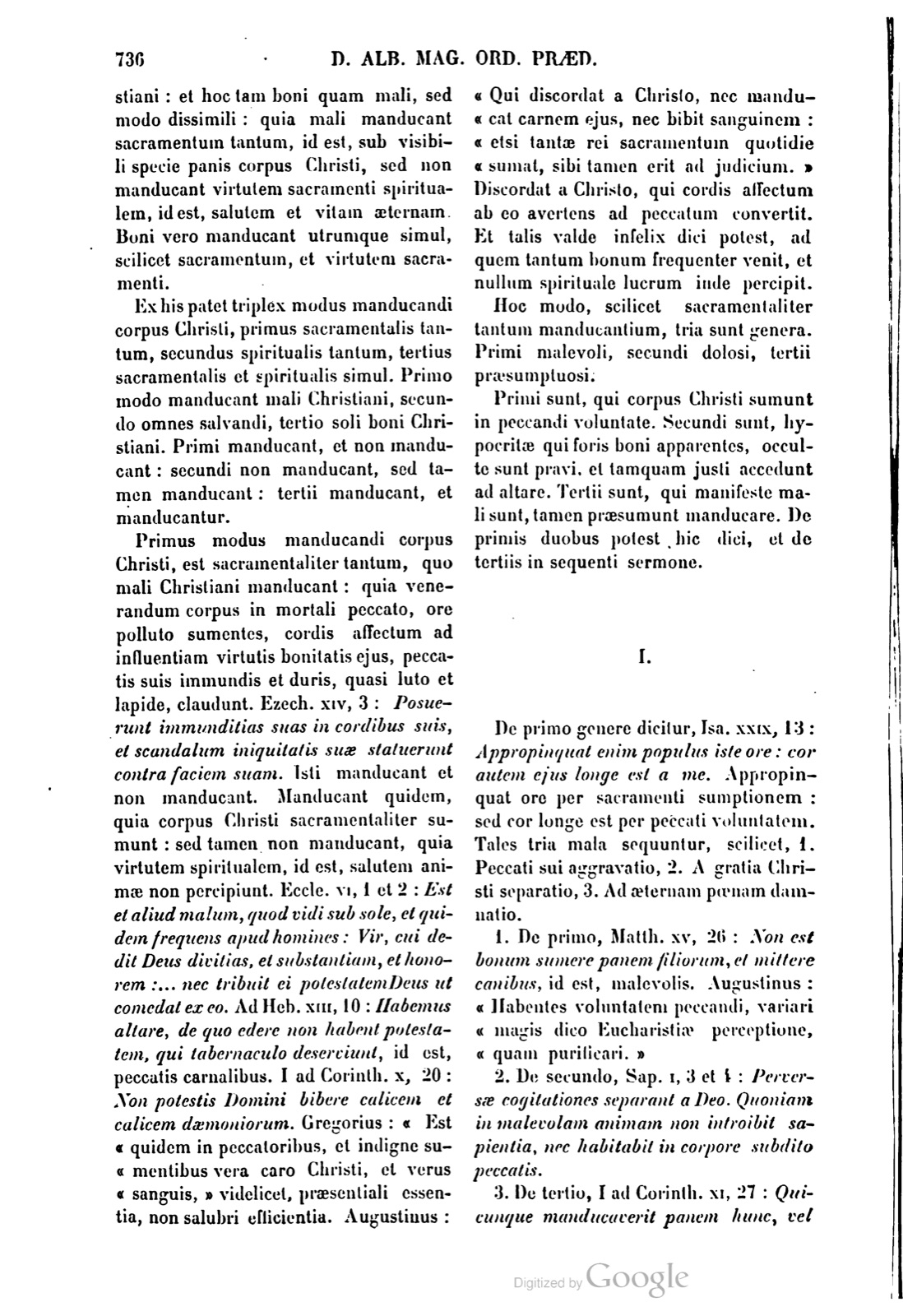
3. De tertio, I ad Corinth. xi, 27: Quicunque manducaverit panem hunc, vel biberit calicem Domini indigne: reus erit corporis, et sanguinis Domini. Ambrosius: « Indignus est, qui non devota mente accedit ad Eucharistiam, aut in peccandi voluntate manens, hic reus est corporis et sanguinis Domini, id est, ac si Christum occiderit, punietur. »
II.
De secundo genere malorum indigne communicantium, scilicet de dolosis, sive hypocritis, II ad Timoth. iii, 1, 2 et 5: In novissimis diebus instabunt tempora periculosa: et erunt homines seipsos amantes: ... habentes speciem quidem pietatis, virtutem autem ejus abnegantes. Glossa: « Speciem pietatis et religionis, qui eadem sacramenta habent cum piis, virtutem, id est, charitatem abnegantes: multa scilicet mala occulte perpetrantes, et manifesta fallaciter excusando. »
Tales similiter tria mala sequuntur, quia, 1. Socii Judae proditoris efficiuntur, 2. Coram toto mundo confundentur, 3. Extra beatorum consortium projicientur.
1. De primo, Joan. xiii, 18: Qui manducat meum panem, levabit contra me calcaneum suum. Hoc dicitur de Juda, et sibi similibus, et de fictis Domini amicis. Glossa: Qui manducat panem meum, « non ut proficiat, sed ut lateat, is me conculcabit, id est, tradet. » Qui ergo vult latere in peccatis suis sub pulchra specie religionis et communionis, similis efficitur et socius Judae proditoris.
2. De secundo, Eccli. i, 36 et seq.: Ne sis incredibilis timori Domini: et ne accesseris ad illum duplici corde... Ne fueris hypocrita in conspectu hominum: ne forte revelet Deus absconsa tua, et in medio synagogae elidat te: quoniam accessisti maligne ad Dominum, et cor tuum plenum est dolo et fallacia. Nahum, iii, 5 et 6: Ecce ego ad te, meretrix speciosa, dicit Dominus exercituum, id est, anima foris pulchra, intus immunda, et revelabo pudenda tua in facie tua, et ostendam gentibus nuditatem tuam, et regibus ignominiam tuam. Et projiciam super te abominationes, et contumeliis te afficiam.
3. De tertio, Matth. xxiii, 27: Vae vobis hypocritae: qui similes estis sepulcris dealbatis, quae a foris apparent hominibus speciosa, intus vero plena sunt ossibus mortuorum, et omni spurcitia, id est, putredine, verme, et foetore. Sic et vos a foris apparetis hominibus speciosi: intus autem estis pleni hypocrisi, id est, amore vanae laudis, et iniquitate, id est, cupiditate temporalium, et odio veritatis. Et ideo primo dicitur: Vae vobis, id est, extra beatorum consortium miserabilis projectio. Lev. vii, 20: Anima polluta (de hypocrisi debet intelligi) quae ederit de carnibus hostiae pacificorum, id est, corporis Christi, quae oblata est Domino, peribit de populis suis, id est, ejicietur de salvandis ad damnationem mortis aeternae.
3. Concerning the third, 1 Corinthians 11:27: Whoever will have eaten this bread or drunk the chalice of the Lord unworthily will be guilty of the body and blood of the Lord. Ambrose says: "Unworthy is he who does not approach the Eucharist with a devout mind, or who remains in the will of sinning; this man is guilty of the body and blood of the Lord, that is, he will be punished as if he had killed Christ."
II.
Concerning the second kind of evil persons communicating unworthily, namely concerning the deceitful or hypocrites, 2 Timothy 3:1, 2, and 5: In the last days dangerous times will press in, and men will be lovers of themselves: ... having indeed the species of piety, but denying its power. The Gloss says: "The species of piety and religion, those who have the same sacraments with the pious; denying the power, that is, charity, namely by perpetrating many evils secretly and by deceitfully excusing manifest ones."
Three evils similarly follow such persons, because 1. they are made companions of Judas the traitor, 2. they will be confounded before the whole world, 3. they will be cast outside the fellowship of the blessed.
1. Concerning the first, John 13:18: He who eats my bread will lift his heel against me. This is said of Judas and of those like him, and of the feigned friends of the Lord. The Gloss says: He who eats my bread, "not so that he may profit, but so that he may hide, he will trample me, that is, betray me." Therefore he who wishes to hide in his sins under the beautiful species of religion and communion is made like and companion of Judas the traitor.
2. Concerning the second, Ecclesiasticus 1:36 and following: Do not be unbelieving toward the fear of the Lord, and do not approach him with a double heart... Do not be a hypocrite in the sight of men, lest perhaps God reveal your hidden things and strike you down in the midst of the synagogue, because you have approached the Lord wickedly and your heart is full of deceit and fallacy. Nahum 3:5 and 6: Behold, I am against you, beautiful prostitute, says the Lord of hosts, that is, the soul outwardly beautiful, inwardly unclean; and I will reveal your shameful parts in your face, and I will show your nakedness to the nations and your disgrace to kings. And I will cast abominations upon you and afflict you with insults.
3. Concerning the third, Matthew 23:27: Woe to you hypocrites, who are like whitewashed sepulchres, which outwardly appear beautiful to men, but inwardly are full of the bones of the dead and of every filth, that is, putrefaction, worm, and stench. So also you outwardly appear beautiful to men, but inwardly you are full of hypocrisy, that is, love of empty praise, and iniquity, that is, desire for temporal things and hatred of truth. And therefore first it is said: Woe to you, that is, miserable casting out from the fellowship of the blessed. Leviticus 7:20: A polluted soul (this must be understood of hypocrisy) which eats from the flesh of the victim of peace offerings, that is, of the body of Christ, which has been offered to the Lord, will perish from its peoples, that is, it will be cast from those to be saved into the damnation of eternal death.
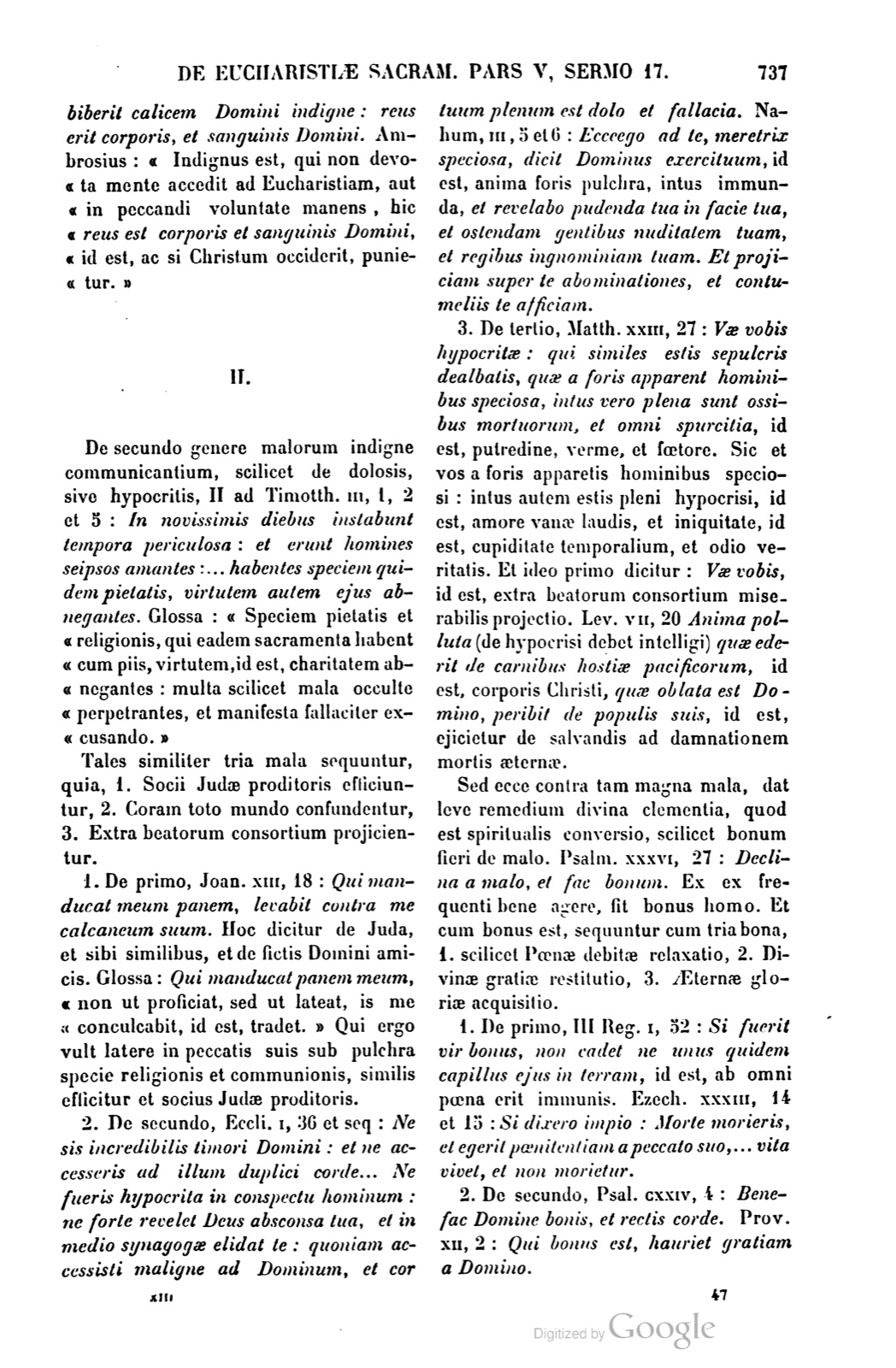
Sed ecce contra tam magna mala, dat leve remedium divina clementia, quod est spiritualis conversio, scilicet bonum fieri de malo. Psalm. xxxvi, 27: Declina a malo, et fac bonum. Ex ex frequenti bene agere, fit bonus homo. Et cum bonus est, sequuntur cum tria bona, 1. scilicet Poenae debitae relaxatio, 2. Divinae gratiae restitutio, 3. Aeternae gloriae acquisitio.
1. De primo, III Reg. i, 52: Si fuerit vir bonus, non cadet ne unus quidem capillus ejus in terram, id est, ab omni poena erit immunis. Ezech. xxxiii, 14 et 15: Si dixero impio: Morte morieris, et egerit poenitentiam a peccato suo, ... vita vivet, et non morietur.
2. De secundo, Psal. cxxiv, 4: Benefac Domine bonis, et rectis corde. Prov. xii, 2: Qui bonus est, hauriet gratiam a Domino.
3. De tertio, Matth. xxv, 21: Euge serve bone, et fidelis, quia super pauca fuisti fidelis, super multa te constituam intra in gaudium domini tui. Euge, quasi bene gaude: serve bone, quia in pauca fuisti fidelis, id est, in bonis quae tibi commisi, bene negotiatus es: supra multa te constituam, id est, supra bona aeterni gaudii: unde intra in gaudium Domini Dei tui, ut scilicet omni parte gaudio perfruaris. Isa. li, 11: Venient in Sion laudantes, et laetitia sempiterna super capita eorum. Quia causa aeternae laetitiae erit in Domini Dei sui contemplatione. Jerem. xxxi, 12 et 13: Venient, et laudabunt in monte Sion: et confluent ad bona Domini. Tunc laetabitur virgo in choro, juvenes et senes simul. Virgo est Beata Virgo Maria praecentrix in choro coelesti: juvenes sunt omnes beati, senes Angeli. Isti simul Deum laudabunt, et in bonis ejus sine fine gaudebunt. Amen.
But behold, against such great evils divine clemency gives a light remedy, which is spiritual conversion, namely that one become good from evil. Psalm 36:27: Turn away from evil and do good. From frequent doing well, a good man is made. And when he is good, three goods follow him, 1. namely relaxation of the punishment owed, 2. restitution of divine grace, 3. acquisition of eternal glory.
1. Concerning the first, 3 Kings 1:52: If he will be a good man, not even one hair of his will fall to the ground, that is, he will be immune from every punishment. Ezekiel 33:14 and 15: If I say to the impious man: You will die by death, and he does penance for his sin, ... by life he will live and will not die.
2. Concerning the second, Psalm 124:4: Do good, O Lord, to the good and the upright of heart. Proverbs 12:2: He who is good will draw grace from the Lord.
3. Concerning the third, Matthew 25:21: Well done, good and faithful servant; because you have been faithful over a few things, I will set you over many things; enter into the joy of your lord. Well done, as if: rejoice well; good servant, because you have been faithful in few things, that is, in the goods which I committed to you, you have traded well; I will set you over many things, that is, over the goods of eternal joy; hence enter into the joy of the Lord your God, so that, namely, in every part you may enjoy joy. Isaiah 51:11: They will come into Sion praising, and everlasting joy upon their heads. Because the cause of eternal joy will be in the contemplation of the Lord their God. Jeremiah 31:12 and 13: They will come and praise on Mount Sion, and they will flow together to the goods of the Lord. Then the virgin will rejoice in the choir, young men and old men together. The virgin is the Blessed Virgin Mary, the precentor in the heavenly choir; the young men are all the blessed; the old men are the Angels. These together will praise God and rejoice without end in his goods. Amen.

If a page does not appear, its photograph has not been uploaded yet.