Works › Sermons on the Most Holy Sacrament of the Eucharist
Volume 13 · pp. 731–734
Sermon XVI. On Our Preparation and Spiritual Eating
A marker with ≈ is an approximate page boundary, placed by measure of the text; the page photographs remain the authority. In the paired views, clicking a page marker brings that page into view.
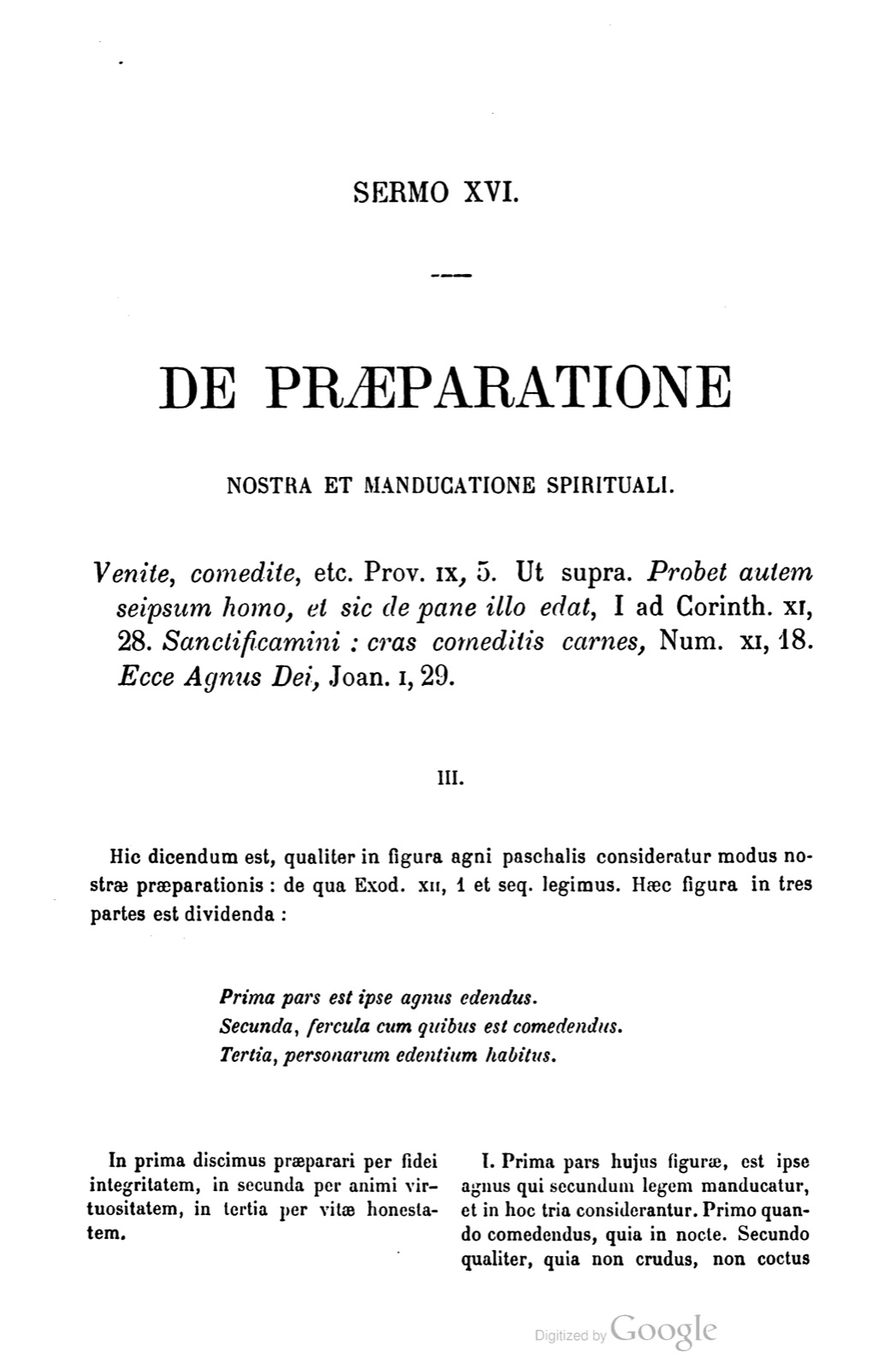
### Sermo XVI
### De praeparatione nostra et manducatione spirituali
Venite, comedite, etc. Prov. ix, 5. Ut supra. Probet autem seipsum homo, et sic de pane illo edat, I ad Corinth. xi, 28. Sanctificamini: cras comeditis carnes, Num. xi, 18. Ecce Agnus Dei, Joan. i, 29.
III.
Hic dicendum est, qualiter in figura agni paschalis consideratur modus nostrae praeparationis: de qua Exod. xii, 1 et seq. legimus. Haec figura in tres partes est dividenda:
Prima pars est ipse agnus edendus.
Secunda, fercula cum quibus est comedendus.
Tertia, personarum edentium habitus.
In prima discimus praeparari per fidei integritatem, in secunda per animi virtuositatem, in tertia per vitae honestatem.
I. Prima pars hujus figurae, est ipse agnus qui secundum legem manducatur, et in hoc tria considerantur. Primo quando comedendus, quia in nocte. Secundo qualiter, quia non crudus, non coctus aqua, sed assus igni. Tertio quid in eo comeditur, quia caput cum pedibus et intestinis: et in his fidei nostrae integritas de corpore Christi figuratur.
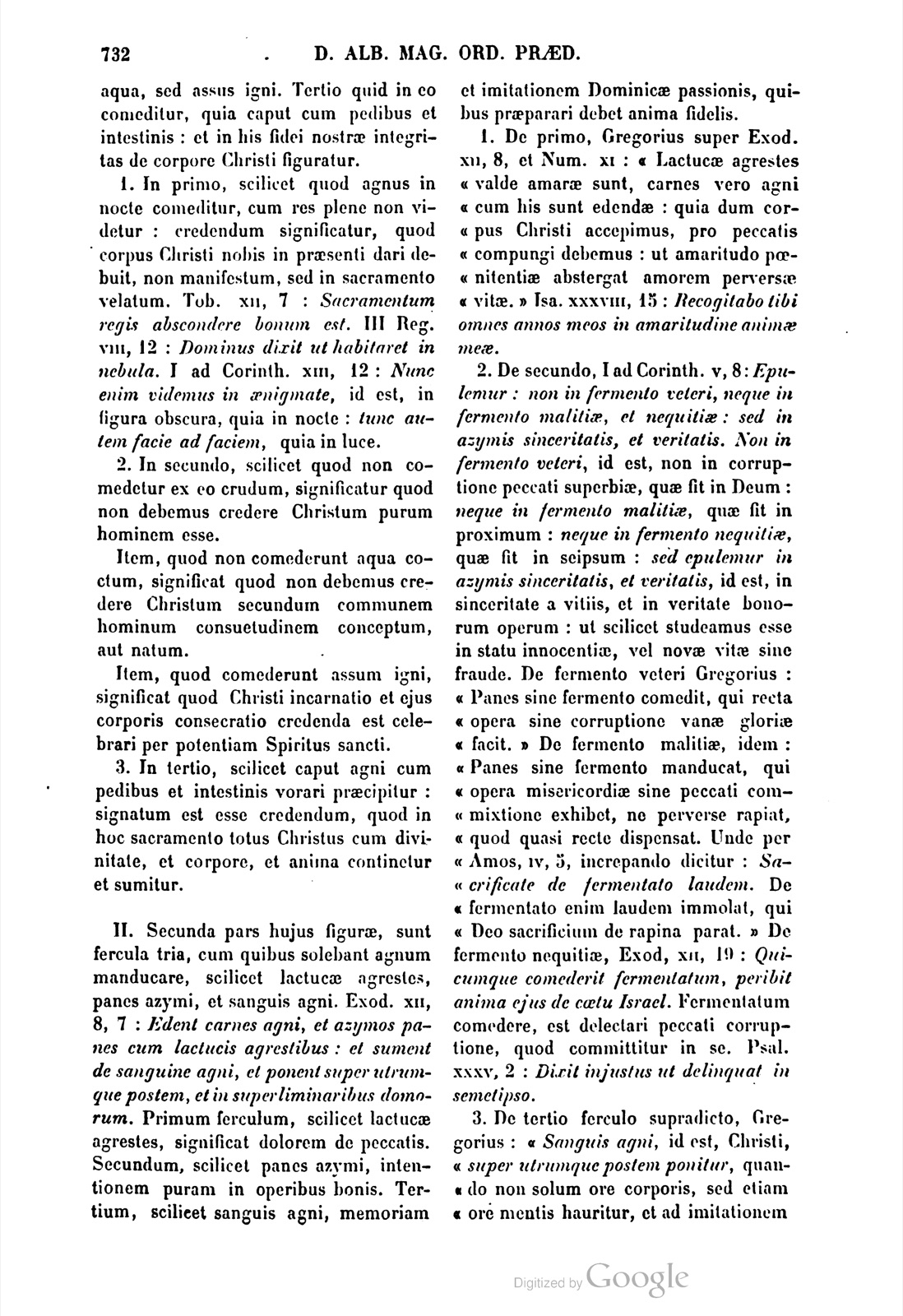
1. In primo, scilicet quod agnus in nocte comeditur, cum res plene non videtur: credendum significatur, quod corpus Christi nobis in praesenti dari debuit, non manifestum, sed in sacramento velatum. Tob. xii, 7: Sacramentum regis abscondere bonum est. III Reg. viii, 12: Dominus dixit ut habitaret in nebula. I ad Corinth. xiii, 12: Nunc enim videmus in aenigmate, id est, in figura obscura, quia in nocte: tunc autem facie ad faciem, quia in luce.
2. In secundo, scilicet quod non comedetur ex eo crudum, significatur quod non debemus credere Christum purum hominem esse.
Item, quod non comederunt aqua coctum, significat quod non debemus credere Christum secundum communem hominum consuetudinem conceptum, aut natum.
Item, quod comederunt assum igni, significat quod Christi incarnatio et ejus corporis consecratio credenda est celebrari per potentiam Spiritus sancti.
3. In tertio, scilicet caput agni cum pedibus et intestinis vorari praecipitur: signatum est esse credendum, quod in hoc sacramento totus Christus cum divinitate, et corpore, et anima continetur et sumitur.
II. Secunda pars hujus figurae, sunt fercula tria, cum quibus solebant agnum manducare, scilicet lactucae agrestes, panes azymi, et sanguis agni. Exod. xii, 8, 7: Edent carnes agni, et azymos panes cum lactucis agrestibus: et sument de sanguine agni, et ponent super utrumque postem, et in superliminaribus domorum. Primum ferculum, scilicet lactucae agrestes, significat dolorem de peccatis. Secundum, scilicet panes azymi, intentionem puram in operibus bonis. Tertium, scilicet sanguis agni, memoriam et imitationem Dominicae passionis, quibus praeparari debet anima fidelis.
### Sermon XVI
### On Our Preparation and Spiritual Eating
Come, eat, etc. Proverbs 9:5. As above. But let a man prove himself, and so let him eat of that bread, 1 Corinthians 11:28. Be sanctified; tomorrow you will eat flesh, Numbers 11:18. Behold the Lamb of God, John 1:29.
III.
Here one must speak of how the mode of our preparation is considered in the figure of the paschal lamb, concerning which we read in Exodus 12:1 and following. This figure must be divided into three parts:
The first part is the lamb itself to be eaten.
The second, the dishes with which it is to be eaten.
The third, the habit of the persons eating.
In the first we learn to be prepared through integrity of faith, in the second through the virtuousness of the soul, in the third through the honesty of life.
I. The first part of this figure is the lamb itself, which is eaten according to the law, and in this three things are considered. First, when it is to be eaten, because at night. Secondly, in what manner, because not raw, not cooked in water, but roasted by fire. Thirdly, what is eaten in it, because the head with the feet and intestines; and in these the integrity of our faith concerning the body of Christ is figured.
1. In the first, namely that the lamb is eaten at night, when the thing is not fully seen, it is signified that one must believe that the body of Christ had to be given to us in the present, not manifest, but veiled in a sacrament. Tobit 12:7: It is good to hide the sacrament of the king. 3 Kings 8:12: The Lord said that he would dwell in a cloud. 1 Corinthians 13:12: For now we see in an enigma, that is, in an obscure figure, because at night; but then face to face, because in the light.
2. In the second, namely that nothing raw is eaten from it, it is signified that we ought not to believe that Christ is a mere man.
Likewise, that they did not eat it cooked in water signifies that we ought not to believe that Christ was conceived or born according to the common custom of men.
Likewise, that they ate it roasted by fire signifies that the incarnation of Christ and the consecration of his body must be believed to be celebrated through the power of the Holy Spirit.
3. In the third, namely that the head of the lamb with the feet and intestines is commanded to be devoured, it has been signified that one must believe that in this sacrament the whole Christ with deity, body, and soul is contained and received.
II. The second part of this figure is the three dishes with which they were accustomed to eat the lamb, namely wild lettuces, unleavened loaves, and the blood of the lamb. Exodus 12:8, 7: They will eat the flesh of the lamb and unleavened loaves with wild lettuces; and they will take from the blood of the lamb and place it upon each doorpost and on the lintels of the houses. The first dish, namely wild lettuces, signifies sorrow for sins. The second, namely unleavened loaves, signifies pure intention in good works. The third, namely the blood of the lamb, signifies remembrance and imitation of the Lord's Passion, by which the faithful soul ought to be prepared.
1. De primo, Gregorius super Exod. xii, 8, et Num. xi: « Lactucae agrestes valde amarae sunt, carnes vero agni cum his sunt edendae: quia dum corpus Christi accepimus, pro peccatis compungi debemus: ut amaritudo poenitentiae abstergat amorem perversae vitae. » Isa. xxxviii, 15: Recogitabo tibi omnes annos meos in amaritudine animae meae.
2. De secundo, I ad Corinth. v, 8: Epulemur: non in fermento veteri, neque in fermento malitiae, et nequitiae: sed in azymis sinceritatis, et veritatis. Non in fermento veteri, id est, non in corruptione peccati superbiae, quae fit in Deum: neque in fermento malitiae, quae fit in proximum: neque in fermento nequitiae, quae fit in seipsum: sed epulemur in azymis sinceritatis, et veritatis, id est, in sinceritate a vitiis, et in veritate bonorum operum: ut scilicet studeamus esse in statu innocentiae, vel novae vitae sine fraude. De fermento veteri Gregorius: « Panes sine fermento comedit, qui recta opera sine corruptione vanae gloriae facit. » De fermento malitiae, idem: « Panes sine fermento manducat, qui opera misericordiae sine peccati commixtione exhibet, ne perverse rapiat, quod quasi recte dispensat. Unde per Amos, iv, 5, increpando dicitur: Sacrificate de fermentato laudem. De fermentato enim laudem immolat, qui Deo sacrificium de rapina parat. » De fermento nequitiae, Exod. xi, 19: Quicumque comederit fermentatum, peribit anima ejus de caetu Israel. Fermentatum comedere, est delectari peccati corruptione, quod committitur in se. Psal. xxxv, 2: Dixit injustus ut delinquat in semetipso.
3. De tertio ferculo supradicto, Gregorius: « Sanguis agni, id est, Christi, super utrumque postem ponitur, quando non solum ore corporis, sed etiam ore mentis hauritur, et ad imitationem intenta mente cogitatur. Nam qui sic Redemptoris sanguinem accipit, ut imitari Passionem ejus necdum velit: in uno tantum poste sanguinem ponit. » Item, in superliminaribus ponendus est sanguis agni, quia non tantum in memoria, sed in manifesto debet portari crux Passionis Christi. Ad Galatas, vi, 14, 17: Mihi absit gloriari, nisi in cruce Domini nostri Jesu Christi: per quem mihi mundus crucifixus est, et ego mundo. Et ibidem statim post subditur: Ego enim stigmata Domini Jesu in corpore meo porto.
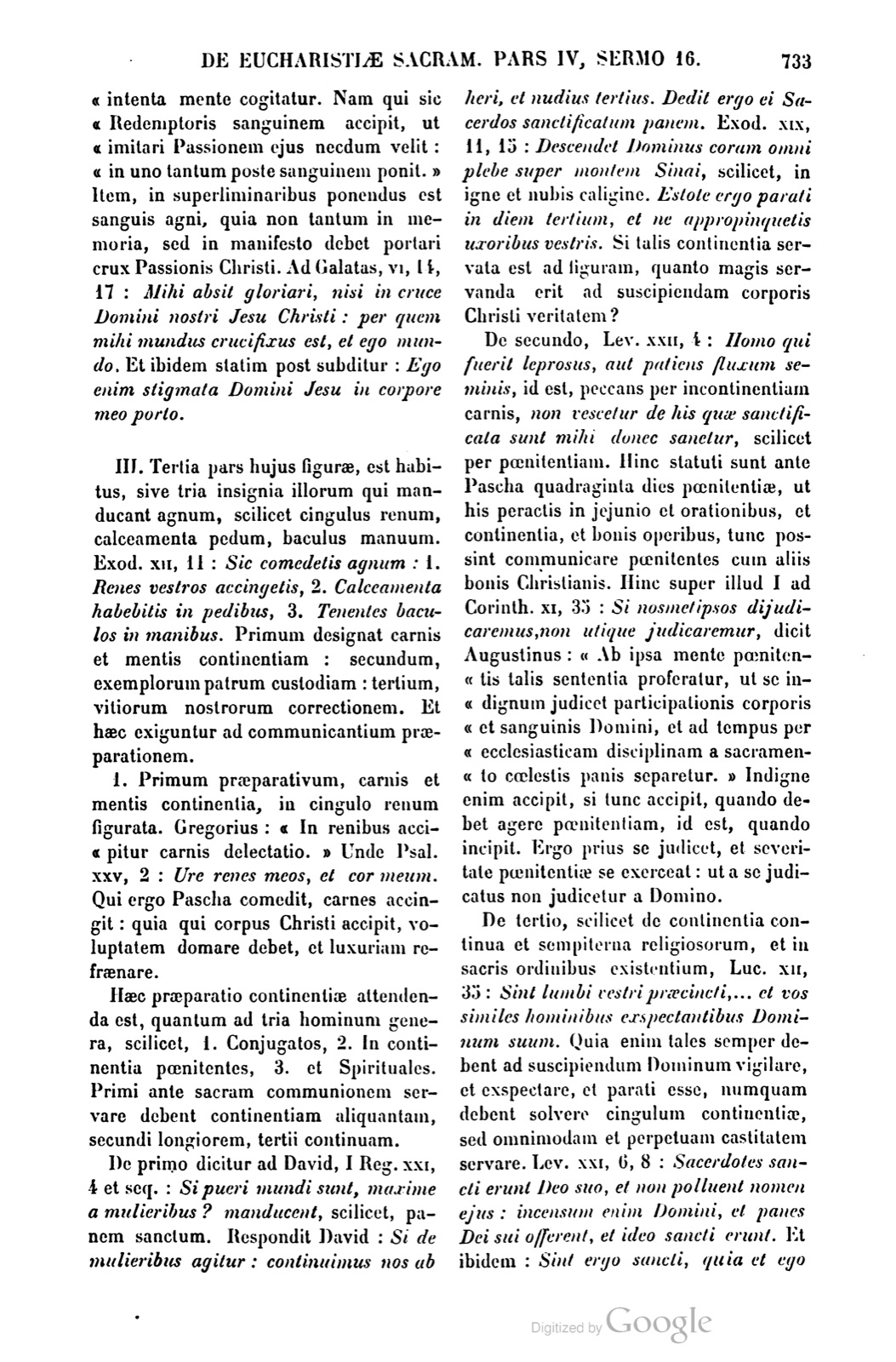
III. Tertia pars hujus figurae, est habitus, sive tria insignia illorum qui manducant agnum, scilicet cingulus renum, calceamenta pedum, baculus manuum. Exod. xii, 11: Sic comedetis agnum: 1. Renes vestros accingetis, 2. Calceamenta habebitis in pedibus, 3. Tenentes baculos in manibus. Primum designat carnis et mentis continentiam: secundum, exemplorum patrum custodiam: tertium, vitiorum nostrorum correctionem. Et haec exiguntur ad communicantium praeparationem.
1. Concerning the first, Gregory on Exodus 12:8 and Numbers 11 says: "Wild lettuces are very bitter, but the flesh of the lamb is to be eaten with them, because when we receive the body of Christ, we ought to be pricked in heart for sins, so that the bitterness of penance may wipe away the love of a perverse life." Isaiah 38:15: I will think over for you all my years in the bitterness of my soul.
2. Concerning the second, 1 Corinthians 5:8: Let us feast, not in the old leaven, nor in the leaven of malice and wickedness, but in the unleavened loaves of sincerity and truth. Not in the old leaven, that is, not in the corruption of the sin of pride, which is committed against God; nor in the leaven of malice, which is committed against neighbor; nor in the leaven of wickedness, which is committed against oneself; but let us feast in the unleavened loaves of sincerity and truth, that is, in sincerity from vices and in the truth of good works, so that, namely, we may strive to be in the state of innocence or of new life without fraud. Concerning the old leaven Gregory says: "He eats loaves without leaven who does right works without the corruption of vainglory." Concerning the leaven of malice, the same says: "He eats loaves without leaven who offers works of mercy without the admixture of sin, lest he perversely seize what he, as it were, rightly dispenses. Hence through Amos 4:5 it is said in rebuke: Sacrifice praise from what is leavened. For he immolates praise from what is leavened who prepares a sacrifice for God from robbery." Concerning the leaven of wickedness, Exodus 11:19: Whoever eats what is leavened, his soul will perish from the assembly of Israel. To eat what is leavened is to delight in the corruption of sin which is committed in oneself. Psalm 35:2: The unjust man said that he would sin in himself.
3. Concerning the third aforesaid dish, Gregory says: "The blood of the lamb, that is, of Christ, is placed upon both doorposts when it is drunk not only by the mouth of the body but also by the mouth of the mind, and is considered with an attentive mind for imitation. For he who receives the blood of the Redeemer in such a way that he does not yet wish to imitate his Passion places the blood on only one doorpost." Likewise, the blood of the lamb must be placed on the lintels, because the cross of Christ's Passion ought to be borne not only in memory, but in manifest action. Galatians 6:14, 17: Far be it from me to glory except in the cross of our Lord Jesus Christ, through whom the world has been crucified to me, and I to the world. And in the same place immediately afterward it is added: For I bear the marks of the Lord Jesus in my body.
III. The third part of this figure is the habit, or the three insignia of those who eat the lamb, namely the belt of the loins, the shoes of the feet, and the staff of the hands. Exodus 12:11: Thus you will eat the lamb: 1. You will gird your loins, 2. You will have shoes on your feet, 3. Holding staffs in your hands. The first designates continence of flesh and mind; the second, keeping the examples of the fathers; the third, correction of our vices. And these are required for the preparation of communicants.
1. Primum praeparativum, carnis et mentis continentia, in cingulo renum figurata. Gregorius: « In renibus accipitur carnis delectatio. » Unde Psal. xxv, 2: Ure renes meos, et cor meum. Qui ergo Pascha comedit, carnes accingit: quia qui corpus Christi accipit, voluptatem domare debet, et luxuriam refraenare.
Haec praeparatio continentiae attendenda est, quantum ad tria hominum genera, scilicet, 1. Conjugatos, 2. In continentia poenitentes, 3. et Spirituales. Primi ante sacram communionem servare debent continentiam aliquantam, secundi longiorem, tertii continuam.
De primo dicitur ad David, I Reg. xxi, 4 et seq.: Si pueri mundi sunt, maxime a mulieribus? manducent, scilicet, panem sanctum. Respondit David: Si de mulieribus agitur: continuimus nos ab heri, et nudius tertius. Dedit ergo ei Sacerdos sanctificatum panem. Exod. xix, 11, 15: Descendet Dominus coram omni plebe super montem Sinai, scilicet, in igne et nubis caligine. Estote ergo parati in diem tertium, et ne appropinquetis uxoribus vestris. Si talis continentia servata est ad figuram, quanto magis servanda erit ad suscipiendam corporis Christi veritatem?
De secundo, Lev. xxii, 4: Homo qui fuerit leprosus, aut patiens fluxum seminis, id est, peccans per incontinentiam carnis, non vescetur de his quae sanctificata sunt mihi donec sanetur, scilicet per poenitentiam. Hinc statuti sunt ante Pascha quadraginta dies poenitentiae, ut his peractis in jejunio et orationibus, et continentia, et bonis operibus, tunc possint communicare poenitentes cum aliis bonis Christianis. Hinc super illud I ad Corinth. xi, 31: Si nosmetipsos dijudicaremus, non utique judicaremur, dicit Augustinus: « Ab ipsa mente poenitentis talis sententia proferatur, ut se indignum judicet participationis corporis et sanguinis Domini, et ad tempus per ecclesiasticam disciplinam a sacramento coelestis panis separetur. » Indigne enim accipit, si tunc accipit, quando debet agere poenitentiam, id est, quando incipit. Ergo prius se judicet, et severitate poenitentiae se exerceat: ut a se judicatus non judicetur a Domino.
De tertio, scilicet de continentia continua et sempiterna religiosorum, et in sacris ordinibus existentium, Luc. xii, 35: Sint lumbi vestri praecincti, ... et vos similes hominibus exspectantibus Dominum suum. Quia enim tales semper debent ad suscipiendum Dominum vigilare, et exspectare, et parati esse, numquam debent solvere cingulum continentiae, sed omnimodam et perpetuam castitatem servare. Lev. xxi, 6, 8: Sacerdotes sancti erunt Deo suo, et non polluent nomen ejus: incensum enim Domini, et panes Dei sui offerent, et ideo sancti erunt. Et ibidem: Sint ergo sancti, quia et ego sanctus sum, Dominus, qui sanctifico eos: de quo etiam Venerabilis inquit Beda: « Si veteris testamenti Sacerdotes, secundum ordinem vicis suae intraturi templum ad offerendas legales hostias, a propriis uxoribus oportuit abstinere: quanto magis nostri Sacerdotes, quos ad consecrandum sacrosanctum corpus Domini paratos semper esse oportet, continuam et sempiternam debent castitatem observare? »
1. The first preparative, continence of flesh and mind, is figured in the belt of the loins. Gregory says: "In the loins the delight of the flesh is taken." Hence Psalm 25:2: Burn my loins and my heart. Therefore he who eats the Passover girds his flesh, because he who receives the body of Christ ought to tame pleasure and restrain luxury.
This preparation of continence must be attended to according to three kinds of men, namely 1. the married, 2. those doing penance in continence, 3. and the spiritual. The first ought to preserve some continence before sacred communion, the second a longer continence, the third a continual continence.
Concerning the first, it is said to David, 1 Kings 21:4 and following: If the young men are clean, especially from women, let them eat, namely, the holy bread. David answered: If it is a matter of women, we have kept ourselves from yesterday and the day before. Therefore the Priest gave him the sanctified bread. Exodus 19:11, 15: The Lord will descend before all the people upon Mount Sinai, namely in fire and darkness of cloud. Therefore be prepared for the third day and do not approach your wives. If such continence was preserved for the figure, how much more will it have to be preserved for receiving the truth of Christ's body?
Concerning the second, Leviticus 22:4: The man who will have been leprous, or suffering a flow of seed, that is, sinning through incontinence of the flesh, will not eat from those things which have been sanctified for me until he is healed, namely through penance. Hence forty days of penance have been established before Easter, so that after these have been completed in fasting and prayers, and continence and good works, then penitents may communicate with other good Christians. Hence on that text 1 Corinthians 11:31: If we judged ourselves, certainly we would not be judged, Augustine says: "From the mind itself of the penitent let such a sentence be brought forth, that he judge himself unworthy of participation in the body and blood of the Lord, and for a time by ecclesiastical discipline be separated from the sacrament of heavenly bread." For he receives unworthily if he receives then when he ought to do penance, that is, when he begins. Therefore let him first judge himself and exercise himself by the severity of penance, so that, judged by himself, he may not be judged by the Lord.
Concerning the third, namely concerning the continual and everlasting continence of religious and of those existing in sacred orders, Luke 12:35: Let your loins be girded, ... and you be like men waiting for their lord. For because such persons ought always to watch, wait, and be prepared for receiving the Lord, they ought never to loose the belt of continence, but to preserve every kind of perpetual chastity. Leviticus 21:6, 8: Priests will be holy to their God, and they will not pollute his name; for they offer the incense of the Lord and the loaves of their God, and therefore they will be holy. And in the same place: Therefore let them be holy, because I also am holy, the Lord who sanctifies them; concerning which also Venerable Bede says: "If it was fitting for the Priests of the Old Testament, about to enter the temple according to the order of their turn to offer legal victims, to abstain from their own wives, how much more ought our Priests, whom it is fitting always to be prepared for consecrating the sacrosanct body of the Lord, to observe continual and everlasting chastity?"
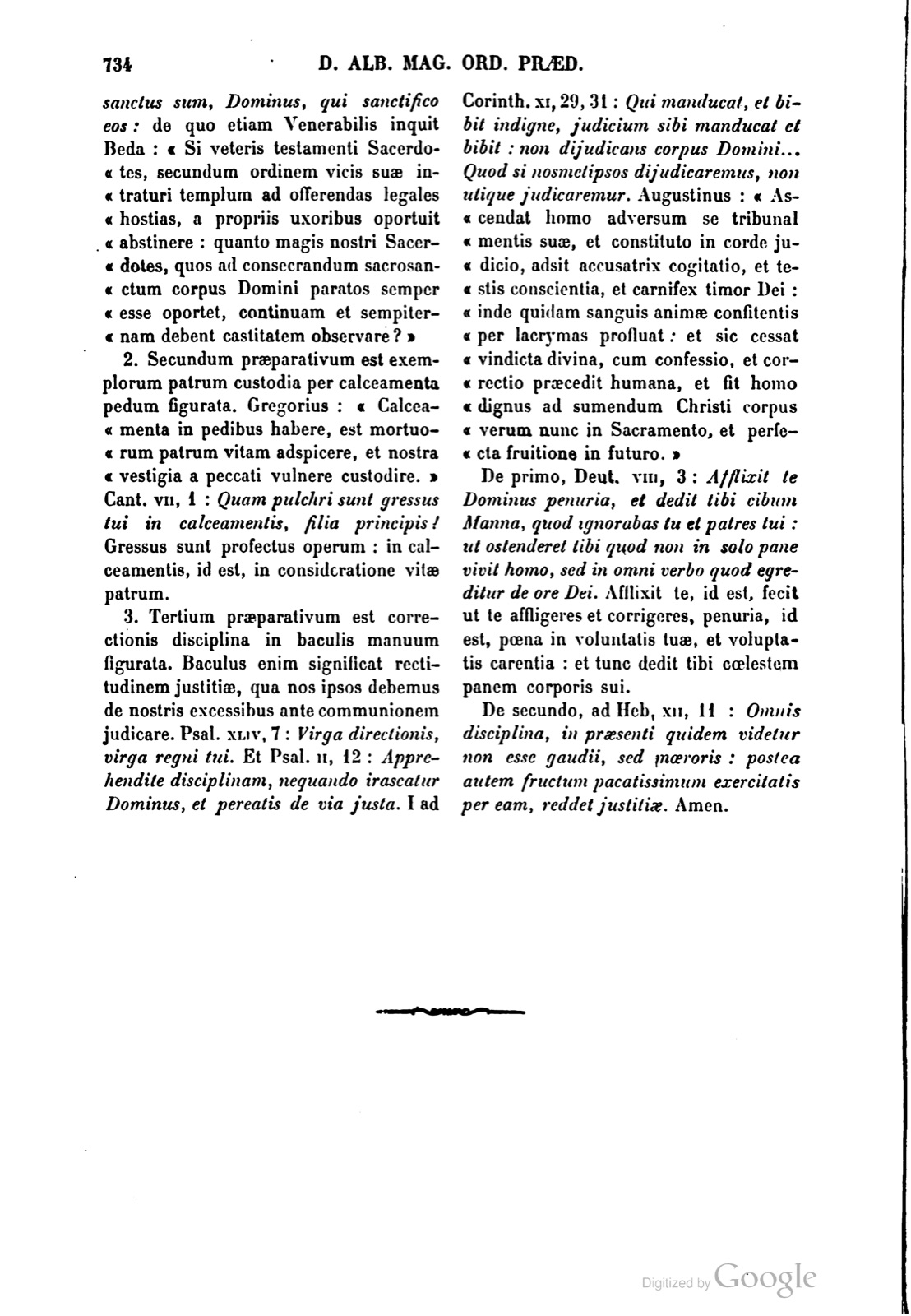
2. Secundum praeparativum est exemplorum patrum custodia per calceamenta pedum figurata. Gregorius: « Calceamenta in pedibus habere, est mortuorum patrum vitam adspicere, et nostra vestigia a peccati vulnere custodire. » Cant. vii, 1: Quam pulchri sunt gressus tui in calceamentis, filia principis! Gressus sunt profectus operum: in calceamentis, id est, in consideratione vitae patrum.
3. Tertium praeparativum est correctionis disciplina in baculis manuum figurata. Baculus enim significat rectitudinem justitiae, qua nos ipsos debemus de nostris excessibus ante communionem judicare. Psal. xliv, 7: Virga directionis, virga regni tui. Et Psal. ii, 12: Apprehendite disciplinam, nequando irascatur Dominus, et pereatis de via justa. I ad Corinth. xi, 29, 31: Qui manducat, et bibit indigne, judicium sibi manducat et bibit: non dijudicans corpus Domini... Quod si nosmetipsos dijudicaremus, non utique judicaremur. Augustinus: « Ascendat homo adversum se tribunal mentis suae, et constituto in corde judicio, adsit accusatrix cogitatio, et testis conscientia, et carnifex timor Dei: inde quidam sanguis animae confitentis per lacrymas profluat: et sic cessat vindicta divina, cum confessio, et correctio praecedit humana, et fit homo dignus ad sumendum Christi corpus verum nunc in Sacramento, et perfecta fruitione in futuro. »
De primo, Deut. viii, 3: Afflixit te Dominus penuria, et dedit tibi cibum Manna, quod ignorabas tu et patres tui: ut ostenderet tibi quod non in solo pane vivit homo, sed in omni verbo quod egreditur de ore Dei. Afflixit te, id est, fecit ut te affligeres et corrigeres, penuria, id est, poena in voluntatis tuae, et voluptatis carentia: et tunc dedit tibi coelestem panem corporis sui.
De secundo, ad Heb. xii, 11: Omnis disciplina, in praesenti quidem videtur non esse gaudii, sed moeroris: postea autem fructum pacatissimum exercitatis per eam, reddet justitiae. Amen.
2. The second preparative is keeping the examples of the fathers, figured by the shoes of the feet. Gregory says: "To have shoes on the feet is to behold the life of the dead fathers and to guard our footsteps from the wound of sin." Song of Songs 7:1: How beautiful are your steps in shoes, daughter of the prince! The steps are the advancements of works; in shoes, that is, in consideration of the life of the fathers.
3. The third preparative is the discipline of correction figured in the staffs of the hands. For the staff signifies the rectitude of justice, by which we ought to judge ourselves concerning our excesses before communion. Psalm 44:7: The rod of direction, the rod of your kingdom. And Psalm 2:12: Lay hold of discipline, lest at any time the Lord grow angry and you perish from the just way. 1 Corinthians 11:29, 31: He who eats and drinks unworthily eats and drinks judgment to himself, not judging the body of the Lord... But if we judged ourselves, certainly we would not be judged. Augustine says: "Let a man ascend against himself the tribunal of his mind, and, with judgment established in his heart, let accusing thought be present, and conscience as witness, and the fear of God as executioner; thence let a certain blood of the confessing soul flow forth through tears, and thus divine vengeance ceases, when human confession and correction precede, and a man is made worthy for receiving the true body of Christ now in the Sacrament and in perfect enjoyment in the future."
Concerning the first, Deuteronomy 8:3: The Lord afflicted you with want and gave you the food manna, which you and your fathers did not know, so that he might show you that man does not live by bread alone, but by every word that comes forth from the mouth of God. He afflicted you, that is, he made you afflict and correct yourself, with want, that is, with punishment in the lack of your will and pleasure; and then he gave you the heavenly bread of his body.
Concerning the second, Hebrews 12:11: Every discipline in the present indeed seems not to be of joy, but of sorrow; afterward, however, to those exercised by it, it will render the most peaceful fruit of justice. Amen.
If a page does not appear, its photograph has not been uploaded yet.