Works › Sermons on the Most Holy Sacrament of the Eucharist
Volume 13 · pp. 682–685
Sermon IV. On the Third Thing Concerning the Sacrifice, Namely, on the Excellence of Our Sacrifice
A marker with ≈ is an approximate page boundary, placed by measure of the text; the page photographs remain the authority. In the paired views, clicking a page marker brings that page into view.
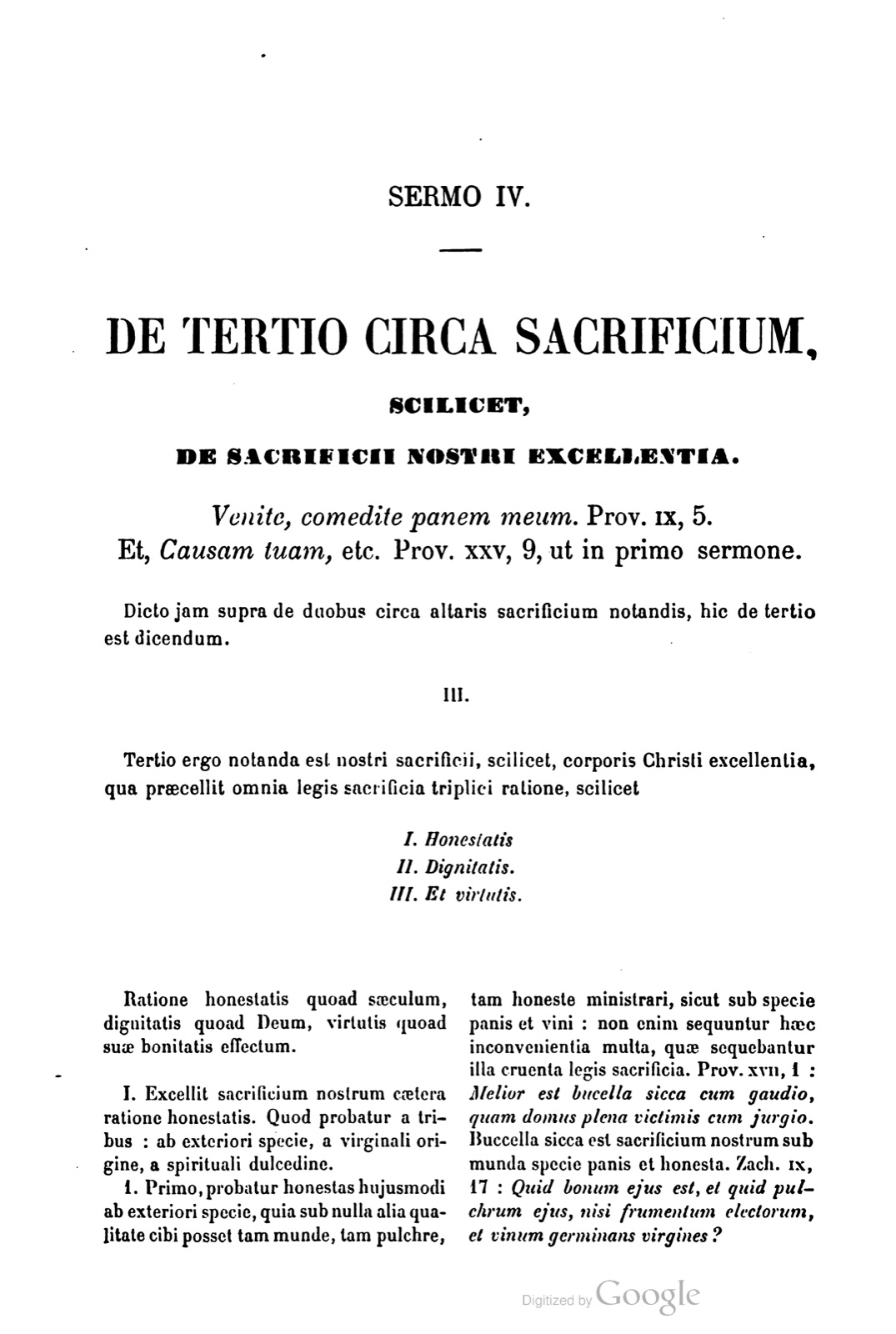
### Sermo IV
### De tertio circa sacrificium, scilicet, de sacrificii nostri excellentia
Venite, comedite panem meum. Prov. ix, 5.
Et, Causam tuam, etc. Prov. xxv, 9, ut in primo sermone.
Dicto jam supra de duobus circa altaris sacrificium notandis, hic de tertio est dicendum.
III.
Tertio ergo notanda est nostri sacrificii, scilicet, corporis Christi excellentia, qua praecellit omnia legis sacrificia triplici ratione, scilicet
I. Honestatis.
II. Dignitatis.
III. Et virtutis.
Ratione honestatis quoad saeculum, dignitatis quoad Deum, virtutis quoad suae bonitatis effectum.
I. Excellit sacrificium nostrum caetera ratione honestatis. Quod probatur a tribus: ab exteriori specie, a virginali origine, a spirituali dulcedine.
1. Primo, probatur honestas hujusmodi ab exteriori specie, quia sub nulla alia qualitate cibi posset tam munde, tam pulchre, tam honeste ministrari, sicut sub specie panis et vini: non enim sequuntur haec inconvenientia multa, quae sequebantur illa cruenta legis sacrificia. Prov. xvii, 1: Melior est buccella sicca cum gaudio, quam domus plena victimis cum jurgio. Buccella sicca est sacrificium nostrum sub munda specie panis et honesta. Zach. ix, 17: Quid bonum ejus est, et quid pulchrum ejus, nisi frumentum electorum, et vinum germinans virgines?
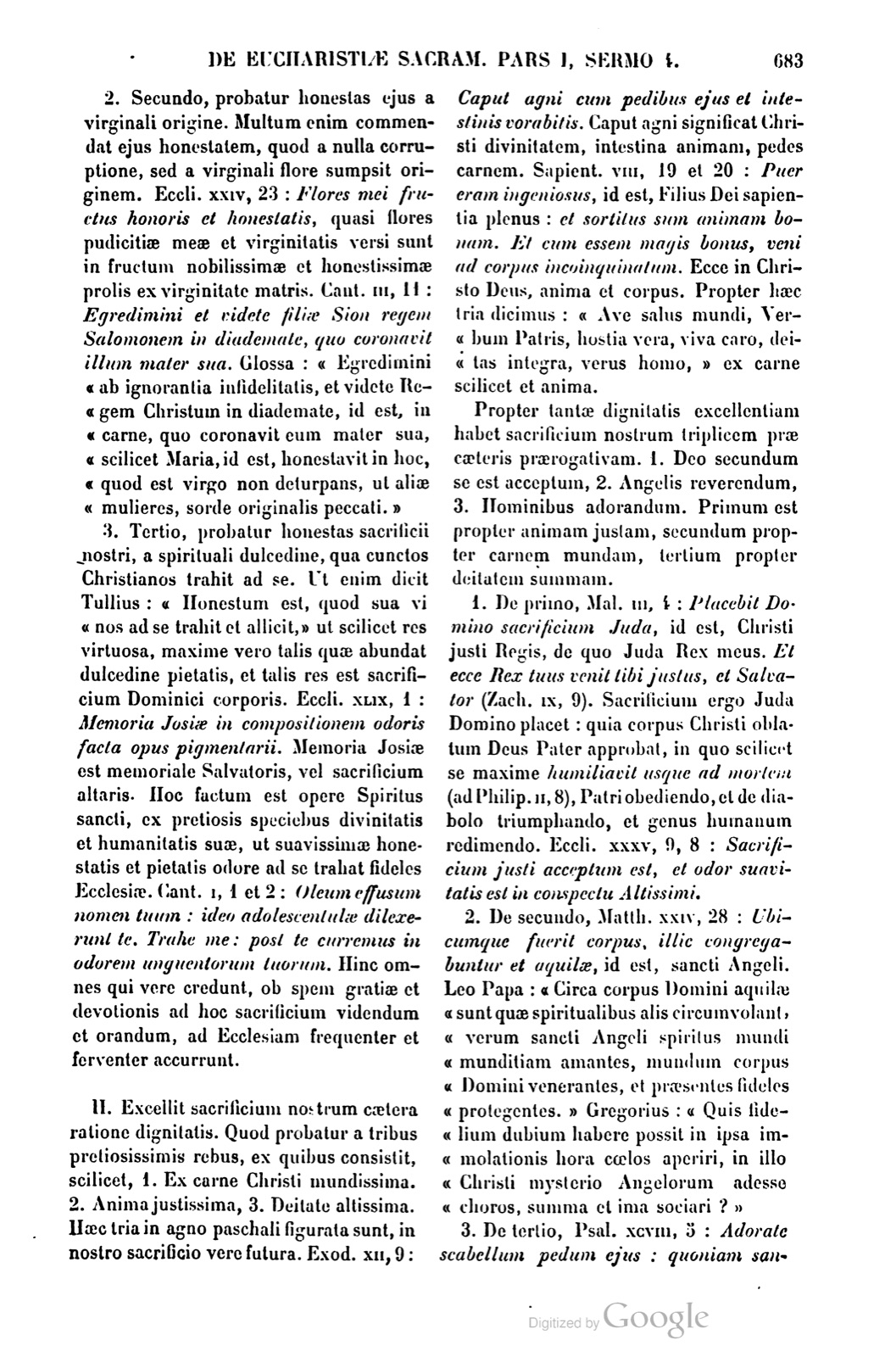
2. Secundo, probatur honestas ejus a virginali origine. Multum enim commendat ejus honestatem, quod a nulla corruptione, sed a virginali flore sumpsit originem. Eccli. xxiv, 23: Flores mei fructus honoris et honestatis, quasi flores pudicitiae meae et virginitatis versi sunt in fructum nobilissimae et honestissimae prolis ex virginitate matris. Cant. iii, 11: Egredimini et videte filiae Sion regem Salomonem in diademate, quo coronavit illum mater sua. Glossa: « Egredimini ab ignorantia infidelitatis, et videte Regem Christum in diademate, id est, in carne, quo coronavit eum mater sua, scilicet Maria, id est, honestavit in hoc, quod est virgo non deturpans, ut aliae mulieres, sorde originalis peccati. »
3. Tertio, probatur honestas sacrificii nostri, a spirituali dulcedine, qua cunctos Christianos trahit ad se. Ut enim dicit Tullius: « Honestum est, quod sua vi nos ad se trahit et allicit, ut scilicet res virtuosa, maxime vero talis quae abundat dulcedine pietatis, et talis res est sacrificium Dominici corporis. Eccli. xlix, 1: Memoria Josiae in compositionem odoris facta opus pigmentarii. Memoria Josiae est memoriale Salvatoris, vel sacrificium altaris. Hoc factum est opere Spiritus sancti, ex pretiosis speciebus divinitatis et humanitatis suae, ut suavissimae honestatis et pietatis odore ad se trahat fideles Ecclesiae. Cant. i, 1 et 2: Oleum effusum nomen tuum: ideo adolescentulae dilexerunt te. Trahe me: post te curremus in odorem unguentorum tuorum. Hinc omnes qui vere credunt, ob spem gratiae et devotionis ad hoc sacrificium videndum et orandum, ad Ecclesiam frequenter et ferventer accurrunt.
### Sermon IV
### On the Third Thing Concerning the Sacrifice, Namely, on the Excellence of Our Sacrifice
Come, eat my bread. Proverbs 9:5.
And, Treat your cause, etc. Proverbs 25:9, as in the first sermon.
Now that the two things to be noted concerning the sacrifice of the altar have been spoken of above, here one must speak concerning the third.
III.
Therefore thirdly the excellence of our sacrifice, namely, of the body of Christ, is to be noted, by which it surpasses all sacrifices of the law by a threefold reason, namely
I. Of honorableness.
II. Of dignity.
III. And of power.
By reason of honorableness as regards the world, of dignity as regards God, of power as regards the effect of its goodness.
I. Our sacrifice excels the others by reason of honorableness. This is proved from three things: from the exterior species, from the virginal origin, from the spiritual sweetness.
1. First, this sort of honorableness is proved from the exterior species, because under no other quality of food could it be ministered so cleanly, so beautifully, so honorably, as under the species of bread and wine; for these many inconveniences do not follow, which followed those bloody sacrifices of the law. Proverbs 17:1: Better is a dry morsel with joy than a house full of victims with quarrel. The dry morsel is our sacrifice under the clean and honorable species of bread. Zechariah 9:17: What is his good, and what is his beautiful thing, except the grain of the elect and wine springing forth virgins?
2. Secondly, its honorableness is proved from its virginal origin. For it greatly commends its honorableness that it took origin from no corruption, but from a virginal flower. Ecclesiasticus 24:23: My flowers are fruits of honor and honorableness, as if the flowers of my modesty and virginity were turned into the fruit of the most noble and most honorable offspring from the virginity of the mother. Song of Songs 3:11: Go forth and see, daughters of Zion, King Solomon in the diadem with which his mother crowned him. Gloss: "Go forth from the ignorance of unbelief, and see King Christ in the diadem, that is, in the flesh, with which his mother, namely Mary, crowned him, that is, honored him in this, that she is a virgin not defiling, as other women do, with the stain of original sin."
3. Thirdly, the honorableness of our sacrifice is proved from spiritual sweetness, by which it draws all Christians to itself. For as Tullius says: "The honorable is what by its own force draws and entices us to itself," namely as a virtuous thing, and especially such a thing as abounds with the sweetness of piety; and such a thing is the sacrifice of the Lord's body. Ecclesiasticus 49:1: The memory of Josiah was made into a composition of odor, the work of a perfumer. The memory of Josiah is the memorial of the Savior, or the sacrifice of the altar. This has been made by the work of the Holy Spirit, from the precious species of his divinity and humanity, so that by the most sweet odor of honorableness and piety it may draw to itself the faithful of the Church. Song of Songs 1:1 and 2: Your name is poured-out oil; therefore the young maidens have loved you. Draw me; after you we will run in the odor of your ointments. Hence all who truly believe, on account of hope of grace and devotion, frequently and fervently run together to the Church to see and pray to this sacrifice.
II. Excellit sacrificium nostrum caetera ratione dignitatis. Quod probatur a tribus pretiosissimis rebus, ex quibus consistit, scilicet, 1. Ex carne Christi mundissima. 2. Anima justissima, 3. Deitate altissima. Haec tria in agno paschali figurata sunt, in nostro sacrificio vere futura. Exod. xii, 9: Caput agni cum pedibus ejus et intestinis vorabitis. Caput agni significat Christi divinitatem, intestina animam, pedes carnem. Sapient. viii, 19 et 20: Puer eram ingeniosus, id est, Filius Dei sapientia plenus: et sortitus sum animam bonam. Et cum essem magis bonus, veni ad corpus incoinquinatum. Ecce in Christo Deus, anima et corpus. Propter haec tria dicimus: « Ave salus mundi, Verbum Patris, hostia vera, viva caro, deitas integra, verus homo, » ex carne scilicet et anima.
Propter tantae dignitatis excellentiam habet sacrificium nostrum triplicem prae caeteris praerogativam. 1. Deo secundum se est acceptum, 2. Angelis reverendum, 3. Hominibus adorandum. Primum est propter animam justam, secundum propter carnem mundam, tertium propter deitatem summam.
1. De primo, Mal. iii, 4: Placebit Domino sacrificium Juda, id est, Christi justi Regis, de quo Juda Rex meus. Et ecce Rex tuus venit tibi justus, et Salvator (Zach. ix, 9). Sacrificium ergo Juda Domino placet: quia corpus Christi oblatum Deus Pater approbat, in quo scilicet se maxime humiliavit usque ad mortem (ad Philip. ii, 8), Patri obediendo, et de diabolo triumphando, et genus humanum redimendo. Eccli. xxxv, 9, 8: Sacrificium justi acceptum est, et odor suavitatis est in conspectu Altissimi.
2. De secundo, Matth. xxiv, 28: Ubicumque fuerit corpus, illic congregabuntur et aquilae, id est, sancti Angeli. Leo Papa: « Circa corpus Domini aquilae sunt quae spiritualibus alis circumvolant, verum sancti Angeli spiritus mundi munditiam amantes, mundum corpus Domini venerantes, et praesentes fideles protegentes. » Gregorius: « Quis fidelium dubium habere possit in ipsa immolationis hora caelos aperiri, in illo Christi mysterio Angelorum adesse choros, summa et ima sociari? »
II. Our sacrifice excels the others by reason of dignity. This is proved from three most precious things of which it consists, namely, 1. From the most clean flesh of Christ. 2. From the most just soul. 3. From the highest Deity. These three were figured in the paschal lamb, truly future in our sacrifice. Exodus 12:9: You will devour the head of the lamb with its feet and entrails. The head of the lamb signifies the divinity of Christ, the entrails the soul, the feet the flesh. Wisdom 8:19 and 20: I was an ingenious boy, that is, the Son of God full of wisdom; and I obtained a good soul. And when I was more good, I came to an undefiled body. Behold in Christ God, soul, and body. On account of these three we say: "Hail salvation of the world, Word of the Father, true victim, living flesh, whole deity, true man," namely from flesh and soul.
On account of the excellence of so great a dignity our sacrifice has a threefold prerogative before the rest. 1. According to itself it is acceptable to God, 2. To be reverenced by Angels, 3. To be adored by men. The first is because of the just soul, the second because of the clean flesh, the third because of the highest deity.
1. Concerning the first, Malachi 3:4: The sacrifice of Judah will please the Lord, that is, of Christ the just King, concerning whom, Judah is my King. And behold your King comes to you, just and Savior (Zechariah 9:9). Therefore the sacrifice of Judah pleases the Lord, because God the Father approves the offered body of Christ, in which namely he humbled himself most greatly unto death (Philippians 2:8), by obeying the Father, triumphing over the devil, and redeeming the human race. Ecclesiasticus 35:9, 8: The sacrifice of the just man is accepted, and it is an odor of sweetness in the sight of the Most High.
2. Concerning the second, Matthew 24:28: Wherever the body will be, there also the eagles will be gathered, that is, the holy Angels. Pope Leo: "Around the body of the Lord are the eagles which fly around with spiritual wings, truly the holy Angels, pure spirits loving cleanness, venerating the clean body of the Lord, and protecting the faithful who are present." Gregory: "Who of the faithful could have doubt that in the very hour of immolation the heavens are opened, that in that mystery of Christ the choirs of Angels are present, that the highest and lowest things are joined?"
3. De tertio, Psal. xcviii, 5: Adorate scabellum pedum ejus: quoniam sanctum est. Isa. lxvi, 1. Haec dicit Dominus: Caelum sedes mea, terra autem scabellum pedum meorum. Dicitur terra scabellum Dei et signat carnem Christi quae originaliter de terra est. Haec est nobis adoranda, quia sancta, quia Deo unita. Augustinus: « Sciendum quia in Christo terra est, id est, caro quae sine impietate adoratur, quia a verbo Dei assumpta: qui enim adorat, non terram intuetur, sed illum potius cujus scabellum est propter quem adorat. » Item, Augustinus: « Dicunt haeretici, Quid est quod carnem ejus quam creaturam esse non negas, similiter cum divinitate adoras, et ei non minus quam divinitati deservis? Respondeo, Dominicam carnem, imo perfectam in Christo humanitatem, ideo adoro, quia a divinitate suscepta, et divinitati in unitate personae est unita. Si hominem separaveris a Deo, illi nec credo, nec servio, velut si quis purpuram vel diadema regis per se jacens inveniat, numquid ea adorabit? cum ea vero Rex fuerit indutus, periculum mortis incurrit, si ea cum Rege quis adorare contempserit. Sic etiam in Christo Domino humanitatem non solam vel nudam, sed divinitati unitam, scilicet, unum Filium Dei, verum Deum et verum hominem, si quis adorare contempserit aeternaliter morietur. » Alexander Papa: « Nihil in sacrificiis majus esse potest, quam corpus et sanguis Christi: et sicut haec oblatio potior est caeteris, ita potius excoli et venerari debet. » Quia ergo inaestimabiliter melior est caeteris, quia Deo unita, maxime debet adorari, et docendi sunt parvuli Christianorum eam reverenter adorare.
III. Tertio, excellit sacrificium nostrum caetera ratione virtutis, id est, per effectum suae bonitatis. Habet enim triplicem bonum actum in triplici statu fidelium, scilicet, 1. In hoc mundo, 2. In purgatorio, 3. In coelo. In primo statu peccata quotidiana relaxat, in secundo poenam gravem alleviat, in tertio gaudium magnum generat. Hinc est, quod triplices missae celebrari solent, scilicet pro salute vivorum, pro requie defunctorum, et pro gloria beatorum. Hinc est etiam, quod hostiam sacram Sacerdos in tres partes frangit, ut virtus sacrificii corporis Domini in praedicto triplici statu fidelium valere demonstretur.
3. Concerning the third, Psalm 98:5: Adore the footstool of his feet, because it is holy. Isaiah 66:1. Thus says the Lord: Heaven is my seat, but the earth the footstool of my feet. Earth is called the footstool of God and signifies the flesh of Christ, which originally is from earth. This is to be adored by us, because it is holy, because it is united to God. Augustine: "One must know that in Christ there is earth, that is, flesh, which is adored without impiety, because it has been assumed by the Word of God; for he who adores does not gaze upon the earth, but rather upon him whose footstool it is, on account of whom he adores." Likewise, Augustine: "The heretics say, What is this, that you adore his flesh, which you do not deny to be a creature, similarly with the divinity, and serve it no less than the divinity? I answer: I adore the Lord's flesh, indeed the perfect humanity in Christ, because it was taken up by the divinity and is united to the divinity in unity of person. If you separate the man from God, I neither believe him nor serve him; as if someone should find the purple or diadem of the king lying by itself, would he adore it? But when the King has been clothed with it, he incurs the danger of death if anyone scorns to adore it with the King. So also in Christ the Lord, if anyone scorns to adore the humanity not alone or naked, but united to the divinity, namely the one Son of God, true God and true man, he will die eternally." Pope Alexander: "Nothing in sacrifices can be greater than the body and blood of Christ; and as this offering is more excellent than the rest, so it ought more excellently to be cultivated and venerated." Therefore because it is inestimably better than the rest, because it is united to God, it ought most greatly to be adored, and the little ones of Christians are to be taught to adore it reverently.
III. Thirdly, our sacrifice excels the others by reason of power, that is, through the effect of its goodness. For it has a threefold good action in the threefold state of the faithful, namely, 1. In this world, 2. In purgatory, 3. In heaven. In the first state it relaxes daily sins, in the second it alleviates grave punishment, in the third it generates great joy. Hence it is that threefold masses are accustomed to be celebrated, namely for the salvation of the living, for the rest of the dead, and for the glory of the blessed. Hence it is also that the Priest breaks the sacred host into three parts, so that the power of the sacrifice of the Lord's body may be shown to avail in the aforesaid threefold state of the faithful.
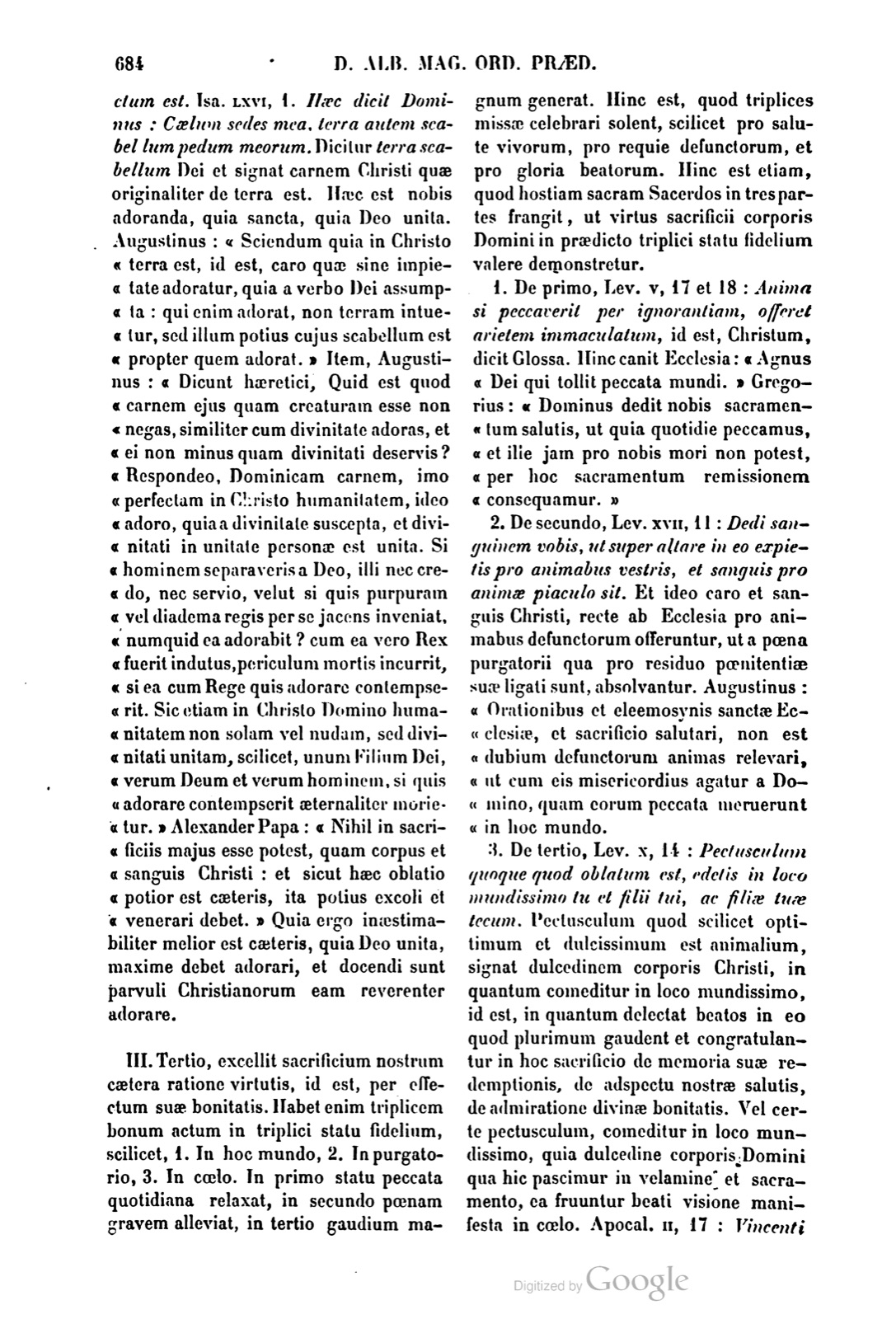
1. De primo, Lev. v, 17 et 18: Anima si peccaverit per ignorantiam, offeret arietem immaculatum, id est, Christum, dicit Glossa. Hinc canit Ecclesia: « Agnus Dei qui tollit peccata mundi. » Gregorius: « Dominus dedit nobis sacramentum salutis, ut quia quotidie peccamus, et ille jam pro nobis mori non potest, per hoc sacramentum remissionem consequamur. »
2. De secundo, Lev. xvii, 11: Dedi sanguinem vobis, ut super altare in eo expietis pro animabus vestris, et sanguis pro animae piaculo sit. Et ideo caro et sanguis Christi, recte ab Ecclesia pro animabus defunctorum offeruntur, ut a poena purgatorii qua pro residuo poenitentiae suae ligati sunt, absolvantur. Augustinus: « Orationibus et eleemosynis sanctae Ecclesiae, et sacrificio salutari, non est dubium defunctorum animas relevari, ut cum eis misericordius agatur a Domino, quam eorum peccata meruerunt in hoc mundo. »
3. De tertio, Lev. x, 14: Pectusculum quoque quod oblatum est, edetis in loco mundissimo tu et filii tui, ac filiae tuae tecum. Pectusculum quod scilicet optimum et dulcissimum est animalium, signat dulcedinem corporis Christi, in quantum comeditur in loco mundissimo, id est, in quantum delectat beatos in eo quod plurimum gaudent et congratulantur in hoc sacrificio de memoria suae redemptionis, de adspectu nostrae salutis, de admiratione divinae bonitatis. Vel certe pectusculum, comeditur in loco mundissimo, quia dulcedine corporis Domini qua hic pascimur in velamine et sacramento, ea fruuntur beati visione manifesta in coelo. Apocal. ii, 17: Vincenti dabo manna absconditum. Infra, dicit Glossa, meipsum qui sum panis vivus, qui de caelo descendi (Joan. vi, 51). Quod manna etsi nunc manet absconditum, tunc erit manifestum, habens omnis saporis delectamentum, hinc dicit Complenda: « Perficiant in nobis Domine sacramenta, quod continent: ut quae nunc specie gerimus, rerum veritate capiamus, » id est, corpore Christi, manifesta visione videamus, vel perfruamur secundum illud: Qui diligit me, diligetur a Patre meo: et ego diligam eum, et manifestabo ei meipsum (Joan. xiv, 21). Et in illa Domini visione erit nobis omnis boni plena fruitio. Psal. xv, 10: Adimplebis me laetitia cum vultu tuo. Psal. xvi, 15: Satiabor cum apparuerit gloria tua. Amen.
1. Concerning the first, Leviticus 5:17 and 18: If a soul has sinned through ignorance, he will offer an immaculate ram, that is, Christ, says the Gloss. Hence the Church sings: "Lamb of God who takes away the sins of the world." Gregory: "The Lord gave us the sacrament of salvation so that, because we sin daily and he now cannot die for us, through this sacrament we may obtain remission."
2. Concerning the second, Leviticus 17:11: I have given you blood so that upon the altar you may expiate in it for your souls, and the blood may be for the atonement of the soul. And therefore the flesh and blood of Christ are rightly offered by the Church for the souls of the dead, so that they may be absolved from the punishment of purgatory by which they are bound for the remainder of their penance. Augustine: "By the prayers and alms of holy Church, and by the saving sacrifice, there is no doubt that the souls of the dead are relieved, so that it may be dealt more mercifully with them by the Lord than their sins deserved in this world."
3. Concerning the third, Leviticus 10:14: The little breast also which has been offered, you will eat in a most clean place, you and your sons and your daughters with you. The little breast, which, namely, is the best and sweetest part of animals, signifies the sweetness of the body of Christ, insofar as it is eaten in a most clean place, that is, insofar as it delights the blessed in this, that they greatly rejoice and congratulate themselves in this sacrifice concerning the memory of their redemption, concerning the sight of our salvation, concerning the admiration of divine goodness. Or certainly the little breast is eaten in a most clean place because the blessed enjoy, by manifest vision in heaven, that sweetness of the Lord's body by which we are fed here in veil and sacrament. Apocalypse 2:17: To him who conquers I will give the hidden manna. Below, the Gloss says: myself, who am the living bread, who came down from heaven (John 6:51). Although that manna now remains hidden, then it will be manifest, having the delight of every flavor; hence the Postcommunion says: "May the sacraments accomplish in us, Lord, what they contain, so that what we now carry under species, we may receive in the truth of things," that is, may see the body of Christ by manifest vision, or enjoy it according to that saying: He who loves me will be loved by my Father; and I will love him, and I will manifest myself to him (John 14:21). And in that vision of the Lord there will be for us the full enjoyment of every good. Psalm 15:10: You will fill me with joy with your countenance. Psalm 16:15: I will be satisfied when your glory appears. Amen.

If a page does not appear, its photograph has not been uploaded yet.