Works › Sermons on the Most Holy Sacrament of the Eucharist
Volume 13 · pp. 679–681
Sermon III, Continuation
A marker with ≈ is an approximate page boundary, placed by measure of the text; the page photographs remain the authority. In the paired views, clicking a page marker brings that page into view.
### Sermo III, continuatio
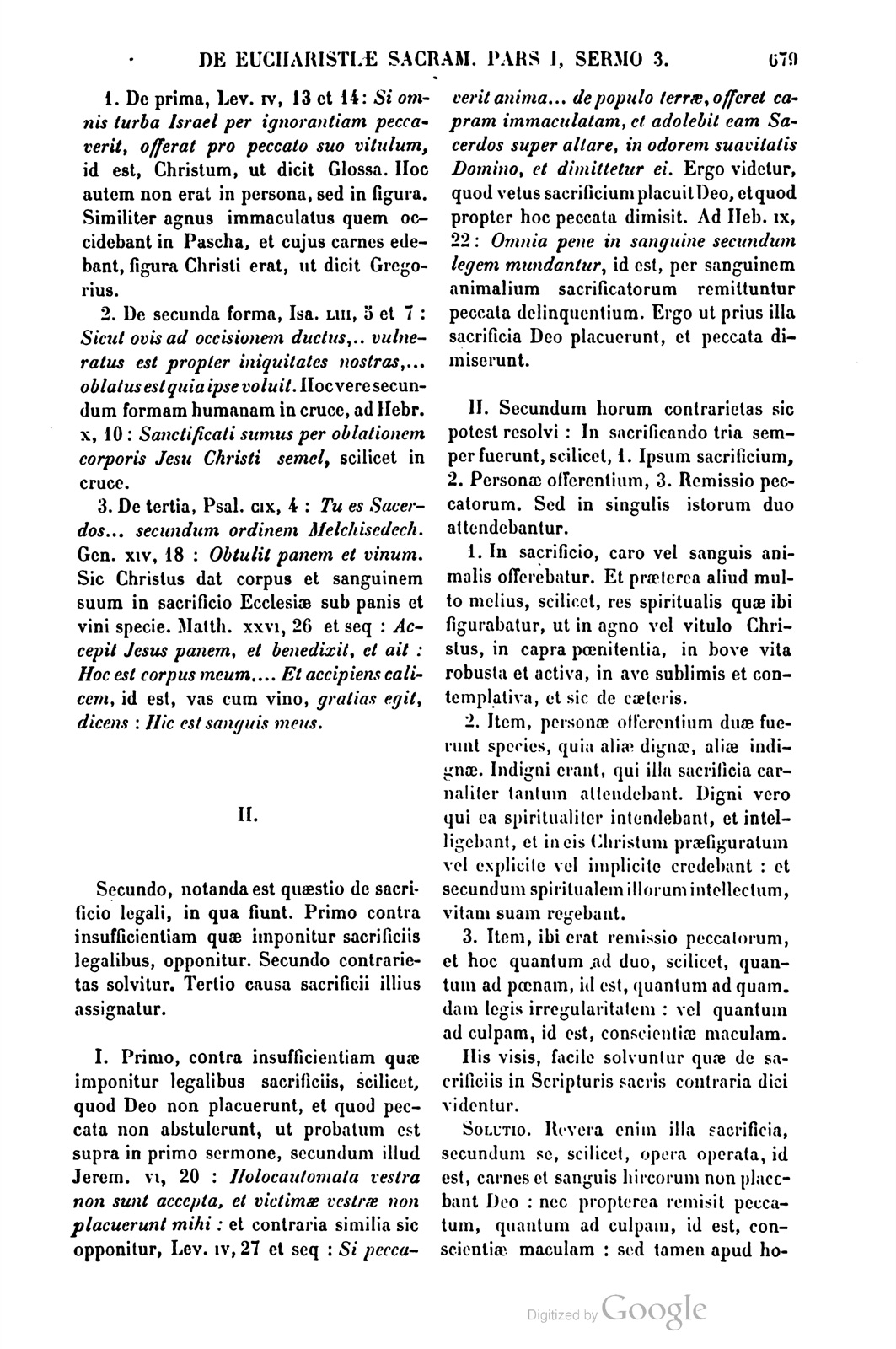
1. De prima, Lev. iv, 13 et 14: Si omnis turba Israel per ignorantiam peccaverit, offerat pro peccato suo vitulum, id est, Christum, ut dicit Glossa. Hoc autem non erat in persona, sed in figura. Similiter agnus immaculatus quem occidebant in Pascha, et cujus carnes edebant, figura Christi erat, ut dicit Gregorius.
2. De secunda forma, Isa. liii, 5 et 7: Sicut ovis ad occisionem ductus, ... vulneratus est propter iniquitates nostras, ... oblatus est quia ipse voluit. Hoc vere secundum formam humanam in cruce, ad Hebr. x, 10: Sanctificati sumus per oblationem corporis Jesu Christi semel, scilicet in cruce.
3. De tertia, Psal. cix, 4: Tu es Sacerdos ... secundum ordinem Melchisedech. Gen. xiv, 18: Obtulit panem et vinum. Sic Christus dat corpus et sanguinem suum in sacrificio Ecclesiae sub panis et vini specie. Matth. xxvi, 26 et seq.: Accepit Jesus panem, et benedixit, et ait: Hoc est corpus meum.... Et accipiens calicem, id est, vas cum vino, gratias egit, dicens: Hic est sanguis meus.
II.
Secundo, notanda est quaestio de sacrificio legali, in qua fiunt. Primo contra insufficientiam quae imponitur sacrificiis legalibus, opponitur. Secundo contrarietas solvitur. Tertio causa sacrificii illius assignatur.
I. Primo, contra insufficientiam quae imponitur legalibus sacrificiis, scilicet, quod Deo non placuerunt, et quod peccata non abstulerunt, ut probatum est supra in primo sermone, secundum illud Jerem. vi, 20: Holocautomata vestra non sunt accepta, et victimae vestrae non placuerunt mihi: et contraria similia sic opponitur, Lev. iv, 27 et seq.: Si peccaverit anima ... de populo terrae, offeret capram immaculatam, et adolebit eam Sacerdos super altare, in odorem suavitatis Domino, et dimittetur ei. Ergo videtur, quod vetus sacrificium placuit Deo, et quod propter hoc peccata dimisit. Ad Heb. ix, 22: Omnia pene in sanguine secundum legem mundantur, id est, per sanguinem animalium sacrificatorum remittuntur peccata delinquentium. Ergo ut prius illa sacrificia Deo placuerunt, et peccata dimiserunt.
II. Secundum horum contrarietas sic potest resolvi: In sacrificando tria semper fuerunt, scilicet, 1. Ipsum sacrificium, 2. Personae offerentium, 3. Remissio peccatorum. Sed in singulis istorum duo attendebantur.
1. In sacrificio, caro vel sanguis animalis offerebatur. Et praeterea aliud multo melius, scilicet, res spiritualis quae ibi figurabatur, ut in agno vel vitulo Christus, in capra poenitentia, in bove vita robusta et activa, in ave sublimis et contemplativa, et sic de caeteris.
2. Item, personae offerentium duae fuerunt species, quia aliae dignae, aliae indignae. Indigni erant, qui illa sacrificia carnaliter tantum attendebant. Digni vero qui ea spiritualiter intendebant, et intelligebant, et in eis Christum praefiguratum vel explicite vel implicite credebant: et secundum spiritualem illorum intellectum, vitam suam regebant.
3. Item, ibi erat remissio peccatorum, et hoc quantum ad duo, scilicet, quantum ad poenam, id est, quantum ad quamdam legis irregularitatem: vel quantum ad culpam, id est, conscientiae maculam.
### Sermon III, Continuation
1. Concerning the first, Leviticus 4:13 and 14: If the whole multitude of Israel has sinned through ignorance, let it offer for its sin a calf, that is, Christ, as the Gloss says. But this was not in person, but in figure. Similarly, the immaculate lamb which they killed at Passover, and whose flesh they ate, was a figure of Christ, as Gregory says.
2. Concerning the second form, Isaiah 53:5 and 7: Like a sheep he was led to slaughter, ... he was wounded for our iniquities, ... he was offered because he himself willed it. This is truly according to the human form on the cross; Hebrews 10:10: We have been sanctified through the offering of the body of Jesus Christ once, namely on the cross.
3. Concerning the third, Psalm 109:4: You are a Priest ... according to the order of Melchisedech. Genesis 14:18: He offered bread and wine. Thus Christ gives his body and blood in the sacrifice of the Church under the species of bread and wine. Matthew 26:26 and following: Jesus took bread, and blessed it, and said: This is my body.... And taking the chalice, that is, the vessel with wine, he gave thanks, saying: This is my blood.
II.
Secondly, the question concerning the legal sacrifice is to be noted, in which things are done. First, objection is made against the insufficiency which is imposed upon legal sacrifices. Secondly, the contrariety is solved. Thirdly, the cause of that sacrifice is assigned.
I. First, against the insufficiency which is imposed upon legal sacrifices, namely, that they did not please God and that they did not take away sins, as was proved above in the first sermon, according to that saying of Jeremiah 6:20: Your holocausts are not accepted, and your victims have not pleased me; and a similar contrary is objected thus, Leviticus 4:27 and following: If a soul has sinned ... from the people of the land, he will offer an immaculate she-goat, and the Priest will burn it upon the altar for an odor of sweetness to the Lord, and it will be forgiven him. Therefore it seems that the old sacrifice pleased God, and that because of this he forgave sins. Hebrews 9:22: Almost all things according to the law are cleansed in blood, that is, through the blood of sacrificed animals the sins of delinquents are remitted. Therefore, as before, those sacrifices pleased God and remitted sins.
II. Secondly, the contrariety of these things can be resolved thus: In sacrificing there always were three things, namely, 1. The sacrifice itself, 2. The persons offering, 3. The remission of sins. But in each of these two things were attended to.
1. In the sacrifice, the flesh or blood of an animal was offered. And besides this something else much better, namely, the spiritual reality which was figured there, as in the lamb or calf Christ, in the she-goat penance, in the ox robust and active life, in the bird sublime and contemplative life, and so concerning the others.
2. Likewise, of the persons offering there were two kinds, because some were worthy, others unworthy. The unworthy were those who attended to those sacrifices only carnally. But the worthy were those who intended and understood them spiritually, and believed in Christ prefigured in them, either explicitly or implicitly; and according to their spiritual understanding, they ruled their life.
3. Likewise, there was remission of sins there, and this as to two things, namely, as to punishment, that is, as to a certain irregularity of the law, or as to fault, that is, the stain of conscience.
His visis, facile solvuntur quae de sacrificiis in Scripturis sacris contraria dici videntur.
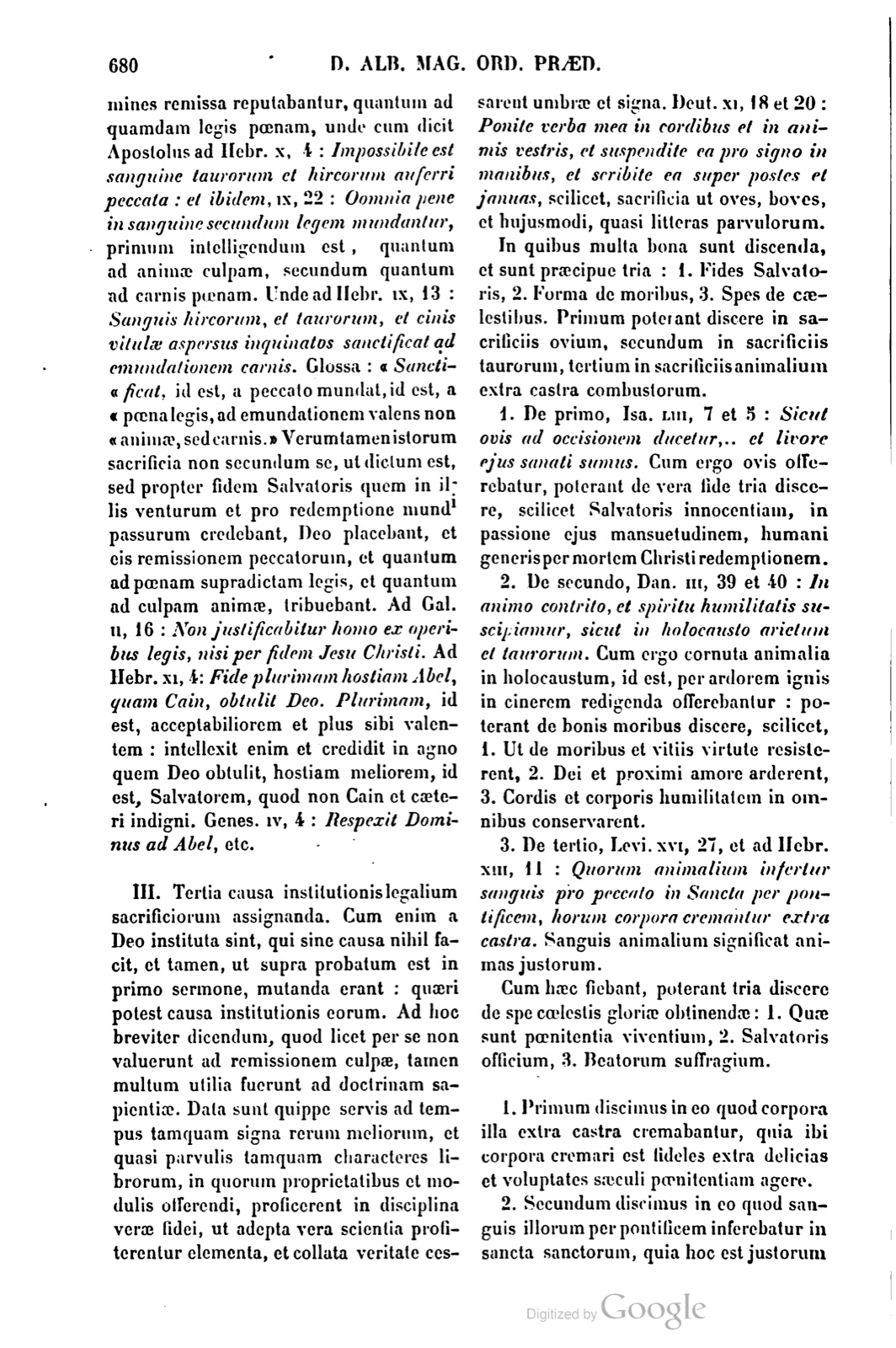
Solutio. Revera enim illa sacrificia, secundum se, scilicet, opera operata, id est, carnes et sanguis hircorum non placebant Deo: nec propterea remisit peccatum, quantum ad culpam, id est, conscientiae maculam: sed tamen apud homines remissa reputabantur, quantum ad quamdam legis poenam, unde cum dicit Apostolus ad Hebr. x, 4: Impossibile est sanguine taurorum et hircorum auferri peccata: et ibidem, ix, 22: Omnia pene in sanguine secundum legem mundantur, primum intelligendum est, quantum ad animae culpam, secundum quantum ad carnis poenam. Unde ad Hebr. ix, 13: Sanguis hircorum, et taurorum, et cinis vitulae aspersus inquinatos sanctificat ad emundationem carnis. Glossa: « Sanctificat, id est, a peccato mundat, id est, a poena legis, ad emundationem valens non animae, sed carnis. » Verumtamen istorum sacrificia non secundum se, ut dictum est, sed propter fidem Salvatoris quem in illis venturum et pro redemptione mundi passurum credebant, Deo placebant, et eis remissionem peccatorum, et quantum ad poenam supradictam legis, et quantum ad culpam animae, tribuebant. Ad Gal. ii, 16: Non justificabitur homo ex operibus legis, nisi per fidem Jesu Christi. Ad Hebr. xi, 4: Fide plurimam hostiam Abel, quam Cain, obtulit Deo. Plurimam, id est, acceptabiliorem et plus sibi valentem: intellexit enim et credidit in agno quem Deo obtulit, hostiam meliorem, id est, Salvatorem, quod non Cain et caeteri indigni. Genes. iv, 4: Respexit Dominus ad Abel, etc.
III. Tertia causa institutionis legalium sacrificiorum assignanda. Cum enim a Deo instituta sint, qui sine causa nihil facit, et tamen, ut supra probatum est in primo sermone, mutanda erant: quaeri potest causa institutionis eorum. Ad hoc breviter dicendum, quod licet per se non valuerunt ad remissionem culpae, tamen multum utilia fuerunt ad doctrinam sapientiae. Data sunt quippe servis ad tempus tamquam signa rerum meliorum, et quasi parvulis tamquam characteres librorum, in quorum proprietatibus et modulis offerendi, proficerent in disciplina verae fidei, ut adepta vera scientia profiterentur elementa, et collata veritate cessarent umbrae et signa. Deut. xi, 18 et 20: Ponite verba mea in cordibus et in animis vestris, et suspendite ea pro signo in manibus, et scribite ea super postes et januas, scilicet, sacrificia ut oves, boves, et hujusmodi, quasi litteras parvulorum.
In quibus multa bona sunt discenda, et sunt praecipue tria: 1. Fides Salvatoris, 2. Forma de moribus, 3. Spes de caelestibus. Primum poterant discere in sacrificiis ovium, secundum in sacrificiis taurorum, tertium in sacrificiis animalium extra castra combustorum.
1. De primo, Isa. liii, 7 et 5: Sicut ovis ad occisionem ducetur... et livore ejus sanati sumus. Cum ergo ovis offerebatur, poterant de vera fide tria discere, scilicet Salvatoris innocentiam, in passione ejus mansuetudinem, humani generis per mortem Christi redemptionem.
These things having been seen, the things which seem to be said contrarily about sacrifices in the sacred Scriptures are easily solved.
Solution. For in truth those sacrifices, according to themselves, namely, the works worked, that is, the flesh and blood of goats, did not please God; nor on account of them did he remit sin as to fault, that is, the stain of conscience. Yet among men they were reckoned remitted as to a certain punishment of the law. Hence when the Apostle says at Hebrews 10:4: It is impossible for sins to be taken away by the blood of bulls and goats, and in the same place, 9:22: Almost all things according to the law are cleansed in blood, the first must be understood as to the fault of the soul, the second as to the punishment of the flesh. Hence Hebrews 9:13: The blood of goats and bulls, and the sprinkled ashes of a heifer, sanctifies the defiled for the cleansing of the flesh. Gloss: "It sanctifies, that is, cleanses from sin, that is, from the punishment of the law, having power for the cleansing not of the soul but of the flesh." Nevertheless the sacrifices of these, not according to themselves, as has been said, but because of faith in the Savior, whom they believed would come in them and suffer for the redemption of the world, pleased God and bestowed on them remission of sins both as to the aforesaid punishment of the law and as to the fault of the soul. Galatians 2:16: Man will not be justified from the works of the law, except through faith in Jesus Christ. Hebrews 11:4: By faith Abel offered to God a more abundant victim than Cain. More abundant, that is, more acceptable and more availing for himself: for he understood and believed in the lamb which he offered to God, a better victim, that is, the Savior, which Cain and the other unworthy did not. Genesis 4:4: The Lord looked to Abel, etc.
III. The third cause of the institution of legal sacrifices must be assigned. For since they were instituted by God, who does nothing without cause, and yet, as was proved above in the first sermon, they were to be changed, the cause of their institution can be asked. To this one must say briefly that although by themselves they did not avail for remission of fault, nevertheless they were very useful for the teaching of wisdom. For they were given to servants for a time as signs of better things, and as characters of books to little ones, so that in their properties and modes of offering, they might advance in the discipline of true faith, so that once true knowledge had been obtained, the elements would be professed, and once truth had been conferred, shadows and signs would cease. Deuteronomy 11:18 and 20: Put my words in your hearts and in your souls, and hang them as a sign on your hands, and write them above posts and doors, namely, sacrifices such as sheep, oxen, and things of this sort, as letters of little ones.
In these many good things are to be learned, and there are chiefly three: 1. Faith in the Savior, 2. Form concerning morals, 3. Hope concerning heavenly things. The first they could learn in the sacrifices of sheep, the second in the sacrifices of bulls, the third in the sacrifices of animals burned outside the camp.
1. Concerning the first, Isaiah 53:7 and 5: Like a sheep he will be led to slaughter... and by his bruise we have been healed. Therefore when a sheep was offered, they could learn three things concerning true faith, namely the innocence of the Savior, his meekness in the Passion, and the redemption of the human race through the death of Christ.
2. De secundo, Dan. iii, 39 et 40: In animo contrito, et spiritu humilitatis suscipiamur, sicut in holocausto arietum et taurorum. Cum ergo cornuta animalia in holocaustum, id est, per ardorem ignis in cinerem redigenda offerebantur: poterant de bonis moribus discere, scilicet, 1. Ut de moribus et vitiis virtute resisterent, 2. Dei et proximi amore arderent, 3. Cordis et corporis humilitatem in omnibus conservarent.
3. De tertio, Levi. xvi, 27, et ad Hebr. xiii, 11: Quorum animalium infertur sanguis pro peccato in Sancta per pontificem, horum corpora cremantur extra castra. Sanguis animalium significat animas justorum.
Cum haec fiebant, poterant tria discere de spe coelestis gloriae obtinendae: 1. Quae sunt poenitentia viventium, 2. Salvatoris officium, 3. Beatorum suffragium.
1. Primum discimus in eo quod corpora illa extra castra cremabantur, quia ibi corpora cremari est fideles extra delicias et voluptates saeculi poenitentiam agere.
2. Secundum discimus in eo quod sanguis illorum per pontificem inferebatur in sancta sanctorum, quia hoc est justorum post hanc vitam beneficio Christi assumi in caelum.
3. Tertium discimus in eo quod sanguis per pontificem in sancta delatus, valuit ad redemptionem peccatorum hominum vivorum: quia hoc est animas beatorum, jam per Christum in caelo sublevatas, intercedere pro peccatis exsulum adhuc in mundo relictorum.
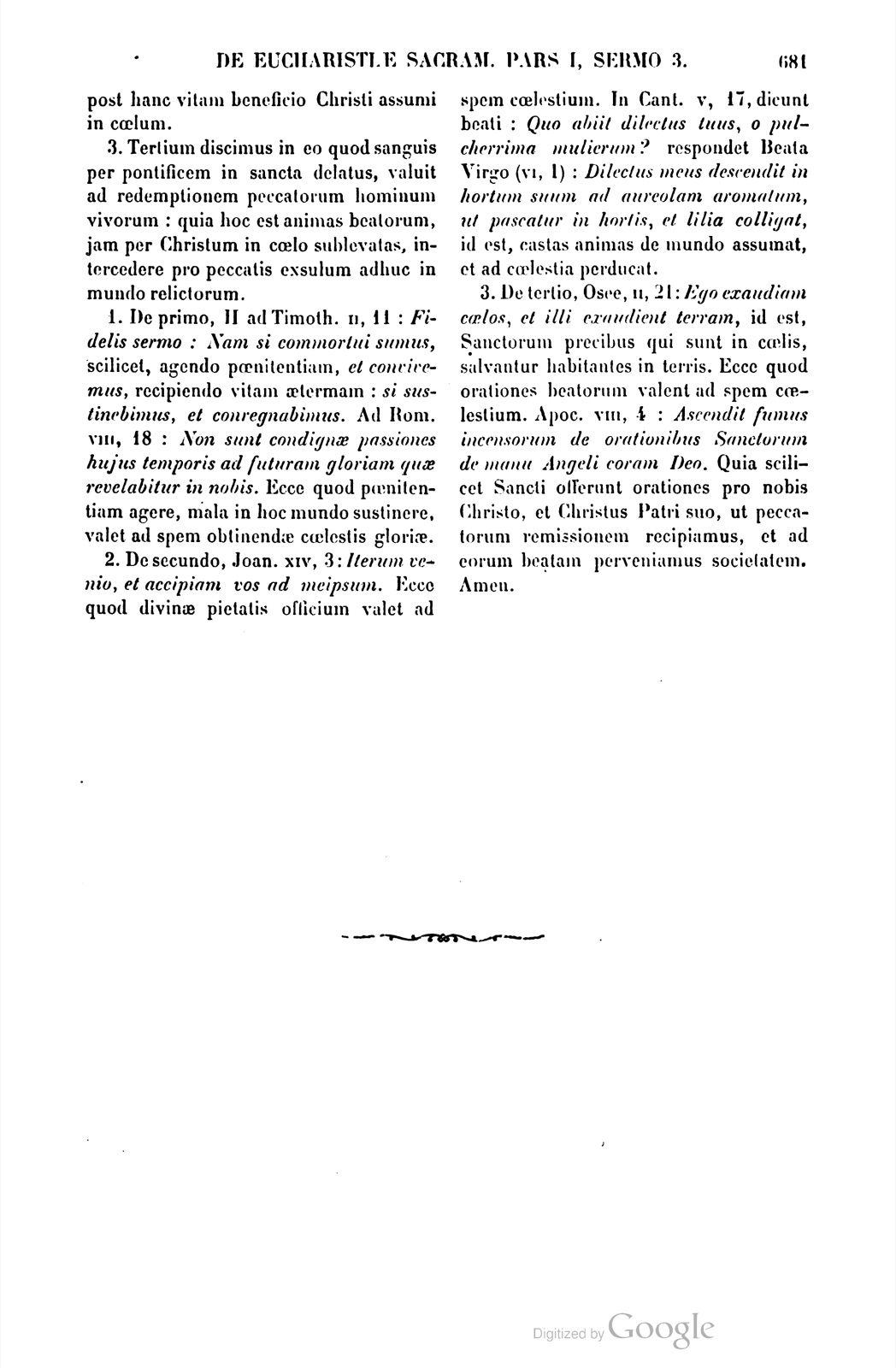
1. De primo, II ad Timoth. ii, 11: Fidelis sermo: Nam si commortui sumus, scilicet, agendo poenitentiam, et convivemus, recipiendo vitam aeternam: si sustinebimus, et conregnabimus. Ad Rom. viii, 18: Non sunt condignae passiones hujus temporis ad futuram gloriam quae revelabitur in nobis. Ecce quod poenitentiam agere, mala in hoc mundo sustinere, valet ad spem obtinendae caelestis gloriae.
2. De secundo, Joan. xiv, 3: Iterum venio, et accipiam vos ad meipsum. Ecce quod divinae pietatis officium valet ad spem coelestium. In Cant. v, 17, dicunt beati: Quo abiit dilectus tuus, o pulcherrima mulierum? respondet Beata Virgo (vi, 1): Dilectus meus descendit in hortum suum ad aureolam aromatum, ut pascatur in hortis, et lilia colligat, id est, castas animas de mundo assumat, et ad coelestia perducat.
3. De tertio, Osee, ii, 21: Ego exaudiam caelos, et illi exaudient terram, id est, Sanctorum precibus qui sunt in caelis, salvantur habitantes in terris. Ecce quod orationes beatorum valent ad spem coelestium. Apoc. viii, 4: Ascendit fumus incensorum de orationibus Sanctorum de manu Angeli coram Deo. Quia scilicet Sancti offerunt orationes pro nobis Christo, et Christus Patri suo, ut peccatorum remissionem recipiamus, et ad eorum beatam perveniamus societatem. Amen.
2. Concerning the second, Daniel 3:39 and 40: May we be received with a contrite soul and a spirit of humility, as in a holocaust of rams and bulls. Therefore when horned animals were offered as a holocaust, that is, to be reduced to ashes by the heat of fire, they could learn concerning good morals, namely, 1. That by virtue they should resist concerning morals and vices, 2. That they should burn with love of God and neighbor, 3. That in all things they should preserve humility of heart and body.
3. Concerning the third, Leviticus 16:27, and Hebrews 13:11: The animals whose blood is brought into the Holy Place for sin by the pontiff, their bodies are burned outside the camp. The blood of animals signifies the souls of the just.
When these things were done, they could learn three things concerning hope of obtaining heavenly glory: 1. What the penance of the living is, 2. The office of the Savior, 3. The suffrage of the blessed.
1. The first we learn in the fact that those bodies were burned outside the camp, because for bodies to be burned there is for the faithful to do penance outside the delights and pleasures of the age.
2. The second we learn in the fact that their blood was brought by the pontiff into the holy of holies, because this is for the just after this life to be taken up into heaven by the benefit of Christ.
3. The third we learn in the fact that the blood brought by the pontiff into the holy place availed for the redemption of the sins of living men: because this is for the souls of the blessed, already lifted up into heaven through Christ, to intercede for the sins of exiles still left in the world.
1. Concerning the first, 2 Timothy 2:11: A faithful saying: For if we have died together, namely by doing penance, we will also live together, by receiving eternal life; if we endure, we will also reign together. Romans 8:18: The sufferings of this time are not worthy of the future glory which will be revealed in us. Behold that doing penance and enduring evils in this world avails for the hope of obtaining heavenly glory.
2. Concerning the second, John 14:3: I come again, and I will receive you to myself. Behold that the office of divine piety avails for hope of heavenly things. In Song of Songs 5:17, the blessed say: Where has your beloved gone, O most beautiful of women? The Blessed Virgin answers (6:1): My beloved has gone down into his garden, to the little bed of spices, that he may feed in the gardens and gather lilies, that is, assume chaste souls from the world and lead them to heavenly things.
3. Concerning the third, Hosea 2:21: I will hear the heavens, and they will hear the earth, that is, by the prayers of the Saints who are in heaven, those dwelling on earth are saved. Behold that the prayers of the blessed avail for hope of heavenly things. Apocalypse 8:4: The smoke of the incense of the prayers of the Saints ascended from the hand of the Angel before God. Because, namely, the Saints offer prayers for us to Christ, and Christ offers them to his Father, so that we may receive remission of sins and come to their blessed society. Amen.
If a page does not appear, its photograph has not been uploaded yet.