Works › Sermons on the Most Holy Sacrament of the Eucharist
Volume 13 · pp. 686–689
Sermon V. On the Third Cause of Institution, That It Be the Food of Man, by Reason of Divine Liberality
A marker with ≈ is an approximate page boundary, placed by measure of the text; the page photographs remain the authority. In the paired views, clicking a page marker brings that page into view.
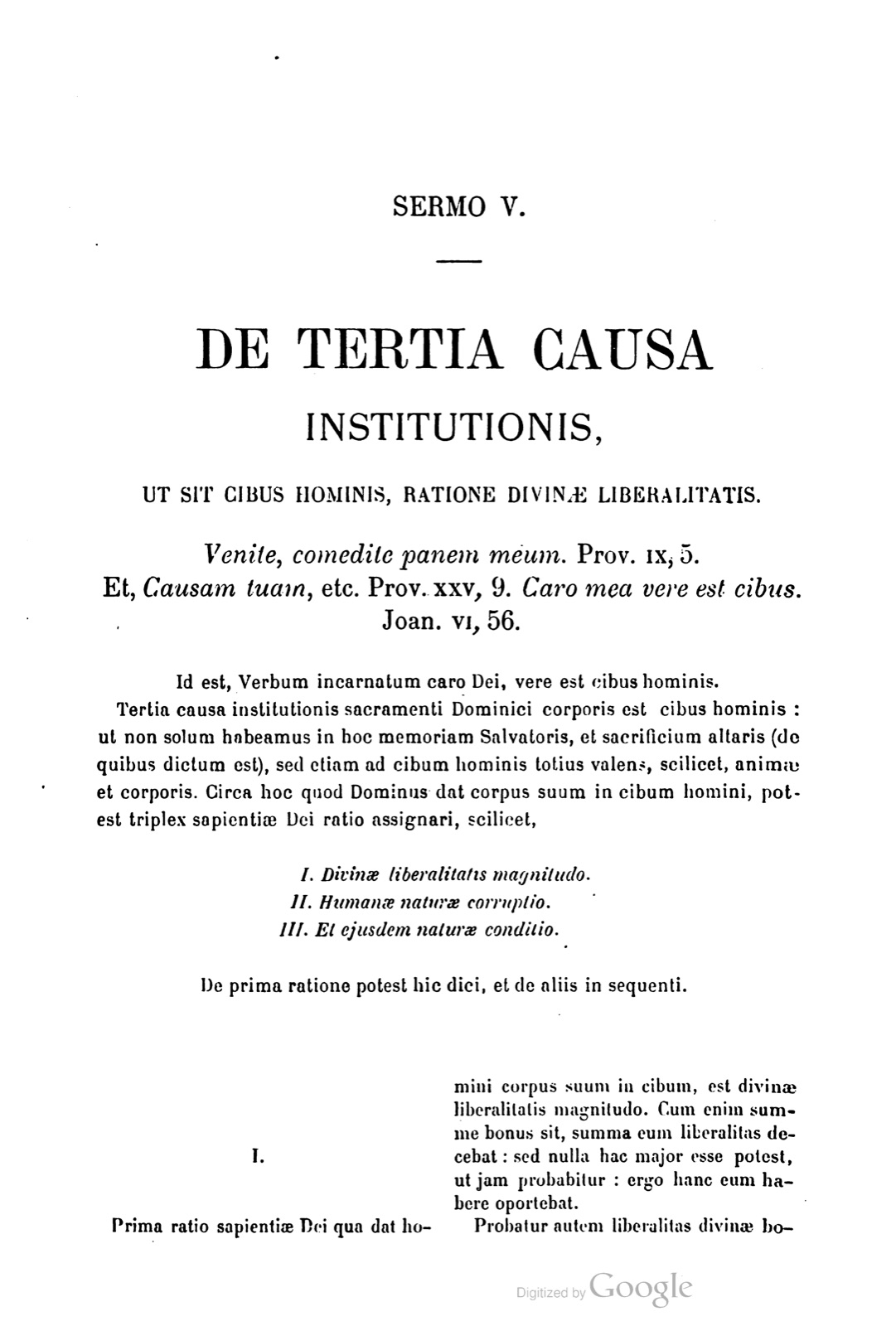
### Sermo V
### De tertia causa institutionis, ut sit cibus hominis, ratione divinae liberalitatis
Venite, comedite panem meum. Prov. ix, 5.
Et, Causam tuam, etc. Prov. xxv, 9. Caro mea vere est cibus. Joan. vi, 56.
Id est, Verbum incarnatum caro Dei, vere est cibus hominis.
Tertia causa institutionis sacramenti Dominici corporis est cibus hominis: ut non solum habeamus in hoc memoriam Salvatoris, et sacrificium altaris (de quibus dictum est), sed etiam ad cibum hominis totius valens, scilicet, animae et corporis. Circa hoc quod Dominus dat corpus suum in cibum homini, potest triplex sapientiae Dei ratio assignari, scilicet,
I. Divinae liberalitatis magnitudo.
II. Humanae naturae corruptio.
III. Et ejusdem naturae conditio.
De prima ratione potest hic dici, et de aliis in sequenti.
I.
Prima ratio sapientiae Dei qua dat homini corpus suum in cibum, est divinae liberalitatis magnitudo. Cum enim summe bonus sit, summa eum liberalitas decebat: sed nulla hac major esse potest, ut jam probabitur: ergo hanc eum habere oportebat.
Probatur autem liberalitas divinae bonitatis maxima esse in hoc facto quantum ad tria: primo quantum ad magnificentiam doni, secundo quantum ad nobilitatem dantis, tertio quantum ad utilitatem accipientis.
I. Probatur in hoc facto maxima liberalitas Dei, quantum ad magnificentiam doni. Quia largitor omnium bonorum in hoc sacramento dat seipsum, et hoc largissime: quia proprium corpus in cibum secundum quod dicit: Accipite, et comedite: Hoc est corpus meum (Matth. xxvi, 26). Hic autem summus et supereffluentissimus gradus est divinae largitatis quantum ad donum. Hinc gradus quidam proponi possunt divinae liberalitatis, quibus largitus est homini bona sua, et sic patebit, quod iste sit summus.
Primus gradus liberalitatis Dei, quod largitus est homini caelum et terram et omnes irrationales creaturas ad serviendum. Eccli. xvii, 1 et 3: Deus creavit de terra hominem, ... et dedit illi potestatem eorum, quae sunt super terram. Gen. i, 26: Faciamus hominem ad imaginem, et similitudinem nostram: et praesit universae creaturae. Hinc caelum et terra et omnia quae in eis sunt, serviunt homini. Deut. iv, 19: Solem et lunam et omnia astra caeli creavit Dominus Deus tuus in ministerium cunctis gentibus. Matth. v, 45: Deus solem suum oriri facit super bonos, et malos, et pluit super justos et injustos. Act. xiv, 16: Et quidem Deus non sine testimonio semetipsum reliquit, bene faciens de coelo, dans pluvias, et tempora fructifera, implens cibo, et laetitia corda nostra. Non sine testimonio se reliquit benefaciens, id est, per beneficia et creaturas se Deum et liberalem testatus est. Psal. viii, 5 et 7: Quid est homo quod memores ejus? ... Et constituisti eum super opera manuum tuarum.
### Sermon V
### On the Third Cause of Institution, That It Be the Food of Man, by Reason of Divine Liberality
Come, eat my bread. Proverbs 9:5.
And, Treat your cause, etc. Proverbs 25:9. My flesh is truly food. John 6:56.
That is, the incarnate Word, the flesh of God, is truly the food of man.
The third cause of the institution of the sacrament of the Lord's body is the food of man: so that in this we may have not only the memory of the Savior and the sacrifice of the altar, concerning which it has been spoken, but also something availing for the food of the whole man, namely of soul and body. Concerning this, that the Lord gives his body as food to man, a threefold reason of God's wisdom can be assigned, namely,
I. The greatness of divine liberality.
II. The corruption of human nature.
III. And the condition of the same nature.
Concerning the first reason something can be said here, and concerning the others in what follows.
I.
The first reason of God's wisdom by which he gives his body to man as food is the greatness of divine liberality. For since he is supremely good, the highest liberality befitted him; but none can be greater than this, as will now be proved; therefore it was fitting that he have this.
But the liberality of divine goodness is proved to be greatest in this deed as to three things: first as to the magnificence of the gift, secondly as to the nobility of the giver, thirdly as to the usefulness of the receiver.
I. In this deed the greatest liberality of God is proved as to the magnificence of the gift. Because the giver of all good things in this sacrament gives himself, and this most largely, because he gives his own body as food according to what he says: Take and eat: This is my body (Matthew 26:26). But here is the highest and most superabundant grade of divine largesse as to the gift. Hence certain grades can be proposed of divine liberality, by which he has bestowed his good things on man, and thus it will be clear that this is the highest.
The first grade of God's liberality is that he bestowed on man heaven and earth and all irrational creatures for serving. Ecclesiasticus 17:1 and 3: God created man from the earth, ... and gave him power over those things which are upon the earth. Genesis 1:26: Let us make man to our image and likeness, and let him rule over every creature. Hence heaven and earth and all things which are in them serve man. Deuteronomy 4:19: The Lord your God created the sun and moon and all the stars of heaven for the service of all nations. Matthew 5:45: God makes his sun rise over the good and the evil, and rains upon the just and unjust. Acts 14:16: And indeed God did not leave himself without testimony, doing good from heaven, giving rains and fruitful seasons, filling our hearts with food and gladness. He did not leave himself without testimony by doing good, that is, through benefits and creatures he bore witness to himself as God and liberal. Psalm 8:5 and 7: What is man that you are mindful of him? ... And you set him over the works of your hands.
Secundus gradus, quod largitus est homini illas nobilissimas creaturas rationabiles supercoelestes, id est, sanctos Angelos ad ministrandum. Ad Hebr. i, 14: Nonne omnes sunt administratorii spiritus, in ministerium missi propter eos, qui haereditatem capiunt salutis, Matth. xviii, 10: Angeli eorum in caelis semper vident faciem Patris. Angeli dicuntur parvulorum, quia unicuique a nativitate datus est Angelus ad ministerium. Hinc leguntur hominibus saepe obsequia impendisse, et faciunt adhuc quotidie peccatores convertendo, multos a malis defendendo, justos ad caelos deducendo. Exod. xxiii, 20: Ecce mitto Angelum meum, qui praecedat te, et custodiat in via, et introducat ad locum quem paravi. Praecedet te, lumen virtutum ostendendo: custodiet in via, in igne purgatorii defendendo: et introducet te, ad sedem regni coelestis perducendo.
Tertius gradus, quod largitus est Deus homini seipsum. Lucae, i, 68, 73: Benedictus Dominus Deus Israel, quia visitavit, et fecit redemptionem plebis suae... Jusjurandum, quod juravit ad Abraham patrem nostrum, daturum se nobis. Et dedit seipsum multis modis, primo in socium nostrae peregrinationis. Baruch, iii, 36 et seq.: Hic est Deus noster, qui adinvenit omnem viam disciplinae, et tradidit illam Jacob puero suo, et Israel dilecto suo. Post haec in terris visus est, et cum hominibus conversatus est. Quasi diceret: Quia Deus fecerat homini viam peregrinationis, dans mandata bonae conversationis: ne via homini videretur gravis, factus est Deus homo, et per hoc socius viae et peregrinationis. Luc. viii, 1 et 2: Iter faciebat Jesus per civitates, et castella praedicans, et evangelizans regnum Dei: et duodecim cum illo, et mulieres aliquae, quae erant curatae a spiritibus malignis, et infirmitatibus: Maria, quae vocatur Magdalene, et Joanna, et Susanna, et aliae multae. Et vere bonus dedit se in bonum socium, quia socios viae lassos verbis optimis confortavit, periclitantes liberavit, infirmos curavit, mortuos suscitavit.
The second grade is that he bestowed on man those most noble supercelestial rational creatures, that is, the holy Angels for ministering. Hebrews 1:14: Are they not all ministering spirits, sent into ministry on account of those who receive the inheritance of salvation? Matthew 18:10: Their Angels in heaven always see the face of the Father. They are called Angels of little ones because to each one from birth an Angel has been given for ministry. Hence they are read often to have rendered services to men, and they still do this daily by converting sinners, defending many from evils, and leading the just to the heavens. Exodus 23:20: Behold, I send my Angel, who will go before you and guard you on the way, and bring you to the place which I have prepared. He will go before you by showing the light of the virtues; he will guard you on the way by defending you in the fire of purgatory; and he will bring you in by leading you to the seat of the heavenly kingdom.
The third grade is that God bestowed himself on man. Luke 1:68, 73: Blessed is the Lord God of Israel, because he has visited and made redemption of his people... The oath which he swore to Abraham our father, that he would give himself to us. And he gave himself in many ways, first as companion of our pilgrimage. Baruch 3:36 and following: This is our God, who discovered every way of discipline and handed it on to Jacob his servant and to Israel his beloved. After these things he was seen on earth and conversed with men. As if he were saying: Because God had made for man the way of pilgrimage, giving commandments of good conduct, lest the way should seem heavy to man, God was made man, and through this companion of the way and pilgrimage. Luke 8:1 and 2: Jesus made a journey through cities and towns preaching and evangelizing the kingdom of God, and the twelve with him, and certain women who had been cured of malignant spirits and infirmities: Mary, who is called Magdalene, and Joanna, and Susanna, and many others. And truly the good one gave himself as a good companion, because he comforted companions of the way who were weary with the best words, liberated those in danger, cured the sick, raised the dead.
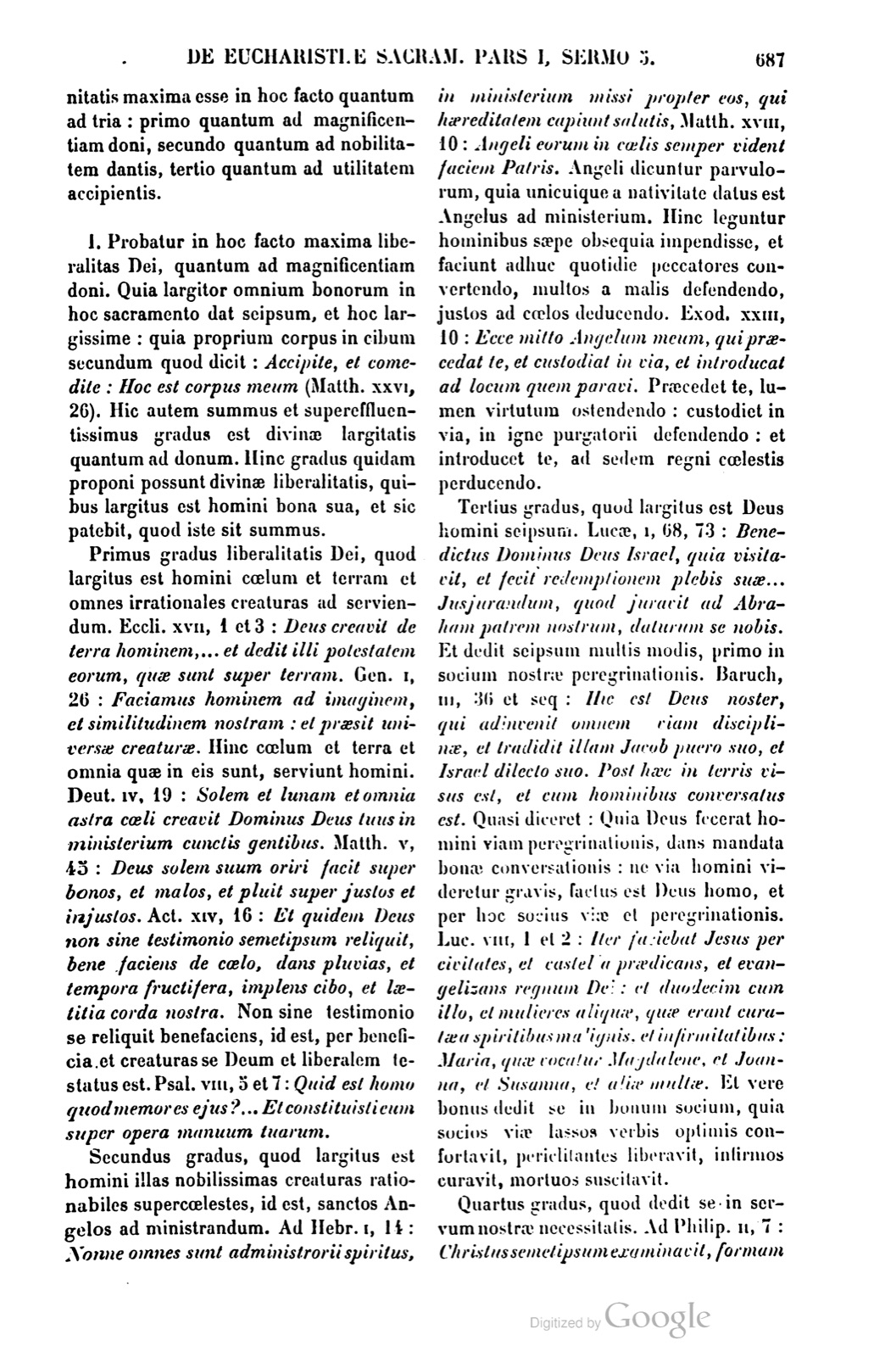
Quartus gradus, quod dedit se in servum nostrae necessitatis. Ad Philip. ii, 7: Christus semetipsum exinanivit, formam servi accipiens. Hinc sitientem potavit, esurientem pavit, pedes discipulorum lavit. Matth. xx, 28: Filius hominis non venit ministrari, sed ministrare. Luc. xxii, 27: Ego in medio vestrum sum, sicut qui ministrat.
Quintus gradus est, quod dedit se in pretium nostrae redemptionis. Ad Ephes. v, 2: Christus dilexit nos, et tradidit semetipsum pro nobis, oblationem et hostiam Deo in odorem suavitatis. Matth. xx, 28: Filius hominis... venit dare animam suam, redemptionem pro multis.
Sextus gradus, et summus liberalitatis Domini est, quod dat homini corpus suum in cibum. Osee, xi, 3 et 4: Ego quasi nutritius Ephraim, et declinavi ad eum, ut vesceretur. Joan. vi, 52: Panis, quem ego dabo, caro mea est pro mundi vita. Gregorius: « Bonus pastor, Dominus animam suam pro ovibus posuit, ut in sacramento nostro, corpus suum et sanguinem verteret, et oves quas redemerat, carnis suae alimento satiaret. » Et in hoc est expressio summae largitatis, et praecipui amoris: magnum enim est, dare se in socium peregrinationis, et in servum necessitatis, et majus in pretium redemptionis. Tale tamen donum adhuc est in separatione et remotione ab eo cui datur: sed quod datur in cibum, datur non ad separationem aliquam, sed ad omnimodam unionem: uniuntur enim in unitate corporis, cibus et sumens cibum. Joan. vi, 57: Qui manducat meam carnem, et bibit meum sanguinem, in me manet, et ego in illo. Et sic apparet in tali dono supereffluentissima largitas divinae bonitatis.
II. Probatur in hoc facto maxima liberalitas Dei, quantum ad nobilitatem dantis, quae tam excellens est in hoc sacramento, ut corpus suum largiatur diffuse et late: quia non solum dat illud dignis et amicis, verum non subtrahit indignis, malignis, et inimicis.
1. Psal. xxvi, 2: Appropiant super me nocentes, ut edant carnes meas. Qui enim permisit se malignorum manibus semel crucifigi, permittit se quotidie sceleratorum manibus tractari, et immundorum ac inimicorum dentibus in Sacramento lacerari.
2. Hinc hosti suo et traditori Judae dicitur in coena cum aliis Discipulis suis corpus suum dedisse.
3. Veritatem enim suae praesentiae ad instar solis oriri facit super bonos et malos, exhibens se in hoc mundo dignis et indignis: licet non ab omnibus effectus suscipiatur aequalis. Nam dignus effectum suscipit bonitatis Dei, indignus severitatis.
The fourth grade is that he gave himself as servant of our necessity. Philippians 2:7: Christ emptied himself, taking the form of a servant. Hence he gave drink to the thirsty, fed the hungry, washed the feet of the disciples. Matthew 20:28: The Son of man did not come to be ministered to, but to minister. Luke 22:27: I am in the midst of you as one who ministers.
The fifth grade is that he gave himself as the price of our redemption. Ephesians 5:2: Christ loved us and handed himself over for us, an offering and victim to God in an odor of sweetness. Matthew 20:28: The Son of man... came to give his soul as redemption for many.
The sixth grade, and the highest of the Lord's liberality, is that he gives his body to man as food. Hosea 11:3 and 4: I was like a nurse to Ephraim, and I bent down to him so that he might eat. John 6:52: The bread which I will give is my flesh for the life of the world. Gregory: "The good shepherd, the Lord, laid down his soul for the sheep, so that in our sacrament he might turn his body and blood, and satisfy with the nourishment of his flesh the sheep whom he had redeemed." And in this there is the expression of the highest largesse and of chief love; for it is great to give oneself as companion of pilgrimage and as servant of necessity, and greater as the price of redemption. Yet such a gift is still in separation and removal from him to whom it is given; but what is given as food is given not for any separation, but for every kind of union: for food and the one taking food are united in the unity of the body. John 6:57: He who eats my flesh and drinks my blood remains in me, and I in him. And thus in such a gift the most superabundant largesse of divine goodness appears.
II. In this deed the greatest liberality of God is proved as to the nobility of the giver, which is so excellent in this sacrament that he bestows his body broadly and widely, because he not only gives it to the worthy and to friends, but truly does not withdraw it from the unworthy, the malignant, and enemies.
1. Psalm 26:2: The harmful draw near upon me, to eat my flesh. For he who once permitted himself to be crucified by the hands of the malignant, permits himself daily to be handled by the hands of the wicked and to be torn in the Sacrament by the teeth of the unclean and of enemies.
2. Hence he is said at the supper, with his other Disciples, to have given his body to his enemy and betrayer Judas.
3. For he makes the truth of his presence rise after the likeness of the sun upon the good and the evil, displaying himself in this world to the worthy and the unworthy, although the effect is not received equally by all. For the worthy man receives the effect of God's goodness; the unworthy man, of severity.
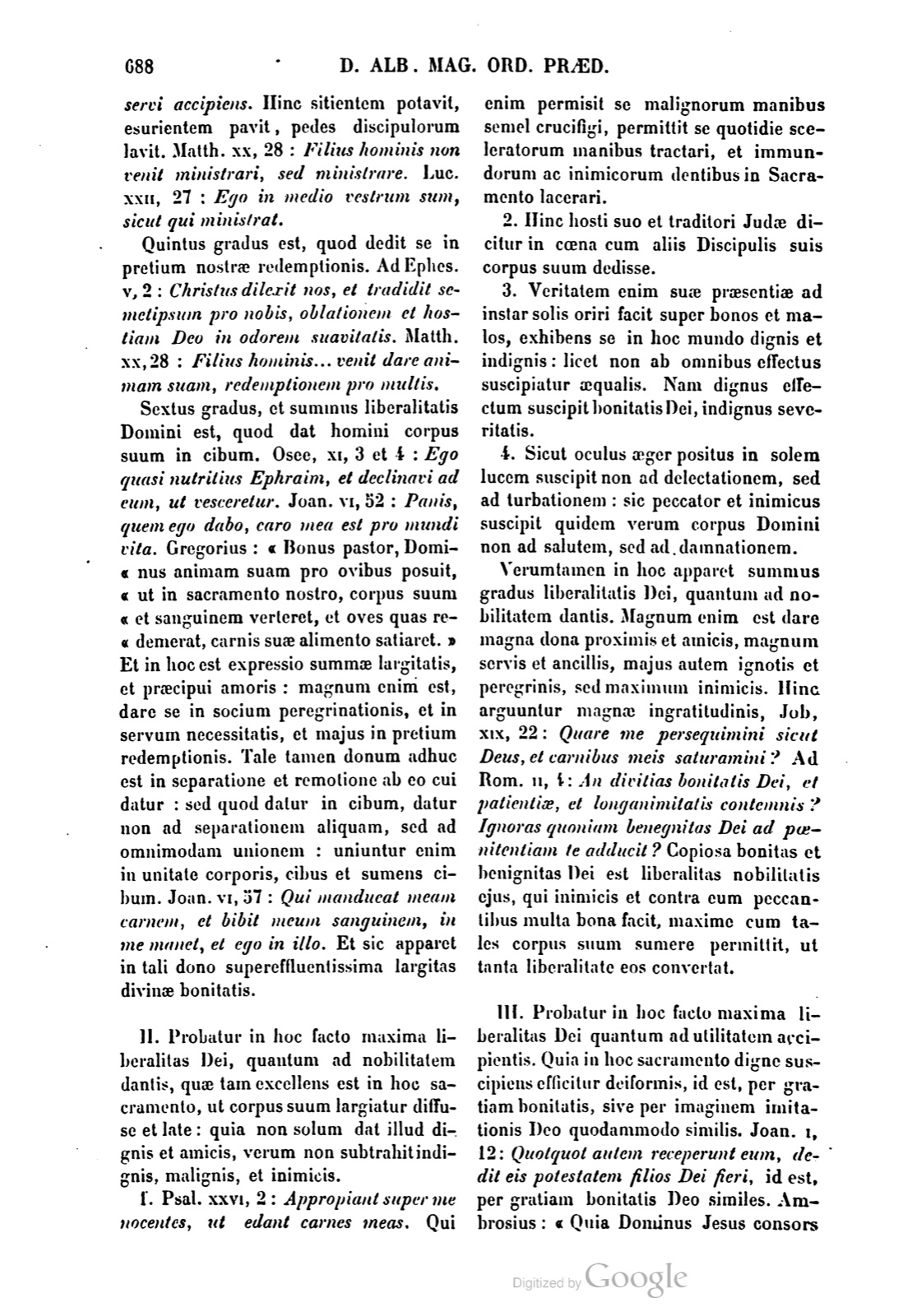
4. Sicut oculus aeger positus in solem lucem suscipit non ad delectationem, sed ad turbationem: sic peccator et inimicus suscipit quidem verum corpus Domini non ad salutem, sed ad damnationem.
Verumtamen in hoc apparet summus gradus liberalitatis Dei, quantum ad nobilitatem dantis. Magnum enim est dare magna dona proximis et amicis, magnum servis et ancillis, majus autem ignotis et peregrinis, sed maximum inimicis. Hinc arguuntur magnae ingratitudinis, Job, xix, 22: Quare me persequimini sicut Deus, et carnibus meis saturamini? Ad Rom. ii, 4: An divitias bonitatis Dei, et patientiae, et longanimitatis contemnis? Ignoras quoniam benignitas Dei ad poenitentiam te adducit? Copiosa bonitas et benignitas Dei est liberalitas nobilitatis ejus, qui inimicis et contra eum peccantibus multa bona facit, maxime cum tales corpus suum sumere permittit, ut tanta liberalitate eos convertat.
III. Probatur in hoc facto maxima liberalitas Dei quantum ad utilitatem accipientis. Quia in hoc sacramento digne suscipiens efficitur deiformis, id est, per gratiam bonitatis, sive per imaginem imitationis Deo quodammodo similis. Joan. i, 12: Quotquot autem receperunt eum, dedit eis potestatem filios Dei fieri, id est, per gratiam bonitatis Deo similes. Ambrosius: « Quia Dominus Jesus consors est divinitatis et corporis, et tu qui accipis carnem ejus, divinae substantiae in illo participas alimento. » Divina substantia bonitas est. In hoc ergo alimento divinae substantiae participare, est assimilari per gratiam bonitati divinae. Prov. xii, 2: Qui bonus est, hauriet gratiam a Domino. Gratia vero est influentia divinae bonitatis in animam, per quam assimilata Deo fit ei grata et vitae aeternae digna. Non ergo sufficit liberalitati divinae quod in hoc cibo intellectum illuminat, quod affectum sanat, quod memoriam delectat, quod totum hominem in bono confortat, quod corpori suo mystico associat: quin insuper, ut dictum est, Deo similem faciat: et iste gradus summus est et supereffluentissimus divinae largitatis, quantum ad utilitatem accipientis: nemo enim potest creaturam ad majus promovere, quam quod assimiletur suo Creatori, in praesenti scilicet per gratiam, et in futuro per gloriam: II ad Corinth. ix, 15: Gratias Deo ago super inenarrabili dono ejus. Amen.
4. Just as a sick eye set in the sun receives the light not for delight but for disturbance, so the sinner and enemy indeed receives the true body of the Lord, not for salvation, but for damnation.
Nevertheless in this appears the highest grade of God's liberality as to the nobility of the giver. For it is great to give great gifts to neighbors and friends, great to servants and handmaids, but greater to the unknown and pilgrims, and greatest to enemies. Hence they are accused of great ingratitude, Job 19:22: Why do you persecute me like God and are sated with my flesh? Romans 2:4: Do you despise the riches of God's goodness, patience, and long-suffering? Do you not know that the kindness of God leads you to penance? The copious goodness and kindness of God is the liberality of his nobility, who does many good things for enemies and for those sinning against him, especially when he permits such persons to receive his body, so that by so great a liberality he may convert them.
III. In this deed the greatest liberality of God is proved as to the usefulness of the receiver. Because in this sacrament the one receiving worthily is made deiform, that is, by grace of goodness, or through the image of imitation, in some way similar to God. John 1:12: As many as received him, he gave them power to be made sons of God, that is, through grace of goodness similar to God. Ambrose: "Because the Lord Jesus is sharer of divinity and of body, you also, who receive his flesh, participate in the divine substance in that food." The divine substance is goodness. Therefore to participate in divine substance in this food is to be assimilated by grace to divine goodness. Proverbs 12:2: He who is good will draw grace from the Lord. But grace is an inflow of divine goodness into the soul, through which, assimilated to God, it becomes pleasing to him and worthy of eternal life. Therefore it is not enough for divine liberality that in this food it illuminates the intellect, heals the affection, delights the memory, strengthens the whole man in good, associates him with its mystical body; but beyond this, as has been said, it makes him similar to God. And this grade is the highest and most superabundant of divine largesse as to the usefulness of the receiver: for no one can advance a creature to anything greater than that it be assimilated to its Creator, namely in the present through grace and in the future through glory. 2 Corinthians 9:15: I give thanks to God for his unspeakable gift. Amen.

If a page does not appear, its photograph has not been uploaded yet.