Works › Posterior Analytics, Books I–II
Volume 2 · pp. 225–227
Chapter 9. That in a demonstration which is through accident and particular, or of one affection, there can be several causes.
A marker with ≈ is an approximate page boundary, placed by measure of the text; the page photographs remain the authority. In the paired views, clicking a page marker brings that page into view.
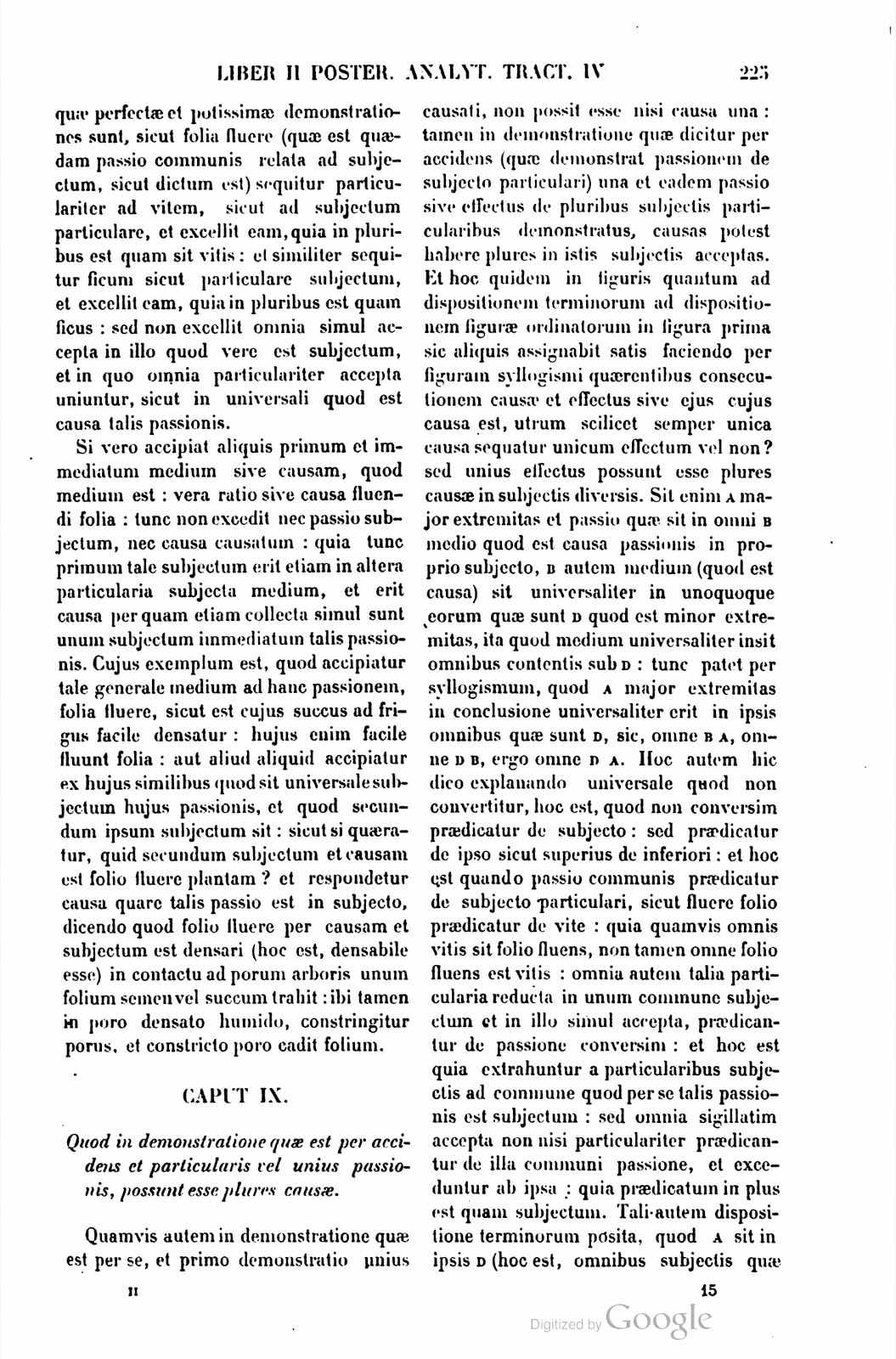
CAPUT IX. Quod in demonstratione quae est per accidens et particularis vel unius passionis, possunt esse plures causae.
Quamvis autem in demonstratione quae est per se, et primo demonstratio unius causati, non possit esse nisi causa una, tamen in demonstratione quae dicitur per accidens, quae demonstrat passionem de subjecto particulari, una et eadem passio sive effectus de pluribus subjectis particularibus demonstratus, causas potest habere plures in istis subjectis acceptas. Et hoc quidem in figuris quantum ad dispositionem terminorum ad dispositionem figurae ordinatorum in figura prima aliquis assignabit satis faciendo per figuram syllogismi quaerentibus consecutionem causae et effectus sive ejus cujus causa est, utrum scilicet semper unica causa sequatur unicum effectum vel non. Sed unius effectus possunt esse plures causae in subjectis diversis. Sit enim A major extremitas et passio quae sit in omni B medio quod est causa passionis in proprio subjecto; B autem medium, quod est causa, sit universaliter in unoquoque eorum quae sunt D, quod est minor extremitas, ita quod medium universaliter insit omnibus contentis sub D. Tunc patet per syllogismum quod A major extremitas in conclusione universaliter erit in ipsis omnibus quae sunt D, sic: omne B A; omne D B; ergo omne D A. Hoc autem hic dico explanando universale quod non convertitur, hoc est, quod non conversim praedicatur de subjecto, sed praedicatur de ipso sicut superius de inferiori. Et hoc est quando passio communis praedicatur de subjecto particulari, sicut fluere folio praedicatur de vite, quia quamvis omnis vitis sit folio fluens, non tamen omne folio fluens est vitis. Omnia autem talia particularia reducta in unum commune subjectum et in illo simul accepta, praedicantur de passione conversim; et hoc est quia extrahuntur a particularibus subjectis ad commune quod per se talis passionis est subjectum. Sed omnia sigillatim accepta nonnisi particulariter praedicantur de illa communi passione, et exceduntur ab ipsa, quia praedicatum in plus est quam subjectum. Tali autem dispositione terminorum posita, quod A sit in ipsis D, hoc est, omnibus subjectis quae sunt sub A, causa est medium B. Oportet igitur quod A extendatur secundum communitatem in plus quam B, hoc est, quod passio in plus sit quam particularis causa passionis, quia A non est causa A secundum totum ambitum ipsius A, sed tantum secundum hoc quod A est in D; B enim est causa inhaerentiae quod A est in D.
Si vero aliquis diceret quod non est in plus, sed in aeque, tunc cum medium in prima figura accipiatur supra subjectum et sub praedicato, et sic causa est medium, tunc quaeremus quid hoc est, quare vel propter quid hoc, scilicet B, magis est causa illius quod A insit D quam e converso, quod A esset causa qua B est in D, et non esset rationem assignare, quia in convertibilibus utrumque subjicitur alteri et praedicatur de altero. Oportet igitur secundum dispositionem primi modi in prima figura majus extremum in plus esse quam medium. Ulterius quia A medium positum est esse in pluribus particularibus subjectis quam in D in quo est per A medium et causam, sit aliquod subjectum particulare in quo est A communis passio, ita quod A sit in omnibus particularibus subjectis ipsius E, et praedicetur de omni E et concludi potest de E sicut de D concluditur. Oportet igitur quod omnia quae sunt E et de quibus praedicatur E sint unum et unita in aliquo uno quod sit medium et causa particularis per quam concluditur A de E universaliter, et quod illud medium sit aliud quam B, quia quod passio aliqua communis insit duobus diversis specie particularibus subjectis, non potest esse una et eadem causa propria, cum causa passionis de propriis et essentialibus subjecti sumatur, et jam positum sit, quod subjecta particularia sunt specie diversa.
CHAPTER 9. That in a demonstration which is through accident and particular, or of one affection, there can be several causes.
But although in a demonstration which is through itself, and first a demonstration of one caused thing, there cannot be anything except one cause, nevertheless in a demonstration that is called through accident, which demonstrates an affection of a particular subject, one and the same affection or effect, demonstrated of several particular subjects, can have several causes accepted in those subjects. And someone will assign this sufficiently in figures, with respect to the disposition of terms ordered to the disposition of the figure in the first figure, by satisfying through the figure of the syllogism those who ask about the consequence of cause and effect, or of that of which it is the cause, namely whether one single cause always follows one single effect or not. But there can be several causes of one effect in diverse subjects. For let A be the major extreme and the affection which is in every B, the middle which is the cause of the affection in its proper subject; but let B, the middle which is the cause, be universally in each of the things that are D, which is the minor extreme, so that the middle is universally in all things contained under D. Then it is clear through the syllogism that A, the major extreme, will be universally in the conclusion in all the very things that are D, thus: every B is A; every D is B; therefore every D is A. But I say this here in explaining a universal which is not converted, that is, which is not predicated conversely of the subject, but is predicated of it as a superior is predicated of an inferior. And this is when a common affection is predicated of a particular subject, as flowing leaves is predicated of vine, because although every vine is something flowing leaves, nevertheless not everything flowing leaves is vine. But all such particulars, reduced into one common subject and accepted together in that subject, are predicated conversely of the affection; and this is because they are drawn out from particular subjects to the common which through itself is the subject of such an affection. But all things accepted one by one are predicated of that common affection only particularly, and are exceeded by it, because the predicate is in more things than the subject. But when such a disposition of the terms has been posited, namely that A is in the very D's, that is, in all subjects which are under A, the cause is the middle B. Therefore A must be extended according to commonness to more things than B, that is, the affection must be in more things than the particular cause of the affection, because A is not the cause of A according to the whole scope of A itself, but only according to this, that A is in D; for B is the cause of the inherence by which A is in D.
But if someone were to say that it is not in more things, but in equal things, then, since the middle in the first figure is accepted above the subject and under the predicate, and so the cause is the middle, then we will ask what this is, why or on account of what this, namely B, is more the cause of the fact that A belongs to D than conversely A would be the cause by which B is in D; and there would be no account to assign, because in convertibles each is subjected to the other and predicated of the other. Therefore according to the disposition of the first mode in the first figure, the greater extreme must be in more things than the middle. Further, because A, the middle posited, is in more particular subjects than in D, in which it is through A as middle and cause, let there be some particular subject in which A, the common affection, exists, so that A is in all the particular subjects of E itself, and is predicated of every E and can be concluded of E just as it is concluded of D. Therefore all things that are E, and of which E is predicated, must be one and united in some one thing that is the middle and particular cause through which A is concluded universally of E, and that middle must be other than B, because that some common affection belongs to two particular subjects diverse in species cannot have one and the same proper cause, since the cause of an affection is taken from the proper and essential things of the subject, and it has already been posited that the particular subjects are diverse in species.
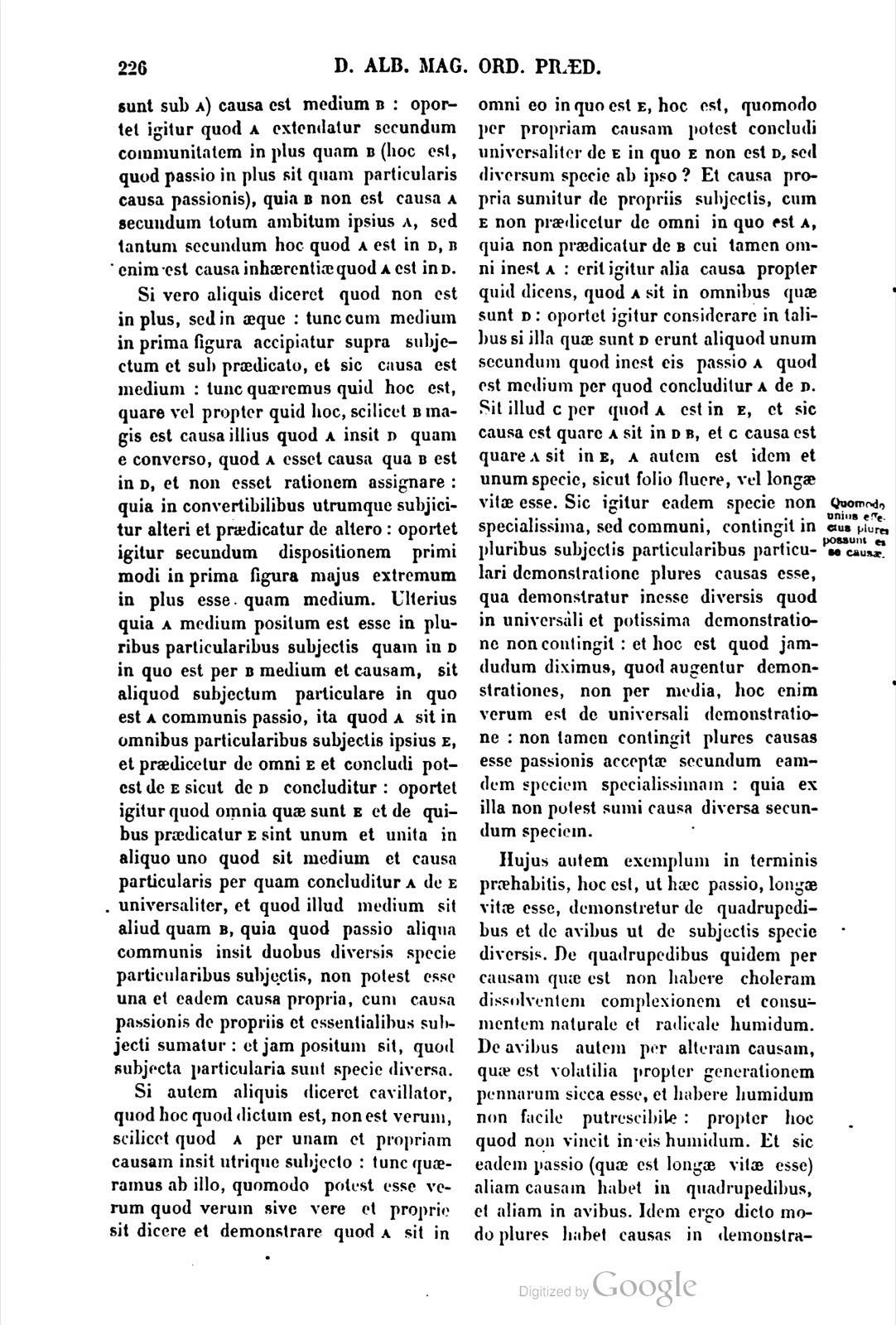
Si autem aliquis diceret cavillator, quod hoc quod dictum est non est verum, scilicet quod A per unam et propriam causam insit utrique subjecto, tunc quaeramus ab illo, quomodo potest esse verum quod verum sive vere et proprie sit dicere et demonstrare quod A sit in omni eo in quo est E, hoc est, quomodo per propriam causam potest concludi universaliter de E in quo E non est D, sed diversum specie ab ipso? Et causa propria sumitur de propriis subjectis, cum E non praedicetur de omni in quo est A, quia non praedicatur de B, cui tamen omni inest A. Erit igitur alia causa propter quid dicens, quod A sit in omnibus quae sunt D. Oportet igitur considerare in talibus si illa quae sunt D erunt aliquod unum secundum quod inest eis passio A quod est medium per quod concluditur A de D. Sit illud C per quod A est in E, et sic causa est quare A sit in D B, et C causa est quare A sit in E. A autem est idem et unum specie, sicut folio fluere, vel longae vitae esse.
<marginal-label>Quomodo unius effectus plures causae.</marginal-label>
Sic igitur eadem specie non unius specialissima, sed communi, contingit in pluribus subjectis particularibus particulari demonstratione plures causas esse, qua demonstratur inesse diversis; quod in universali et potissima demonstratione non contingit. Et hoc est quod jamdudum diximus, quod augentur demonstrationes, non per media, hoc enim verum est de universali demonstratione; non tamen contingit plures causas esse passionis acceptae secundum eamdem speciem specialissimam, quia ex illa non potest sumi causa diversa secundum speciem.
Hujus autem exemplum in terminis prae habitis, hoc est, ut haec passio, longae vitae esse, demonstretur de quadrupedibus et de avibus ut de subjectis specie diversis. De quadrupedibus quidem per causam quae est non habere choleram dissolventem complexionem et consumentem naturale et radicale humidum. De avibus autem per alteram causam, quae est volatilia propter generationem pennarum sicca esse, et habere humidum non facile putrescibile: propter hoc quod non vincit in eis humidum. Et sic eadem passio, quae est longae vitae esse, aliam causam habet in quadrupedibus, et aliam in avibus. Idem ergo dicto modo plures habet causas in demonstratione per accidens et in particulari; et hoc est quod probare intendimus. Sic ergo se habet in causis in universali et in particulari demonstratione immediatis.
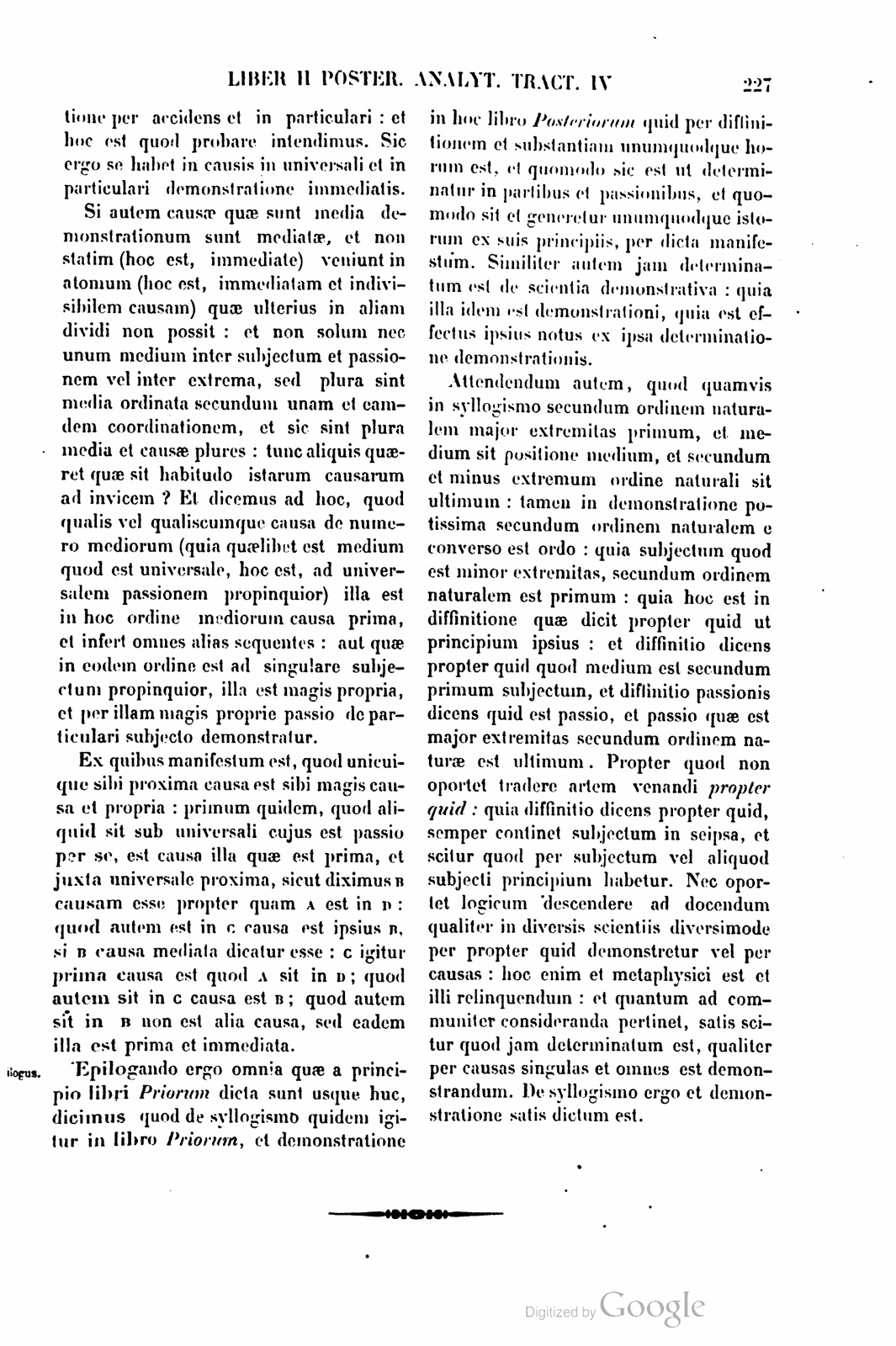
Si autem causae quae sunt media demonstrationum sunt mediatae, et non statim, hoc est, immediate, veniunt in atomum, hoc est, immediatam et indivisibilem causam, quae ulterius in aliam dividi non possit, et non solum nec unum medium inter subjectum et passionem vel inter extrema, sed plura sint media ordinata secundum unam et eamdem coordinationem, et sic sint plura media et causae plures, tunc aliquis quaeret quae sit habitudo istarum causarum ad invicem. Et dicemus ad hoc, quod qualis vel qualiscumque causa de numero mediorum, quia quaelibet est medium quod est universale, hoc est, ad universalem passionem propinquior, illa est in hoc ordine mediorum causa prima, et infert omnes alias sequentes; aut quae in eodem ordine est ad singulare subjectum propinquior, illa est magis propria, et per illam magis proprie passio de particulari subjecto demonstratur.
But if some quibbler were to say that what has been said is not true, namely that A belongs to each subject through one and proper cause, then let us ask him how it can be true that it is truly or really and properly said and demonstrated that A is in everything in which E is, that is, how through a proper cause it can be concluded universally of E, in which E is not D but is diverse in species from it. And a proper cause is taken from proper subjects, since E is not predicated of everything in which A is, because it is not predicated of B, to every instance of which A nevertheless belongs. Therefore there will be another cause saying why A is in all the things that are D. Therefore in such things one must consider whether those things that are D will be some one thing according to which the affection A is in them, which is the middle through which A is concluded of D. Let that be C, through which A is in E, and thus the cause why A is in D is B, and C is the cause why A is in E. But A is the same and one in species, as to flow leaves, or to be long-lived.
<marginal-label>How there are several causes of one effect.</marginal-label>
Thus, therefore, with the same thing in species, not in one most special species but in a common species, it happens in several particular subjects that there are several causes by particular demonstration, by which it is demonstrated to belong to diverse things; this does not happen in universal and most powerful demonstration. And this is what we said a little while ago, that demonstrations are increased, not through middles; for this is true of universal demonstration. Nevertheless it does not happen that there are several causes of an affection accepted according to the same most special species, because from that a cause diverse according to species cannot be taken.
But an example of this is in the terms had before, namely that this affection, to be long-lived, is demonstrated of quadrupeds and of birds as of subjects diverse in species. Of quadrupeds it is demonstrated through the cause which is not to have bile dissolving the complexion and consuming the natural and radical moisture. But of birds it is demonstrated through another cause, which is that winged animals are dry because of the generation of feathers, and have a moisture not easily putrescible, on account of the fact that moisture does not prevail in them. And so the same affection, which is to be long-lived, has one cause in quadrupeds and another in birds. Therefore the same thing, in the stated way, has several causes in demonstration through accident and in particular; and this is what we intend to prove. Thus, therefore, the matter stands with immediate causes in universal and in particular demonstration.
But if the causes which are the middles of demonstrations are mediate, and do not immediately, that is, straightaway, come to the atom, that is, to the immediate and indivisible cause which cannot further be divided into another, and if there is not only, nor one, middle between the subject and the affection or between the extremes, but there are several middles ordered according to one and the same coordination, and thus there are several middles and several causes, then someone will ask what the relation of those causes is to one another. And to this we will say that whatever sort of cause, or any cause whatever, from the number of middles, because each is a middle that is universal, that is, closer to the universal affection, that one in this order of middles is the first cause and brings in all the others following; or the one which in the same order is closer to the singular subject, that one is more proper, and through that one the affection is more properly demonstrated of the particular subject.
Ex quibus manifestum est, quod unicuique sibi proxima causa est sibi magis causa et propria. Primum quidem, quod aliquid sit sub universali cujus est passio per se, est causa illa quae est prima, et juxta universale proxima, sicut diximus B causam esse propter quam A est in D. Quod autem est in C causa est ipsius B, si B causa mediata dicatur esse; C igitur prima causa est quod A sit in D; quod autem sit in C causa est B; quod autem sit in B non est alia causa, sed eadem illa est prima et immediata.
<marginal-label>Epilogus.</marginal-label>
Epilogando ergo omnia quae a principio libri Priorum dicta sunt usque huc, dicimus quod de syllogismo quidem igitur in libro Priorum, et demonstratione in hoc libro Posteriorum quid per diffinitionem et substantiam unumquodque horum est, et quomodo sic est ut determinatur in partibus et passionibus, et quomodo sit et generetur unumquodque istorum ex suis principiis, per dicta manifestum. Similiter autem jam determinatum est de scientia demonstrativa, quia illa idem est demonstrationi, quia est effectus ipsius notus ex ipsa determinatione demonstrationis.
Attendendum autem, quod quamvis in syllogismo secundum ordinem naturalem major extremitas primum, et medium sit positione medium, et secundum et minus extremum ordine naturali sit ultimum, tamen in demonstratione potissima secundum ordinem naturalem e converso est ordo: quia subjectum quod est minor extremitas, secundum ordinem naturalem est primum, quia hoc est in diffinitione quae dicit propter quid ut principium ipsius; et diffinitio dicens propter quid quod medium est secundum primum subjectum, et diffinitio passionis dicens quid est passio, et passio quae est major extremitas secundum ordinem naturae est ultimum. Propter quod non oportet tradere artem venandi propter quid, quia diffinitio dicens propter quid semper continet subjectum in seipsa, et scitur quod per subjectum vel aliquod subjecti principium habetur. Nec oportet logicum descendere ad docendum qualiter in diversis scientiis diversimode per propter quid demonstretur vel per causas; hoc enim et metaphysici est et illi relinquendum. Et quantum ad communiter consideranda pertinet, satis scitur quod jam determinatum est, qualiter per causas singulas et omnes est demonstrandum. De syllogismo ergo et demonstratione satis dictum est.
From these things it is manifest that for each thing its proximate cause is more a cause for it and more proper to it. First indeed, that something is under the universal whose affection it is through itself, that cause is the first and proximate next to the universal, just as we said that B is the cause on account of which A is in D. But what is in C is the cause of B itself, if B is said to be a mediate cause; therefore C is the first cause that A is in D; but B is the cause that it is in C; and that it is in B has no other cause, but that same one is first and immediate.
<marginal-label>Epilogue.</marginal-label>
Therefore, by epiloguing all the things that have been said from the beginning of the book of the Prior Analytics up to here, we say that concerning syllogism indeed, in the book of the Prior Analytics, and concerning demonstration in this book of the Posterior Analytics, what each of these is through definition and substance, and how it is such as is determined in parts and affections, and how each of these exists and is generated from its principles, are manifest through what has been said. Likewise it has now been determined concerning demonstrative science, because that is the same as demonstration, since it is the effect of demonstration known from the very determination of demonstration.
But it must be attended to that, although in syllogism according to the natural order the major extreme is first, and the middle is in position the middle and second, and the lesser extreme according to the natural order is last, nevertheless in the most powerful demonstration according to the natural order the order is the converse, because the subject, which is the minor extreme, according to the natural order is first, since this is in the definition that says why, as its principle; and the definition saying why, which is the middle, is second according to the first subject; and the definition of the affection saying what the affection is, and the affection which is the major extreme, according to the order of nature is last. On account of this, it is not necessary to hand down an art of hunting the why, because the definition saying why always contains the subject in itself, and it is known that it is had through the subject or through some principle of the subject. Nor is it necessary for the logician to descend to teaching how, in diverse sciences, demonstration is made in diverse ways through the why or through causes; for this belongs to the metaphysician and must be left to him. And as far as the things to be considered commonly are concerned, it is sufficiently known by what has now been determined how demonstration must be made through each single cause and through all causes. Therefore enough has been said concerning syllogism and demonstration.
If a page does not appear, its photograph has not been uploaded yet.