Works › Posterior Analytics, Books I–II
Volume 2 · pp. 223–225
Chapter 8. On the determination of the question introduced.
A marker with ≈ is an approximate page boundary, placed by measure of the text; the page photographs remain the authority. In the paired views, clicking a page marker brings that page into view.
CAPUT VIII. De determinatione quaestionis inductae.
Hanc autem quaestionem determinare cupientes resumimus adhuc quaestionem ut melius intelligatur determinatio. Est igitur haec quaestio, utrum in demonstrativis contingat ejusdem effectus et unius non eamdem esse causam cum effectu convertibilem, sed alteram, aut hoc non contingat? Ad hoc autem dicimus, quod siquidem per se fiat demonstratio, ita scilicet quod passio per se demonstretur de subjecto per se et per causam per se, et fiat demonstratio secundum accidens, hoc est, per medium accidentale, quae est demonstratio vera et potissima, non potest esse quod idem habeat plures causas, et quod causa diffinite et determinate non sequatur ad effectum determinatum. Si vero non sic est demonstratio, sed per medium accidentale, vel signum, quae est demonstratio non potissima, tunc contingit in his quibus passio inest ut duobus primis subjectis, ut prae habitum est. Est autem in demonstrativis causam, et id cujus est causa sive effectum aliter considerare secundum accidens; hoc enim saepe contingit. Quamvis tale accidens intendatur ad ea quae proposita sunt, et pertinent essentialiter ad demonstrationem, et tunc aliquantulum aliter se habebit causa ad causatum, ita quod posito causato non diffinite ponitur causa. Si autem non sit secundum accidens, sed per se et per suam substantiam sit causa, tunc penitus similiter, hoc est, in habitudine una, se habebit medium ad extremum quod causatum est, ita quod sicut est unum, ita est alterum, hoc modo quod secundum eamdem ad invicem se habent habitudinem, ita quod siquidem aequivocum est medium quod causa est, et causatum erit aequivocum. Si vero medium est sicut in genere uno, cujus ratio una et univoca est, similiter se habebit effectus, ita quod unius generis et univocus est. Si autem medium est analogum secundum proportionem ad unum in multis generibus vel speciebus acceptum, tunc etiam effectus vel causa erit analogice in multis, sicut in passione quam dudum in terminis habitis posuimus, proportionale quod est commutabiliter, est in multis, scilicet in numeris et lineis et tempore et motu et ponderibus et multis aliis, et est in numeris primo, in aliis autem secundum proportionem ad numerum.
Si ergo quaeratur propter quid commutabiliter proportio est in istis, medium, quod est causa in haec quaestione per demonstrationem determinanda, est analogum commune omnibus istis secundum analogiam ad numerum. Alia enim causa in particulari accepta hujus demonstrationis est in numeris, et alia particulariter accepta in lineis, licet in communi proportio sit ad unum, in quantum est linea secundum se particulariter accepta, alia est causa et diversa. In quantum autem linea est quantitas per divisionem numeri suspiciens proportionale augmentum, sic secundum analogiam eadem causa est talis passionis et in numeris et in lineis, sicut et in omnibus aliis in quibus attenditur communicatio proportionis.
CHAPTER 8. On the determination of the question introduced.
But wishing to determine this question, we take up the question again so that the determination may be better understood. Therefore the question is this: whether, in demonstrative matters, it happens that of the same effect, and of one effect, there is not the same cause convertible with the effect, but another cause; or whether this does not happen. To this we say that if indeed demonstration is made through itself, namely in such a way that an affection through itself is demonstrated of a subject through itself and through a cause through itself, and the demonstration is made according to accident, that is, through an accidental middle, which is a true and most powerful demonstration, it cannot be that the same thing has several causes, and that the cause does not definitely and determinately follow upon the determinate effect. But if the demonstration is not so, but is through an accidental middle or sign, which is not the most powerful demonstration, then this happens in the things to which the affection belongs as to two first subjects, as was had before. But in demonstrative matters the cause, and that of which it is the cause, or the effect, can be considered otherwise according to accident; for this often happens. Although such an accident is directed to those things that have been proposed, and they pertain essentially to demonstration, still then the cause will be related somewhat otherwise to the caused, so that, when the caused has been posited, the cause is not definitely posited. But if it is not according to accident, but the cause is through itself and through its own substance, then the middle will be related to the extreme which is the caused entirely similarly, that is, in one relation, so that as the one is, so is the other, in this way: they are related to each other according to the same relation, so that if indeed the middle which is the cause is equivocal, the caused too will be equivocal. But if the middle is as in one genus, whose account is one and univocal, the effect will be related similarly, so that it is of one genus and univocal. But if the middle is analogous according to proportion to one thing, accepted in many genera or species, then also the effect or cause will be analogically in many, as in the affection that a little while ago we posited in the terms we had, the proportional which is commutably, is in many, namely in numbers and lines and time and motion and weights and many other things, and it is first in numbers, but in the others according to proportion to number.
Therefore, if it is asked why proportion exists commutably in these things, the middle, which is the cause in this question to be determined through demonstration, is the analogue common to all these according to analogy to number. For one cause of this demonstration, accepted in particular, is in numbers, and another, accepted particularly, is in lines, although in common there is proportion to one thing; insofar as a line is accepted particularly according to itself, the cause is another and diverse. But insofar as a line is a quantity, receiving proportional increase through division of number, in this way according to analogy the same cause of such an affection is in numbers and in lines, just as it is in all the other things in which communication of proportion is attended to.
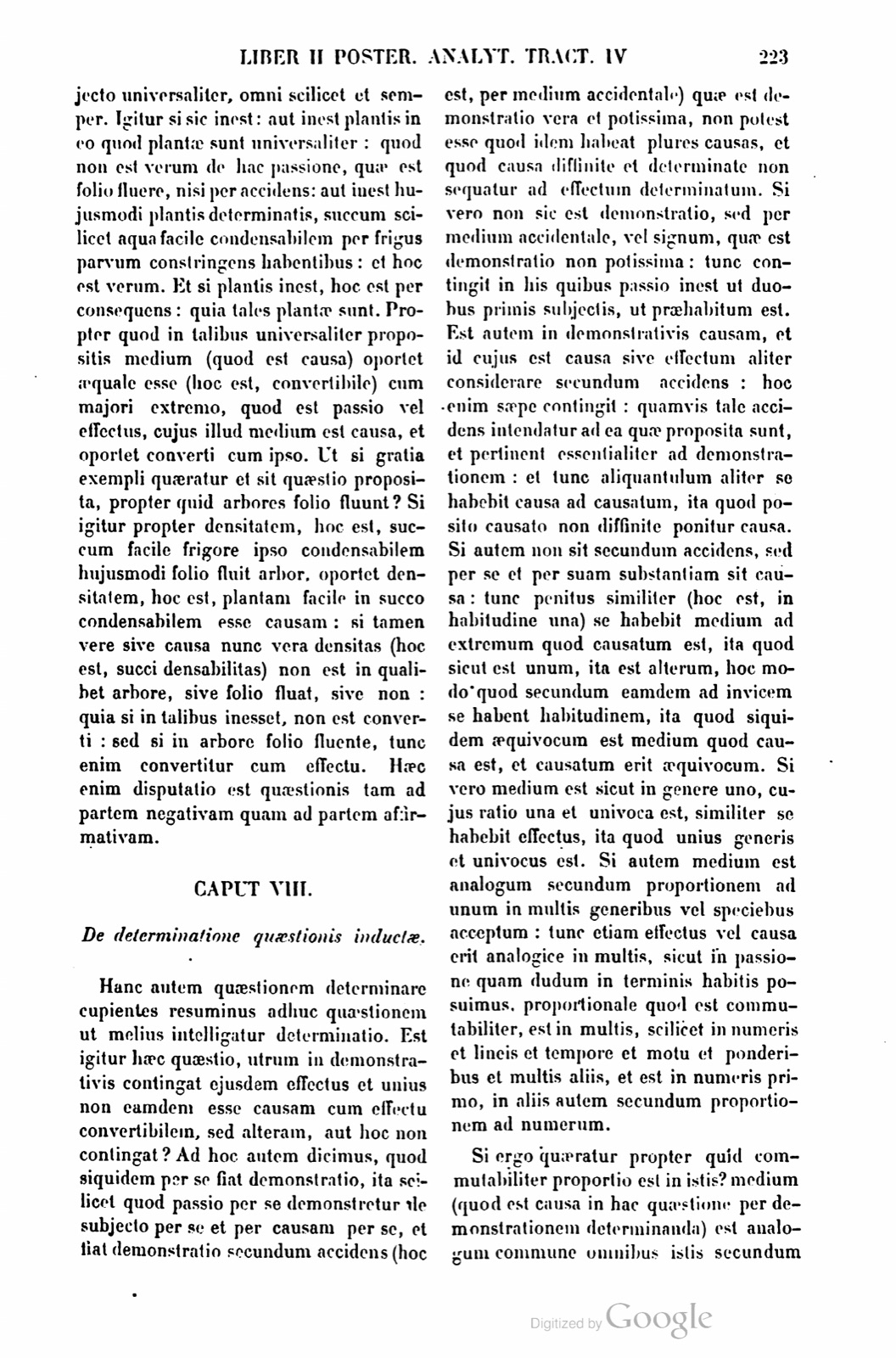
In aequivocis autem exemplum est, ut similem esse colorem colori et figuram figurae, aliam oportet ponere causam in similitudinibus in coloribus, et aliam in figuris, quia similitudo in figuris et similitudo in coloribus diversa sunt, non analogica, neque aequivoca; et ideo aliud et aliud medium oportet dare. Nec habebit hoc unum nomen non aequivoce; et quod illud medium est causa, ideo causa erit aequivoca. Similiter similitudo est aequivocum in omnibus diversis similitudinibus, et in diversis haec quidem similitudo quae est in figuris vel figuratis in quantum unius figurae sunt, et analoga, hoc est, secundum idem proportionata, habere latera, et habere aequales angulos, quia figurae similes sunt, latera et angulos habentes aequales secundum proportionem unius ad alterum. In coloribus autem simile vel similitudo est habere sensum unum formalem secundum unum et idem specie subjectum, aut aliud aliquod hujusmodi in una qualitate acceptum. Et ideo simile in coloribus et figuris est aequivocum, et quae passiones secundum analogiam eaedem sunt, plerumque illae etiam in demonstratione qua demonstrari debent de communi illorum subjecto, medium habebunt commune secundum analogiam. Haec autem omnia ideo dicta sunt, ut sciatur quae passio univoca vel analoga vel aequivoca de quo subjecto et per quam causam habeat demonstrari.
Et gratia hujus materiae dicimus, quod causa et causatum sic se habent secundum consecutionem ad invicem, et etiam subjectum in quo causa est et de quo per causam passio habet demonstrari. Haec autem habitudo talis est, quod accipiente aliquo unumquodque subjectum particulare cui inest passio et causa passionis, semper passio et causa passionis est in plus quam illud particulare subjectum. Sicut patet in hac passione, quod est interiores et exteriores quatuor angulos rectis aequales habere: est enim passio quadrati et quadranguli et trianguli; et ideo in plus est quam particulare subjectum quod est triangulo esse, aut quam in hoc particulari quod est esse in quadrangulo. Si autem accipiatur hoc in quo omnia haec sunt, tunc sunt in aequalibus, ita quod subjecto quod secundum ipsum illi passioni subjectum est, aequale est, et non est in plus unum quam alterum. Si enim hoc accipiatur cui secundum se inest passio, tunc essent aequalia, sicut si dicatur quod omnis figura in qua linea super lineam cadens, constituit angulos exteriores et interiores his subjectis et supra quatuor recta, aequales sunt, tunc illud subjectum et medium et passio similiter, hoc est, aequaliter est, quia convertibilia erunt. Cujus aequalitas causa est, quia medium dicens quid et propter quid, est ratio diffinitiva primi termini, hoc est, passionis quae in demonstratione secundum verum est primus et major terminus, quia non subjicitur, sed praedicatur tantum. Praedicatum autem est in ratione primi, et ideo convertitur cum passione; et cum subjectum sit causa dicens propter quid et in diffinitione dicente quid et propter quid, convertitur etiam haec cum subjecto universali quod secundum seipsum subjectum est. Et sic major extremitas et medium et subjectum in tali demonstratione, quae potissima est, convertitur. Ex tali enim medio quod est primi termini ratio, omnis scientiae conclusionum demonstrativarum fiunt in his demonstrationibus, quae perfectae et potissimae demonstrationes sunt.
But in equivocals there is an example, as being similar, color to color and figure to figure. One must posit one cause in similarities in colors, and another in figures, because similarity in figures and similarity in colors are diverse, not analogous, nor univocal; and therefore one and another middle must be given. Nor will this have one name non-equivocally; and because that middle is the cause, therefore the cause will be equivocal. Likewise similarity is an equivocal in all diverse similarities; and among diverse things, this similarity which is in figures or figured things, insofar as they are of one figure, and analogous, that is, proportioned according to the same thing, is to have sides and to have equal angles, because similar figures are those having sides and angles equal according to the proportion of one to the other. But in colors, similar or similarity is to have one formal sense according to one and the same subject in species, or some other thing of this sort accepted in one quality. And therefore the similar in colors and figures is equivocal; and those affections that are the same according to analogy, for the most part, also in the demonstration by which they ought to be demonstrated of their common subject, will have a common middle according to analogy. But all these things have been said for this reason, that it may be known which affection, univocal or analogous or equivocal, has to be demonstrated of which subject and through which cause.
And for the sake of this matter we say that cause and caused are related in this way according to consequence to each other, and so also is the subject in which the cause is and of which the affection has to be demonstrated through the cause. But this relation is such that, when someone accepts any particular subject to which the affection and the cause of the affection belong, the affection and the cause of the affection are always in more things than that particular subject. This is clear in this affection, namely to have the four interior and exterior angles equal to right angles; for it is an affection of square and quadrangle and triangle, and therefore it is in more things than the particular subject which is being a triangle, or than in this particular which is being in a quadrangle. But if that is accepted in which all these are, then they are in equals, so that what is equal is that subject which according to itself is subject to that affection, and one is not in more things than the other. For if that is accepted to which the affection belongs according to itself, then they would be equal, as if it is said that every figure in which a line falling upon a line constitutes exterior and interior angles equal to these subjects and above four right angles; then that subject and the middle and the affection are similarly, that is, equally, because they will be convertible. The cause of this equality is that the middle, saying what and why, is the definitive account of the first term, that is, of the affection which in demonstration according to truth is the first and major term, because it is not subjected but is only predicated. But the predicate is in the account of the first, and therefore it is converted with the affection; and since the subject is the cause saying why, and in the definition saying what and why, this too is converted with the universal subject which according to itself is the subject. And thus the major extreme and the middle and the subject in such a demonstration, which is the most powerful, are converted. For from such a middle, which is the account of the first term, all conclusions of demonstrative sciences are made in these demonstrations, which are perfect and most powerful demonstrations.
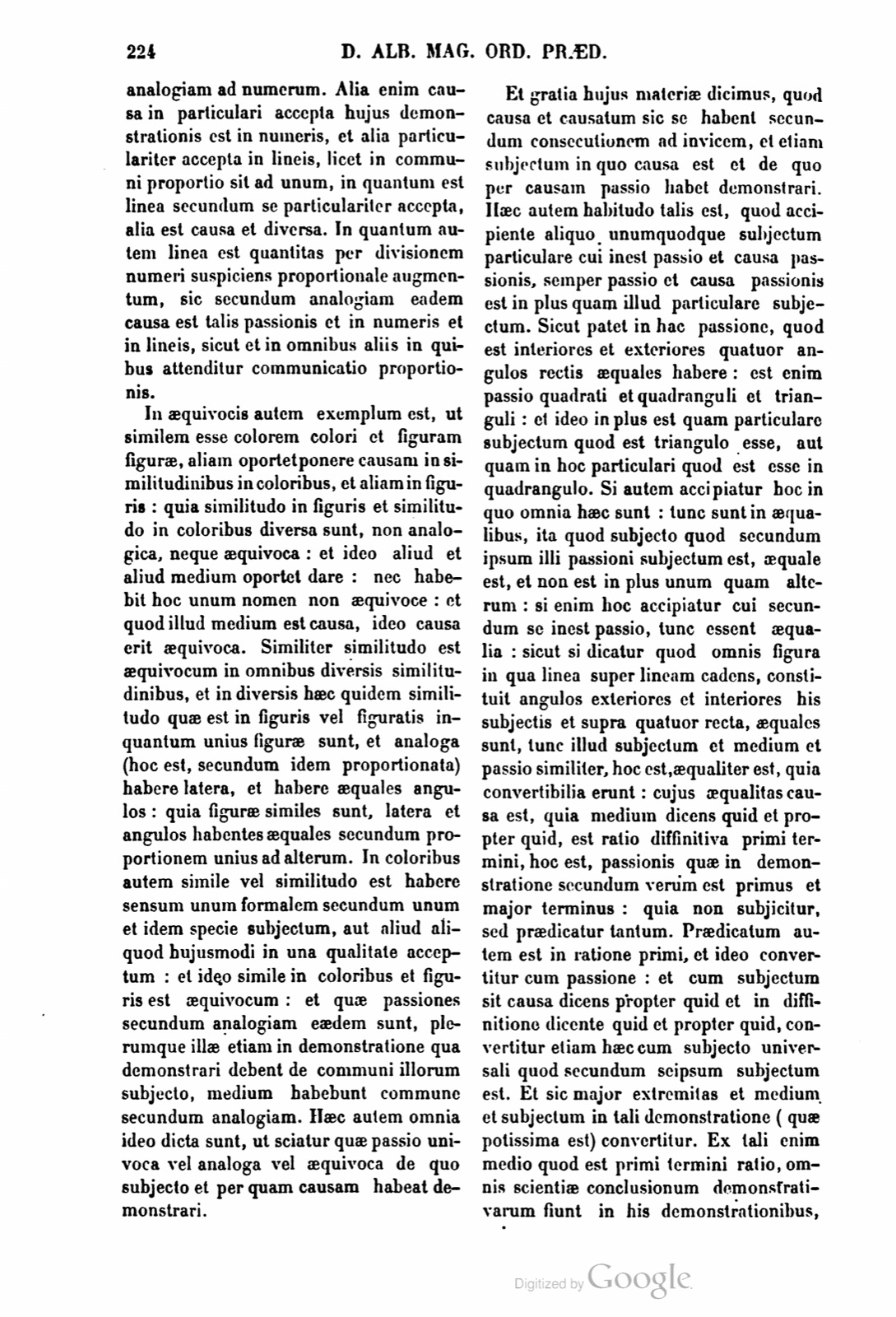
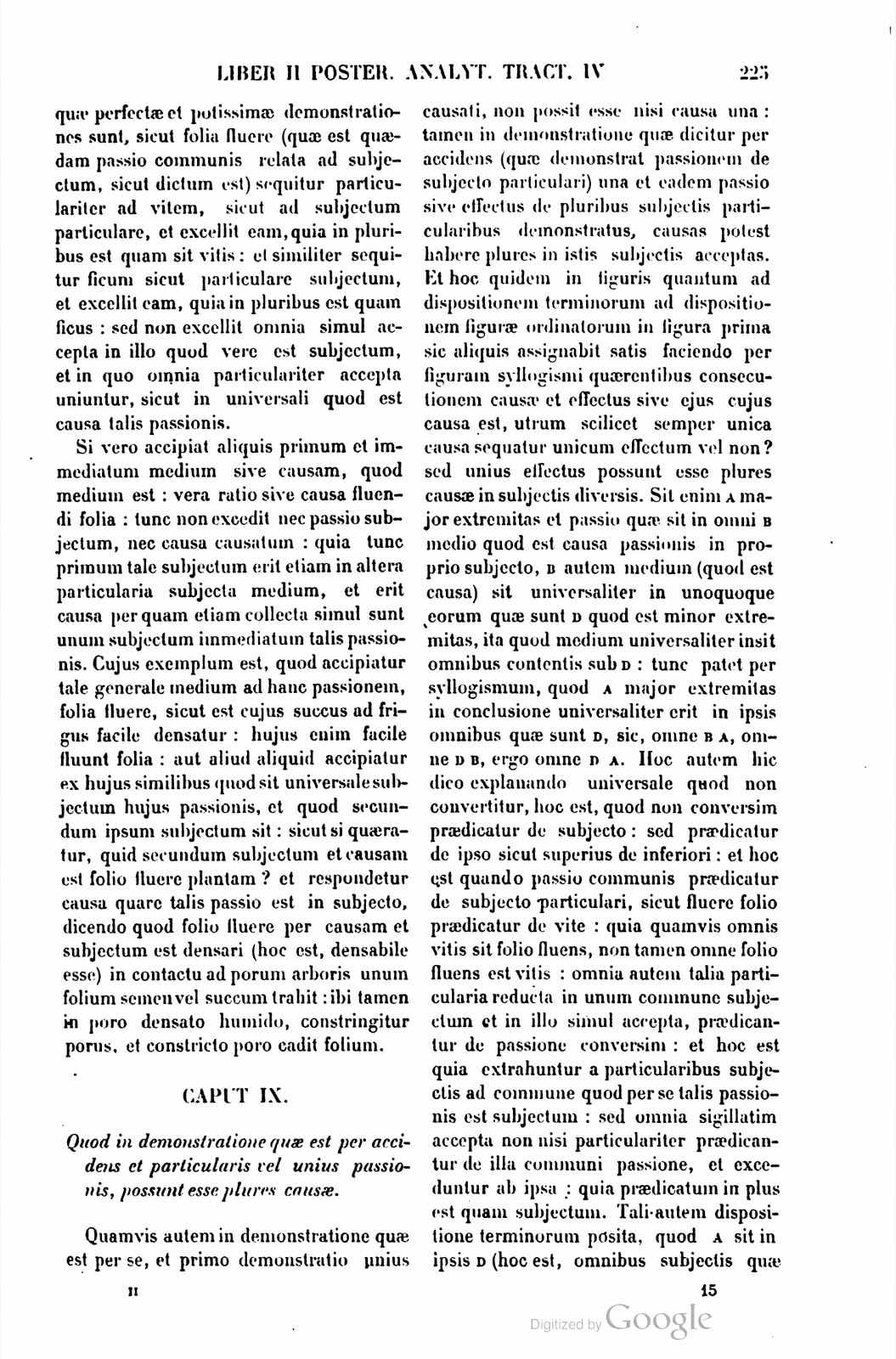
Sicut folia fluere, quae est quaedam passio communis relata ad subjectum, sicut dictum est, sequitur particulariter ad vitem, sicut ad subjectum particulare, et excellit eam, quia in pluribus est quam sit vitis; et similiter sequitur ficum sicut particulare subjectum, et excellit eam, quia in pluribus est quam ficus. Sed non excellit omnia simul accepta in illo quod vere est subjectum, et in quo omnia particulariter accepta uniuntur, sicut in universali quod est causa talis passionis.
Si vero accipiat aliquis primum et immediatum medium sive causam, quod medium est vera ratio sive causa fluendi folia, tunc non excedit nec passio subjectum, nec causa causatum, quia tunc primum tale subjectum erit etiam in altera particularia subjecta medium, et erit causa per quam etiam collecta simul sunt unum subjectum immediatum talis passionis. Cujus exemplum est, quod accipiatur tale generale medium ad hanc passionem, folia fluere, sicut est cujus succus ad frigus facile densatur. Hujus enim facile fluunt folia. Aut aliud aliquid accipiatur ex hujus similibus quod sit universale subjectum hujus passionis, et quod secundum ipsum subjectum sit, sicut si quaeratur, quid secundum subjectum et causam est folio fluere plantam? Et respondetur causa quare talis passio est in subjecto, dicendo quod folio fluere per causam et subjectum est densari, hoc est, densabile esse, in contactu ad porum arboris unum folium semen vel succum trahit. Ibi tamen in poro densato humido, constringitur porus, et constricto poro cadit folium.
For example, to flow leaves, which is a certain common affection related to a subject, as has been said, follows particularly upon vine as upon a particular subject, and exceeds it, because it is in more things than vine is; and similarly it follows upon fig as a particular subject, and exceeds it, because it is in more things than fig. But it does not exceed all the things taken together in that which is truly the subject, and in which all the things accepted particularly are united, as in the universal which is the cause of such an affection.
But if someone accepts the first and immediate middle or cause, which middle is the true account or cause of flowing leaves, then neither does the affection exceed the subject, nor the cause the caused, because then the first such subject will also be the middle in the other particular subjects, and it will be the cause through which the things gathered together are also one immediate subject of such an affection. An example of this is that such a general middle is accepted for this affection, to flow leaves, as that whose sap is easily thickened by cold. For the leaves of this flow easily. Or something else is accepted from things like this which is the universal subject of this affection, and which is according to that very subject. For example, if it is asked what, according to subject and cause, it is for a plant to flow leaves, the cause why such an affection is in the subject is answered by saying that to flow leaves, by cause and subject, is to be thickened, that is, to be capable of thickening, at contact with the pore of the tree where one leaf draws seed or sap. There, however, in the pore thickened by moisture, the pore is constricted, and when the pore has been constricted the leaf falls.
If a page does not appear, its photograph has not been uploaded yet.