Works › Posterior Analytics, Books I–II
Volume 2 · pp. 221–223
Chapter 7. A doubt about the relation of cause to caused, and conversely of caused to cause.
A marker with ≈ is an approximate page boundary, placed by measure of the text; the page photographs remain the authority. In the paired views, clicking a page marker brings that page into view.
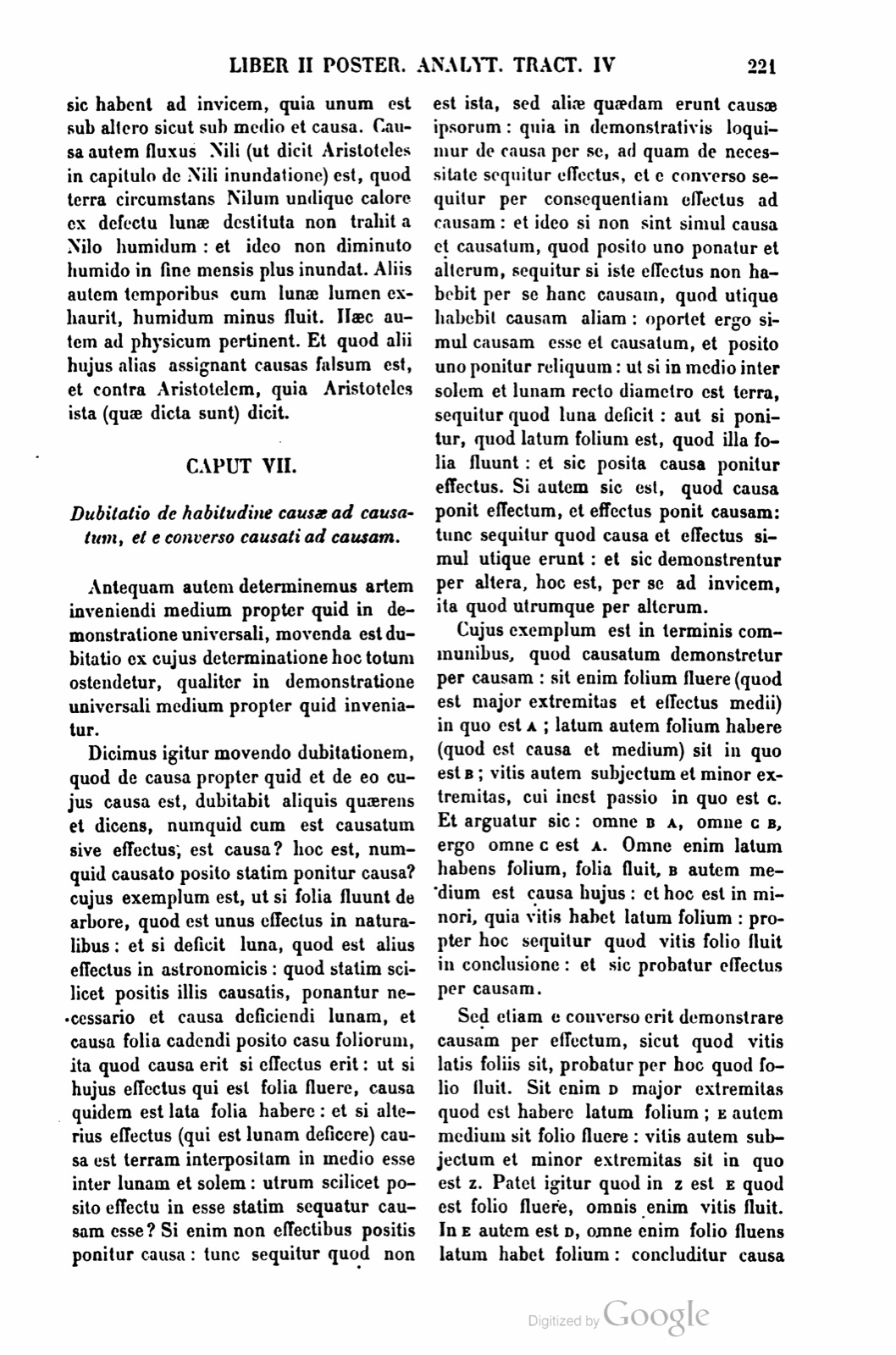
CAPUT VII. Dubitatio de habitudine causae ad causatum, et e converso causati ad causam.
Antequam autem determinemus artem inveniendi medium propter quid in demonstratione universali, movenda est dubitatio ex cujus determinatione hoc totum ostendetur, qualiter in demonstratione universali medium propter quid inveniatur.
Dicimus igitur movendo dubitationem, quod de causa propter quid et de eo cujus causa est, dubitabit aliquis quaerens et dicens, numquid cum est causatum sive effectus, est causa? hoc est, numquid causato posito statim ponitur causa? cujus exemplum est, ut si folia fluunt de arbore, quod est unus effectus in naturalibus; et si deficit luna, quod est alius effectus in astronomicis; quod statim scilicet positis illis causatis, ponantur necessario et causa deficiendi lunam, et causa folia cadendi posito casu foliorum, ita quod causa erit si effectus erit. Ut si hujus effectus qui est folia fluere, causa quidem est lata folia habere; et si alterius effectus, qui est lunam deficere, causa est terram interpositam in medio esse inter lunam et solem, utrum scilicet posito effectu in esse statim sequatur causam esse? Si enim non effectibus positis ponitur causa, tunc sequitur quod non est ista, sed aliae quaedam erunt causae ipsorum, quia in demonstrativis loquimur de causa per se, ad quam de necessitate sequitur effectus, et e converso sequitur per consequentiam effectus ad causam. Et ideo si non sint simul causa et causatum, quod posito uno ponatur et alterum, sequitur si iste effectus non habebit per se hanc causam, quod utique habebit causam aliam. Oportet ergo simul causam esse et causatum, et posito uno ponitur reliquum: ut si in medio inter solem et lunam recto diametro est terra, sequitur quod luna deficit; aut si ponitur, quod latum folium est, quod illa folia fluunt; et sic posita causa ponitur effectus. Si autem sic est, quod causa ponit effectum, et effectus ponit causam, tunc sequitur quod causa et effectus simul utique erunt; et sic demonstrentur per altera, hoc est, per se ad invicem, ita quod utrumque per alterum.
Cujus exemplum est in terminis communibus, quod causatum demonstretur per causam: sit enim folium fluere, quod est major extremitas et effectus medii, in quo est A; latum autem folium habere, quod est causa et medium, sit in quo est B; vitis autem subjectum et minor extremitas, cui inest passio, in quo est C. Et arguatur sic: omne B A; omne C B; ergo omne C est A. Omne enim latum habens folium, folia fluit; A autem medium est causa hujus; et hoc est in minori, quia vitis habet latum folium. Propter hoc sequitur quod vitis folio fluit in conclusione; et sic probatur effectus per causam.
Sed etiam e converso erit demonstrare causam per effectum, sicut quod vitis latis foliis sit, probatur per hoc quod folio fluit. Sit enim D major extremitas quod est habere latum folium; E autem medium sit folio fluere; vitis autem subjectum et minor extremitas sit in quo est Z. Patet igitur quod in Z est E quod est folio fluere: omnis enim vitis fluit. In E autem est D: omne enim folio fluens latum habet folium. Concluditur causa per effectum sic: omne quod fluit folio, latum habet folium; omnis vitis folio fluit; ergo omnis vitis latum habet folium. Causa autem consequentiae et non consequentis, quae est medium, est folio fluere.
CHAPTER 7. A doubt about the relation of cause to caused, and conversely of caused to cause.
But before we determine the art of finding the middle that gives the why in universal demonstration, a doubt must be raised; from the determination of it this whole matter will be shown, namely how, in universal demonstration, the middle that gives the why is found.
Therefore, in raising the doubt, we say that concerning the cause on account of which something is, and concerning that of which it is the cause, someone will be in doubt, asking and saying: when the caused thing or effect exists, is the cause present? that is, when the caused thing has been posited, is the cause immediately posited? An example of this is as follows: if leaves flow from a tree, which is one effect in natural things; and if the moon is eclipsed, which is another effect in astronomical things; namely, whether, when those caused things have immediately been posited, both the cause of the moon's being eclipsed and, once the fall of the leaves has been posited, the cause of the leaves' falling are necessarily posited, so that the cause will exist if the effect exists. For example, if the cause of this effect, which is leaves flowing, is to have broad leaves; and if the cause of the other effect, which is the moon being eclipsed, is that the earth is interposed in the middle between the moon and the sun, then, namely, once the effect has been posited in being, does it immediately follow that the cause exists? For if, when the effects have been posited, the cause is not posited, then it follows that this is not the cause, but certain other things will be the causes of them, because in demonstrative matters we speak of a cause through itself, upon which the effect follows of necessity, and conversely the effect follows by consequence upon the cause. And therefore if cause and caused are not simultaneous, so that, when one is posited, the other also is posited, then it follows, if this effect will not have this cause through itself, that it will certainly have another cause. Therefore the cause and the caused must be simultaneous, and when one is posited the remaining one is posited: as, if the earth is in the middle between the sun and the moon in a straight diameter, it follows that the moon is eclipsed; or if it is posited that a leaf is broad, that those leaves flow; and so, when the cause has been posited, the effect is posited. But if it is the case that the cause posits the effect, and the effect posits the cause, then it follows that the cause and effect will certainly be simultaneous; and thus they may be demonstrated through the other, that is, through themselves in relation to one another, so that each is demonstrated through the other.
An example of this is in common terms, that the caused thing is demonstrated through the cause. Let the flowing of leaves, which is the major extreme and the effect of the middle, be that in which A is; but let having a broad leaf, which is the cause and middle, be that in which B is; and let vine, the subject and minor extreme to which the affection belongs, be that in which C is. And let the argument be made in this way: every B is A; every C is B; therefore every C is A. For everything having a broad leaf flows its leaves; but A, the middle, is the cause of this; and this is in the minor, because the vine has a broad leaf. On account of this it follows in the conclusion that the vine flows its leaves; and in this way the effect is proved through the cause.
But conversely, too, there will be a demonstration of the cause through the effect, as that the vine is with broad leaves is proved through the fact that it flows its leaves. Let D, the major extreme, be having a broad leaf; but let E, the middle, be flowing leaves; and let vine, the subject and minor extreme, be that in which Z is. Therefore it is clear that E, which is to flow leaves, is in Z; for every vine flows. But D is in E; for everything that flows leaves has a broad leaf. The cause is concluded through the effect in this way: everything that flows leaves has a broad leaf; every vine flows leaves; therefore every vine has a broad leaf. But the cause of the consequence, and not of the consequent, which is the middle, is to flow leaves.
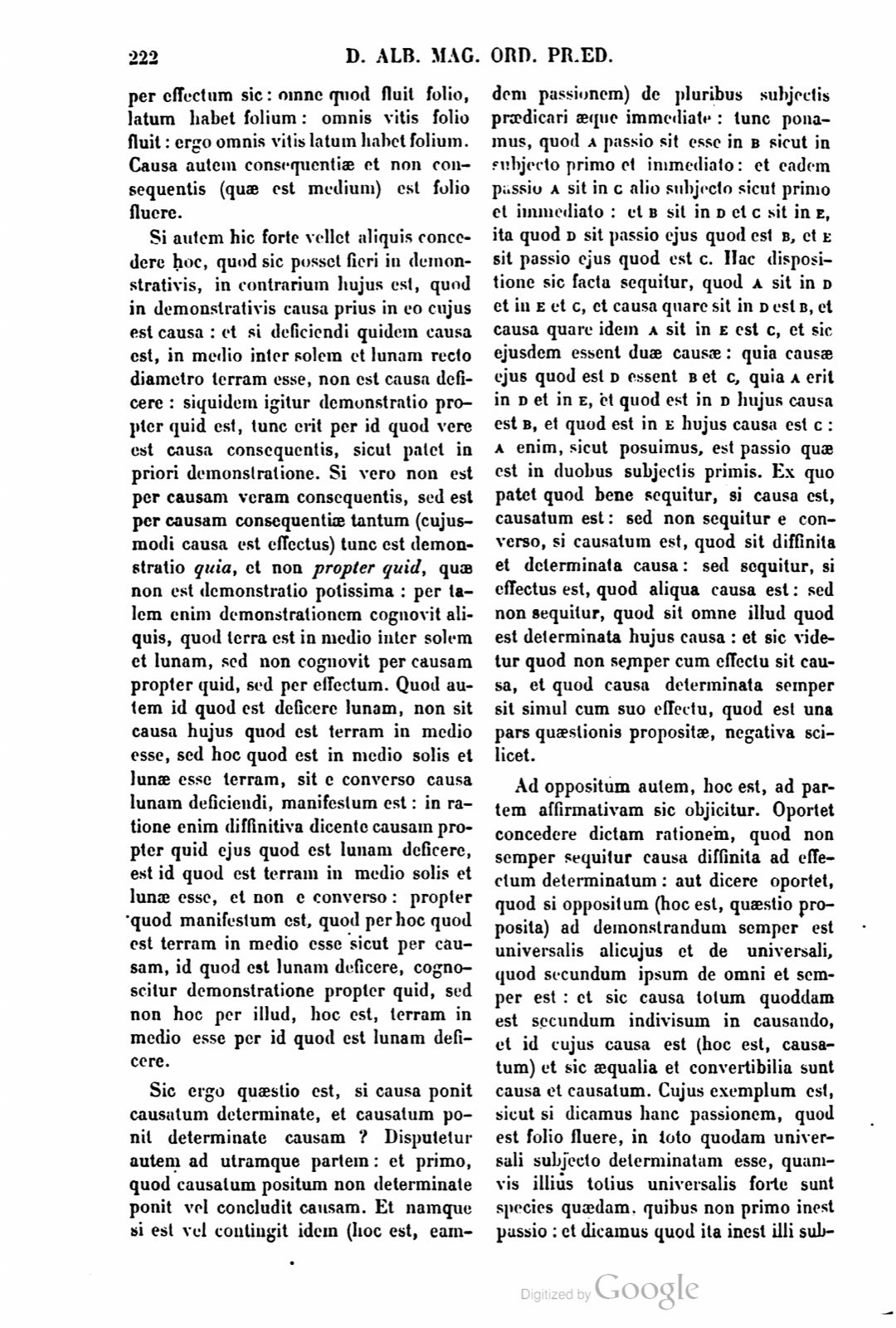
Si autem hic forte vellet aliquis concedere hoc, quod sic posset fieri in demonstrativis, in contrarium hujus est, quod in demonstrativis causa prius in eo cujus est causa; et si deficiendi quidem causa est, in medio inter solem et lunam recto diametro terram esse, non est causa deficere; siquidem igitur demonstratio propter quid est, tunc erit per id quod vere est causa consequentis, sicut patet in priori demonstratione. Si vero non est per causam veram consequentis, sed est per causam consequentiae tantum, cujusmodi causa est effectus, tunc est demonstratio quia, et non propter quid, quae non est demonstratio potissima. Per talem enim demonstrationem cognovit aliquis quod terra est in medio inter solem et lunam, sed non cognovit per causam propter quid, sed per effectum. Quod autem id quod est deficere lunam non sit causa hujus quod est terram in medio esse, sed hoc quod est in medio solis et lunae esse terram, sit e converso causa lunam deficiendi, manifestum est. In ratione enim diffinitiva dicente causam propter quid ejus quod est lunam deficere, est id quod est terram in medio solis et lunae esse, et non e converso. Propter quod manifestum est, quod per hoc quod est terram in medio esse sicut per causam, id quod est lunam deficere cognoscitur demonstratione propter quid, sed non hoc per illud, hoc est, terram in medio esse per id quod est lunam deficere.
Sic ergo quaestio est, si causa ponit causatum determinate, et causatum ponit determinate causam? Disputetur autem ad utramque partem, et primo, quod causatum positum non determinate ponit vel concludit causam. Et namque si est vel contingit idem, hoc est, eamdem passionem, de pluribus subjectis praedicari aeque immediate, tunc ponamus, quod A passio sit esse in B sicut in subjecto primo et immediato; et eadem passio A sit in C alio subjecto sicut primo et immediato; et B sit in D et C sit in E, ita quod D sit passio ejus quod est B, et E sit passio ejus quod est C. Hac dispositione sic facta sequitur quod A sit in D et in E et C, et causa quare sit in D est B, et causa quare idem A sit in E est C. Et sic ejusdem essent duae causae, quia causae ejus quod est D essent B et C, quia A erit in D et in E, et quod est in D hujus causa est B, et quod est in E hujus causa est C. A enim, sicut posuimus, est passio quae est in duobus subjectis primis. Ex quo patet quod bene sequitur, si causa est, causatum est; sed non sequitur e converso, si causatum est, quod sit diffinita et determinata causa, sed sequitur, si effectus est, quod aliqua causa est. Sed non sequitur, quod sit omne illud quod est determinata hujus causa; et sic videtur quod non semper cum effectu sit causa, et quod causa determinata semper sit simul cum suo effectu, quod est una pars quaestionis propositae, negativa scilicet.
But if perhaps someone here wished to concede this, that in demonstrative matters it could happen in this way, against this is the fact that in demonstrative matters the cause is prior in that of which it is the cause; and if indeed the cause of being eclipsed is that the earth is in the middle between the sun and the moon in a straight diameter, then to be eclipsed is not the cause. If, therefore, the demonstration is a demonstration why, then it will be through that which is truly the cause of the consequent, as is clear in the former demonstration. But if it is not through the true cause of the consequent, but only through the cause of the consequence, of which sort of cause the effect is, then it is a demonstration that, and not why, and it is not the most powerful demonstration. For through such a demonstration someone has known that the earth is in the middle between the sun and the moon, but he has not known it through the cause why, but through the effect. But that the thing which is the moon's being eclipsed is not the cause of this, namely that the earth is in the middle, but conversely that this, namely that the earth is in the middle of the sun and moon, is the cause of the moon being eclipsed, is manifest. For in the definitive account that states the cause why of that which is the moon being eclipsed, there is this, that the earth is in the middle of the sun and moon, and not conversely. On account of this it is manifest that through the fact that the earth is in the middle, as through a cause, that which is the moon being eclipsed is known by a demonstration why, but not this through that, that is, not that the earth is in the middle through the fact that the moon is eclipsed.
Thus, therefore, the question is whether the cause posits the caused determinately, and whether the caused posits the cause determinately. But let the dispute proceed to each side; and first, that the caused thing, once posited, does not determinately posit or conclude the cause. For indeed, if the same thing exists or happens, that is, the same affection, to be predicated equally immediately of several subjects, then let us posit that A, the affection, is in B as in a first and immediate subject; and that the same affection A is in C, another subject, as in a first and immediate subject; and that B is in D and C is in E, so that D is the affection of that which is B, and E is the affection of that which is C. When this disposition has been made in this way, it follows that A is in D and in E and C, and the cause why it is in D is B, and the cause why the same A is in E is C. And in this way there would be two causes of the same thing, because the causes of that which is D would be B and C, because A will be in D and in E, and B is the cause of what is in D, and C is the cause of what is in E. For A, as we have posited, is the affection which is in two first subjects. From this it is clear that this follows well: if the cause exists, the caused thing exists; but it does not follow conversely, if the caused thing exists, that there is a defined and determinate cause, but it follows, if the effect exists, that some cause exists. But it does not follow that it is all that which is the determinate cause of this; and so it seems that the cause is not always present with the effect, and that the determinate cause is always simultaneous with its effect. This is one side of the proposed question, namely the negative side.
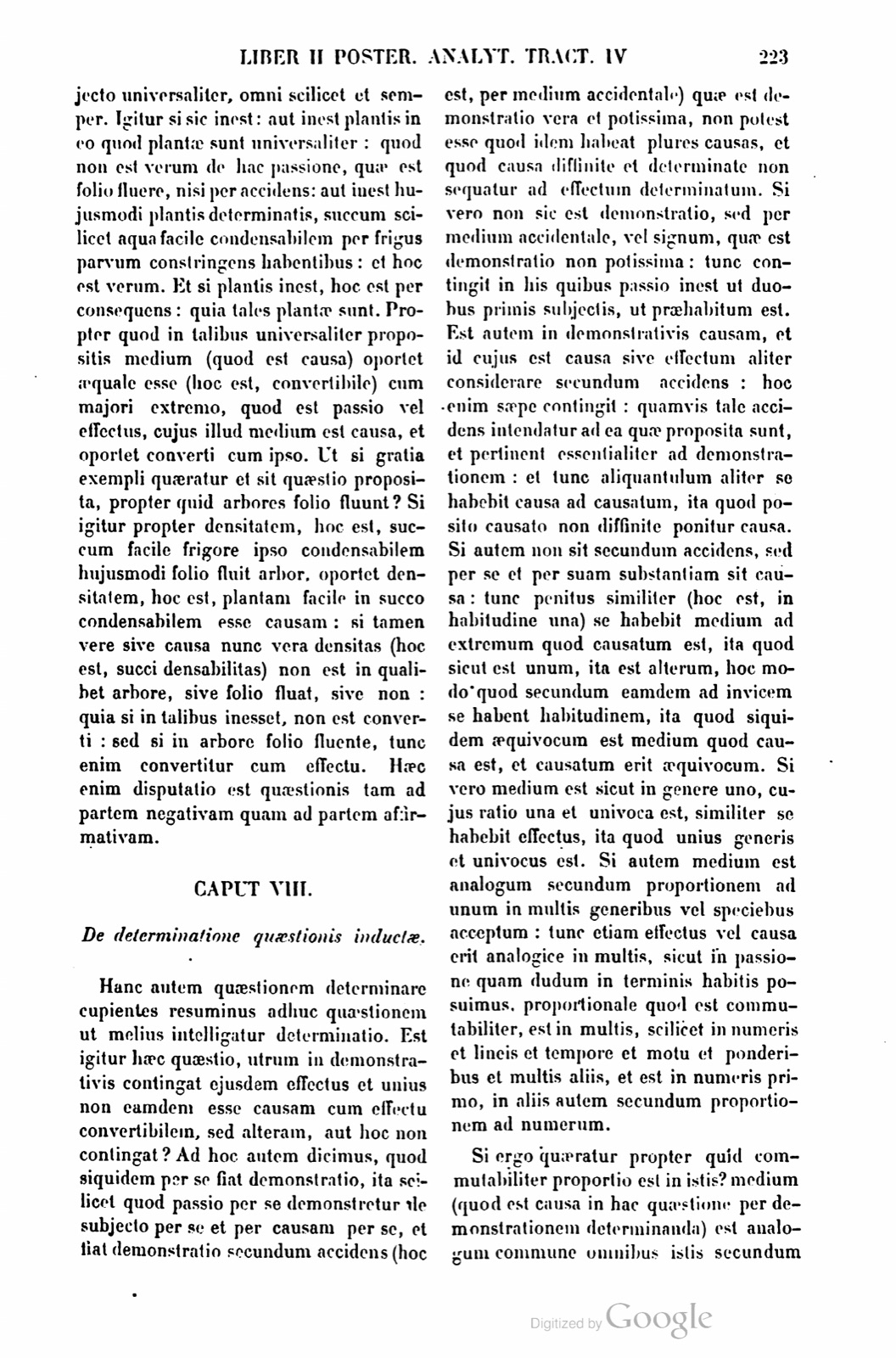
Ad oppositum autem, hoc est, ad partem affirmativam sic objicitur. Oportet concedere dictam rationem, quod non semper sequitur causa diffinita ad effectum determinatum; aut dicere oportet, quod si oppositum, hoc est, quaestio proposita, ad demonstrandum semper est universalis alicujus et de universali, quod secundum ipsum de omni et semper est, et sic causa totum quoddam est secundum indivisum in causando, et id cujus causa est, hoc est, causatum, et sic aequalia et convertibilia sunt causa et causatum. Cujus exemplum est, sicut si dicamus hanc passionem, quod est folio fluere, in toto quodam universali subjecto determinatam esse, quamvis illius totius universalis forte sunt species quaedam, quibus non primo inest passio, et dicamus quod ita inest illi subjecto universaliter, omni scilicet et semper. Igitur si sic inest: aut inest plantis in eo quod plantae sunt universaliter, quod non est verum de hac passione, quae est folio fluere, nisi per accidens; aut inest hujusmodi plantis determinatis, succum scilicet aqua facile condensabilem per frigus parvum constringens habentibus, et hoc est verum. Et si plantis inest, hoc est per consequens, quia tales plantae sunt. Propter quod in talibus universaliter propositis medium, quod est causa, oportet aequale esse, hoc est, convertibile, cum majori extremo, quod est passio vel effectus, cujus illud medium est causa, et oportet converti cum ipso. Ut si gratia exempli quaeratur et sit quaestio proposita, propter quid arbores folio fluunt? Si igitur propter densitatem, hoc est, succum facile frigore ipso condensabilem, hujusmodi folio fluit arbor, oportet densitatem, hoc est, plantam facile in succo condensabilem esse causam. Si tamen vere sive causa nunc vera densitas, hoc est, succi densabilitas, non est in qualibet arbore, sive folio fluat, sive non, quia si in talibus inesset, non est converti; sed si in arbore folio fluente, tunc enim convertitur cum effectu. Haec enim disputatio est quaestionis tam ad partem negativam quam ad partem affirmativam.
But to the opposite, that is, to the affirmative side, the objection is made in this way. One must concede the stated argument, that a defined cause does not always follow upon a determinate effect; or one must say that if the opposite, that is, the proposed question, is always for demonstration of some universal and concerning a universal, which according to itself is of every case and always, then the cause is a certain whole according to what is undivided in causing, and so is that of which it is the cause, that is, the caused thing; and thus cause and caused are equal and convertible. An example of this is as if we say that this affection, which is to flow leaves, is determined in a certain whole universal subject, although perhaps there are certain species of that whole universal to which the affection does not belong first, and we say that it belongs to that subject universally, namely to every instance and always. Therefore if it belongs in this way, either it belongs to plants insofar as they are plants universally, which is not true of this affection, which is to flow leaves, except by accident; or it belongs to determined plants of this sort, namely those having sap easily condensable by water and constricting through a small cold, and this is true. And if it belongs to plants, this is through consequence, because they are such plants. On account of this, in such things proposed universally, the middle, which is the cause, must be equal, that is, convertible, with the major extreme, which is the affection or effect of which that middle is the cause, and must be converted with it. For example, if it is asked and there is the proposed question, why do trees flow leaves? If, therefore, because of density, that is, because of sap easily condensable by cold itself, a tree of this sort flows leaves, then density, that is, the plant easily condensable in sap, must be the cause. If, however, true density, or the cause now truly, that is, condensability of sap, is not in every tree, whether it flows leaves or not, because if it were present in such things, it is not convertible; but if it is in a tree flowing leaves, then it is converted with the effect. For this is the dispute of the question both toward the negative side and toward the affirmative side.
If a page does not appear, its photograph has not been uploaded yet.