Works › Posterior Analytics, Books I–II
Volume 2 · pp. 218–221
Chapter 6. On finding the why, or the cause, in particular demonstration.
A marker with ≈ is an approximate page boundary, placed by measure of the text; the page photographs remain the authority. In the paired views, clicking a page marker brings that page into view.
CAPUT VI. De inventione propter quid sive causae in demonstratione particulari.
Ut autem habeamus proposita, hoc est, causam in qualibet quaestione demonstrabili nobis exposita, sive facta nobis, propter quid haec passio insit subjecto, vel propter quid non insit, eligere oportet, hoc est, electione unam divisionem utilem alteri in unum praeoptare: quia, sicut diximus, non omnes divisiones ad hoc sunt utiles; oportet ergo eligere decisiones utiles ab inutilibus.
<marginal-label>Quare dixit decisiones et divisiones.</marginal-label>
Decisiones autem dico totius integri divisiones, in quibus aliquando per partem aliud demonstrat inesse toti, ut crispitudo demonstratur inesse homini propter caput quod crispum est. Divisionem autem voco quae fit divisione totius universalis in partes suas subjectivas. Sic ergo oportet primo eligere divisiones et decisiones utiles ab inutilibus, si veram causam in quaestionibus propositis volumus invenire. Si autem electis decisionibus et divisionibus, in quas dividitur propositum genus vel propositum totum, oportet eligere genus subjectum, quod subjectum communiter est omnibus dividentibus quae per divisionem electa sunt, quod est commune omnium illorum, et illud invenire. Ut si quaedam sunt quae considerantur per divisionem animalia, hoc est, species animalium, quarum nulla est subalterna, sed ex aequo dividunt genus, oportet et eligere talia qualia essentialia et per se insunt omni animali, hoc est, animali universali universaliter considerato. De illis enim consideratio est utilis, quia quaecumque participant aliquod genus commune, participant omnia consequentia illius generis per illam communem naturam generis, et illa communis natura generis erit causa participandi consequentia ad illam naturam. Unde si animalia sunt quae considerantur per divisionem accepta et proposita, accipiendum est animal quod est genus commune omnibus istis, et considerandum qualia insunt animali secundum quod est animal, hoc est, tales passiones eligendae sunt, et causae quae sequuntur essentialia animalis in eo quod est animal, et non in eo quod est hoc animal vel illud in specie consideratum vel individuo. Acceptis autem his per electionem, tunc postea considerandum est de reliquis quae sub animali per divisionem sunt accepta, et considerandum qualia illi etiam inhaereant, quod ut species vel genus proximum sub animali communi acceptum est. Ut si, gratia exempli, acceptum sub animali est avis, considerandum est qualia, hoc est, quales passiones et passionum causae, omni avi inhaereant, et non huic vel illi tantum. Et sic semper descendendo a communi ad proximum sub illo, considerandum est et videndum est quid sequatur ad illud in communi acceptum. Sic enim manifestum est et hoc erit, quoniam habebimus jam dicere causam per se propter quid insunt esse quae speciebus animalis per divisionem dicuntur inesse ut passiones, quae passiones sunt reductae sub commune quod est animal. Ut, verbi gratia, habebimus dicere causas vel causam propter quid haec quae inhaerent homini, insunt aut equo; insunt enim his propter hoc quod animalia sunt. Quorumcumque enim est una natura communis, istis insunt omnia quae sunt consequentia ad illam naturam.
CHAPTER 6. On finding the why, or the cause, in particular demonstration.
Now in order that we may have the things proposed, that is, the cause in any demonstrable question set forth to us, or made for us, why this affection belongs to a subject, or why it does not belong, one must choose, that is, by election prefer one useful division to another as one division; because, as we have said, not all divisions are useful for this. Therefore one must choose useful divisions from useless ones.
<marginal-label>Why he said decisions and divisions.</marginal-label>
But by decisions I mean divisions of an integral whole, in which sometimes through a part it demonstrates that something else belongs to the whole, as curliness is demonstrated to belong to a man on account of the head which is curly. But I call a division that which is made by division of a universal whole into its subjective parts. Thus, therefore, one must first choose useful divisions and decisions from useless ones, if we wish to find the true cause in the proposed questions. But when the decisions and divisions have been chosen, into which the proposed genus or proposed whole is divided, one must choose the subject genus, which is commonly subject to all the dividers that have been chosen through division, which is common to all of them, and find that. For example, if there are certain things which are considered through division as animals, that is, species of animals, none of which is subordinate, but which divide the genus equally, one must also choose such things as are essential and belong through themselves to every animal, that is, to the universal animal universally considered. For consideration concerning these is useful, because whatever things participate in some common genus participate in all the things consequent upon that genus through that common nature of the genus, and that common nature of the genus will be the cause of participating in the things consequent upon that nature. Hence, if animals are the things considered, accepted, and proposed through division, animal must be accepted as the genus common to all those, and one must consider what sorts of things belong to animal according as it is animal, that is, such affections must be chosen, and the causes that follow the essentials of animal in that it is animal, and not in that it is this animal or that animal considered in species or individual. But when these have been accepted by election, then afterwards one must consider the remaining things that have been accepted under animal by division, and consider what sorts of things also inhere in that which is accepted as a species or proximate genus under common animal. For example, if bird has been accepted under animal, one must consider what sorts of things, that is, what sorts of affections and causes of affections, inhere in every bird, and not only in this bird or that bird. And so, always by descending from the common to the proximate thing under it, one must consider and see what follows upon that thing accepted in common. For in this way this too is manifest, since we will now have how to state the cause through itself why the things are present which are said to belong as affections to the species of animal through division, affections which are reduced under the common which is animal. Thus, for example, we will have how to state the causes, or the cause, why these things that inhere in man are present also in horse; for they are present in them because they are animals. For in whatever things there is one common nature, in those are present all things that are consequent upon that nature.
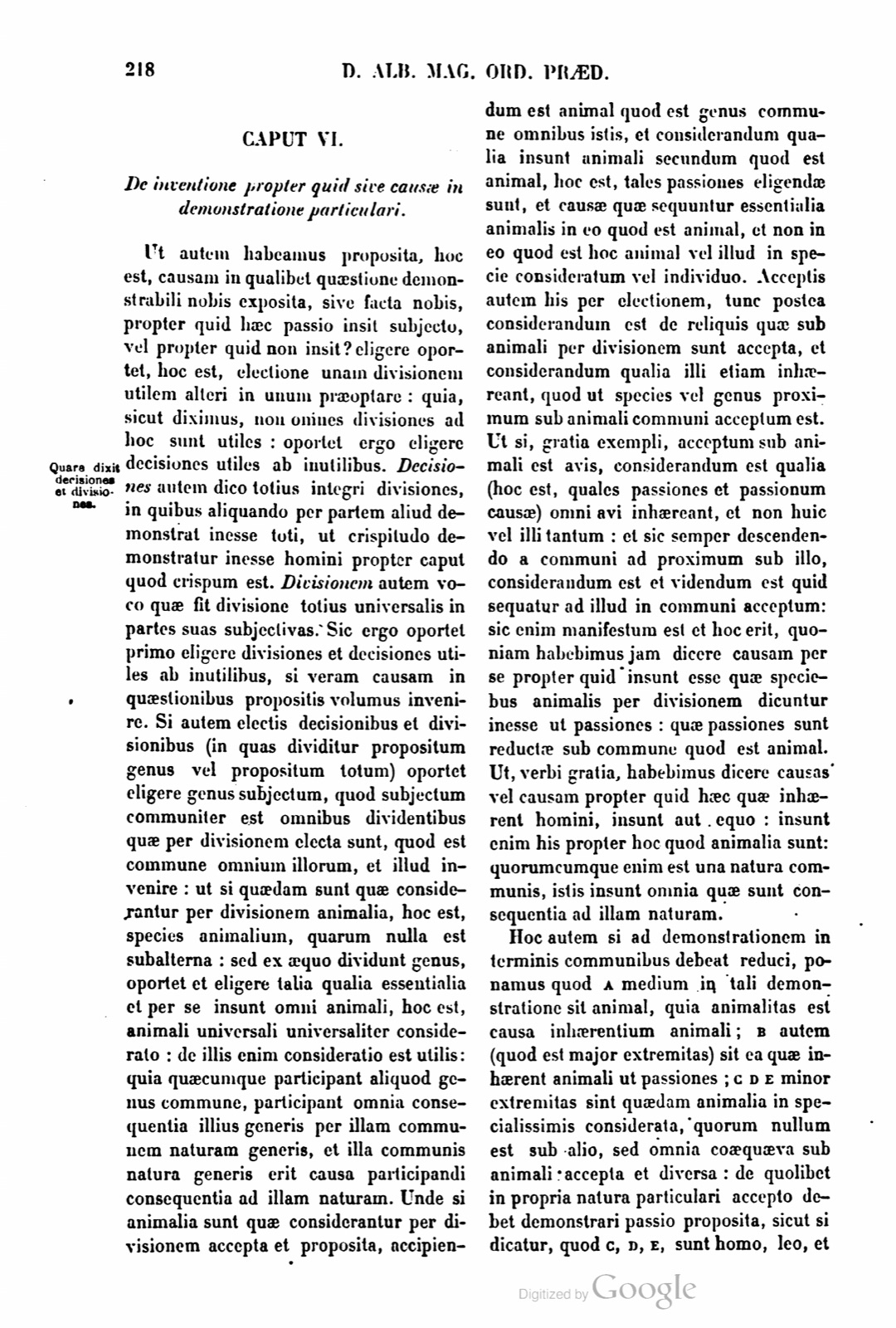
Hoc autem si ad demonstrationem in terminis communibus debeat reduci, ponamus quod A medium in tali demonstratione sit animal, quia animalitas est causa inhaerentium animali; B autem, quod est major extremitas, sit ea quae inhaerent animali ut passiones; C D E minor extremitas sint quaedam animalia in specialissimis considerata, quorum nullum est sub alio, sed omnia coaequaeva sub animali accepta et diversa. De quolibet in propria natura particulari accepto debet demonstrari passio proposita, sicut si dicatur quod C, D, E, sunt homo, leo, et equus. Manifestum igitur, tali dispositione terminorum facta, propter quid ut causam est B passio in D, hoc est, in leone, quia propter hoc quod D est A. Similiter autem manifestum est propter quid idem B est in aliis, scilicet C et E quae sunt homo et equus; cuilibet enim illorum inest propter A. Sic enim syllogizatur: omne A est B; omne C A; ergo omne C B. In terminis autem specialibus: omne animal sensibile; omnis homo animal; ergo omnis homo sensibilis. Et est demonstratio particularis, quia id de quo probatur passio, in particulari et propria natura est consideratum; talis enim, ut dudum determinatum est, vocatur particularis demonstratio. Similiter autem considerandum est in aliis communibus sub illo communi primo acceptis, et semper in aliis subdivisis communibus acceptis deorsum a communi praedescendendo, quia in illis omnibus est eadem ratio quoad hoc, quod acceptis inferioribus et considerato quod cuilibet inest et non tantum uni, hoc enim commune sequitur ad ipsam rationem proximae communis naturae quae est in eis.
Nunc quidem igitur in hac arte inveniendi causam dicemus communia nomina generum, et per illam naturam generis omnibus communem talibus insunt eis; et quamvis de communi hoc dicamus, tamen oportet non solum considerare communia secundum naturam, sed etiam considerare in ea quae sunt communia ex accidente naturali, quia in illis hoc commune et naturale accidens erit causa quare insit passio, quae sub illo communi sunt accepta. Unde considerare etiam oportet si aliud aliquod commune accipiatur secundum accidens commune pluribus: tunc enim oportet considerare in suis partibus, scilicet specialibus sub illo communi proximo acceptis. Hoc enim inerit eis secundum illud commune accidens. Unde oportet accipere qualia sunt illa quae hic per divisionem accepta sub communi sequantur omnia communiter; haec enim omnia ab illo accidente communi causantur.
Exemplum, sicut si sub animali accipiamus cornua habentia sive cornuta: omne enim cornutum, animal; sed non convertitur. Omne autem cornutum sequitur habere plures ventres, et sequitur non in utraque mandibula, superiori scilicet et inferiori, dentes anteriores esse qui incisores vocantur. Et haec reducenda sunt in proximum commune, quod est cornua habere sive cornutum esse, quia illa omnia sequitur habere plures ventres et dentes incisores in mandibula superiori non habere. Sic enim manifestum est propter quid hoc quod dicitur, quod est passio talis, est in illis quae per divisionem sub illis accepta sunt, sicut in ariete, bove, et cervo, et hirco, et hujusmodi, syllogizando sicut prius. Propter idem enim quod est in particularibus omnibus, sicut propter habere cornua sive cornuta esse, inest eis talis passio qualis est plures ventres habere, et carere anterioribus dentibus in superiori mandibula. Propter quam autem naturam particularem hoc sit in hoc et illo animali, ad scientiam libri Animalium pertinet subtiliter probare. Sed in communi duos ventres habent animalia dentibus carentia, quibus, ut durus cibus conteri possit ad minima, his natura dedit ventrem unum in quo cibus non sufficienter divisus trajiciatur et mollificetur, a quo primo quum mollificatus est, revocetur, quibus talibus dentibus existentibus mollis cibus conteratur, et tunc in secundum ventrem, qui est stomachus, trajiciatur ad dirigendum. Debilium autem dentium in superiori mandibula et aliquando deficientium est ut frequenter causa evaporatio materiae terrestris, ex qua dentes generari deberent et fortificari, in cornua. Haec tamen ad scientiam libri Animalium pertinent, et hic gratia exempli inducti sunt ponenda. Sic igitur per commune accidens particularibus demonstrantur inesse passiones illius communis.
But if this must be reduced to demonstration in common terms, let us posit that A, the middle in such a demonstration, is animal, because animality is the cause of things inhering in animal; but let B, which is the major extreme, be the things that inhere in animal as affections; let C, D, and E, the minor extreme, be certain animals considered in the most special species, of which none is under another, but all are accepted as coordinate and diverse under animal. The proposed affection must be demonstrated of any one whatever accepted in its proper and particular nature, as if it be said that C, D, and E are man, lion, and horse. Therefore, once such a disposition of the terms has been made, it is manifest why, as to the cause, B, the affection, is in D, that is, in lion: because this is on account of the fact that D is A. Likewise it is manifest why the same B is in the others, namely C and E, which are man and horse; for it is present in each of them on account of A. For the syllogism is made in this way: every A is B; every C is A; therefore every C is B. But in special terms: every animal is sensible; every man is an animal; therefore every man is sensible. And it is a particular demonstration, because that of which the affection is proved is considered in a particular and proper nature; for such a demonstration, as was determined a little while ago, is called a particular demonstration. Likewise one must consider in the other common things accepted under that first common thing, and always in other subdivided common things accepted by descending downward from the common, because in all those there is the same account with regard to this: once the lower things have been accepted and it has been considered what belongs to each and not only to one, this common thing follows upon the very account of the proximate common nature which is in them.
Now, therefore, in this art of finding the cause we will state the common names of genera, and through that nature of the genus common to all, such things belong to them; and although we speak about this common thing, nevertheless one must not only consider common things according to nature, but also consider in it those things that are common from a natural accident, because in those that common and natural accident will be the cause why an affection belongs to the things that have been accepted under that common thing. Hence one must also consider whether some other common thing is accepted according to an accident common to many; for then one must consider in its parts, namely the special parts accepted under that proximate common thing. For this will be in them according to that common accident. Hence one must accept what sorts of things all the things accepted here by division under the common follow commonly; for all these things are caused by that common accident.
An example is this: if under animal we accept things having horns, or horned things. For every horned thing is an animal, but it is not converted. But every horned thing follows upon having several stomachs, and it follows upon there not being front teeth, which are called incisors, in both jaws, namely the upper and the lower. And these things must be reduced to the proximate common thing, which is to have horns or to be horned, because all those things follow upon having several stomachs and not having incisor teeth in the upper jaw. For in this way it is manifest why that which is said, namely that it is such an affection, is in those things that have been accepted by division under those things, as in the ram, ox, stag, goat, and things of this sort, syllogizing as before. For on account of the same thing which is in all the particulars, as on account of having horns or being horned, such an affection belongs to them as having several stomachs and lacking front teeth in the upper jaw. But through what particular nature this is so in this and that animal pertains to the science of the book On Animals to prove subtly. But in common, animals lacking teeth have two stomachs; in order that hard food can be ground down to very small parts, nature has given to these one stomach into which food not sufficiently divided is passed over and softened; from that first stomach, when it has been softened, it is recalled, so that, when such teeth exist, soft food may be ground, and then it may be passed over into the second stomach, which is the stomach, for digestion. But the cause of weak teeth in the upper jaw, and sometimes of teeth that are absent, is most often the evaporation of earthy matter, from which teeth ought to be generated and strengthened, into horns. These things, however, pertain to the science of the book On Animals, and here they must be set down as brought in for the sake of an example. Thus, therefore, through a common accident affections of that common thing are demonstrated to belong to particulars.
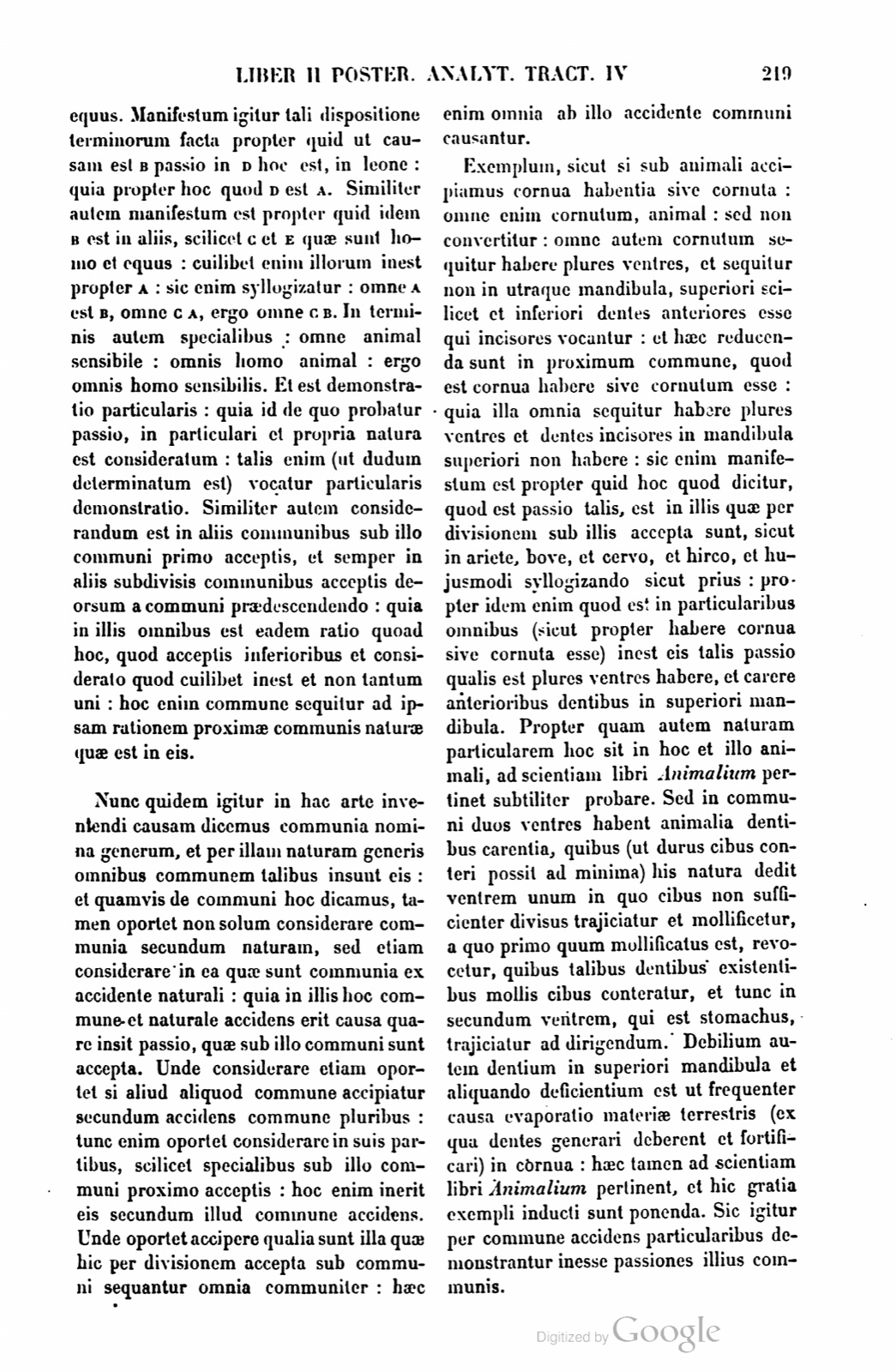
Amplius autem quia commune aliquando non est ut genus, neque sicut commune accidens, sed potius aliquando commune secundum analogiam sive secundum proportionem, ideo alius modus est aliquando commune secundum analogiam eligere quod omnibus insit in propria natura et particulari sub illo communi acceptus. In aliquibus enim est accipere unum quod sit omnino idem in natura vel accidente univoce, sicut patet in eo quod, quia proprium nomen non habet, oportet vocare sepion, et est loco ossis in pisce qui sepia vocatur, et spinam piscis et os animalis terrestris. Haec enim non possunt habere aliquod unum quod univoce dicatur de illis, quia sepion carneae est substantiae, compositionis magis continuae et flexibilis; os autem magis durum et non flexibile et non passibile. Sunt tamen quaedam passiones quae sequuntur etiam hujus ratione communis quod per analogiam est in eis causa hujus quod est in eis, sicut una natura per analogiam ad unum, sicut quod est continere mollia corporis ne decidant.
Eadem autem proposita, hoc est, passiones propositae, sunt omnia haec consequentes, quae quidem idem habent medium in communi analogo, hoc est, eamdem causam, quia medium est causa per quam causam syllogizantur omnibus subjectis in esse, et est durities vel soliditas in sepion, et spina, et osse. Omnia haec dura sunt, et per hoc continent mollia ne decidant; et syllogizatur sic: omnia quae dura habent in mollibus, habent ea ut contineant mollia; sepia habet sic dura; ergo, etc. Similiter est de pisce et spina, et terrestri animali et osse. Amplius autem talia communia, per quae particularibus probantur inesse passiones illud commune consequentes quod unum est in particularibus in propria natura acceptis, diversimode sunt. Horum enim quaedam sunt eadem genere, ut primo inducta, homo, leo, equus, et quaecumque habent differentias proprias constitutivas specierum; ex quo communi derivata sunt aliorum specialium. Aut aliter sunt per analogiam vel per accidens commune, sicut istis quae dicta sunt, sepion, spina, et os, quibus commune est contrarius status: sistunt enim omnia haec et continent mollia in contrario statu; natura enim mollium est concidere deorsum, et illa tenent ea ad situm membris proportionatum. Et in uno communi genere sunt vel secundum analogiam communem echo, iris, et idolum in speculo apparens: omnia enim haec tria idem medium quod est causa proposita et quaesita. In genere enim illius sunt unum: omnia enim ista repercussio vel reflexio sunt; sed sunt specie altera, quia repercussio idoli est reflexio ad speculum, echo reflexio soni ad solidum planum concavum, iris autem reflexio luminis solis ad aquosam nubem soli secundum situm appositam 1.
Moreover, because the common is sometimes not as a genus, nor as a common accident, but rather is sometimes common according to analogy or according to proportion, therefore another mode is sometimes to choose the common according to analogy, which belongs to all in their proper nature and in a particular accepted under that common. For in some things one must accept one thing that is wholly the same univocally in nature or accident, as is clear in the case of that which, because it does not have a proper name, must be called sepion, and it is in place of a bone in the fish that is called cuttlefish, and the spine of a fish and the bone of a terrestrial animal. For these cannot have some one thing that is said univocally of them, because sepion is of a fleshy substance, of a more continuous and flexible composition; but bone is harder and not flexible and not susceptible. Nevertheless there are certain affections which also follow by reason of this common thing, which by analogy is in them the cause of this which is in them, as one nature by analogy to one thing, such as the containing of the soft things of the body lest they fall down.
But the same proposed things, that is, the proposed affections, are consequent upon all these things, which indeed have the same middle in an analogous common, that is, the same cause, because the middle is the cause through which, as cause, they are syllogized as being in all the subjects; and it is hardness or solidity in sepion, spine, and bone. All these are hard, and through this they contain the soft things lest they fall down; and the syllogism is made thus: all things that have hard things among soft things have them so that they may contain the soft things; cuttlefish has hard things in this way; therefore, and so on. The same is true of fish and spine, and of terrestrial animal and bone. Moreover such common things, through which affections consequent upon that common thing, which is one in particulars accepted in their proper nature, are proved to belong to particulars, exist in diverse ways. For some of these are the same in genus, as the things first introduced, man, lion, horse, and whatever things have proper differences constitutive of species; from this common thing the special properties of others have been derived. Or otherwise they exist by analogy or by a common accident, as in these things that have been stated, sepion, spine, and bone, for which the common thing is an opposite standing; for all these things stand and contain the soft things in an opposite standing, since the nature of soft things is to fall downward, and those things hold them at a position proportioned to the members. And in one common genus, or according to a common analogy, are echo, rainbow, and the image appearing in a mirror; for all these three have the same middle, which is the proposed and sought cause. For in the genus of that they are one; for all these things are repercussion or reflection. But they are different in species, because the repercussion of an image is reflection toward a mirror, echo is the reflection of sound toward a solid concave plane, and the rainbow is the reflection of the light of the sun toward a watery cloud positioned according to site with respect to the sun 1.
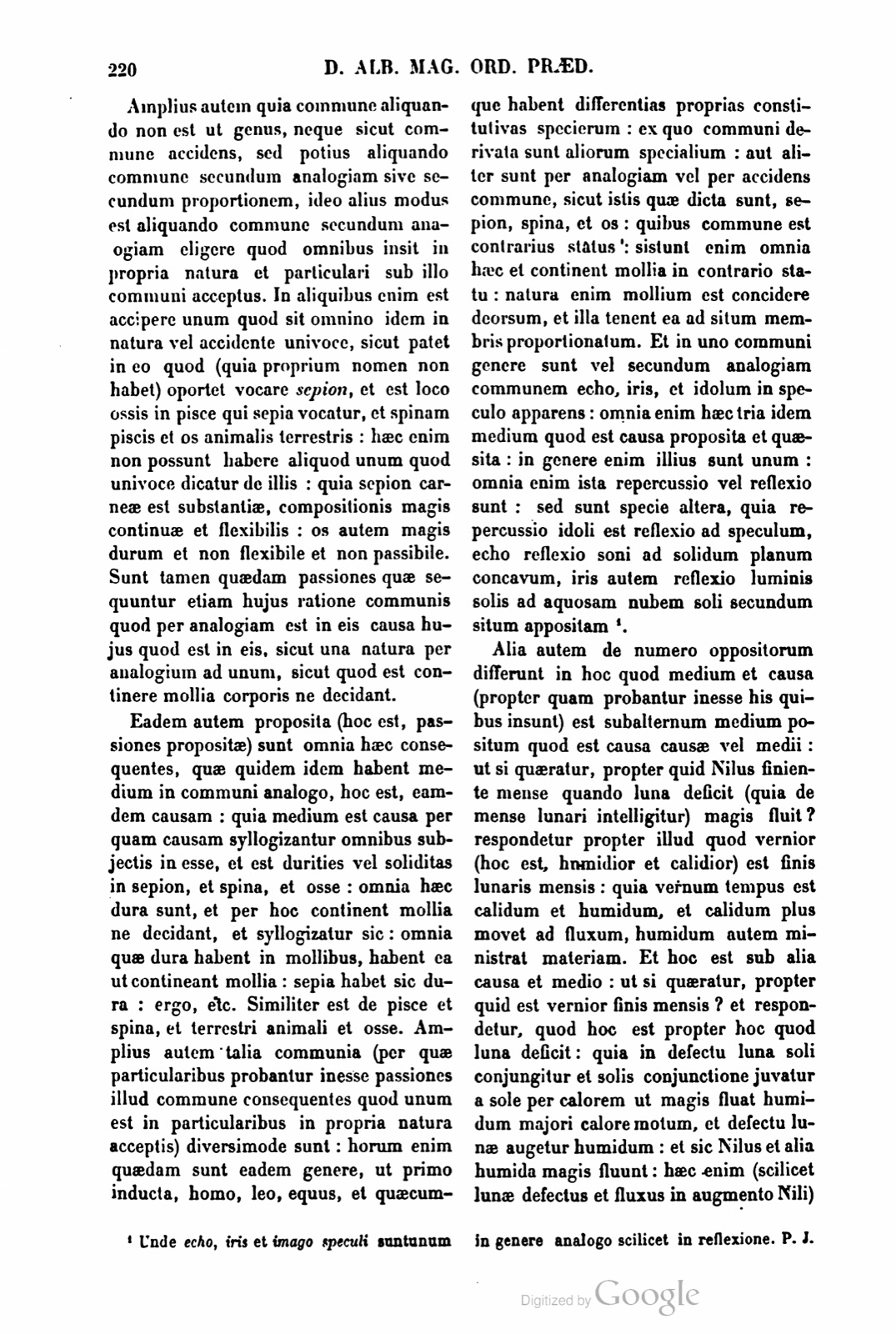
Alia autem de numero oppositorum differunt in hoc quod medium et causa, propter quam probantur inesse his quibus insunt, est subalternum medium positum quod est causa causae vel medii. Ut si quaeratur, propter quid Nilus finiente mense quando luna deficit, quia de mense lunari intelligitur, magis fluit? respondetur propter illud quod vernior, hoc est, humidior et calidior, est finis lunaris mensis: quia vernum tempus est calidum et humidum, et calidum plus movet ad fluxum, humidum autem ministrat materiam. Et hoc est sub alia causa et medio: ut si quaeratur, propter quid est vernior finis mensis? et respondetur, quod hoc est propter hoc quod luna deficit: quia in defectu luna soli conjungitur et solis conjunctione juvatur a sole per calorem ut magis fluat humidum majori calore motum, et defectu lunae augetur humidum; et sic Nilus et alia humida magis fluunt. Haec enim, scilicet lunae defectus et fluxus in augmento Nili, sic habent ad invicem, quia unum est sub altero sicut sub medio et causa. Causa autem fluxus Nili, ut dicit Aristoteles in capitulo de Nili inundatione, est quod terra circumstans Nilum undique calore ex defectu lunae destituta non trahit a Nilo humidum; et ideo non diminuto humido in fine mensis plus inundat. Aliis autem temporibus cum lunae lumen exhaurit, humidum minus fluit. Haec autem ad physicum pertinent. Et quod alii hujus alias assignant causas falsum est, et contra Aristotelem, quia Aristoteles ista quae dicta sunt dicit.
But other things, from the number of opposites, differ in this, that the middle and cause, on account of which they are proved to belong to those things to which they belong, is a posited subordinate middle which is the cause of the cause or of the middle. For example, if it is asked why the Nile flows more at the end of the month when the moon is eclipsed, because it is understood of the lunar month, the answer is: because the end of the lunar month is more springlike, that is, more humid and warmer; because springtime is warm and humid, and the warm moves more toward flow, while the humid supplies matter. And this is under another cause and middle: as if it is asked why the end of the month is more springlike, and it is answered that this is because the moon is eclipsed; because in an eclipse the moon is joined to the sun and by the conjunction of the sun is aided by the sun through heat, so that the humid, moved by greater heat, may flow more, and by the eclipse of the moon the humid is increased; and so the Nile and other humid things flow more. For these things, namely the eclipse of the moon and the flow in the increase of the Nile, are related to one another in this way, because one is under the other as under a middle and cause. But the cause of the flow of the Nile, as Aristotle says in the chapter concerning the inundation of the Nile, is that the earth surrounding the Nile on every side, deprived of heat because of the eclipse of the moon, does not draw moisture from the Nile; and therefore, since the moisture is not diminished at the end of the month, it inundates more. But at other times, when the light of the moon draws out moisture, the moisture flows less. These matters, however, belong to the physicist. And that others assign other causes of this is false and contrary to Aristotle, because Aristotle says the things that have been stated.
Notes
- Hence echo, rainbow, and the image of a mirror are one in an analogous genus, namely in reflection. P. J. (Unde echo, iris et imago speculi sunt unum in genere analogo scilicet in reflexione. P. J.) ↩
If a page does not appear, its photograph has not been uploaded yet.