Works › Posterior Analytics, Books I–II
Volume 2 · pp. 214–215
Chapter IV. How many and what things must be considered in division.
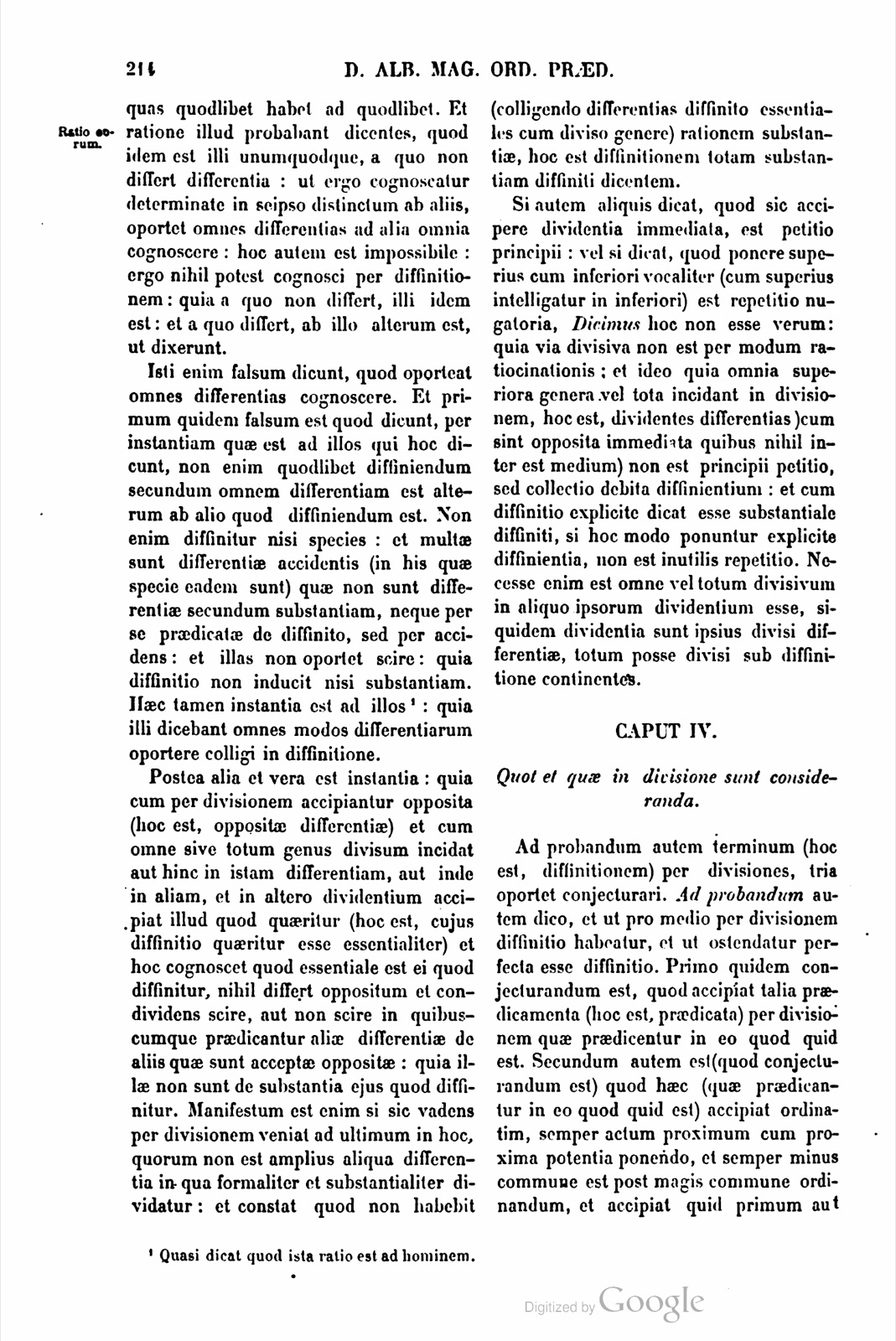
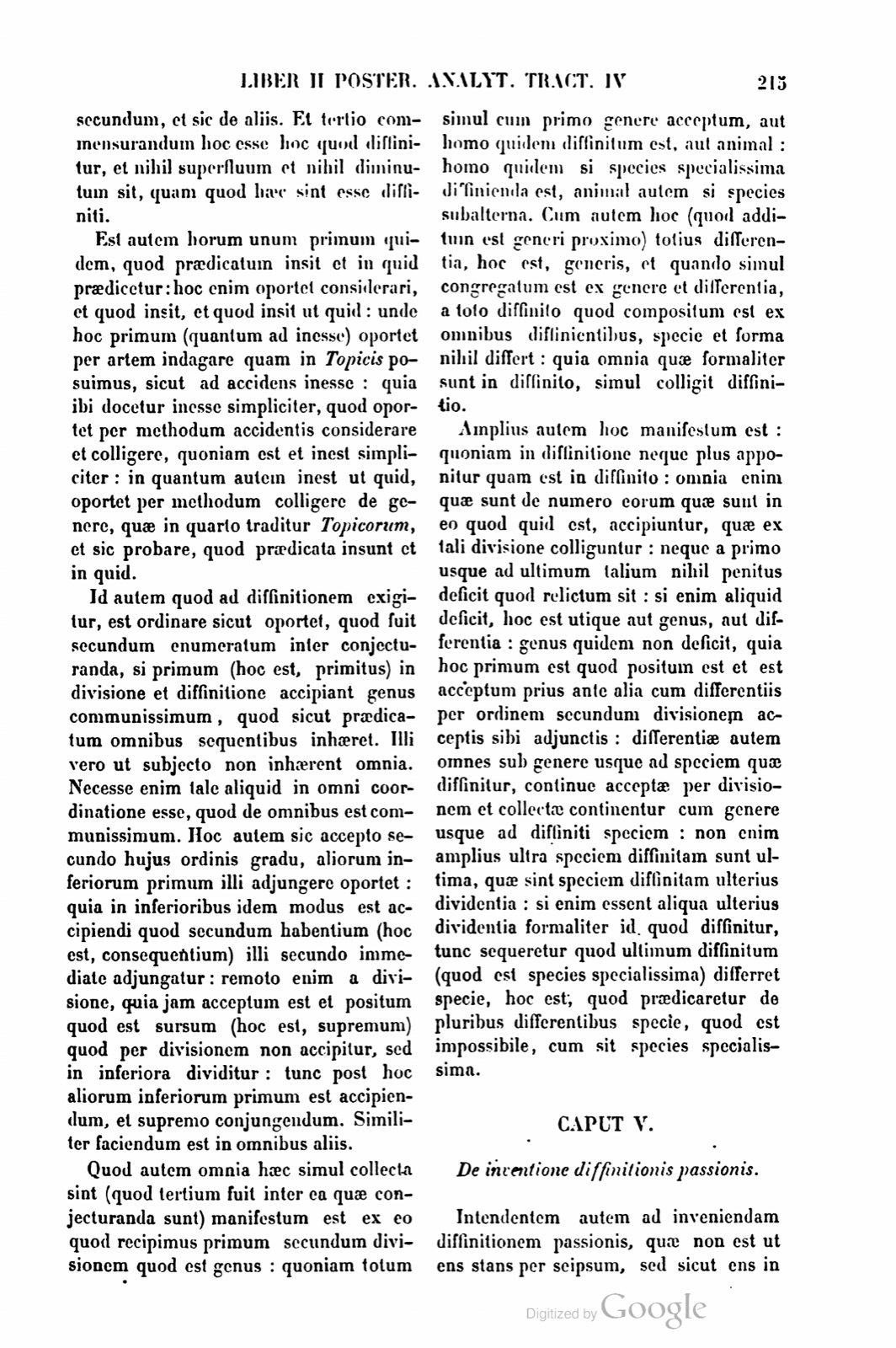
CAPUT IV. Quot et quae in divisione sunt consideranda. Ad probandum autem terminum (hoc est, diffinitionem) per divisiones, tria oportet conjecturari. Ad probandum autem dico, et ut pro medio per divisionem diffinitio habeatur, et ut ostendatur perfecta esse diffinitio. Primo quidem conjecturandum est, quod accipiat talia praedicamenta (hoc est, praedicata) per divisionem quae praedicentur in eo quod quid est. Secundum autem est (quod conjecturandum est) quod haec (quae praedicantur in eo quod quid est) accipiat ordinatim, semper actum proximum cum proxima potentia ponendo, et semper minus commune est post magis commune ordinandum, et accipiat quid primum aut secundum, et sic de aliis. Et tertio commensurandum hoc esse hoc quod diffinitur, et nihil superfluum et nihil diminutum sit, quam quod haec sint esse diffiniti. Est autem horum unum primum quidem, quod praedicatum insit et in quid praedicetur: hoc enim oportet considerari, et quod insit, et quod insit ut quid: unde hoc primum (quantum ad inesse) oportet per artem indagare quam in Topicis posuimus, sicut ad accidens inesse: quia ibi docetur inesse simpliciter, quod oportet per methodum accidentis considerare et colligere, quoniam est et inest simpliciter: in quantum autem inest ut quid, oportet per methodum colligere de genere, quae in quarto traditur Topicorum, et sic probare, quod praedicata insunt et in quid. Id autem quod ad diffinitionem exigitur, est ordinare sicut oportet, quod fuit secundum enumeratum inter conjecturanda, si primum (hoc est, primitus) in divisione et diffinitione accipiant genus communissimum, quod sicut praedicatum omnibus sequentibus inhaeret. Illi vero ut subjecto non inhaerent omnia. Necesse enim tale aliquid in omni coordinatione esse, quod de omnibus est communissimum. Hoc autem sic accepto secundo hujus ordinis gradu, aliorum inferiorum primum illi adjungere oportet: quia in inferioribus idem modus est accipiendi quod secundum habentium (hoc est, consequentium) illi secundo immediate adjungatur: remoto enim a divisione, quia jam acceptum est et positum quod est sursum (hoc est, supremum) quod per divisionem non accipitur, sed in inferiora dividitur: tunc post hoc aliorum inferiorum primum est accipiendum, et supremo conjungendum. Similiter faciendum est in omnibus aliis. Quod autem omnia haec simul collecta sint (quod tertium fuit inter ea quae conjecturanda sunt) manifestum est ex eo quod recipimus primum secundum divisionem quod est genus: quoniam totum simul cum primo genere acceptum, aut homo quidem diffinitum est, aut animal: homo quidem si species specialissima diffinienda est, animal autem si species subalterna. Cum autem hoc (quod additum est generi proximo) totius differentia, hoc est, generis, et quando simul congregatum est ex genere et differentia, a toto diffinito quod compositum est ex omnibus diffinientibus, specie et forma nihil differt: quia omnia quae formaliter sunt in diffinito, simul colligit diffinitio. Amplius autem hoc manifestum est: quoniam in diffinitione neque plus apponitur quam est in diffinito: omnia enim quae sunt de numero eorum quae sunt in eo quod quid est, accipiuntur, quae ex tali divisione colliguntur: neque a primo usque ad ultimum talium nihil penitus deficit quod relictum sit: si enim aliquid deficit, hoc est utique aut genus, aut differentia: genus quidem non deficit, quia hoc primum est quod positum est et est acceptum prius ante alia cum differentiis per ordinem secundum divisionem acceptis sibi adjunctis: differentiae autem omnes sub genere usque ad speciem quae diffinitur, continue acceptae per divisionem et collectae continentur cum genere usque ad diffiniti speciem: non enim amplius ultra speciem diffinitam sunt ultima, quae sint speciem diffinitam ulterius dividentia: si enim essent aliqua ulterius dividentia formaliter id, quod diffinitur, tunc sequeretur quod ultimum diffinitum (quod est species specialissima) differret specie, hoc est, quod praedicaretur de pluribus differentibus specie, quod est impossibile, cum sit species specialissima.
CHAPTER IV. How many and what things must be considered in division. But for proving a term, that is, a definition, through divisions, one must conjecture three things. But I say for proving, both so that the definition may be had as a middle through division, and so that it may be shown that the definition is perfect. First indeed one must conjecture that through division he receives such predicaments, that is, predicates, as are predicated in that which is what it is. The second is, which must be conjectured, that he receive these things, which are predicated in that which is what it is, in order, always placing the proximate act with the proximate potency, and always the less common thing must be ordered after the more common, and he must receive what is first or second, and so concerning the others. And third, that this which is defined must be commensurated to this, and that nothing superfluous and nothing diminished should be present beyond the fact that these are the being of the defined thing. But the first one of these is indeed that the predicate should belong and be predicated in what; for this must be considered, both that it belongs and that it belongs as what. Hence this first thing, as regards belonging, must be searched out through the art which we posited in the Topics, as with respect to an accident's belonging; because there simple belonging is taught, which one must consider and gather through the method of accident, namely that it is and belongs simply. But insofar as it belongs as what, one must gather through the method concerning genus, which is handed down in the fourth book of the Topics, and thus prove that the predicates belong and belong in what. But that which is required for definition is to order as one ought, which was enumerated second among the things to be conjectured, if they receive first, that is, primitively, in division and definition, the most common genus, which inheres as a predicate in all the following things. But all things do not inhere in that as in a subject. For it is necessary that there be some such thing in every coordination, which is the most common of all. But when this has been received in this way, in the second grade of this order one must join to it the first of the other lower things, because in the lower things there is the same mode of receiving, that what is second among things having themselves, that is, among consequent things, is immediately joined to that second. For once it has been removed from division because what is above, that is, supreme, has now been received and posited, which is not received through division but is divided into inferior things, then after this the first of the other inferior things must be received and joined to the supreme. It must be done similarly in all other things. But that all these things gathered together are together, which was the third among the things that must be conjectured, is manifest from the fact that we receive the first according to division, which is genus, since the whole taken together with the first genus is either the defined human being or animal: human being indeed if the most-specific species must be defined, but animal if the subaltern species must be defined. But when this, which has been added to the proximate genus, is the difference of the whole, that is, of the genus, and when it has been gathered together from genus and difference, it differs in nothing by species and form from the whole defined thing which is composed from all the defining things, because definition gathers together all things which are formally in the defined thing. Moreover this is manifest: because in definition no more is added than is in the defined thing. For all things which are from the number of those things which are in that which is what it is are received, which are gathered from such division; nor from the first down to the last of such things does anything at all fail by being left behind. For if something fails, this is surely either genus or difference. The genus indeed does not fail, because this is the first thing which is posited and is received before the others, with the differences received according to division through order joined to it. But all the differences under the genus down to the species which is defined, received continuously through division and gathered, are contained with the genus down to the species of the defined thing. For beyond the defined species there are no further ultimate things which divide the defined species further; for if there were some things further dividing formally that which is defined, then it would follow that the ultimate defined thing, which is the most-specific species, would differ in species, that is, would be predicated of several things differing in species, which is impossible, since it is the most-specific species.
If a page does not appear, its photograph has not been uploaded yet.