Works › Posterior Analytics, Books I–II
Volume 2 · pp. 212–214
Chapter III. On finding definition through division, and that this way is useful.
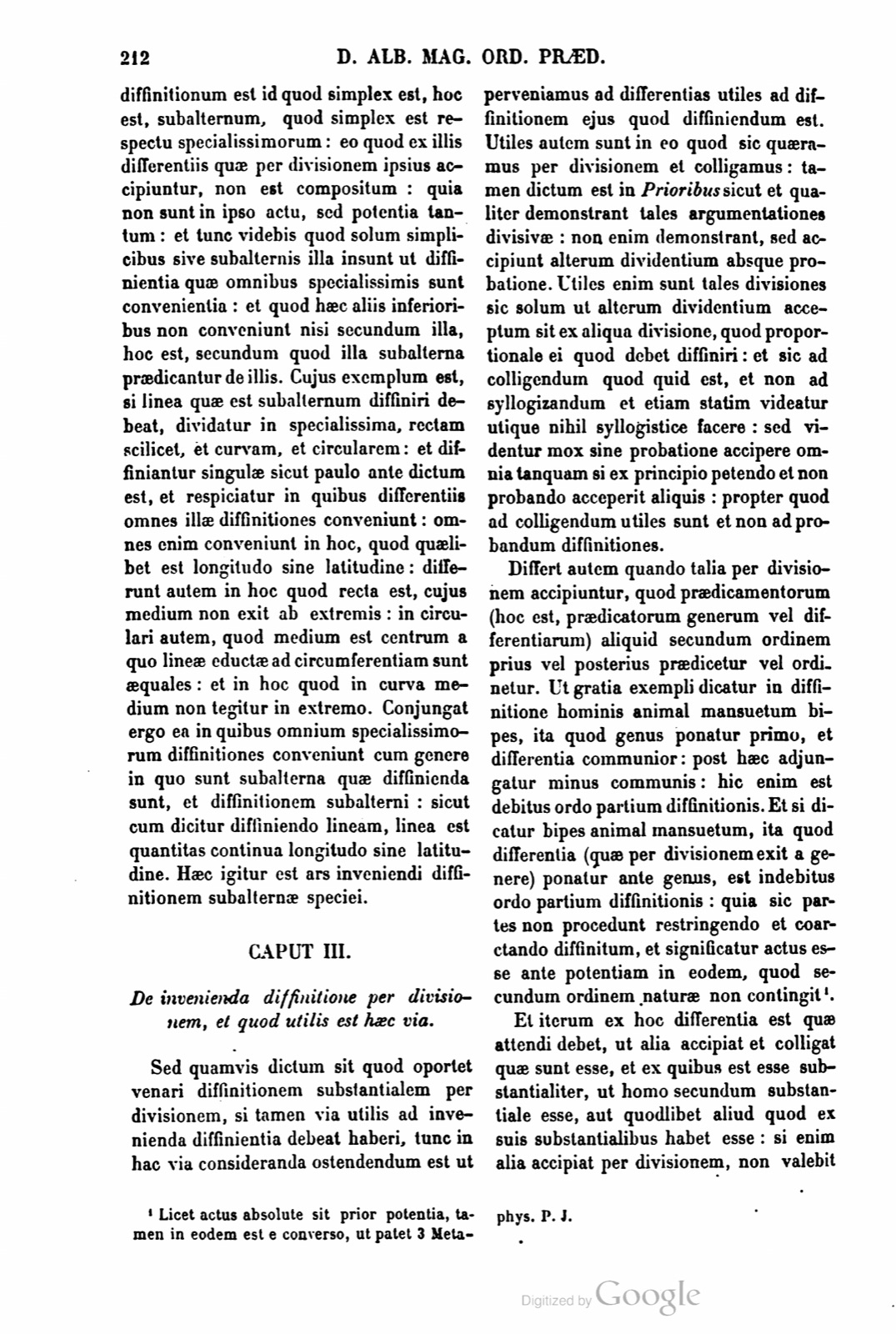
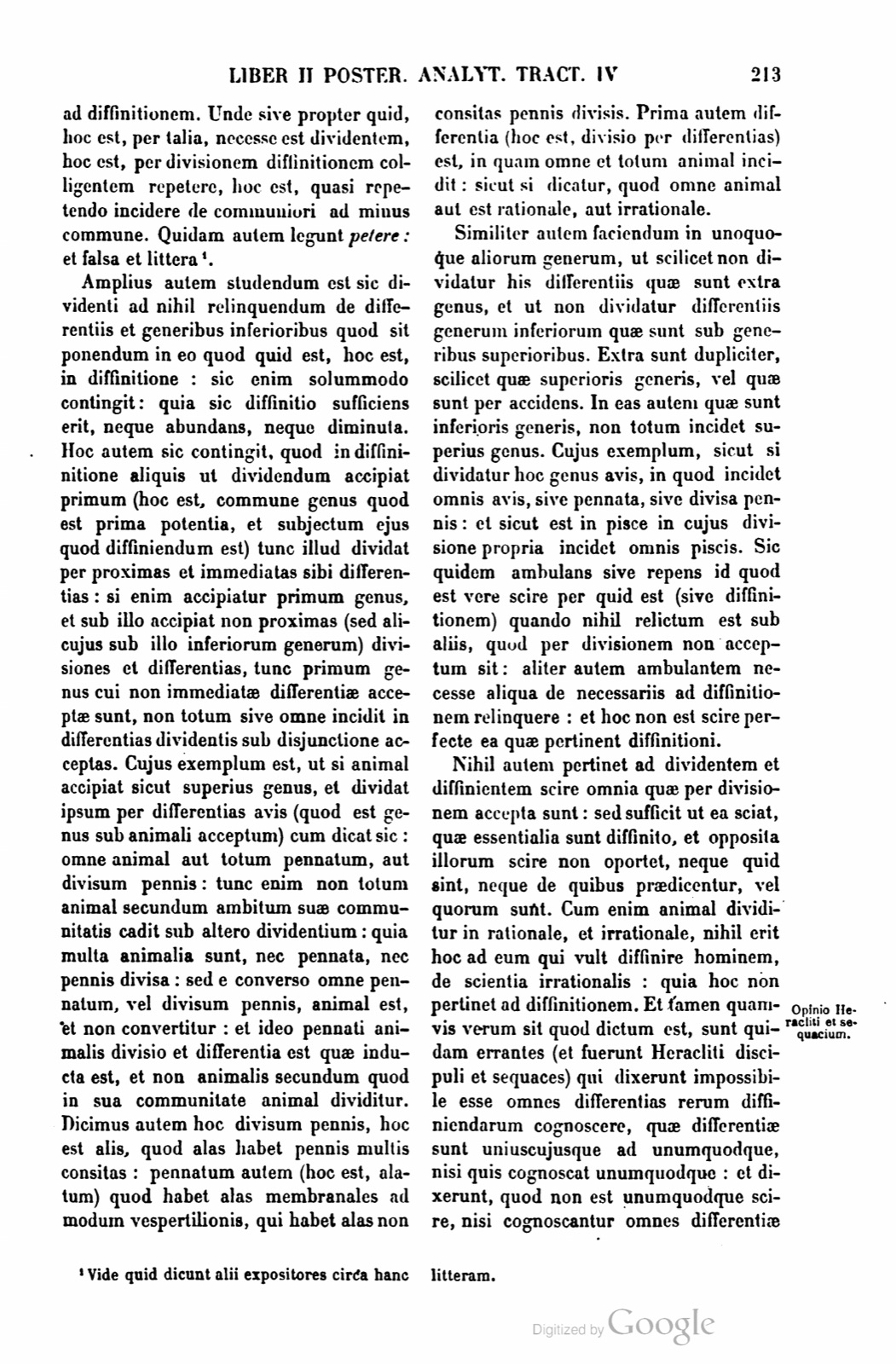
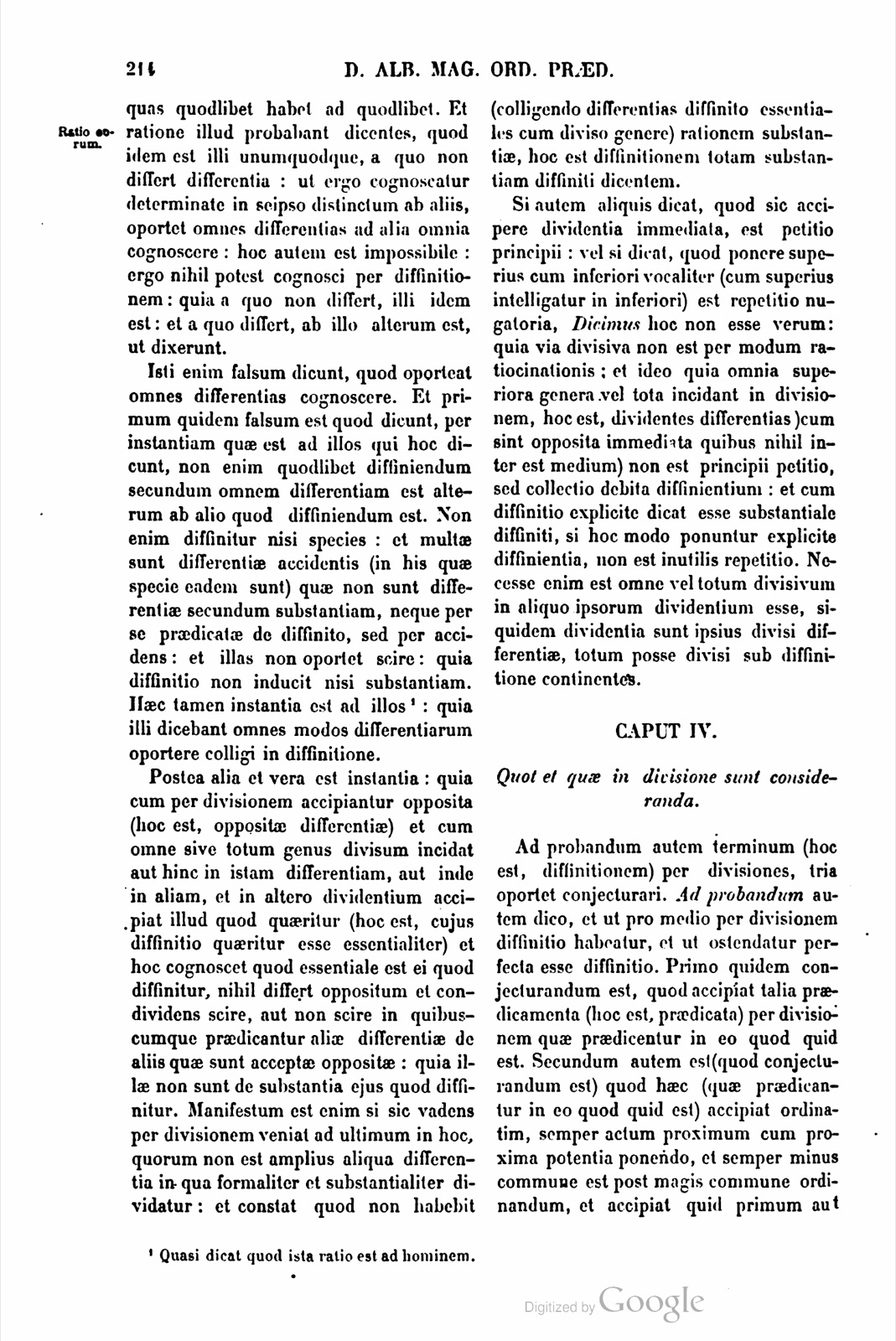
CAPUT III. De invenienda diffinitione per divisionem, et quod utilis est haec via. Sed quamvis dictum sit quod oportet venari diffinitionem substantialem per divisionem, si tamen via utilis ad invenienda diffinientia debeat haberi, tunc in hac via consideranda ostendendum est ut perveniamus ad differentias utiles ad diffinitionem ejus quod diffiniendum est. Utiles autem sunt in eo quod sic quaeramus per divisionem et colligamus: tamen dictum est in Prioribus sicut et qualiter demonstrant tales argumentationes divisivae: non enim demonstrant, sed accipiunt alterum dividentium absque probatione. Utiles enim sunt tales divisiones sic solum ut alterum dividentium acceptum sit ex aliqua divisione, quod proportionale ei quod debet diffiniri: et sic ad colligendum quod quid est, et non ad syllogizandum et etiam statim videatur utique nihil syllogistice facere: sed videntur mox sine probatione accipere omnia tanquam si ex principio petendo et non probando acceperit aliquis: propter quod ad colligendum utiles sunt et non ad probandum diffinitiones. Differt autem quando talia per divisionem accipiuntur, quod praedicamentorum (hoc est, praedicatorum generum vel differentiarum) aliquid secundum ordinem prius vel posterius praedicetur vel ordinetur. Ut gratia exempli dicatur in diffinitione hominis animal mansuetum bipes, ita quod genus ponatur primo, et differentia communior: post haec adjungatur minus communis: hic enim est debitus ordo partium diffinitionis. Et si dicatur bipes animal mansuetum, ita quod differentia (quae per divisionem exit a genere) ponatur ante genus, est indebitus ordo partium diffinitionis: quia sic partes non procedunt restringendo et coarctando diffinitum, et significatur actus esse ante potentiam in eodem, quod secundum ordinem naturae non contingit 1. Et iterum ex hoc differentia est quae attendi debet, ut alia accipiat et colligat quae sunt esse, et ex quibus est esse substantialiter, ut homo secundum substantiale esse, aut quodlibet aliud quod ex suis substantialibus habet esse: si enim alia accipiat per divisionem, non valebit ad diffinitionem. Unde sive propter quid, hoc est, per talia, necesse est dividentem, hoc est, per divisionem diffinitionem colligentem repetere, hoc est, quasi repetendo incidere de communiori ad minus commune. Quidam autem legunt petere: et falsa est littera 2. Amplius autem studendum est sic dividenti ad nihil relinquendum de differentiis et generibus inferioribus quod sit ponendum in eo quod quid est, hoc est, in diffinitione: sic enim solummodo contingit: quia sic diffinitio sufficiens erit, neque abundans, neque diminuta. Hoc autem sic contingit, quod in diffinitione aliquis ut dividendum accipiat primum (hoc est, commune genus quod est prima potentia, et subjectum ejus quod diffiniendum est) tunc illud dividat per proximas et immediatas sibi differentias: si enim accipiatur primum genus, et sub illo accipiat non proximas (sed alicujus sub illo inferiorum generum) divisiones et differentias, tunc primum genus cui non immediatae differentiae acceptae sunt, non totum sive omne incidit in differentias dividentis sub disjunctione acceptas. Cujus exemplum est, ut si animal accipiat sicut superius genus, et dividat ipsum per differentias avis (quod est genus sub animali acceptum) cum dicat sic: omne animal aut totum pennatum, aut divisum pennis: tunc enim non totum animal secundum ambitum suae communitatis cadit sub altero dividentium: quia multa animalia sunt, nec pennata, nec pennis divisa: sed e converso omne pennatum, vel divisum pennis, animal est, et non convertitur: et ideo pennati animalis divisio et differentia est quae inducta est, et non animalis secundum quod in sua communitate animal dividitur. Dicimus autem hoc divisum pennis, hoc est alis, quod alas habet pennis multis consitas: pennatum autem (hoc est, alatum) quod habet alas membranales ad modum vespertilionis, qui habet alas non consitas pennis divisis. Prima autem differentia (hoc est, divisio per differentias) est, in quam omne et totum animal incidit: sicut si dicatur, quod omne animal aut est rationale, aut irrationale. Similiter autem faciendum in unoquoque aliorum generum, ut scilicet non dividatur his differentiis quae sunt extra genus, et ut non dividatur differentiis generum inferiorum quae sunt sub generibus superioribus. Extra sunt dupliciter, scilicet quae superioris generis, vel quae sunt per accidens. In eas autem quae sunt inferioris generis, non totum incidet superius genus. Cujus exemplum, sicut si dividatur hoc genus avis, in quod incidet omnis avis, sive pennata, sive divisa pennis: et sicut est in pisce in cujus divisione propria incidet omnis piscis. Sic quidem ambulans sive repens id quod est vere scire per quid est (sive diffinitionem) quando nihil relictum est sub aliis, quod per divisionem non acceptum sit: aliter autem ambulantem necesse aliqua de necessariis ad diffinitionem relinquere: et hoc non est scire perfecte ea quae pertinent diffinitioni. Nihil autem pertinet ad dividentem et diffinientem scire omnia quae per divisionem accepta sunt: sed sufficit ut ea sciat, quae essentialia sunt diffinito, et opposita illorum scire non oportet, neque quid sint, neque de quibus praedicentur, vel quorum sunt. Cum enim animal dividitur in rationale, et irrationale, nihil erit hoc ad eum qui vult diffinire hominem, de scientia irrationalis: quia hoc non pertinet ad diffinitionem. <marginal-label>Opinio Heracliti et sequacium.</marginal-label> Et tamen quamvis verum sit quod dictum est, sunt quidam errantes (et fuerunt Heracliti discipuli et sequaces) qui dixerunt impossibile esse omnes differentias rerum diffiniendarum cognoscere, quae differentiae sunt uniuscujusque ad unumquodque, nisi quis cognoscat unumquodque: et dixerunt, quod non est unumquodque scire, nisi cognoscantur omnes differentiae quas quodlibet habet ad quodlibet. <marginal-label>Ratio eorum.</marginal-label> Et ratione illud probabant dicentes, quod idem est illi unumquodque, a quo non differt differentia: ut ergo cognoscatur determinate in seipso distinctum ab aliis, oportet omnes differentias ad alia omnia cognoscere: hoc autem est impossibile: ergo nihil potest cognosci per diffinitionem: quia a quo non differt, illi idem est: et a quo differt, ab illo alterum est, ut dixerunt. Isti enim falsum dicunt, quod oporteat omnes differentias cognoscere. Et primum quidem falsum est quod dicunt, per instantiam quae est ad illos qui hoc dicunt, non enim quodlibet diffiniendum secundum omnem differentiam est alterum ab alio quod diffiniendum est. Non enim diffinitur nisi species: et multae sunt differentiae accidentis (in his quae specie eadem sunt) quae non sunt differentiae secundum substantiam, neque per se praedicatae de diffinito, sed per accidens: et illas non oportet scire: quia diffinitio non inducit nisi substantiam. Haec tamen instantia est ad illos 3: quia illi dicebant omnes modos differentiarum oportere colligi in diffinitione. Postea alia et vera est instantia: quia cum per divisionem accipiantur opposita (hoc est, oppositae differentiae) et cum omne sive totum genus divisum incidat aut hinc in istam differentiam, aut inde in aliam, et in altero dividentium accipiat illud quod quaeritur (hoc est, cujus diffinitio quaeritur esse essentialiter) et hoc cognoscet quod essentiale est ei quod diffinitur, nihil differt oppositum et condividens scire, aut non scire in quibuscumque praedicantur aliae differentiae de aliis quae sunt acceptae oppositae: quia illae non sunt de substantia ejus quod diffinitur. Manifestum est enim si sic vadens per divisionem veniat ad ultimum in hoc, quorum non est amplius aliqua differentia in qua formaliter et substantialiter dividatur: et constat quod non habebit (colligendo differentias diffinito essentiales cum diviso genere) rationem substantiae, hoc est diffinitionem totam substantiam diffiniti dicentem. Si autem aliquis dicat, quod sic accipere dividentia immediata, est petitio principii: vel si dicat, quod ponere superius cum inferiori vocaliter (cum superius intelligatur in inferiori) est repetitio nugatoria, dicimus hoc non esse verum: quia via divisiva non est per modum ratiocinationis; et ideo quia omnia superiora genera vel tota incidant in divisionem, hoc est, dividentes differentias (cum sint opposita immediata quibus nihil inter est medium) non est principii petitio, sed collectio debita diffinientium: et cum diffinitio explicite dicat esse substantiale diffiniti, si hoc modo ponuntur explicite diffinientia, non est inutilis repetitio. Necesse enim est omne vel totum divisivum in aliquo ipsorum dividentium esse, siquidem dividentia sunt ipsius divisi differentiae, totum posse divisi sub diffinitione continentes.
CHAPTER III. On finding definition through division, and that this way is useful. But although it has been said that one must hunt a substantial definition through division, nevertheless, if a useful way for finding the defining things ought to be had, then in considering this way it must be shown that we may arrive at differences useful for the definition of that which must be defined. But they are useful in that we thus seek and gather through division; nevertheless it was said in the Prior Analytics how and in what way such divisive arguments demonstrate. For they do not demonstrate, but they receive one of the dividing things without proof. For such divisions are useful only in this way, that one of the dividing things is received from some division, which is proportionate to that which must be defined; and thus they are useful for gathering what it is, and not for syllogizing, and even immediately they would certainly seem to do nothing syllogistically. Rather, they seem at once to receive all things without proof, as if someone had received them by begging from the beginning and not by proving; for this reason they are useful for gathering definitions and not for proving them. But when such things are received through division, it makes a difference that something of the predicaments, that is, of the predicated genera or differences, is predicated or ordered as prior or posterior according to order. As for example, in the definition of human being let one say tame biped animal, so that the genus is posited first and the more common difference, and after these the less common is joined; for this is the due order of the parts of definition. And if it is said, biped tame animal, so that the difference, which by division goes out from the genus, is posited before the genus, there is an undue order of the parts of definition, because in this way the parts do not proceed by restricting and narrowing the defined thing, and act is signified as being before potency in the same thing, which does not happen according to the order of nature 1. And again from this there is a difference that must be attended to, so that one may receive and gather other things which are being and from which there is substantial being, as human being according to substantial being, or anything else which has being from its substantial things. For if he receives other things through division, it will not avail for definition. Hence whether on account of what, that is, through such things, it is necessary for the divider, that is, for the one gathering definition through division, to repeat, that is, as if by repeating to fall from the more common to the less common. But certain people read to seek; and the letter is false 2. Moreover the one dividing in this way must study to leave nothing behind among the differences and inferior genera which must be posited in that which is what it is, that is, in the definition. For only thus does it happen, because thus the definition will be sufficient, neither abundant nor diminished. But this happens thus: that in definition someone receives as what must be divided the first, that is, the common genus which is the first potency and subject of that which must be defined; then he divides that through the differences proximate and immediate to it. For if the first genus is received, and under it he receives divisions and differences not proximate but belonging to some inferior genera under it, then the first genus, to which not immediate differences have been received, does not fall wholly or entirely into the differences of the divider received under disjunction. An example of this is that, if he receives animal as the higher genus and divides it through the differences of bird, which is a genus received under animal, when he says thus: every animal is either wholly feathered or divided with feathers, then not the whole animal according to the scope of its commonness falls under one of the dividing things, because there are many animals neither feathered nor divided with feathers; but conversely every feathered thing or thing divided with feathers is an animal, and it is not converted. And therefore the division and difference that has been introduced belongs to the feathered animal, and not to animal according as animal is divided in its commonness. But we call this divided with feathers, that is, with wings, which has wings sewn with many feathers; but feathered, that is, winged, that which has membranous wings in the manner of a bat, which has wings not sewn with divided feathers. But the first difference, that is, division through differences, is that into which every and the whole animal falls, as if it is said that every animal is either rational or irrational. But similarly one must act in any of the other genera, namely so that it is not divided by these differences which are outside the genus, and so that it is not divided by differences of inferior genera which are under higher genera. Things are outside in two ways, namely those which belong to a higher genus or those which are by accident. But the whole higher genus will not fall into those things which belong to an inferior genus. An example of this is if this genus bird is divided, into which every bird will fall, whether feathered or divided with feathers; and as it is in fish, into whose proper division every fish will fall. Thus indeed, walking or creeping, one truly knows through what it is, or through definition, when nothing has been left under others which has not been received through division; but one walking otherwise must leave behind some things necessary for definition, and this is not to know perfectly the things which pertain to definition. But it does not pertain to the one dividing and defining to know all things which have been received through division; rather, it suffices that he know those things which are essential to the defined thing, and he need not know their opposites, neither what they are, nor of what things they are predicated, or whose they are. For when animal is divided into rational and irrational, nothing concerning the science of the irrational will belong to the one who wishes to define human being, because this does not pertain to the definition. <marginal-label>Opinion of Heraclitus and his followers.</marginal-label> And nevertheless, although what has been said is true, there are certain erring persons, and they were disciples and followers of Heraclitus, who said that it is impossible to know all the differences of things to be defined, which differences belong to each thing with respect to each thing, unless someone knows each thing; and they said that there is no knowing each thing unless all the differences are known which anything whatever has with respect to anything whatever. <marginal-label>Their argument.</marginal-label> And they proved that by reason, saying that each thing is the same as that from which it does not differ by a difference; therefore, so that it may be known determinately in itself as distinct from others, one must know all the differences with respect to all other things. But this is impossible; therefore nothing can be known through definition, because it is the same as that from which it does not differ, and it is other than that from which it differs, as they said. For these persons speak falsely in saying that one must know all differences. And indeed the first thing they say is false through an objection which is against those who say this, for not everything to be defined is other than another thing to be defined according to every difference. For only a species is defined; and there are many differences of accident in those things which are the same in species which are not differences according to substance, nor are predicated per se of the defined thing, but by accident; and one need not know those, because definition introduces only substance. Nevertheless this objection is against them 3, because they said that all modes of differences must be gathered in definition. Afterward there is another and true objection, because when opposites, that is, opposite differences, are received through division, and when every or the whole divided genus falls either on this side into that difference or on that side into the other, and in one of the dividing things he receives that which is sought, that is, that whose definition is sought as being essentially, and he will know this which is essential to that which is defined, it makes no difference whether he knows or does not know the opposite and co-dividing thing in whatever things other differences are predicated of other things which have been received as opposite, because those are not of the substance of that which is defined. For it is manifest that if, thus going through division, he comes to the ultimate in this, of which there is no further difference in which it is formally and substantially divided, then it is agreed that by gathering differences essential to the defined thing with the divided genus he will have the account of the substance, that is, the definition stating the whole substance of the defined thing. But if someone says that to receive the immediate dividing things in this way is a begging of the principle, or if he says that to posit the superior vocally with the inferior, since the superior is understood in the inferior, is an empty repetition, we say that this is not true, because the divisive way is not through the mode of reasoning; and therefore, because all higher genera or wholes fall into the division, that is, into the dividing differences, since they are immediate opposites between which there is no middle, it is not a begging of the principle, but the due gathering of defining things. And since definition explicitly states the substantial being of the defined thing, if the defining things are explicitly posited in this way, it is not a useless repetition. For every or the whole divisive thing must be in one of the dividing things themselves, since the dividing things are the differences of the divided itself, containing the whole power of the divided under definition.
Notes
- Although act absolutely is prior to potency, nevertheless in the same thing it is conversely, as is clear in the third book of the Metaphysics. P. J. (Licet actus absolute sit prior potentia, tamen in eodem est e converso, ut patet 3 Metaphys. P. J.) ↩
- See what other expositors say concerning this letter. (Vide quid dicunt alii expositores circa hanc litteram.) ↩
- As if he said that this argument is ad hominem. (Quasi dicat quod ista ratio est ad hominem.) ↩
If a page does not appear, its photograph has not been uploaded yet.