Works › Posterior Analytics, Books I–II
Volume 2 · pp. 211–212
Chapter II. On the mode of finding the definition of a subaltern species.
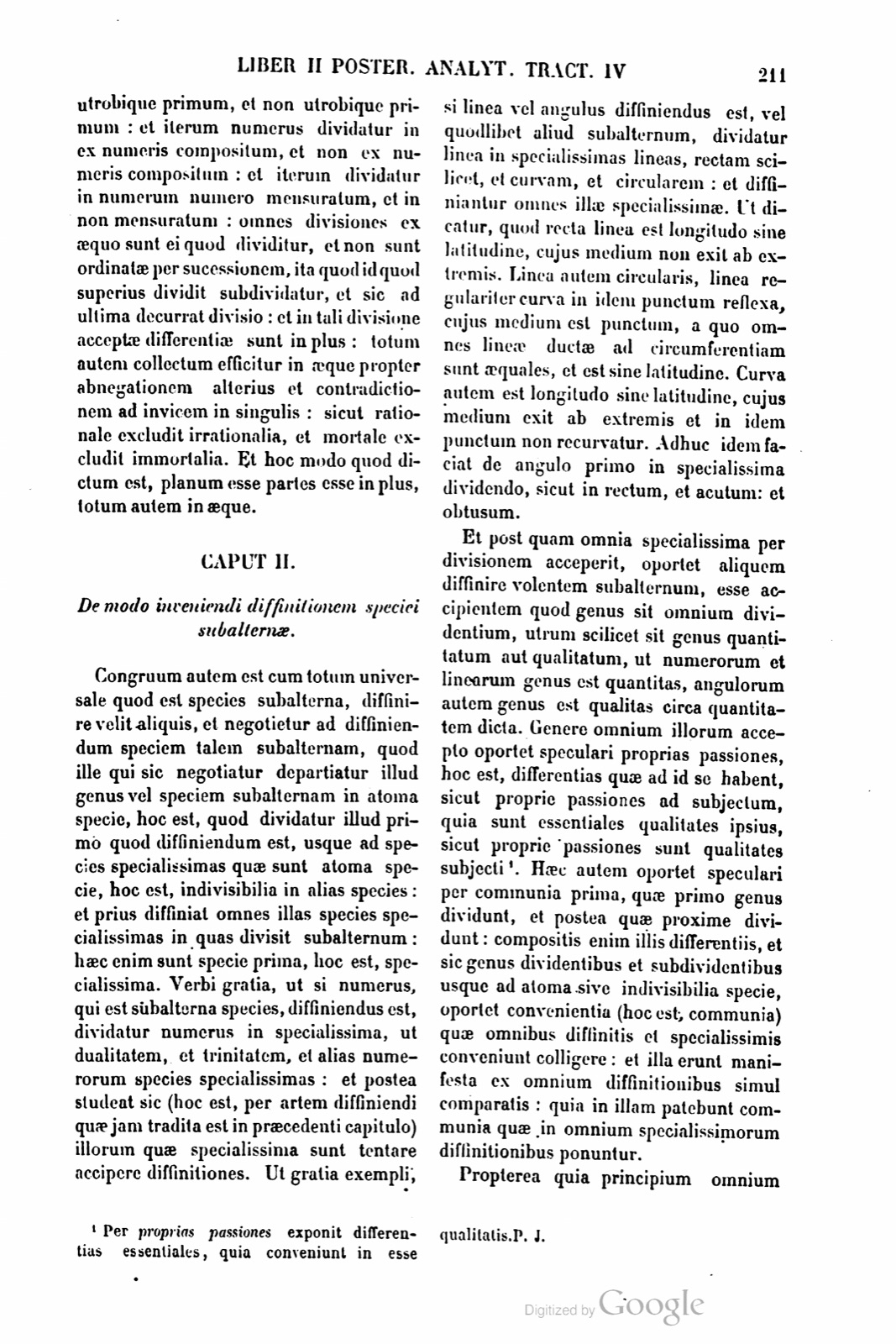
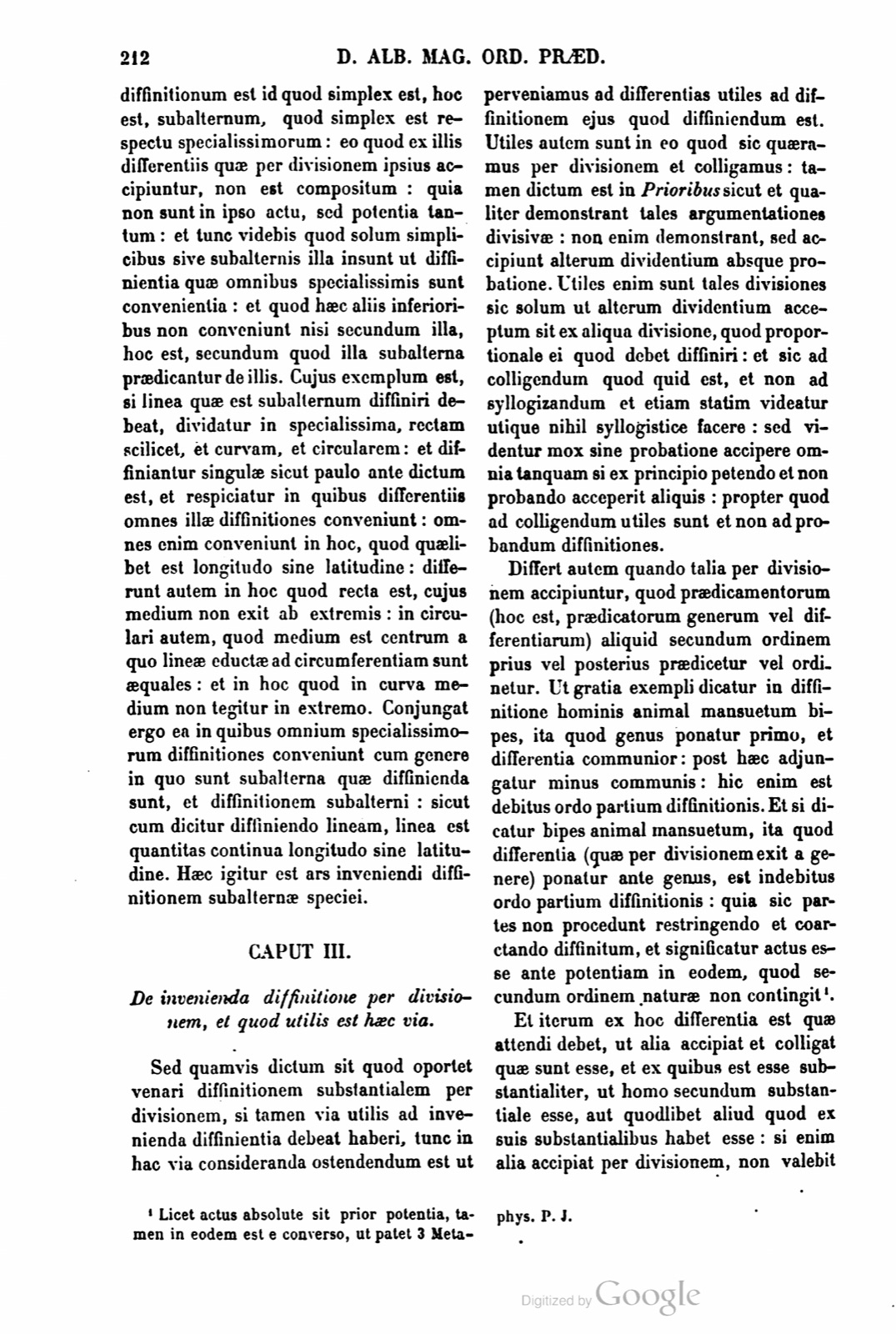
CAPUT II. De modo inveniendi diffinitionem speciei subalternae. Congruum autem est cum totum universale quod est species subalterna, diffinire velit aliquis, et negotietur ad diffiniendum speciem talem subalternam, quod ille qui sic negotiatur departiatur illud genus vel speciem subalternam in atoma specie, hoc est, quod dividatur illud primo quod diffiniendum est, usque ad species specialissimas quae sunt atoma specie, hoc est, indivisibilia in alias species: et prius diffiniat omnes illas species specialissimas in quas divisit subalternum: haec enim sunt specie prima, hoc est, specialissima. Verbi gratia, ut si numerus, qui est subalterna species, diffiniendus est, dividatur numerus in specialissima, ut dualitatem, et trinitatem, et alias numerorum species specialissimas: et postea studeat sic (hoc est, per artem diffiniendi quae jam tradita est in praecedenti capitulo) illorum quae specialissima sunt tentare accipere diffinitiones. Ut gratia exempli, si linea vel angulus diffiniendus est, vel quodlibet aliud subalternum, dividatur linea in specialissimas lineas, rectam scilicet, et curvam, et circularem: et diffiniantur omnes illae specialissimae. Ut dicatur, quod recta linea est longitudo sine latitudine, cujus medium non exit ab extremis. Linea autem circularis, linea regulariter curva in idem punctum reflexa, cujus medium est punctum, a quo omnes lineae ductae ad circumferentiam sunt aequales, et est sine latitudine. Curva autem est longitudo sine latitudine, cujus medium exit ab extremis et in idem punctum non recurvatur. Adhuc idem faciat de angulo primo in specialissima dividendo, sicut in rectum, et acutum: et obtusum. Et postquam omnia specialissima per divisionem acceperit, oportet aliquem diffinire volentem subalternum, esse accipientem quod genus sit omnium dividentium, utrum scilicet sit genus quantitatum aut qualitatum, ut numerorum et linearum genus est quantitas, angulorum autem genus est qualitas circa quantitatem dicta. Genere omnium illorum accepto oportet speculari proprias passiones, hoc est, differentias quae ad id se habent, sicut propriae passiones ad subjectum, quia sunt essentiales qualitates ipsius, sicut propriae passiones sunt qualitates subjecti 1. Haec autem oportet speculari per communia prima, quae primo genus dividunt, et postea quae proxime dividunt: compositis enim illis differentiis, et sic genus dividentibus et subdividentibus usque ad atoma sive indivisibilia specie, oportet convenientia (hoc est, communia) quae omnibus diffinitis et specialissimis conveniunt colligere: et illa erunt manifesta ex omnium diffinitionibus simul comparatis: quia in illam patebunt communia quae in omnium specialissimorum diffinitionibus ponuntur. Propterea quia principium omnium diffinitionum est id quod simplex est, hoc est, subalternum, quod simplex est respectu specialissimorum: eo quod ex illis differentiis quae per divisionem ipsius accipiuntur, non est compositum: quia non sunt in ipso actu, sed potentia tantum: et tunc videbis quod solum simplicibus sive subalternis illa insunt ut diffinientia quae omnibus specialissimis sunt convenientia: et quod haec aliis inferioribus non conveniunt nisi secundum illa, hoc est, secundum quod illa subalterna praedicantur de illis. Cujus exemplum est, si linea quae est subalternum diffiniri debeat, dividatur in specialissima, rectam scilicet, et curvam, et circularem: et diffiniantur singulae sicut paulo ante dictum est, et respiciatur in quibus differentiis omnes illae diffinitiones conveniunt: omnes enim conveniunt in hoc, quod quaelibet est longitudo sine latitudine: differunt autem in hoc quod recta est, cujus medium non exit ab extremis: in circulari autem, quod medium est centrum a quo lineae eductae ad circumferentiam sunt aequales: et in hoc quod in curva medium non tegitur in extremo. Conjungat ergo ea in quibus omnium specialissimorum diffinitiones conveniunt cum genere in quo sunt subalterna quae diffinienda sunt, et diffinitionem subalterni: sicut cum dicitur diffiniendo lineam, linea est quantitas continua longitudo sine latitudine. Haec igitur est ars inveniendi diffinitionem subalternae speciei.
CHAPTER II. On the mode of finding the definition of a subaltern species. But when someone wishes to define a whole universal which is a subaltern species, and is engaged in defining such a subaltern species, it is fitting that the one so engaged should divide that genus or subaltern species into atoms in species, that is, that what is first to be defined should be divided down to most-specific species, which are atoms in species, that is, indivisible into other species; and that he first define all those most-specific species into which he divided the subaltern. For these are first in species, that is, most-specific. For example, if number, which is a subaltern species, must be defined, let number be divided into most-specific things, such as duality and trinity and other most-specific species of numbers; and afterward let him thus study, that is, through the art of defining which has now been handed down in the preceding chapter, to try to receive the definitions of those things which are most-specific. As for the sake of example, if line or angle must be defined, or anything else subaltern, let line be divided into most-specific lines, namely straight, curved, and circular; and let all those most-specific things be defined. Thus let it be said that a straight line is length without breadth, whose middle does not go out from the extremes. But a circular line is a line regularly curved back into the same point, whose middle is a point from which all lines drawn to the circumference are equal, and it is without breadth. But a curved line is length without breadth, whose middle goes out from the extremes and is not curved back into the same point. Moreover let him do the same concerning angle, first by dividing into most-specific things, as into right, acute, and obtuse. And after he has received all the most-specific things through division, one wishing to define the subaltern must be receiving what genus there is of all the dividing things, namely whether it is the genus of quantities or of qualities, as the genus of numbers and lines is quantity, but the genus of angles is quality spoken of around quantity. When the genus of all those has been received, one must consider the proper passions, that is, the differences which are related to it as proper passions to a subject, because they are its essential qualities, just as proper passions are qualities of the subject 1. But one must consider these through the first common things, which first divide the genus, and afterward those which divide proximately. For when those differences have been composed, and so divide and subdivide the genus down to atoms or things indivisible in species, one must gather the agreeing things, that is, the common things, which belong to all the defined and most-specific things; and those will be manifest from the definitions of all compared together, because in that comparison the common things will be evident which are posited in the definitions of all the most-specific things. For this reason, because the principle of all definitions is that which is simple, that is, the subaltern, which is simple with respect to the most-specific things, because it is not composed from those differences which are received through its division, since they are not in it in act but only in potency. And then you will see that only to simple or subaltern things do those things belong as defining things which are agreeing with all the most-specific things; and that these do not belong to other inferior things except according to those, that is, according as those subalterns are predicated of them. An example of this is if line, which is a subaltern, ought to be defined; let it be divided into most-specific things, namely straight, curved, and circular; and let the individual ones be defined as was said a little before, and let it be observed in which differences all those definitions agree. For all agree in this, that each is length without breadth; but they differ in this, that the straight line is that whose middle does not go out from the extremes; but in the circular line, that the middle is the center from which lines drawn to the circumference are equal; and in this, that in the curved line the middle is not covered in the extreme. Therefore let him join those things in which the definitions of all the most-specific things agree with the genus in which are the subalterns that must be defined, and the definition of the subaltern: as when line is defined, line is a continuous quantity, length without breadth. This therefore is the art of finding the definition of a subaltern species.
Notes
- He explains essential differences through proper passions, because they agree in the being of quality. P. J. (Per proprias passiones exponit differentias essentiales, quia conveniunt in esse qualitatis. P. J.) ↩
If a page does not appear, its photograph has not been uploaded yet.