Works › Posterior Analytics, Books I–II
Volume 2 · pp. 198–199
Chapter II. In what way demonstration is through the material and formal cause.
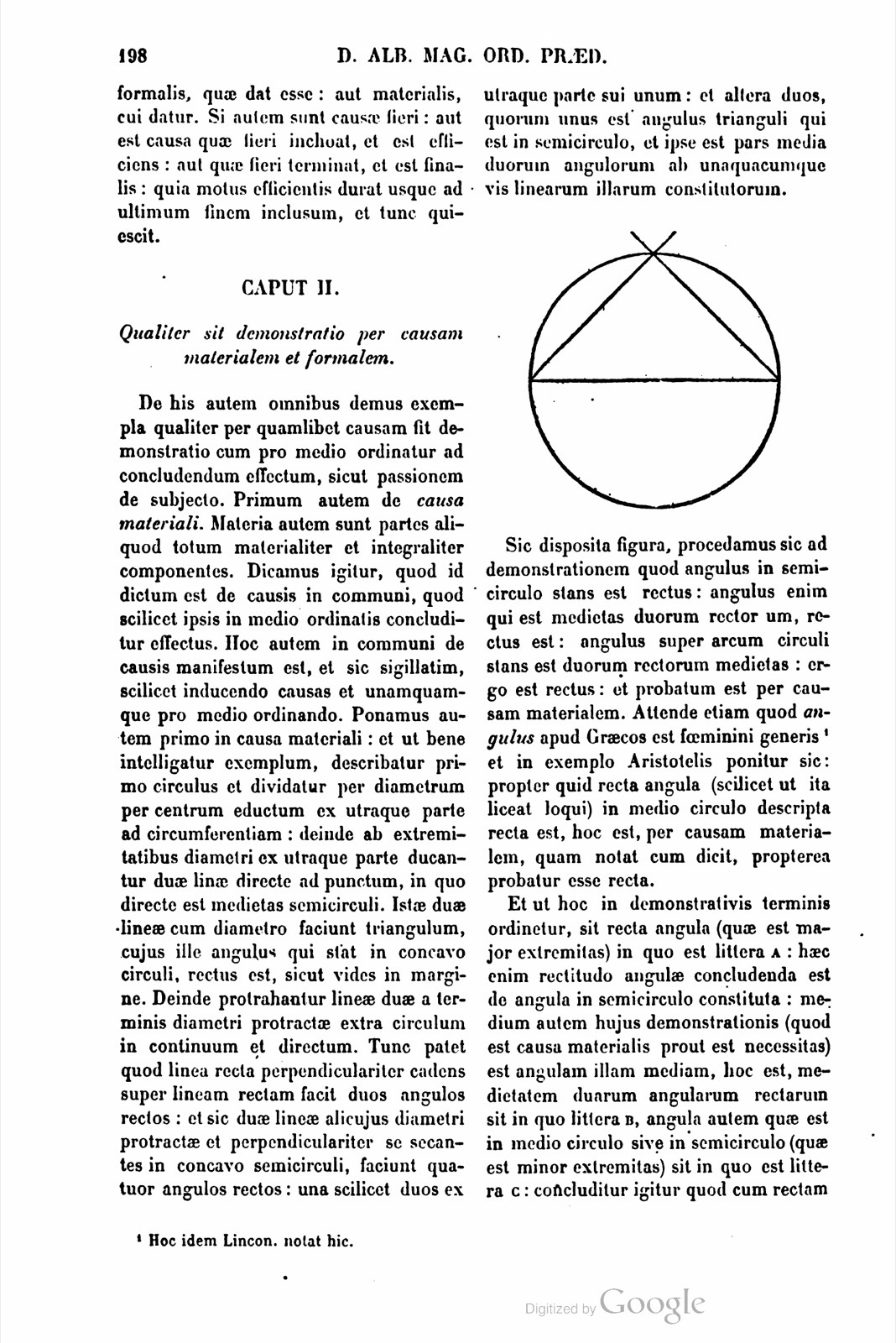
CAPUT II. Qualiter sit demonstratio per causam materialem et formalem. De his autem omnibus demus exempla qualiter per quamlibet causam fit demonstratio cum pro medio ordinatur ad concludendum effectum, sicut passionem de subjecto. Primum autem de causa materiali. Materia autem sunt partes aliquod totum materialiter et integraliter componentes. Dicamus igitur, quod id dictum est de causis in communi, quod scilicet ipsis in medio ordinatis concluditur effectus. Hoc autem in communi de causis manifestum est, et sic sigillatim, scilicet inducendo causas et unamquamque pro medio ordinando. Ponamus autem primo in causa materiali: et ut bene intelligatur exemplum, describatur primo circulus et dividatur per diametrum per centrum eductum ex utraque parte ad circumferentiam: deinde ab extremitatibus diametri ex utraque parte ducantur duae lineae directe ad punctum, in quo directe est medietas semicirculi. Istae duae lineae cum diametro faciunt triangulum, cujus ille angulus qui stat in concavo circuli, rectus est, sicut vides in margine. Deinde protrahantur lineae duae a terminis diametri protractae extra circulum in continuum et directum. Tunc patet quod linea recta perpendiculariter cadens super lineam rectam facit duos angulos rectos: et sic duae lineae alicujus diametri protractae et perpendiculariter se secantes in concavo semicirculi, faciunt quatuor angulos rectos: una scilicet duos ex utraque parte sui unum: et altera duos, quorum unus est angulus trianguli qui est in semicirculo, et ipse est pars media duorum angulorum ab unaquacumque vis linearum illarum constitutorum. Sic disposita figura, procedamus sic ad demonstrationem quod angulus in semicirculo stans est rectus: angulus enim qui est medietas duorum rectorum, rectus est: angulus super arcum circuli stans est duorum rectorum medietas: ergo est rectus: et probatum est per causam materialem. Attende etiam quod angulus apud Graecos est foeminini generis 1 et in exemplo Aristotelis ponitur sic: propter quid recta angula (scilicet ut ita liceat loqui) in medio circulo descripta recta est, hoc est, per causam materialem, quam notat cum dicit, propterea probatur esse recta. Et ut hoc in demonstrativis terminis ordinetur, sit recta angula (quae est major extremitas) in quo est littera A: haec enim rectitudo angulae concludenda est de angula in semicirculo constituta: medium autem hujus demonstrationis (quod est causa materialis prout est necessitas) est angulam illam mediam, hoc est, medietatem duarum angularum rectarum sit in quo littera B, angula autem quae est in medio circulo sive in semicirculo (quae est minor extremitas) sit in quo est littera C: concluditur igitur quod cum rectam angulam esse est in C, hoc est, in angula semicirculi. Causa autem per quam concluditur est B: hoc enim quod est B aequale est cum A, quia medietas duorum rectorum est una angula recta: et una angula recta est A: B ergo et aequaliter angulae sunt: et B est recta; ergo et A recta. Ei vero quod est C (hoc est, angulae in semicirculo positae) inest B medium: eo quod B positum est esse duarum angularum rectarum medium. Existente autem C medio duarum rectarum angularum (sicut dicit minor propositio) concludetur, quod A major extremitas (quae est rectam esse angulam) in C est in conclusione, sicut major extremitas est in minori. Hoc autem quod est C erat angulam in semicirculo existentem rectam esse: et hoc erat propositum. Huic autem conclusioni idem est (quoad conclusionem eamdem inferendam) id quod erat esse (hoc est, diffinitio) recti, cum hoc aliquis demonstrare volens per causam formalem ratione diffinitiva significando pro medio poneret. At vero si aliquis diceret quod diffinitio medium esse non posset, dicimus quod causa formalis quid erat esse in diffinitione dicens, jam in ante habitis significata et probata est esse medium: et tunc sic erit arguendum: omne cujus ratio rectitudinis habetur, rectum est: anguli in semicirculo constituti ratio est rectitudinis: ergo est rectus. Ratio enim rectitudinis est in angulo aequalitas angulorum ex utraque lineae perpendiculariter super aliam lineam stantis et duos rectos ex utraque parte sui facientis, sicut vides in margine. Secundum autem causam materialem sic arguitur: omne quod est medietas duorum rectorum, est rectum: angulus in semicirculo est medietas duorum rectorum: ergo est rectus. Hoc igitur modo arguitur per causam materialem et per causam formalem. Exempla autem quae ponuntur, non sunt potissimae demonstrationis, sed inducuntur ad ostensionem, quod ex ordinatione causae pro medio concluditur effectus.
CHAPTER II. In what way demonstration is through the material and formal cause. But concerning all these let us give examples of how demonstration is made through each cause when it is ordered as the middle for concluding the effect, as a passion of a subject. But first concerning the material cause. Now matter is the parts composing some whole materially and integrally. Therefore let us say that this has been said about causes in common, namely that when they are ordered in the middle, the effect is concluded. But this is manifest concerning causes in common, and thus singly, namely by introducing the causes and ordering each one as the middle. But let us posit first in the material cause; and so that the example may be well understood, let a circle first be described and let it be divided by a diameter drawn through the center from each side to the circumference. Then from the ends of the diameter on each side let two lines be drawn directly to the point in which directly there is the middle of the semicircle. Those two lines with the diameter make a triangle, of which that angle which stands in the concavity of the circle is right, as you see in the margin. Then let the two lines drawn from the termini of the diameter be extended outside the circle in a continuous and straight line. Then it is clear that a straight line falling perpendicularly upon a straight line makes two right angles; and thus the two lines of some diameter, extended and cutting one another perpendicularly in the concavity of the semicircle, make four right angles: one, namely, two, one on each side of itself; and the other two, of which one is the angle of the triangle which is in the semicircle, and that angle is the middle part of the two angles constituted by either one of those lines. With the figure thus disposed, let us proceed thus to the demonstration that the angle standing in the semicircle is right: for the angle which is the half of two right angles is right; the angle standing upon the arc of a circle is the half of two right angles; therefore it is right; and it has been proved through the material cause. Attend also that among the Greeks angle is of the feminine gender 1, and in Aristotle's example it is posited thus: on account of what is the right angle, described in the middle of the circle, right, namely, that we may be allowed to speak so? That is, through the material cause, which he notes when he says that therefore it is proved to be right. And so that this may be ordered in demonstrative terms, let the right angle, which is the greater extremity, be that in which the letter A is; for this rectitude of the angle is to be concluded of the angle constituted in the semicircle. But let the middle of this demonstration, which is the material cause insofar as it is necessity, be that that middle angle, that is, the half of two right angles, is that in which the letter B is; but let the angle which is in the middle of the circle or in the semicircle, which is the lesser extremity, be that in which the letter C is. Therefore it is concluded that, since to be a right angle is in C, that is, in the angle of the semicircle. But the cause through which it is concluded is B; for this which is B is equal with A, because the half of two right angles is one right angle, and one right angle is A; therefore B and the angles are equally so, and B is right; therefore A also is right. But to that which is C, that is, to the angle posited in the semicircle, the middle B belongs, because B has been posited as being the middle of two right angles. But when C exists as the middle of two right angles, as the minor proposition says, it will be concluded that A, the greater extremity, which is to be a right angle, is in C in the conclusion, just as the greater extremity is in the lesser. But this which is C was the angle existing in the semicircle being right; and this was the proposed point. But to this conclusion the what-it-was-to-be, that is, the definition, of the right is the same, as to the inferring of the same conclusion, when someone wishing to demonstrate this through the formal cause would posit it as the middle by signifying with a definitive account. But if someone were to say that definition could not be the middle, we say that the formal cause saying what it was to be in definition has already in the matters had before been signified and proved to be the middle; and then one must argue thus: everything of which the account of rectitude is had is right; of the angle constituted in the semicircle the account is rectitude; therefore it is right. For the account of rectitude in an angle is the equality of angles from each side of a line standing perpendicularly upon another line and making two right angles on each side of itself, as you see in the margin. But according to the material cause one argues thus: everything which is the half of two right angles is right; the angle in a semicircle is the half of two right angles; therefore it is right. Therefore in this mode one argues through the material cause and through the formal cause. But the examples which are posited are not examples of the most powerful demonstration, but are introduced for showing that from the ordering of a cause as the middle the effect is concluded.
Notes
- Lincoln notes this same thing here. (Hoc idem Lincon. notat hic.) ↩
If a page does not appear, its photograph has not been uploaded yet.