Works › Posterior Analytics, Books I–II
Volume 2 · pp. 199–200
Chapter III. In what way it is made through the efficient cause, and in what way through the final cause.
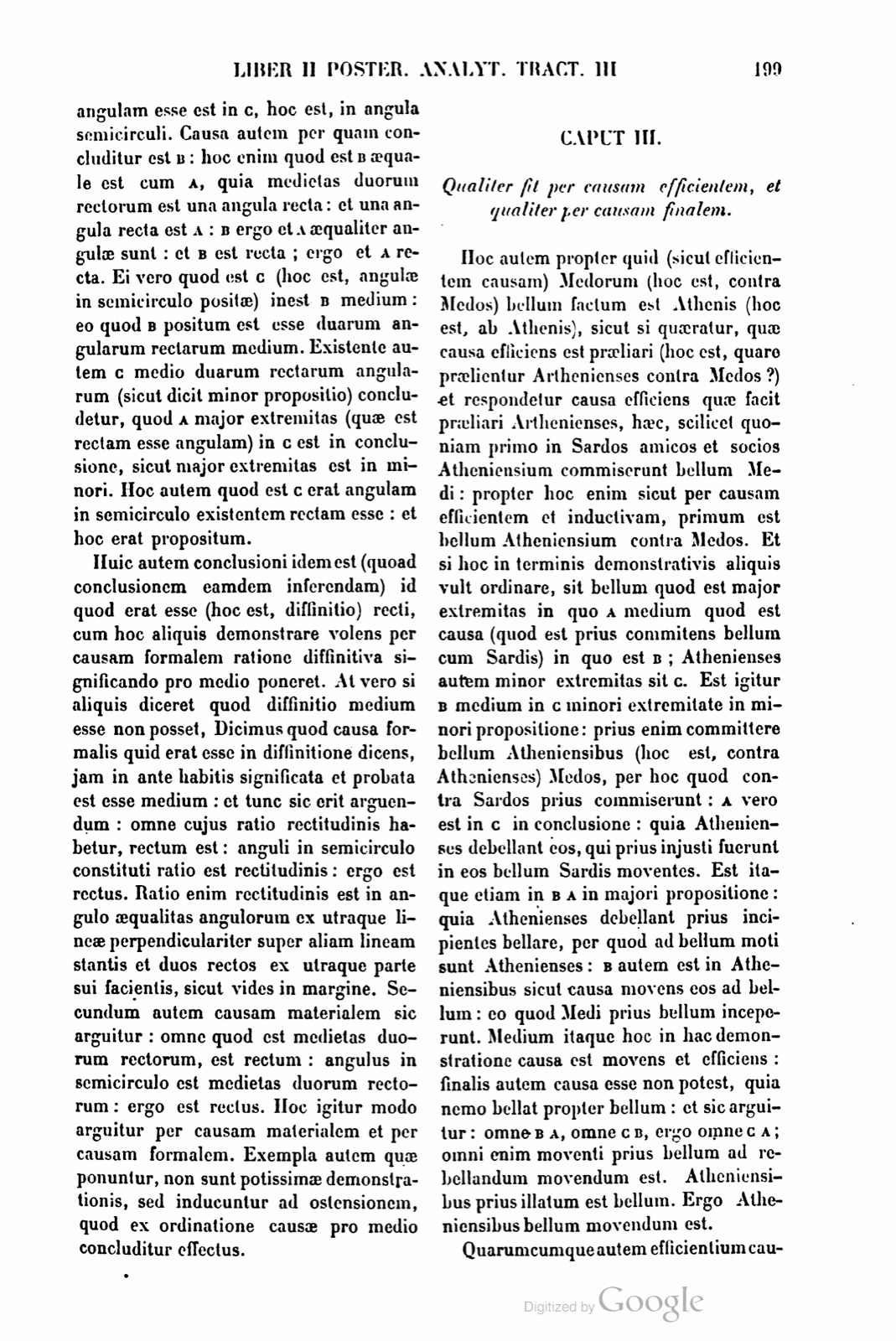
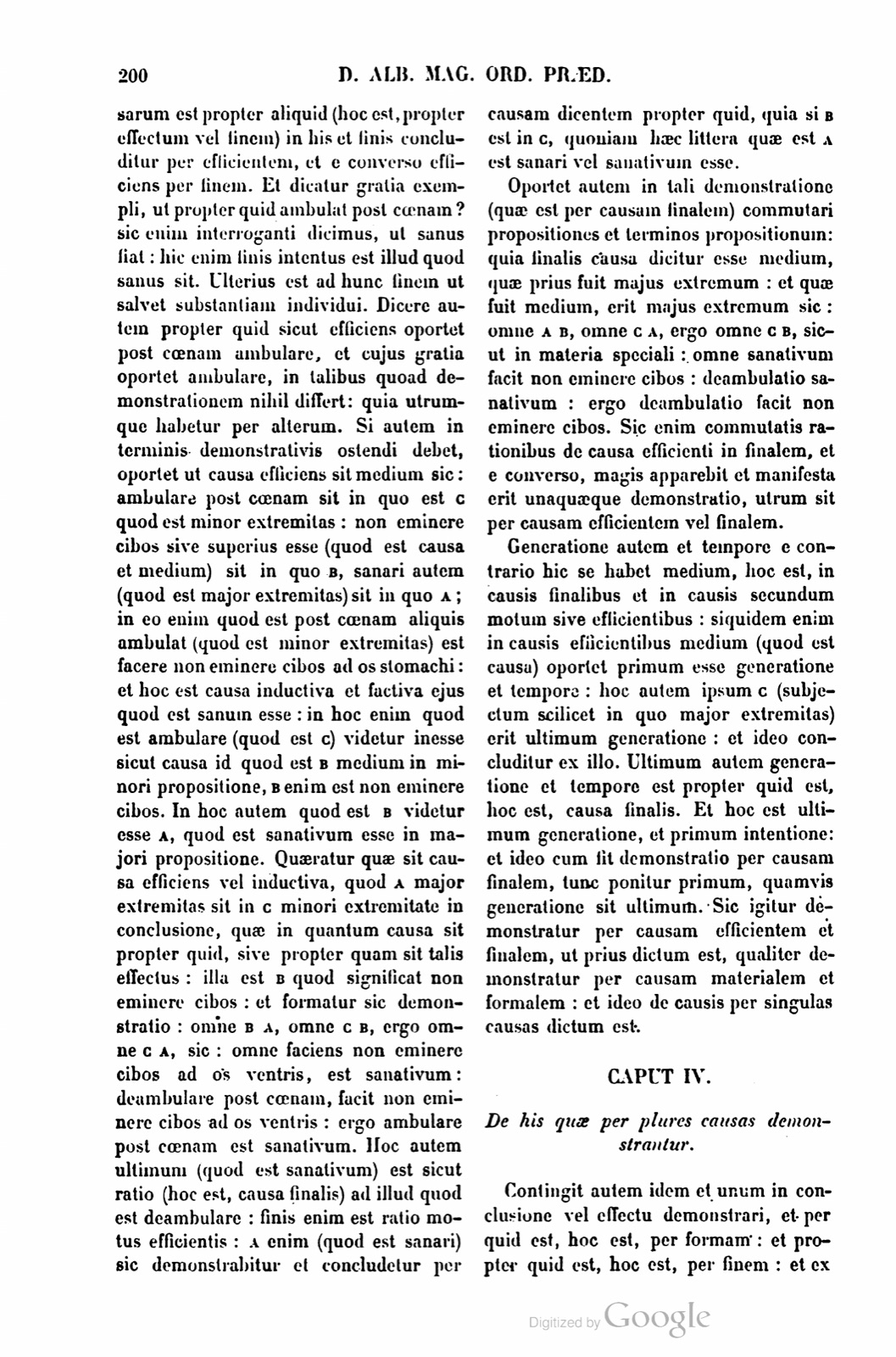
CAPUT III. Qualiter fit per causam efficientem, et qualiter per causam finalem. Hoc autem propter quid (sicut efficientem causam) Medorum (hoc est, contra Medos) bellum factum est Athenis (hoc est, ab Athenis), sicut si quaeratur, quae causa efficiens est praeliari (hoc est, quare praelientur Athenienses contra Medos?) et respondetur causa efficiens quae facit praeliari Athenienses, haec, scilicet quoniam primo in Sardos amicos et socios Atheniensium commiserunt bellum Medi: propter hoc enim sicut per causam efficientem et inductivam, primum est bellum Atheniensium contra Medos. Et si hoc in terminis demonstrativis aliquis vult ordinare, sit bellum quod est major extremitas in quo A, medium quod est causa (quod est prius commitens bellum cum Sardis) in quo est B; Athenienses autem minor extremitas sit C. Est igitur B medium in C minori extremitate in minori propositione: prius enim committere bellum Atheniensibus (hoc est, contra Athenienses) Medos, per hoc quod contra Sardos prius commiserunt: A vero est in C in conclusione: quia Athenienses debellant eos, qui prius injusti fuerunt in eos bellum Sardis moventes. Est itaque etiam in B A in majori propositione: quia Athenienses debellant prius incipientes bellare, per quod ad bellum moti sunt Athenienses: B autem est in Atheniensibus sicut causa movens eos ad bellum: eo quod Medi prius bellum inceperunt. Medium itaque hoc in hac demonstratione causa est movens et efficiens: finalis autem causa esse non potest, quia nemo bellat propter bellum: et sic arguitur: omne B A, omne C B, ergo omne C A; omni enim moventi prius bellum ad rebellandum movendum est. Atheniensibus prius illatum est bellum. Ergo Atheniensibus bellum movendum est. Quarumcumque autem efficientium causarum est propter aliquid (hoc est, propter effectum vel finem) in his et finis concluditur per efficientem, et e converso efficiens per finem. Et dicatur gratia exempli, ut propter quid ambulat post coenam? sic enim interroganti dicimus, ut sanus fiat: hic enim finis intentus est illud quod sanus sit. Ulterius est ad hunc finem ut salvet substantiam individui. Dicere autem propter quid sicut efficiens oportet post coenam ambulare, et cujus gratia oportet ambulare, in talibus quoad demonstrationem nihil differt: quia utrumque habetur per alterum. Si autem in terminis demonstrativis ostendi debet, oportet ut causa efficiens sit medium sic: ambulare post coenam sit in quo est C quod est minor extremitas: non eminere cibos sive superius esse (quod est causa et medium) sit in quo B, sanari autem (quod est major extremitas) sit in quo A; in eo enim quod est post coenam aliquis ambulat (quod est minor extremitas) est facere non eminere cibos ad os stomachi: et hoc est causa inductiva et factiva ejus quod est sanum esse: in hoc enim quod est ambulare (quod est C) videtur inesse sicut causa id quod est A medium in minori propositione, B enim est non eminere cibos. In hoc autem quod est B videtur esse A, quod est sanativum esse in majori propositione. Quaeratur quae sit causa efficiens vel inductiva, quod A major extremitas sit in C minori extremitate in conclusione, quae in quantum causa sit propter quid, sive propter quam sit talis effectus: illa est A quod significat non eminere cibos: et formatur sic demonstratio: omne B A, omne C B, ergo omne C A, sic: omne faciens non eminere cibos ad os ventris, est sanativum: deambulare post coenam, facit non eminere cibos ad os ventris: ergo ambulare post coenam est sanativum. Hoc autem ultimum (quod est sanativum) est sicut ratio (hoc est, causa finalis) ad illud quod est deambulare: finis enim est ratio motus efficientis: A enim (quod est sanari) sic demonstrabitur et concludetur per causam dicentem propter quid, quia si B est in C, quoniam haec littera quae est A est sanari vel sanativum esse. Oportet autem in tali demonstratione (quae est per causam finalem) commutari propositiones et terminos propositionum: quia finalis causa dicitur esse medium, quae prius fuit majus extremum: et quae fuit medium, erit majus extremum sic: omne A B, omne C A, ergo omne C B, sicut in materia speciali: omne sanativum facit non eminere cibos: deambulatio sanativum: ergo deambulatio facit non eminere cibos. Sic enim commutatis rationibus de causa efficienti in finalem, et e converso, magis apparebit et manifesta erit unaquaeque demonstratio, utrum sit per causam efficientem vel finalem. Generatione autem et tempore e contrario hic se habet medium, hoc est, in causis finalibus et in causis secundum motum sive efficientibus: siquidem enim in causis efficientibus medium (quod est causa) oportet primum esse generatione et tempore: hoc autem ipsum C (subjectum scilicet in quo major extremitas) erit ultimum generatione: et ideo concluditur ex illo. Ultimum autem generatione et tempore est propter quid est, hoc est, causa finalis. Et hoc est ultimum generatione, et primum intentione: et ideo cum fit demonstratio per causam finalem, tunc ponitur primum, quamvis in generatione sit ultimum. Sic igitur demonstratur per causam efficientem et finalem, ut prius dictum est, qualiter demonstratur per causam materialem et formalem: et ideo de causis per singulas causas dictum est.
CHAPTER III. In what way it is made through the efficient cause, and in what way through the final cause. But this on-account-of-what, as an efficient cause, namely why the war of the Medes, that is, against the Medes, was made at Athens, that is, by the Athenians, is as if it is asked what efficient cause there is for fighting, that is, why the Athenians fight against the Medes, and there is answered the efficient cause which makes the Athenians fight, namely this: because first the Medes committed war against the Sardians, friends and allies of the Athenians. For on account of this, as through an efficient and inducing cause, the war of the Athenians against the Medes is first. And if someone wishes to order this in demonstrative terms, let war, which is the greater extremity, be that in which A is; let the middle which is the cause, namely the earlier committing of war with the Sardians, be that in which B is; but let the Athenians, the lesser extremity, be C. Therefore the middle B is in C, the lesser extremity, in the minor proposition; for the Medes earlier committed war against the Athenians, that is, against the Athenians, through the fact that they earlier committed it against the Sardians. But A is in C in the conclusion, because the Athenians wage war against those who were earlier unjust toward them by moving war against the Sardians. And so A is also in B in the major proposition, because the Athenians wage war against those first beginning to fight, through which the Athenians were moved to war. But B is in the Athenians as the cause moving them to war, because the Medes earlier began the war. Therefore this middle in this demonstration is the moving and efficient cause; but it cannot be the final cause, because no one fights for the sake of war. And thus one argues: every B is A, every C is B, therefore every C is A; for by every prior mover of war one must be moved to fighting back. War was earlier brought upon the Athenians. Therefore war must be moved by the Athenians. But of whatever efficient causes there is something on account of which, that is, on account of the effect or end, in these things the end is concluded through the efficient cause, and conversely the efficient cause through the end. And let it be said for the sake of example: on account of what does one walk after supper? For to one asking thus we say, so that he may become healthy; for here the intended end is that he should be healthy. Further, it is ordered to this end, that he preserve the substance of the individual. But in such matters, as regards demonstration, it differs in no way to say on account of what as the efficient cause one must walk after supper, and for the sake of what one must walk, because each is had through the other. But if it must be shown in demonstrative terms, it is necessary that the efficient cause be the middle thus: let walking after supper be that in which C is, which is the lesser extremity; let the food not rise or be above, which is the cause and middle, be that in which B is; but let being healed, which is the greater extremity, be that in which A is. For in this, that someone walks after supper, which is the lesser extremity, there is causing food not to rise to the mouth of the stomach; and this is the inducing and making cause of that which is to be healthy. For in this which is to walk, which is C, there seems to belong as cause that which is the middle A in the minor proposition, for B is food not rising. But in this which is B, A seems to be, which is to be healing in the major proposition. Let it be asked what the efficient or inducing cause is, that A, the greater extremity, should be in C, the lesser extremity, in the conclusion, which insofar as it is a cause is the on-account-of-what, or that on account of which such an effect exists. That is A, which signifies food not rising; and the demonstration is formed thus: every B is A, every C is B, therefore every C is A, thus: everything causing food not to rise to the mouth of the belly is healing; walking after supper causes food not to rise to the mouth of the belly; therefore walking after supper is healing. But this last thing, which is healing, is as the account, that is, the final cause, with respect to that which is walking; for the end is the account of the motion of the efficient cause. For A, which is to be healed, will thus be demonstrated and concluded through the cause saying on account of what, because if B is in C, since this letter which is A is being healed or being healing. But in such a demonstration, which is through the final cause, the propositions and the terms of the propositions must be exchanged, because the final cause is said to be the middle which previously was the greater extremity; and that which was the middle will be the greater extremity thus: every A is B, every C is A, therefore every C is B, as in the special matter: everything healing makes food not rise; walking is healing; therefore walking makes food not rise. For when the accounts have thus been exchanged from the efficient cause into the final cause and conversely, each demonstration will appear more and will be manifest, whether it is through the efficient or through the final cause. But in generation and time the middle has itself here contrariwise, that is, in final causes and in causes according to motion or efficient causes. For in efficient causes the middle, which is the cause, must be first in generation and time; but this C itself, namely the subject in which the greater extremity is, will be last in generation, and therefore it is concluded from that. But what is last in generation and time is the on-account-of-what, that is, the final cause. And this is last in generation and first in intention; and therefore when demonstration is made through the final cause, then it is posited first, although in generation it is last. Thus therefore demonstration is made through the efficient and final cause, as before it was said how demonstration is made through the material and formal cause; and therefore concerning causes it has been said through the individual causes.
If a page does not appear, its photograph has not been uploaded yet.