Works › Posterior Analytics, Books I–II
Volume 2 · pp. 188–190
Chapter X. On the doubt of the ancients, which definition is according to species and which according to matter.
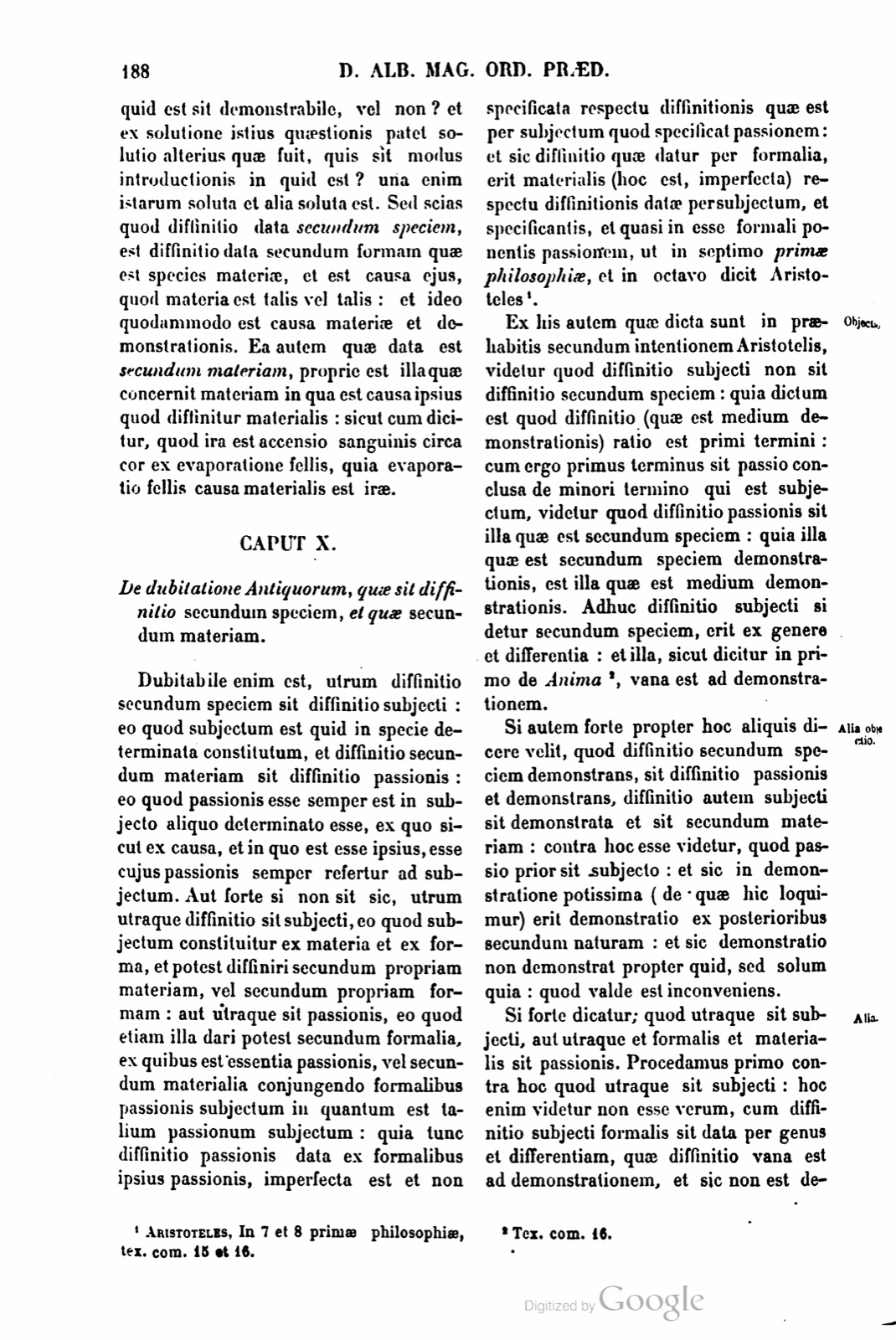
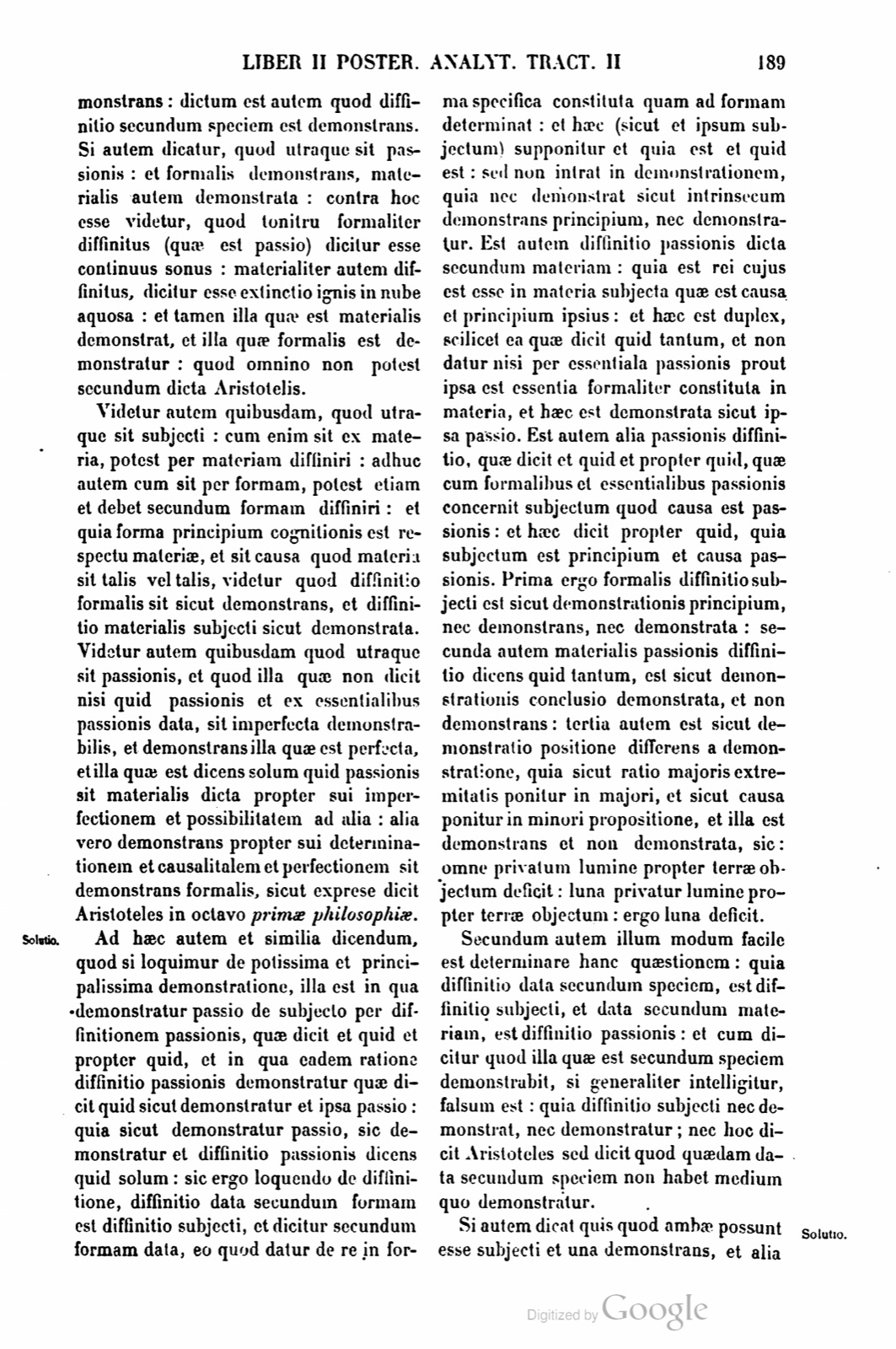
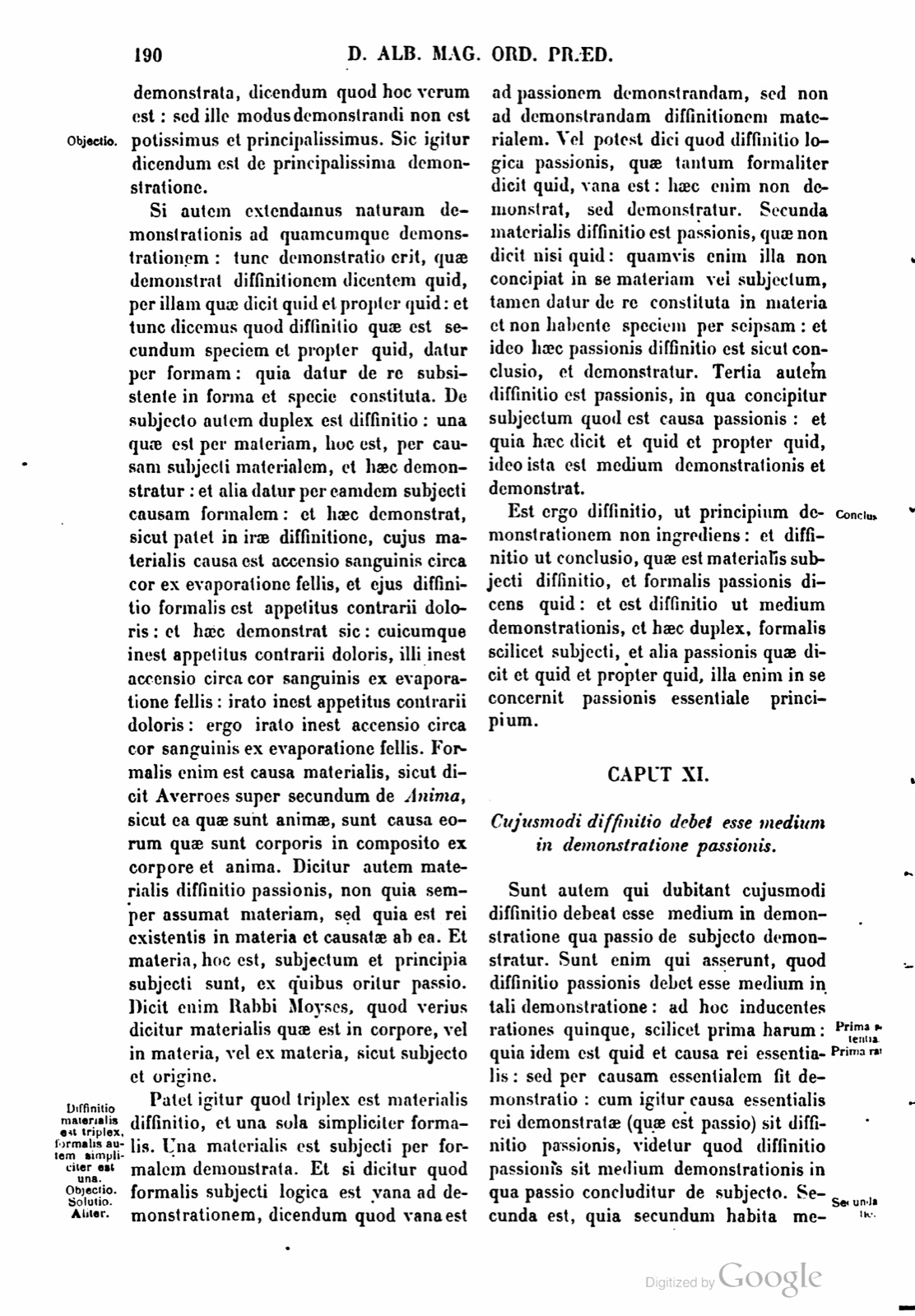
CAPUT X. De dubitatione Antiquorum, quae sit diffinitio secundum speciem, et quae secundum materiam. Dubitabile enim est, utrum diffinitio secundum speciem sit diffinitio subjecti: eo quod subjectum est quid in specie determinata constitutum, et diffinitio secundum materiam sit diffinitio passionis: eo quod passionis esse semper est in subjecto aliquo determinato esse, ex quo sicut ex causa, et in quo est esse ipsius, esse cujus passionis semper refertur ad subjectum. Aut forte si non sit sic, utrum utraque diffinitio sit subjecti, eo quod subjectum constituitur ex materia et ex forma, et potest diffiniri secundum propriam materiam, vel secundum propriam formam: aut utraque sit passionis, eo quod etiam illa dari potest secundum formalia, ex quibus est essentia passionis, vel secundum materialia conjungendo formalibus passionis subjectum in quantum est talium passionum subjectum: quia tunc diffinitio passionis data ex formalibus ipsius passionis, imperfecta est et non specificata respectu diffinitionis quae est per subjectum quod specificat passionem: et sic diffinitio quae datur per formalia, erit materialis (hoc est, imperfecta) respectu diffinitionis datae per subjectum, et specificantis, et quasi in esse formali ponentis passionem, ut in septimo primae philosophiae, et in octavo dicit Aristoteles 1. <marginal-label>Objectio.</marginal-label> Ex his autem quae dicta sunt in praehabitis secundum intentionem Aristotelis, videtur quod diffinitio subjecti non sit diffinitio secundum speciem: quia dictum est quod diffinitio (quae est medium demonstrationis) ratio est primi termini: cum ergo primus terminus sit passio conclusa de minori termino qui est subjectum, videtur quod diffinitio passionis sit illa quae est secundum speciem: quia illa quae est secundum speciem demonstrationis, est illa quae est medium demonstrationis. Adhuc diffinitio subjecti si detur secundum speciem, erit ex genere et differentia: et illa, sicut dicitur in primo de Anima 2, vana est ad demonstrationem. <marginal-label>Alia objectio.</marginal-label> Si autem forte propter hoc aliquis dicere velit, quod diffinitio secundum speciem demonstrans, sit diffinitio passionis et demonstrans, diffinitio autem subjecti sit demonstrata et sit secundum materiam: contra hoc esse videtur, quod passio prior sit subjecto: et sic in demonstratione potissima (de qua hic loquimur) erit demonstratio ex posterioribus secundum naturam: et sic demonstratio non demonstrat propter quid, sed solum quia: quod valde est inconveniens. <marginal-label>Alia.</marginal-label> Si forte dicatur; quod utraque sit subjecti, aut utraque et formalis et materialis sit passionis. Procedamus primo contra hoc quod utraque sit subjecti: hoc enim videtur non esse verum, cum diffinitio subjecti formalis sit data per genus et differentiam, quae diffinitio vana est ad demonstrationem, et sic non est demonstrans: dictum est autem quod diffinitio secundum speciem est demonstrans. Si autem dicatur, quod utraque sit passionis: et formalis demonstrans, materialis autem demonstrata: contra hoc esse videtur, quod tonitru formaliter diffinitus (quae est passio) dicitur esse continuus sonus: materialiter autem diffinitus, dicitur esse extinctio ignis in nube aquosa: et tamen illa quae est materialis demonstrat, et illa quae formalis est demonstratur: quod omnino non potest secundum dicta Aristotelis. Videtur autem quibusdam, quod utraque sit subjecti: cum enim sit ex materia, potest per materiam diffiniri: adhuc autem cum sit per formam, potest etiam et debet secundum formam diffiniri: et quia forma principium cognitionis est respectu materiae, et sit causa quod materia sit talis vel talis, videtur quod diffinitio formalis sit sicut demonstrans, et diffinitio materialis subjecti sicut demonstrata. Videtur autem quibusdam quod utraque sit passionis, et quod illa quae non dicit nisi quid passionis et ex essentialibus passionis data, sit imperfecta demonstrabilis, et demonstrans illa quae est perfecta, et illa quae est dicens solum quid passionis sit materialis dicta propter sui imperfectionem et possibilitatem ad alia: alia vero demonstrans propter sui determinationem et causalitatem et perfectionem sit demonstrans formalis, sicut expresse dicit Aristoteles in octavo primae philosophiae. <marginal-label>Solutio.</marginal-label> Ad haec autem et similia dicendum, quod si loquimur de potissima et principalissima demonstratione, illa est in qua demonstratur passio de subjecto per diffinitionem passionis, quae dicit et quid et propter quid, et in qua eadem ratione diffinitio passionis demonstratur quae dicit quid sicut demonstratur et ipsa passio: quia sicut demonstratur passio, sic demonstratur et diffinitio passionis dicens quid solum: sic ergo loquendo de diffinitione, diffinitio data secundum formam est diffinitio subjecti, et dicitur secundum formam data, eo quod datur de re in forma specifica constituta quam ad formam determinat: et haec (sicut et ipsum subjectum) supponitur et quia est et quid est: sed non intrat in demonstrationem, quia nec demonstrat sicut intrinsecum demonstrans principium, nec demonstratur. Est autem diffinitio passionis dicta secundum materiam: quia est rei cujus est esse in materia subjecta quae est causa et principium ipsius: et haec est duplex, scilicet ea quae dicit quid tantum, et non datur nisi per essentialia passionis prout ipsa est essentia formaliter constituta in materia, et haec est demonstrata sicut ipsa passio. Est autem alia passionis diffinitio, quae dicit et quid et propter quid, quae cum formalibus et essentialibus passionis concernit subjectum quod causa est passionis: et haec dicit propter quid, quia subjectum est principium et causa passionis. Prima ergo formalis diffinitio subjecti est sicut demonstrationis principium, nec demonstrans, nec demonstrata: secunda autem materialis passionis diffinitio dicens quid tantum, est sicut demonstrationis conclusio demonstrata, et non demonstrans: tertia autem est sicut demonstratio positione differens a demonstratione, quia sicut ratio majoris extremitatis ponitur in majori, et sicut causa ponitur in minori propositione, et illa est demonstrans et non demonstrata, sic: omne privatum lumine propter terrae objectum deficit: luna privatur lumine propter terrae objectum: ergo luna deficit. <marginal-label>Solutio.</marginal-label> Secundum autem illum modum facile est determinare hanc quaestionem: quia diffinitio data secundum speciem, est diffinitio subjecti, et data secundum materiam, est diffinitio passionis: et cum dicitur quod illa quae est secundum speciem demonstrabit, si generaliter intelligitur, falsum est: quia diffinitio subjecti nec demonstrat, nec demonstratur; nec hoc dicit Aristoteles sed dicit quod quaedam data secundum speciem non habet medium quo demonstratur. Si autem dicat quis quod ambae possunt esse subjecti et una demonstrans, et alia demonstrata, dicendum quod hoc verum est: sed ille modus demonstrandi non est potissimus et principalissimus. Sic igitur dicendum est de principalissima demonstratione. <marginal-label>Objectio.</marginal-label> Si autem extendamus naturam demonstrationis ad quamcumque demonstrationem: tunc demonstratio erit, quae demonstrat diffinitionem dicentem quid, per illam quae dicit quid et propter quid: et tunc dicemus quod diffinitio quae est secundum speciem et propter quid, datur per formam: quia datur de re subsistente in forma et specie constituta. De subjecto autem duplex est diffinitio: una quae est per materiam, hoc est, per causam subjecti materialem, et haec demonstratur: et alia datur per eamdem subjecti causam formalem: et haec demonstrat, sicut patet in irae diffinitione, cujus materialis causa est accensio sanguinis circa cor ex evaporatione fellis, et ejus diffinitio formalis est appetitus contrarii doloris: et haec demonstrat sic: cuicumque inest appetitus contrarii doloris, illi inest accensio circa cor sanguinis ex evaporatione fellis: irato inest appetitus contrarii doloris: ergo irato inest accensio circa cor sanguinis ex evaporatione fellis. Formalis enim est causa materialis, sicut dicit Averroes super secundum de Anima, sicut ea quae sunt animae, sunt causa eorum quae sunt corporis in composito ex corpore et anima. Dicitur autem materialis diffinitio passionis, non quia semper assumat materiam, sed quia est rei existentis in materia et causatae ab ea. Et materia, hoc est, subjectum et principia subjecti sunt, ex quibus oritur passio. Dicit enim Rabbi Moyses, quod verius dicitur materialis quae est in corpore, vel in materia, vel ex materia, sicut subjecto et origine. <marginal-label>Diffinitio materialis est triplex, formalis autem simpliciter est una.</marginal-label> Patet igitur quod triplex est materialis diffinitio, et una sola simpliciter formalis. Una materialis est subjecti per formalem demonstrata. <marginal-label>Objectio.</marginal-label> Et si dicitur quod formalis subjecti logica est vana ad demonstrationem. <marginal-label>Solutio.</marginal-label> Dicendum quod vana est ad passionem demonstrandam, sed non ad demonstrandam diffinitionem materialem. <marginal-label>Aliter.</marginal-label> Vel potest dici quod diffinitio logica passionis, quae tantum formaliter dicit quid, vana est: haec enim non demonstrat, sed demonstratur. Secunda materialis diffinitio est passionis, quae non dicit nisi quid: quamvis enim illa non concipiat in se materiam vel subjectum, et tamen datur de re constituta in materia et non habente speciem per seipsam: et ideo haec passionis diffinitio est sicut conclusio, et demonstratur. Tertia autem diffinitio est passionis, in qua concipitur subjectum quod est causa passionis: et quia haec dicit et quid et propter quid, ideo ista est medium demonstrationis et demonstrat. <marginal-label>Conclusio.</marginal-label> Est ergo diffinitio, ut principium demonstrationem non ingrediens: et diffinitio ut conclusio, quae est materialis subjecti diffinitio, et formalis passionis dicens quid: et est diffinitio ut medium demonstrationis, et haec duplex, formalis scilicet subjecti, et alia passionis quae dicit et quid et propter quid, illa enim in se concernit passionis essentiale principium.
CHAPTER X. On the doubt of the ancients, which definition is according to species and which according to matter. For it is doubtful whether definition according to species is the definition of the subject, because the subject is some what constituted in a determinate species, and whether definition according to matter is the definition of the passion, because the being of a passion is always being in some determinate subject, from which as from a cause, and in which, is the being of that passion, whose being is always referred to the subject. Or perhaps, if it is not so, whether both definitions belong to the subject, because the subject is constituted from matter and from form and can be defined according to its proper matter or according to its proper form; or whether both belong to the passion, because that too can be given according to the formal things from which the essence of the passion is, or according to material things by joining to the formal things of the passion the subject insofar as it is the subject of such passions. For then the definition of the passion given from the formal things of that passion is imperfect and not specified with respect to the definition which is through the subject that specifies the passion; and thus the definition which is given through formal things will be material, that is, imperfect, with respect to the definition given through the subject and specifying and as it were placing the passion in formal being, as Aristotle says in the seventh of the First Philosophy and in the eighth 1. <marginal-label>Objection.</marginal-label> But from these things which have been said in what was had before according to Aristotle's intention, it seems that the definition of the subject is not a definition according to species, because it has been said that definition, which is the middle of demonstration, is the account of the first term. Therefore since the first term is the passion concluded of the lesser term, which is the subject, it seems that the definition of the passion is that which is according to species, because that which is according to the species of demonstration is that which is the middle of demonstration. Moreover, if the definition of the subject is given according to species, it will be from genus and difference, and that, as is said in the first book On the Soul 2, is vain for demonstration. <marginal-label>Another objection.</marginal-label> But if perhaps on account of this someone should wish to say that the definition according to species which demonstrates is the definition of the passion and is demonstrating, but the definition of the subject is demonstrated and is according to matter, the fact that the passion is prior to the subject seems to be against this; and thus in the most powerful demonstration, concerning which we are speaking here, there will be demonstration from things posterior according to nature; and thus demonstration does not demonstrate on account of what, but only that, which is very unsuitable. <marginal-label>Another.</marginal-label> If perhaps it is said that both belong to the subject, or that both, both the formal and the material, belong to the passion, let us first proceed against this, that both belong to the subject. For this seems not to be true, since the formal definition of the subject is given through genus and difference, which definition is vain for demonstration, and thus is not demonstrating; but it has been said that definition according to species is demonstrating. But if it is said that both belong to the passion, and that the formal is demonstrating but the material is demonstrated, against this there seems to be the fact that thunder, defined formally, which is a passion, is said to be a continuous sound; but, defined materially, it is said to be extinction of fire in a watery cloud; and nevertheless that which is material demonstrates, and that which is formal is demonstrated, which wholly cannot stand according to Aristotle's sayings. But it seems to certain people that both belong to the subject, since, because it is from matter, it can be defined through matter; moreover, since it is through form, it can also and must be defined according to form; and because form is the principle of cognition with respect to matter and is the cause that matter is such or such, it seems that the formal definition is as demonstrating, and the material definition of the subject as demonstrated. But it seems to certain people that both belong to the passion, and that the one which says nothing except what the passion is and is given from the essentials of the passion is imperfect, demonstrable, and demonstrating that which is perfect; and that the one which says only what the passion is is called material because of its imperfection and its possibility toward other things, but the other, demonstrating because of its determination and causality and perfection, is the formal demonstrating definition, as Aristotle expressly says in the eighth book of the First Philosophy. <marginal-label>Solution.</marginal-label> But to these and similar things one must say that, if we speak of the most powerful and most principal demonstration, it is that in which the passion is demonstrated of the subject through the definition of the passion, which says both what and on account of what, and in which, by the same account, the definition of the passion which says what is demonstrated, just as the passion itself is demonstrated; because just as the passion is demonstrated, so too the definition of the passion saying only what is demonstrated. Thus therefore, speaking of definition, the definition given according to form is the definition of the subject and is said to be given according to form because it is given of a thing constituted in specific form, which it determines to form; and this, like the subject itself, is supposed both as to that it is and as to what it is. But it does not enter into demonstration, because it neither demonstrates as an intrinsic demonstrating principle, nor is demonstrated. But the definition of a passion is said to be according to matter because it belongs to a thing whose being is in subject matter, which is the cause and principle of it; and this is twofold, namely that which says what only and is given only through the essentials of the passion insofar as the passion itself is an essence formally constituted in matter, and this is demonstrated just like the passion itself. But there is another definition of a passion, which says both what and on account of what, which with the formal and essential things of the passion concerns the subject which is the cause of the passion; and this says on account of what, because the subject is the principle and cause of the passion. Therefore the first formal definition of the subject is as a principle of demonstration, neither demonstrating nor demonstrated; but the second, material definition of the passion, saying only what, is as a conclusion of demonstration that is demonstrated and not demonstrating; but the third is as a demonstration differing from demonstration in position, because just as the account of the greater extremity is posited in the major, and just as the cause is posited in the minor proposition, and that one is demonstrating and not demonstrated, so: everything deprived of light because of the earth's interposition fails; the moon is deprived of light because of the earth's interposition; therefore the moon fails. <marginal-label>Solution.</marginal-label> But according to that mode it is easy to determine this question, because definition given according to species is the definition of the subject, and definition given according to matter is the definition of the passion; and when it is said that that which is according to species will demonstrate, if this is understood generally, it is false, because the definition of the subject neither demonstrates nor is demonstrated. Nor does Aristotle say this, but he says that a certain thing given according to species does not have a middle by which it is demonstrated. But if someone says that both can belong to the subject and one is demonstrating and the other demonstrated, one must say that this is true, but that mode of demonstrating is not the most powerful and most principal. Thus therefore one must speak concerning the most principal demonstration. <marginal-label>Objection.</marginal-label> But if we extend the nature of demonstration to any demonstration whatever, then there will be a demonstration which demonstrates the definition saying what through that which says what and on account of what; and then we shall say that the definition which is according to species and on account of what is given through form, because it is given of a thing subsisting in form and constituted in species. But of the subject there is a twofold definition: one which is through matter, that is, through the material cause of the subject, and this is demonstrated; and another is given through the same formal cause of the subject, and this demonstrates, as is clear in the definition of anger, whose material cause is kindling of blood around the heart from evaporation of bile, and whose formal definition is appetite for the contrary of pain. And this demonstrates thus: to whatever there belongs appetite for the contrary of pain, to that there belongs kindling of blood around the heart from evaporation of bile; to the angry person there belongs appetite for the contrary of pain; therefore to the angry person there belongs kindling around the heart of blood from evaporation of bile. For the formal is the cause of the material, as Averroes says upon the second book On the Soul, just as those things which belong to the soul are the cause of those things which belong to the body in the composite from body and soul. But the material definition of a passion is so called not because it always assumes matter, but because it belongs to a thing existing in matter and caused by it. And matter, that is, the subject and the principles of the subject, are those from which the passion arises. For Rabbi Moses says that that is more truly called material which is in a body, or in matter, or from matter, as from a subject and origin. <marginal-label>The material definition is threefold, but the formal definition is simply one.</marginal-label> Therefore it is clear that material definition is threefold, and formal definition simply one alone. One material definition belongs to the subject, demonstrated through the formal. <marginal-label>Objection.</marginal-label> And if it is said that the logical formal definition of the subject is vain for demonstration: <marginal-label>Solution.</marginal-label> One must say that it is vain for demonstrating a passion, but not for demonstrating the material definition. <marginal-label>Otherwise.</marginal-label> Or it can be said that the logical definition of a passion, which only formally says what, is vain; for this does not demonstrate, but is demonstrated. The second material definition belongs to the passion, and it says nothing except what. For although that definition does not conceive matter or subject in itself, nevertheless it is given of a thing constituted in matter and not having species through itself; and therefore this definition of the passion is as a conclusion, and is demonstrated. But the third definition belongs to the passion, in which the subject is conceived, which is the cause of the passion; and because this says both what and on account of what, therefore that definition is the middle of demonstration and demonstrates. <marginal-label>Conclusion.</marginal-label> Therefore there is definition as a principle not entering demonstration; and definition as a conclusion, which is the material definition of the subject and the formal definition of the passion saying what; and there is definition as the middle of demonstration, and this is twofold, namely the formal definition of the subject, and the other, of the passion, which says both what and on account of what, for that one concerns in itself the essential principle of the passion.
If a page does not appear, its photograph has not been uploaded yet.