Works › Posterior Analytics, Books I–II
Volume 2 · pp. 187–188
Chapter IX. To which definition it belongs to be elicited from demonstration, and to which not.
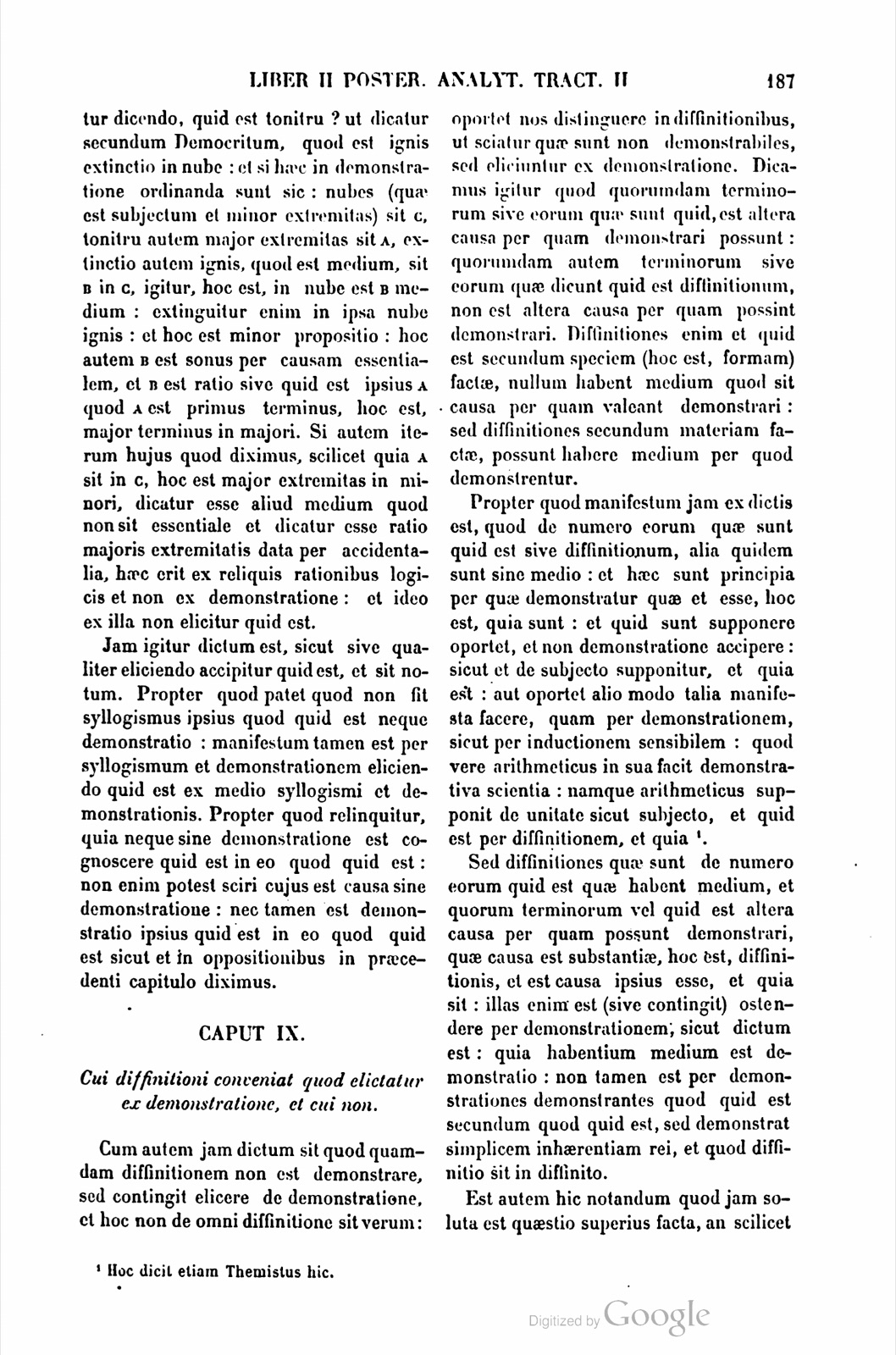
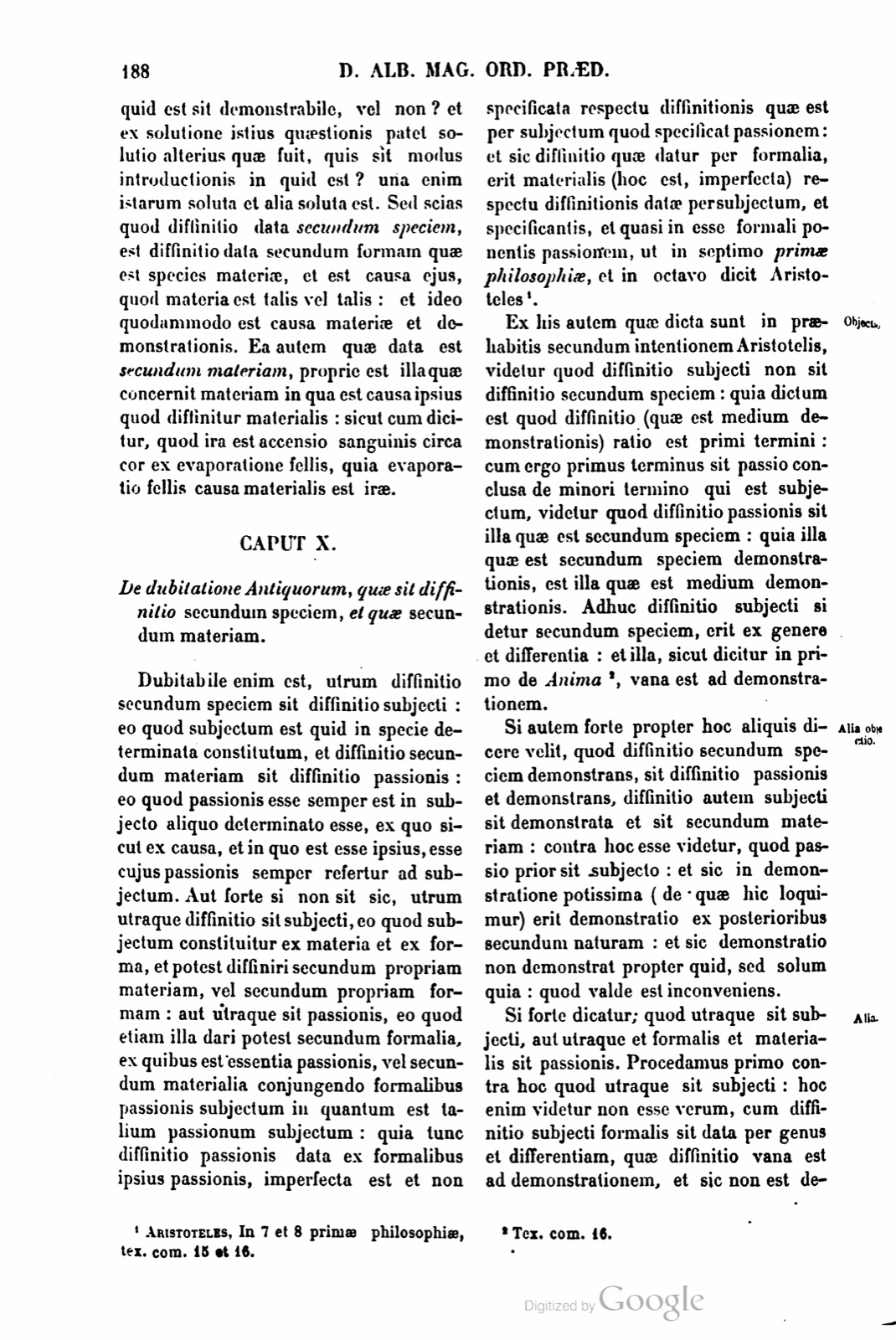
CAPUT IX. Cui diffinitioni conveniat quod eliciatur ex demonstratione, et cui non. Cum autem jam dictum sit quod quamdam diffinitionem non est demonstrare, sed contingit elicere de demonstratione, et hoc non de omni diffinitione sit verum: oportet nos distinguere in diffinitionibus, ut sciatur quae sunt non demonstrabiles, sed eliciuntur ex demonstratione. Dicamus igitur quod quorumdam terminorum sive eorum quae sunt quid, est altera causa per quam demonstrari possunt: quorumdam autem terminorum sive eorum quae dicunt quid est diffinitionum, non est altera causa per quam possint demonstrari. Diffinitiones enim et quid est secundum speciem (hoc est, formam) factae, nullum habent medium quod sit causa per quam valeant demonstrari: sed diffinitiones secundum materiam factae, possunt habere medium per quod demonstrentur. Propter quod manifestum jam ex dictis est, quod de numero eorum quae sunt quid est sive diffinitionum, alia quidem sunt sine medio: et haec sunt principia per quae demonstratur quae et esse, hoc est, quia sunt: et quid sunt supponere oportet, et non demonstratione accipere: sicut et de subjecto supponitur, et quia est: aut oportet alio modo talia manifesta facere, quam per demonstrationem, sicut per inductionem sensibilem: quod vere arithmeticus in sua facit demonstrativa scientia: namque arithmeticus supponit de unitate sicut subjecto, et quid est per diffinitionem, et quia 1. Sed diffinitiones quae sunt de numero eorum quid est quae habent medium, et quorum terminorum vel quid est altera causa per quam possunt demonstrari, quae causa est substantiae, hoc est, diffinitionis, et est causa ipsius esse, et quia sit: illas enim est (sive contingit) ostendere per demonstrationem; sicut dictum est: quia habentium medium est demonstratio: non tamen est per demonstrationes demonstrantes quod quid est secundum quod quid est, sed demonstrat simplicem inhaerentiam rei, et quod diffinitio sit in diffinito. Est autem hic notandum quod jam soluta est quaestio superius facta, an scilicet quid est sit demonstrabile, vel non? et ex solutione istius quaestionis patet solutio alterius quae fuit, quis sit modus introductionis in quid est? una enim istarum soluta et alia soluta est. Sed scias quod diffinitio data secundum speciem, est diffinitio data secundum formam quae est species materiae, et est causa ejus, quod materia est talis vel talis: et ideo quodammodo est causa materiae et demonstrationis. Ea autem quae data est secundum materiam, proprie est illa quae concernit materiam in qua est causa ipsius quod diffinitur materialis: sicut cum dicitur, quod ira est accensio sanguinis circa cor ex evaporatione fellis, quia evaporatio fellis causa materialis est irae.
CHAPTER IX. To which definition it belongs to be elicited from demonstration, and to which not. But since it has now been said that a certain definition is not to be demonstrated, but it happens that it is elicited from demonstration, and this is not true of every definition, we must distinguish within definitions, so that it may be known which are not demonstrable but are elicited from demonstration. Therefore let us say that of some terms, or of those things which are what, there is another cause through which they can be demonstrated; but of some terms, or of definitions which say what it is, there is not another cause through which they can be demonstrated. For definitions and what it is made according to species, that is, form, have no middle which is a cause through which they can be demonstrated; but definitions made according to matter can have a middle through which they may be demonstrated. For this reason it is now manifest from what has been said that, from the number of those things which are what it is or definitions, some indeed are without a middle; and these are principles through which both that they are is demonstrated, that is, because they are. And one must suppose what they are, and not receive it by demonstration, just as concerning the subject both what it is and that it is are supposed; or one must make such things manifest in some other way than by demonstration, as through sensible induction, which truly the arithmetician does in his demonstrative science. For the arithmetician supposes concerning unity as concerning a subject both what it is through definition and that it is 1. But the definitions which are from the number of those what-it-is things which have a middle, and of which terms, or what-it-is, there is another cause through which they can be demonstrated, which cause is of the substance, that is, of the definition, and is the cause of its very being and that it is: those, indeed, it is possible, or it happens, to show through demonstration, as has been said, because of things having a middle there is demonstration. Nevertheless this is not through demonstrations demonstrating what it is according as it is what it is, but it demonstrates the simple inherence of the thing and that the definition is in the defined thing. But here it must be noted that the question made above has now been solved, namely whether what it is is demonstrable or not. And from the solution of that question the solution of the other is clear, which was, what is the mode of introduction into what it is? For when one of these has been solved, the other has also been solved. But know that a definition given according to species is a definition given according to form, which is the species of matter and is the cause of this, that the matter is such or such; and therefore in some way it is the cause of matter and of demonstration. But that which has been given according to matter is properly that which concerns the matter in which there is the cause of that which is defined materially, as when it is said that anger is a kindling of blood around the heart from evaporation of bile, because evaporation of bile is the material cause of anger.
Notes
- Themistius also says this here. (Hoc dicit etiam Themistus hic.) ↩
If a page does not appear, its photograph has not been uploaded yet.