Works › Posterior Analytics, Books I–II
Volume 2 · pp. 184–187
Chapter VIII. In what way definition is elicited from demonstration, although it is not demonstrated.
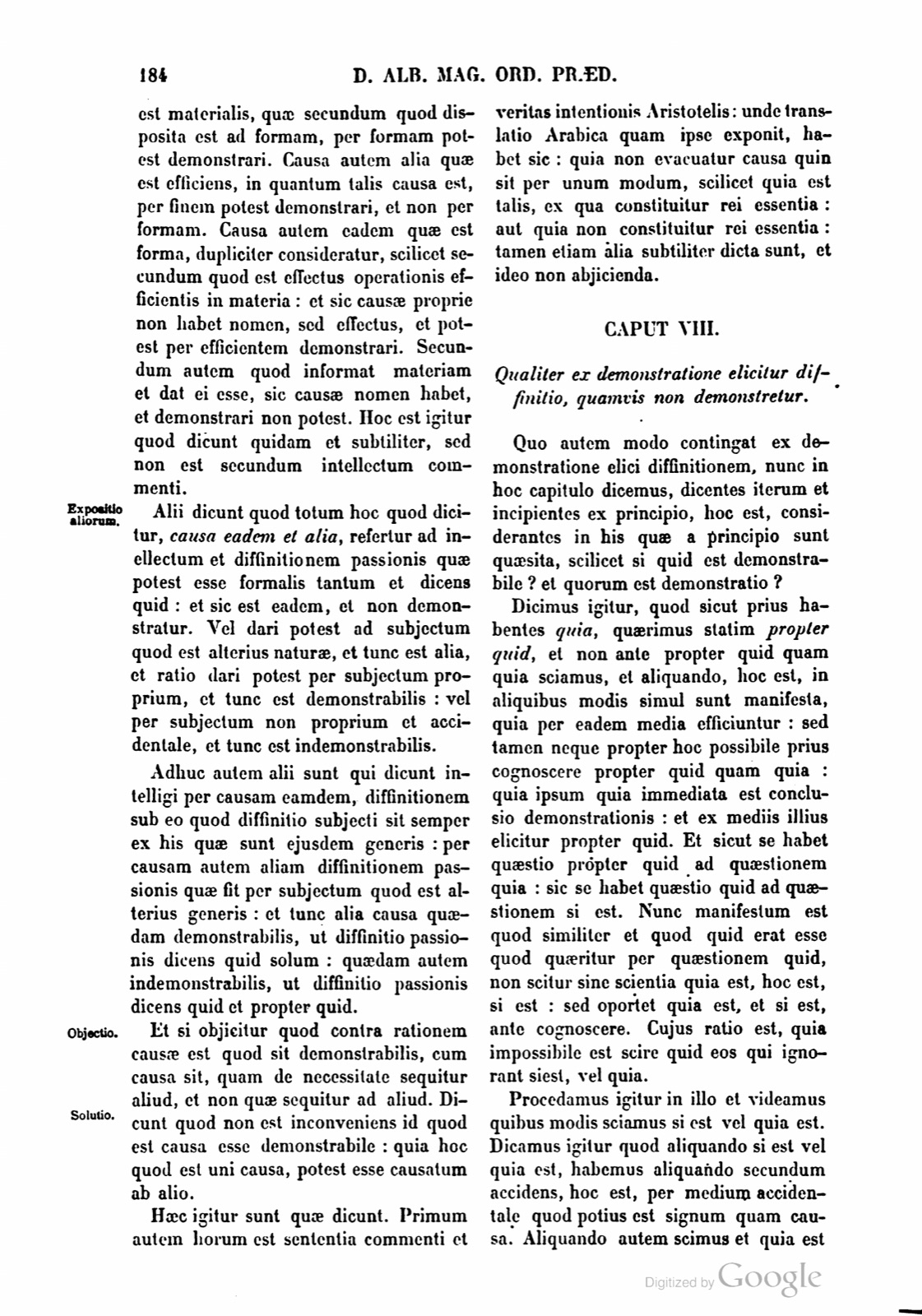
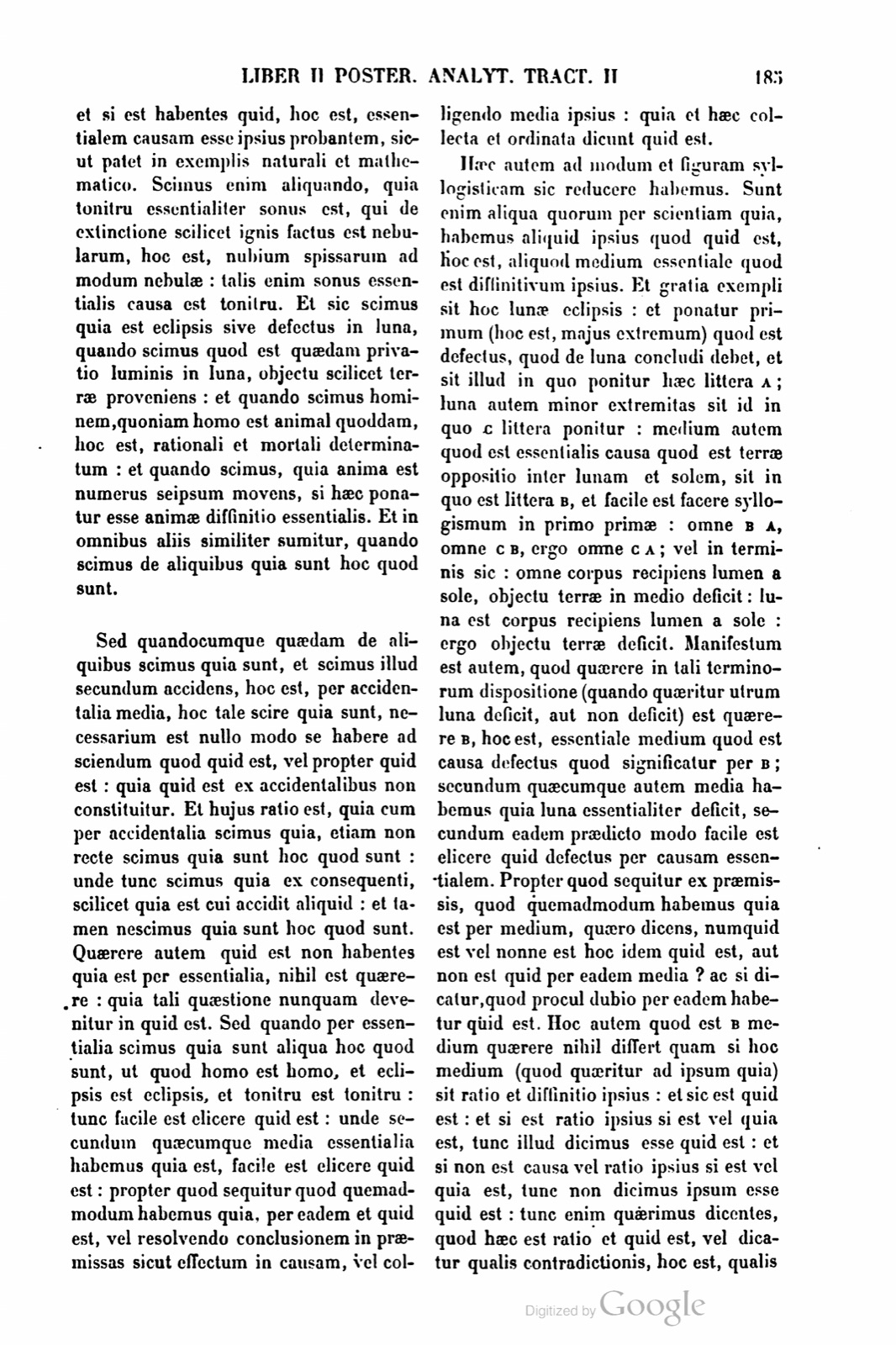
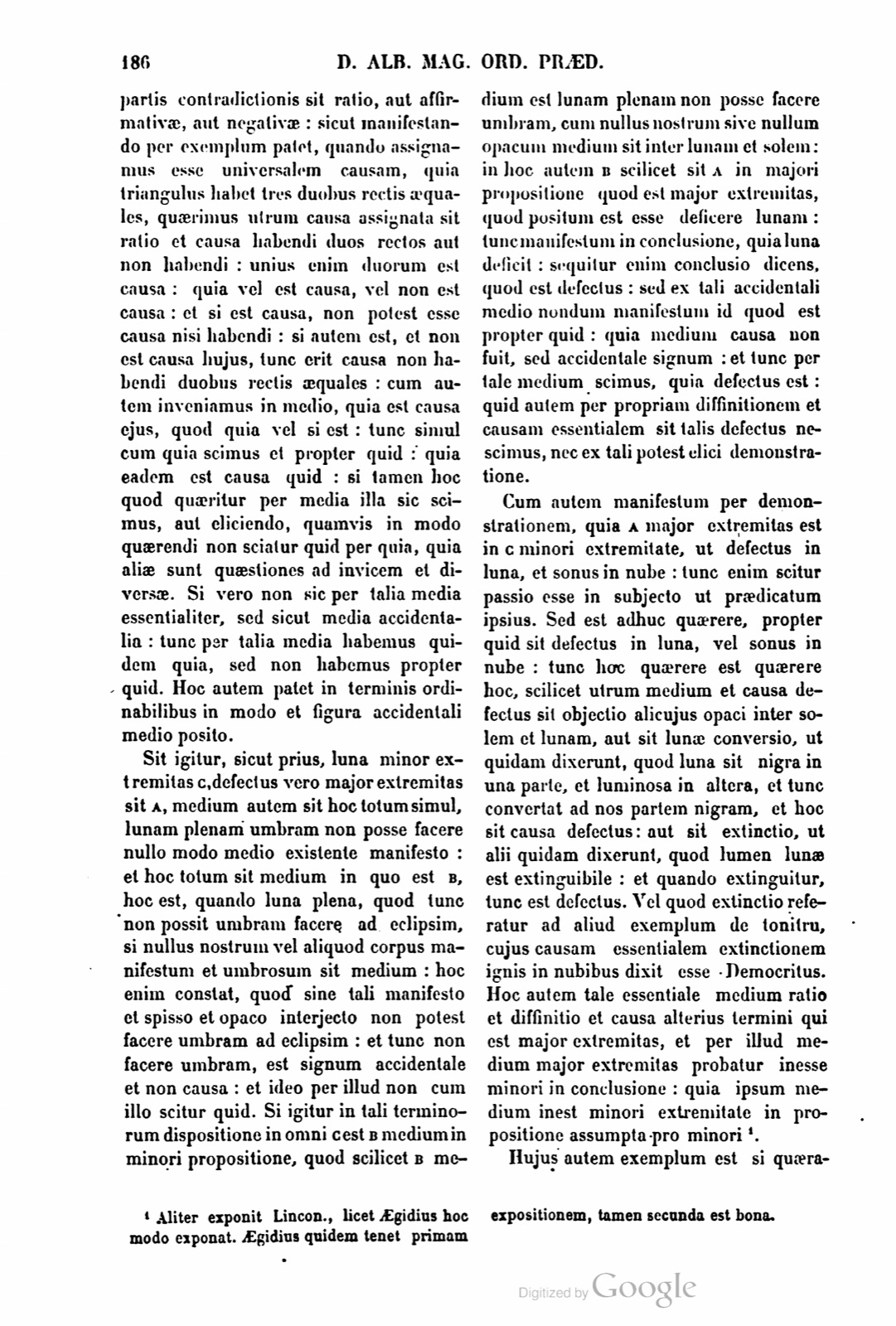
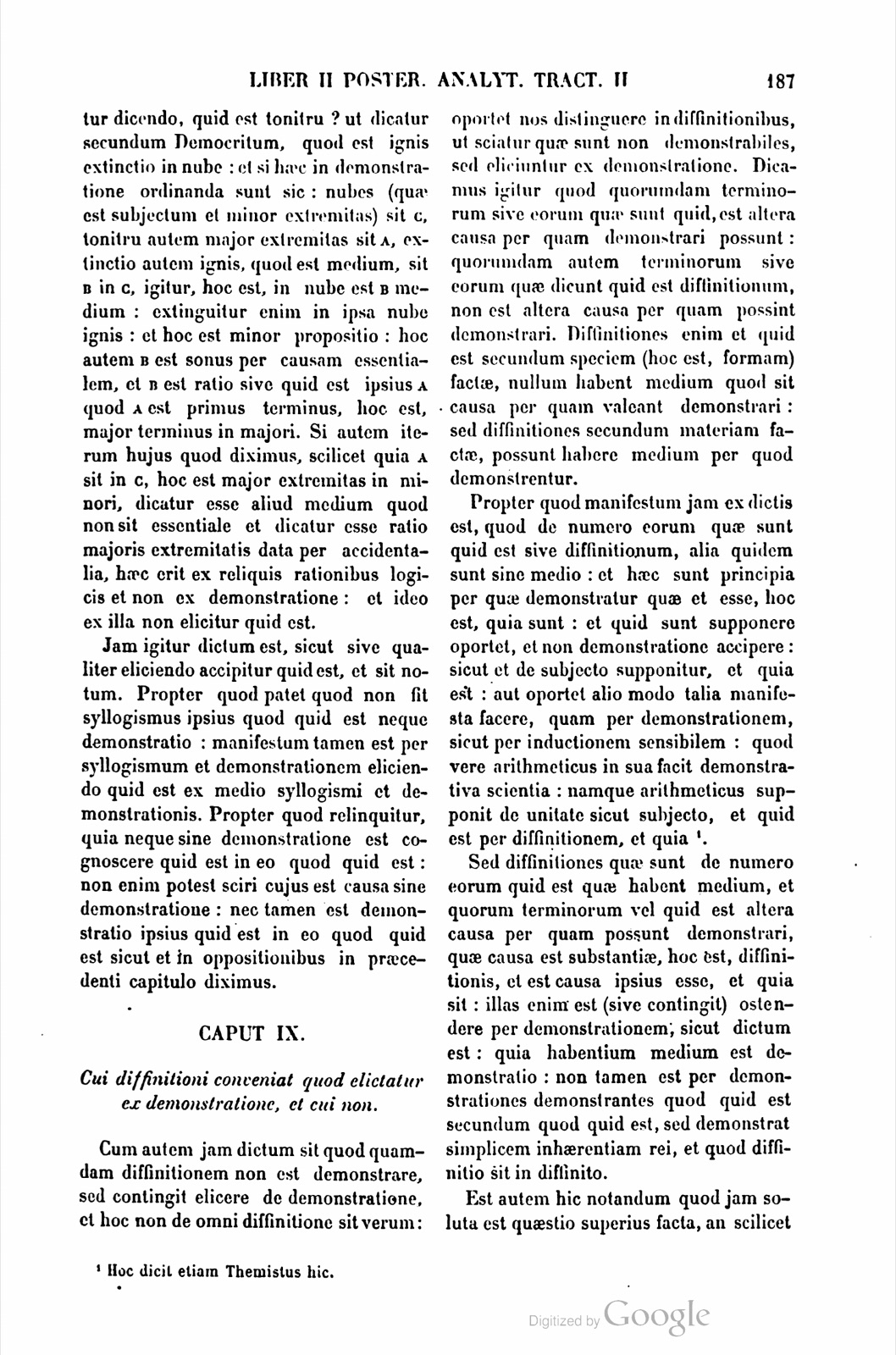
CAPUT VIII. Qualiter ex demonstratione elicitur diffinitio, quamvis non demonstretur. Quo autem modo contingat ex demonstratione elici diffinitionem, nunc in hoc capitulo dicemus, dicentes iterum et incipientes ex principio, hoc est, considerantes in his quae a principio sunt quaesita, scilicet si quid est demonstrabile? et quorum est demonstratio? Dicimus igitur, quod sicut prius habentes quia, quaerimus statim propter quid, et non ante propter quid quam quia sciamus, et aliquando, hoc est, in aliquibus modis simul sunt manifesta, quia per eadem media efficiuntur: sed tamen neque propter hoc possibile prius cognoscere propter quid quam quia: quia ipsum quia immediata est conclusio demonstrationis: et ex mediis illius elicitur propter quid. Et sicut se habet quaestio propter quid ad quaestionem quia: sic se habet quaestio quid ad quaestionem si est. Nunc manifestum est quod similiter et quod quid erat esse quod quaeritur per quaestionem quid, non scitur sine scientia quia est, hoc est, si est: sed oportet quia est, et si est, ante cognoscere. Cujus ratio est, quia impossibile est scire quid eos qui ignorant si est, vel quia. Procedamus igitur in illo et videamus quibus modis sciamus si est vel quia est. Dicamus igitur quod aliquando si est vel quia est, habemus aliquando secundum accidens, hoc est, per medium accidentale quod potius est signum quam causa. Aliquando autem scimus et quia est et si est habentes quid, hoc est, essentialem causam esse ipsius probantem, sicut patet in exemplis naturali et mathematico. Scimus enim aliquando, quia tonitru essentialiter sonus est, qui de extinctione scilicet ignis factus est nebulorum, hoc est, nubium spissarum ad modum nebulae: talis enim sonus essentialis causa est tonitru. Et sic scimus quia est eclipsis sive defectus in luna, quando scimus quod est quaedam privatio luminis in luna, objectu scilicet terrae proveniens: et quando scimus hominem, quoniam homo est animal quoddam, hoc est, rationali et mortali determinatum: et quando scimus, quia anima est numerus seipsum movens, si haec ponatur esse animae diffinitio essentialis. Et in omnibus aliis similiter sumitur, quando scimus de aliquibus quia sunt hoc quod sunt. Sed quandocumque quaedam de aliquibus scimus quia sunt, et scimus illud secundum accidens, hoc est, per accidentalia media, hoc tale scire quia sunt, necessarium est nullo modo se habere ad sciendum quod quid est, vel propter quid est: quia quid est ex accidentalibus non constituitur. Et hujus ratio est, quia cum per accidentalia scimus quia, etiam non recte scimus quia sunt hoc quod sunt: unde tunc scimus quia ex consequenti, scilicet quia est cui accidit aliquid: et tamen nescimus quia sunt hoc quod sunt. Quaerere autem quid est non habentes quia est per essentialia, nihil est quaerere: quia tali quaestione nunquam devenitur in quid est. Sed quando per essentialia scimus quia sunt aliqua hoc quod sunt, ut quod homo est homo, et eclipsis est eclipsis, et tonitru est tonitru: tunc facile est elicere quid est: unde secundum quaecumque media essentialia habemus quia est, facile est elicere quid est: propter quod sequitur quod quemadmodum habemus quia, per eadem et quid est, vel resolvendo conclusionem in praemissas sicut effectum in causam, vel colligendo media ipsius: quia et haec collecta et ordinata dicunt quid est. Haec autem ad modum et figuram syllogisticam sic reducere habemus. Sunt enim aliqua quorum per scientiam quia, habemus aliquid ipsius quod quid est, hoc est, aliquod medium essentiale quod est diffinitivum ipsius. Et gratia exempli sit hoc lunae eclipsis: et ponatur primum (hoc est, majus extremum) quod est defectus, quod de luna concludi debet, et sit illud in quo ponitur haec littera A; luna autem minor extremitas sit id in quo C littera ponitur: medium autem quod est essentialis causa quod est terrae oppositio inter lunam et solem, sit in quo est littera B, et facile est facere syllogismum in primo primae: omne B A, omne C B, ergo omne C A; vel in terminis sic: omne corpus recipiens lumen a sole, objectu terrae in medio deficit: luna est corpus recipiens lumen a sole: ergo objectu terrae deficit. Manifestum est autem, quod quaerere in tali terminorum dispositione (quando quaeritur utrum luna deficit, aut non deficit) est quaerere B, hoc est, essentiale medium quod est causa defectus quod significatur per B; secundum quaecumque autem media habemus quia luna essentialiter deficit, secundum eadem praedicto modo facile est elicere quid defectus per causam essentialem. Propter quod sequitur ex praemissis, quod quemadmodum habemus quia est per medium, quaero dicens, numquid est vel nonne est hoc idem quid est, aut non est quid per eadem media? ac si dicatur, quod procul dubio per eadem habetur quid est. Hoc autem quod est B medium quaerere nihil differt quam si hoc medium (quod quaeritur ad ipsum quia) sit ratio et diffinitio ipsius: et sic est quid est: et si est ratio ipsius si est vel quia est, tunc illud dicimus esse quid est: et si non est causa vel ratio ipsius si est vel quia est, tunc non dicimus ipsum esse quid est: tunc enim quaerimus dicentes, quod haec est ratio et quid est, vel dicatur qualis contradictionis, hoc est, qualis partis contradictionis sit ratio, aut affirmativae, aut negativae: sicut manifestando per exemplum patet, quando assignamus esse universalem causam, quia triangulus habet tres duobus rectis aequales, quaerimus utrum causa assignata sit ratio et causa habendi duos rectos aut non habendi: unius enim duorum est causa: quia vel est causa, vel non est causa: et si est causa, non potest esse causa nisi habendi: si autem est, et non est causa hujus, tunc erit causa non habendi duobus rectis aequales: cum autem inveniamus in medio, quia est causa ejus, quod quia vel si est: tunc simul cum quia scimus et propter quid: quia eadem est causa quid: si tamen hoc quod quaeritur per media illa sic scimus, aut eliciendo, quamvis in modo quaerendi non sciatur quid per quia, quia aliae sunt quaestiones ad invicem et diversae. Si vero non sic per talia media essentialiter, sed sicut media accidentalia: tunc per talia media habemus quidem quia, sed non habemus propter quid. Hoc autem patet in terminis ordinabilibus in modo et figura accidentali medio posito. Sit igitur, sicut prius, luna minor extremitas C, defectus vero major extremitas sit A, medium autem sit hoc totum simul, lunam plenam umbram non posse facere nullo modo medio existente manifesto: et hoc totum sit medium in quo est B, hoc est, quando luna plena, quod tunc non possit umbram facere ad eclipsim, si nullus nostrum vel aliquod corpus manifestum et umbrosum sit medium: hoc enim constat, quod sine tali manifesto et spisso et opaco interjecto non potest facere umbram ad eclipsim: et tunc non facere umbram, est signum accidentale et non causa: et ideo per illud non cum illo scitur quid. Si igitur in tali terminorum dispositione in omni C est B medium in minori propositione, quod scilicet B medium est lunam plenam non posse facere umbram, cum nullus nostrum sive nullum opacum medium sit inter lunam et solem: in hoc autem B scilicet sit A in majori propositione quod est major extremitas, quod positum est esse deficere lunam: tunc manifestum in conclusione, quia luna deficit: sequitur enim conclusio dicens, quod est defectus: sed ex tali accidentali medio nondum manifestum id quod est propter quid: quia medium causa non fuit, sed accidentale signum: et tunc per tale medium scimus, quia defectus est: quid autem per propriam diffinitionem et causam essentialem sit talis defectus nescimus, nec ex tali potest elici demonstratione. Cum autem manifestum per demonstrationem, quia A major extremitas est in C minori extremitate, ut defectus in luna, et sonus in nube: tunc enim scitur passio esse in subjecto ut praedicatum ipsius. Sed est adhuc quaerere, propter quid sit defectus in luna, vel sonus in nube: tunc hoc quaerere est quaerere hoc, scilicet utrum medium et causa defectus sit objectio alicujus opaci inter solem et lunam, aut sit lunae conversio, ut quidam dixerunt, quod luna sit nigra in una parte, et luminosa in altera, et tunc convertat ad nos partem nigram, et hoc sit causa defectus: aut sit extinctio, ut alii quidam dixerunt, quod lumen lunae est extinguibile: et quando extinguitur, tunc est defectus. Vel quod extinctio referatur ad aliud exemplum de tonitru, cujus causam essentialem extinctionem ignis in nubibus dixit esse Democritus. Hoc autem tale essentiale medium ratio et diffinitio et causa alterius termini qui est major extremitas, et per illud medium major extremitas probatur inesse minori in conclusione: quia ipsum medium inest minori extremitate in propositione assumpta pro minori 1. Hujus autem exemplum est si quaeratur dicendo, quid est tonitru? ut dicatur secundum Democritum, quod est ignis extinctio in nube: et si haec in demonstratione ordinanda sunt sic: nubes (quae est subjectum et minor extremitas) sit C, tonitru autem major extremitas sit A, extinctio autem ignis, quod est medium, sit B in C, igitur, hoc est, in nube est B medium: extinguitur enim in ipsa nube ignis: et hoc est minor propositio: hoc autem B est sonus per causam essentialem, et B est ratio sive quid est ipsius A quod A est primus terminus, hoc est, major terminus in majori. Si autem iterum hujus quod diximus, scilicet quia A sit in C, hoc est major extremitas in minori, dicatur esse aliud medium quod non sit essentiale et dicatur esse ratio majoris extremitatis data per accidentalia, haec erit ex reliquis rationibus logicis et non ex demonstratione: et ideo ex illa non elicitur quid est. Jam igitur dictum est, sicut sive qualiter eliciendo accipitur quid est, et sit notum. Propter quod patet quod non fit syllogismus ipsius quod quid est neque demonstratio: manifestum tamen est per syllogismum et demonstrationem eliciendo quid est ex medio syllogismi et demonstrationis. Propter quod relinquitur, quia neque sine demonstratione est cognoscere quid est in eo quod quid est: non enim potest sciri cujus est causa sine demonstratione: nec tamen est demonstratio ipsius quid est in eo quod quid est sicut et in oppositionibus in praecedenti capitulo diximus.
CHAPTER VIII. In what way definition is elicited from demonstration, although it is not demonstrated. But in what way it happens that a definition is elicited from demonstration, we shall now say in this chapter, speaking again and beginning from the beginning, that is, considering in those things which have been asked from the beginning, namely whether what it is is demonstrable, and of which things there is demonstration. Therefore we say that, just as before, having that it is, we at once ask on account of what, and we do not know on account of what before that it is; and sometimes, that is, in some modes, they are manifest at once, because they are effected through the same middles. But nevertheless not even on account of this is it possible to know on account of what before that it is, because the that-it-is itself is the immediate conclusion of demonstration, and from the middles of that the on-account-of-what is elicited. And as the question on account of what has itself to the question that, so the question what has itself to the question whether it is. Now it is manifest that similarly the what-it-was-to-be which is sought by the question what is not known without the science that it is, that is, whether it is; but one must know that it is and whether it is beforehand. The reason of this is that it is impossible for those who are ignorant whether it is or that it is to know what. Therefore let us proceed in that and see in what modes we know whether it is or that it is. Therefore let us say that sometimes we have whether it is or that it is according to accident, that is, through an accidental middle which is rather a sign than a cause. But sometimes we know both that it is and whether it is while having what, that is, while having the essential cause proving its being, as is clear in a natural and a mathematical example. For sometimes we know that thunder is essentially a sound, which has been made from the extinction, namely of fire, of vapors, that is, of thick clouds in the manner of vapor; for such a sound is the essential cause of thunder. And thus we know that there is an eclipse or defect in the moon when we know that there is a certain privation of light in the moon, arising, namely, from the interposition of the earth; and when we know a human being, since a human being is a certain animal, that is, determined by rational and mortal; and when we know that the soul is a number moving itself, if this is posited to be the essential definition of soul. And in all other things it is taken similarly, when we know concerning some things that they are this which they are. But whenever we know concerning certain things that they are, and we know that according to accident, that is, through accidental middles, such knowledge that they are is necessarily in no way related to knowing what it is or on account of what it is, because what it is is not constituted from accidental things. And the reason of this is that, when through accidental things we know that, still we do not rightly know that they are this which they are; hence then we know that from what follows, namely that there is something to which something happens, and yet we do not know that they are this which they are. But to ask what it is when we do not have that it is through essentials is to ask nothing, because by such a question one never arrives at what it is. But when through essentials we know that some things are this which they are, as that a human being is a human being, and an eclipse is an eclipse, and thunder is thunder, then it is easy to elicit what it is. Hence according to whatever essential middles we have that it is, it is easy to elicit what it is; for this reason it follows that, in the same way as we have that it is, through the same things we also have what it is, either by resolving the conclusion into the premises as an effect into a cause, or by gathering its middles, because these too, gathered and ordered, state what it is. But we have to reduce these things to syllogistic mode and figure thus. For there are some things of which, through the science that, we have something of the what-it-is itself, that is, some essential middle which is definitive of it. And for the sake of example let this be an eclipse of the moon; and let the first, that is, the greater extreme, be posited as defect, which must be concluded of the moon, and let that be that in which this letter A is posited; but let the moon, the lesser extremity, be that in which the letter C is posited. But let the middle, which is the essential cause, which is the opposition of the earth between the moon and the sun, be that in which the letter B is; and it is easy to make a syllogism in the first of the first: every B is A, every C is B, therefore every C is A. Or in terms thus: every body receiving light from the sun fails by the interposition of the earth in the middle; the moon is a body receiving light from the sun; therefore it fails by the interposition of the earth. But it is manifest that to ask in such a disposition of terms, when it is asked whether the moon fails or does not fail, is to ask B, that is, the essential middle which is the cause of the defect which is signified by B. But according to whatever middles we have that the moon essentially fails, according to the same things in the aforesaid way it is easy to elicit what defect is through the essential cause. For this reason it follows from the premises that, in the same way as we have that it is through a middle, I ask by saying whether this same thing is or is not what it is, or whether what is is not through the same middles; as if it were said that without doubt what it is is had through the same things. But to ask this middle, which is B, differs in no way from asking whether this middle, which is sought for the that-it-is itself, is the account and definition of it; and thus it is what it is. And if it is the account of its whether it is or that it is, then we say that it is what it is; and if it is not the cause or account of its whether it is or that it is, then we do not say that it is what it is. For then we ask by saying that this is the account and what it is, or let it be said of which side of the contradiction, that is, of which part of the contradiction it is the account, either of the affirmative or of the negative; as is clear by manifesting through an example, when we assign as the universal cause why the triangle has three angles equal to two right angles, we ask whether the assigned cause is the account and cause of having two right angles or of not having them. For it is the cause of one of the two, because either it is a cause or it is not a cause; and if it is a cause, it cannot be a cause except of having them; but if it is and is not the cause of this, then it will be the cause of not having angles equal to two right angles. But when we find in the middle that it is the cause of that which is that or whether it is, then together with that we also know on account of what, because the same thing is the cause of what. If nevertheless we know in this way that which is sought through those middles, or by eliciting it, although in the mode of asking what is not known through that, because the questions are other to one another and diverse. But if not thus through such middles essentially, but as accidental middles, then through such middles we indeed have that, but we do not have on account of what. And this is clear in terms orderable in mode and figure when an accidental middle has been posited. Therefore let the moon, as before, be the lesser extremity C, but let defect be the greater extremity A, and let the middle be this whole thing together, namely that the full moon can in no way make a shadow when no manifest middle exists; and let this whole thing be the middle in which B is, that is, when the moon is full, that then it cannot make a shadow for an eclipse if none of us or no manifest and shadowy body is the middle. For this is agreed, that without such a manifest, dense, and opaque thing interposed it cannot make a shadow for an eclipse; and then not making a shadow is an accidental sign and not a cause, and therefore through that, not together with that, what it is is known. Therefore if in such a disposition of terms B, the middle, is in every C in the minor proposition, namely that the middle B is that the full moon cannot make a shadow when none of us, or no opaque middle, is between the moon and the sun; but in this B, namely, A is in the major proposition, which is the greater extremity, which has been posited as the moon failing, then it is manifest in the conclusion that the moon fails. For the conclusion follows, saying that there is defect; but from such an accidental middle the thing which is on account of what is not yet manifest, because the middle was not the cause but an accidental sign; and then through such a middle we know that defect exists, but we do not know what such a defect is through its proper definition and essential cause, nor can it be elicited from such a demonstration. But when it is manifest through demonstration that A, the greater extremity, is in C, the lesser extremity, as defect in the moon and sound in a cloud, for then the passion is known to be in the subject as its predicate. But there still remains to ask why there is defect in the moon, or sound in a cloud; then to ask this is to ask this, namely whether the middle and cause of the defect is the interposition of some opaque thing between the sun and the moon, or whether it is the turning of the moon, as certain people said, that the moon is black in one part and luminous in another, and then turns the black part toward us and this is the cause of the defect; or whether it is extinction, as certain others said, that the light of the moon is extinguishable, and when it is extinguished, then there is defect. Or that extinction is referred to the other example concerning thunder, whose essential cause Democritus said to be the extinction of fire in the clouds. But such an essential middle is the account and definition and cause of the other term, which is the greater extremity; and through that middle the greater extremity is proved to be in the lesser in the conclusion, because the middle itself is in the lesser extremity in the proposition assumed as the minor 1. But an example of this is if it is asked by saying, what is thunder? so that it may be said according to Democritus that it is extinction of fire in a cloud. And if these things are to be ordered in demonstration thus: let cloud, which is the subject and lesser extremity, be C; but let thunder, the greater extremity, be A; but let extinction of fire, which is the middle, be B in C. Therefore, that is, in the cloud, there is the middle B, for fire is extinguished in that very cloud, and this is the minor proposition. But this B is sound through an essential cause, and B is the account or what-it-is of A itself, because A is the first term, that is, the greater term in the major. But if again of this which we have said, namely that A is in C, that is, the greater extremity in the lesser, another middle is said to exist which is not essential, and is said to be the account of the greater extremity given through accidental things, this will be from the remaining logical accounts and not from demonstration; and therefore what it is is not elicited from it. Therefore it has now been said how, or in what way, what it is is received by eliciting it, and let it be known. For this reason it is clear that there is not made a syllogism or demonstration of what-it-is itself; nevertheless what it is is manifest by syllogism and demonstration, by eliciting it from the middle of syllogism and demonstration. For this reason it remains that knowing what it is in that which is what it is is neither without demonstration, for it cannot be known of what it is the cause without demonstration, and yet there is not a demonstration of the what-it-is itself in that which is what it is, as we also said in the preceding chapter in the oppositions.
Notes
- Lincoln explains otherwise, although Giles explains in this way. Giles indeed holds the first exposition; nevertheless the second is good. (Aliter exponit Lincon., licet Egidius hoc modo exponat. Aegidius quidem tenet primam expositionem, tamen secunda est bona.) ↩
If a page does not appear, its photograph has not been uploaded yet.