Works › Posterior Analytics, Books I–II
Volume 2 · pp. 182–184
Chapter VII. In what way, according to the mode of demonstration of the things introduced, definition also can be demonstrated or syllogized.
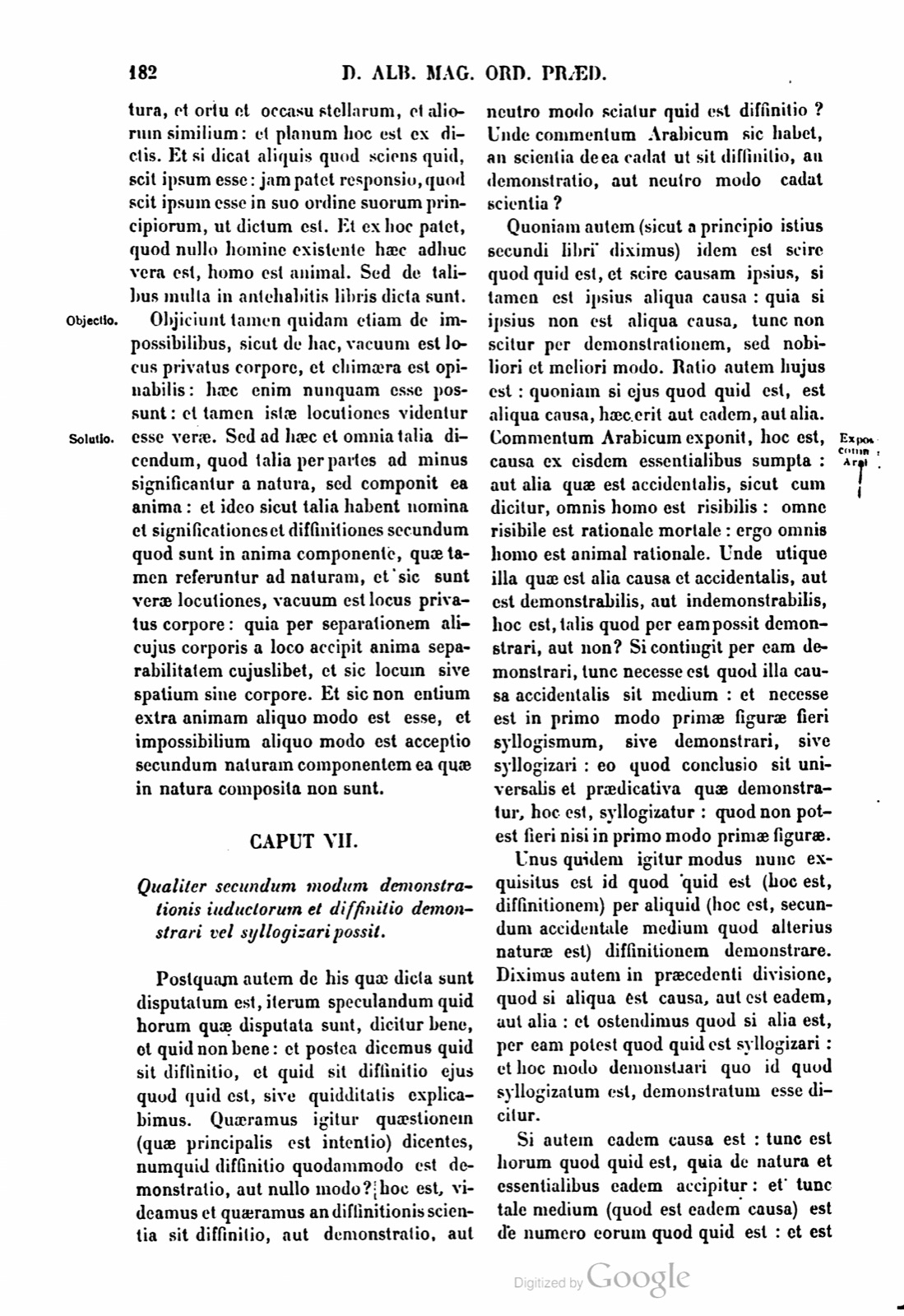
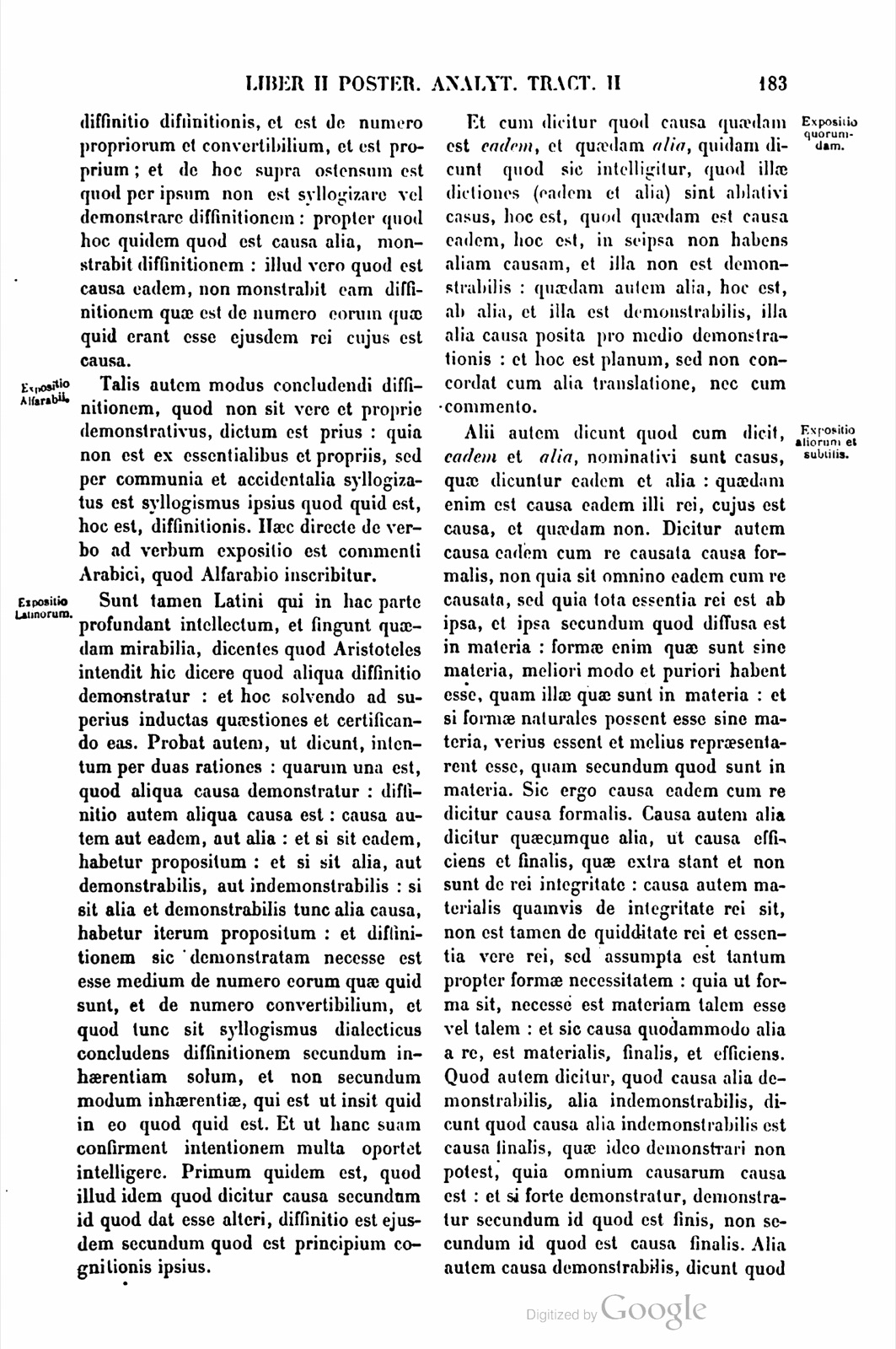
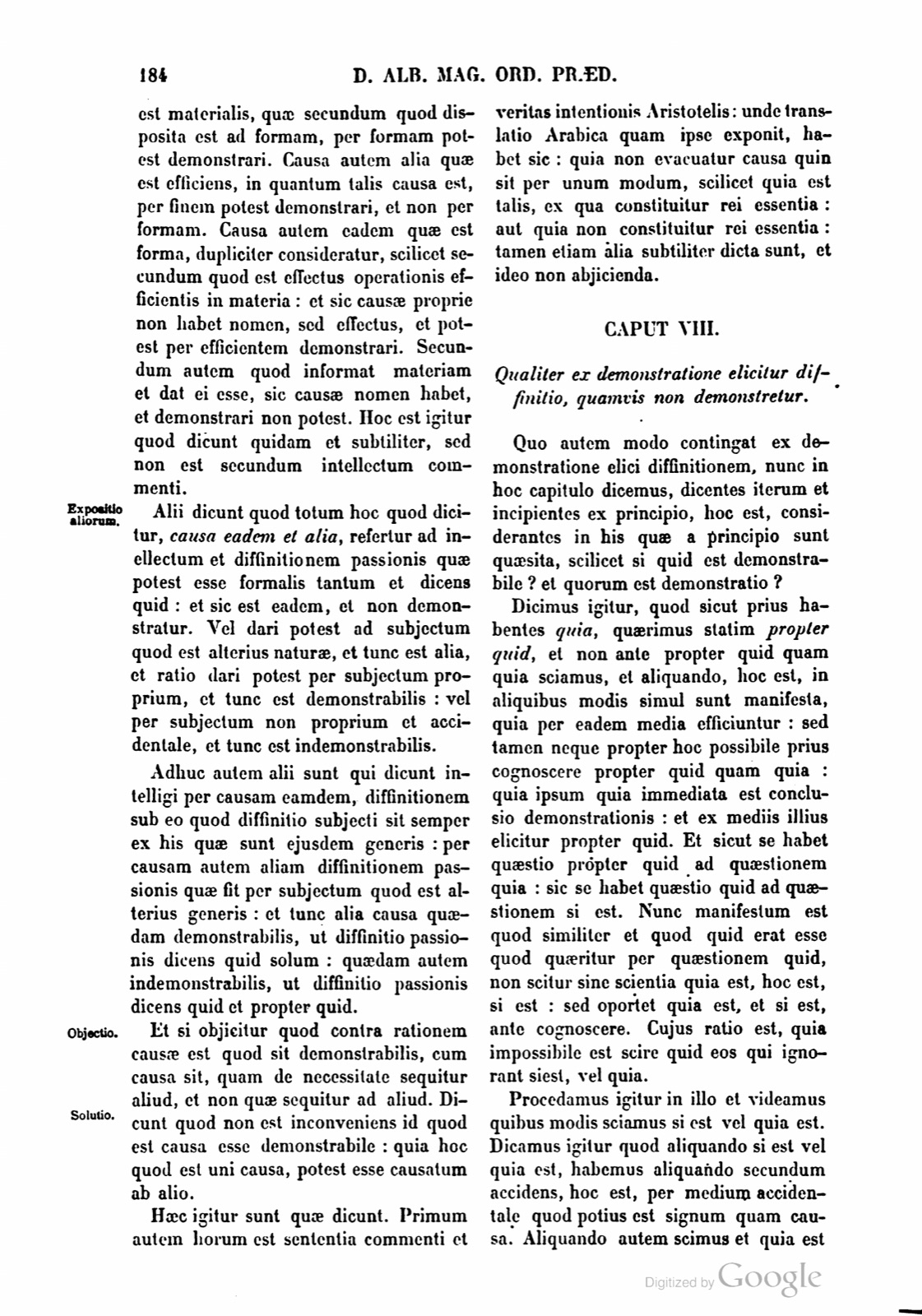
CAPUT VII. Qualiter secundum modum demonstrationis inductorum et diffinitio demonstrari vel syllogizari possit. Postquam autem de his quae dicta sunt disputatum est, iterum speculandum quid horum quae disputata sunt, dicitur bene, et quid non bene: et postea dicemus quid sit diffinitio, et quid sit diffinitio ejus quod quid est, sive quidditatis explicabimus. Quaeramus igitur quaestionem (quae principalis est intentio) dicentes, numquid diffinitio quodammodo est demonstratio, aut nullo modo? hoc est, videamus et quaeramus an diffinitionis scientia sit diffinitio, aut demonstratio, aut neutro modo sciatur quid est diffinitio? Unde commentum Arabicum sic habet, an scientia de ea cadat ut sit diffinitio, an demonstratio, aut neutro modo cadat scientia? Quoniam autem (sicut a principio istius secundi libri diximus) idem est scire quod quid est, et scire causam ipsius, si tamen est ipsius aliqua causa: quia si ipsius non est aliqua causa, tunc non scitur per demonstrationem, sed nobiliori et meliori modo. Ratio autem hujus est: quoniam si ejus quod quid est, est aliqua causa, haec erit aut eadem, aut alia. <marginal-label>Expositio commenti Arabici.</marginal-label> Commentum Arabicum exponit, hoc est, causa ex eisdem essentialibus sumpta: aut alia quae est accidentalis, sicut cum dicitur, omnis homo est risibilis: omne risibile est rationale mortale: ergo omnis homo est animal rationale. Unde utique illa quae est alia causa et accidentalis, aut est demonstrabilis, aut indemonstrabilis, hoc est, talis quod per eam possit demonstrari, aut non? Si contingit per eam demonstrari, tunc necesse est quod illa causa accidentalis sit medium: et necesse est in primo modo primae figurae fieri syllogismum, sive demonstrari, sive syllogizari: eo quod conclusio sit universalis et praedicativa quae demonstratur, hoc est, syllogizatur: quod non potest fieri nisi in primo modo primae figurae. Unus quidem igitur modus nunc exquisitus est id quod quid est (hoc est, diffinitionem) per aliquid (hoc est, secundum accidentale medium quod alterius naturae est) diffinitionem demonstrare. Diximus autem in praecedenti divisione, quod si aliqua est causa, aut est eadem, aut alia: et ostendimus quod si alia est, per eam potest quod quid est syllogizari: et hoc modo demonstrari quo id quod syllogizatum est, demonstratum esse dicitur. Si autem eadem causa est: tunc est horum quod quid est, quia de natura et essentialibus eadem accipitur: et tunc tale medium (quod est eadem causa) est de numero eorum quod quid est: et est diffinitio diffinitionis, et est de numero propriorum et convertibilium, et est proprium; et de hoc supra ostensum est quod per ipsum non est syllogizare vel demonstrare diffinitionem: propter quod hoc quidem quod est causa alia, monstrabit diffinitionem: illud vero quod est causa eadem, non monstrabit eam diffinitionem quae est de numero eorum quae quid erant esse ejusdem rei cujus est alia causa. <marginal-label>Expositio Alfarabii.</marginal-label> Talis autem modus concludendi diffinitionem, quod non sit vere et proprie demonstrativus, dictum est prius: quia non est ex essentialibus et propriis, sed per communia et accidentalia syllogizatus est syllogismus ipsius quod quid est, hoc est, diffinitionis. Haec directe de verbo ad verbum expositio est commenti Arabici, quod Alfarabio inscribitur. <marginal-label>Expositio Latinorum.</marginal-label> Sunt tamen Latini qui in hac parte profundant intellectum, et fingunt quaedam mirabilia, dicentes quod Aristoteles intendit hic dicere quod aliqua diffinitio demonstratur: et hoc solvendo ad superius inductas quaestiones et certificando eas. Probat autem, ut dicunt, intentum per duas rationes: quarum una est, quod aliqua causa demonstratur: diffinitio autem aliqua causa est: causa autem aut eadem, aut alia: et si sit eadem, habetur propositum: et si sit alia, aut demonstrabilis, aut indemonstrabilis: si sit alia et demonstrabilis tunc alia causa, habetur iterum propositum: et diffinitionem sic demonstratam necesse est esse medium de numero eorum quae quid sunt, et de numero convertibilium, et quod tunc sit syllogismus dialecticus vel concludens diffinitionem secundum inhaerentiam solum, et non secundum modum inhaerentiae, qui est ut insit quid in eo quod quid est. Et ut hanc suam confirment intentionem multa oportet intelligere. Primum quidem est, quod illud idem quod dicitur causa secundum id quod dat esse alteri, diffinitio est ejusdem secundum quod est principium cognitionis ipsius. <marginal-label>Expositio quorumdam.</marginal-label> Et cum dicitur quod causa quaedam est eadem, et quaedam alia, quidam dicunt quod sic intelligitur, quod illae dictiones (eadem et alia) sint ablativi casus, hoc est, quod quaedam est causa eadem, hoc est, in seipsa non habens aliam causam, et illa non est demonstrabilis: quaedam autem alia, hoc est, ab alia, et illa est demonstrabilis, illa alia causa posita pro medio demonstrationis: et hoc est planum, sed non concordat cum alia translatione, nec cum commento. <marginal-label>Expositio subtilis.</marginal-label> Alii autem dicunt quod cum dicit, eadem et alia, nominativi sunt casus, quae dicuntur eadem et alia: quaedam enim est causa eadem illi rei, cujus est causa, et quaedam non. Dicitur autem causa eadem cum re causata causa formalis, non quia sit omnino eadem cum re causata, sed quia tota essentia rei est ab ipsa, et ipsa secundum quod diffusa est in materia: formae enim quae sunt sine materia, meliori modo et puriori habent esse, quam illae quae sunt in materia: et si formae naturales possent esse sine materia, verius essent et melius repraesentarent esse, quam secundum quod sunt in materia. Sic ergo causa eadem cum re dicitur causa formalis. Causa autem alia dicitur quaecumque alia, ut causa efficiens et finalis, quae extra stant et non sunt de rei integritate: causa autem materialis quamvis de integritate rei sit, non est tamen de quidditate rei et essentia vere rei, sed assumpta est tantum propter formae necessitatem: quia ut forma sit, necesse est materiam talem esse vel talem: et sic causa quodammodo alia a re, est materialis, finalis, et efficiens. Quod autem dicitur, quod causa alia demonstrabilis, alia indemonstrabilis, dicunt quod causa alia indemonstrabilis est causa finalis, quae ideo demonstrari non potest, quia omnium causarum causa est: et si forte demonstratur, demonstratur secundum id quod est finis, non secundum id quod est causa finalis. Alia autem causa demonstrabilis, dicunt quod est materialis, quae secundum quod disposita est ad formam, per formam potest demonstrari. Causa autem alia quae est efficiens, in quantum talis causa est, per finem potest demonstrari, et non per formam. Causa autem eadem quae est forma, dupliciter consideratur, scilicet secundum quod est effectus operationis efficientis in materia: et sic causae proprie non habet nomen, sed effectus, et potest per efficientem demonstrari. Secundum autem quod informat materiam et dat ei esse, sic causae nomen habet, et demonstrari non potest. Hoc est igitur quod dicunt quidam et subtiliter, sed non est secundum intellectum commenti. <marginal-label>Expositio aliorum.</marginal-label> Alii dicunt quod totum hoc quod dicitur, causa eadem et alia, refertur ad intellectum et diffinitionem passionis quae potest esse formalis tantum et dicens quid: et sic est eadem, et non demonstratur. Vel dari potest ad subjectum quod est alterius naturae, et tunc est alia, et ratio dari potest per subjectum proprium, et tunc est demonstrabilis: vel per subjectum non proprium et accidentale, et tunc est indemonstrabilis. Adhuc autem alii sunt qui dicunt intelligi per causam eamdem, diffinitionem sub eo quod diffinitio subjecti sit semper ex his quae sunt ejusdem generis: per causam autem aliam diffinitionem passionis quae fit per subjectum quod est alterius generis: et tunc alia causa quaedam demonstrabilis, ut diffinitio passionis dicens quid solum: quaedam autem indemonstrabilis, ut diffinitio passionis dicens quid et propter quid. <marginal-label>Objectio.</marginal-label> Et si objicitur quod contra rationem causae est quod sit demonstrabilis, cum causa sit, quam de necessitate sequitur aliud, et non quae sequitur ad aliud. <marginal-label>Solutio.</marginal-label> Dicunt quod non est inconveniens id quod est causa esse demonstrabile: quia hoc quod est uni causa, potest esse causatum ab alio. Haec igitur sunt quae dicunt. Primum autem horum est sententia commenti et veritas intentionis Aristotelis: unde translatio Arabica quam ipse exponit, habet sic: quia non evacuatur causa quin sit per unum modum, scilicet quia est talis, ex qua constituitur rei essentia: aut quia non constituitur rei essentia: tamen etiam alia subtiliter dicta sunt, et ideo non abjicienda.
CHAPTER VII. In what way, according to the mode of demonstration of the things introduced, definition also can be demonstrated or syllogized. But after there has been dispute about the things which have been said, one must again consider which of these things that have been disputed is said well, and which not well; and afterwards we shall say what definition is, and what the definition of what it is is, or we shall explain quidditas. Therefore let us ask the question, which is the principal intention, saying: is definition in some way demonstration, or in no way? that is, let us see and ask whether the science of definition is definition, or demonstration, or whether what definition is is known in neither way. Hence the Arabic commentary has it thus: whether science concerning it falls so that it is definition, or demonstration, or in neither way does science fall. But since, as from the beginning of this second book we have said, to know what it is and to know the cause of it are the same thing, if nevertheless there is some cause of it; because if there is not some cause of it, then it is not known through demonstration, but in a nobler and better way. The reason of this is that if there is some cause of that which is what it is, this will be either the same or another. <marginal-label>Exposition of the Arabic commentary.</marginal-label> The Arabic commentary explains: that is, a cause taken from the same essentials; or another cause which is accidental, as when it is said, every human being is capable of laughter; every thing capable of laughter is rational mortal; therefore every human being is a rational animal. Hence surely that which is another and accidental cause is either demonstrable or indemonstrable, that is, such that through it one can demonstrate, or not. If it happens that demonstration is made through it, then it is necessary that that accidental cause be the middle; and it is necessary for the syllogism to be made in the first mode of the first figure, whether it is demonstrated or syllogized, because the conclusion that is demonstrated, that is, syllogized, is universal and predicative; and this cannot be done except in the first mode of the first figure. Therefore one mode has now been investigated: to demonstrate what it is, that is, definition, through something, that is, according to an accidental middle which is of another nature. But we said in the preceding division that, if there is some cause, it is either the same or another; and we showed that if it is another, through it what it is can be syllogized, and in this mode demonstrated in which that which has been syllogized is said to have been demonstrated. But if the cause is the same, then it belongs to those things which are what it is, because it is taken from the nature and the essentials; and then such a middle, which is the same cause, is from the number of those things which are what it is, and is a definition of definition, and is from the number of proper and convertible things, and is a property. And concerning this it was shown above that through it one cannot syllogize or demonstrate definition; for this reason this, namely that which is another cause, will show definition, but that which is the same cause will not show that definition which is from the number of those things which were what it was to be of the same thing of which there is another cause. <marginal-label>Exposition of Alfarabi.</marginal-label> But such a mode of concluding definition, namely that it is not truly and properly demonstrative, has been stated before, because it is not from essential and proper things, but the syllogism of what it is, that is, of definition, has been syllogized through common and accidental things. This is directly word for word the exposition of the Arabic commentary, which is ascribed to Alfarabi. <marginal-label>Exposition of the Latins.</marginal-label> Nevertheless there are Latins who deepen the understanding in this part and fashion certain wonderful things, saying that Aristotle intends here to say that some definition is demonstrated, and this by solving the questions introduced above and by making them certain. But he proves, as they say, the intended point by two arguments, of which one is that some cause is demonstrated; but definition is some cause; but a cause is either the same or another; and if it is the same, the proposed point is had; and if it is another, it is either demonstrable or indemonstrable; if it is another and demonstrable, then another cause, again the proposed point is had; and the definition thus demonstrated must be a middle from the number of those things which are what something is, and from the number of convertible things, and then it must be a dialectical syllogism or one concluding definition according to inherence alone, and not according to the mode of inherence which is that what something is should be in that in which it is what it is. And in order that they may confirm this intention of theirs, many things must be understood. The first indeed is that the same thing which is called a cause according to the fact that it gives being to another is the definition of the same thing according as it is the principle of cognition of it. <marginal-label>Exposition of certain persons.</marginal-label> And when it is said that one cause is the same and another cause another, certain people say that this is understood thus, that those words, same and other, are of the ablative case: that is, that one is a cause by the same, that is, not having another cause in itself, and that one is not demonstrable; but another is by another, that is, from another, and that one is demonstrable, that other cause being posited for the middle of demonstration. And this is plain, but it does not agree with the other translation, nor with the commentary. <marginal-label>Subtle exposition.</marginal-label> But others say that when he says same and other, they are nominative cases, which are called same and other; for one cause is the same as that thing of which it is the cause, and one is not. But the formal cause is called the same cause with the caused thing, not because it is wholly the same as the caused thing, but because the whole essence of the thing is from it, and from it according as it is diffused in matter; for forms which are without matter have being in a better and purer mode than those which are in matter; and if natural forms could be without matter, they would be more truly and better, and would represent being better, than according as they are in matter. Thus therefore the formal cause is called the same cause with the thing. But any other cause whatever is called another cause, as the efficient and final cause, which stand outside and are not of the integrity of the thing. But the material cause, although it is of the integrity of the thing, is nevertheless not truly of the quidditas and essence of the thing, but is assumed only on account of the necessity of the form, because in order that the form be, it is necessary that the matter be such or such; and thus in some way a cause other than the thing is material, final, and efficient. But concerning what is said, that one other cause is demonstrable, another indemonstrable, they say that the other indemonstrable cause is the final cause, which therefore cannot be demonstrated, because it is the cause of all causes; and if perhaps it is demonstrated, it is demonstrated according to that which is an end, not according to that which is a final cause. But the other demonstrable cause, they say, is material, which, according as it is disposed to form, can be demonstrated through form. But the other cause which is efficient, insofar as it is such a cause, can be demonstrated through the end and not through form. But the same cause which is form is considered in two ways, namely according as it is the effect of an efficient operation in matter; and thus it does not properly have the name of cause, but of effect, and it can be demonstrated through the efficient cause. But according as it informs matter and gives being to it, thus it has the name of cause and cannot be demonstrated. This therefore is what certain people say, and subtly, but it is not according to the understanding of the commentary. <marginal-label>Exposition of others.</marginal-label> Others say that this whole thing which is said, the same and another cause, is referred to the understanding and definition of a passion, which can be formal only and say what; and thus it is the same, and is not demonstrated. Or it can be given with respect to a subject which is of another nature, and then it is another, and an account can be given through the proper subject, and then it is demonstrable; or through a non-proper and accidental subject, and then it is indemonstrable. Moreover there are others who say that by the same cause is understood definition under this aspect, that the definition of the subject is always from those things which are of the same genus; but by another cause, the definition of a passion which comes through a subject which is of another genus; and then one other cause is demonstrable, as a definition of the passion saying only what, but another is indemonstrable, as a definition of the passion saying both what and on account of what. <marginal-label>Objection.</marginal-label> And if it is objected that it is contrary to the account of a cause that it should be demonstrable, since a cause is that which another follows from necessity, and not that which follows upon another: <marginal-label>Solution.</marginal-label> They say that it is not unsuitable for that which is a cause to be demonstrable, because that which is the cause of one thing can be caused by another. These therefore are the things which they say. But the first of these is the opinion of the commentary and the truth of Aristotle's intention. Hence the Arabic translation which he expounds has it thus: because the cause is not emptied away from being in one mode, namely because it is such a thing from which the essence of the thing is constituted, or because the essence of the thing is not constituted; yet the other things too have been subtly said, and therefore they should not be rejected.
If a page does not appear, its photograph has not been uploaded yet.