Works › Posterior Analytics, Books I–II
Volume 2 · pp. 180–182
Chapter VI. That nominal definition is not a demonstrable what, just as neither is real definition.
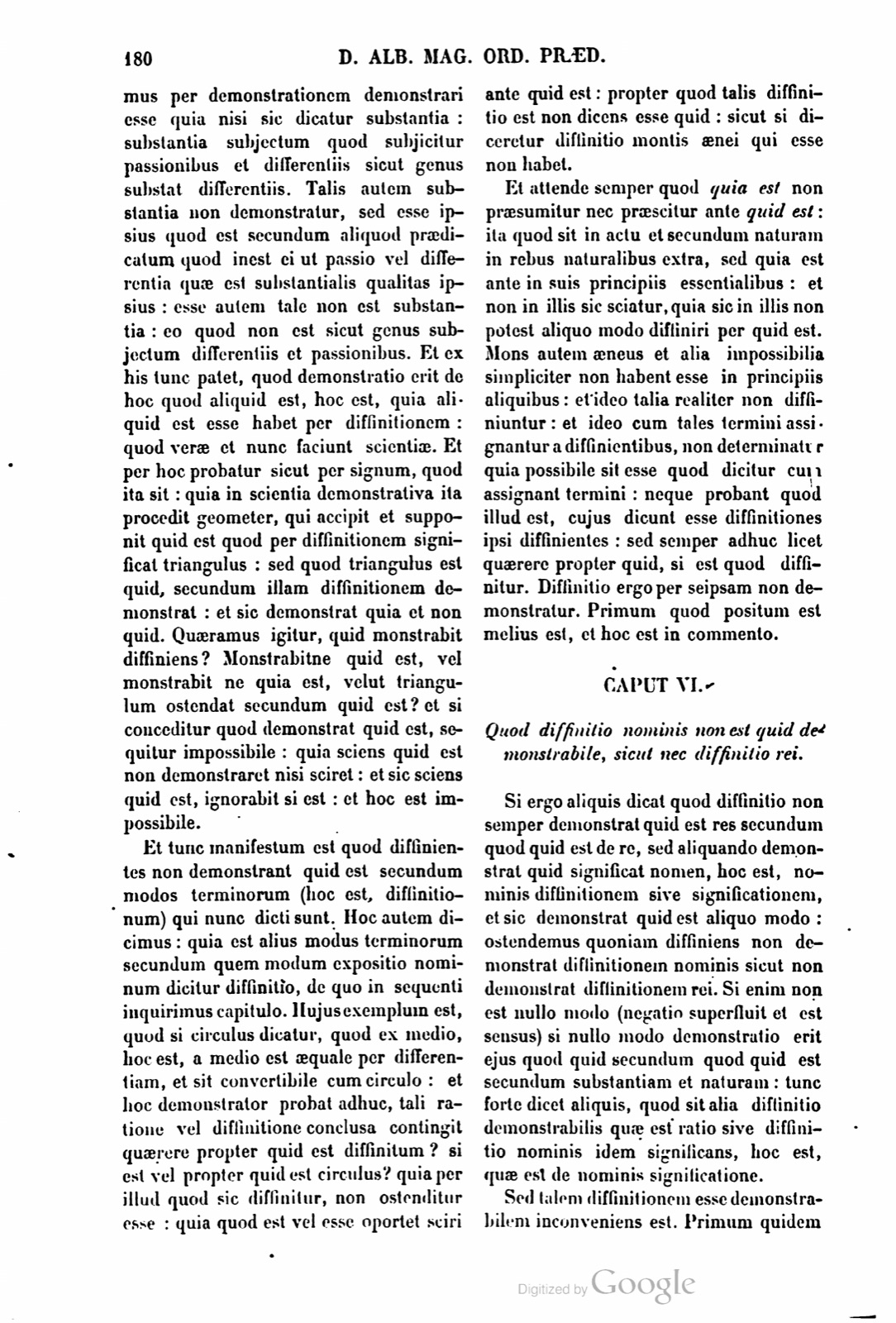
CAPUT VI. Quod diffinitio nominis non est quid demonstrabile, sicut nec diffinitio rei. Si ergo aliquis dicat quod diffinitio non semper demonstrat quid est res secundum quod quid est de re, sed aliquando demonstrat quid significat nomen, hoc est, nominis diffinitionem sive significationem, et sic demonstrat quid est aliquo modo: ostendemus quoniam diffiniens non demonstrat diffinitionem nominis sicut non demonstrat diffinitionem rei. Si enim non est nullo modo (negatio superfluit et est sensus) si nullo modo demonstratio erit ejus quod quid secundum quod quid est secundum substantiam et naturam: tunc forte dicet aliquis, quod sit alia diffinitio demonstrabilis quae est ratio sive diffinitio nominis idem significans, hoc est, quae est de nominis significatione. Sed talem diffinitionem esse demonstrabilem inconveniens est. Primum quidem
CHAPTER VI. That nominal definition is not a demonstrable what, just as neither is real definition. Therefore if someone says that definition does not always demonstrate what the thing is according to what it is concerning the thing, but sometimes demonstrates what the name signifies, that is, the definition or signification of the name, and thus demonstrates what it is in some way, we will show that one defining does not demonstrate the definition of a name, just as he does not demonstrate the definition of a thing. For if it is not in no way, the negation is superfluous and this is the sense, if in no way demonstration will be of that which is what according as it is what it is according to substance and nature, then perhaps someone will say that there is another demonstrable definition which is the account or definition of a name signifying the same thing, that is, which is concerning the signification of the name. But that such a definition is demonstrable is unsuitable. First indeed
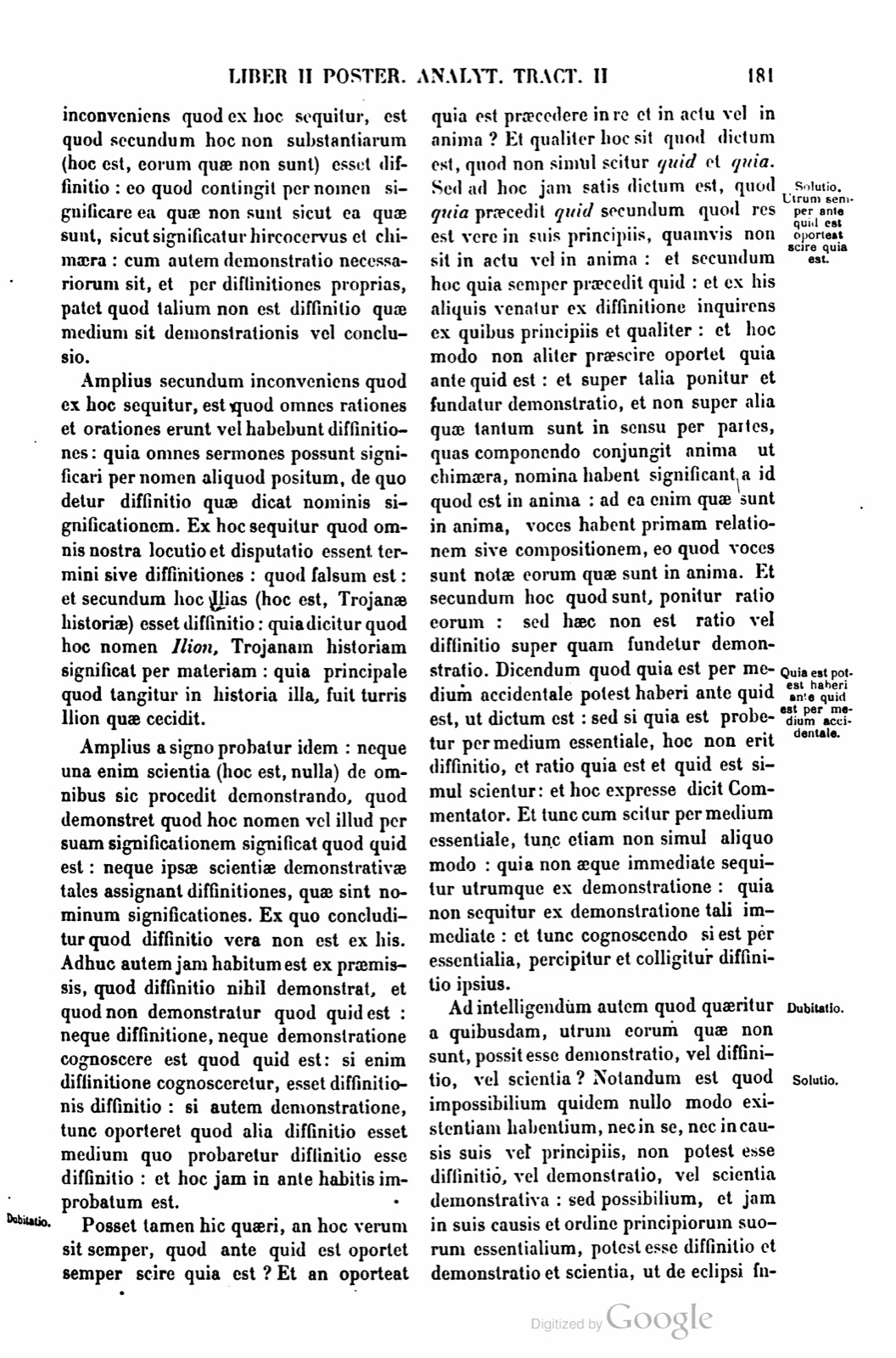
inconveniens quod ex hoc sequitur, est quia quod secundum hoc non substantiarum (hoc est, eorum quae non sunt) esset diffinitio: eo quod contingit per nomen significare ea quae non sunt sicut ea quae sunt, sicut significatur hircocervus et chimaera: cum autem demonstratio necessariorum sit, et per diffinitiones proprias, patet quod talium non est diffinitio quae medium sit demonstrationis vel conclusio. Amplius secundum inconveniens quod ex hoc sequitur, est quod omnes rationes et orationes erunt vel habebunt diffinitiones: quia omnes sermones possunt significari per nomen aliquod positum, de quo detur diffinitio quae dicat nominis significationem. Ex hoc sequitur quod omnis nostra locutio et disputatio essent termini sive diffinitiones: quod falsum est: et secundum hoc Ilias (hoc est, Trojanae historiae) esset diffinitio: quia dicitur quod hoc nomen Ilion, Trojanam historiam significat per materiam: quia principale quod tangitur in historia illa, fuit turris Ilion quae cecidit. Amplius a signo probatur idem: neque una enim scientia (hoc est, nulla) de omnibus sic procedit demonstrando, quod demonstret quod hoc nomen vel illud per suam significationem significat quod quid est: neque ipsae scientiae demonstrativae tales assignant diffinitiones, quae sint nominum significationes. Ex quo concluditur quod diffinitio vera non est ex his. Adhuc autem jam habitum est ex praemissis, quod diffinitio nihil demonstrat, et quod non demonstratur quod quid est: neque diffinitione, neque demonstratione cognoscere est quod quid est: si enim diffinitione cognosceretur, esset diffinitionis diffinitio: si autem demonstratione, tunc oporteret quod alia diffinitio esset medium quo probaretur diffinitio esse diffinitio: et hoc jam in ante habitis improbatum est. <marginal-label>Dubitatio.</marginal-label> Posset tamen hic quaeri, an hoc verum sit semper, quod ante quid est oportet semper scire quia est? Et an oporteat quia est praecedere in re et in actu vel in anima? Et qualiter hoc sit quod dictum est, quod non simul scitur quid et quia. <marginal-label>Solutio.</marginal-label> <marginal-label>Utrum semper ante quid est scire oporteat quia est.</marginal-label> Sed ad hoc jam satis dictum est, quod quia praecedit quid secundum quod res est vere in suis principiis, quamvis non sit in actu vel in anima: et secundum hoc quia semper praecedit quid: et ex his aliquis venatur ex diffinitione inquirens ex quibus principiis et qualiter: et hoc modo non aliter praescire oportet quia ante quid est: et super talia ponitur et fundatur demonstratio, et non super alia quae tantum sunt in sensu per partes, quas componendo conjungit anima ut chimaera, nomina habent significantia id quod est in anima: ad ea enim quae sunt in anima, voces habent primam relationem sive compositionem, eo quod voces sunt notae eorum quae sunt in anima. Et secundum hoc quod sunt, ponitur ratio eorum: sed haec non est ratio vel diffinitio super quam fundetur demonstratio. <marginal-label>Quia est potest haberi ante quid est per medium accidentale.</marginal-label> Dicendum quod quia est per medium accidentale potest haberi ante quid est, ut dictum est: sed si quia est probetur per medium essentiale, hoc non erit diffinitio, et ratio quia est et quid est simul scientur: et hoc expresse dicit Commentator. Et tunc cum scitur per medium essentiale, tunc etiam non simul aliquo modo: quia non aeque immediate sequitur utrumque ex demonstratione: quia non sequitur ex demonstratione tali immediate: et tunc cognoscendo si est per essentialia, percipitur et colligitur diffinitio ipsius. <marginal-label>Dubitatio.</marginal-label> Ad intelligendum autem quod quaeritur a quibusdam, utrum eorum quae non sunt, possit esse demonstratio, vel diffinitio, vel scientia? <marginal-label>Solutio.</marginal-label> Notandum est quod impossibilium quidem nullo modo existentiam habentium, nec in se, nec in causis suis vel principiis, non potest esse diffinitio, vel demonstratio, vel scientia demonstrativa: sed possibilium, et jam in suis causis et ordine principiorum suorum essentialium, potest esse diffinitio et demonstratio et scientia, ut de eclipsi futura, et ortu et occasu stellarum, et aliorum similium: et planum hoc est ex dictis. Et si dicat aliquis quod sciens quid, scit ipsum esse: jam patet responsio, quod scit ipsum esse in suo ordine suorum principiorum, ut dictum est. Et ex hoc patet, quod nullo homine existente haec adhuc vera est, homo est animal. Sed de talibus multa in ante habitis libris dicta sunt. <marginal-label>Objectio.</marginal-label> Objiciunt tamen quidam etiam de impossibilibus, sicut de hac, vacuum est locus privatus corpore, et chimaera est opinabilis: haec enim nunquam esse possunt: et tamen istae locutiones videntur esse verae. <marginal-label>Solutio.</marginal-label> Sed ad haec et omnia talia dicendum, quod talia per partes ad minus significantur a natura, sed componit ea anima: et ideo sicut talia habent nomina et significationes et diffinitiones secundum quod sunt in anima componente, quae tamen referuntur ad naturam, et sic sunt verae locutiones, vacuum est locus privatus corpore: quia per separationem alicujus corporis a loco accipit anima separabilitatem cujuslibet, et sic locum sive spatium sine corpore. Et sic non entium extra animam aliquo modo est esse, et impossibilium aliquo modo est acceptio secundum naturam componentem ea quae in natura composita non sunt.
the unsuitable consequence that follows from this is that according to this there would be a definition of non-substances, that is, of those things which are not, because it happens through a name to signify things that are not just as things that are, as goat-stag and chimera are signified. But since demonstration is of necessary things and is through proper definitions, it is clear that there is not of such things a definition which is the middle of demonstration or a conclusion. Further, the second unsuitable consequence that follows from this is that all accounts and speeches will be or will have definitions, because all speeches can be signified through some imposed name, of which a definition may be given that states the signification of the name. From this it follows that all our speech and disputation would be terms or definitions, which is false; and according to this the Iliad, that is, the Trojan history, would be a definition, because it is said that this name Ilion signifies the Trojan history through matter, because the principal thing touched upon in that history was the tower Ilion, which fell. Further, the same is proved from a sign: for not even one science, that is, no science at all, proceeds thus about all things by demonstrating, so that it demonstrates that this name or that name by its signification signifies what it is; nor do the demonstrative sciences themselves assign such definitions, which are significations of names. From this it is concluded that true definition is not from these things. Moreover it has now been had from the things premised that definition demonstrates nothing, and that what it is is not demonstrated. Neither by definition nor by demonstration is it to know what it is; for if it were known by definition, there would be a definition of definition; but if it were known by demonstration, then another definition would have to be the middle by which definition would be proved to be a definition; and this has already been disproved in the things had before. <marginal-label>Doubt.</marginal-label> Nevertheless here it could be asked whether this is always true, that before what it is one must always know that it is; and whether that it is must precede in the thing and in act, or in the soul; and how this is, which has been said, that what and that are not known at once. <marginal-label>Solution.</marginal-label> <marginal-label>Whether one must always know that it is before what it is.</marginal-label> But to this enough has now been said: that the that precedes the what according as the thing is truly in its principles, although it is not in act or in the soul; and according to this, the that always precedes the what. And from these things someone hunts from definition by inquiring from what principles and in what way it is; and in this way one must not otherwise foreknow that it is before what it is. And demonstration is placed and founded upon such things, and not upon other things which are only in sense through parts, which the soul composes by joining them, as chimera. Names have signified that which is in the soul; for voices have their first relation or composition to those things which are in the soul, because voices are marks of those things which are in the soul. And according to this, because they are, their account is posited; but this is not the account or definition upon which demonstration is founded. <marginal-label>That it is can be had before what it is through an accidental middle.</marginal-label> One must say that that it is can be had before what it is through an accidental middle, as has been said; but if that it is is proved through an essential middle, this will not be definition, and the account that it is and what it is will be known at once; and the Commentator says this expressly. And then, when it is known through an essential middle, even then they are not at once in some way, because both do not follow equally immediately from demonstration, since it does not follow from such demonstration immediately; and then, by knowing whether it is through essential things, the definition of it itself is perceived and gathered. <marginal-label>Doubt.</marginal-label> But for understanding what is asked by certain people, whether there can be demonstration, or definition, or science of those things which are not: <marginal-label>Solution.</marginal-label> It must be noted that of impossibles having existence in no way, neither in themselves nor in their causes or principles, there cannot be definition, or demonstration, or demonstrative science; but of possibles, and of things already in their causes and in the order of their essential principles, there can be definition and demonstration and science, as concerning a future eclipse, and the rising and setting of stars, and other similar things; and this is plain from what has been said. And if someone says that one knowing what a thing is knows that it is, the response is already clear: that he knows it to be in the order of its principles, as has been said. And from this it is clear that, with no human being existing, this is still true: a human being is an animal. But many things concerning such matters have been said in the books previously had. <marginal-label>Objection.</marginal-label> Nevertheless certain people object also about impossibles, as about this, a vacuum is a place deprived of body, and chimera is opinable; for these things can never be, and nevertheless these expressions seem to be true. <marginal-label>Solution.</marginal-label> But to these things and to all such things one must say that such things are signified by parts at least from nature, but the soul composes them. And therefore, just as such things have names and significations and definitions according as they are in the composing soul, which nevertheless are referred to nature, so they are true expressions: a vacuum is a place deprived of body, because through the separation of some body from a place the soul receives the separability of anything whatever, and thus place or space without body. And thus in some way there is being of non-beings outside the soul, and in some way there is a reception of impossibles according to nature composing those things which are not in composed nature.
If a page does not appear, its photograph has not been uploaded yet.