Works › Posterior Analytics, Books I–II
Volume 2 · pp. 140–142
Chapter VI. On the comparison of science to science according to unity or identity.
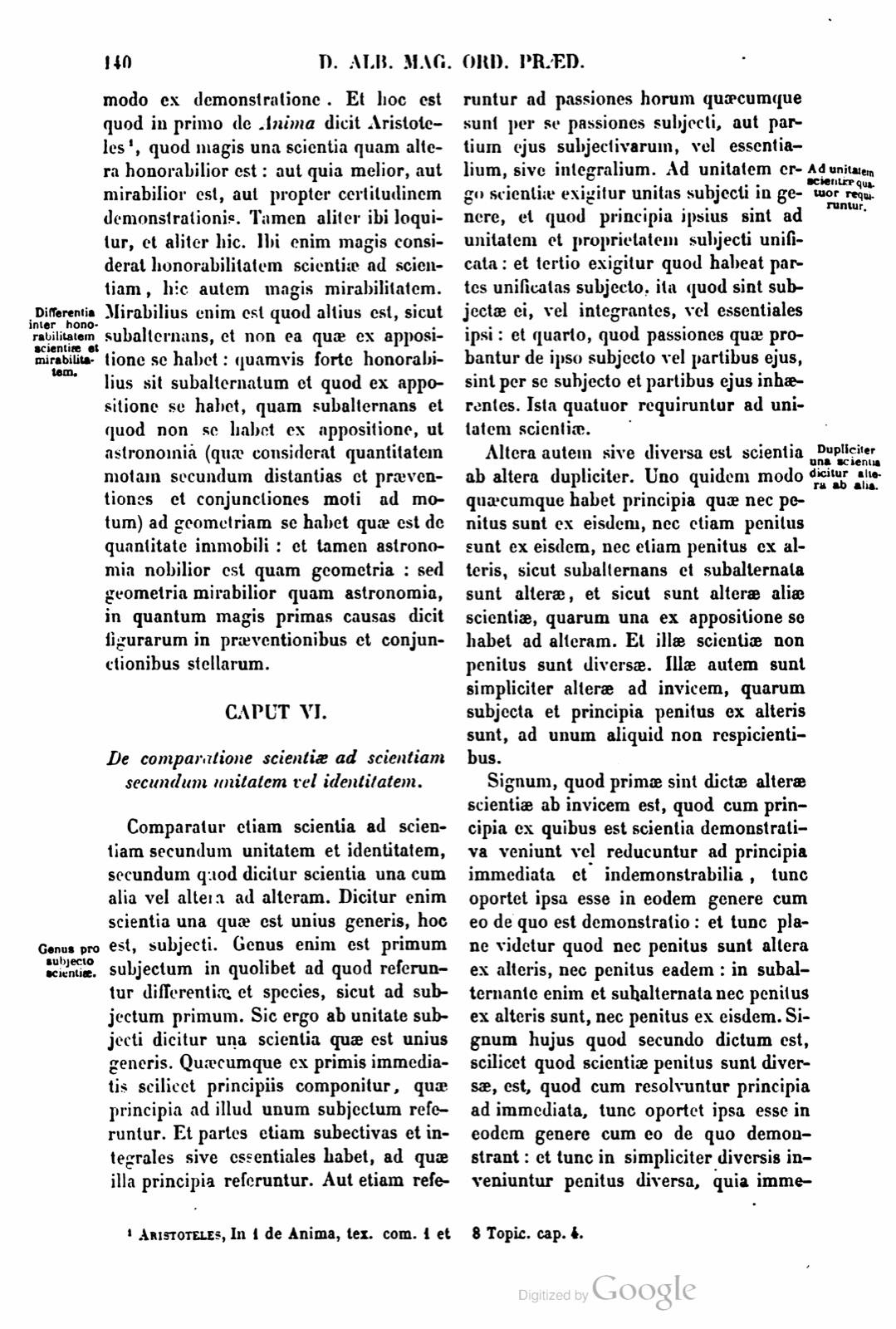
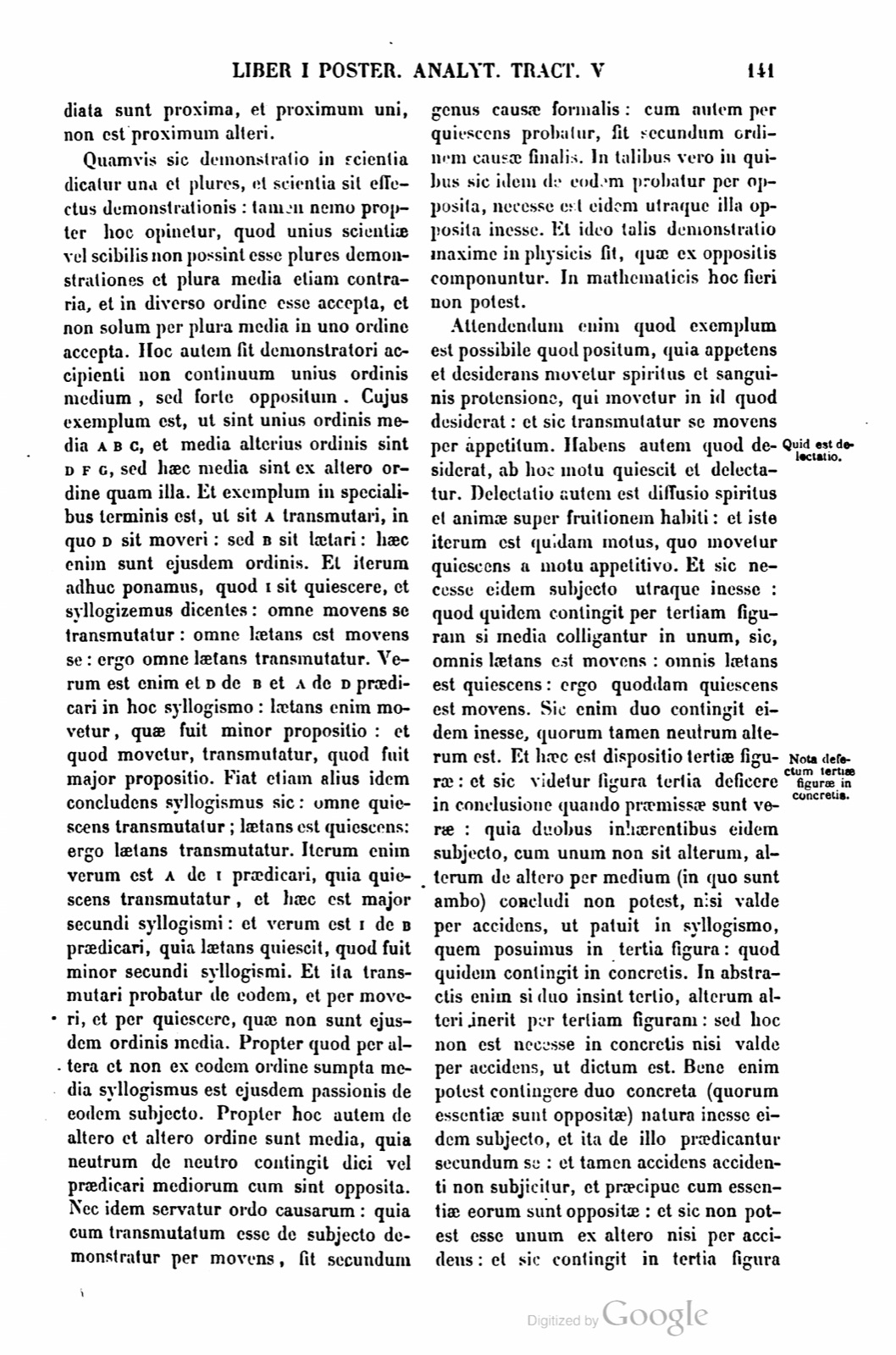
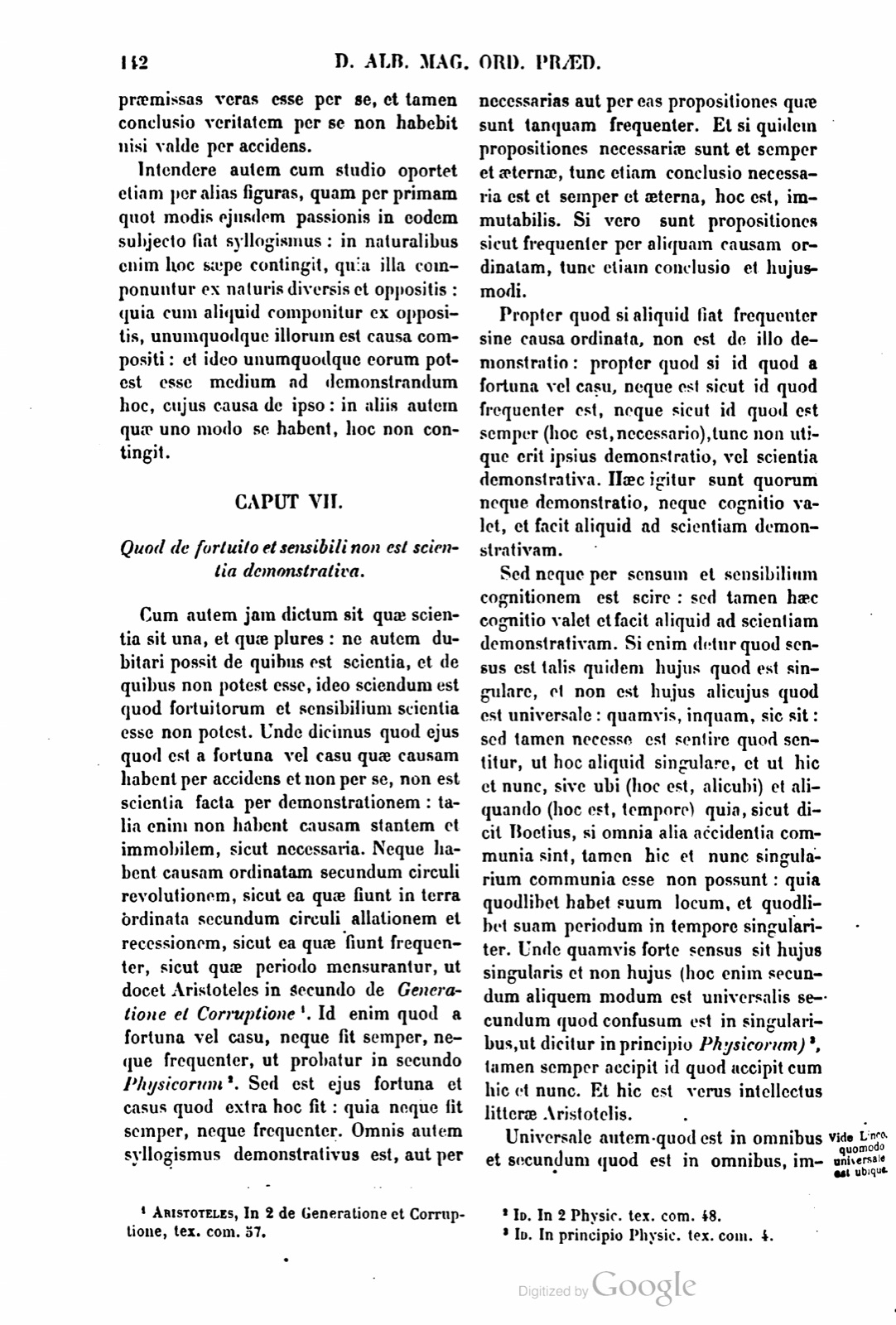
CAPUT VI. De comparatione scientiae ad scientiam secundum unitatem vel identitatem. Comparatur etiam scientia ad scientiam secundum unitatem et identitatem, secundum quod dicitur scientia una cum alia vel altera ad alteram. Dicitur enim scientia una quae est unius generis, hoc est, subjecti. Genus enim est primum subjectum in quolibet ad quod referuntur differentiae et species, sicut ad subjectum primum. Sic ergo ab unitate subjecti dicitur una scientia quae est unius generis. Quaecumque ex primis immediatis scilicet principiis componitur, quae principia ad illud unum subjectum referuntur. Et partes etiam subjectivas et integrales sive essentiales habet, ad quae illa principia referuntur. Aut etiam referuntur ad passiones horum quaecumque sunt per se passiones subjecti, aut partium ejus subjectivarum, vel essentialium, sive integralium. Ad unitatem ergo scientiae exigitur unitas subjecti in genere, et quod principia ipsius sint ad unitatem et proprietatem subjecti unificata: et tertio exigitur quod habeat partes unificatas subjecto, ita quod sint subjectae ei, vel integrantes, vel essentiales ipsi: et quarto, quod passiones quae probantur de ipso subjecto vel partibus ejus, sint per se subjecto et partibus ejus inhaerentes. Ista quatuor requiruntur ad unitatem scientiae. <marginal-label>Genus pro subjecto scientiae.</marginal-label> <marginal-label>Ad unitatem scientiae quatuor requiruntur.</marginal-label> <marginal-label>Dupliciter una scientia dicitur altera ab alia.</marginal-label> Altera autem sive diversa est scientia una ab altera dupliciter. Uno quidem modo quaecumque habet principia quae nec penitus sunt ex eisdem, nec etiam penitus sunt ex alteris, sicut subalternans et subalternata sunt alterae, et sicut sunt alterae aliae scientiae, quarum una ex appositione se habet ad alteram. Et illae scientiae non penitus sunt diversae. Illae autem sunt simpliciter alterae ad invicem, quarum subjecta et principia penitus ex alteris sunt, ad unum aliquid non respicientibus. Signum, quod primae sint dictae alterae scientiae ab invicem est, quod cum principia ex quibus est scientia demonstrativa veniunt vel reducuntur ad principia immediata et indemonstrabilia, tunc oportet ipsa esse in eodem genere cum eo de quo est demonstratio: et tunc plane videtur quod nec penitus sunt altera ex alteris, nec penitus eadem: in subalternante enim et subalternata nec penitus ex alteris sunt, nec penitus ex eisdem. Signum hujus quod secundo dictum est, scilicet quod scientiae penitus sunt diversae, est, quod cum resolvuntur principia ad immediata, tunc oportet ipsa esse in eodem genere cum eo de quo demonstrant: et tunc in simpliciter diversis inveniuntur penitus diversa, quia immediata sunt proxima, et proximum uni, non est proximum alteri. Quamvis sic demonstratio in scientia dicatur una et plures, et scientia sit effectus demonstrationis: tamen nemo propter hoc opinetur, quod unius scientiae vel scibilis non possint esse plures demonstrationes et plura media etiam contraria, et in diverso ordine esse accepta, et non solum per plura media in uno ordine accepta. Hoc autem fit demonstratori accipienti non continuum unius ordinis medium, sed forte oppositum. Cujus exemplum est, ut sint unius ordinis media A B C, et media alterius ordinis sint D F G, sed haec media sint ex altero ordine quam illa. Et exemplum in specialibus terminis est, ut sit A transmutari, in quo D sit moveri: sed B sit laetari: haec enim sunt ejusdem ordinis. Et iterum adhuc ponamus, quod I sit quiescere, et syllogizemus dicentes: omne movens se transmutatur: omne laetans est movens se: ergo omne laetans transmutatur. Verum est enim et D de B et A de D praedicari in hoc syllogismo: laetans enim movetur, quae fuit minor propositio: et quod movetur, transmutatur, quod fuit major propositio. Fiat etiam alius idem concludens syllogismus sic: omne quiescens transmutatur; laetans est quiescens: ergo laetans transmutatur. Iterum enim verum est A de I praedicari, quia quiescens transmutatur, et haec est major secundi syllogismi: et verum est I de B praedicari, quia laetans quiescit, quod fuit minor secundi syllogismi. Et ita transmutari probatur de eodem, et per moveri, et per quiescere, quae non sunt ejusdem ordinis media. Propter quod per altera et non ex eodem ordine sumpta media syllogismus est ejusdem passionis de eodem subjecto. Propter hoc autem de altero et altero ordine sunt media, quia neutrum de neutro contingit dici vel praedicari mediorum cum sint opposita. Nec idem servatur ordo causarum: quia cum transmutatum esse de subjecto demonstratur per movens, fit secundum genus causae formalis: cum autem per quiescens probatur, fit secundum ordinem causae finalis. In talibus vero in quibus sic idem de eodem probatur per opposita, necesse est eidem utraque illa opposita inesse. Et ideo talis demonstratio maxime in physicis fit, quae ex oppositis componuntur. In mathematicis hoc fieri non potest. <marginal-label>Quid est delectatio.</marginal-label> Attendendum enim quod exemplum est possibile quod positum, quia appetens et desiderans movetur spiritus et sanguinis protensione, qui movetur in id quod desiderat: et sic transmutatur se movens per appetitum. Habens autem quod desiderat, ab hoc motu quiescit et delectatur. Delectatio autem est diffusio spiritus et animae super fruitionem habiti: et iste iterum est quidam motus, quo movetur quiescens a motu appetitivo. Et sic necesse eidem subjecto utraque inesse: quod quidem contingit per tertiam figuram si media colligantur in unum, sic, omnis laetans est movens: omnis laetans est quiescens: ergo quoddam quiescens est movens. Sic enim duo contingit eidem inesse, quorum tamen neutrum alterum est. Et haec est dispositio tertiae figurae: et sic videtur figura tertia deficere in conclusione quando praemissae sunt verae: quia duobus inhaerentibus eidem subjecto, cum unum non sit alterum, alterum de altero per medium (in quo sunt ambo) concludi non potest, nisi valde per accidens, ut patuit in syllogismo, quem posuimus in tertia figura: quod quidem contingit in concretis. In abstractis enim si duo insint tertio, alterum alteri inerit per tertiam figuram: sed hoc non est necesse in concretis nisi valde per accidens, ut dictum est. Bene enim potest contingere duo concreta (quorum essentiae sunt oppositae) natura inesse eidem subjecto, et ita de illo praedicantur secundum se: et tamen accidens accidenti non subjicitur, et praecipue cum essentiae eorum sunt oppositae: et sic non potest esse unum ex altero nisi per accidens: et sic contingit in tertia figura praemissas veras esse per se, et tamen conclusio veritatem per se non habebit nisi valde per accidens. <marginal-label>Nota defectum tertiae figurae in concretis.</marginal-label> Intendere autem cum studio oportet etiam per alias figuras, quam per primam quot modis ejusdem passionis in eodem subjecto fiat syllogismus: in naturalibus enim hoc saepe contingit, quia illa componuntur ex naturis diversis et oppositis: quia cum aliquid componitur ex oppositis, unumquodque illorum est causa compositi: et ideo unumquodque eorum potest esse medium ad demonstrandum hoc, cujus causa de ipso: in aliis autem quae uno modo se habent, hoc non contingit.
CHAPTER VI. On the comparison of science to science according to unity or identity. Science is also compared to science according to unity and identity, according as one science is said to be one with another or other in relation to another. For a science is called one which is of one genus, that is, of one subject. For genus is the first subject in anything to which differences and species are referred, as to a first subject. Thus, therefore, from the unity of the subject a science is called one which is of one genus. It is whatever is composed from first immediate principles, namely principles which are referred to that one subject. And it also has subjective and integral or essential parts to which those principles are referred. Or they are also referred to the properties of these, whatever properties are per se properties of the subject, or of its subjective, or essential, or integral parts. Therefore for the unity of a science the unity of the subject in a genus is required, and that its principles be unified toward the unity and property of the subject; and thirdly it is required that it have parts unified to the subject, so that they are subjected to it, or are integrating, or essential to it; and fourthly, that the properties which are proved of the subject itself or of its parts be inhering per se in the subject and its parts. These four things are required for the unity of a science. <marginal-label>Genus as the subject of science.</marginal-label> <marginal-label>Four things are required for the unity of science.</marginal-label> <marginal-label>In two ways one science is said to be other than another.</marginal-label> But one science is other or diverse from another in two ways. In one way, every science is other which has principles that are neither entirely from the same things nor also entirely from other things, as a subalternating and a subalternated science are other, and as other sciences are other, of which one is related by addition to another. And those sciences are not entirely diverse. But those sciences are simply other in relation to one another whose subjects and principles are entirely from other things, not looking toward some one thing. The sign that the first are said to be sciences other than one another is this: when the principles from which demonstrative science is come, or are reduced, to immediate and indemonstrable principles, then they must be in the same genus with that concerning which there is demonstration; and then it plainly seems that they are neither entirely other from other things nor entirely the same. For in the subalternating and the subalternated they are neither entirely from other things nor entirely from the same things. The sign of this which was said secondly, namely that sciences are entirely diverse, is that, when the principles are resolved to immediate principles, then they must be in the same genus with that concerning which they demonstrate; and then in things simply diverse they are found to be entirely diverse, because immediate things are proximate, and what is proximate to one thing is not proximate to another. Although in this way demonstration in science is called one and many, and science is the effect of demonstration, nevertheless let no one on account of this think that there cannot be several demonstrations and several middles, even contrary ones, of one science or of one knowable thing, and that they cannot be taken in a different order, and not only through several middles taken in one order. But this happens for a demonstrator who accepts not the continuous middle of one order, but perhaps the opposite. The example of this is: let the middles of one order be A B C, and let the middles of another order be D F G, but let these middles be from another order than those. And the example in special terms is that let A be to be changed, in which D is to be moved; but let B be to rejoice, for these are of the same order. And again let us further posit that I is to rest, and let us syllogize by saying: everything moving itself is changed; everything rejoicing is moving itself; therefore everything rejoicing is changed. For it is true in this syllogism both that D is predicated of B and that A is predicated of D; for the rejoicing thing is moved, which was the minor proposition, and what is moved is changed, which was the major proposition. Let another syllogism also be made concluding the same thing thus: every resting thing is changed; the rejoicing thing is resting; therefore the rejoicing thing is changed. For again it is true that A is predicated of I, because what is resting is changed, and this is the major of the second syllogism; and it is true that I is predicated of B, because the rejoicing thing rests, which was the minor of the second syllogism. And thus to be changed is proved of the same thing both through to be moved and through to rest, which are not middles of the same order. Therefore through other middles, and middles taken not from the same order, there is a syllogism of the same property concerning the same subject. But for this reason the middles are of one and another order, because neither of the middles can be said or predicated of the other when they are opposites. Nor is the same order of causes preserved, because, when being changed is demonstrated of the subject through moving, it is made according to the genus of formal cause; but when it is proved through resting, it is made according to the order of final cause. But in such things in which the same thing is thus proved of the same thing through opposites, it is necessary that both those opposites belong to the same thing. And therefore such demonstration occurs especially in physical things, which are composed from opposites. In mathematics this cannot happen. <marginal-label>What delight is.</marginal-label> For it must be attended to that the example placed is possible, because one appetizing and desiring is moved by the extension of spirit and blood, which is moved into that which it desires; and thus what moves itself is changed through appetite. But having what it desires, it rests from this motion and is delighted. But delight is the diffusion of spirit and soul over the enjoyment of the thing possessed; and this again is a certain motion by which the resting thing is moved from appetitive motion. And thus it is necessary that both belong to the same subject; and this indeed happens through the third figure if the middles are gathered into one, thus: every rejoicing thing is moving; every rejoicing thing is resting; therefore some resting thing is moving. For in this way two things can belong to the same thing, of which nevertheless neither is the other. And this is the disposition of the third figure; and thus the third figure seems to be deficient in the conclusion when the premises are true, because when two things inhere in the same subject, since one is not the other, one cannot be concluded of the other through a middle in which both are, except very much per accidens, as was clear in the syllogism that we placed in the third figure. This indeed happens in concretes. For in abstracts, if two things belong to a third, one will belong to the other through the third figure; but this is not necessary in concretes except very much per accidens, as has been said. For it can well happen that two concrete things, whose essences are opposed, belong by nature to the same subject, and so are predicated of it according to themselves; and nevertheless an accident is not subjected to an accident, especially when their essences are opposed. And thus one cannot be from the other except through accident; and so it happens in the third figure that the premises are true per se, and nevertheless the conclusion will not have truth per se except very much per accidens. <marginal-label>Note the defect of the third figure in concretes.</marginal-label> But one must also attend with study through other figures than the first, in how many modes a syllogism of the same property in the same subject is made. For in natural things this often happens, because they are composed from diverse and opposed natures; because when something is composed from opposites, each one of them is a cause of the composite; and therefore each of them can be a middle for demonstrating this, the cause of which is concerning it. But in other things which stand in one way, this does not happen.
If a page does not appear, its photograph has not been uploaded yet.