Works › Posterior Analytics, Books I–II
Volume 2 · pp. 138–140
Chapter V. On the comparison of demonstration to demonstration according to its proper effect, which is science.
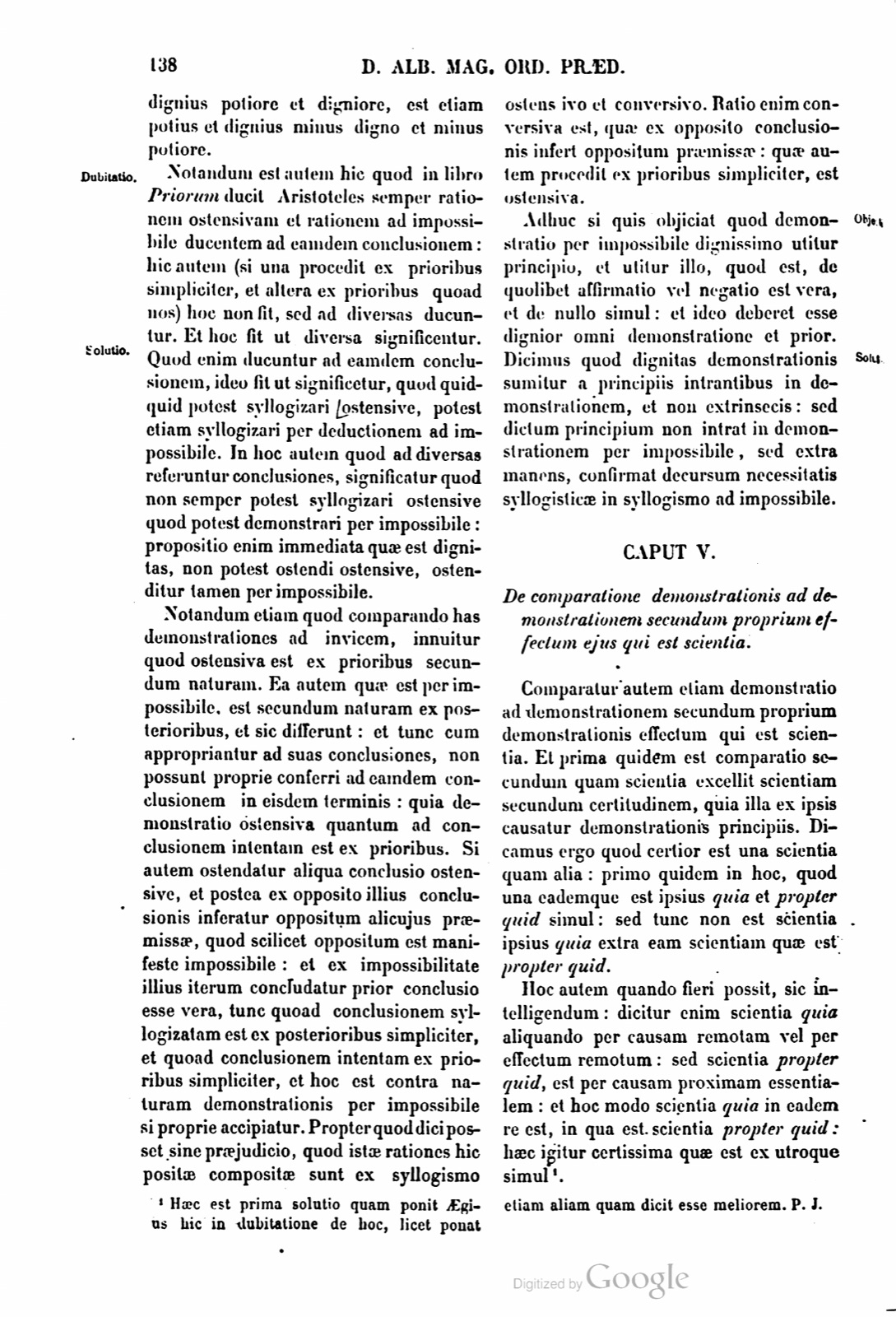
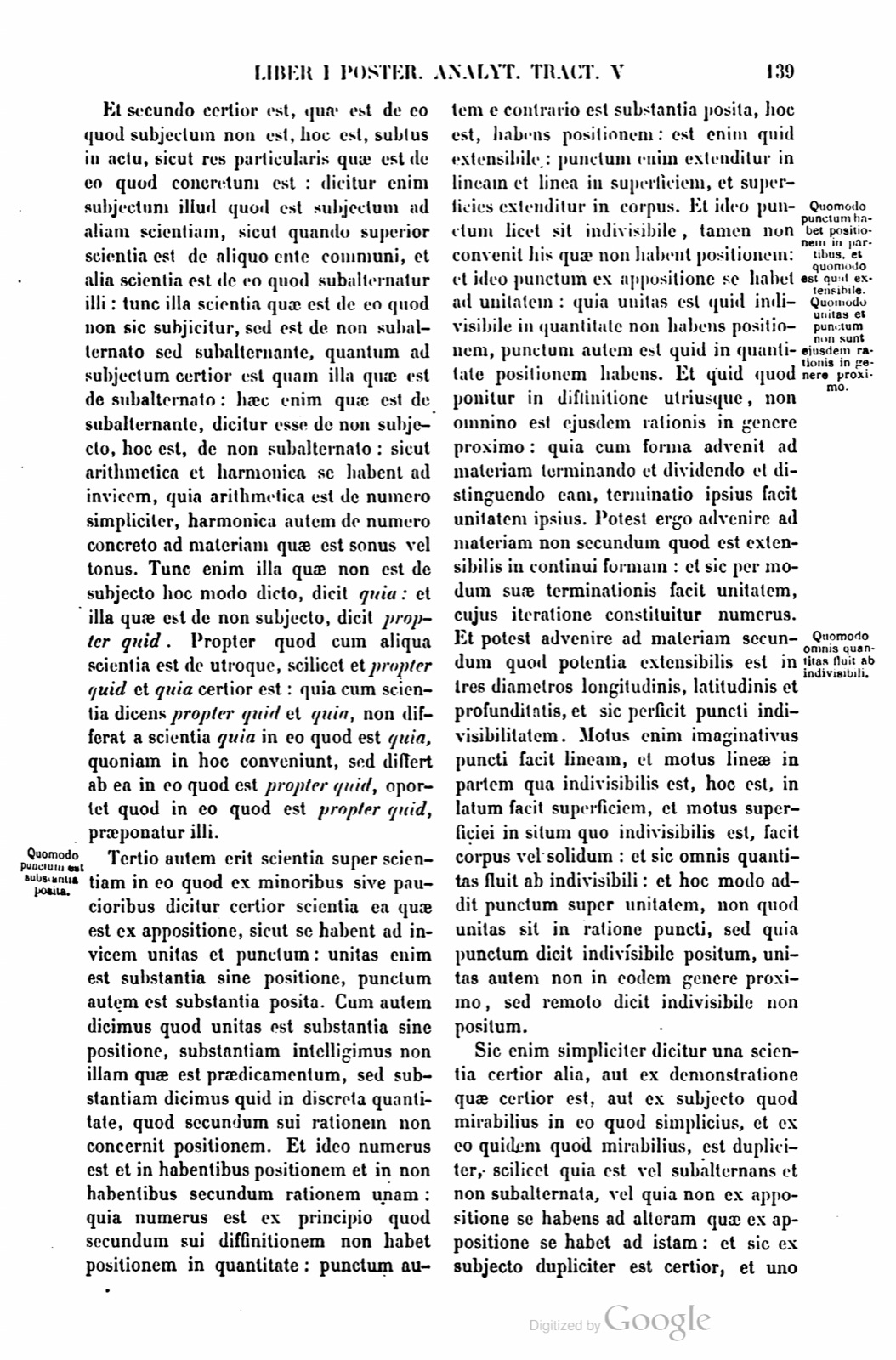
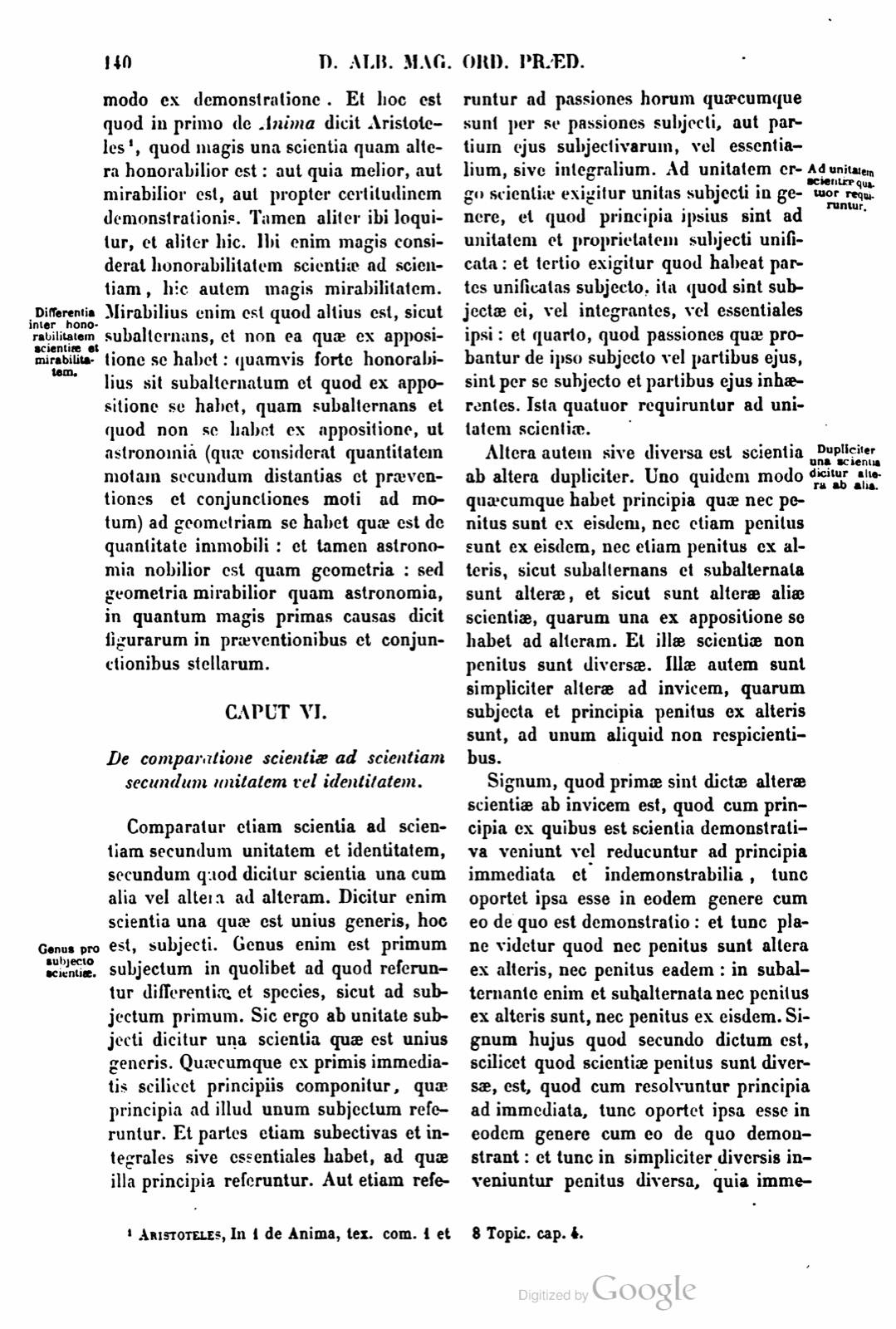
CAPUT V. De comparatione demonstrationis ad demonstrationem secundum proprium effectum ejus qui est scientia. Comparatur autem etiam demonstratio ad demonstrationem secundum proprium demonstrationis effectum qui est scientia. Et prima quidem est comparatio secundum quam scientia excellit scientiam secundum certitudinem, quia illa ex ipsis causatur demonstrationis principiis. Dicamus ergo quod certior est una scientia quam alia: primo quidem in hoc, quod una eademque est ipsius quia et propter quid simul: sed tunc non est scientia ipsius quia extra eam scientiam quae est propter quid. Hoc autem quando fieri possit, sic intelligendum: dicitur enim scientia quia aliquando per causam remotam vel per effectum remotum: sed scientia propter quid, est per causam proximam essentialem: et hoc modo scientia quia in eadem re est, in qua est scientia propter quid: haec igitur certissima quae est ex utroque simul 1. Et secundo certior est, quae est de eo quod subjectum non est, hoc est, subtus in actu, sicut res particularis quae est de eo quod concretum est: dicitur enim subjectum illud quod est subjectum ad aliam scientiam, sicut quando superior scientia est de aliquo ente communi, et alia scientia est de eo quod subalternatur illi: tunc illa scientia quae est de eo quod non sic subjicitur, sed est de non subalternato sed subalternante, quantum ad subjectum certior est quam illa quae est de subalternato: haec enim quae est de subalternante, dicitur esse de non subjecto, hoc est, de non subalternato: sicut arithmetica et harmonica se habent ad invicem, quia arithmetica est de numero simpliciter, harmonica autem de numero concreto ad materiam quae est sonus vel tonus. Tunc enim illa quae non est de subjecto hoc modo dicto, dicit quia: et illa quae est de non subjecto, dicit propter quid. Propter quod cum aliqua scientia est de utroque, scilicet et propter quid et quia certior est: quia cum scientia dicens propter quid et quia, non differat a scientia quia in eo quod est quia, quoniam in hoc conveniunt, sed differt ab ea in eo quod est propter quid, oportet quod in eo quod est propter quid, praeponatur illi. <marginal-label>Quomodo punctum est substantia posita.</marginal-label> Tertio autem erit scientia super scientiam in eo quod ex minoribus sive paucioribus dicitur certior scientia ea quae est ex appositione, sicut se habent ad invicem unitas et punctum: unitas enim est substantia sine positione, punctum autem est substantia posita. Cum autem dicimus quod unitas est substantia sine positione, substantiam intelligimus non illam quae est praedicamentum, sed substantiam dicimus quid in discreta quantitate, quod secundum sui rationem non concernit positionem. Et ideo numerus est et in habentibus positionem et in non habentibus secundum rationem unam: quia numerus est ex principio quod secundum sui diffinitionem non habet positionem in quantitate: punctum autem e contrario est substantia posita, hoc est, habens positionem: est enim quid extensibile: punctum enim extenditur in lineam et linea in superficiem, et superficies extenditur in corpus. Et ideo punctum licet sit indivisibile, tamen non convenit his quae non habent positionem: et ideo punctum ex appositione se habet ad unitatem: quia unitas est quid indivisibile in quantitate non habens positionem, punctum autem est quid in quantitate positionem habens. Et quid quod ponitur in diffinitione utriusque, non omnino est ejusdem rationis in genere proximo: quia cum forma advenit ad materiam terminando et dividendo et distinguendo eam, terminatio ipsius facit unitatem ipsius. Potest ergo advenire ad materiam non secundum quod est extensibilis in continui formam: et sic per modum suae terminationis facit unitatem, cujus iteratione constituitur numerus. Et potest advenire ad materiam secundum quod potentia extensibilis est in tres diametros longitudinis, latitudinis et profunditatis, et sic perficit puncti indivisibilitatem. Motus enim imaginativus puncti facit lineam, et motus lineae in partem qua indivisibilis est, hoc est, in latum facit superficiem, et motus superficiei in situm quo indivisibilis est, facit corpus vel solidum: et sic omnis quantitas fluit ab indivisibili: et hoc modo addit punctum super unitatem, non quod unitas sit in ratione puncti, sed quia punctum dicit indivisibile positum, unitas autem non in eodem genere proximo, sed remoto dicit indivisibile non positum. <marginal-label>Quomodo punctum habet positionem in partibus, quomodo et est quid extensibile.</marginal-label> <marginal-label>Quomodo unitas et punctum non sunt ejusdem rationis in genere proximo.</marginal-label> <marginal-label>Quomodo omnis quantitas fluit ab indivisibili.</marginal-label> Sic enim simpliciter dicitur una scientia certior alia, aut ex demonstratione quae certior est, aut ex subjecto quod mirabilius in eo quod simplicius, et ex eo quidem quod mirabilius, est dupliciter, scilicet quia est vel subalternans et non subalternata, vel quia non ex appositione se habens ad alteram quae ex appositione se habet ad istam: et sic ex subjecto dupliciter est certior, et uno modo ex demonstratione. Et hoc est quod in primo de Anima dicit Aristoteles 2, quod magis una scientia quam altera honorabilior est: aut quia melior, aut mirabilior est, aut propter certitudinem demonstrationis. Tamen aliter ibi loquitur, et aliter hic. Ibi enim magis considerat honorabilitatem scientiae ad scientiam, hic autem magis mirabilitatem. Mirabilius enim est quod altius est, sicut subalternans, et non ea quae ex appositione se habet: quamvis forte honorabilius sit subalternatum et quod ex appositione se habet, quam subalternans et quod non se habet ex appositione, ut astronomia (quae considerat quantitatem motam secundum distantias et praeventiones et conjunctiones moti ad motum) ad geometriam se habet quae est de quantitate immobili: et tamen astronomia nobilior est quam geometria: sed geometria mirabilior quam astronomia, in quantum magis primas causas dicit figurarum in praeventionibus et conjunctionibus stellarum. <marginal-label>Differentia inter honorabilitatem scientiae et mirabilitatem.</marginal-label>
CHAPTER V. On the comparison of demonstration to demonstration according to its proper effect, which is science. But demonstration is also compared to demonstration according to the proper effect of demonstration, which is science. And the first comparison is that according to which science excels science according to certainty, because that certainty is caused from the very principles themselves of demonstration. Therefore let us say that one science is more certain than another: first, indeed, in this, that one and the same science is at once of the that and of the on-account-of-what; but then there is no science of the that outside that science which is of the on-account-of-what. But when this can happen must be understood thus: for science that is sometimes said to be through a remote cause or through a remote effect, but science on account of what is through the proximate essential cause; and in this way science that is in the same thing is in that thing in which science on account of what also is. Therefore that science which is from each, namely from both together, is most certain 1. And secondly, that science is more certain which is about that which is not a subject, that is, is not underneath in act in the way a particular thing is, namely the science which is about that which is concrete. For that is called a subject which is subjected to another science, as when a higher science is about some common being and another science is about that which is subalternated to it. Then that science which is about what is not thus subjected, but is about the non-subalternated but subalternating thing, as regards the subject is more certain than that which is about the subalternated thing. For that science which is about the subalternating is said to be about a non-subject, that is, about a non-subalternated thing, as arithmetic and harmonics are related to one another, because arithmetic is about number simply, but harmonics is about number concreted to matter, which is sound or tone. For then the science which is not about a subject in this stated way says the that, and the science which is about the non-subject says the on-account-of-what. Therefore, when some science is about both, namely both the on-account-of-what and the that, it is more certain, because, since the science saying the on-account-of-what and the that does not differ from the science that in that which is the that, since in this they agree, but differs from it in that which is the on-account-of-what, it must be preferred to that science in that which is the on-account-of-what. <marginal-label>How a point is positioned substance.</marginal-label> Thirdly, however, one science will be above another science in this, that the science that is from smaller or fewer things is called more certain than that science which is from addition, as unity and point are related to one another. For unity is substance without position, but point is positioned substance. But when we say that unity is substance without position, by substance we understand not that substance which is the predicament, but by substance we mean a what in discrete quantity, which according to its own account does not concern position. And therefore number is both in things having position and in things not having position according to one account, because number is from a principle which according to its definition does not have position in quantity. But a point, on the contrary, is positioned substance, that is, substance having position; for it is an extensible what. For a point is extended into a line, and a line is extended into a surface, and a surface is extended into a body. And therefore, although a point is indivisible, nevertheless it does not belong to those things that do not have position; and therefore point is related to unity by addition, because unity is an indivisible what in quantity not having position, but point is a what in quantity having position. And the what which is placed in the definition of each is not altogether of the same account in the proximate genus, because when form comes to matter by terminating it and dividing it and distinguishing it, its termination makes the unity of that matter. Therefore form can come to matter not according as matter is extensible into the form of the continuous, and thus by the mode of its termination it makes unity, by the repetition of which number is constituted. And it can come to matter according as matter is extensible in potency into the three diameters of length, breadth, and depth, and thus it perfects the indivisibility of a point. For the imaginative motion of a point makes a line, and the motion of a line into the part by which it is indivisible, that is, into breadth, makes a surface, and the motion of a surface into the position by which it is indivisible makes a body or solid; and thus every quantity flows from the indivisible. And in this way point adds something upon unity, not because unity is in the account of point, but because point says a positioned indivisible, while unity, not in the same proximate genus but in a remote genus, says an unpositioned indivisible. <marginal-label>How a point has position in parts, and how it is an extensible what.</marginal-label> <marginal-label>How unity and point are not of the same account in the proximate genus.</marginal-label> <marginal-label>How every quantity flows from the indivisible.</marginal-label> For thus one science is said simply to be more certain than another either from the demonstration which is more certain, or from the subject, which is more marvelous in that it is simpler; and from that subject indeed, insofar as it is more marvelous, the account is in two ways, namely because it is either subalternating and not subalternated, or because it is not related by addition to another science which is related by addition to it. And thus it is more certain from the subject in two ways, and in one way from demonstration. And this is what Aristotle says in the first book On the Soul 2, that one science is more honorable than another either because it is better, or because it is more marvelous, or on account of the certainty of demonstration. Nevertheless he speaks in one way there and in another way here. For there he considers more the honorability of science in relation to science, but here he considers more the marvelousness. For that which is higher is more marvelous, as the subalternating science is, and not that science which is related by addition, although perhaps the subalternated science and that which is related by addition is more honorable than the subalternating and what is not related by addition, as astronomy, which considers moved quantity according to distances and preventions and conjunctions of the moved thing to the moved thing, is related to geometry, which is about immobile quantity; and nevertheless astronomy is nobler than geometry, but geometry is more marvelous than astronomy, insofar as it more states the first causes of figures in the preventions and conjunctions of the stars. <marginal-label>The difference between the honorability of science and marvelousness.</marginal-label>
Notes
- This is the first solution which Aegidius places here in the doubt about this, although he also places another, which he says is better. P. J. (Haec est prima solutio quam ponit Aegidius hic in dubitatione de hoc, licet ponat etiam aliam quam dicit esse meliorem. P. J.) ↩
- Aristotle, in book 1 of On the Soul, text commentary 1, and Topics 8, chapter 4. (Aristoteles, in 1 de Anima, tex. com. 1 et 8 Topic. cap. 4.) ↩
If a page does not appear, its photograph has not been uploaded yet.