Works › Posterior Analytics, Books I–II
Volume 2 · pp. 142–144
Chapter VII. That there is no demonstrative science concerning the fortuitous and the sensible.
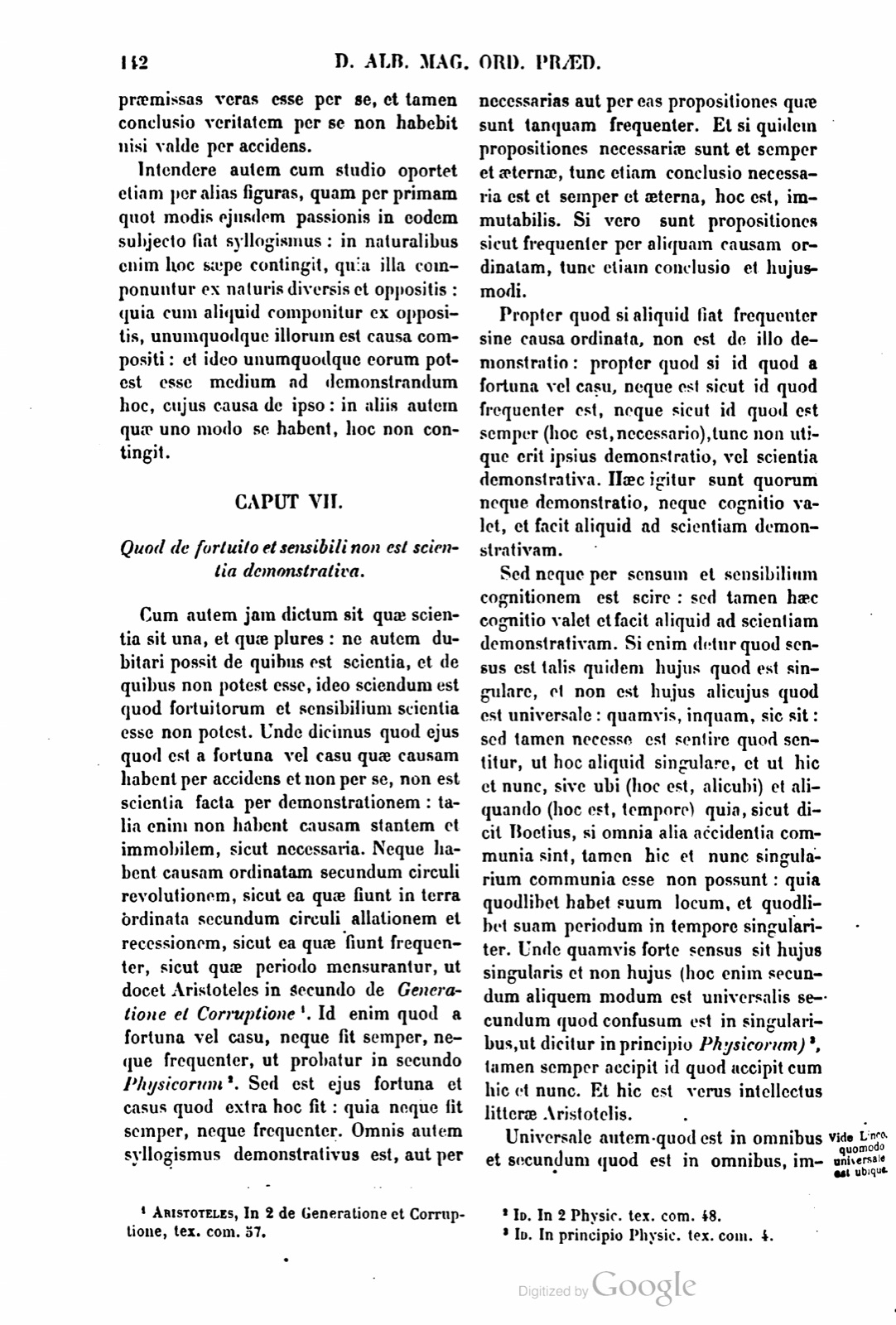
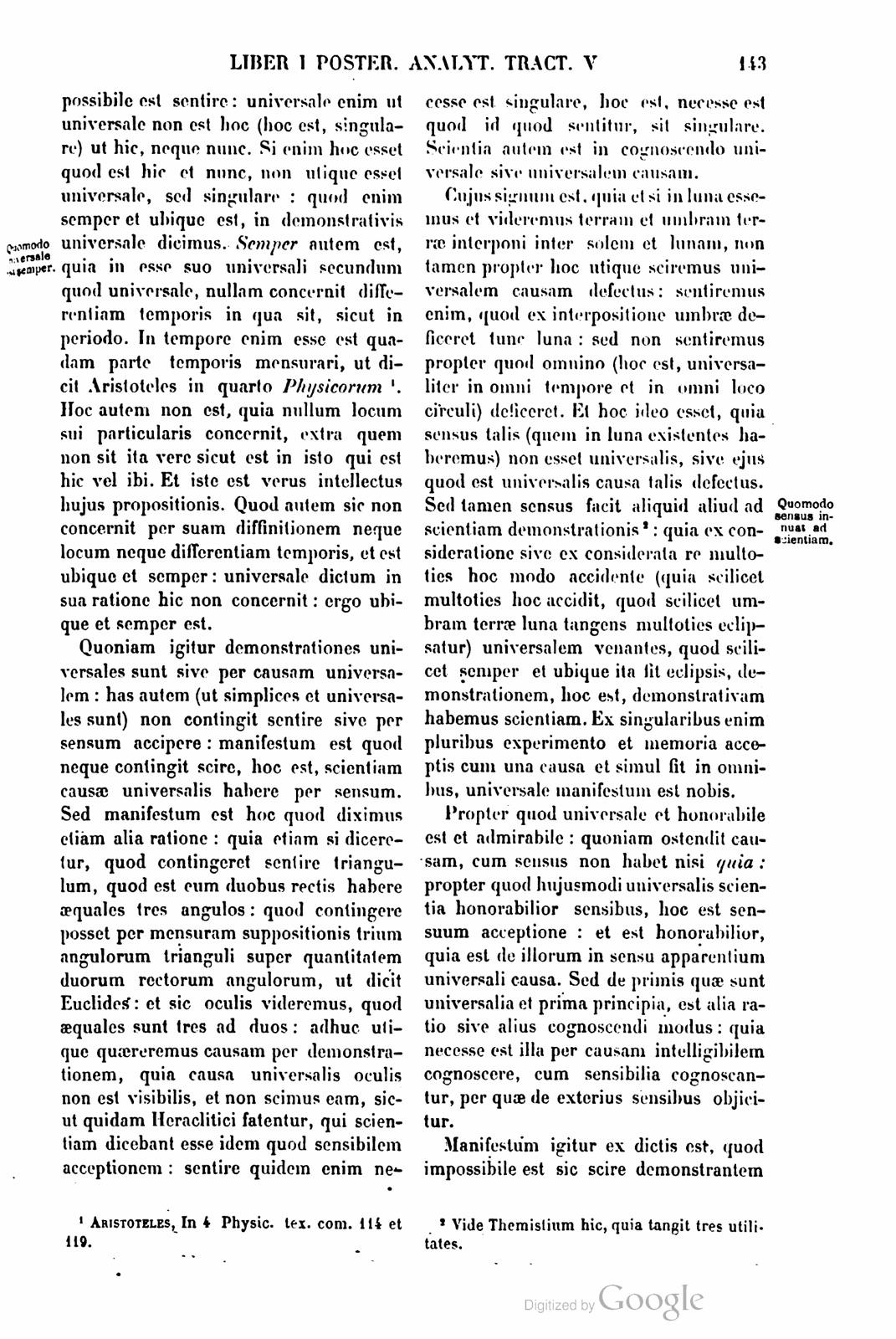
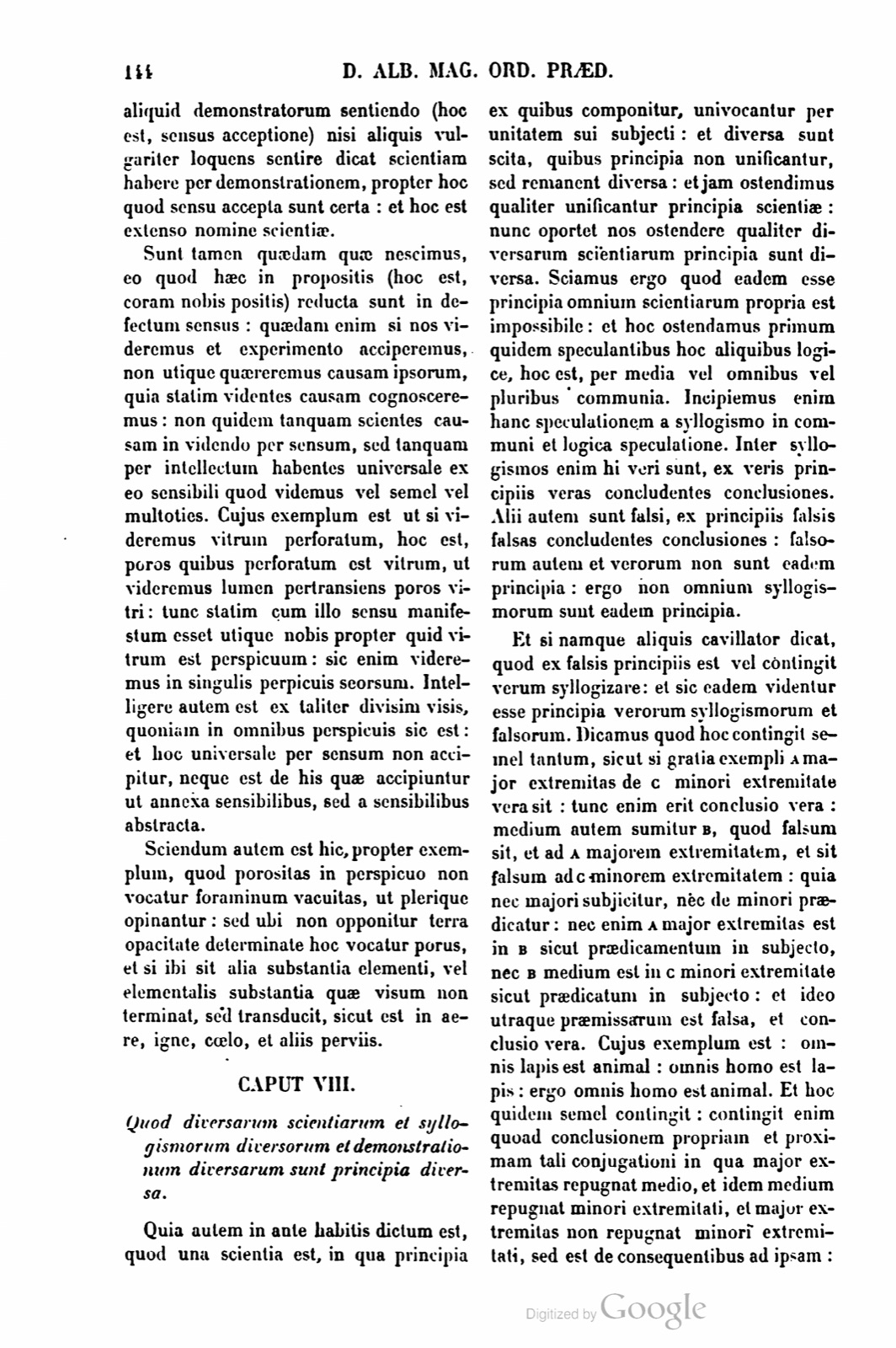
CAPUT VII. Quod de fortuito et sensibili non est scientia demonstrativa. Cum autem jam dictum sit quae scientia sit una, et quae plures: ne autem dubitari possit de quibus est scientia, et de quibus non potest esse, ideo sciendum est quod fortuitorum et sensibilium scientia esse non potest. Unde dicimus quod ejus quod est a fortuna vel casu quae causam habent per accidens et non per se, non est scientia facta per demonstrationem: talia enim non habent causam stantem et immobilem, sicut necessaria. Neque habent causam ordinatam secundum circuli revolutionem, sicut ea quae fiunt in terra ordinata secundum circuli allationem et recessionem, sicut ea quae fiunt frequenter, sicut quae periodo mensurantur, ut docet Aristoteles in secundo de Generatione et Corruptione 1. Id enim quod a fortuna vel casu, neque fit semper, neque frequenter, ut probatur in secundo Physicorum 2. Sed est ejus fortuna et casus quod extra hoc fit: quia neque fit semper, neque frequenter. Omnis autem syllogismus demonstrativus est, aut per necessarias aut per eas propositiones quae sunt tanquam frequenter. Et si quidem propositiones necessariae sunt et semper et aeternae, tunc etiam conclusio necessaria est et semper et aeterna, hoc est, immutabilis. Si vero sunt propositiones sicut frequenter per aliquam causam ordinatam, tunc etiam conclusio et hujusmodi. Propter quod si aliquid fiat frequenter sine causa ordinata, non est de illo demonstratio: propter quod si id quod a fortuna vel casu, neque est sicut id quod frequenter est, neque sicut id quod est semper (hoc est, necessario), tunc non utique erit ipsius demonstratio, vel scientia demonstrativa. Haec igitur sunt quorum neque demonstratio, neque cognitio valet, et facit aliquid ad scientiam demonstrativam. Sed neque per sensum et sensibilium cognitionem est scire: sed tamen haec cognitio valet et facit aliquid ad scientiam demonstrativam. Si enim detur quod sensus est talis quidem hujus quod est singulare, et non est hujus alicujus quod est universale: quamvis, inquam, sic sit: sed tamen necesse est sentire quod sentitur, ut hoc aliquid singulare, et ut hic et nunc, sive ubi (hoc est, alicubi) et aliquando (hoc est, tempore) quia, sicut dicit Boetius, si omnia alia accidentia communia sint, tamen hic et nunc singularium communia esse non possunt: quia quodlibet habet suum locum, et quodlibet suam periodum in tempore singulariter. Unde quamvis forte sensus sit hujus singularis et non hujus (hoc enim secundum aliquem modum est universalis secundum quod confusum est in singularibus, ut dicitur in principio Physicorum) 3, tamen semper accipit id quod accipit cum hic et nunc. Et hic est verus intellectus litterae Aristotelis. <marginal-label>Vide Linco. quomodo universale est ubique.</marginal-label> <marginal-label>Quomodo universale sit semper.</marginal-label> Universale autem quod est in omnibus et secundum quod est in omnibus, impossibile est sentire: universale enim ut universale non est hoc (hoc est, singulare) ut hic, neque nunc. Si enim hoc esset quod est hic et nunc, non utique esset universale, sed singulare: quod enim semper et ubique est, in demonstrativis universale dicimus. Semper autem est, quia in esse suo universali secundum quod universale, nullam concernit differentiam temporis in qua sit, sicut in periodo. In tempore enim esse est quadam parte temporis mensurari, ut dicit Aristoteles in quarto Physicorum 4. Hoc autem non est, quia nullum locum sui particularis concernit, extra quem non sit ita vere sicut est in isto qui est hic vel ibi. Et iste est verus intellectus hujus propositionis. Quod autem sic non concernit per suam diffinitionem neque locum neque differentiam temporis, et est ubique et semper: universale dictum in sua ratione hic non concernit: ergo ubique et semper est. Quoniam igitur demonstrationes universales sunt sive per causam universalem: has autem (ut simplices et universales sunt) non contingit sentire sive per sensum accipere: manifestum est quod neque contingit scire, hoc est, scientiam causae universalis habere per sensum. Sed manifestum est hoc quod diximus etiam alia ratione: quia etiam si diceretur, quod contingeret sentire triangulum, quod est eum duobus rectis habere aequales tres angulos: quod contingere posset per mensuram suppositionis trium angulorum trianguli super quantitatem duorum rectorum angulorum, ut dicit Euclides: et sic oculis videremus, quod aequales sunt tres ad duos: adhuc utique quaereremus causam per demonstrationem, quia causa universalis oculis non est visibilis, et non scimus eam, sicut quidam Heraclitici fatentur, qui scientiam dicebant esse idem quod sensibilem acceptionem: sentire quidem enim necesse est singulare, hoc est, necesse est quod id quod sentitur, sit singulare. Scientia autem est in cognoscendo universale sive universalem causam. Cujus signum est, quia et si in luna essemus et videremus terram et umbram terrae interponi inter solem et lunam, non tamen propter hoc utique sciremus universalem causam defectus: sentiremus enim, quod ex interpositione umbrae deficeret tunc luna: sed non sentiremus propter quod omnino (hoc est, universaliter in omni tempore et in omni loco circuli) deficeret. Et hoc ideo esset, quia sensus talis (quem in luna existentes haberemus) non esset universalis, sive ejus quod est universalis causa talis defectus. Sed tamen sensus facit aliquid aliud ad scientiam demonstrationis 5: quia ex consideratione sive ex considerata re multoties hoc modo accidente (quia scilicet multoties hoc accidit, quod scilicet umbram terrae luna tangens multoties eclipsatur) universalem venantes, quod scilicet semper et ubique ita fit eclipsis, demonstrationem, hoc est, demonstrativam habemus scientiam. Ex singularibus enim pluribus experimento et memoria acceptis cum una causa et simul fit in omnibus, universale manifestum est nobis. <marginal-label>Quomodo sensus innuat ad scientiam.</marginal-label> Propter quod universale et honorabile est et admirabile: quoniam ostendit causam, cum sensus non habet nisi quia: propter quod hujusmodi universalis scientia honorabilior sensibus, hoc est sensuum acceptione: et est honorabilior, quia est de illorum in sensu apparentium universali causa. Sed de primis quae sunt universalia et prima principia, est alia ratio sive alius cognoscendi modus: quia necesse est illa per causam intelligibilem cognoscere, cum sensibilia cognoscantur, per quae de exterius sensibus objicitur. Manifestum igitur ex dictis est, quod impossibile est sic scire demonstrantem aliquid demonstratorum sentiendo (hoc est, sensus acceptione) nisi aliquis vulgariter loquens sentire dicat scientiam habere per demonstrationem, propter hoc quod sensu accepta sunt certa: et hoc est extenso nomine scientiae. Sunt tamen quaedam quae nescimus, eo quod haec in propositis (hoc est, coram nobis positis) reducta sunt in defectum sensus: quaedam enim si nos videremus et experimento acciperemus, non utique quaereremus causam ipsorum, quia statim videntes causam cognosceremus: non quidem tanquam scientes causam in videndo per sensum, sed tanquam per intellectum habentes universale ex eo sensibili quod videmus vel semel vel multoties. Cujus exemplum est ut si videremus vitrum perforatum, hoc est, poros quibus perforatum est vitrum, ut videremus lumen pertransiens poros vitri: tunc statim cum illo sensu manifestum esset utique nobis propter quid vitrum est perspicuum: sic enim videremus in singulis perspicuis seorsum. Intelligere autem est ex taliter divisim visis, quoniam in omnibus perspicuis sic est: et hoc universale per sensum non accipitur, neque est de his quae accipiuntur ut annexa sensibilibus, sed a sensibilibus abstracta. Sciendum autem est hic, propter exemplum, quod porositas in perspicuo non vocatur foraminum vacuitas, ut plerique opinantur: sed ubi non opponitur terra opacitate determinate hoc vocatur porus, et si ibi sit alia substantia elementi, vel elementalis substantia quae visum non terminat, sed transducit, sicut est in aere, igne, caelo, et aliis perviis.
CHAPTER VII. That there is no demonstrative science concerning the fortuitous and the sensible. But since it has now been said which science is one and which sciences are many, lest it be possible to doubt about what things there is science and about what things there cannot be science, one must therefore know that there cannot be science of fortuitous things and sensible things. Hence we say that of that which is from fortune or chance, things which have a cause per accidens and not through themselves, there is no science made through demonstration. For such things do not have a standing and immobile cause, as necessary things have. Nor do they have a cause ordered according to the revolution of the circle, as those things that happen on earth are ordered according to the circle's bringing and receding, as those things happen frequently, as things that are measured by a period, as Aristotle teaches in the second book On Generation and Corruption 1. For that which is from fortune or chance happens neither always nor frequently, as is proved in the second book of the Physics 2. But fortune and chance belong to that which happens outside this, because it happens neither always nor frequently. But every demonstrative syllogism is either through necessary propositions or through those propositions which hold for the most part. And if indeed the propositions are necessary and always and eternal, then the conclusion also is necessary and always and eternal, that is, immutable. But if the propositions are as for the most part through some ordered cause, then the conclusion also is of this kind. Therefore, if something happens frequently without an ordered cause, there is no demonstration concerning it. For this reason, if that which is from fortune or chance is neither like that which is frequent nor like that which is always, that is, necessary, then there will certainly not be demonstration of it, or demonstrative science. These, therefore, are the things of which neither demonstration nor cognition has force, and it contributes something to demonstrative science. But neither through sense and cognition of sensible things is there knowing; nevertheless this cognition has force and contributes something to demonstrative science. For if it is granted that sense is of this thing which is singular, and is not of some thing which is universal, although, I say, it is thus, nevertheless it is necessary to sense what is sensed as this singular something, and as here and now, or where, that is, somewhere, and sometime, that is, in time, because, as Boethius says, even if all other accidents are common, nevertheless the here and now of singulars cannot be common, because each thing has its own place and each thing has its own period in time singularly. Hence, although perhaps sense is of this singular and not of this, for this in a certain way is universal according as it is confused in singulars, as is said at the beginning of the Physics 3, nevertheless it always receives what it receives with here and now. And this is the true understanding of Aristotle's text. <marginal-label>See Lincoln, how the universal is everywhere.</marginal-label> <marginal-label>How the universal is always.</marginal-label> But the universal which is in all things and according as it is in all things cannot be sensed; for the universal as universal is not this, that is, singular, as here, nor now. For if it were this which is here and now, it would certainly not be universal but singular. For that which is always and everywhere, in demonstrative matters, we call universal. But it is always because in its universal being, according as it is universal, it concerns no difference of time in which it is, as in a period. For to be in time is to be measured by some part of time, as Aristotle says in the fourth book of the Physics 4. But this is not so, because it concerns no place of its particular outside which it is not as truly as it is in that which is here or there. And this is the true understanding of this proposition. But what thus does not concern, by its definition, either place or difference of time, and is everywhere and always, namely the universal spoken of, does not concern here in its account; therefore it is everywhere and always. Since, therefore, demonstrations are universal or are through a universal cause, but these, as they are simple and universal, cannot be sensed or received through sense, it is manifest that neither is it possible to know, that is, to have science of the universal cause, through sense. But what we have said is also manifest by another reason: because even if it were said that it was possible to sense a triangle, namely that it has three angles equal to two right angles, which could happen through the measure of the laying of the three angles of the triangle upon the quantity of two right angles, as Euclid says, and thus with our eyes we would see that the three are equal to the two, nevertheless we would certainly still seek the cause through demonstration, because the universal cause is not visible to the eyes and we do not know it, as certain Heracliteans confess, who used to say that science is the same as sensible reception. For to sense is necessarily singular, that is, it is necessary that what is sensed be singular. But science is in knowing the universal or the universal cause. The sign of this is that, even if we were on the moon and saw the earth and the shadow of the earth interposed between the sun and the moon, nevertheless on account of this we would certainly not know the universal cause of eclipse. For we would sense that from the interposition of the shadow the moon was then eclipsed; but we would not sense on account of what, absolutely, that is, universally in every time and in every place of the circle, it was eclipsed. And this would be so because such a sense, which we would have while existing on the moon, would not be universal, or of that which is the universal cause of such an eclipse. Yet sense nevertheless contributes something else to the science of demonstration 5, because from consideration, or from the thing considered as happening many times in this way, because namely this happens many times, that the moon touching the shadow of the earth is eclipsed many times, hunting for the universal, namely that eclipse always and everywhere happens thus, we have demonstration, that is, demonstrative science. For from several singulars received by experience and memory, when there is one cause and it occurs at once in all, the universal is manifest to us. <marginal-label>How sense gives an indication toward science.</marginal-label> For this reason the universal is both honorable and admirable, because it shows the cause, whereas sense has only the that; for this reason universal science of this kind is more honorable than the senses, that is, than reception by the senses, and it is more honorable because it is about the universal cause of those things appearing in sense. But concerning the first things which are universal and first principles, there is another account or another mode of knowing, because it is necessary to know them through an intelligible cause, whereas sensible things are known through the things that are presented outwardly to the senses. Therefore it is manifest from what has been said that it is impossible for one demonstrating thus to know any of the demonstrated things by sensing, that is, by reception of sense, unless someone speaking commonly says that to sense is to have science through demonstration, on account of this, that the things received by sense are certain; and this is with the name of science extended. Yet there are certain things that we do not know, because these among things proposed, that is, among things placed before us, have been reduced to a defect of sense. For certain things, if we saw them and received them by experience, we certainly would not seek their cause, because, seeing the cause at once, we would know it: not indeed as though knowing the cause by seeing through sense, but as having through intellect the universal from that sensible thing which we see either once or many times. The example of this is that if we saw perforated glass, that is, the pores by which the glass is perforated, so that we saw light passing through the pores of the glass, then at once with that sense it would certainly be manifest to us on account of what glass is transparent; for thus we would see separately in individual transparent things. But to understand is from things seen separately in such a way, because in all transparent things it is thus; and this universal is not received through sense, nor is it among those things that are received as attached to sensibles, but it is abstracted from sensibles. But here, on account of the example, it must be known that porosity in a transparent thing is not called an emptiness of holes, as many think, but where earth is not opposed by a determinate opacity this is called a pore, and if there is there another substance of an element, or an elemental substance, which does not terminate sight but carries it across, as it is in air, fire, heaven, and other permeable things.
Notes
- Aristotle, in book 2 of On Generation and Corruption, text commentary 57. (Aristoteles, in 2 de Generatione et Corruptione, tex. com. 57.) ↩
- The same, in book 2 of the Physics, text commentary 48. (Id., in 2 Physic., tex. com. 48.) ↩
- The same, at the beginning of the Physics, text commentary 4. (Id., in principio Physic., tex. com. 4.) ↩
- Aristotle, in book 4 of the Physics, text commentaries 114 and 119. (Aristoteles, in 4 Physic., tex. com. 114 et 119.) ↩
- See Themistius here, because he touches upon three utilities. (Vide Themistium hic, quia tangit tres utilitates.) ↩
If a page does not appear, its photograph has not been uploaded yet.