Works › Posterior Analytics, Books I–II
Volume 2 · pp. 136–138
Chapter IV. On the reasons by which it is proved that ostensive demonstration is preferable to that which leads to the impossible.
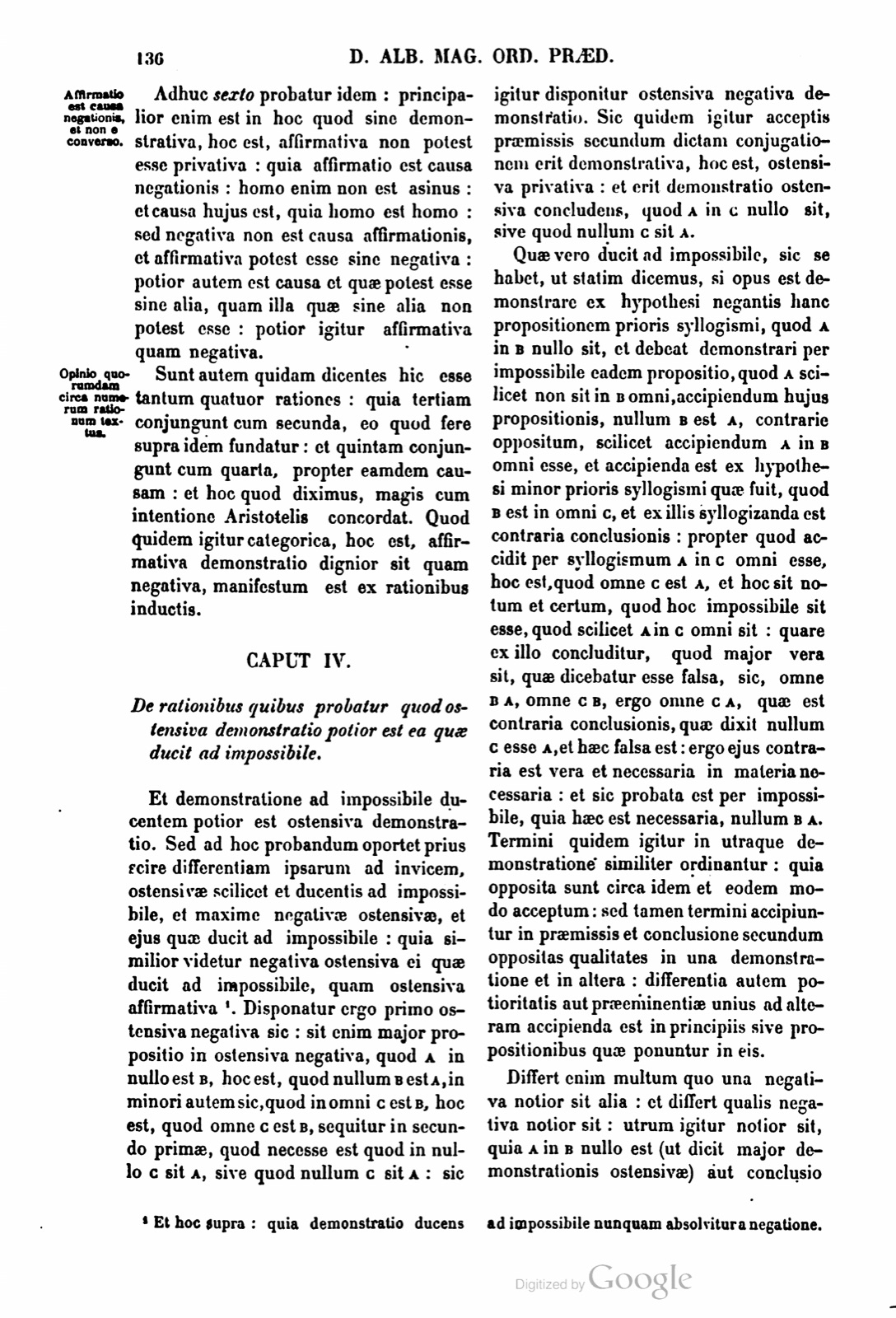
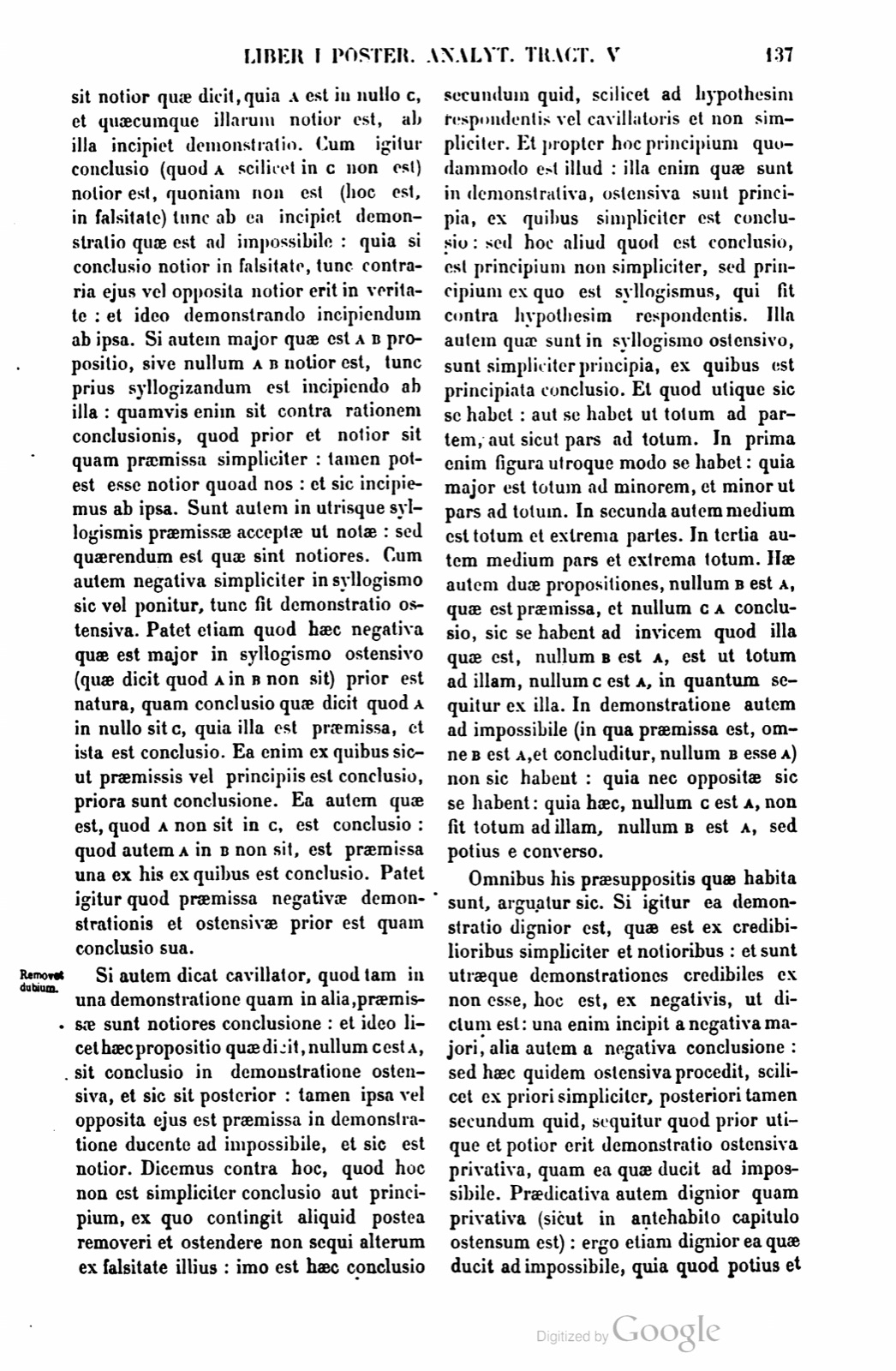
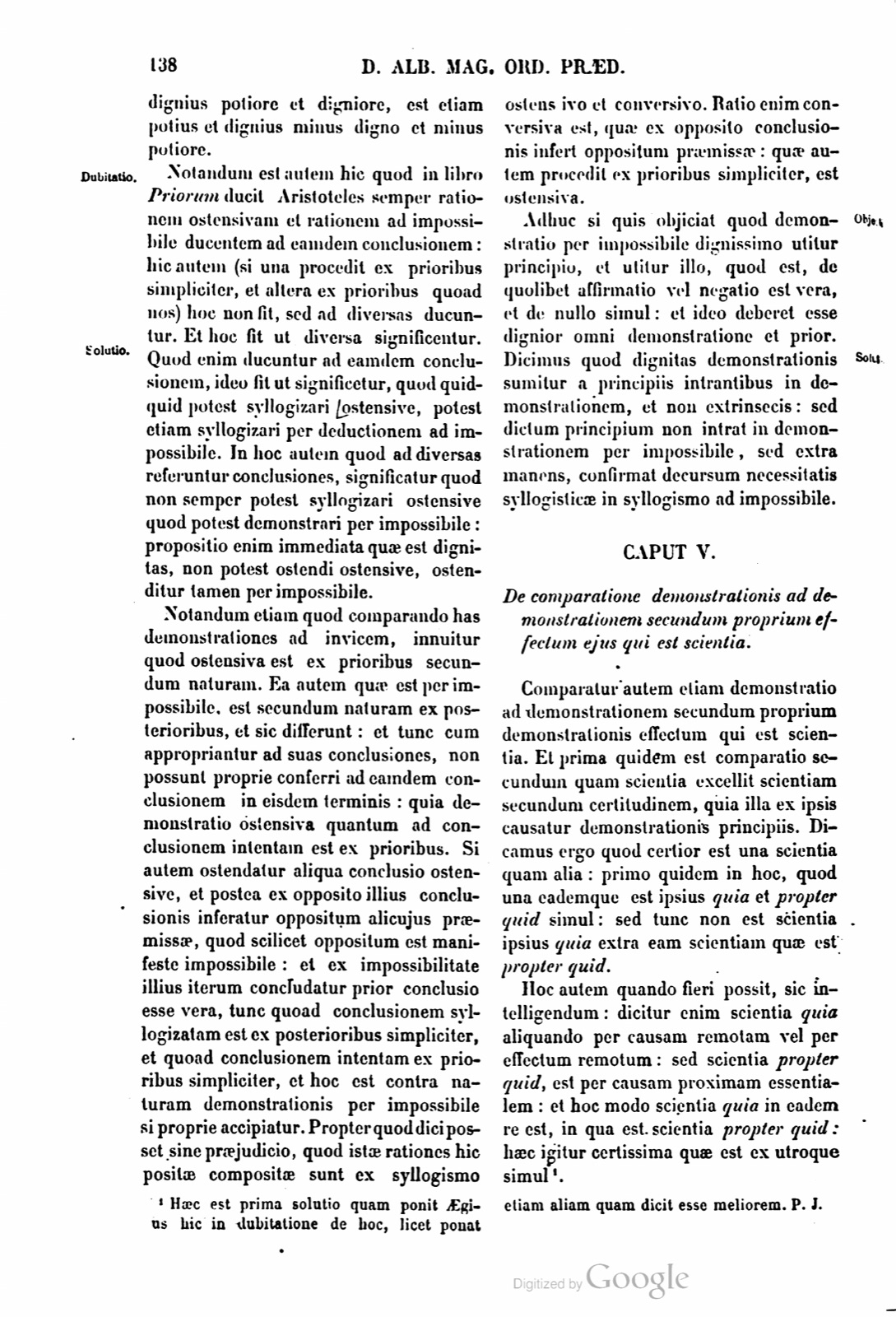
CAPUT IV. De rationibus quibus probatur quod ostensiva demonstratio potior est ea quae ducit ad impossibile. Et demonstratione ad impossibile ducentem potior est ostensiva demonstratio. Sed ad hoc probandum oportet prius scire differentiam ipsarum ad invicem, ostensivae scilicet et ducentis ad impossibile, et maxime negativae ostensivae, et ejus quae ducit ad impossibile: quia similior videtur negativa ostensiva ei quae ducit ad impossibile, quam ostensiva affirmativa 1. Disponatur ergo primo ostensiva negativa sic: sit enim major propositio in ostensiva negativa, quod A in nullo est B, hoc est, quod nullum B est A, in minori autem sic, quod in omni C est B, hoc est, quod omne C est B, sequitur in secundo primae, quod necesse est quod in nullo C sit A, sive quod nullum C sit A: sic igitur disponitur ostensiva negativa demonstratio. Sic quidem igitur acceptis praemissis secundum dictam conjugationem erit demonstrativa, hoc est, ostensiva privativa: et erit demonstratio ostensiva concludens, quod A in C nullo sit, sive quod nullum C sit A. Quae vero ducit ad impossibile, sic se habet, ut statim dicemus, si opus est demonstrare ex hypothesi negantis hanc propositionem prioris syllogismi, quod A in B nullo sit, et debeat demonstrari per impossibile eadem propositio, quod A scilicet non sit in B omni, accipiendum hujus propositionis, nullum B est A, contrarie oppositum, scilicet accipiendum A in B omni esse, et accipienda est ex hypothesi minor prioris syllogismi quae fuit, quod B est in omni C, et ex illis syllogizanda est contraria conclusionis: propter quod accidit per syllogismum A in C omni esse, hoc est, quod omne C est A, et hoc sit notum et certum, quod hoc impossibile sit esse, quod scilicet A in C omni sit: quare ex illo concluditur, quod major vera sit, quae dicebatur esse falsa, sic, omne B A, omne C B, ergo omne C A, quae est contraria conclusionis, quae dixit nullum C esse A, et haec falsa est: ergo ejus contraria est vera et necessaria in materia necessaria: et sic probata est per impossibile, quia haec est necessaria, nullum B A. Termini quidem igitur in utraque demonstratione similiter ordinantur: quia opposita sunt circa idem et eodem modo acceptum: sed tamen termini accipiuntur in praemissis et conclusione secundum oppositas qualitates in una demonstratione et in altera: differentia autem potioritatis aut praeeminentiae unius ad alteram accipienda est in principiis sive propositionibus quae ponuntur in eis. Differt enim multum quo una negativa notior sit alia: et differt qualis negativa notior sit: utrum igitur notior sit, quia A in B nullo est (ut dicit major demonstrationis ostensivae) aut conclusio sit notior quae dicit, quia A est in nullo C, et quaecumque illarum notior est, ab illa incipiet demonstratio. Cum igitur conclusio (quod A scilicet in C non est) notior est, quoniam non est (hoc est, in falsitate) tunc ab ea incipiet demonstratio quae est ad impossibile: quia si conclusio notior in falsitate, tunc contraria ejus vel opposita notior erit in veritate: et ideo demonstrando incipiendum ab ipsa. Si autem major quae est A B propositio, sive nullum A B notior est, tunc prius syllogizandum est incipiendo ab illa: quamvis enim sit contra rationem conclusionis, quod prior et notior sit quam praemissa simpliciter: tamen potest esse notior quoad nos: et sic incipiemus ab ipsa. Sunt autem in utrisque syllogismis praemissae acceptae ut notae: sed quaerendum est quae sint notiores. Cum autem negativa simpliciter in syllogismo sic vel ponitur, tunc fit demonstratio ostensiva. Patet etiam quod haec negativa quae est major in syllogismo ostensivo (quae dicit quod A in B non sit) prior est natura, quam conclusio quae dicit quod A in nullo sit C, quia illa est praemissa, et ista est conclusio. Ea enim ex quibus sicut praemissis vel principiis est conclusio, priora sunt conclusione. Ea autem quae est, quod A non sit in C, est conclusio: quod autem A in B non sit, est praemissa una ex his ex quibus est conclusio. Patet igitur quod praemissa negativae demonstrationis et ostensivae prior est quam conclusio sua. <marginal-label>Removet dubium.</marginal-label> Si autem dicat cavillator, quod tam in una demonstratione quam in alia, praemissae sunt notiores conclusione: et ideo licet haec propositio quae dicit, nullum C est A, sit conclusio in demonstratione ostensiva, et sic sit posterior: tamen ipsa vel opposita ejus est praemissa in demonstratione ducente ad impossibile, et sic est notior. Dicemus contra hoc, quod hoc non est simpliciter conclusio aut principium, ex quo contingit aliquid postea removeri et ostendere non sequi alterum ex falsitate illius: imo est haec conclusio secundum quid, scilicet ad hypothesim respondentis vel cavillatoris et non simpliciter. Et propter hoc principium quodammodo est illud: illa enim quae sunt in demonstrativa, ostensiva sunt principia, ex quibus simpliciter est conclusio: sed hoc aliud quod est conclusio, est principium non simpliciter, sed principium ex quo est syllogismus, qui fit contra hypothesim respondentis. Illa autem quae sunt in syllogismo ostensivo, sunt simpliciter principia, ex quibus est principiata conclusio. Et quod utique sic se habet: aut se habet ut totum ad partem, aut sicut pars ad totum. In prima enim figura utroque modo se habet: quia major est totum ad minorem, et minor ut pars ad totum. In secunda autem medium est totum et extrema partes. In tertia autem medium pars et extrema totum. Hae autem duae propositiones, nullum B est A, quae est praemissa, et nullum C A conclusio, sic se habent ad invicem quod illa quae est, nullum B est A, est ut totum ad illam, nullum C est A, in quantum sequitur ex illa. In demonstratione autem ad impossibile (in qua praemissa est, omne B est A, et concluditur, nullum B esse A) non sic habent: quia nec oppositae sic se habent: quia haec, nullum C est A, non fit totum ad illam, nullum B est A, sed potius e converso. Omnibus his praesuppositis quae habita sunt, arguatur sic. Si igitur ea demonstratio dignior est, quae est ex credibilioribus simpliciter et notioribus: et sunt utraeque demonstrationes credibiles ex non esse, hoc est, ex negativis, ut dictum est: una enim incipit a negativa majori, alia autem a negativa conclusione: sed haec quidem ostensiva procedit, scilicet ex priori simpliciter, posteriori tamen secundum quid, sequitur quod prior utique et potior erit demonstratio ostensiva privativa, quam ea quae ducit ad impossibile. Praedicativa autem dignior quam privativa (sicut in antehabito capitulo ostensum est): ergo etiam dignior ea quae ducit ad impossibile, quia quod potius et dignius potiore et digniore, est etiam potius et dignius minus digno et minus potiore. <marginal-label>Dubitatio.</marginal-label> Notandum est autem hic quod in libro Priorum ducit Aristoteles semper rationem ostensivam et rationem ad impossibile ducentem ad eamdem conclusionem: hic autem (si una procedit ex prioribus simpliciter, et altera ex prioribus quoad nos) hoc non fit, sed ad diversas ducuntur. Et hoc fit ut diversa significentur. Quod enim ducuntur ad eamdem conclusionem, ideo fit ut significetur, quod quidquid potest syllogizari ostensive, potest etiam syllogizari per deductionem ad impossibile. In hoc autem quod ad diversas referuntur conclusiones, significatur quod non semper potest syllogizari ostensive quod potest demonstrari per impossibile: propositio enim immediata quae est dignitas, non potest ostendi ostensive, ostenditur tamen per impossibile. <marginal-label>Solutio.</marginal-label> Notandum etiam quod comparando has demonstrationes ad invicem, innuitur quod ostensiva est ex prioribus secundum naturam. Ea autem quae est per impossibile, est secundum naturam ex posterioribus, et sic differunt: et tunc cum appropriantur ad suas conclusiones, non possunt proprie conferri ad eamdem conclusionem in eisdem terminis: quia demonstratio ostensiva quantum ad conclusionem intentam est ex prioribus. Si autem ostendatur aliqua conclusio ostensive, et postea ex opposito illius conclusionis inferatur oppositum alicujus praemissae, quod scilicet oppositum est manifeste impossibile: et ex impossibilitate illius iterum concludatur prior conclusio esse vera, tunc quoad conclusionem syllogizatam est ex posterioribus simpliciter, et quoad conclusionem intentam ex prioribus simpliciter, et hoc est contra naturam demonstrationis per impossibile si proprie accipiatur. Propter quod dici posset sine praejudicio, quod istae rationes hic positae compositae sunt ex syllogismo ostensivo et conversivo. Ratio enim conversiva est, quae ex opposito conclusionis infert oppositum praemissae: quae autem procedit ex prioribus simpliciter, est ostensiva. <marginal-label>Objectio.</marginal-label> Adhuc si quis objiciat quod demonstratio per impossibile dignissimo utitur principio, et utitur illo, quod est, de quolibet affirmatio vel negatio est vera, et de nullo simul: et ideo deberet esse dignior omni demonstratione et prior. <marginal-label>Solutio.</marginal-label> Dicimus quod dignitas demonstrationis sumitur a principiis intrantibus in demonstrationem, et non extrinsecis: sed dictum principium non intrat in demonstrationem per impossibile, sed extra manens, confirmat decursum necessitatis syllogisticae in syllogismo ad impossibile.
CHAPTER IV. On the reasons by which it is proved that ostensive demonstration is preferable to that which leads to the impossible. And ostensive demonstration is preferable to demonstration leading to the impossible. But for proving this one must first know their difference from one another, namely the difference of the ostensive and of the demonstration leading to the impossible, and especially of negative ostensive demonstration and of that which leads to the impossible, because negative ostensive demonstration seems more similar to that which leads to the impossible than affirmative ostensive demonstration is 1. Therefore first let negative ostensive demonstration be arranged thus: in negative ostensive demonstration let the major proposition be that A is in no B, that is, that no B is A; but in the minor let it be thus, that B is in every C, that is, that every C is B. It follows in the second mode of the first figure that necessarily A is in no C, or that no C is A; therefore in this way negative ostensive demonstration is arranged. Therefore, with the premises thus accepted according to the stated pairing, it will be demonstrative, that is, ostensive privative; and it will be an ostensive demonstration concluding that A is in no C, or that no C is A. But the demonstration which leads to the impossible stands thus, as we will say immediately, if there is need to demonstrate from the hypothesis of one denying this proposition of the previous syllogism, that A is in no B, and the same proposition must be demonstrated through the impossible, namely that A is not in every B. The contrary opposite of this proposition, no B is A, must be accepted, namely A must be accepted as being in every B; and the minor of the previous syllogism, which was that B is in every C, must be accepted from the hypothesis, and from these the contrary of the conclusion must be syllogized. On account of this it happens through the syllogism that A is in every C, that is, that every C is A; and let this be known and certain, that it is impossible for this to be, namely that A is in every C. Therefore from that it is concluded that the major is true, the one that was said to be false, thus: every B is A; every C is B; therefore every C is A, which is the contrary of the conclusion that said that no C is A, and this is false; therefore its contrary is true and necessary in necessary matter; and thus it has been proved through the impossible, because this is necessary, no B is A. Therefore the terms in both demonstrations are similarly ordered, because opposites are about the same thing and are taken in the same way; nevertheless the terms are taken in the premises and conclusion according to opposite qualities in the one demonstration and in the other. But the difference of preferability or preeminence of one over the other must be taken in the principles or propositions that are placed in them. For it makes a great difference by which negative one negative is more known than another, and it makes a difference what sort of negative is more known: whether, therefore, it is more known that A is in no B, as the major of the ostensive demonstration says, or whether the conclusion is more known, which says that A is in no C; and whichever of these is more known, from that demonstration will begin. Therefore, when the conclusion, namely that A is not in C, is more known because it is not, that is, in falsity, then from it the demonstration which is to the impossible will begin, because if the conclusion is more known in falsity, then its contrary or opposite will be more known in truth, and therefore in demonstrating one must begin from it. But if the major, which is the A B proposition, or no A B, is more known, then first one must syllogize by beginning from it; for although it is against the account of a conclusion that it be prior and more known than a premise simply, nevertheless it can be more known in relation to us, and thus we will begin from it. But in both syllogisms the premises are accepted as known; nevertheless one must ask which are more known. But when the negative is simply thus placed in the syllogism, then an ostensive demonstration is made. It is also clear that this negative, which is the major in the ostensive syllogism, saying that A is not in B, is prior by nature to the conclusion which says that A is in no C, because that is the premise and this is the conclusion. For those things from which, as from premises or principles, the conclusion is, are prior to the conclusion. But the proposition that A is not in C is the conclusion; but that A is not in B is one premise from those from which the conclusion is. Therefore it is clear that the premise of the negative and ostensive demonstration is prior to its conclusion. <marginal-label>He removes a doubt.</marginal-label> But if the caviller says that, in one demonstration as much as in the other, the premises are more known than the conclusion, and therefore, although this proposition which says no C is A is the conclusion in ostensive demonstration, and thus is posterior, nevertheless it itself or its opposite is a premise in the demonstration leading to the impossible, and thus it is more known, we will say against this that this is not simply a conclusion or a principle from which it happens that something is afterward removed and that one shows that the other does not follow from its falsity. Rather, this conclusion is according to something, namely relative to the hypothesis of the respondent or caviller and not simply. And on account of this that principle is that thing in a certain way. For the things that are in demonstrative, ostensive demonstration are principles from which the conclusion is simply; but this other thing, which is the conclusion, is a principle not simply, but a principle from which there is a syllogism made against the respondent's hypothesis. But the things that are in the ostensive syllogism are principles simply, from which there is a conclusion principled by them. And what is thus disposed is disposed either as whole to part or as part to whole. For in the first figure it is disposed in both ways, because the major is whole to the minor and the minor is as part to whole. But in the second the middle is the whole and the extremes are parts. In the third, however, the middle is part and the extremes are whole. But these two propositions, no B is A, which is the premise, and no C A, the conclusion, are related to one another thus, that the proposition no B is A is as whole to that proposition no C is A, insofar as it follows from it. But in demonstration to the impossible, in which the premise is every B is A and it is concluded that no B is A, they are not related thus, because not even the opposites are related thus; for this proposition, no C is A, does not become whole to that one, no B is A, but rather conversely. With all these things that have been had presupposed, let it be argued thus. Therefore, if that demonstration is worthier which is from things more credible simply and more known, and both demonstrations are credible from non-being, that is, from negatives, as has been said, for one begins from a negative major and the other from a negative conclusion, but this ostensive demonstration proceeds, namely from what is prior simply, though posterior according to something, it follows that the privative ostensive demonstration will certainly be prior and preferable to that which leads to the impossible. But predicative demonstration is worthier than privative, as was shown in the chapter just had; therefore it is also worthier than that which leads to the impossible, because what is preferable and worthier than the preferable and worthier is also preferable and worthier than what is less worthy and less preferable. <marginal-label>Doubt.</marginal-label> But it must be noted here that in the book of the Prior Analytics Aristotle always leads the ostensive reason and the reason leading to the impossible to the same conclusion; but here, if one proceeds from things prior simply and the other from things prior in relation to us, this does not happen, but they are led to diverse conclusions. And this is done so that diverse things may be signified. For the fact that they are led to the same conclusion is done so that it may be signified that whatever can be syllogized ostensively can also be syllogized through deduction to the impossible. But in the fact that the conclusions are referred to diverse things, it is signified that what can be demonstrated through the impossible cannot always be syllogized ostensively. For an immediate proposition which is a dignity cannot be shown ostensively, yet it is shown through the impossible. <marginal-label>Solution.</marginal-label> It must also be noted that, by comparing these demonstrations to one another, it is suggested that ostensive demonstration is from things prior according to nature. But the demonstration that is through the impossible is according to nature from posterior things, and thus they differ; and then, when they are appropriated to their own conclusions, they cannot properly be compared with respect to the same conclusion in the same terms, because ostensive demonstration, as regards the intended conclusion, is from prior things. But if some conclusion is shown ostensively, and afterward from the opposite of that conclusion the opposite of some premise is inferred, namely an opposite that is manifestly impossible, and from the impossibility of that again the prior conclusion is concluded to be true, then with respect to the syllogized conclusion it is from posterior things simply, and with respect to the intended conclusion it is from prior things simply; and this is contrary to the nature of demonstration through the impossible, if it is properly taken. For this reason it could be said without prejudice that these reasons placed here are composed from an ostensive and a conversive syllogism. For a conversive reason is one which from the opposite of the conclusion infers the opposite of the premise; but the one that proceeds from things prior simply is ostensive. <marginal-label>Objection.</marginal-label> Moreover, if someone objects that demonstration through the impossible uses the worthiest principle, and uses that principle which is that, of anything whatever, either affirmation or negation is true, and not both at once, and therefore it ought to be worthier and prior to every demonstration. <marginal-label>Solution.</marginal-label> We say that the dignity of demonstration is taken from the principles entering into demonstration, and not from extrinsic principles; but the stated principle does not enter into demonstration through the impossible, but, remaining outside, confirms the course of syllogistic necessity in the syllogism to the impossible.
Notes
- And this above: because demonstration leading to the impossible is never released from negation. (Et hoc supra: quia demonstratio ducens ad impossibile nunquam absolvitur a negatione.) ↩
If a page does not appear, its photograph has not been uploaded yet.