Works › Posterior Analytics, Books I–II
Volume 2 · pp. 133–136
End of Chapter II and Chapter III
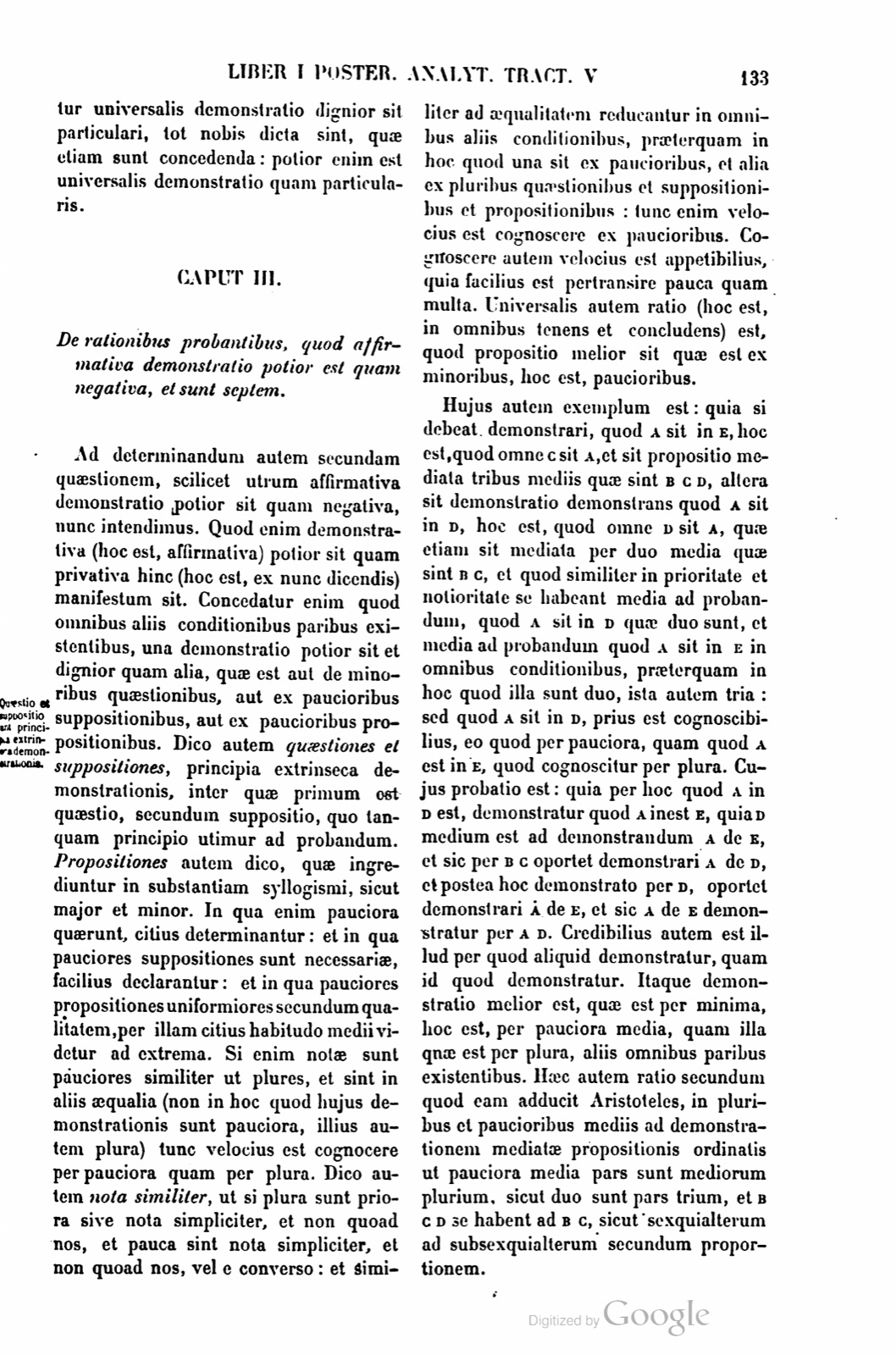
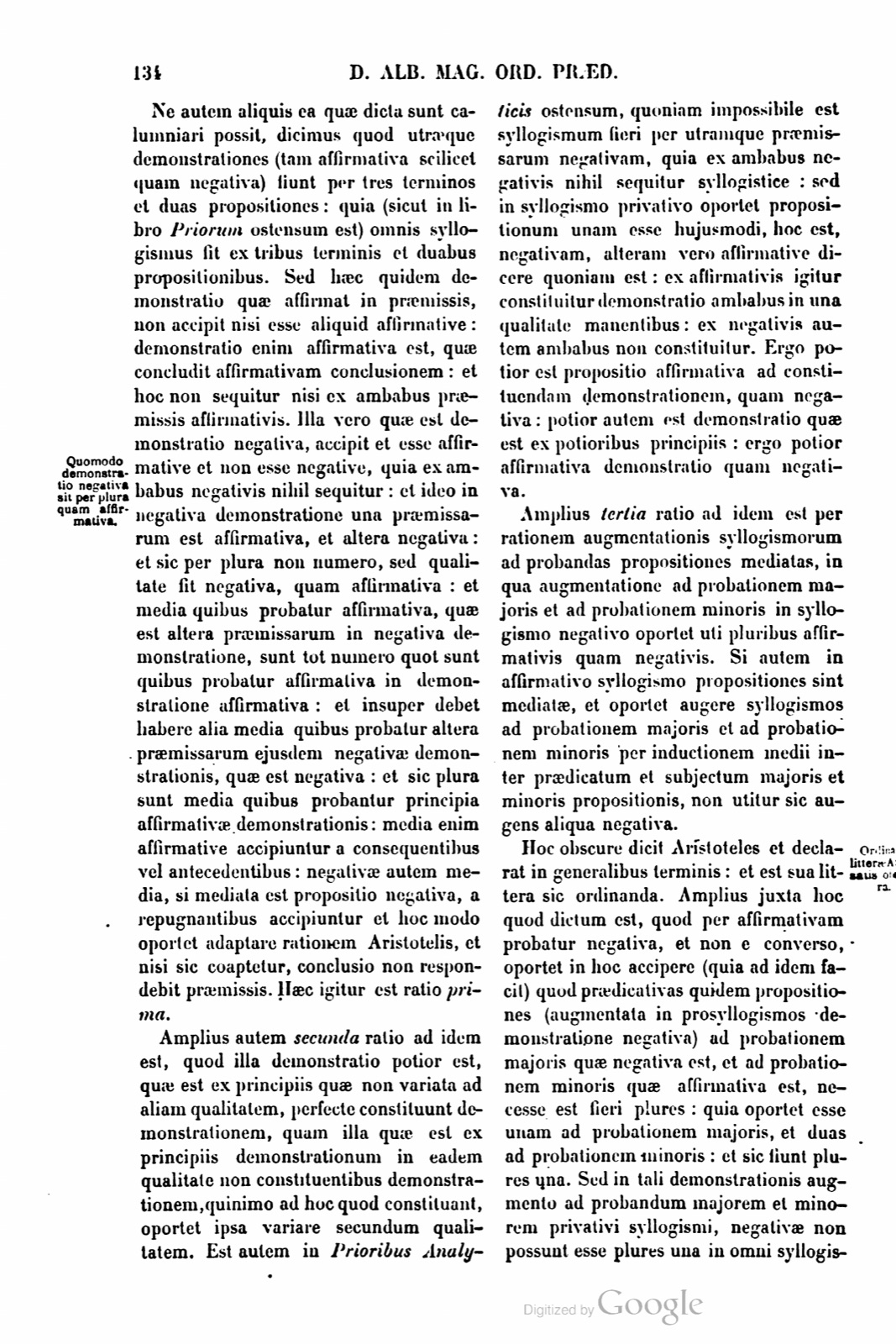
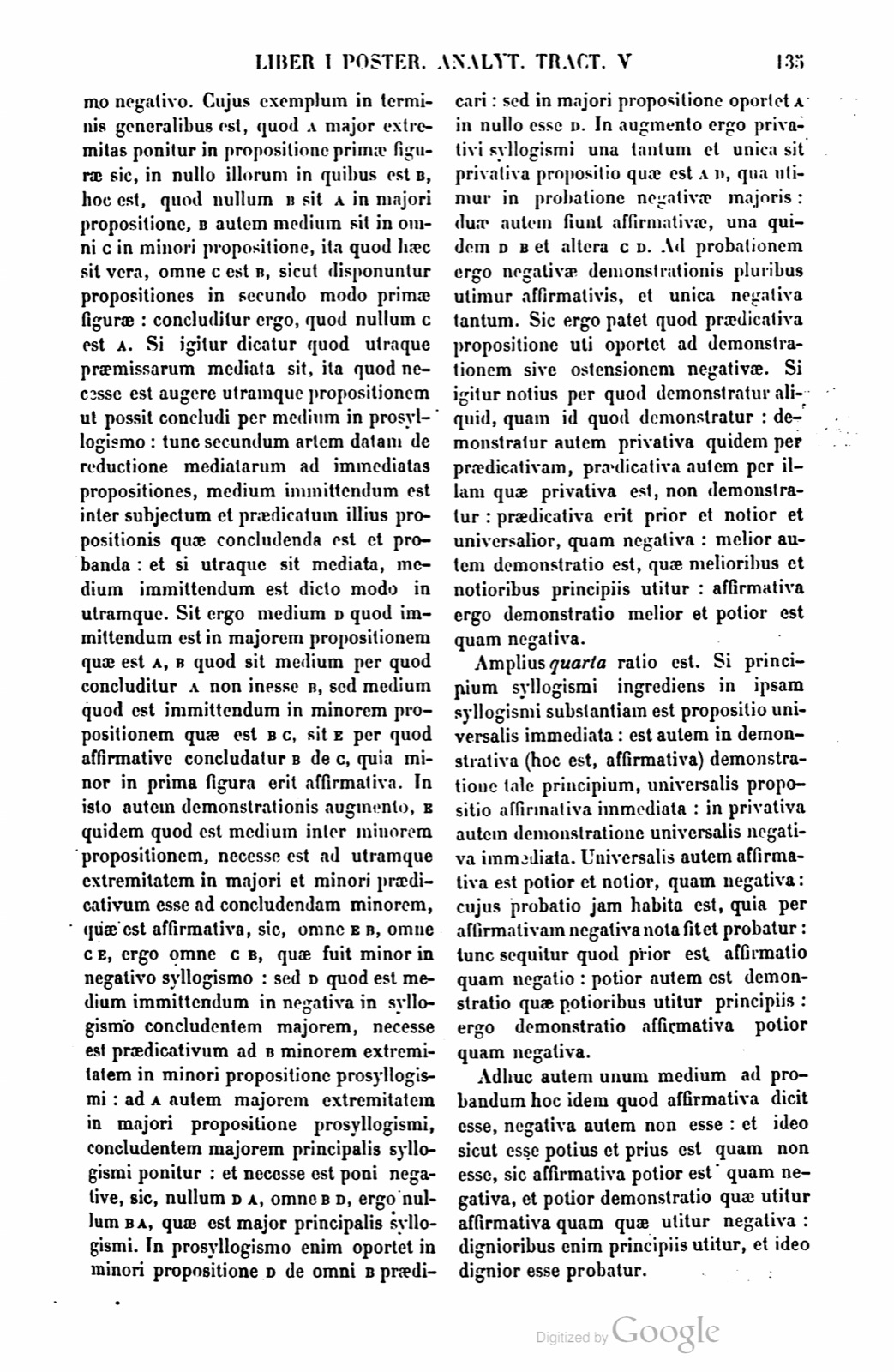
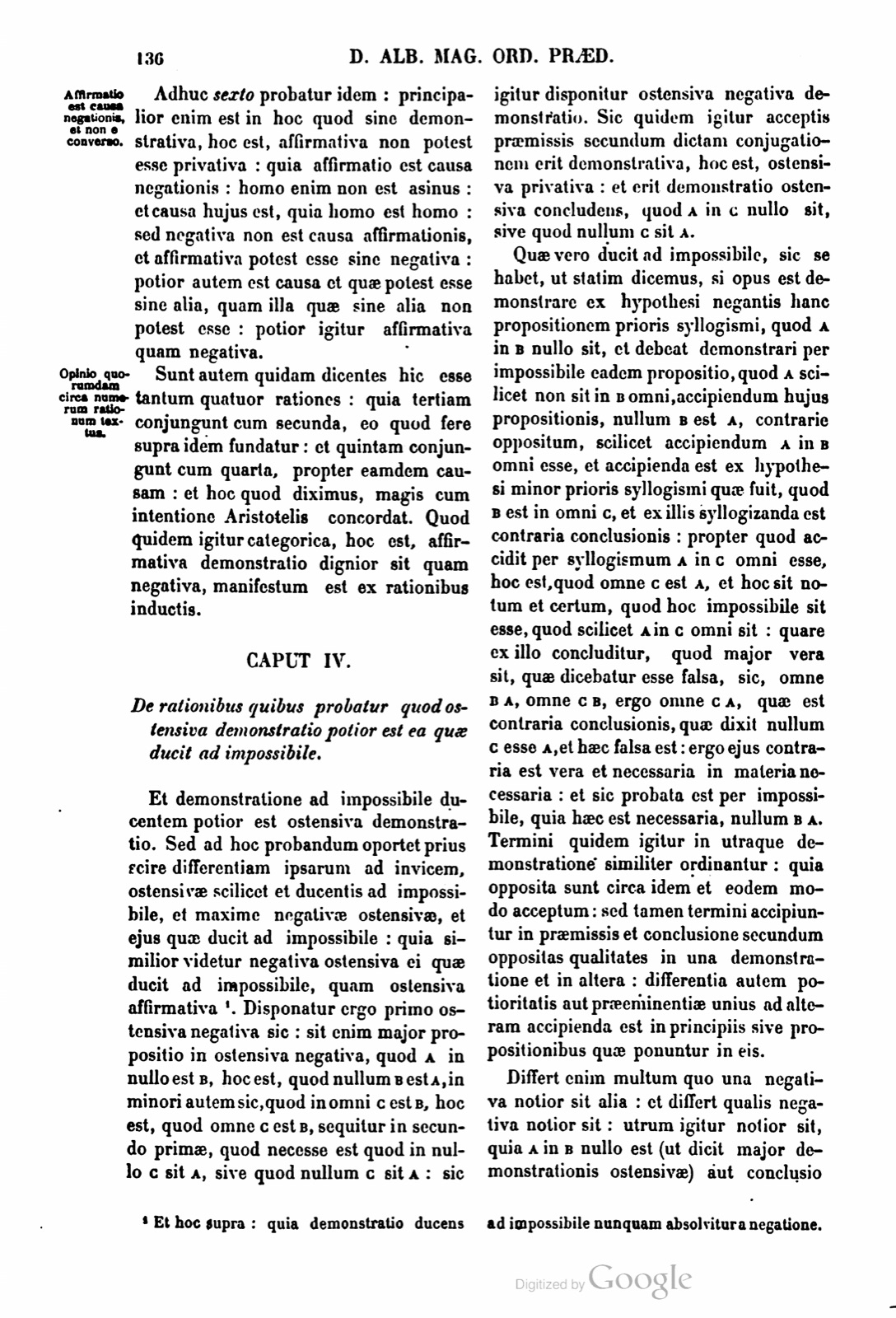
universalis demonstratio dignior sit particulari, tot nobis dicta sint, quae etiam sunt concedenda: potior enim est universalis demonstratio quam particularis. CAPUT III. De rationibus probantibus, quod affirmativa demonstratio potior est quam negativa, et sunt septem. Ad determinandum autem secundam quaestionem, scilicet utrum affirmativa demonstratio potior sit quam negativa, nunc intendimus. Quod enim demonstrativa (hoc est, affirmativa) potior sit quam privativa hinc (hoc est, ex nunc dicendis) manifestum sit. Concedatur enim quod omnibus aliis conditionibus paribus existentibus, una demonstratio potior sit et dignior quam alia, quae est aut de minoribus quaestionibus, aut ex paucioribus suppositionibus, aut ex paucioribus propositionibus. Dico autem quaestiones et suppositiones, principia extrinseca demonstrationis, inter quae primum est quaestio, secundum suppositio, quo tanquam principio utimur ad probandum. Propositiones autem dico, quae ingrediuntur in substantiam syllogismi, sicut major et minor. In qua enim pauciora quaerunt, citius determinantur: et in qua pauciores suppositiones sunt necessariae, facilius declarantur: et in qua pauciores propositiones uniformiores secundum qualitatem, per illam citius habitudo medii videtur ad extrema. Si enim notae sunt pauciores similiter ut plures, et sint in aliis aequalia (non in hoc quod hujus demonstrationis sunt pauciora, illius autem plura) tunc velocius est cognoscere per pauciora quam per plura. Dico autem nota similiter, ut si plura sunt priora sive nota simpliciter, et non quoad nos, et pauca sint nota simpliciter, et non quoad nos, vel e converso: et similiter ad aequalitatem reducantur in omnibus aliis conditionibus, praeterquam in hoc quod una sit ex paucioribus, et alia ex pluribus quaestionibus et suppositionibus et propositionibus: tunc enim velocius est cognoscere ex paucioribus. Cognoscere autem velocius est appetibilius, quia facilius est pertransire pauca quam multa. Universalis autem ratio (hoc est, in omnibus tenens et concludens) est, quod propositio melior sit quae est ex minoribus, hoc est, paucioribus. <marginal-label>Quaestio et suppositio sunt principia extrinseca demonstrationis.</marginal-label> Hujus autem exemplum est: quia si debeat demonstrari, quod A sit in E, hoc est, quod omne E sit A, et sit propositio mediata tribus mediis quae sint B C D, altera sit demonstratio demonstrans quod A sit in D, hoc est, quod omne D sit A, quae etiam sit mediata per duo media quae sint B C, et quod similiter in prioritate et notioritate se habeant media ad probandum, quod A sit in D quae duo sunt, et media ad probandum quod A sit in E in omnibus conditionibus, praeterquam in hoc quod illa sunt duo, ista autem tria: sed quod A sit in D, prius est cognoscibilius, eo quod per pauciora, quam quod A est in E, quod cognoscitur per plura. Cujus probatio est: quia per hoc quod A in D est, demonstratur quod A inest E, quia D medium est ad demonstrandum A de E, et sic per B C oportet demonstrari A de D, et postea hoc demonstrato per D, oportet demonstrari A de E, et sic A de E demonstratur per A D. Credibilius autem est illud per quod aliquid demonstratur, quam id quod demonstratur. Itaque demonstratio melior est, quae est per minima, hoc est, per pauciora media, quam illa quae est per plura, aliis omnibus paribus existentibus. Haec autem ratio secundum quod eam adducit Aristoteles, in pluribus et paucioribus mediis ad demonstrationem mediatae propositionis ordinatis ut pauciora media pars sunt mediorum plurium, sicut duo sunt pars trium, et B C D se habent ad B C, sicut sexquialterum ad subsexquialterum secundum proportionem. Ne autem aliquis ea quae dicta sunt calumniari possit, dicimus quod utraeque demonstrationes (tam affirmativa scilicet quam negativa) fiunt per tres terminos et duas propositiones: quia (sicut in libro Priorum ostensum est) omnis syllogismus fit ex tribus terminis et duabus propositionibus. Sed haec quidem demonstratio quae affirmat in praemissis, non accipit nisi esse aliquid affirmative: demonstratio enim affirmativa est, quae concludit affirmativam conclusionem: et hoc non sequitur nisi ex ambabus praemissis affirmativis. Illa vero quae est demonstratio negativa, accipit et esse affirmative et non esse negative, quia ex ambabus negativis nihil sequitur: et ideo in negativa demonstratione una praemissarum est affirmativa, et altera negativa: et sic per plura non numero, sed qualitate fit negativa, quam affirmativa: et media quibus probatur affirmativa, quae est altera praemissarum in negativa demonstratione, sunt tot numero quot sunt quibus probatur affirmativa in demonstratione affirmativa: et insuper debet habere alia media quibus probatur altera praemissarum ejusdem negativae demonstrationis, quae est negativa: et sic plura sunt media quibus probantur principia affirmativae demonstrationis: media enim affirmative accipiuntur a consequentibus vel antecedentibus: negativae autem media, si mediata est propositio negativa, a repugnantibus accipiuntur et hoc modo oportet adaptare rationem Aristotelis, et nisi sic coaptetur, conclusio non respondebit praemissis. Haec igitur est ratio prima. <marginal-label>Quomodo demonstratio negativa sit per plura quam affirmativa.</marginal-label> Amplius autem secunda ratio ad idem est, quod illa demonstratio potior est, quae est ex principiis quae non variata ad aliam qualitatem, perfecte constituunt demonstrationem, quam illa quae est ex principiis demonstrationum in eadem qualitate non constituentibus demonstrationem, quinimo ad hoc quod constituant, oportet ipsa variare secundum qualitatem. Est autem in Prioribus Analyticis ostensum, quoniam impossibile est syllogismum fieri per utramque praemissarum negativam, quia ex ambabus negativis nihil sequitur syllogistice: sed in syllogismo privativo oportet propositionum unam esse hujusmodi, hoc est, negativam, alteram vero affirmative dicere quoniam est: ex affirmativis igitur constituitur demonstratio ambabus in una qualitate manentibus: ex negativis autem ambabus non constituitur. Ergo potior est propositio affirmativa ad constituendam demonstrationem, quam negativa: potior autem est demonstratio quae est ex potioribus principiis: ergo potior affirmativa demonstratio quam negativa. Amplius tertia ratio ad idem est per rationem augmentationis syllogismorum ad probandas propositiones mediatas, in qua augmentatione ad probationem majoris et ad probationem minoris in syllogismo negativo oportet uti pluribus affirmativis quam negativis. Si autem in affirmativo syllogismo propositiones sint mediatae, et oportet augere syllogismos ad probationem majoris et ad probationem minoris per inductionem medii inter praedicatum et subjectum majoris et minoris propositionis, non utitur sic augens aliqua negativa. <marginal-label>Ordinatio litterae Aristotelis obscura.</marginal-label> Hoc obscure dicit Aristoteles et declarat in generalibus terminis: et est sua littera sic ordinanda. Amplius juxta hoc quod dictum est, quod per affirmativam probatur negativa, et non e converso, oportet in hoc accipere (quia ad idem facit) quod praedicativas quidem propositiones (augmentata in prosyllogismos demonstratione negativa) ad probationem majoris quae negativa est, et ad probationem minoris quae affirmativa est, necesse est fieri plures: quia oportet esse unam ad probationem majoris, et duas ad probationem minoris: et sic fiunt plures una. Sed in tali demonstrationis augmento ad probandum majorem et minorem privativi syllogismi, negativae non possunt esse plures una in omni syllogismo negativo. Cujus exemplum in terminis generalibus est, quod A major extremitas ponitur in propositione primae figurae sic, in nullo illorum in quibus est B, hoc est, quod nullum B sit A in majori propositione, B autem medium sit in omni C in minori propositione, ita quod haec sit vera, omne C est B, sicut disponuntur propositiones in secundo modo primae figurae: concluditur ergo, quod nullum C est A. Si igitur dicatur quod utraque praemissarum mediata sit, ita quod necesse est augere utramque propositionem ut possit concludi per medium in prosyllogismo: tunc secundum artem datam de reductione mediatarum ad immediatas propositiones, medium immittendum est inter subjectum et praedicatum illius propositionis quae concludenda est et probanda: et si utraque sit mediata, medium immittendum est dicto modo in utramque. Sit ergo medium D quod immittendum est in majorem propositionem quae est A, B quod sit medium per quod concluditur A non inesse B, sed medium quod est immittendum in minorem propositionem quae est B C, sit E per quod affirmative concludatur B de C, quia minor in prima figura erit affirmativa. In isto autem demonstrationis augmento, E quidem quod est medium inter minorem propositionem, necesse est ad utramque extremitatem in majori et minori praedicativum esse ad concludendam minorem, quae est affirmativa, sic, omne E B, omne C E, ergo omne C B, quae fuit minor in negativo syllogismo: sed D quod est medium immittendum in negativa in syllogismo concludentem majorem, necesse est praedicativum ad A minorem extremitatem in minori propositione prosyllogismi: ad A autem majorem extremitatem in majori propositione prosyllogismi, concludentem majorem principalis syllogismi ponitur: et necesse est poni negative, sic, nullum D A, omne B D, ergo nullum B A, quae est major principalis syllogismi. In prosyllogismo enim oportet in minori propositione D de omni B praedicari: sed in majori propositione oportet A in nullo esse D. In augmento ergo privativi syllogismi una tantum et unica sit privativa propositio quae est A D, qua utimur in probatione negativae majoris: duae autem fiunt affirmativae, una quidem D B et altera C D. Ad probationem ergo negativae demonstrationis pluribus utimur affirmativis, et unica negativa tantum. Sic ergo patet quod praedicativa propositione uti oportet ad demonstrationem sive ostensionem negativae. Si igitur notius per quod demonstratur aliquid, quam id quod demonstratur: demonstratur autem privativa quidem per praedicativam, praedicativa autem per illam quae privativa est, non demonstratur: praedicativa erit prior et notior et universalior, quam negativa: melior autem demonstratio est, quae melioribus et notioribus principiis utitur: affirmativa ergo demonstratio melior et potior est quam negativa. Amplius quarta ratio est. Si principium syllogismi ingrediens in ipsam syllogismi substantiam est propositio universalis immediata: est autem in demonstrativa (hoc est, affirmativa) demonstratione tale principium, universalis propositio affirmativa immediata: in privativa autem demonstratione universalis negativa immediata. Universalis autem affirmativa est potior et notior, quam negativa: cujus probatio jam habita est, quia per affirmativam negativa nota fit et probatur: tunc sequitur quod prior est affirmatio quam negatio: potior autem est demonstratio quae potioribus utitur principiis: ergo demonstratio affirmativa potior quam negativa. Adhuc autem unum medium ad probandum hoc idem quod affirmativa dicit esse, negativa autem non esse: et ideo sicut esse potius et prius est quam non esse, sic affirmativa potior est quam negativa, et potior demonstratio quae utitur affirmativa quam quae utitur negativa: dignioribus enim principiis utitur, et ideo dignior esse probatur. <marginal-label>Affirmatio est causa negationis, et non e converso.</marginal-label> Adhuc sexto probatur idem: principalior enim est in hoc quod sine demonstrativa, hoc est, affirmativa non potest esse privativa: quia affirmatio est causa negationis: homo enim non est asinus: et causa hujus est, quia homo est homo: sed negativa non est causa affirmationis, et affirmativa potest esse sine negativa: potior autem est causa et quae potest esse sine alia, quam illa quae sine alia non potest esse: potior igitur affirmativa quam negativa. <marginal-label>Opinio quorumdam circa numerum rationum textus.</marginal-label> Sunt autem quidam dicentes hic esse tantum quatuor rationes: quia tertiam conjungunt cum secunda, eo quod fere supra idem fundatur: et quintam conjungunt cum quarta, propter eamdem causam: et hoc quod diximus, magis cum intentione Aristotelis concordat. Quod quidem igitur categorica, hoc est, affirmativa demonstratio dignior sit quam negativa, manifestum est ex rationibus inductis.
universal demonstration is worthier than particular, let so many things have been said by us, which also must be granted: for universal demonstration is preferable to particular demonstration. CHAPTER III. On the reasons proving that affirmative demonstration is preferable to negative demonstration, and they are seven. Now we intend to determine the second question, namely whether affirmative demonstration is preferable to negative. For that demonstrative demonstration, that is, affirmative demonstration, is preferable to privative demonstration, that is, negative demonstration, will be manifest from this, that is, from the things now to be said. For let it be granted that, with all other conditions existing as equal, one demonstration is preferable and worthier than another when it is either about fewer questions, or from fewer suppositions, or from fewer propositions. But I call questions and suppositions the extrinsic principles of demonstration, among which the first is the question, the second the supposition, which we use as a principle for proving. But I call propositions those which enter into the substance of the syllogism, such as the major and the minor. For in that demonstration in which fewer things are sought, they are determined more quickly; and in that in which fewer suppositions are necessary, they are declared more easily; and in that in which there are fewer propositions more uniform according to quality, through that one the relation of the middle to the extremes is seen more quickly. For if fewer things are known similarly as more things are known, and they are equal in other respects, not in this respect that there are fewer things in this demonstration and more in that one, then it is swifter to know through fewer than through more. But I say similarly known, as if the many are prior or known simply and not in relation to us, and the few are known simply and not in relation to us, or conversely; and similarly they are reduced to equality in all other conditions, except in this, that one demonstration is from fewer, and the other from more questions and suppositions and propositions. For then it is swifter to know from fewer. But to know more swiftly is more desirable, because it is easier to pass through few things than many. And the universal account, that is, the account holding and concluding in all cases, is that the proposition is better which is from fewer, that is, from the smaller number. <marginal-label>Question and supposition are extrinsic principles of demonstration.</marginal-label> But the example of this is as follows: if it must be demonstrated that A is in E, that is, that every E is A, and the proposition is mediate by three middles, which are B, C, and D, let the other demonstration be one demonstrating that A is in D, that is, that every D is A, which also is mediate through two middles, B and C; and let the middles for proving that A is in D, which are two, and the middles for proving that A is in E, be related similarly in priority and knowability in all conditions except in this, that those are two and these are three. But that A is in D is earlier and more knowable because it is through fewer things than that A is in E, which is known through more. The proof of this is that through the fact that A is in D, it is demonstrated that A is in E, because D is the middle for demonstrating A of E; and thus through B and C one must demonstrate A of D, and afterward, with this demonstrated through D, one must demonstrate A of E, and thus A of E is demonstrated through A D. But that through which something is demonstrated is more credible than that which is demonstrated. And so the demonstration which is through the least things, that is, through fewer middles, is better than that which is through more, with all other things existing as equal. But this reason, according as Aristotle brings it forward, is in more and fewer middles ordered to the demonstration of the mediate proposition, so that the fewer middles are a part of the more numerous middles, just as two are a part of three, and B C D are related to B C as the sesquialteral to the subsesquialteral according to proportion. But lest someone be able to calumniate the things that have been said, we say that both demonstrations, namely both affirmative and negative, are made through three terms and two propositions, because, as was shown in the book of the Prior Analytics, every syllogism is made from three terms and two propositions. But this demonstration, which affirms in the premises, accepts nothing except that something is affirmatively; for an affirmative demonstration is one that concludes an affirmative conclusion, and this does not follow except from both premises being affirmative. But that demonstration which is negative accepts both being affirmatively and non-being negatively, because nothing follows from both premises being negative; and therefore in negative demonstration one of the premises is affirmative and the other negative. And thus the negative is made through more things, not in number but in quality, than the affirmative; and the middles by which the affirmative is proved, which is one of the premises in the negative demonstration, are as many in number as those by which the affirmative is proved in affirmative demonstration. And besides this it must have other middles by which the other premise of the same negative demonstration is proved, the one which is negative; and thus there are more middles by which the principles of affirmative demonstration are proved. For affirmative middles are taken from consequents or antecedents; but the middles of a negative proposition, if the negative proposition is mediate, are taken from things repugnant, and in this way one must adapt Aristotle's reason; and unless it is thus fitted together, the conclusion will not answer to the premises. Therefore this is the first reason. <marginal-label>How negative demonstration is through more things than affirmative.</marginal-label> Moreover, the second reason for the same is that that demonstration is preferable which is from principles which, not varied into another quality, perfectly constitute the demonstration, than that which is from principles of demonstrations that do not constitute a demonstration in the same quality; indeed, in order that they may constitute one, they must be varied according to quality. But it was shown in the Prior Analytics that it is impossible for a syllogism to be made through both premises being negative, because nothing follows syllogistically from two negatives; but in a privative syllogism one of the propositions must be of this kind, that is, negative, but the other must say affirmatively that it is. Therefore a demonstration is constituted from affirmatives when both remain in one quality, but it is not constituted from both negatives. Therefore the affirmative proposition is preferable to the negative for constituting demonstration; but the demonstration which is from preferable principles is preferable; therefore affirmative demonstration is preferable to negative. Moreover, the third reason for the same is through the account of the augmentation of syllogisms for proving mediate propositions; in this augmentation, for the proof of the major and for the proof of the minor in a negative syllogism, one must use more affirmatives than negatives. But if the propositions in an affirmative syllogism are mediate, and one must augment the syllogisms for the proof of the major and for the proof of the minor through the insertion of a middle between the predicate and subject of the major and minor proposition, the one augmenting in this way uses no negative. <marginal-label>The ordering of Aristotle's text is obscure.</marginal-label> Aristotle says this obscurely and declares it in general terms; and his text must be ordered in this way. Moreover, next to this which has been said, that a negative is proved through an affirmative and not conversely, one must accept in this matter, because it makes for the same point, that predicative propositions, when a negative demonstration has been augmented into prosyllogisms, must become more numerous for the proof of the major, which is negative, and for the proof of the minor, which is affirmative, because there must be one for the proof of the major and two for the proof of the minor, and thus they become more by one. But in such an augmentation of the demonstration for proving the major and minor of a privative syllogism, the negatives cannot be more by one in any negative syllogism. An example of this in general terms is that the major extreme A is placed in a proposition of the first figure thus, in none of those in which B is, that is, that no B is A in the major proposition; but let B, the middle, be in every C in the minor proposition, so that this is true, every C is B, just as the propositions are disposed in the second mode of the first figure. Therefore it is concluded that no C is A. Therefore if it is said that both premises are mediate, so that it is necessary to augment each proposition so that it can be concluded through a middle in a prosyllogism, then, according to the art given concerning the reduction of mediate propositions to immediate propositions, a middle must be inserted between the subject and predicate of that proposition which must be concluded and proved; and if each is mediate, a middle must be inserted in the stated way into each. Therefore let D be the middle that must be inserted into the major proposition, which is A, B, and let it be the middle through which it is concluded that A is not in B. But let the middle that must be inserted into the minor proposition, which is B C, be E, through which B may be concluded affirmatively of C, because the minor in the first figure will be affirmative. In this augmentation of demonstration, however, E, which is the middle between the minor proposition, must be predicative with respect to each extreme in the major and minor for concluding the minor, which is affirmative, thus: every E is B; every C is E; therefore every C is B, which was the minor in the negative syllogism. But D, which is the middle to be inserted into the negative in the syllogism concluding the major, must be predicative with respect to A, the minor extreme, in the minor proposition of the prosyllogism; but with respect to A, the major extreme, it is placed in the major proposition of the prosyllogism concluding the major of the principal syllogism; and it must be placed negatively, thus: no D is A; every B is D; therefore no B is A, which is the major of the principal syllogism. For in the prosyllogism D must be predicated of every B in the minor proposition, but in the major proposition A must be in no D. Therefore in the augmentation of the privative syllogism there is only one and single privative proposition, which is A D, which we use in the proof of the negative major; but two become affirmative, one D B and the other C D. Therefore for the proof of negative demonstration we use more affirmatives and only one negative. Thus, therefore, it is clear that one must use a predicative proposition for the demonstration or showing of a negative. Therefore, if that through which something is demonstrated is more known than that which is demonstrated, and the privative is indeed demonstrated through the predicative, but the predicative is not demonstrated through that which is privative, the predicative will be prior and more known and more universal than the negative. But the demonstration which uses better and better-known principles is better; therefore affirmative demonstration is better and preferable to negative. Moreover, the fourth reason is this. If the principle of syllogism entering into the very substance of the syllogism is a universal immediate proposition, but in demonstrative, that is, affirmative demonstration such a principle is a universal affirmative immediate proposition, and in privative demonstration it is a universal negative immediate proposition, then, since the universal affirmative is preferable and more known than the negative, the proof of which has already been had, because through the affirmative the negative becomes known and is proved, it follows that affirmation is prior to negation. But the demonstration which uses preferable principles is preferable; therefore affirmative demonstration is preferable to negative. Moreover, there is one middle for proving this same thing, namely what the affirmative says is, while the negative says is not; and therefore, just as being is preferable and prior to non-being, so the affirmative is preferable to the negative, and the demonstration that uses an affirmative is preferable to the one that uses a negative. For it uses worthier principles, and therefore it is proved to be worthier. <marginal-label>Affirmation is the cause of negation, and not conversely.</marginal-label> Moreover, the same is proved by a sixth reason: for it is more principal in this, that without demonstrative, that is, affirmative demonstration, privative demonstration cannot exist, because affirmation is the cause of negation. For a human being is not a donkey, and the cause of this is that a human being is a human being; but the negative is not the cause of affirmation, and the affirmative can exist without the negative. But the cause, and what can exist without another, is preferable to that which cannot exist without another; therefore the affirmative is preferable to the negative. <marginal-label>The opinion of some concerning the number of the reasons in the text.</marginal-label> But there are some who say that here there are only four reasons, because they join the third with the second, since it is founded almost upon the same thing, and they join the fifth with the fourth for the same cause; and what we have said agrees more with Aristotle's intention. Therefore that categorical demonstration, that is, affirmative demonstration, is worthier than negative is manifest from the reasons brought in.
If a page does not appear, its photograph has not been uploaded yet.