Works › Posterior Analytics, Books I–II
Volume 2 · pp. 130–132
Chapter II. On the six reasons by which it is proved that universal demonstration is preferable to particular.
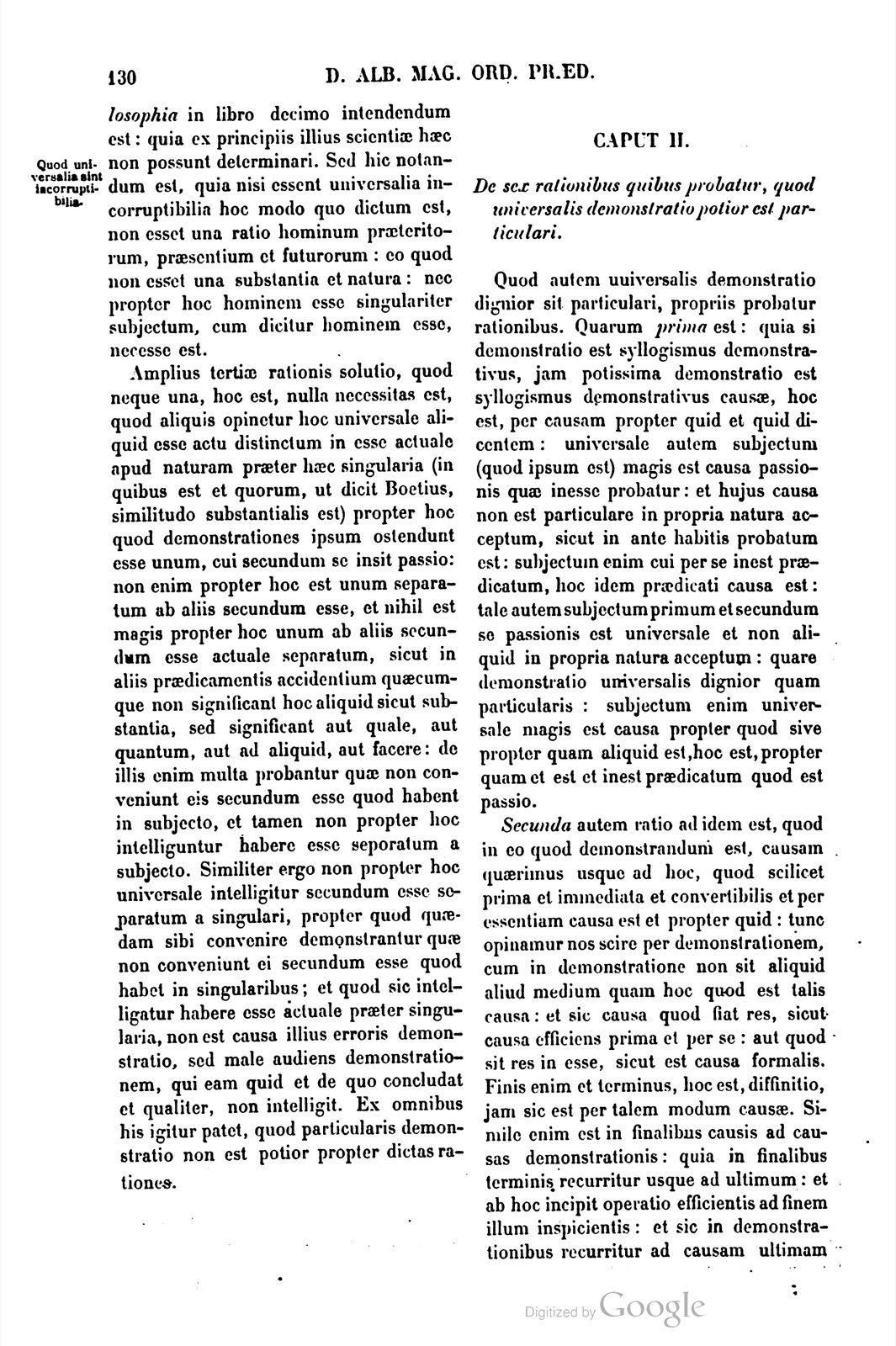
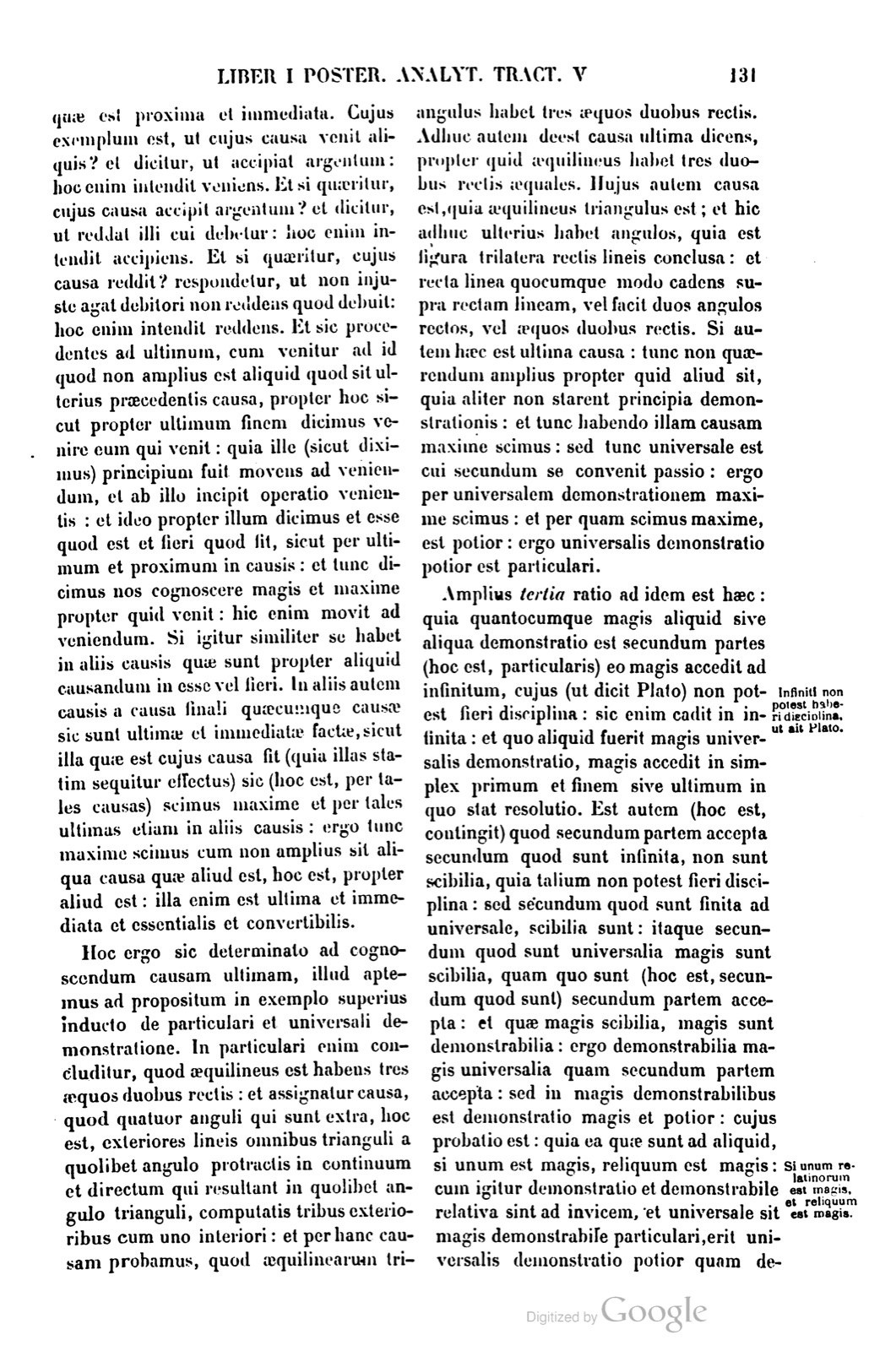
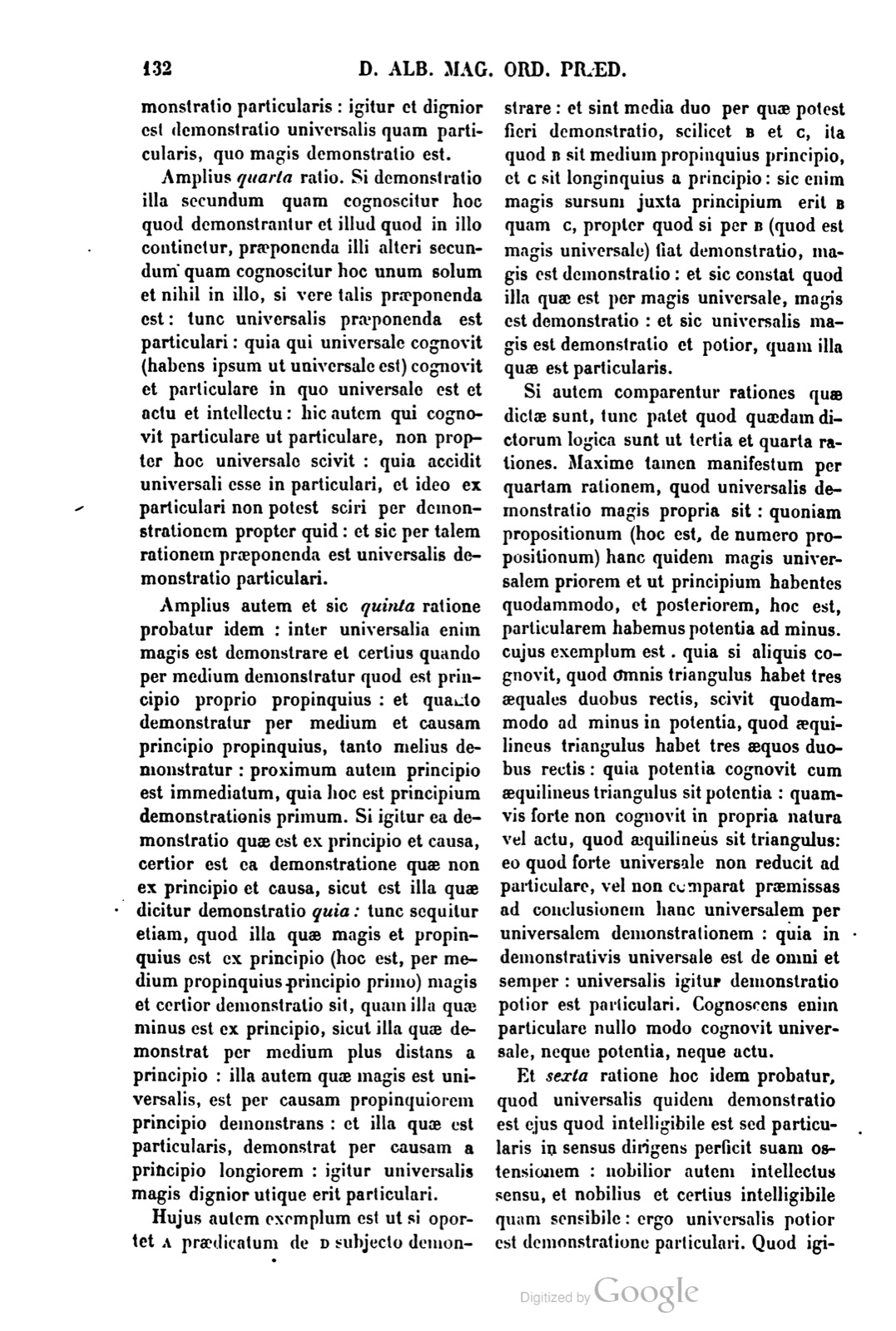
CAPUT II. De sex rationibus quibus probatur, quod universalis demonstratio potior est particulari. Quod autem universalis demonstratio dignior sit particulari, propriis probatur rationibus. Quarum prima est: quia si demonstratio est syllogismus demonstrativus, jam potissima demonstratio est syllogismus demonstrativus causae, hoc est, per causam propter quid et quidditatem: universale autem subjectum (quod ipsum est) magis est causa passionis quae inesse probatur: et hujus causa non est particulare in propria natura acceptum, sicut in ante habitis probatum est: subjectum enim cui per se inest praedicatum, hoc idem praedicati causa est: tale autem subjectum primum et secundum se passionis est universale et non aliquid in propria natura acceptum: quare demonstratio universalis dignior quam particularis: subjectum enim universale magis est causa propter quod sive propter quam aliquid est, hoc est, propter quam et est et inest praedicatum quod est passio. Secunda autem ratio ad idem est, quod in eo quod demonstrandum est, causam quaerimus usque ad hoc, quod scilicet prima et immediata et convertibilis et per essentiam causa est et propter quid: tunc opinamur nos scire per demonstrationem, cum in demonstratione non sit aliquid aliud medium quam hoc quod est talis causa: et sic causa quod fiat res, sicut causa efficiens prima et per se: aut quod sit res in esse, sicut est causa formalis. Finis enim et terminus, hoc est, diffinitio, jam sic est per talem modum causae. Simile enim est in finalibus causis ad causas demonstrationis: quia in finalibus terminis recurritur usque ad ultimum: et ab hoc incipit operatio efficientis ad finem illum inspicientis: et sic in demonstrationibus recurritur ad causam ultimam quae est proxima et immediata. Cujus exemplum est, ut cujus causa venit aliquis? et dicitur, ut accipiat argentum: hoc enim intendit veniens. Et si quaeritur, cujus causa accipit argentum? et dicitur, ut reddat illi cui debetur: hoc enim intendit accipiens. Et si quaeritur, cujus causa reddit? respondetur, ut non injuste agat debitori non reddens quod debuit: hoc enim intendit reddens. Et sic procedentes ad ultimum, cum venitur ad id quod non amplius est aliquid quod sit ulterius praecedentis causa, propter hoc sicut propter ultimum finem dicimus venire eum qui venit: quia ille (sicut diximus) principium fuit movens ad veniendum, et ab illo incipit operatio venientis: et ideo propter illum dicimus et esse quod est et fieri quod fit, sicut per ultimum et proximum in causis: et tunc dicimus nos cognoscere magis et maxime propter quid venit: hic enim movit ad veniendum. Si igitur similiter se habet in aliis causis quae sunt propter aliquid causandum in esse vel fieri. In aliis autem causis a causa finali quaecumque causae sic sunt ultimae et immediatae factae, sicut illa quae est cujus causa fit (quia illas statim sequitur effectus) sic (hoc est, per tales causas) scimus maxime et per tales ultimas etiam in aliis causis: ergo tunc maxime scimus cum non amplius sit aliqua causa quae aliud est, hoc est, propter aliud est: illa enim est ultima et immediata et essentialis et convertibilis. Hoc ergo sic determinato ad cognoscendum causam ultimam, illud aptemus ad propositum in exemplo superius inducto de particulari et universali demonstratione. In particulari enim concluditur, quod aequilineus est habens tres aequos duobus rectis: et assignatur causa, quod quatuor anguli qui sunt extra, hoc est, exteriores lineis omnibus trianguli a quolibet angulo protractis in continuum et directum qui resultant in quolibet angulo trianguli, computatis tribus exterioribus cum uno interiori: et per hanc causam probamus, quod aequilinearum triangulus habet tres aequos duobus rectis. Adhuc autem deest causa ultima dicens, propter quid aequilineus habet tres duobus rectis aequales. Hujus autem causa est, quia aequilineus triangulus est: et hic adhuc ulterius habet angulos, quia est figura trilatera rectis lineis conclusa: et recta linea quocumque modo cadens supra rectam lineam, vel facit duos angulos rectos, vel aequos duobus rectis. Si autem haec est ultima causa: tunc non quaerendum amplius propter quid aliud sit, quia aliter non starent principia demonstrationis: et tunc habendo illam causam maxime scimus: sed tunc universale est cui secundum se convenit passio: ergo per universalem demonstrationem maxime scimus: et per quam scimus maxime, est potior: ergo universalis demonstratio potior est particulari. <marginal-label>Infiniti non potest haberi disciplina, ut ait Plato.</marginal-label> Amplius tertia ratio ad idem est haec: quia quantocumque magis aliquid sive aliqua demonstratio est secundum partes (hoc est, particularis) eo magis accedit ad infinitum, cujus (ut dicit Plato) non potest fieri disciplina: sic enim cadit in infinita: et quo aliquid fuerit magis universalis demonstratio, magis accedit in simplex primum et finem sive ultimum in quo stat resolutio. Est autem (hoc est, contingit) quod secundum partem accepta secundum quod sunt infinita, non sunt scibilia, quia talium non potest fieri disciplina: sed secundum quod sunt finita ad universale, scibilia sunt: itaque secundum quod sunt universalia magis sunt scibilia, quam quo sunt (hoc est, secundum quod sunt) secundum partem accepta: et quae magis scibilia, magis sunt demonstrabilia: ergo demonstrabilia magis universalia quam secundum partem accepta: sed in magis demonstrabilibus est demonstratio magis et potior: cujus probatio est: quia ea quae sunt ad aliquid, si unum est magis, reliquum est magis: cum igitur demonstratio et demonstrabile relativa sint ad invicem, et universale sit magis demonstrabile particulari, erit universalis demonstratio potior quam demonstratio particularis: igitur et dignior est demonstratio universalis quam particularis, quo magis demonstratio est. <marginal-label>Si unum relativorum est magis, et reliquum est magis.</marginal-label> Amplius quarta ratio. Si demonstratio illa secundum quam cognoscitur hoc quod demonstrantur et illud quod in illo continetur, praeponenda illi alteri secundum quam cognoscitur hoc unum solum et nihil in illo, si vere talis praeponenda est: tunc universalis praeponenda est particulari: quia qui universale cognovit (habens ipsum ut universale est) cognovit et particulare in quo universale est et actu et intellectu: hic autem qui cognovit particulare ut particulare, non propter hoc universale scivit: quia accidit universali esse in particulari, et ideo ex particulari non potest sciri per demonstrationem propter quid: et sic per talem rationem praeponenda est universalis demonstratio particulari. Amplius autem et sic quinta ratione probatur idem: inter universalia enim magis est demonstrare et certius quando per medium demonstratur quod est principio proprio propinquius: et quanto demonstratur per medium et causam principio propinquius, tanto melius demonstratur: proximum autem principio est immediatum, quia hoc est principium demonstrationis primum. Si igitur ea demonstratio quae est ex principio et causa, certior est ea demonstratione quae non ex principio et causa, sicut est illa quae dicitur demonstratio quia: tunc sequitur etiam, quod illa quae magis et propinquius est ex principio (hoc est, per medium propinquius principio primo) magis et certior demonstratio sit, quam illa quae minus est ex principio, sicut illa quae demonstrat per medium plus distans a principio: illa autem quae magis est universalis, est per causam propinquiorem principio demonstrans: et illa quae est particularis, demonstrat per causam a principio longiorem: igitur universalis magis dignior utique erit particulari. Hujus autem exemplum est ut si oportet A praedicatum de D subjecto demonstrare: et sint media duo per quae potest fieri demonstratio, scilicet B et C, ita quod B sit medium propinquius principio, et C sit longinquius a principio: sic enim magis sursum juxta principium erit B quam C, propter quod si per B (quod est magis universale) fiat demonstratio, magis est demonstratio: et sic constat quod illa quae est per magis universale, magis est demonstratio: et sic universalis magis est demonstratio et potior, quam illa quae est particularis. Si autem comparentur rationes quae dictae sunt, tunc patet quod quaedam dictorum logica sunt ut tertia et quarta rationes. Maxime tamen manifestum per quartam rationem, quod universalis demonstratio magis propria sit: quoniam propositionum (hoc est, de numero propositionum) hanc quidem magis universalem priorem et ut principium habentes quodammodo, et posteriorem, hoc est, particularem habemus potentia ad minus. Cujus exemplum est: quia si aliquis cognovit, quod omnis triangulus habet tres aequales duobus rectis, scivit quodammodo ad minus in potentia, quod aequilineus triangulus habet tres aequos duobus rectis: quia potentia cognovit cum aequilineus triangulus sit potentia: quamvis forte non cognovit in propria natura vel actu, quod aequilineus sit triangulus: eo quod forte universale non reducit ad particulare, vel non comparat praemissas ad conclusionem hanc universalem per universalem demonstrationem: quia in demonstrativis universale est de omni et semper: universalis igitur demonstratio potior est particulari. Cognoscens enim particulare nullo modo cognovit universale, neque potentia, neque actu. Et sexta ratione hoc idem probatur, quod universalis quidem demonstratio est ejus quod intelligibile est sed particularis in sensus dirigens perficit suam ostensionem: nobilior autem intellectus sensu, et nobilius et certius intelligibile quam sensibile: ergo universalis potior est demonstratione particulari. Quod igitur
CHAPTER II. On the six reasons by which it is proved that universal demonstration is preferable to particular demonstration. But that universal demonstration is worthier than particular is proved by proper reasons. The first of these is: because if demonstration is a demonstrative syllogism, now the most powerful demonstration is a demonstrative syllogism of the cause, that is, through the cause on account of which and through the quiddity; but the universal subject, which is what the thing itself is, is more the cause of the property which is proved to be present. And the cause of this is not the particular taken in its proper nature, as has been proved in the things held before. For the subject to which the predicate belongs through itself is this same cause of the predicate; but such a first subject of the property, and subject according to itself, is the universal and not something taken in its proper nature. Therefore universal demonstration is worthier than particular demonstration, for the universal subject is more the cause on account of which, or by reason of which, something is, that is, by reason of which the predicate which is a property both is and is present. But the second reason for the same is that, in that which is to be demonstrated, we seek the cause up to this point, namely that it is the first and immediate and convertible cause and through the essence, and the on-account-of-which. Then we think that we know through demonstration, when in the demonstration there is no other middle than that which is such a cause; and thus it is the cause that the thing comes to be, as the first and per se efficient cause is, or that the thing is in being, as the formal cause is. For the end and term, that is, the definition, is now in this way through such a mode of cause. For it is similar in final causes to the causes of demonstration, because among final terms one runs back to the last, and from this the operation of the efficient cause looking toward that end begins; and thus in demonstrations one runs back to the ultimate cause, which is proximate and immediate. The example of this is: for the sake of what does someone come? And it is said, so that he may receive money; for the one coming intends this. And if it is asked, for the sake of what does he receive money? And it is said, so that he may repay the one to whom it is owed; for the one receiving intends this. And if it is asked, for the sake of what does he repay? It is answered, so that he may not act unjustly by not repaying to the debtor what he owed; for the one repaying intends this. And thus, proceeding to the last, when one comes to that beyond which there is no longer anything that is a further cause of what precedes, on account of this, as on account of the ultimate end, we say that he who comes comes, because that, as we have said, was the principle moving him to come, and from it the operation of the one coming begins. And therefore on account of it we say both that what is, is, and that what comes to be, comes to be, as through the ultimate and proximate thing in causes; and then we say that we know more and most of all on account of what he came, for this moved him to come. Therefore if it is similarly disposed in other causes which exist for the sake of causing something in being or in coming-to-be. But in other causes apart from the final cause, whatever causes are thus made ultimate and immediate, as that which is that for the sake of which it comes to be, because the effect follows them at once, thus, that is, through such causes, we know most of all, and through such ultimate causes also in the other causes. Therefore we know most of all when there is no longer some cause that is another, that is, that is on account of another; for that cause is ultimate and immediate and essential and convertible. Therefore, with this determined in this way for knowing the ultimate cause, let us apply it to the proposal in the example introduced above concerning particular and universal demonstration. For in the particular it is concluded that the equal-sided figure is one having three angles equal to two right angles; and the cause is assigned, namely that the four angles which are outside, that is, exterior to all the lines of the triangle drawn out from any angle continuously and straight, which result at any angle of the triangle, with the three exterior angles counted together with one interior angle; and through this cause we prove that the equal-sided triangle has three angles equal to two right angles. But the ultimate cause is still lacking, saying on account of what the equal-sided triangle has three angles equal to two right angles. But the cause of this is because it is an equal-sided triangle; and this still further has angles because it is a three-sided figure enclosed by straight lines, and a straight line falling upon a straight line in whatever way either makes two right angles or angles equal to two right angles. But if this is the ultimate cause, then one must not ask further on account of what other thing it is, because otherwise the principles of demonstration would not come to a stop; and then, having that cause, we know most of all. But then the universal is that to which the property belongs according to itself. Therefore through universal demonstration we know most of all; and that through which we know most of all is preferable. Therefore universal demonstration is preferable to particular demonstration. <marginal-label>Of the infinite there cannot be discipline, as Plato says.</marginal-label> Moreover, the third reason for the same is this: because by however much more something, or some demonstration, is according to parts, that is, particular, by that much more it approaches the infinite, of which, as Plato says, there can be no discipline; for thus it falls into infinite things. And by however much some demonstration has been more universal, by that much more it approaches the simple first thing and the end or ultimate thing in which resolution stands. But it is, that is, it happens, that things taken according to the part, according as they are infinite, are not knowable, because there cannot be discipline of such things; but according as they are finite with respect to the universal, they are knowable. Therefore according as they are universals they are more knowable than they are, that is, than according as they are, taken according to the part. And the things that are more knowable are more demonstrable; therefore universal things are more demonstrable than things taken according to the part. But in more demonstrable things demonstration is more and preferable. The proof of this is that, in things that are relative, if one is more, the remaining one is more. Therefore, since demonstration and the demonstrable are relative to one another, and the universal is more demonstrable than the particular, universal demonstration will be preferable to particular demonstration. Therefore universal demonstration is also worthier than particular, by the amount that it is more demonstration. <marginal-label>If one of relatives is more, the remaining one also is more.</marginal-label> Moreover, the fourth reason. If that demonstration according to which that which is demonstrated and that which is contained in it are known must be preferred to that other demonstration according to which this one thing alone is known and nothing in it, if such a demonstration truly must be preferred, then the universal must be preferred to the particular, because the one who has known the universal, having it as it is universal, has known also the particular in which the universal is both in act and in understanding. But this one who has known the particular as particular has not on account of this known the universal, because it happens to the universal to be in the particular, and therefore from the particular it cannot be known through a demonstration on account of which. And thus through such a reason universal demonstration must be preferred to particular. Moreover also, in this way the same thing is proved by a fifth reason: for among universals to demonstrate is more, and is more certain, when that which is nearer to the proper principle is demonstrated through a middle; and by how much something is demonstrated through a middle and cause nearer to the principle, by that much it is demonstrated better. But what is nearest to the principle is immediate, because this is the first principle of demonstration. Therefore, if that demonstration which is from a principle and cause is more certain than that demonstration which is not from a principle and cause, as is that which is called demonstration that, then it also follows that that demonstration which is more and more nearly from the principle, that is, through a middle nearer to the first principle, is more and a more certain demonstration than that which is less from the principle, such as that which demonstrates through a middle more distant from the principle. But that which is more universal is demonstrating through a cause nearer to the principle, and that which is particular demonstrates through a cause farther from the principle; therefore the universal will surely be worthier than the particular. The example of this is that, if one must demonstrate predicate A of subject D, and there are two middles through which the demonstration can be made, namely B and C, so that B is the middle nearer to the principle and C is farther from the principle, then B will be higher up near the principle more than C. On this account, if a demonstration is made through B, which is more universal, it is more a demonstration; and thus it is established that the demonstration which is through the more universal is more a demonstration, and thus the universal is more a demonstration and preferable to the demonstration which is particular. But if the reasons that have been stated are compared, then it is clear that certain of the things stated are logical, such as the third and fourth reasons. Nevertheless, through the fourth reason it is especially manifest that universal demonstration is more proper, since, among propositions, that is, from the number of propositions, having the more universal proposition prior and as a principle in some way, we also have the posterior, that is, the particular, at least in potency. The example of this is that if someone has known that every triangle has three angles equal to two right angles, he has known in some way, at least in potency, that an equal-sided triangle has three angles equal to two right angles, because he has known it in potency, since an equal-sided triangle is in potency, although perhaps he has not known in proper nature or in act that the equal-sided is a triangle, because perhaps he does not reduce the universal to the particular, or does not compare the premises to this universal conclusion through universal demonstration, because in demonstrative matters the universal is of every instance and always. Therefore universal demonstration is preferable to particular. For one knowing the particular has in no way known the universal, neither in potency nor in act. And by a sixth reason this same thing is proved, that universal demonstration indeed belongs to that which is intelligible, but particular demonstration, directing itself into the senses, completes its showing. But intellect is nobler than sense, and the intelligible is nobler and more certain than the sensible. Therefore the universal is preferable to particular demonstration. Therefore that
If a page does not appear, its photograph has not been uploaded yet.