Works › Posterior Analytics, Books I–II
Volume 2 · pp. 126–130
Treatise V. On the comparison of demonstration to demonstration. Chapter I.
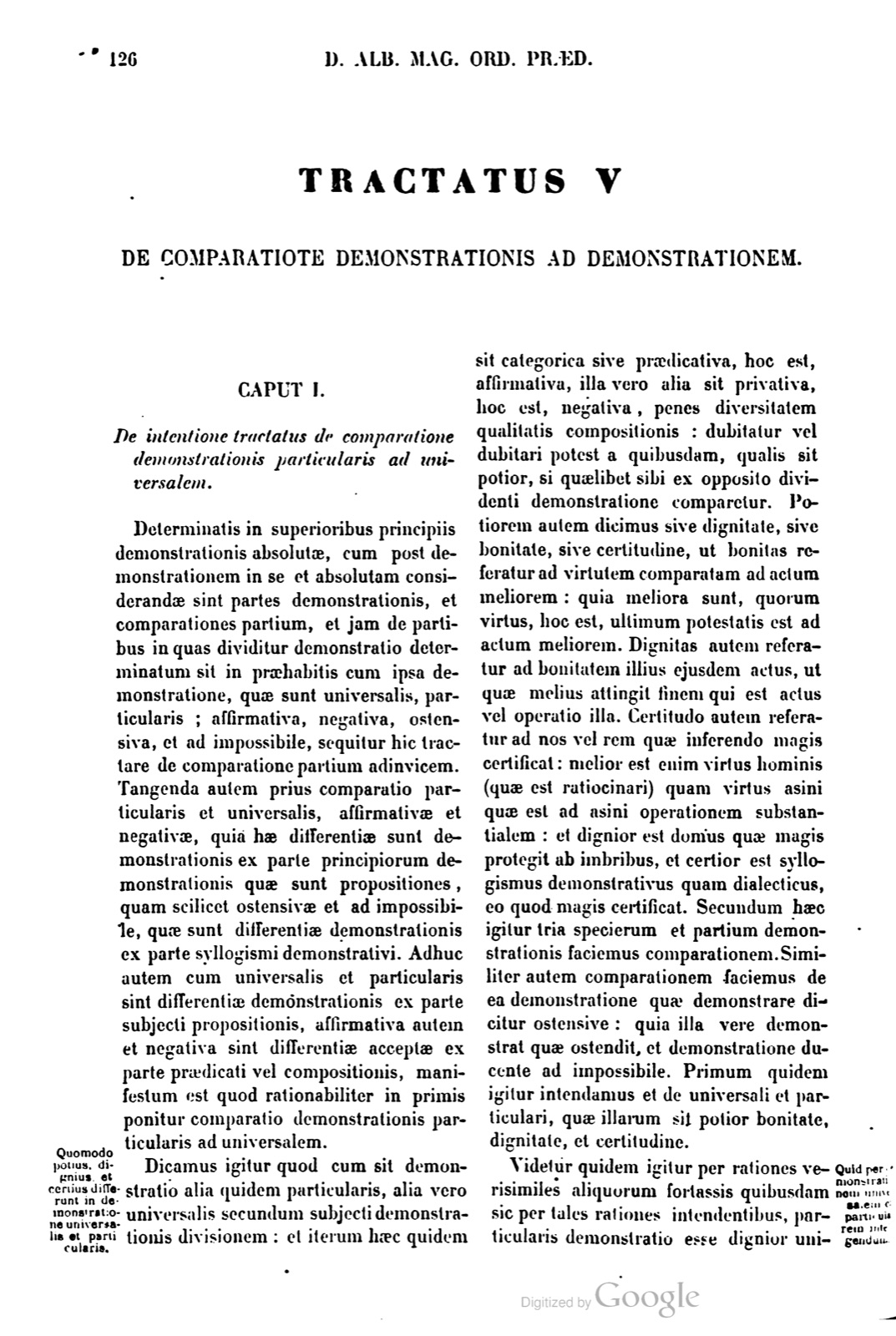
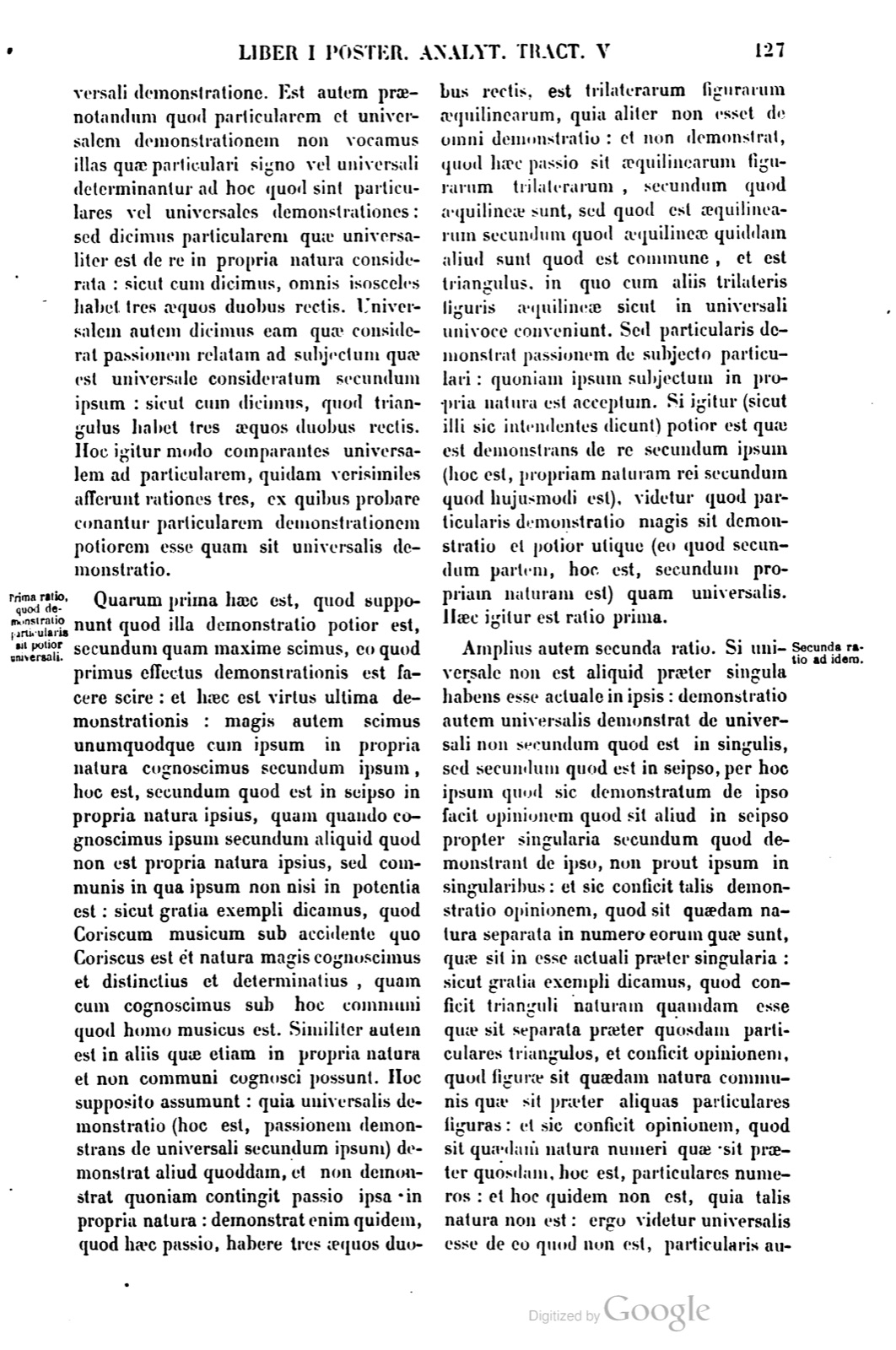
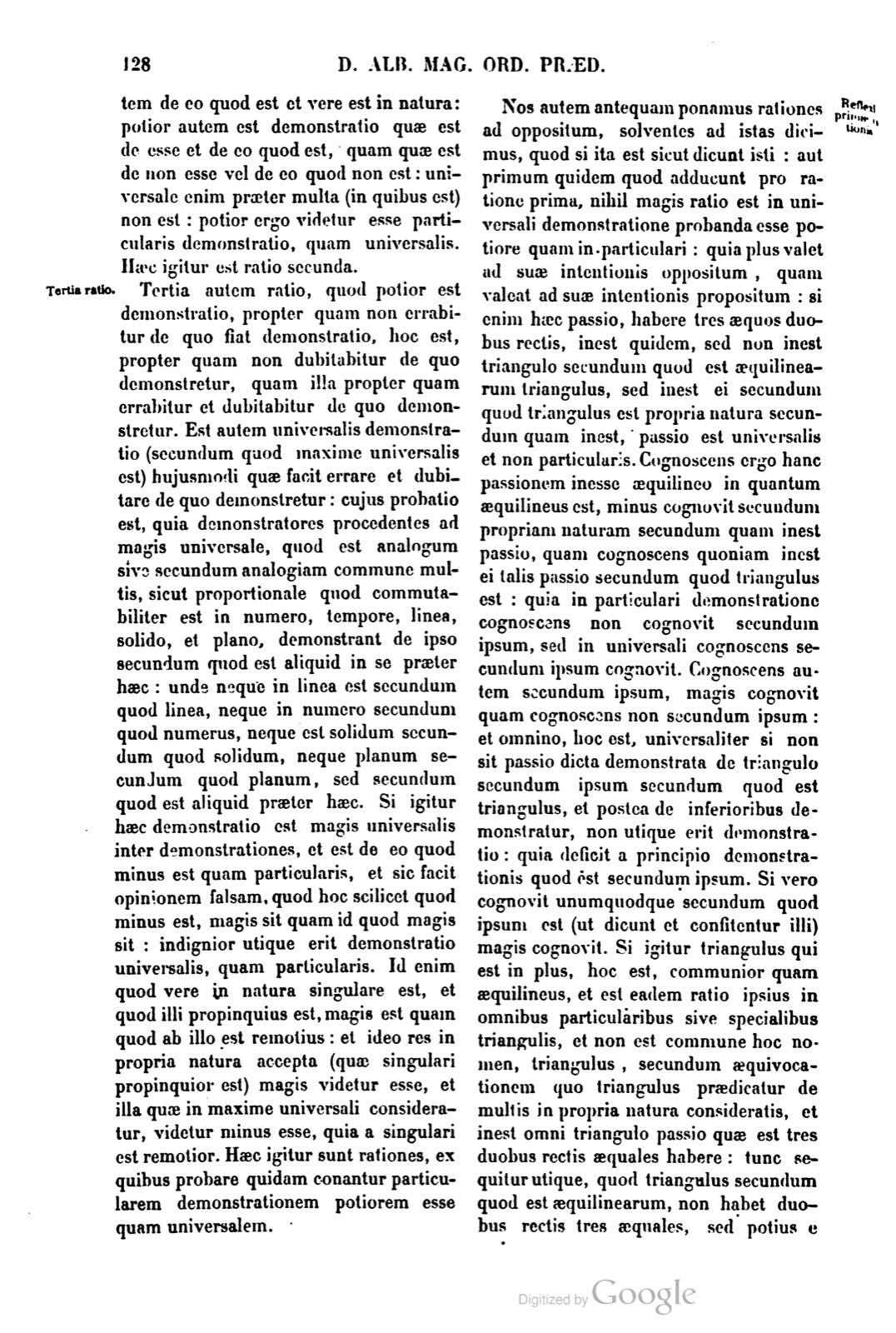
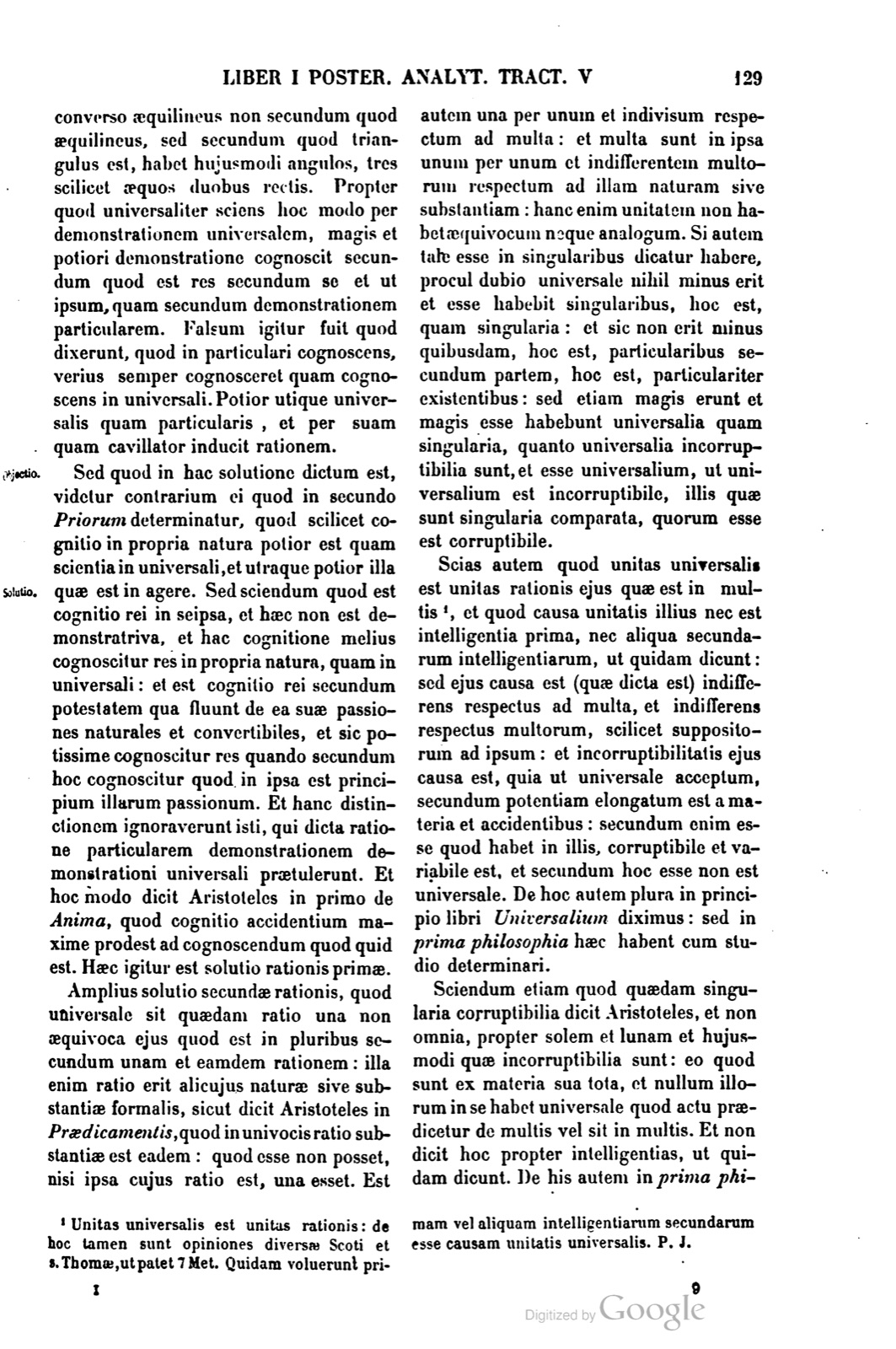
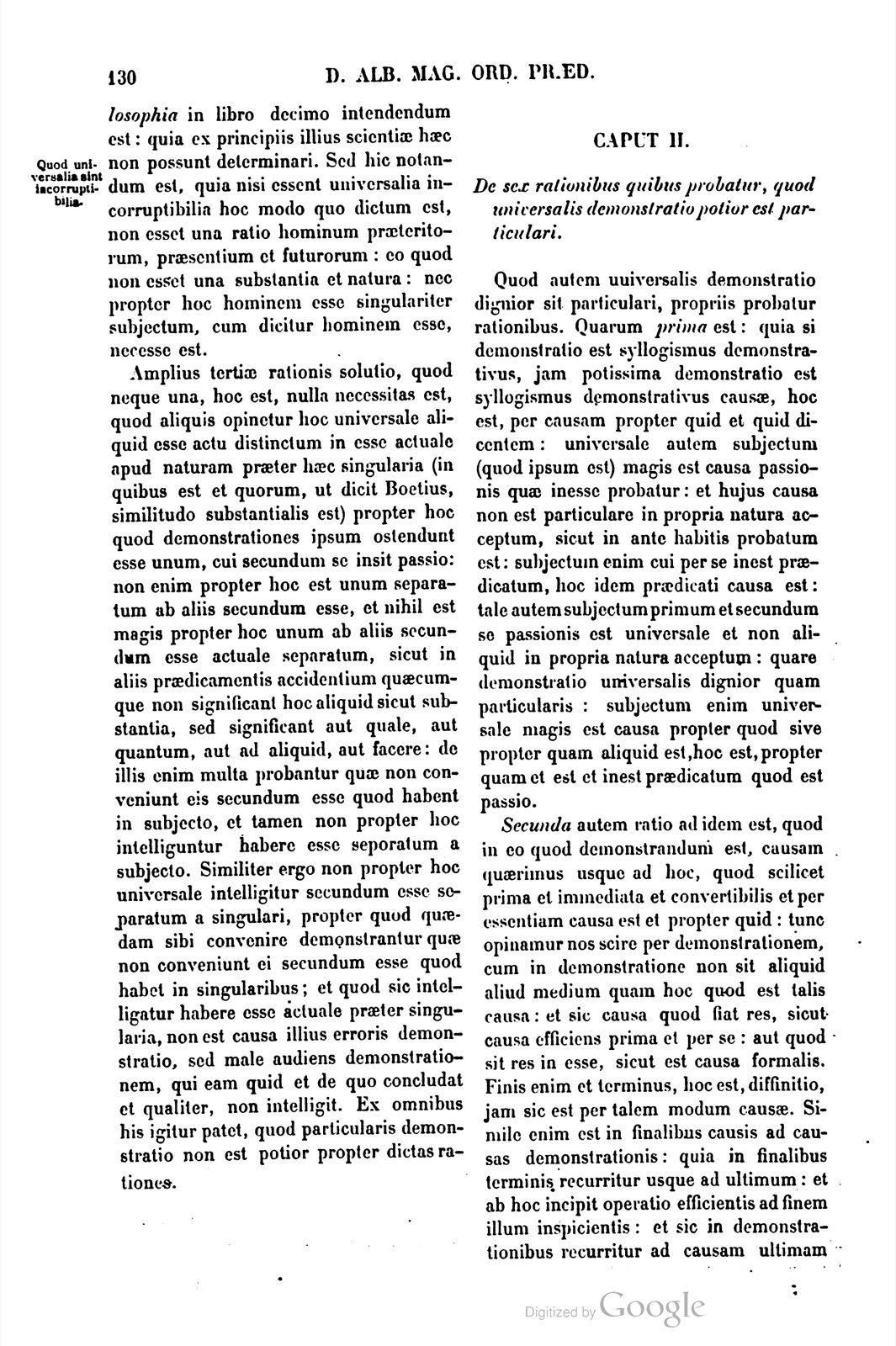
TRACTATUS V. De comparatione demonstrationis ad demonstrationem. CAPUT I. De intentione tractatus de comparatione demonstrationis particularis ad universalem. Determinatis in superioribus principiis demonstrationis absolutae, cum post demonstrationem in se et absolutam considerandae sint partes demonstrationis, et comparationes partium, et jam de partibus in quas dividitur demonstratio determinatum sit in praehabitis cum ipsa demonstratione, quae sunt universalis, particularis; affirmativa, negativa, ostensiva, et ad impossibile, sequitur hic tractare de comparatione partium ad invicem. Tangenda autem prius comparatio particularis et universalis, affirmativae et negativae, quia hae differentiae sunt demonstrationis ex parte principiorum demonstrationis quae sunt propositiones, quam scilicet ostensivae et ad impossibile, quae sunt differentiae demonstrationis ex parte syllogismi demonstrativi. Adhuc autem cum universalis et particularis sint differentiae demonstrationis ex parte subjecti propositionis, affirmativa autem et negativa sint differentiae acceptae ex parte praedicati vel compositionis, manifestum est quod rationabiliter in primis ponitur comparatio demonstrationis particularis ad universalem. <marginal-label>Quomodo potius, dignius, et certius differunt in demonstratione universalis et particularis.</marginal-label> Dicamus igitur quod cum sit demonstratio alia quidem particularis, alia vero universalis secundum subjecti demonstrationis divisionem: et iterum haec quidem sit categorica sive praedicativa, hoc est, affirmativa, illa vero alia sit privativa, hoc est, negativa, penes diversitatem qualitatis compositionis: dubitatur vel dubitari potest a quibusdam, qualis sit potior, si quaelibet sibi ex opposito dividenti demonstratione comparetur. Potiorem autem dicimus sive dignitate, sive bonitate, sive certitudine, ut bonitas referatur ad virtutem comparatam ad actum meliorem: quia meliora sunt, quorum virtus, hoc est, ultimum potestatis est ad actum meliorem. Dignitas autem referatur ad bonitatem illius ejusdem actus, ut quae melius attingit finem qui est actus vel operatio illa. Certitudo autem referatur ad nos vel rem quae inferendo magis certificat: melior est enim virtus hominis (quae est ratiocinari) quam virtus asini quae est ad asini operationem substantialem: et dignior est domus quae magis protegit ab imbribus, et certior est syllogismus demonstrativus quam dialecticus, eo quod magis certificat. Secundum haec igitur tria specierum et partium demonstrationis faciemus comparationem. Similiter autem comparationem faciemus de ea demonstratione quae demonstrare dicitur ostensive: quia illa vere demonstrat quae ostendit, et demonstratione ducente ad impossibile. Primum quidem igitur intendamus et de universali et particulari, quae illarum sit potior bonitate, dignitate, et certitudine. <marginal-label>Quid per demonstrationem universalem et particularem intelligendum.</marginal-label> Videtur quidem igitur per rationes verisimiles aliquorum fortassis quibusdam sic per tales rationes intendentibus, particularis demonstratio esse dignior universali demonstratione. Est autem praenotandum quod particularem et universalem demonstrationem non vocamus illas quae particulari signo vel universali determinantur ad hoc quod sint particulares vel universales demonstrationes: sed dicimus particularem quae universaliter est de re in propria natura considerata: sicut cum dicimus, omnis isosceles habet tres aequos duobus rectis. Universalem autem dicimus eam quae considerat passionem relatam ad subjectum quae est universale consideratum secundum ipsum: sicut cum dicimus, quod triangulus habet tres aequos duobus rectis. Hoc igitur modo comparantes universalem ad particularem, quidam verisimiles afferunt rationes tres, ex quibus probare conantur particularem demonstrationem potiorem esse quam sit universalis demonstratio. <marginal-label>Prima ratio, quod demonstratio particularis sit potior universali.</marginal-label> Quarum prima haec est, quod supponunt quod illa demonstratio potior est, secundum quam maxime scimus, eo quod primus effectus demonstrationis est facere scire: et haec est virtus ultima demonstrationis: magis autem scimus unumquodque cum ipsum in propria natura cognoscimus secundum ipsum, hoc est, secundum quod est in seipso in propria natura ipsius, quam quando cognoscimus ipsum secundum aliquid quod non est propria natura ipsius, sed communis in qua ipsum non nisi in potentia est: sicut gratia exempli dicamus, quod Coriscum musicum sub accidente quo Coriscus est et natura magis cognoscimus et distinctius et determinatius, quam cum cognoscimus sub hoc communi quod homo musicus est. Similiter autem est in aliis quae etiam in propria natura et non communi cognosci possunt. Hoc supposito assumunt: quia universalis demonstratio (hoc est, passionem demonstrans de universali secundum ipsum) demonstrat aliud quoddam, et non demonstrat quoniam contingit passio ipsa in propria natura: demonstrat enim quidem, quod haec passio, habere tres aequos duobus rectis, est trilaterarum figurarum aequilinearum, quia aliter non esset de omni demonstratio: et non demonstrat, quod haec passio sit aequilinearum figurarum trilaterarum, secundum quod aequilineae sunt, sed quod est aequilinearum secundum quod aequilineae quiddam aliud sunt quod est commune, et est triangulus, in quo cum aliis trilateris figuris aequilineae sicut in universali univoce conveniunt. Sed particularis demonstrat passionem de subjecto particulari: quoniam ipsum subjectum in propria natura est acceptum. Si igitur (sicut illi sic intendentes dicunt) potior est quae est demonstrans de re secundum ipsum (hoc est, propriam naturam rei secundum quod hujusmodi est), videtur quod particularis demonstratio magis sit demonstratio et potior utique (eo quod secundum partem, hoc est, secundum propriam naturam est) quam universalis. Haec igitur est ratio prima. <marginal-label>Secunda ratio ad idem.</marginal-label> Amplius autem secunda ratio. Si universale non est aliquid praeter singula habens esse actuale in ipsis: demonstratio autem universalis demonstrat de universali non secundum quod est in singulis, sed secundum quod est in seipso, per hoc ipsum quod sic demonstratum de ipso facit opinionem quod sit aliud in seipso propter singularia secundum quod demonstrant de ipso, non prout ipsum in singularibus: et sic conficit talis demonstratio opinionem, quod sit quaedam natura separata in numero eorum quae sunt, quae sit in esse actuali praeter singularia: sicut gratia exempli dicamus, quod conficit trianguli naturam quamdam esse quae sit separata praeter quosdam particulares triangulos, et conficit opinionem, quod figurae sit quaedam natura communis quae sit praeter aliquas particulares figuras: et sic conficit opinionem, quod sit quaedam natura numeri quae sit praeter quosdam, hoc est, particulares numeros: et hoc quidem non est, quia talis natura non est: ergo videtur universalis esse de eo quod non est, particularis autem de eo quod est et vere est in natura: potior autem est demonstratio quae est de esse et de eo quod est, quam quae est de non esse vel de eo quod non est: universale enim praeter multa (in quibus est) non est: potior ergo videtur esse particularis demonstratio, quam universalis. Haec igitur est ratio secunda. <marginal-label>Tertia ratio.</marginal-label> Tertia autem ratio, quod potior est demonstratio, propter quam non errabitur de quo fiat demonstratio, hoc est, propter quam non dubitabitur de quo demonstretur, quam illa propter quam errabitur et dubitabitur de quo demonstretur. Est autem universalis demonstratio (secundum quod maxime universalis est) hujusmodi quae facit errare et dubitare de quo demonstretur: cujus probatio est, quia demonstratores procedentes ad magis universale, quod est analogum sive secundum analogiam commune multis, sicut proportionale quod commutabiliter est in numero, tempore, linea, solido, et plano, demonstrant de ipso secundum quod est aliquid in se praeter haec: unde neque in linea est secundum quod linea, neque in numero secundum quod numerus, neque est solidum secundum quod solidum, neque planum secundum quod planum, sed secundum quod est aliquid praeter haec. Si igitur haec demonstratio est magis universalis inter demonstrationes, et est de eo quod minus est quam particularis, et sic facit opinionem falsam, quod hoc scilicet quod minus est, magis sit quam id quod magis sit: indignior utique erit demonstratio universalis, quam particularis. Id enim quod vere in natura singulare est, et quod illi propinquius est, magis est quam quod ab illo est remotius: et ideo res in propria natura accepta (quae singulari propinquior est) magis videtur esse, et illa quae in maxime universali consideratur, videtur minus esse, quia a singulari est remotior. Haec igitur sunt rationes, ex quibus probare quidam conantur particularem demonstrationem potiorem esse quam universalem. <marginal-label>Resp. primae rationis.</marginal-label> Nos autem antequam ponamus rationes ad oppositum, solventes ad istas dicimus, quod si ita est sicut dicunt isti: aut primum quidem quod adducunt pro ratione prima, nihil magis ratio est in universali demonstratione probanda esse potiore quam in particulari: quia plus valet ad suae intentionis oppositum, quam valeat ad suae intentionis propositum: si enim haec passio, habere tres aequos duobus rectis, inest quidem, sed non inest triangulo secundum quod est aequilinearum triangulus, sed inest ei secundum quod triangulus est propria natura secundum quam inest, passio est universalis et non particularis. Cognoscens ergo hanc passionem inesse aequilineo in quantum aequilineus est, minus cognovit secundum propriam naturam secundum quam inest passio, quam cognoscens quoniam inest ei talis passio secundum quod triangulus est: quia in particulari demonstratione cognoscens non cognovit secundum ipsum, sed in universali cognoscens secundum ipsum cognovit. Cognoscens autem secundum ipsum, magis cognovit quam cognoscens non secundum ipsum: et omnino, hoc est, universaliter si non sit passio dicta demonstrata de triangulo secundum ipsum secundum quod est triangulus, et postea de inferioribus demonstretur, non utique erit demonstratio: quia deficit a principio demonstrationis quod est secundum ipsum. Si vero cognovit unumquodque secundum quod ipsum est (ut dicunt et confitentur illi) magis cognovit. Si igitur triangulus qui est in plus, hoc est, communior quam aequilineus, et est eadem ratio ipsius in omnibus particularibus sive specialibus triangulis, et non est commune hoc nomen, triangulus, secundum aequivocationem quo triangulus praedicatur de multis in propria natura consideratis, et inest omni triangulo passio quae est tres duobus rectis aequales habere: tunc sequitur utique, quod triangulus secundum quod est aequilinearum, non habet duobus rectis tres aequales, sed potius e converso aequilineus non secundum quod aequilineus, sed secundum quod triangulus est, habet hujusmodi angulos, tres scilicet aequos duobus rectis. Propter quod universaliter sciens hoc modo per demonstrationem universalem, magis et potiori demonstratione cognoscit secundum quod est res secundum se et ut ipsum, quam secundum demonstrationem particularem. Falsum igitur fuit quod dixerunt, quod in particulari cognoscens, verius semper cognosceret quam cognoscens in universali. Potior utique universalis quam particularis et per suam, quam cavillator inducit rationem. <marginal-label>Objectio.</marginal-label> Sed quod in hac solutione dictum est, videtur contrarium ei quod in secundo Priorum determinatur, quod scilicet cognitio in propria natura potior est quam scientia in universali, et utraque potior illa quae est in agere. <marginal-label>Solutio.</marginal-label> Sed sciendum quod est cognitio rei in seipsa, et haec non est demonstrativa, et hac cognitione melius cognoscitur res in propria natura, quam in universali: et est cognitio rei secundum potestatem qua fluunt de ea suae passiones naturales et convertibiles, et sic potissime cognoscitur res quando secundum hoc cognoscitur quod in ipsa est principium illarum passionum. Et hanc distinctionem ignoraverunt isti, qui dicta ratione particularem demonstrationem demonstrationi universali praetulerunt. Et hoc modo dicit Aristoteles in primo de Anima, quod cognitio accidentium maxime prodest ad cognoscendum quod quid est. Haec igitur est solutio rationis primae. Amplius solutio secundae rationis, quod universale sit quaedam ratio una non aequivoca ejus quod est in pluribus secundum unam et eamdem rationem: illa enim ratio erit alicujus naturae sive substantiae formalis, sicut dicit Aristoteles in Praedicamentis, quod in univocis ratio substantiae est eadem: quod esse non posset, nisi ipsa cujus ratio est, una esset. Est autem una per unum et indivisum respectum ad multa: et multa sunt in ipsa unum per unum et indifferentem multorum respectum ad illam naturam sive substantiam: hanc enim unitatem non habet aequivocum neque analogum. Si autem tale esse in singularibus dicatur habere, procul dubio universale nihil minus erit et esse habebit singularibus, hoc est, quam singularia: et sic non erit minus quibusdam, hoc est, particularibus secundum partem, hoc est, particulariter existentibus: sed etiam magis erunt et magis esse habebunt universalia quam singularia, quanto universalia incorruptibilia sunt, et esse universalium, ut universalium est incorruptibile, illis quae sunt singularia comparata, quorum esse est corruptibile. Scias autem quod unitas universalis est unitas rationis ejus quae est in multis 1, et quod causa unitatis illius nec est intelligentia prima, nec aliqua secundarum intelligentiarum, ut quidam dicunt: sed ejus causa est (quae dicta est) indifferens respectus ad multa, et indifferens respectus multorum, scilicet suppositorum ad ipsum: et incorruptibilitatis ejus causa est, quia ut universale acceptum, secundum potentiam elongatum est a materia et accidentibus: secundum enim esse quod habet in illis, corruptibile et variabile est, et secundum hoc esse non est universale. De hoc autem plura in principio libri Universalium diximus: sed in prima philosophia haec habent cum studio determinari. Sciendum etiam quod quaedam singularia corruptibilia dicit Aristoteles, et non omnia, propter solem et lunam et hujusmodi quae incorruptibilia sunt: eo quod sunt ex materia sua tota, et nullum illorum in se habet universale quod actu praedicetur de multis vel sit in multis. Et non dicit hoc propter intelligentias, ut quidam dicunt. De his autem in prima philosophia in libro decimo intendendum est: quia ex principiis illius scientiae haec non possunt determinari. Sed hic notandum est, quia nisi essent universalia incorruptibilia hoc modo quo dictum est, non esset una ratio hominum praeteritorum, praesentium et futurorum: eo quod non esset una substantia et natura: nec propter hoc hominem esse singulariter subjectum, cum dicitur hominem esse, necesse est. <marginal-label>Quod universalia sint incorruptibilia.</marginal-label> Amplius tertiae rationis solutio, quod neque una, hoc est, nulla necessitas est, quod aliquis opinetur hoc universale aliquid esse actu distinctum in esse actuale apud naturam praeter haec singularia (in quibus est et quorum, ut dicit Boetius, similitudo substantialis est) propter hoc quod demonstrationes ipsum ostendunt esse unum, cui secundum se insit passio: non enim propter hoc est unum separatum ab aliis secundum esse, et nihil est magis propter hoc unum ab aliis secundum esse actuale separatum, sicut in aliis praedicamentis accidentium quaecumque non significant hoc aliquid sicut substantia, sed significant aut quale, aut quantum, aut ad aliquid, aut facere: de illis enim multa probantur quae non conveniunt eis secundum esse quod habent in subjecto, et tamen non propter hoc intelliguntur habere esse separatum a subjecto. Similiter ergo non propter hoc universale intelligitur secundum esse separatum a singulari, propter quod quaedam sibi convenire demonstrantur quae non conveniunt ei secundum esse quod habet in singularibus; et quod sic intelligatur habere esse actuale praeter singularia, non est causa illius erroris demonstratio, sed male audiens demonstrationem, qui eam quid et de quo concludat et qualiter, non intelligit. Ex omnibus his igitur patet, quod particularis demonstratio non est potior propter dictas rationes.
TREATISE V. On the comparison of demonstration to demonstration. CHAPTER I. On the intention of the treatise concerning the comparison of particular demonstration to universal demonstration. When the principles of demonstration taken absolutely have been determined in what has gone before, since after demonstration in itself and taken absolutely the parts of demonstration and the comparisons of the parts must be considered, and since concerning the parts into which demonstration is divided it has already been determined in what has been set forth before together with demonstration itself, namely universal and particular, affirmative and negative, ostensive and to the impossible, it follows here to treat of the comparison of the parts to one another. But first the comparison of the particular and the universal, and of the affirmative and the negative, must be touched on, because these are differences of demonstration on the part of the principles of demonstration, which are propositions, rather than the ostensive and the demonstration to the impossible, which are differences of demonstration on the part of the demonstrative syllogism. Moreover, since universal and particular are differences of demonstration on the part of the subject of the proposition, but affirmative and negative are differences taken from the part of the predicate or of composition, it is manifest that the comparison of particular demonstration to universal is reasonably placed first. <marginal-label>How the preferable, the worthier, and the more certain differ in the demonstration of the universal and the particular.</marginal-label> Therefore let us say that, since one demonstration is particular and another universal according to the division of the subject of the demonstration, and again since this one is categorical or predicative, that is, affirmative, but that other one is privative, that is, negative, according to the diversity of the quality of composition, it is doubted, or can be doubted by some, which is preferable if any is compared with the demonstration that divides opposite to it. But we call something preferable either in dignity, or in goodness, or in certainty, so that goodness is referred to a power compared to a better act, because those things are better whose power, that is, whose ultimate capacity, is for a better act. But dignity is referred to the goodness of that same act, as that which better reaches the end which is that act or operation. Certainty, however, is referred to us or to the thing which by inferring gives greater certainty. For the power of a human being, which is to reason, is better than the power of a donkey, which is for the substantial operation of a donkey; and a house is worthier when it protects more from rains, and a demonstrative syllogism is more certain than a dialectical one, because it gives greater certainty. Therefore according to these three things we will make the comparison of the species and parts of demonstration. Similarly, however, we will make a comparison concerning that demonstration which is said to demonstrate ostensively, because that demonstration truly demonstrates which shows, and concerning demonstration leading to the impossible. Therefore first let us direct our intention concerning the universal and the particular, which of them is preferable in goodness, dignity, and certainty. <marginal-label>What is to be understood by universal and particular demonstration.</marginal-label> Therefore, by plausible reasons of some, perhaps it seems to some persons intending thus through such reasons that particular demonstration is worthier than universal demonstration. But it must be noted beforehand that we do not call particular and universal demonstrations those which are determined by a particular sign or a universal sign in order that they be particular or universal demonstrations. Rather, we call particular the one which universally concerns a thing considered in its proper nature, as when we say, every isosceles has three angles equal to two right angles. But we call universal that which considers a property related to a subject which is a universal considered according to itself, as when we say that a triangle has three angles equal to two right angles. Therefore, comparing the universal to the particular in this way, certain people bring forward three plausible reasons from which they try to prove that particular demonstration is preferable to universal demonstration. <marginal-label>The first reason, that particular demonstration is preferable to universal.</marginal-label> Of these the first is this: they suppose that that demonstration is preferable according to which we know most of all, because the first effect of demonstration is to make one know, and this is the ultimate power of demonstration. But we know each thing more when we know it in its proper nature according to itself, that is, according as it is in itself in its own proper nature, than when we know it according to something that is not its proper nature, but is common, in which it itself exists only in potency. For the sake of example, let us say that we know musical Coriscus under the accident by which Coriscus is and under his nature more, and more distinctly and more determinately, than when we know him under this common thing, that he is a musical human being. And it is similar in other things which can also be known in their proper nature and not in a common nature. Having supposed this, they assume that universal demonstration, that is, demonstration showing a property concerning the universal according to itself, demonstrates a certain other thing and does not demonstrate that the property itself happens in the proper nature. For it does indeed demonstrate that this property, to have three angles equal to two right angles, belongs to equal-sided three-sided figures, because otherwise there would not be demonstration of every instance; and it does not demonstrate that this property belongs to equal-sided three-sided figures according as they are equal-sided, but that it belongs to equal-sided figures according as equal-sided figures are some other thing that is common, and this is triangle, in which equal-sided figures agree univocally as in a universal with other three-sided figures. But the particular demonstration demonstrates the property of a particular subject, since the subject itself is taken in its proper nature. Therefore, if, as those so intending say, that demonstration is preferable which demonstrates concerning the thing according to itself, that is, the proper nature of the thing according as it is of this kind, it seems that particular demonstration is more a demonstration and is certainly preferable, because it is according to the part, that is, according to the proper nature, than universal demonstration. Therefore this is the first reason. <marginal-label>Second reason for the same.</marginal-label> Moreover, the second reason. If the universal is not something besides singulars having actual being in them, but universal demonstration demonstrates concerning the universal not according as it is in singulars but according as it is in itself, by this very thing, namely that what has thus been demonstrated about it, it makes the opinion that it is something other in itself on account of the singulars according as they demonstrate about it, and not as it itself is in the singulars; and thus such a demonstration produces the opinion that there is some nature separated in the number of things that are, which is in actual being besides the singulars. Thus, for the sake of example, let us say that it produces the opinion that there is some nature of triangle which is separate besides certain particular triangles, and it produces the opinion that there is some common nature of figure which is besides some particular figures; and thus it produces the opinion that there is some nature of number which is besides certain numbers, that is, besides particular numbers. And this indeed is not so, because such a nature does not exist. Therefore the universal seems to be about that which is not, but the particular about that which is and truly is in nature. But demonstration that is about being and about that which is is preferable to that which is about non-being or about that which is not. For the universal is not apart from the many things in which it is. Therefore particular demonstration seems to be preferable to universal demonstration. Therefore this is the second reason. <marginal-label>Third reason.</marginal-label> But the third reason is that the demonstration on account of which one will not err concerning that of which demonstration is made, that is, on account of which one will not doubt concerning that of which demonstration is made, is preferable to that on account of which one will err and doubt concerning that of which demonstration is made. But universal demonstration, according as it is most universal, is of this sort, one which causes one to err and to doubt concerning that of which demonstration is made. The proof of this is that demonstrators proceeding to a more universal thing, which is analogous or common to many according to analogy, such as the proportional, which is interchangeably in number, time, line, solid, and plane, demonstrate about it according as it is something in itself besides these. Hence it is neither in line according as line, nor in number according as number, nor is it solid according as solid, nor plane according as plane, but according as it is something besides these. Therefore, if this demonstration is more universal among demonstrations, and is about that which is less than the particular, and thus makes the false opinion that this, namely what is less, is more than that which is more, then universal demonstration will certainly be less worthy than particular. For that which is truly singular in nature, and that which is nearer to it, is more than that which is more remote from it; and therefore the thing taken in its proper nature, which is nearer to the singular, seems more to be, and that which is considered in the most universal thing seems less to be, because it is more remote from the singular. Therefore these are the reasons by which some try to prove that particular demonstration is preferable to universal. <marginal-label>Reply to the first reason.</marginal-label> But before we set down the reasons to the opposite, replying to these we say that, if it is so as those people say, then the first thing that they bring forward for the first reason is not more a reason proving that universal demonstration is preferable than it is in particular demonstration, because it has more force for the opposite of their intention than it has for the proposal of their intention. For if this property, to have three angles equal to two right angles, does indeed belong, but does not belong to triangle according as it is a triangle of equal-sided figures, but belongs to it according as triangle is the proper nature according to which the property is present, then the property is universal and not particular. Therefore the one knowing this property to belong to the equal-sided insofar as it is equal-sided has known less according to the proper nature according to which the property is present than one knowing that such a property belongs to it according as it is a triangle, because in the particular demonstration the knower has not known according to the thing itself, but in the universal demonstration the knower has known according to the thing itself. But one knowing according to the thing itself has known more than one knowing not according to the thing itself. And altogether, that is, universally, if the stated property has not been demonstrated of triangle according to itself according as it is triangle, and afterward it is demonstrated of inferiors, it will certainly not be demonstration, because it falls short of the principle of demonstration, which is according to itself. But if he has known each thing according as the thing itself is, as they say and confess, he has known more. Therefore, if triangle, which is more extensive, that is, more common than equal-sided, and whose account is the same in all particular or special triangles, and this name triangle is not common according to equivocation by which triangle is predicated of many things considered in their proper nature, and if the property which is to have three angles equal to two right angles belongs to every triangle, then it surely follows that triangle, according as it belongs to equal-sided figures, does not have three angles equal to two right angles, but rather conversely the equal-sided has angles of this kind, namely three equal to two right angles, not according as it is equal-sided, but according as it is a triangle. For this reason, the one knowing universally in this way through universal demonstration knows more, and by a preferable demonstration, according as the thing is according to itself and as itself, than he does according to particular demonstration. Therefore what they said was false, that one knowing in the particular always knows more truly than one knowing in the universal. The universal is certainly preferable to the particular even by its own reason, which the caviller introduces. <marginal-label>Objection.</marginal-label> But what has been said in this solution seems contrary to what is determined in the second book of the Prior Analytics, namely that cognition in proper nature is preferable to science in the universal, and each is preferable to that which is in action. <marginal-label>Solution.</marginal-label> But one must know that there is cognition of a thing in itself, and this is not demonstrative, and by this cognition the thing is known better in its proper nature than in the universal. And there is cognition of the thing according to the power by which its natural and convertible properties flow from it; and thus the thing is known most powerfully when it is known according to that by which, in it, there is the principle of those properties. And these people, who by the stated reason preferred particular demonstration to universal demonstration, were ignorant of this distinction. And in this way Aristotle says in the first book On the Soul that cognition of accidents is most useful for knowing what a thing is. Therefore this is the solution of the first reason. Moreover, the solution of the second reason is that the universal is a certain one account, not an equivocal account, of that which is in several according to one and the same account. For that account will be of some nature or formal substance, as Aristotle says in the Predicaments, that in univocals the account of substance is the same; and this could not be, unless the very thing whose account it is were one. But it is one through one undivided relation to many; and the many are one in it through one and undifferentiated relation of many things to that nature or substance. For neither the equivocal nor the analogical has this unity. But if such a being is said to be had in singulars, without doubt the universal will be nothing less and will have being in singulars, that is, than singulars; and thus it will not be less than certain things, that is, than particulars existing according to a part, that is, particularly. Rather, universals will even be more and will have being more than singulars, insofar as universals are incorruptible, and the being of universals, as universals, is incorruptible in comparison with those things which are singular, whose being is corruptible. But you should know that the unity of the universal is the unity of the account of that which is in many 1, and that the cause of that unity is neither the first intelligence nor any one of the second intelligences, as some say, but its cause is the undifferentiated relation to many, which has been stated, and the undifferentiated relation of many things, namely of supposits, to it; and the cause of its incorruptibility is that, taken as universal, it is removed in potency from matter and accidents. For according to the being that it has in them it is corruptible and variable, and according to this being it is not universal. But concerning this we have said more at the beginning of the book On Universals; however, in first philosophy these matters must be determined with study. It must also be known that Aristotle calls certain singulars corruptible, and not all, on account of the sun and the moon and things of this kind which are incorruptible, because they are from their whole matter, and none of them has in itself a universal which is actually predicated of many or is in many. And he does not say this on account of the intelligences, as some say. But concerning these things attention must be given in first philosophy, in the tenth book, because from the principles of that science these things cannot be determined. But here it must be noted that, unless universals were incorruptible in this way in which it has been said, there would not be one account of past, present, and future human beings, because there would not be one substance and nature; nor because of this is it necessary that the being-human be singularly a subject when being-human is spoken of. <marginal-label>That universals are incorruptible.</marginal-label> Moreover, the solution of the third reason is that there is not even one, that is, no necessity that someone should think this universal to be something actually distinct in actual being in nature apart from these singulars, in which it is and of which, as Boethius says, there is a substantial likeness, because demonstrations show it to be one, to which a property belongs according to itself. For it is not, on account of this, one thing separated from others according to being; and nothing on account of this is more one thing separated from others according to actual being, as in the other predicaments of accidents, whatever they are, which do not signify this something as substance does, but signify either quality, or quantity, or relation, or action. For concerning them many things are proved which do not belong to them according to the being that they have in a subject, and nevertheless on account of this they are not understood to have being separated from the subject. Therefore similarly the universal is not, on account of this, understood to be separated according to being from the singular because certain things are demonstrated to belong to it which do not belong to it according to the being that it has in singulars; and that it should thus be understood to have actual being apart from singulars is not caused by demonstration as the cause of that error, but by the one who hears the demonstration badly and does not understand what it concludes, and about what, and in what way. From all these things, therefore, it is clear that particular demonstration is not preferable on account of the stated reasons.
Notes
- The unity of the universal is the unity of an account; concerning this, however, there are diverse opinions of Scotus and St. Thomas, as is clear in book 7 of the Metaphysics. Some wished the first intelligence or some one of the second intelligences to be the cause of the unity of the universal. P. J. (Unitas universalis est unitas rationis: de hoc tamen sunt opiniones diversae Scoti et s. Thomae, ut patet 7 Met. Quidam voluerunt primam vel aliquam intelligentiarum secundarum esse causam unitatis universalis. P. J.) ↩
If a page does not appear, its photograph has not been uploaded yet.