Works › Posterior Analytics, Books I–II
Volume 2 · pp. 122–125
Chapter XV. On the reduction of mediate propositions to immediate propositions.
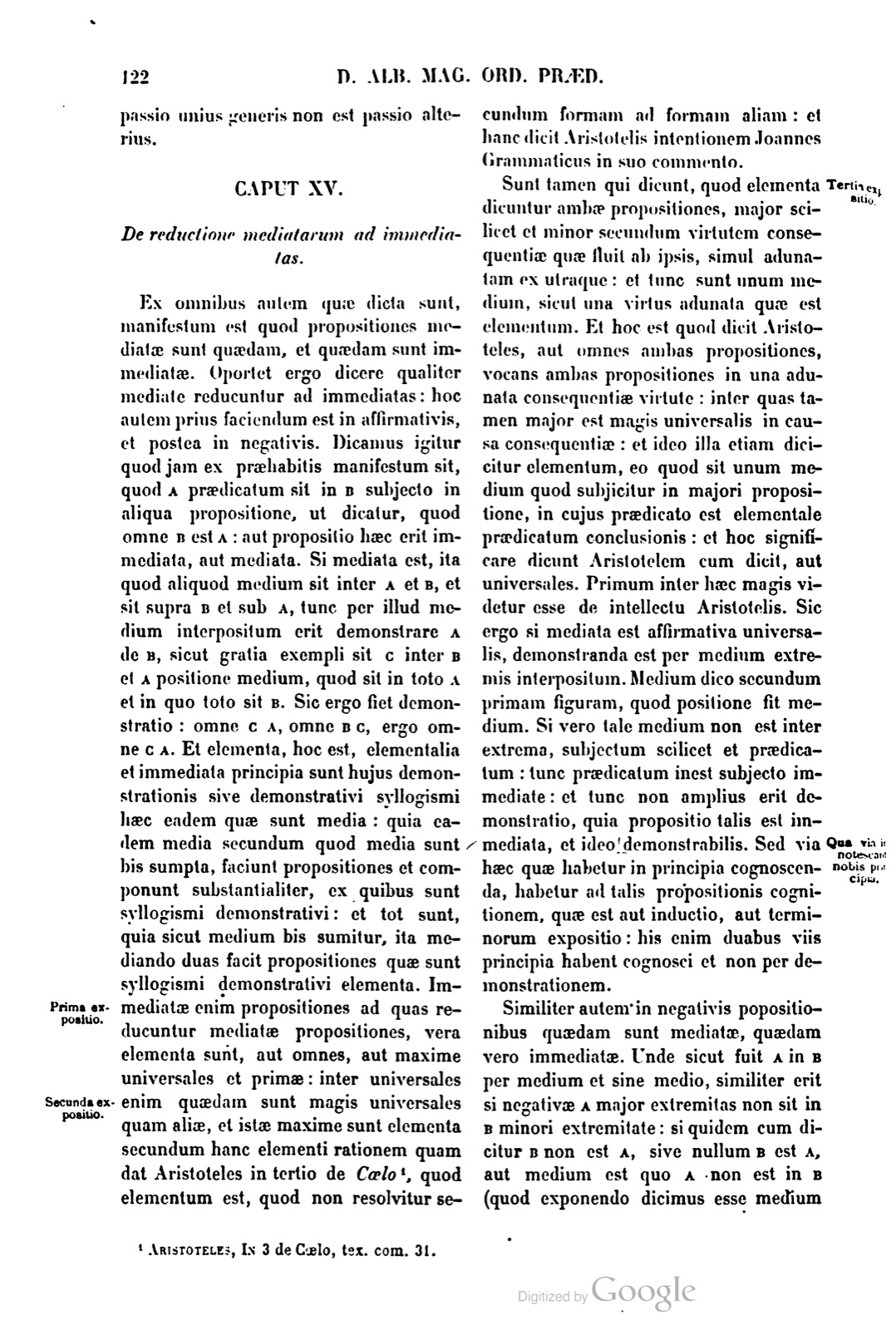
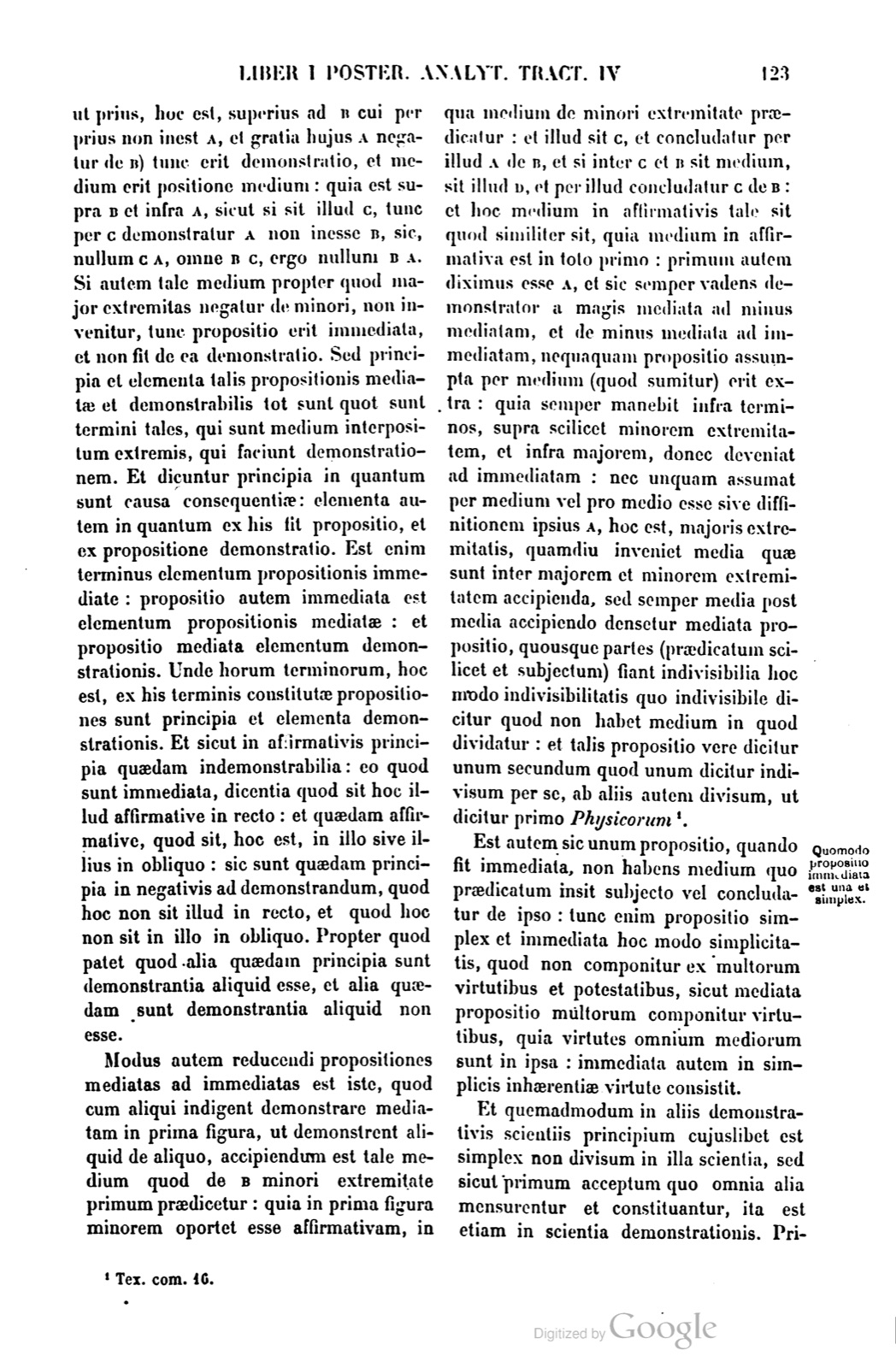
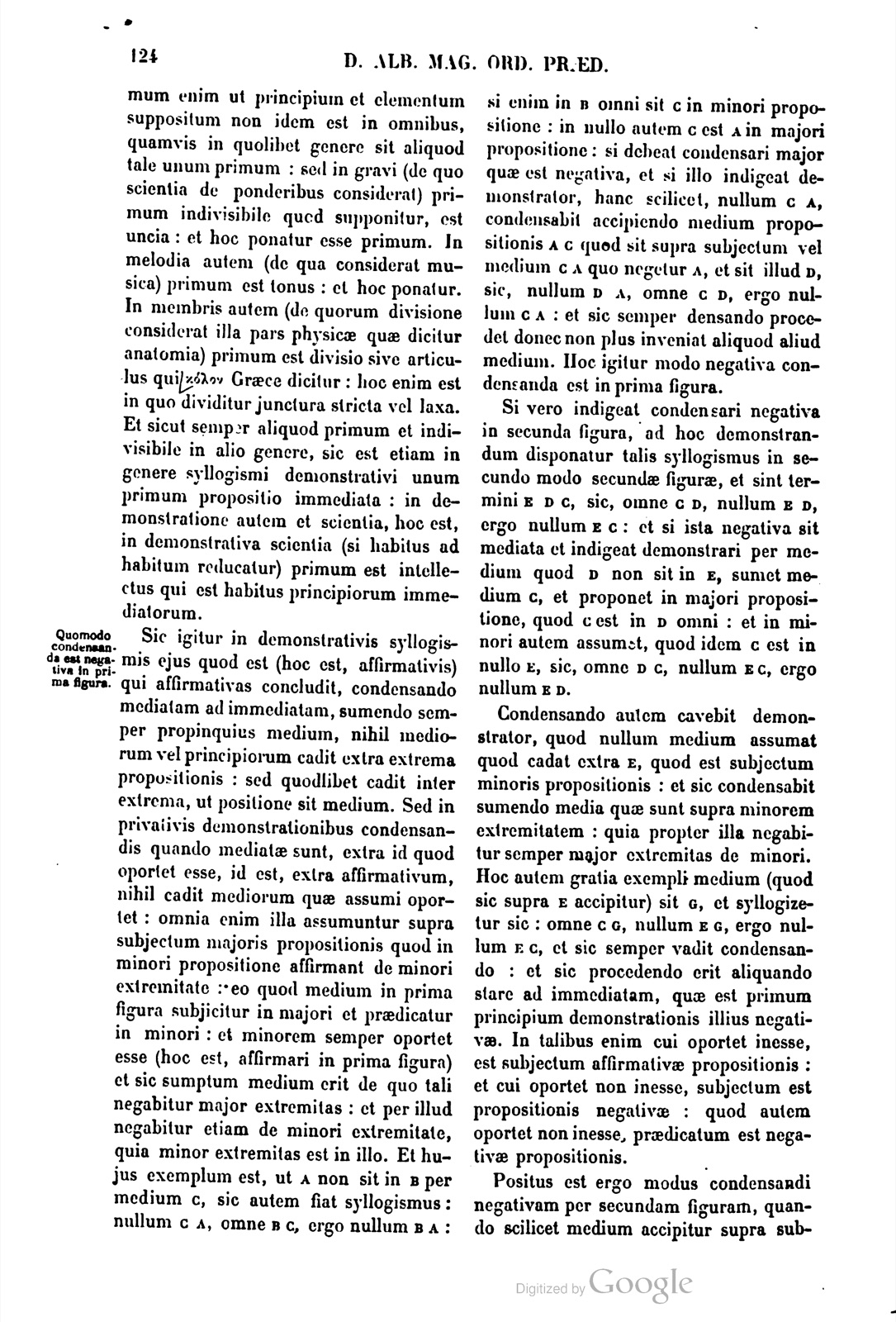
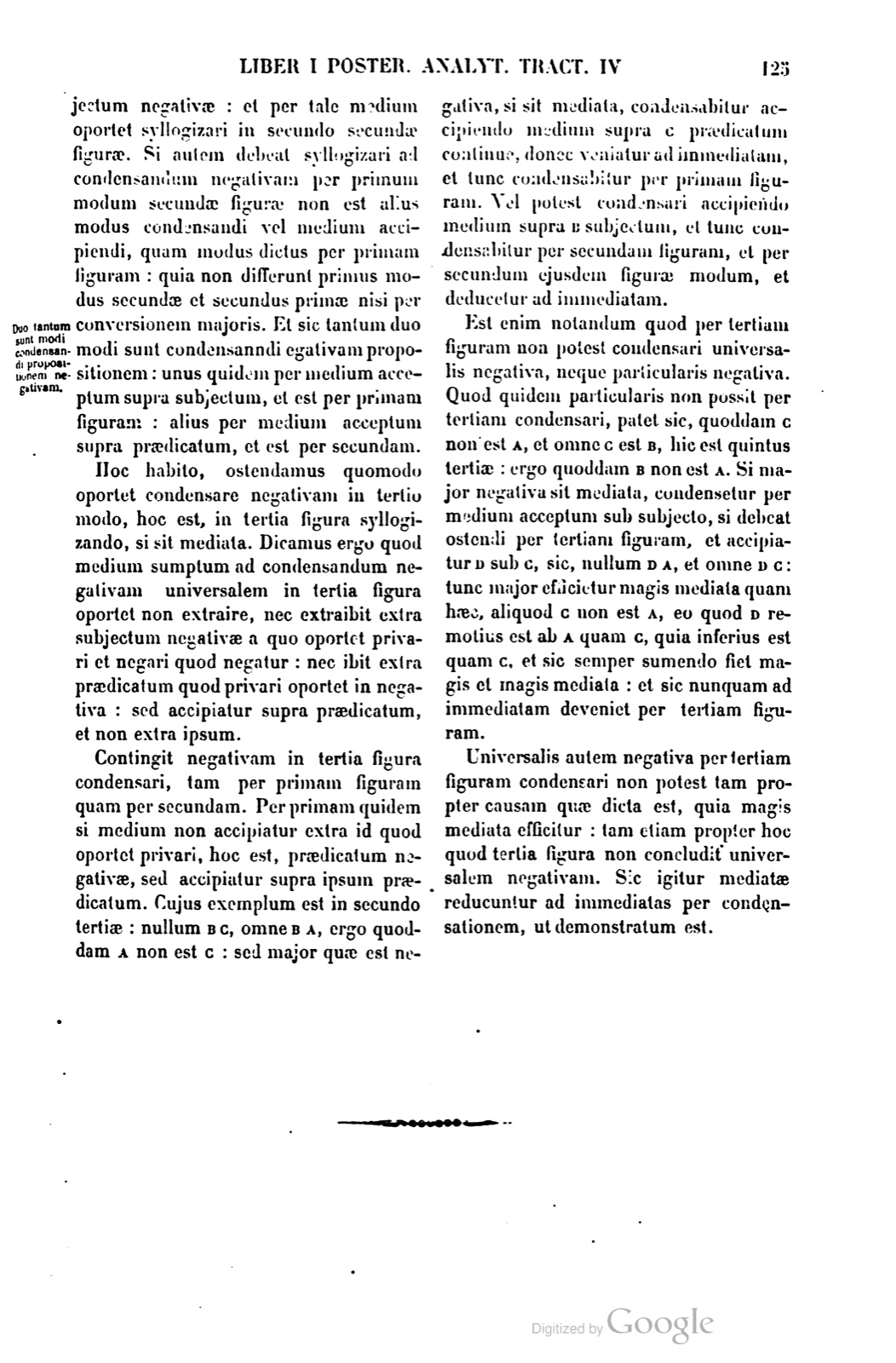
CAPUT XV. De reductione mediatarum ad immediatas. Ex omnibus autem quae dicta sunt, manifestum est quod propositiones mediatae sunt quaedam, et quaedam sunt immediatae. Oportet ergo dicere qualiter mediatae reducuntur ad immediatas: hoc autem prius faciendum est in affirmativis, et postea in negativis. Dicamus igitur quod jam ex praehabitis manifestum sit, quod A praedicatum sit in B subjecto in aliqua propositione, ut dicatur, quod omne B est A: aut propositio haec erit immediata, aut mediata. Si mediata est, ita quod aliquod medium sit inter A et B, et sit supra B et sub A, tunc per illud medium interpositum erit demonstrare A de B, sicut gratia exempli sit C inter B et A positione medium, quod sit in toto A et in quo toto sit B. Sic ergo fiet demonstratio: omne C A, omne B C, ergo omne B A. Et elementa, hoc est, elementalia et immediata principia sunt hujus demonstrationis sive demonstrativi syllogismi haec eadem quae sunt media: quia eadem media secundum quod media sunt bis sumpta, faciunt propositiones et componunt substantialiter, ex quibus sunt syllogismi demonstrativi: et tot sunt, quia sicut medium bis sumitur, ita mediando duas facit propositiones quae sunt syllogismi demonstrativi elementa. Immediatae enim propositiones ad quas reducuntur mediatae propositiones, vera elementa sunt, aut omnes, aut maxime universales et primae: inter universales enim quaedam sunt magis universales quam aliae, et istae maxime sunt elementa secundum hanc elementi rationem quam dat Aristoteles in tertio de Caelo 1, quod elementum est, quod non resolvitur secundum formam ad formam aliam: et hanc dicit Aristotelis intentionem Joannes Grammaticus in suo commento. <marginal-label>Prima expositio.</marginal-label> <marginal-label>Secunda expositio.</marginal-label> Sunt tamen qui dicunt, quod elementa dicuntur ambae propositiones, major scilicet et minor secundum virtutem consequentiae quae fluit ab ipsis, simul adunatam ex utraque: et tunc sunt unum medium, sicut una virtus adunata quae est elementum. Et hoc est quod dicit Aristoteles, aut omnes ambas propositiones, vocans ambas propositiones in una adunata consequentiae virtute: inter quas tamen major est magis universalis in causa consequentiae: et ideo illa etiam dicitur elementum, eo quod sit unum medium quod subjicitur in majori propositione, in cujus praedicato est elementale praedicatum conclusionis: et hoc significare dicunt Aristotelem cum dicit, aut universales. Primum inter haec magis videtur esse de intellectu Aristotelis. Sic ergo si mediata est affirmativa universalis, demonstranda est per medium extremis interpositum. Medium dico secundum primam figuram, quod positione fit medium. Si vero tale medium non est inter extrema, subjectum scilicet et praedicatum, tunc praedicatum inest subjecto immediate, et tunc non amplius erit demonstratio, quia propositio talis est immediata, et ideo indemonstrabilis. <marginal-label>Tertia expositio.</marginal-label> <marginal-label>Qua via innotescant nobis principia.</marginal-label> Sed via haec quae habetur in principia cognoscenda, habetur ad talis propositionis cognitionem, quae est aut inductio, aut terminorum expositio: his enim duabus viis principia habent cognosci et non per demonstrationem. Similiter autem in negativis propositionibus quaedam sunt mediatae, quaedam vero immediatae. Unde sicut fuit A in B per medium et sine medio, similiter erit si negativae A major extremitas non sit in B minori extremitate: si quidem cum dicitur B non est A, sive nullum B est A, aut medium est quo A non est in B, quod exponendo dicimus esse medium ut prius, hoc est, superius ad A cui per prius non inest A, et gratia hujus A negatur de B, tunc erit demonstratio, et medium erit positione medium: quia est supra B et infra A, sicut si sit illud C, tunc per C demonstratur A non inesse B, sic, nullum C A, omne B C, ergo nullum B A. Si autem tale medium propter quod major extremitas negatur de minori, non invenitur, tunc propositio erit immediata, et non fit de ea demonstratio. Sed principia et elementa talis propositionis mediatae et demonstrabilis tot sunt quot sunt termini tales, qui sunt medium interpositum extremis, qui faciunt demonstrationem. Et dicuntur principia in quantum sunt causa consequentiae: elementa autem in quantum ex his fit propositio, et ex propositione demonstratio. Est enim terminus elementum propositionis immediatae: propositio autem immediata est elementum propositionis mediatae: et propositio mediata elementum demonstrationis. Unde horum terminorum, hoc est, ex his terminis constitutae propositiones sunt principia et elementa demonstrationis. Et sicut in affirmativis principia quaedam indemonstrabilia: eo quod sunt immediata, dicentia quod sit hoc illud affirmative in recto: et quaedam affirmative, quod sit, hoc est, in illo sive illius in obliquo: sic sunt quaedam principia in negativis ad demonstrandum, quod hoc non sit illud in recto, et quod hoc non sit in illo in obliquo. Propter quod patet quod alia quaedam principia sunt demonstrantia aliquid esse, et alia quaedam sunt demonstrantia aliquid non esse. Modus autem reducendi propositiones mediatas ad immediatas est iste, quod cum aliqui indigent demonstrare mediatam in prima figura, ut demonstrent aliquid de aliquo, accipiendum est tale medium quod de B minori extremitate sicut primum praedicetur: quia in prima figura minorem oportet esse affirmativam, in qua medium de minori extremitate praedicatur: et illud sit C, et concludatur per illud A de B, et si inter C et B sit medium, sit illud D, et per illud concludatur C de B: et hoc medium in affirmativis tale sit quod similiter sit, quia medium in affirmativa est in toto primo: primum autem diximus esse A, et sic semper vadens demonstrator a magis mediata ad minus mediatam, et de minus mediata ad immediatam, nequaquam propositio assumpta per medium quod sumitur erit extra: quia semper manebit infra terminos, supra scilicet minorem extremitatem, et infra majorem, donec deveniat ad immediatam: nec unquam assumat per medium vel pro medio esse sive diffinitionem ipsius A, hoc est, majoris extremitatis, quamdiu inveniet media quae sunt inter majorem et minorem extremitatem accipienda, sed semper media post media accipiendo densetur mediata propositio, quousque partes (praedicatum scilicet et subjectum) fiant indivisibilia hoc modo indivisibilitatis quo indivisibile dicitur quod non habet medium in quod dividatur: et talis propositio vere dicitur unum secundum quod unum dicitur indivisum per se, ab aliis autem divisum, ut dicitur primo Physicorum 2. <marginal-label>Quomodo propositio est una et simplex.</marginal-label> Est autem sic unum propositio, quando fit immediata, non habens medium quo praedicatum insit subjecto vel concludatur de ipso: tunc enim propositio simplex et immediata hoc modo simplicitatis, quod non componitur ex multorum virtutibus et potestatibus, sicut mediata propositio multorum componitur virtutibus, quia virtutes omnium mediorum sunt in ipsa: immediata autem in simplicis inhaerentiae virtute consistit. Et quemadmodum in aliis demonstrativis scientiis principium cujuslibet est simplex non divisum in illa scientia, sed primum acceptum quo omnia alia mensurentur et constituantur, ita est etiam in scientia demonstrationis. Primum enim ut principium et elementum suppositum non idem est in omnibus, quamvis in quolibet genere sit aliquod tale unum primum: sed in gravi (de quo scientia de ponderibus considerat) primum indivisibile quod supponitur, est uncia: et hoc ponatur esse primum. In melodia autem (de qua considerat musica) primum est tonus: et hoc ponatur. In membris autem (de quorum divisione considerat illa pars physicae quae dicitur anatomia) primum est divisio sive articulus qui κῶλον Graece dicitur: hoc enim est in quo dividitur junctura stricta vel laxa. Et sicut semper aliquod primum et indivisibile in alio genere, sic est etiam in genere syllogismi demonstrativi unum primum propositio immediata: in demonstratione autem et scientia, hoc est, in demonstrativa scientia (si habitus ad habitum reducatur) primum est intellectus qui est habitus principiorum immediatorum. <marginal-label>Quomodo condensanda est negativa in prima figura.</marginal-label> Sic igitur in demonstrativis syllogismis ejus quod est (hoc est, affirmativis) qui affirmativas concludit, condensando mediatam ad immediatam, sumendo semper propinquius medium, nihil mediorum vel principiorum cadit extra extrema propositionis: sed quodlibet cadit inter extrema, ut positione sit medium. Sed in privativis demonstrationibus condensandis quando mediatae sunt, extra id quod oportet esse, id est, extra affirmativum, nihil cadit mediorum quae assumi oportet: omnia enim illa assumuntur supra subjectum majoris propositionis quod in minori propositione affirmant de minori extremitate: eo quod medium in prima figura subjicitur in majori et praedicatur in minori: et minorem semper oportet esse (hoc est, affirmari in prima figura) et sic sumptum medium erit de quo tali negabitur major extremitas: et per illud negabitur etiam de minori extremitate, quia minor extremitas est in illo. Et hujus exemplum est, ut A non sit in B per medium C, sic autem fiat syllogismus: nullum C A, omne B C, ergo nullum B A: si enim in B omni sit C in minori propositione: in nullo autem C est A in majori propositione: si debeat condensari major quae est negativa, et si illo indigeat demonstrator, hanc scilicet, nullum C A, condensabit accipiendo medium propositionis A C quod sit supra subjectum vel medium C A quo negetur A, et sit illud D, sic, nullum D A, omne C D, ergo nullum C A: et sic semper densando procedet donec non plus inveniat aliquod aliud medium. Hoc igitur modo negativa condensanda est in prima figura. Si vero indigeat condensari negativa in secunda figura, ad hoc demonstrandum disponatur talis syllogismus in secundo modo secundae figurae, et sint termini E D C, sic, omne C D, nullum E D, ergo nullum E C: et si ista negativa sit mediata et indigeat demonstrari per medium quod D non sit in E, sumet medium C, et proponet in majori propositione, quod C est in D omni: et in minori autem assumet, quod idem C est in nullo E, sic, omne D C, nullum E C, ergo nullum E D. Condensando autem cavebit demonstrator, quod nullum medium assumat quod cadat extra E, quod est subjectum minoris propositionis: et sic condensabit sumendo media quae sunt supra minorem extremitatem: quia propter illa negabitur semper major extremitas de minori. Hoc autem gratia exempli medium (quod sic supra E accipitur) sit G, et syllogizetur sic: omne C G, nullum E G, ergo nullum E C, et sic semper vadit condensando: et sic procedendo erit aliquando stare ad immediatam, quae est primum principium demonstrationis illius negativae. In talibus enim cui oportet inesse, est subjectum affirmativae propositionis: et cui oportet non inesse, subjectum est propositionis negativae: quod autem oportet non inesse, praedicatum est negativae propositionis. Positus est ergo modus condensandi negativam per secundam figuram, quando scilicet medium accipitur supra subjectum negativae: et per tale medium oportet syllogizari in secundo secundae figurae. Si autem debeat syllogizari ad condensandum negativam per primum modum secundae figurae non est alius modus condensandi vel medium accipiendi, quam modus dictus per primam figuram: quia non differunt primus modus secundae et secundus primae nisi per conversionem majoris. <marginal-label>Duo tantum sunt modi condensandi propositionem negativam.</marginal-label> Et sic tantum duo modi sunt condensandi negativam propositionem: unus quidem per medium acceptum supra subjectum, et est per primam figuram: alius per medium acceptum supra praedicatum, et est per secundam. Hoc habito, ostendamus quomodo oportet condensare negativam in tertio modo, hoc est, in tertia figura syllogizando, si sit mediata. Dicamus ergo quod medium sumptum ad condensandum negativam universalem in tertia figura oportet non extraire, nec extraibit extra subjectum negativae a quo oportet privari et negari quod negatur: nec ibit extra praedicatum quod privari oportet in negativa: sed accipiatur supra praedicatum, et non extra ipsum. Contingit negativam in tertia figura condensari, tam per primam figuram quam per secundam. Per primam quidem si medium non accipiatur extra id quod oportet privari, hoc est, praedicatum negativae, sed accipiatur supra ipsum praedicatum. Cujus exemplum est in secundo tertiae: nullum B C, omne B A, ergo quoddam A non est C: sed major quae est negativa, si sit mediata, condensabitur accipiendo medium supra C praedicatum continue, donec veniatur ad immediatam, et tunc condensabitur per primam figuram. Vel potest condensari accipiendo medium supra E subjectum, et tunc condensabitur per secundam figuram, et per secundum ejusdem figurae modum, et deducetur ad immediatam. Est enim notandum quod per tertiam figuram non potest condensari universalis negativa, neque particularis negativa. Quod quidem particularis non possit per tertiam condensari, patet sic, quoddam C non est A, et omne C est B, hic est quintus tertiae: ergo quoddam B non est A. Si major negativa sit mediata, condensetur per medium acceptum sub subjecto, si debeat ostendi per tertiam figuram, et accipiatur D sub C, sic, nullum D A, et omne D C: tunc major efficietur magis mediata quam haec, aliquod C non est A, eo quod D remotius est ab A quam C, quia inferius est quam C, et sic semper sumendo fiet magis et magis mediata: et sic nunquam ad immediatam deveniet per tertiam figuram. Universalis autem negativa per tertiam figuram condensari non potest tam propter causam quae dicta est, quia magis mediata efficitur: tam etiam propter hoc quod tertia figura non concludit universalem negativam. Sic igitur mediatae reducuntur ad immediatas per condensationem, ut demonstratum est.
CHAPTER XV. On the reduction of mediate propositions to immediate propositions. But from all the things that have been said, it is manifest that some propositions are mediate, and some are immediate. Therefore one must say how mediate propositions are reduced to immediate ones; and this must first be done in affirmatives, and afterward in negatives. Therefore let us say that it is now manifest from what has been set forth before that predicate A is in subject B in some proposition, so that it is said that every B is A: either this proposition will be immediate, or it will be mediate. If it is mediate, so that some middle is between A and B, and is above B and below A, then through that interposed middle it will be possible to demonstrate A of B. For the sake of example, let C be between B and A, a middle by position, which is in the whole of A and in the whole of which B is. Therefore the demonstration will be made thus: every C is A; every B is C; therefore every B is A. And the elements, that is, the elemental and immediate principles of this demonstration or demonstrative syllogism, are these same things which are middles, because the same middles, according as they are middles, being taken twice, make the propositions and substantially compose them, from which demonstrative syllogisms are. And there are as many of them as there are, because, just as the middle is taken twice, so by mediating it makes two propositions which are the elements of the demonstrative syllogism. For the immediate propositions to which mediate propositions are reduced are the true elements, either all of them, or especially the universal and first ones; for among universals some are more universal than others, and these are elements most of all according to that account of an element which Aristotle gives in the third book On the Heavens 1, namely that an element is what is not resolved according to form into another form; and John the Grammarian says that this is Aristotle's intention in his commentary. <marginal-label>First exposition.</marginal-label> <marginal-label>Second exposition.</marginal-label> Yet there are some who say that both propositions, namely the major and the minor, are called elements according to the power of the consequence that flows from them, a power united together from each. And then they are one middle, just as one united power which is the element. And this is what Aristotle says, either all the two propositions, calling the two propositions one thing in the united power of consequence. Among them, however, the major is more universal in the cause of the consequence; and therefore it too is called an element, because it is one middle that is subjected in the major proposition, in whose predicate is the elemental predicate of the conclusion; and they say that Aristotle signifies this when he says, or universals. The first among these seems more to belong to Aristotle's understanding. Therefore in this way, if the universal affirmative is mediate, it must be demonstrated through a middle interposed between the extremes. By middle I mean according to the first figure, that which becomes middle by position. But if such a middle is not between the extremes, namely the subject and the predicate, then the predicate is in the subject immediately, and then there will no longer be demonstration, because such a proposition is immediate, and therefore indemonstrable. <marginal-label>Third exposition.</marginal-label> <marginal-label>By what way the principles become known to us.</marginal-label> But this way, which is had in knowing principles, is had for the cognition of such a proposition, and it is either induction or exposition of terms; for by these two ways principles have to be known, and not through demonstration. Similarly, however, in negative propositions some are mediate, but some are immediate. Hence, just as A was in B through a middle and without a middle, similarly it will be if the negative major extreme A is not in the minor extreme B. If, indeed, when it is said that B is not A, or no B is A, there is a middle by which A is not in B, which in expounding we say to be a middle as before, that is, higher than A, to which A is not present priorly, and for the sake of this A is denied of B, then there will be a demonstration, and the middle will be a middle by position, because it is above B and below A. Thus, if that middle is C, then through C it is demonstrated that A is not in B, in this way: no C is A; every B is C; therefore no B is A. But if such a middle on account of which the major extreme is denied of the minor is not found, then the proposition will be immediate, and no demonstration is made concerning it. But the principles and elements of such a mediate and demonstrable proposition are as many as are the terms of this kind which are the middle interposed between the extremes, which make the demonstration. And they are called principles insofar as they are the cause of the consequence, but elements insofar as from these the proposition is made, and from the proposition the demonstration. For a term is an element of an immediate proposition; an immediate proposition, however, is an element of a mediate proposition; and a mediate proposition is an element of a demonstration. Hence of these terms, that is, the propositions constituted from these terms, are the principles and elements of the demonstration. And just as in affirmatives there are certain indemonstrable principles, because they are immediate, saying that this is that affirmatively in the direct case, and certain principles affirmatively saying that it is, that is, in that or of that in an oblique case, so there are certain principles in negatives for demonstrating that this is not that in the direct case, and that this is not in that in an oblique case. Therefore it is clear that some principles demonstrate that something is, and other principles demonstrate that something is not. But the mode of reducing mediate propositions to immediate ones is this: when some people need to demonstrate a mediate proposition in the first figure, so that they may demonstrate something of something, such a middle must be taken as is predicated of the minor extreme B as the first thing, because in the first figure the minor must be affirmative, in which the middle is predicated of the minor extreme. And let that be C, and through it let A be concluded of B; and if there is a middle between C and B, let that be D, and through it let C be concluded of B. And in affirmatives this middle must be such that it similarly is, because the middle in an affirmative is in the whole first thing; but we have said that the first thing is A. And thus the demonstrator, always proceeding from the more mediate to the less mediate, and from the less mediate to the immediate, in no way will have the proposition assumed through the middle that is taken be outside, because it will always remain beneath the terms, namely above the minor extreme and below the major, until it arrives at the immediate. Nor at any time should he assume, for a middle or in place of a middle, the being or definition of A itself, that is, of the major extreme, so long as he finds middles that are to be taken between the major and minor extreme; rather, by always taking middles after middles, the mediate proposition is thickened down until the parts, namely the predicate and subject, become indivisible in that mode of indivisibility according to which that is called indivisible which has no middle into which it may be divided. And such a proposition is truly called one according as one is called undivided in itself but divided from others, as is said in the first book of the Physics 2. <marginal-label>How a proposition is one and simple.</marginal-label> But a proposition is thus one when it becomes immediate, not having a middle by which the predicate may be present in the subject or be concluded of it. For then the proposition is simple and immediate by this mode of simplicity, because it is not composed from the powers and capacities of many things, as a mediate proposition is composed from the powers of many things, because the powers of all the middles are in it; but an immediate proposition consists in the power of a simple inherence. And just as in the other demonstrative sciences the principle of each one is simple, not divided in that science, but is the first thing accepted by which all the others are measured and constituted, so it is also in the science of demonstration. For the first thing supposed as principle and element is not the same in all things, although in any genus there is some one first thing of this kind. But in the heavy, about which the science concerning weights considers, the first indivisible thing that is supposed is the ounce, and let this be posited as first. In melody, however, about which music considers, the first thing is the tone, and let this be posited. But in members, about whose division that part of physics which is called anatomy considers, the first thing is division or a joint which is called κῶλον in Greek; for this is that in which a strict or loose juncture is divided. And just as there is always some first and indivisible thing in another genus, so also in the genus of demonstrative syllogism the one first thing is the immediate proposition. But in demonstration and science, that is, in demonstrative science, if habit is reduced to habit, the first thing is understanding, which is the habit of immediate principles. <marginal-label>How the negative proposition must be condensed in the first figure.</marginal-label> Thus, therefore, in demonstrative syllogisms of what is, that is, in affirmative syllogisms which conclude affirmatives, in condensing a mediate proposition to an immediate one, by always taking the nearer middle, nothing of the middles or principles falls outside the extremes of the proposition; rather, each falls between the extremes, so that by position it is a middle. But in privative demonstrations that must be condensed, when they are mediate, nothing of the middles that must be assumed falls outside that which must be, that is, outside the affirmative; for all those middles are assumed above the subject of the major proposition, which in the minor proposition they affirm of the minor extreme, because in the first figure the middle is subjected in the major and predicated in the minor. And the minor must always be, that is, must be affirmed in the first figure; and thus the middle taken will be that of which such a major extreme will be denied, and through it the major extreme will also be denied of the minor extreme, because the minor extreme is in it. And the example of this is that A is not in B through middle C; but let the syllogism be made thus: no C is A; every B is C; therefore no B is A. For if C is in every B in the minor proposition, but A is in no C in the major proposition, then if the major, which is negative, must be condensed, and if the demonstrator needs that, namely no C is A, he will condense it by taking a middle of the proposition A C that is above the subject, or a middle C A by which A is denied, and let that be D, thus: no D is A; every C is D; therefore no C is A. And so he will always proceed by condensing until he no longer finds some other middle. Therefore in this way the negative proposition must be condensed in the first figure. But if he needs the negative proposition to be condensed in the second figure, then for demonstrating this such a syllogism should be arranged in the second mode of the second figure, and let the terms be E, D, C, thus: every C is D; no E is D; therefore no E is C. And if this negative proposition is mediate and needs to be demonstrated through a middle by which D is not in E, he will take middle C, and in the major proposition he will propose that C is in every D; but in the minor he will assume that the same C is in no E, thus: every D is C; no E is C; therefore no E is D. But in condensing the demonstrator will take care that he assume no middle that falls outside E, which is the subject of the minor proposition; and thus he will condense by taking middles that are above the minor extreme, because on account of them the major extreme will always be denied of the minor. But for the sake of example, let this middle, which is thus taken above E, be G, and let it be syllogized thus: every C is G; no E is G; therefore no E is C. And so he always proceeds by condensing; and by proceeding thus he will at some time have a stopping at the immediate proposition, which is the first principle of the demonstration of that negative proposition. For in such things that to which it ought to belong is the subject of the affirmative proposition; and that to which it ought not to belong is the subject of the negative proposition; but that which ought not to belong is the predicate of the negative proposition. Therefore the mode of condensing a negative proposition through the second figure has been posited, namely when the middle is taken above the subject of the negative proposition; and through such a middle one must syllogize in the second mode of the second figure. But if one must syllogize for condensing a negative proposition through the first mode of the second figure, there is no other mode of condensing or of taking the middle than the mode stated through the first figure, because the first mode of the second and the second of the first differ only by conversion of the major. <marginal-label>There are only two modes of condensing a negative proposition.</marginal-label> And thus there are only two modes of condensing a negative proposition: one, indeed, through a middle taken above the subject, and it is through the first figure; the other through a middle taken above the predicate, and it is through the second. With this held, let us show how one must condense a negative proposition in the third mode, that is, by syllogizing in the third figure, if it is mediate. Therefore let us say that the middle taken for condensing a universal negative in the third figure must not go outside, nor will it go outside, the subject of the negative from which that which is denied must be removed and denied; nor will it go outside the predicate which must be removed in the negative; but it should be taken above the predicate, and not outside it. It happens that a negative proposition in the third figure is condensed both through the first figure and through the second. Through the first, indeed, if the middle is not taken outside that which must be removed, that is, the predicate of the negative, but is taken above that predicate itself. The example of this is in the second mode of the third: no B is C; every B is A; therefore some A is not C. But the major, which is negative, if it is mediate, will be condensed by taking a middle continuously above predicate C until one comes to an immediate proposition, and then it will be condensed through the first figure. Or it can be condensed by taking a middle above subject E, and then it will be condensed through the second figure and through the second mode of the same figure, and it will be led back to the immediate. For it must be noted that through the third figure neither a universal negative nor a particular negative can be condensed. That a particular negative cannot be condensed through the third is clear thus: some C is not A, and every C is B; this is the fifth of the third; therefore some B is not A. If the major negative is mediate, let it be condensed through a middle taken beneath the subject, if it must be shown through the third figure, and let D be taken beneath C, thus: no D is A, and every D is C. Then the major will be made more mediate than this proposition, some C is not A, because D is more remote from A than C is, since it is lower than C; and thus by always taking in this way it will become more and more mediate, and so it will never arrive at the immediate through the third figure. But a universal negative cannot be condensed through the third figure both on account of the cause that has been stated, because it is made more mediate, and also on account of this, that the third figure does not conclude a universal negative. Thus, therefore, mediate propositions are reduced to immediate ones through condensation, as has been demonstrated.
If a page does not appear, its photograph has not been uploaded yet.