Works › Posterior Analytics, Books I–II
Volume 2 · pp. 121–122
Chapter XIV. On the corollary that follows from what has been said.
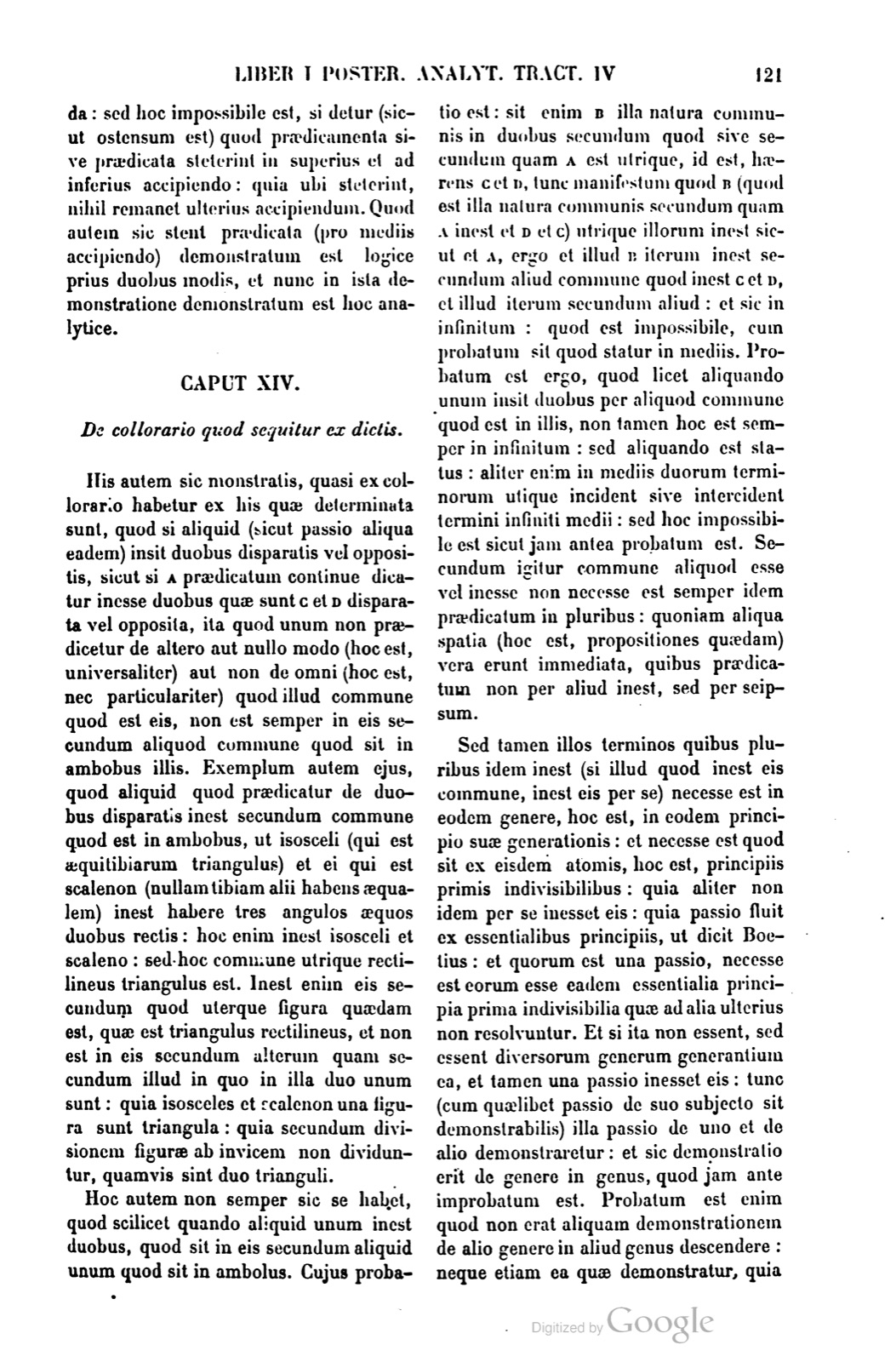
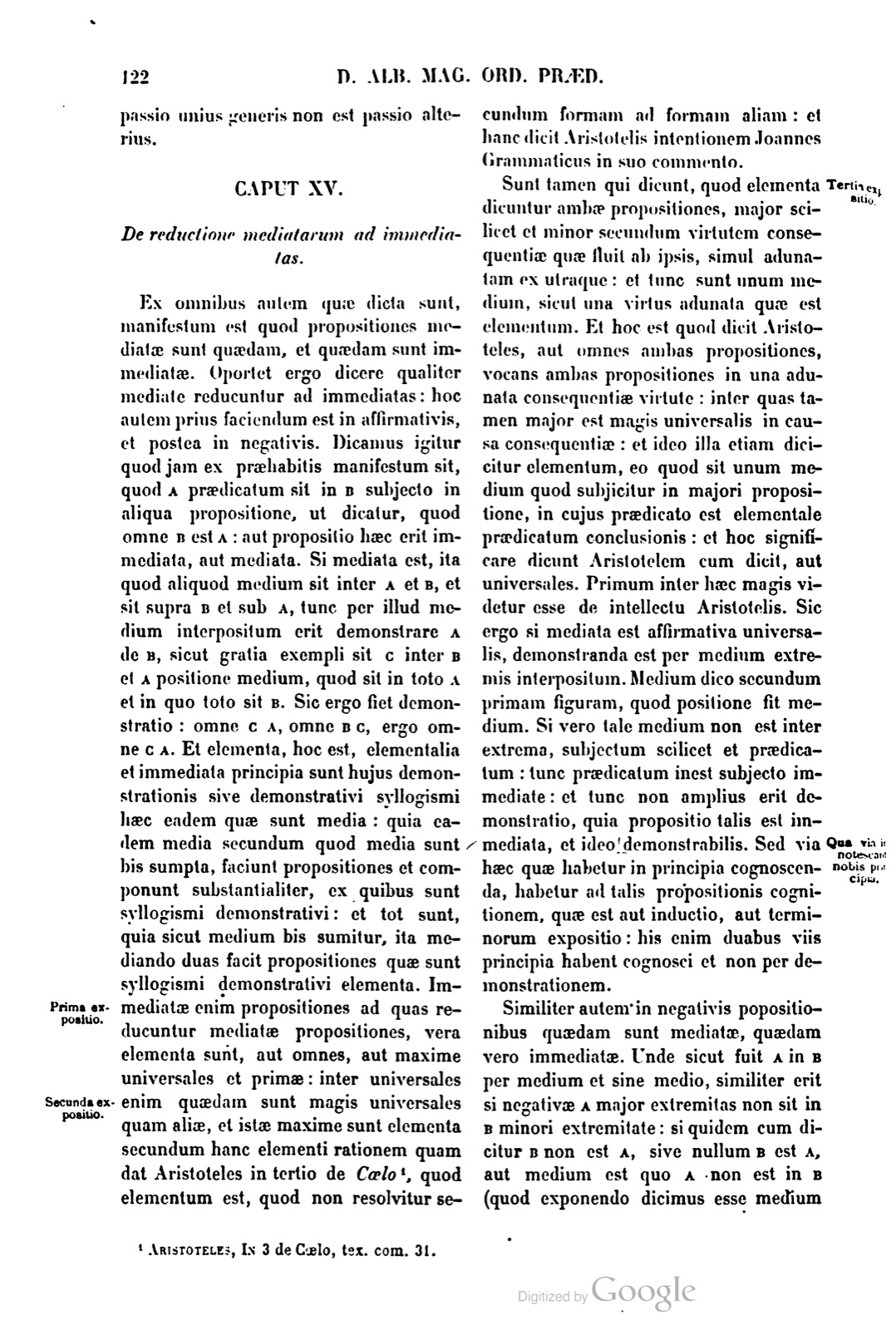
CAPUT XIV. De collorario quod sequitur ex dictis. His autem sic monstratis, quasi ex collorario habetur ex his quae determinata sunt, quod si aliquid (sicut passio aliqua eadem) insit duobus disparatis vel oppositis, sicut si A praedicatum continue dicatur inesse duobus quae sunt C et D disparata vel opposita, ita quod unum non praedicetur de altero aut nullo modo (hoc est, universaliter) aut non de omni (hoc est, nec particulariter) quod illud commune quod est eis, non est semper in eis secundum aliquod commune quod sit in ambobus illis. Exemplum autem ejus, quod aliquid quod praedicatur de duobus disparatis inest secundum commune quod est in ambobus, ut isosceli (qui est aequitibiarum triangulus) et ei qui est scalenon (nullam tibiam alii habens aequalem) inest habere tres angulos aequos duobus rectis: hoc enim inest isosceli et scaleno: sed hoc commune utrique rectilineus triangulus est. Inest enim eis secundum quod uterque figura quaedam est, quae est triangulus rectilineus, et non est in eis secundum alterum quam secundum illud in quo in illa duo unum sunt: quia isosceles et scalenon una figura sunt triangula: quia secundum divisionem figurae ab invicem non dividuntur, quamvis sint duo trianguli. Hoc autem non semper sic se habet, quod scilicet quando aliquid unum inest duobus, quod sit in eis secundum aliquid unum quod sit in ambobus. Cujus probatio est: sit enim B illa natura communis in duobus secundum quod sive secundum quam A est utrique, id est, haerens C et D, tunc manifestum quod B (quod est illa natura communis secundum quam A inest et D et C) utrique illorum inest sicut et A, ergo et illud B iterum inest secundum aliud commune quod inest C et D, et illud iterum secundum aliud: et sic in infinitum: quod est impossibile, cum probatum sit quod statur in mediis. Probatum est ergo, quod licet aliquando unum insit duobus per aliquod commune quod est in illis, non tamen hoc est semper in infinitum: sed aliquando est status: aliter enim in mediis duorum terminorum utique incident sive intercident termini infiniti medii: sed hoc impossibile est sicut jam antea probatum est. Secundum igitur commune aliquod esse vel inesse non necesse est semper idem praedicatum in pluribus: quoniam aliqua spatia (hoc est, propositiones quaedam) vera erunt immediata, quibus praedicatum non per aliud inest, sed per seipsum. Sed tamen illos terminos quibus pluribus idem inest (si illud quod inest eis commune, inest eis per se) necesse est in eodem genere, hoc est, in eodem principio suae generationis: et necesse est quod sit ex eisdem atomis, hoc est, principiis primis indivisibilibus: quia aliter non idem per se inesset eis: quia passio fluit ex essentialibus principiis, ut dicit Boetius: et quorum est una passio, necesse est eorum esse eadem essentialia principia prima indivisibilia quae ad alia ulterius non resolvuntur. Et si ita non essent, sed essent diversorum generum generantium ea, et tamen una passio inesset eis: tunc (cum quaelibet passio de suo subjecto sit demonstrabilis) illa passio de uno et de alio demonstraretur: et sic demonstratio erit de genere in genus, quod jam ante improbatum est. Probatum est enim quod non erat aliquam demonstrationem de alio genere in aliud genus descendere: neque etiam ea quae demonstratur, quia passio unius generis non est passio alterius.
CHAPTER XIV. On the corollary that follows from what has been said. But when these things have been shown thus, from the things that have been determined there is held, as it were from a corollary, that if something (such as some one same property) is in two disparate or opposed things, as if predicate A is said continuously to be in the two things that are C and D, disparate or opposed, so that one is not predicated of the other either in no way (that is, universally) or not of every instance (that is, not even particularly), then that common thing which belongs to them is not always in them according to some common thing which is in both of them. And an example of this, that something which is predicated of two disparate things is in them according to a common thing that is in both, is that it belongs to the isosceles (which is an equal-legged triangle) and to that which is scalene (having no leg equal to another) to have three angles equal to two right angles. For this belongs to the isosceles and to the scalene; but this common thing for each is the rectilinear triangle. For it belongs to them according as each is a certain figure, which is a rectilinear triangle, and it is not in them according to anything other than according to that in which those two are one, because the isosceles and the scalene are one figure, namely triangles, since according to the division of figure they are not divided from one another, although they are two triangles. But this does not always stand in this way, namely that, whenever some one thing is in two things, it is in them according to some one thing that is in both. The proof of this is: let B be that common nature in the two according to which, or by reason of which, A belongs to each, that is, adheres to C and D. Then it is manifest that B (which is that common nature according to which A is in both D and C) is in each of them just as A is. Therefore that B again is in them according to another common thing that is in C and D, and that again according to another, and so on to infinity. This is impossible, since it has been proved that there is a stopping in the middles. Therefore it has been proved that, although sometimes one thing is in two things through some common thing that is in them, nevertheless this is not always so to infinity, but at some point there is a stopping. For otherwise, in the middles of two terms, infinite middle terms would certainly fall in or be interposed; but this is impossible, as has already been proved before. Therefore it is not always necessary that the same predicate be or be present in many things according to some common thing, since some spaces (that is, certain propositions) will be true and immediate, in which the predicate is present not through another thing but through itself. Yet nevertheless those terms in several of which the same thing is present (if that which is common to them and is present in them is present through itself) must be in the same genus, that is, in the same principle of their generation; and it must be from the same atoms, that is, from the first indivisible principles. For otherwise the same thing would not be in them through itself, because a property flows from essential principles, as Boethius says; and those things of which there is one property must have the same essential, first, indivisible principles, which are not resolved further into other things. And if they were not thus, but were of diverse genera generating them, and nevertheless one property were present in them, then, since every property is demonstrable of its subject, that property would be demonstrated of the one and of the other. And thus demonstration will pass from genus into genus, which has already been disproved before. For it has been proved that no demonstration was to descend from one genus into another genus, nor even the thing that is demonstrated, because the property of one genus is not the property of another.
If a page does not appear, its photograph has not been uploaded yet.